T-score bone density: what your number actually means
TL;DR: A T-score compares your bone density to a healthy 30-year-old's peak. Zero is average. Minus 1.0 to minus 2.5 is osteopenia; minus 2.5 or lower is osteoporosis. Women lose bone fastest in the first five years after menopause. Each one-point drop in T-score roughly doubles fracture risk, which is why the number gets attention.
What is a T-score and how is it calculated?
A T-score is one number that tells you how your bone mineral density (BMD) compares to the peak bone density of a healthy young adult, usually a 30-year-old woman of the same sex. The math is simple. Take the difference between your measured BMD and that young-adult average, then divide by the standard deviation of the reference group. The result is a standard deviation score, which is why the numbers come out negative.
A T-score of 0.0 means your bones are exactly as dense as that young-adult benchmark. A T-score of -1.0 means you sit one standard deviation below it, which sounds alarming but reads as normal-to-low-normal in clinical practice. The score comes from a DEXA scan (dual-energy X-ray absorptiometry), which measures density at the hip and lumbar spine, the two sites that best predict serious fracture [1].
Here's something most people never hear. The reference database most labs use is the NHANES III dataset from the National Health and Nutrition Examination Survey, anchored to non-Hispanic white women aged 20-29. That matters if you're a woman of color, because some research suggests this reference population may not track your fracture risk well. The International Society for Clinical Densitometry (ISCD) currently recommends the same reference database for all women regardless of ethnicity, but the debate hasn't closed [2].
Your scan also reports a Z-score. That one compares you to people your own age and sex. The Z-score helps spot secondary causes of bone loss (a medication side effect, a thyroid problem), while the T-score drives the diagnosis and the treatment decision.
What do the T-score ranges mean: normal, osteopenia, osteoporosis?
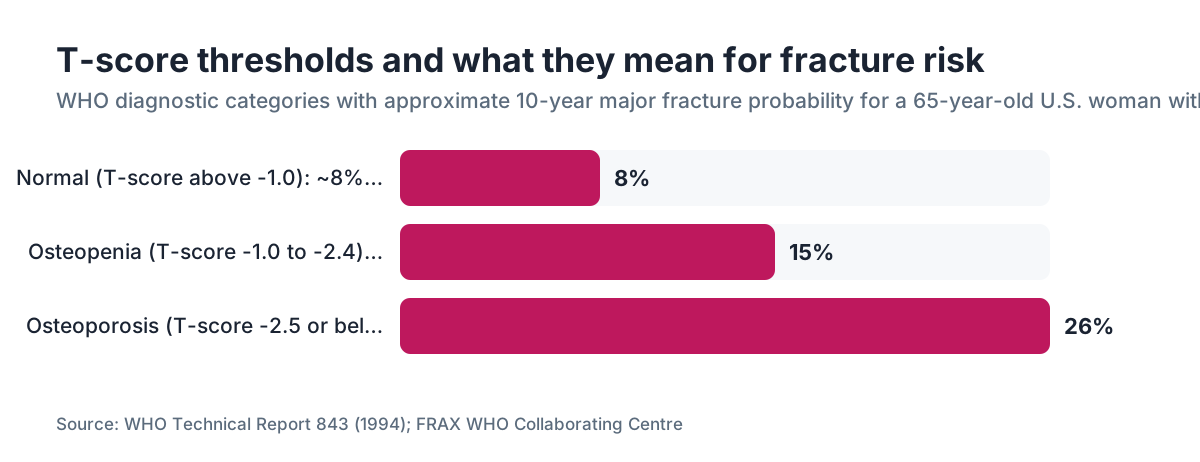
The World Health Organization set the diagnostic thresholds in 1994, and they remain the worldwide standard [3].
| T-score | Diagnosis | |---|---| | -1.0 and above | Normal bone density | | -1.0 to -2.4 | Osteopenia (low bone mass) | | -2.5 and below | Osteoporosis | | -2.5 and below with one or more fragility fractures | Severe osteoporosis |
Osteopenia is not a disease. It's a statistical category that means your bones are thinner than the young-adult average but not thin enough to hit the fracture-risk threshold that triggers medication. About half of postmenopausal women land in osteopenia at some point, so finding yourself there is not a crisis. It is a signal to pay attention to the lifestyle and hormonal factors you can actually move.
Osteoporosis is the threshold where fracture risk climbs high enough that most guidelines recommend medication alongside lifestyle changes. At a T-score of -2.5, your bone density runs roughly 29 percent below the young-adult mean, because one standard deviation in the hip BMD reference dataset equals about 10-12 percent of bone density.
Severe or established osteoporosis means you've already broken a bone from a fall at standing height or less, or in some vertebral cases from something as small as a sneeze. That shifts the risk math and almost always triggers immediate treatment, wherever your exact T-score lands.
The T-score alone misses one number that matters a lot: your 10-year absolute fracture probability. For that, most clinicians run FRAX, the WHO's Fracture Risk Assessment Tool, which layers in age, weight, prior fractures, family history, smoking, alcohol, glucocorticoid use, and secondary diagnoses [4]. A 70-year-old with a T-score of -2.0 who smokes faces a very different picture than a 52-year-old with the same score and no other risks.
How much does bone density drop after menopause?
This is where the numbers get startling. Women lose bone slowly after peak bone mass (around age 25-30), but the rate jumps at menopause because estrogen is one of the main brakes on osteoclast activity, the cells that break bone down. When estrogen falls, those brakes release.
In the two to three years before the final menstrual period and the two to three years after it, women can lose 2-3 percent of spinal bone density per year [5]. That's the perimenopausal window, and it's genuinely fast. Across the decade around menopause, total losses of 10-20 percent are common. After that early postmenopausal surge, the rate settles to roughly 1-1.5 percent per year.
Put it in T-score terms. If your T-score is -0.5 heading into perimenopause and you lose 2 percent a year for five years, you could reach roughly -1.5 to -2.0 by your mid-50s with no intervention at all. Still osteopenia, but it shows why catching the trajectory early beats panicking over one reading.
Menopause timing matters too. Early menopause (before 45) or premature ovarian insufficiency (before 40) means more years of estrogen deprivation, and those women carry meaningfully higher lifetime fracture risk [6]. To place yourself in the transition, the articles on perimenopause age and when does menopause start give a solid starting point.
Race, genetics, and body weight all shift the picture. Black women, on average, have higher baseline BMD and lower fracture rates than white women at the same T-score, one reason the WHO/FRAX thresholds stay under debate. Heavier body weight protects bone, partly through mechanical loading and partly because fat tissue converts adrenal androgens to estrogen after menopause.
What is a good T-score for a woman at 50, 60, or 70?
There's no single good number that works at every age, because what counts as reassuring depends on your starting point and how many risk factors ride along. Here's what the population data shows.
At age 50 (near the U.S. average age of natural menopause, 51), roughly 15 percent of women have osteoporosis and another 37 percent have osteopenia, based on NHANES data [7]. A T-score above -1.0 at 50 is genuinely good news. A score between -1.0 and -2.0 is common but worth watching, especially early in the transition.
By 60, the averages have moved. Close to 25-30 percent of white women have osteoporosis at the hip or spine by then. A T-score of -1.5 at 60 isn't alarming on its own, but paired with a FRAX showing a 10-year hip fracture probability above 3 percent or a major osteoporotic fracture probability above 20 percent, most U.S. guidelines (NOF/BHOF) recommend treatment [4].
At 70, the National Osteoporosis Foundation recommends DEXA screening for every woman regardless of risk factors, because baseline risk by this age is high enough that targeted screening misses too many cases [8]. A T-score above -2.0 at 70 with no prior fractures and no high-risk FRAX score is still manageable with lifestyle and possibly estrogen. A T-score below -2.5 at 70 almost always calls for medication.
The honest answer: a good T-score is one that, combined with your FRAX and your clinical picture, puts your 10-year major fracture probability below 20 percent and your hip fracture probability below 3 percent. Those two thresholds drive the U.S. treatment algorithm.
How does hormone therapy affect bone density scores?
Estrogen therapy is one of the most effective tools known for preserving and even partly rebuilding bone in women who are estrogen-deficient. The Women's Health Initiative (WHI) showed a 33 percent drop in hip fractures and a 24 percent drop in total fractures in women taking combined estrogen-progestin, with a significant hip fracture reduction for estrogen-alone users too [9]. These are hard fracture outcomes, stronger evidence than BMD numbers alone.
The mechanism is direct. Estrogen binds receptors on osteoclasts and their precursors and slows them down. Less osteoclast activity means slower bone breakdown. Even low-dose transdermal estrogen, the kind from an estrogen patch, preserves bone density in postmenopausal women, with studies showing maintenance or slight gains at the spine and hip [9].
Progesterone's role is murkier but probably additive. Some data suggest micronized progesterone has independent bone-protective effects through osteoblast stimulation, though the evidence is thinner than for estrogen. The progesterone page covers that.
For women who started menopause hormone therapy (MHT) mainly for hot flashes and night sweats, bone protection is a real secondary benefit. The USPSTF and NAMS both note that MHT is not FDA-approved as first-line osteoporosis treatment (that role belongs to bisphosphonates, RANK-L inhibitors, and anabolics), but it's appropriate for fracture prevention in younger postmenopausal women who also have menopausal symptoms [10]. If you're on hormone replacement therapy for symptoms, your bones are getting a real benefit alongside the relief.
Timing counts. Starting estrogen early in the transition, during the accelerated loss window, captures more protection than starting a decade later. That's part of the timing hypothesis in MHT research.
Does GLP-1 medication like semaglutide affect bone density?
Here the science is still moving, and honest uncertainty is the right answer. GLP-1 receptor agonists like semaglutide drive large weight loss, and that's the part that raises bone density flags. Body weight is a mechanical stimulus for bone formation. Lose 10-15 percent of it quickly and you tend to shed some bone mass too, mostly at the hip.
In the STEP 1 trial of semaglutide 2.4 mg, participants lost an average of 14.9 percent of body weight over 68 weeks [11]. BMD data from that trial was limited, but secondary and post-hoc analyses showed modest reductions, in the range of 1-2 percent at the hip, similar to what shows up with other weight-loss interventions including bariatric surgery. The open question is whether that loss raises fracture risk, and current data shows no clear fracture signal in GLP-1 trial populations.
Animal studies suggest GLP-1 receptors sit on osteoblasts and that GLP-1 agonism may have direct bone-protective effects that partly offset the mechanical unloading from weight loss. But animal data and human outcomes are separate things, and we don't have long-term fracture endpoint data from semaglutide trials yet.
If you're already at risk for low bone density (osteopenia, a personal or family history of fragility fracture, or recent menopause), raise bone monitoring with your clinician before or during semaglutide for weight loss. Protein intake of at least 1.2 g per kg of body weight, resistance training, and steady calcium and vitamin D are reasonable protective moves no matter what a trial eventually shows about GLP-1 and fracture risk.
WomenRx clinicians can help you weigh this tradeoff if you're managing weight and bone health at the same time.
What factors other than menopause raise fracture risk?
A T-score never stands alone. The same reading carries very different risk depending on who it belongs to. FRAX pulls in twelve clinical risk factors, and knowing them tells you whether your T-score needs action or just monitoring [4].
Risk factors FRAX counts:
- Age (the strongest driver after BMD itself)
- Prior fragility fracture (doubles or triples risk on its own)
- A parent with hip fracture (strong genetic signal)
- Current smoking
- Alcohol at three or more units per day
- Glucocorticoid use (any oral steroid for more than 3 months)
- Rheumatoid arthritis
- Secondary osteoporosis (hyperthyroidism, type 1 diabetes, malabsorption like celiac, chronic kidney disease)
- Low body weight or BMI below 20
Medications beyond steroids matter too, even the ones FRAX doesn't capture. Long-term proton pump inhibitors impair calcium absorption. SSRIs and SNRIs link to higher fracture risk in observational data, though causation stays debated. Thiazolidinediones (some diabetes drugs) cut bone formation. Depo-Provera (injectable contraception) suppresses estrogen and causes measurable BMD loss, worst in adolescents and young women during what should be peak bone-building years.
On the protective side: regular weight-bearing and resistance exercise, calcium of 1,000-1,200 mg per day from food and supplements combined for postmenopausal women [8], vitamin D kept above 20 ng/mL and ideally 30-50 ng/mL, no smoking, and light or no alcohol all move the needle. None of these are cure-alls, but the lifestyle evidence is solid enough that they belong in any serious bone conversation.
When should you get a bone density test and how often?
The U.S. Preventive Services Task Force (USPSTF) recommends DEXA screening for all women 65 and older, and for younger postmenopausal women whose 10-year fracture risk (estimated without BMD) matches or exceeds that of a 65-year-old white woman with no other risk factors, which works out to about a 9.3 percent 10-year major osteoporotic fracture risk on FRAX [12].
The NOF recommends screening at 65, earlier for high-risk younger women, then follow-up scans every 1-2 years on treatment (to check response), or every 2-5 years if your baseline is normal and you've picked up no new risk factors.
Who should think about early testing (before 65):
- Premature ovarian insufficiency or early menopause before 45
- History of anorexia or very low body weight
- Glucocorticoid use for 3 months or longer
- A fragility fracture at any age
- Conditions tied to bone loss: celiac disease, inflammatory bowel disease, primary hyperparathyroidism, hyperthyroidism
- Strong family history of hip fracture
For a full walk-through of the scan itself, the bone density test page covers the procedure, cost, and how to read your report.
Central DEXA (hip and spine) is the gold standard. Peripheral devices, the wrist or heel scanners you see at health fairs, can flag risk but don't produce the T-scores used in diagnostic thresholds. Don't let a peripheral scan reassure you if you carry multiple risk factors. Get a central DEXA.
What are the treatment options once you have a diagnosis?
Treatment hinges on three things read together: your T-score, your FRAX score, and whether you've already fractured. No single number writes the prescription.
For osteopenia with low FRAX risk, lifestyle is the main intervention: calcium, vitamin D, weight-bearing exercise, resistance training, fall prevention, no smoking. Repeat DEXA every 2-5 years is reasonable.
For osteopenia with high FRAX risk or osteoporosis (T-score at or below -2.5), most U.S. guidelines recommend medication [4][8]. The main options:
Bisphosphonates (alendronate, risedronate, zoledronic acid) are first-line for most women. They slow osteoclast activity and cut bone resorption. Oral alendronate 70 mg weekly is the usual starting point. Zoledronic acid, given once a year by IV infusion, works for women who can't tolerate oral versions or have absorption issues. The caveat: bisphosphonates run for 3-5 years, then get reassessed, because of rare but real atypical femoral fractures and jaw osteonecrosis with very long use.
Denosumab (Prolia) is a RANK-L inhibitor injected every six months. It's highly effective, especially at the hip, and often the choice when bisphosphonates fail or in women with kidney disease. The catch is serious: bone loss rebounds fast if you stop without switching to another agent. Stopping denosumab without a plan has caused multiple vertebral fractures where the rebound went unmanaged [5].
Anabolic agents (teriparatide, abaloparatide, romosozumab) build new bone rather than just slowing loss. They're held for severe osteoporosis, very high fracture risk, or treatment failures, partly on cost (romosozumab runs roughly $20,000-$25,000 per year) and partly because romosozumab carries an FDA boxed warning for higher risk of heart attack and stroke [13].
Hormone therapy is a reasonable option for younger postmenopausal women who also have menopausal symptoms, as covered above. It isn't typically filed as a first-line osteoporosis drug, but the fracture-reduction evidence is clear.
The NAMS position statement says: "Hormone therapy is effective for the prevention of postmenopausal osteoporosis and has been shown in randomized controlled trials to reduce the risk of osteoporosis-related fractures, including hip fractures" [10]. That's a direct quote from a major medical society, not a marketing line.
Can you improve your T-score, or just slow its decline?
Actually raising your T-score, meaning gaining density, is possible but harder than most people expect. For most postmenopausal women on lifestyle measures alone, the realistic goal is slowing loss, not reversing it. Medication and, in some cases, hormone therapy can produce real gains.
Bisphosphonates typically raise spine BMD by 3-8 percent over three years and hip BMD by 2-4 percent [5]. Teriparatide can lift spine BMD by 8-13 percent over 20 months. Romosozumab hit spine gains of 13 percent in one year in the ARCH trial. In bone density terms, those numbers are not small.
Lifestyle helps at the margins. Resistance training (real load-bearing work like squats, deadlifts, and weighted carries, more than walking) produces measurable BMD gains in some trials, mostly at the spine. A 2022 meta-analysis in the Journal of Bone and Mineral Research found high-impact and resistance training combined produced spine BMD gains of roughly 1-2 percent in postmenopausal women, real but modest [5].
Calcium's benefit is clearest when you're deficient. If your dietary intake already hits target (around 1,000-1,200 mg per day total), extra calcium from supplements may add nothing and has been tied in some meta-analyses to a modest rise in cardiovascular risk. The field argues over this actively. Food first, supplements only for the gap, is the safer play according to both NOF and NAMS.
Vitamin D matters for calcium absorption and muscle function (which cuts fall risk), but the evidence that vitamin D alone raises BMD once deficiency is corrected is weak. The USPSTF found insufficient evidence that vitamin D plus calcium reduces fractures in community-dwelling adults who aren't deficient [12], a narrower claim than it sounds but worth knowing.
What is the difference between a T-score and a Z-score?
Both come from the same DEXA scan, both are standard deviation scores, and people mix them up constantly. The difference is the reference group.
The T-score compares you to the peak bone mass of a healthy young adult (age 20-29, typically). This is the number that diagnoses osteoporosis and osteopenia in postmenopausal women and men over 50.
The Z-score compares you to the average BMD of people your own age and sex. A Z-score of 0.0 means you're exactly average for your demographic. A Z-score of -2.0 or below is defined as "below the expected range for age" by the ISCD and triggers a workup for secondary causes of bone loss [2].
Why does the split matter clinically? A postmenopausal woman who has lost bone at a normal aging pace might show a T-score of -2.2 (osteoporosis by definition) but a Z-score of 0.0, meaning her bones are typical for her age. That Z-score of 0.0 reassures you that nothing unusual is driving the loss, but the T-score still sets the treatment decision. Flip it around: a 45-year-old with a T-score of -1.8 and a Z-score of -2.5 has bones far worse than expected for her age, a red flag for a secondary cause like malabsorption, hyperthyroidism, or glucocorticoid use.
For premenopausal women and men under 50, the ISCD recommends Z-scores over T-scores for diagnosis, because the WHO's T-score thresholds came from postmenopausal women and don't fit younger populations well [2].
How do you read your DEXA report if your doctor didn't explain it?
DEXA reports look intimidating, but once you know the structure they read easier than most lab results. Here's what to find.
The scan measures BMD at three main sites: the lumbar spine (usually L1-L4 vertebrae averaged), the femoral neck (the narrow part of the hip where most hip fractures happen), and the total hip. Your report lists a T-score and a Z-score for each site.
For diagnosis, the lowest T-score across the hip sites or the lumbar spine sets the category. So if your spine T-score is -2.6 and your hip T-score is -1.8, you meet the osteoporosis threshold on the spine even though your hip sits in osteopenia range.
The report also gives a BMD value in grams per square centimeter (g/cm2). Less intuitive than the T-score, but this is the actual measurement; the T-score gets derived from it. Track your absolute BMD across serial scans, because a change of 3-5 percent (depends on the machine) is the minimum detectable real change (the least significant change in densitometry language). Smaller shifts could be measurement noise rather than true biological change [2].
Most reports include a FRAX calculation. If yours doesn't, you can run it yourself at the WHO's FRAX website using your T-score and clinical risk factors (see citation 4). The two thresholds that matter for U.S. treatment decisions: a 10-year hip fracture risk above 3 percent and a 10-year major osteoporotic fracture risk above 20 percent.
If your report mentions a trabecular bone score (TBS), that's an add-on analysis of bone quality (microarchitecture) rather than plain density. It isn't everywhere yet but shows up more at academic centers and can add information for borderline cases.
Frequently asked questions
What T-score is considered osteoporosis in women?
A T-score of -2.5 or lower at the hip or lumbar spine meets the World Health Organization's diagnostic threshold for osteoporosis in postmenopausal women. If you also have a fragility fracture (a break from minor trauma), the diagnosis is severe osteoporosis regardless of the exact number. These thresholds have been the global standard since 1994.
Is a T-score of -1.5 bad?
A T-score of -1.5 falls in the osteopenia range, meaning low bone mass, not osteoporosis. It's common in perimenopause and early postmenopause. Whether it needs medication depends on your age, FRAX fracture risk, and other clinical factors. Many women at -1.5 are managed well with lifestyle measures, calcium, vitamin D, exercise, and monitoring rather than drugs.
What causes a sudden drop in bone density?
The most common cause of rapid bone loss in women is the estrogen decline around menopause, where losses of 2-3 percent per year at the spine are possible in the early transition. Other causes include starting oral corticosteroids, new hyperthyroidism or hyperparathyroidism, celiac disease or other malabsorption, stopping hormone therapy abruptly, or stopping denosumab without a bridging plan.
Can you reverse osteoporosis naturally without medication?
For most women with established osteoporosis, lifestyle alone is unlikely to produce enough BMD gain to meaningfully change fracture risk. Resistance training, adequate calcium and vitamin D, and weight-bearing exercise can slow loss and modestly raise BMD, but meta-analyses suggest gains of roughly 1-2 percent at the spine. A T-score of -2.5 or below with elevated FRAX scores usually warrants medication plus lifestyle changes.
How accurate are DEXA scans and can results vary between machines?
Central DEXA is the gold standard with good precision, but results can vary by 1-3 percent between different machines or facilities. Serial scans should ideally run on the same machine at the same facility for meaningful comparisons. The least significant change is typically 3-5 percent depending on the site, so small differences between scans may reflect measurement variability rather than actual bone change.
Does weight loss from GLP-1 drugs like semaglutide cause bone loss?
Rapid weight loss of any kind, including from GLP-1 receptor agonists, ties to modest reductions in bone density, mostly at the hip, in the range of 1-2 percent. The STEP 1 trial showed no clear fracture signal, but long-term fracture endpoint data for semaglutide isn't available yet. Women with existing osteopenia should discuss bone monitoring, protein intake, resistance training, and calcium and vitamin D status with their clinician before or during GLP-1 treatment.
At what age do women lose the most bone density?
Women lose bone fastest in the two to three years before and the two to three years after the final menstrual period, the perimenopausal window. Losses at the lumbar spine can reach 2-3 percent per year during this phase. After the early postmenopausal surge (roughly five years), the rate settles to around 1-1.5 percent per year. Peak bone mass arrives around age 25-30, which is why building bone in youth matters.
Does hormone replacement therapy really prevent fractures?
Yes, with real trial data behind it. The Women's Health Initiative showed a 33 percent drop in hip fractures and a 24 percent drop in total fractures in women on combined estrogen-progestin therapy. These were hard fracture outcomes in a large randomized controlled trial, stronger than BMD measurements. Estrogen-alone also cut hip fractures significantly. NAMS recognizes hormone therapy as effective for osteoporosis prevention in postmenopausal women with menopausal symptoms.
What is the FRAX score and how is it different from a T-score?
The T-score measures bone density against a young-adult peak. FRAX is a WHO tool that estimates your 10-year probability of a major osteoporotic fracture (hip, spine, wrist, or shoulder) or a hip fracture specifically, using BMD plus twelve clinical risk factors including age, sex, smoking, and prior fractures. FRAX gives a percentage risk, and U.S. guidelines use thresholds of 20 percent for major fractures and 3 percent for hip fracture to guide treatment.
Should I take calcium supplements if I have osteopenia or osteoporosis?
Aim for total calcium of 1,000-1,200 mg per day for postmenopausal women, from food first and supplements only for the gap. If your diet already provides enough calcium, extra supplements may not help, and some meta-analyses suggest a modest cardiovascular risk with excess supplement intake. Vitamin D (400-800 IU per day at minimum, often more to reach adequate serum levels) is generally recommended alongside calcium.
Is osteopenia the same as osteoporosis?
No. Osteopenia is low bone mass, a T-score between -1.0 and -2.4. It's not a disease; it's a statistical category meaning your bone density sits below the young-adult average but above the osteoporosis threshold. Osteoporosis is a T-score of -2.5 or lower. The distinction matters for treatment: most women with osteopenia are managed with lifestyle measures and monitoring, while osteoporosis often warrants medication.
How often should postmenopausal women repeat a bone density test?
On treatment for osteoporosis, most guidelines recommend repeat DEXA every 1-2 years to check response. If your baseline T-score is normal and you have no new risk factors, a repeat scan every 5 years is reasonable. Women with osteopenia and moderate risk typically repeat every 2-3 years. The point of serial testing is to catch accelerated loss early, not to scan so often that measurement variability hides real trends.
What does a Z-score tell you that a T-score doesn't?
The Z-score compares your bone density to age-matched peers rather than to young adults. A Z-score below -2.0 means your bones are worse than expected for your age, a signal to hunt for a secondary cause like a medication side effect, thyroid problem, malabsorption disorder, or vitamin D deficiency. For postmenopausal women, T-scores drive the diagnosis; Z-scores flag whether something beyond normal aging or menopause is driving the loss.
Can perimenopause cause bone loss even before periods stop?
Yes. Bone loss speeds up during late perimenopause, the two to three years before the final menstrual period, more than after it. Estrogen fluctuates and trends down during this window, and osteoclast activity rises with it. Women still having irregular periods but clearly in late perimenopause can lose bone at 1-3 percent per year at the spine. Early DEXA testing is worth considering for high-risk perimenopausal women.
Sources
- International Society for Clinical Densitometry (ISCD), Official Positions
- International Society for Clinical Densitometry (ISCD), Official Positions on BMD and Z-scores
- World Health Organization, Assessment of Fracture Risk and Its Application to Screening for Postmenopausal Osteoporosis (WHO Technical Report 843)
- WHO Collaborating Centre for Metabolic Bone Diseases, FRAX Fracture Risk Assessment Tool
- NIH National Institute of Arthritis and Musculoskeletal and Skin Diseases (NIAMS), Osteoporosis
- NIH Office on Women's Health, Premature Ovarian Insufficiency
- Centers for Disease Control and Prevention (CDC), National Center for Health Statistics, Osteoporosis Prevalence Data
- National Osteoporosis Foundation (now Bone Health and Osteoporosis Foundation), Clinician's Guide to Prevention and Treatment of Osteoporosis
- Women's Health Initiative, JAMA 2002 and 2004 publications, NIH NHLBI summary
- North American Menopause Society (NAMS), Menopause Practice Guidelines
- Wilding JPH et al., STEP 1 Trial, New England Journal of Medicine, 2021
- U.S. Preventive Services Task Force (USPSTF), Osteoporosis to Prevent Fractures Recommendation Statement, 2018
- FDA Drug Label, Evenity (romosozumab), 2019