Supplements to bring back strength lost during menopause
TL;DR: Estrogen decline during menopause roughly doubles the rate of muscle loss and cuts measurable strength by the mid-50s. Creatine monohydrate (3-5g daily), enough protein (1.2-1.6g per kg bodyweight), vitamin D3 with K2, and omega-3s carry the strongest published evidence for keeping or rebuilding strength. No supplement replaces resistance training or, where appropriate, hormone therapy.
Why does menopause cause muscle and strength loss in the first place?
Estrogen does far more than run your period. It protects skeletal muscle directly, binding to estrogen receptors on muscle fibers, slowing protein breakdown, keeping satellite cells active (the stem cells that repair muscle), and holding inflammation down. When estrogen drops in perimenopause and then falls hard at menopause, all of those signals weaken at once. The National Institute on Aging describes muscle loss with age as sarcopenia, and estrogen loss speeds it up [12].
The numbers are sobering. Women lose roughly 3-8% of muscle mass per decade after 30, and that rate roughly doubles after menopause, according to data reviewed by the American College of Sports Medicine [1]. Strength drops faster than mass, partly because the surviving fibers get worse at generating force. By the early 60s, many women have lost 15-20% of the peak strength they had at 40.
Fat also moves inward, filling in where muscle used to be around the abdomen and thighs. That shift matters past the mirror. Lower muscle mass tracks with insulin resistance, higher fracture risk, and less cardiovascular reserve. So bringing back strength is a health question, not a vanity one.
Progesterone matters here too, though it gets less attention. Progesterone receptors sit in muscle tissue, and progesterone has a mild anabolic signal. If you want the full hormonal picture of menopause and what it does to body composition, that context frames why supplements alone hit a ceiling.
How much muscle loss should I actually expect after menopause?
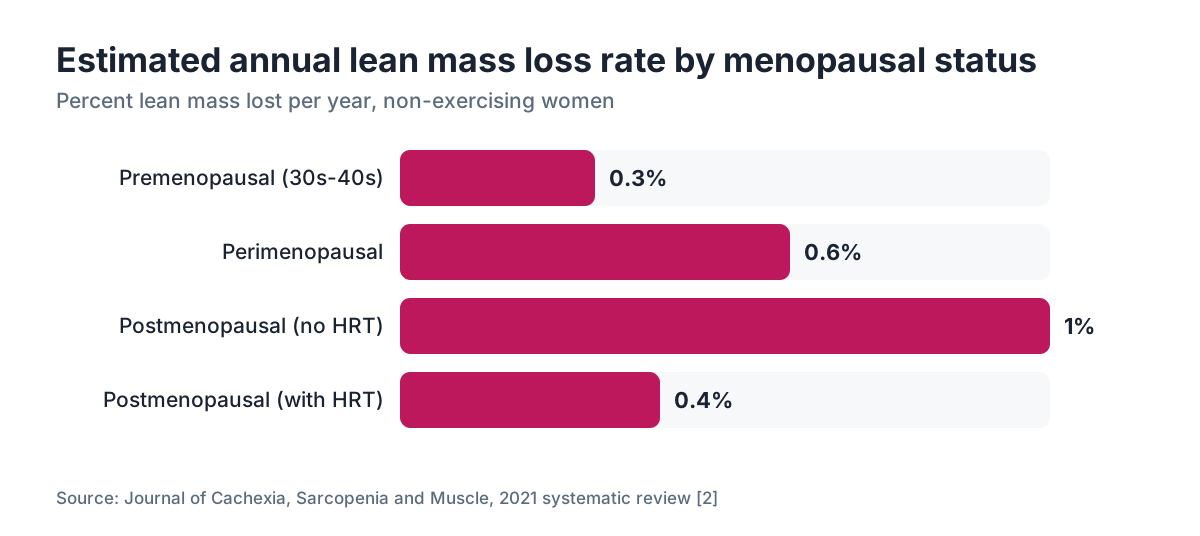
Honest answer: it varies enormously, and the research ranges are wide. A 2021 systematic review in the Journal of Cachexia, Sarcopenia and Muscle found postmenopausal women averaged about 0.6-1.0% lean mass loss per year versus 0.1-0.5% in premenopausal women of similar age [2]. That sounds small. Compounded over 10-15 years, it adds up to several kilograms of functional tissue.
Strength loss runs ahead of mass loss. Grip strength, one of the best-studied proxies for overall muscle function, drops about 1-3% per year in postmenopausal women not on hormone therapy, based on data from the Study of Women's Health Across the Nation (SWAN) [3]. Leg press and squat strength decline at similar or faster rates.
The women who lose the least are the ones who lift regularly and eat enough protein. Obvious, maybe, but worth saying plainly: supplements work on top of that foundation, not instead of it. The most expensive creatine on earth does almost nothing if you're sedentary and eating 50 grams of protein a day.
What supplements have real evidence for strength in menopausal women?
Here are the ones with actual trial data. Not theoretical mechanisms. Not rat studies. Human trials, ideally in peri- or postmenopausal women.
Creatine monohydrate This is the strongest candidate. Creatine raises phosphocreatine stores in muscle, which lets you produce more force during hard efforts and recover faster between sets. A 2021 meta-analysis in Nutrients analyzed 14 randomized controlled trials in older adults and found creatine plus resistance training produced significantly greater gains in lean mass and upper and lower body strength than resistance training plus placebo [4]. The effective dose is 3-5 grams per day. Loading phases (20g/day for 5-7 days) are optional and mainly speed up when you feel it. Monohydrate is the cheapest, best-studied form. Branded variants (Kre-Alkalyn, creatine HCl) don't beat it in any head-to-head trial I can find.
One finding specific to postmenopausal women: creatine appears to have a mild positive effect on bone mineral density when paired with resistance training, which matters given that bone density test results often worsen sharply in the first 5 years after menopause.
Protein and leucine Not glamorous, probably the highest-impact nutritional move you can make. Older muscle becomes resistant to the anabolic signal of amino acids, a phenomenon called anabolic resistance. You need more protein per meal to trigger the same muscle protein synthesis response. Evidence reviewed by the International Society of Sports Nutrition suggests postmenopausal women need 1.2-1.6g of protein per kilogram of bodyweight daily, spread across at least 3 meals at roughly 25-40g each [5]. Most women over 50 eat closer to 0.8g/kg, the minimum to prevent deficiency, not the amount to build or hold strength.
Leucine is the branched-chain amino acid that most directly triggers the mTOR anabolic pathway. Whey is high in leucine (~10-11% by weight), one reason it outperforms soy in some muscle-building trials. Dairy-free? A pea-rice blend with added leucine comes close.
Vitamin D3 with K2 Vitamin D deficiency is nearly universal in women over 50, and it tracks with lower muscle strength, higher fall risk, and slow recovery [6]. Muscle fibers carry vitamin D receptors that regulate calcium handling and protein synthesis. The Endocrine Society defines deficiency as serum 25(OH)D below 20 ng/mL and insufficiency below 30 ng/mL [6]. Many clinicians treating menopausal women aim for 40-60 ng/mL for musculoskeletal benefit.
Dosing is individual. Most women need 2,000-4,000 IU daily to get above 30 ng/mL; some need more. You can't guess this well without a blood test. Pair it with K2 (as MK-7, 100-200mcg daily) because vitamin D drives calcium absorption and K2 steers that calcium toward bone instead of arterial walls.
Omega-3 fatty acids (EPA and DHA) Fish oil is easy to write off as generic wellness advice. The muscle-specific data is real. A 2020 randomized trial in the American Journal of Clinical Nutrition found 3.36g/day of omega-3s significantly increased muscle protein synthesis rates in older women [7]. The mechanism: omega-3s cut muscle-damaging inflammation and make muscle cell membranes more responsive to insulin and amino acids. Dose matters. You need at least 2-3g combined EPA+DHA per day, which is 3-4 standard 1000mg fish oil capsules (most hold only 300mg combined EPA/DHA). A concentrated triglyceride-form fish oil at 1-2 capsules is easier and absorbs better.
Magnesium Easy to overlook. Magnesium is a cofactor in over 300 enzymatic reactions, including ATP production and protein synthesis. Postmenopausal women run low often, because estrogen helps retain magnesium and dietary intake is frequently short. Low magnesium tracks with lower grip strength in population studies. Form matters: glycinate or malate absorbs better than magnesium oxide, which is what fills most cheap multivitamins. 200-400mg elemental magnesium daily is a reasonable range.
Collagen peptides (with vitamin C) Collagen is connective tissue, not muscle. But tendons and ligaments weaken in menopause too, and the evidence that 10-15g of hydrolyzed collagen taken 30-60 minutes before exercise, paired with 50mg vitamin C, raises tendon collagen synthesis is real, from a 2019 study in the American Journal of Clinical Nutrition [8]. If joint pain limits your training, this may help indirectly. It won't build contractile muscle by itself.
Does hormone replacement therapy itself help with strength, and how does it compare to supplements?
HRT isn't a supplement, but it belongs here because it treats the root cause supplements are trying to work around. Estrogen therapy preserves lean mass, slows muscle protein breakdown, and helps hold the neuromuscular coordination that fades with estrogen loss. A 2018 meta-analysis in Climacteric reviewed 29 trials and found estrogen-based HRT attenuated lean mass loss and improved physical function in postmenopausal women versus controls [9].
That doesn't mean everyone belongs on HRT or that it replaces lifting. It means if you're taking creatine and protein and still frustrated by your strength trajectory, a talk with a clinician about hormone replacement therapy may be the missing piece, not a shinier supplement stack.
Platforms like WomenRx help women assess whether HRT fits them, without the year-long wait to see a menopause specialist. Worth exploring before you spend hundreds of dollars on peptides and adaptogens with thin evidence.
Testosterone deserves a mention too. Women make testosterone in the ovaries and adrenal glands, and levels fall meaningfully after menopause. Low testosterone in women tracks with lower muscle mass, lower libido, and less drive to exercise. Testosterone therapy for women is still off-label in the US, but real prescribing is growing. The evidence base is thinner than for estrogen, though suggestive.
What about supplements like ashwagandha, DHEA, or HMB?
These get a lot of attention. Here's an honest read on each.
Ashwagandha (KSM-66 extract) Several small trials suggest ashwagandha at 300-600mg of a root extract lowers cortisol and may support muscle recovery. A 2019 study in Medicine found an 8-week course of 300mg KSM-66 twice daily improved muscle strength and recovery in healthy adults [10]. The effect size was modest, and most trials ran in young men. In menopausal women specifically, the evidence is thin. It's probably not harmful at standard doses, and cortisol dysregulation is real in perimenopause, so there's a theoretical rationale. I wouldn't prioritize it before creatine and protein.
DHEA DHEA is a precursor to both estrogen and testosterone, made by the adrenal glands, and levels fall with age. Supplemental DHEA at 25-50mg/day sells over the counter, which is odd for a hormone. Some trials show modest gains in bone density and muscle function in postmenopausal women; others show little. The trouble: OTC DHEA quality control is poor, absorption is variable, and it converts unpredictably to estrogen or testosterone depending on your enzyme profile. If you want to address DHEA, a clinician-supervised approach beats grabbing something off Amazon.
HMB (beta-hydroxy beta-methylbutyrate) HMB is a metabolite of leucine that reduces muscle protein breakdown. Early trials looked exciting. A 2019 Cochrane systematic review found effects on muscle mass and strength in older adults were small and inconsistent [11]. It's expensive for what you get. The protein and leucine route is better value.
Berberine Sometimes marketed for menopause muscle loss because it improves insulin sensitivity. Not enough evidence in this population to recommend it for strength. Useful for metabolic health more broadly.
How much protein do I really need after menopause, and what sources are best?
The RDA for protein is 0.8g per kilogram of bodyweight. That number was set to prevent deficiency in sedentary young adults. It's the wrong target for a postmenopausal woman trying to hold or rebuild muscle.
The International Society of Sports Nutrition's 2017 position stand recommends 1.4-2.0g/kg for people doing resistance exercise [5]. For a 150-pound (68kg) woman, that's 95-136 grams of protein per day. Most women over 50 in the US eat 60-70g. The gap is real.
Distribution matters as much as the total. Muscle protein synthesis spikes after a protein-rich meal, then drops back to baseline within a few hours. Eating 100g of protein at dinner does less than spreading it across three meals of 30-35g each. A 2019 study in Nutrients found even protein distribution across meals tracked with greater muscle mass in older adults.
Best food sources by leucine content and bioavailability, roughly ranked: whey protein, eggs, Greek yogurt, cottage cheese, fish (salmon especially), chicken breast, beef, pea protein with added leucine. Plant sources generally carry less leucine per gram of protein and lower digestibility, which counts more in older adults. If you eat mostly plant protein, aim for the higher end of the range.
Plain whey isolate or concentrate is probably the most cost-effective supplement on this list if your diet runs protein-short. Not fancy. It works.
Does resistance training change how well these supplements work?
Completely. This is not optional context. Almost every supplement here has a bigger effect combined with resistance training than taken by someone sedentary.
Creatine is the clearest example. The 2021 Nutrients meta-analysis found creatine plus resistance training produced significantly greater strength gains than resistance training alone or creatine alone [4]. Creatine without exercise in older women is real but much smaller.
Same principle with protein. Muscle protein synthesis turns on when two signals arrive together: amino acid availability and mechanical loading (lifting). Extra protein without the training stimulus mostly means you excrete the surplus nitrogen.
For menopausal women new to lifting, twice-weekly full-body sessions are enough to see measurable strength gains within 6-8 weeks, even in women in their 60s and 70s. The muscle isn't gone. It's dormant. The satellite cells that repair and grow muscle fibers still respond to the right stimulus decades after menopause.
If you're not lifting yet, that is where your energy goes first. Supplements accelerate and support a training program. They don't substitute for one.
Are there supplements that are a waste of money for menopause-related strength loss?
Yes. Several popular ones have poor evidence for this specific use.
Collagen for muscle building. Collagen is roughly 30% glycine and low in leucine. It doesn't meaningfully stimulate muscle protein synthesis. It helps connective tissue (see above), but selling it as a muscle builder is misleading.
Most testosterone boosters. Products called "natural testosterone boosters" (often fenugreek, tribulus, D-aspartic acid) have weak evidence at best in young men and essentially none in postmenopausal women. Your testosterone decline is real. These products won't move it.
Maca root. Some evidence maca helps libido and mood in perimenopause. Evidence for strength or muscle mass? Close to zero.
BCAAs as a standalone. Branched-chain amino acid supplements are mostly marketing if you already eat enough total protein and leucine. You're buying part of a protein you could get from food or a complete powder at lower cost.
Estrogen creams sold as supplements. Anything claiming to be a "natural estrogen" supplement (wild yam, high-dose phytoestrogens) is not the same as FDA-approved bioidentical estrogen. Phytoestrogens have weak, inconsistent effects; they don't substitute for HRT and may not help muscle at all.
What does a realistic supplement protocol look like, with doses and timing?
Here's a practical, evidence-grounded stack for a postmenopausal woman focused on regaining strength. None of it needs a prescription.
| Supplement | Dose | Timing | Evidence Level | |---|---|---|---| | Creatine monohydrate | 3-5g daily | Anytime, post-workout convenient | Strong (multiple RCTs) | | Protein (food or whey) | 25-40g per meal, 3x daily | With each main meal | Strong | | Vitamin D3 | 2,000-4,000 IU | With fat-containing meal | Strong for deficiency | | Vitamin K2 (MK-7) | 100-200 mcg | With vitamin D | Moderate | | Magnesium glycinate | 200-400mg elemental | Evening (helps sleep too) | Moderate | | Omega-3 (EPA+DHA) | 2-3g combined | With meals | Moderate-Strong | | Collagen peptides + 50mg vitamin C | 10-15g | 30-60 min pre-workout | Moderate (tendon specific) |
Start with the top three before adding anything. Get a blood test for vitamin D and run a dietary protein audit before spending money. Most women find creatine, protein, and vitamin D alone produce noticeable changes in 8-12 weeks when paired with consistent resistance training.
Cost reality check: creatine monohydrate runs about $0.10-0.20 per day. Whey protein powder is $1-2 per serving. Vitamin D3 is under $0.10 per day. The most effective part of this stack is also the cheapest. You do not need a $150/month "women's menopause formula" with proprietary blends.
When should I talk to a doctor instead of just taking supplements?
If you've done consistent resistance training for 3-6 months, eaten adequate protein, and taken creatine and vitamin D, and you're still losing strength or can't build any, that's a signal to investigate rather than pile on more supplements.
Things worth checking with a clinician: TSH (thyroid), serum 25(OH)D, complete metabolic panel, CBC, and a hormonal panel including estradiol and testosterone. Hypothyroidism mimics menopausal muscle loss and is common in women over 50. Severe vitamin D deficiency needs higher-dose correction under supervision. And if you haven't discussed HRT with a provider, that talk is worth having.
Fracture risk runs parallel. If you're worried about bone strength alongside muscle strength, a DEXA scan can assess both. Many women don't know they have osteopenia until they fracture something. Knowing your bone density helps calibrate how hard to push training and supplementation.
For women managing weight with GLP-1 medications like semaglutide, the muscle-preservation question gets sharper. GLP-1 receptor agonists cause fat loss, but some of the weight lost is lean mass, especially without resistance training and enough protein. The protocol above is particularly relevant if you're on a semaglutide for weight loss program.
WomenRx clinicians evaluate exactly this mix of issues, including hormonal status, GLP-1 candidacy, and body composition goals, without the usual 6-month specialist waitlist.
How long does it take for supplements to actually improve strength after menopause?
Realistic timelines, from the trial literature:
Creatine loading phase (if you use one): strength output rises within 5-7 days for some women because of phosphocreatine saturation. Real but modest, around 5-10% in short-duration high-intensity efforts.
Muscle mass and functional strength changes: 8-12 weeks of consistent resistance training plus creatine and protein is the minimum window where published trials see statistically significant improvement [4]. Don't judge a protocol at 3 weeks.
Vitamin D: if you're deficient, correcting it takes 4-8 weeks of supplementation to raise serum levels meaningfully. Some women feel less fatigue and more muscle comfort before blood levels fully normalize.
Omega-3s: most trial endpoints land at 12-26 weeks. This is a slow burn, not an acute ergogenic.
The honest answer: meaningful, visible strength recovery takes 3-6 months of consistent effort. Women who've done this report the gains start feeling real around the 10-12 week mark, with continued improvement for 6-12 months if training continues. You are not too old. The biology is more forgiving than the fitness industry suggests.
Frequently asked questions
Can creatine cause weight gain in menopausal women?
Creatine causes water retention inside muscle cells (intracellular, not subcutaneous bloat) of about 1-2 kg in the first 1-2 weeks, especially with a loading phase. This is not fat gain. In postmenopausal women, the water retention tends to be less pronounced than in younger adults. Most women find body composition improves with creatine over time because added muscle mass burns more calories at rest.
Is magnesium actually helpful for muscle weakness in menopause?
Yes, when deficiency is the underlying issue, which is common. Magnesium is required for ATP production, muscle contraction, and protein synthesis. Estrogen helps retain magnesium, so its loss in menopause raises deficiency risk. Low serum magnesium correlates with lower grip strength in population studies. Magnesium glycinate at 200-400mg elemental daily is reasonable. Magnesium oxide (common in cheap multivitamins) absorbs poorly.
Do I need to take supplements forever to maintain strength after menopause?
Creatine and protein need to be ongoing because they support ongoing muscle biology, not a one-time fix. Vitamin D is a lifelong need for most women in northern latitudes or with limited sun exposure. Omega-3s are similarly long-term. The good news: the costs are low and the baseline habits (protein at meals, creatine with coffee) become automatic. Think of them as maintenance, not treatment.
Can supplements replace hormone replacement therapy for muscle loss?
No. Supplements address downstream consequences of estrogen loss; they don't replace the hormonal signal itself. HRT addresses the root cause. In published trials, estrogen therapy consistently outperforms placebo for lean mass preservation in postmenopausal women. Supplements and HRT work well together. If you're losing ground on strength despite good training and nutrition, the HRT conversation with a clinician is worth having.
What is the best protein powder for postmenopausal women trying to build strength?
Whey isolate or concentrate is the most evidence-supported option due to high leucine content (~10-11% by weight) and fast absorption. For dairy-free women, a pea-rice blend with added leucine comes closest. Collagen is often marketed for women but is a poor choice for muscle building specifically. Aim for 25-30g of protein per serving. Plain, unflavored versions let you control sweeteners and additives.
Does vitamin D actually help with muscle strength or just bones?
Both. Muscle fibers have vitamin D receptors that regulate calcium handling, protein synthesis, and satellite cell activity. Clinical studies in vitamin D-deficient older adults show meaningful improvements in muscle strength and fall risk reduction when deficiency is corrected. The Endocrine Society defines deficiency as below 20 ng/mL. Many clinicians target 40-60 ng/mL for musculoskeletal benefits. Blood testing before supplementing is genuinely useful here.
Is it too late to build muscle after 60 or 65?
No. Studies including women in their 70s and 80s consistently show that resistance training produces meaningful gains in muscle mass and strength. Satellite cells, which repair and build muscle, remain responsive to mechanical loading decades after menopause. The rate of gain is slower than in younger women, but the biology is intact. Adequate protein and creatine improve outcomes in these age groups specifically.
Can GLP-1 medications like semaglutide worsen muscle loss in menopause?
Potentially, yes. GLP-1 receptor agonists cause significant caloric restriction and fat loss, but some of the weight lost is lean mass, especially without resistance training and high protein intake. Studies in GLP-1 trials show roughly 25-40% of total weight lost can be lean mass in non-exercising participants. Creatine, high protein (1.2-1.6g/kg), and resistance training are particularly important if you're on a GLP-1 medication.
How do I know if my muscle weakness is from menopause or something else?
Common mimics include hypothyroidism, vitamin D deficiency, iron deficiency anemia, and depression. All are common in women over 45. A basic blood panel (TSH, CBC, ferritin, 25-OH vitamin D, CMP) will catch most of them. If those come back normal and your hormone levels confirm low estrogen, then menopause-related sarcopenia is the likely culprit. Don't assume; get the labs.
How much omega-3 do I need for muscle benefits, more than heart health?
Most fish oil trials showing muscle protein synthesis benefits used 2-3.36g of combined EPA and DHA daily, which is higher than the typical heart-health recommendation of around 1g. A standard 1,000mg fish oil capsule usually contains only 300mg combined EPA+DHA, so you'd need 7-10 capsules. A concentrated, triglyceride-form fish oil (higher EPA+DHA per gram) at 2-3 capsules is more practical.
Does perimenopause cause strength loss too, or only after full menopause?
Strength and lean mass decline begins in perimenopause, not only after the final period. Estrogen fluctuates and then trends downward during the perimenopause years, which can start in the early-to-mid 40s. The intervention strategy is the same: protein, creatine, vitamin D, resistance training. Starting before full menopause may help slow the transition rather than trying to recover lost ground afterward.
Should I take DHEA supplements for menopause-related muscle loss?
The evidence is mixed and quality control on OTC DHEA is poor. Some trials show modest improvements in muscle function and bone density in postmenopausal women at 25-50mg daily; others show little effect. DHEA converts unpredictably to estrogen or testosterone depending on your individual enzyme profile. If you want to address DHEA, work with a clinician who can test your baseline and monitor levels rather than self-dosing.
What is anabolic resistance, and why does it make protein more important after menopause?
Anabolic resistance means older muscle requires a larger amino acid stimulus to trigger the same muscle protein synthesis response that younger muscle gets from a smaller dose. You need roughly 40g of protein per meal to maximally stimulate synthesis in a postmenopausal woman, versus about 20-25g in a 25-year-old. This is why total protein recommendations increase with age, and why spreading protein evenly across meals matters more than it did at 30.
Sources
- American College of Sports Medicine, Position Stand on Exercise and Physical Activity for Older Adults
- Journal of Cachexia, Sarcopenia and Muscle (2021) - systematic review of lean mass loss in postmenopausal women
- Study of Women's Health Across the Nation (SWAN), University of Michigan Institute for Social Research
- Nutrients (2021) - meta-analysis of creatine supplementation and resistance training in older adults
- International Society of Sports Nutrition Position Stand: protein and exercise (Journal of the International Society of Sports Nutrition, 2017)
- Office of Dietary Supplements, National Institutes of Health - Vitamin D Fact Sheet for Health Professionals
- American Journal of Clinical Nutrition (2020) - RCT of omega-3 supplementation and muscle protein synthesis in older adults
- American Journal of Clinical Nutrition (2019) - Shaw et al., collagen peptides and tendon collagen synthesis
- Climacteric (2018) - meta-analysis of estrogen-based HRT and lean mass in postmenopausal women
- Cochrane Library - systematic review of HMB and muscle mass/strength in older adults (2019)
- National Institute on Aging (NIH) - How to Prevent Falls and Age-Related Muscle Loss