Sublingual semaglutide: does it actually work for weight loss?
TL;DR: Sublingual semaglutide (drops held under the tongue) is not FDA-approved and has zero published trials showing meaningful weight loss. Semaglutide is a 4,114-dalton peptide that barely crosses oral mucosa. The only approved oral version, Rybelsus, needs a special absorption enhancer and is cleared for diabetes, not weight loss. Compounded sublingual drops sell well but lack efficacy data.
What is sublingual semaglutide and how is it different from the shot?
Semaglutide is a GLP-1 receptor agonist, a molecule that copies a gut hormone your body releases after you eat. It slows stomach emptying, dials down appetite, and tells the brain you have had enough. The FDA-approved injectable versions, Ozempic (for type 2 diabetes) and Wegovy (for chronic weight management), push the drug straight into the fat under your skin and skip the gut entirely. That detail matters. Semaglutide is a large peptide, and stomach acid plus digestive enzymes tear it apart almost completely.
Sublingual means you put a liquid or a dissolvable tablet under your tongue and hold it there until it soaks through the mucous membrane into the small blood vessels below. This works beautifully for some drugs. Nitroglycerin and buprenorphine are the classic examples. Those molecules are small, fat-soluble, and slide through mucosal tissue without much trouble. Semaglutide is the opposite on every count. It weighs 4,114 daltons, roughly ten times more than most sublingual-friendly molecules, and it is hydrophilic, so it does not slip through the fatty cell membranes lining the floor of your mouth [1].
So when a compounding pharmacy or a telehealth company sells "sublingual semaglutide drops," they are betting that enough drug crosses that tissue to matter. The honest answer: no peer-reviewed trial has tested that bet in humans with weight loss as the endpoint.
Is there an approved oral form of semaglutide already?
Yes, and it tells you everything. Rybelsus (oral semaglutide, 3 mg, 7 mg, or 14 mg) got FDA approval in September 2019 for type 2 diabetes in adults [2]. To get there, Novo Nordisk had to solve the exact absorption problem that makes sublingual semaglutide so questionable.
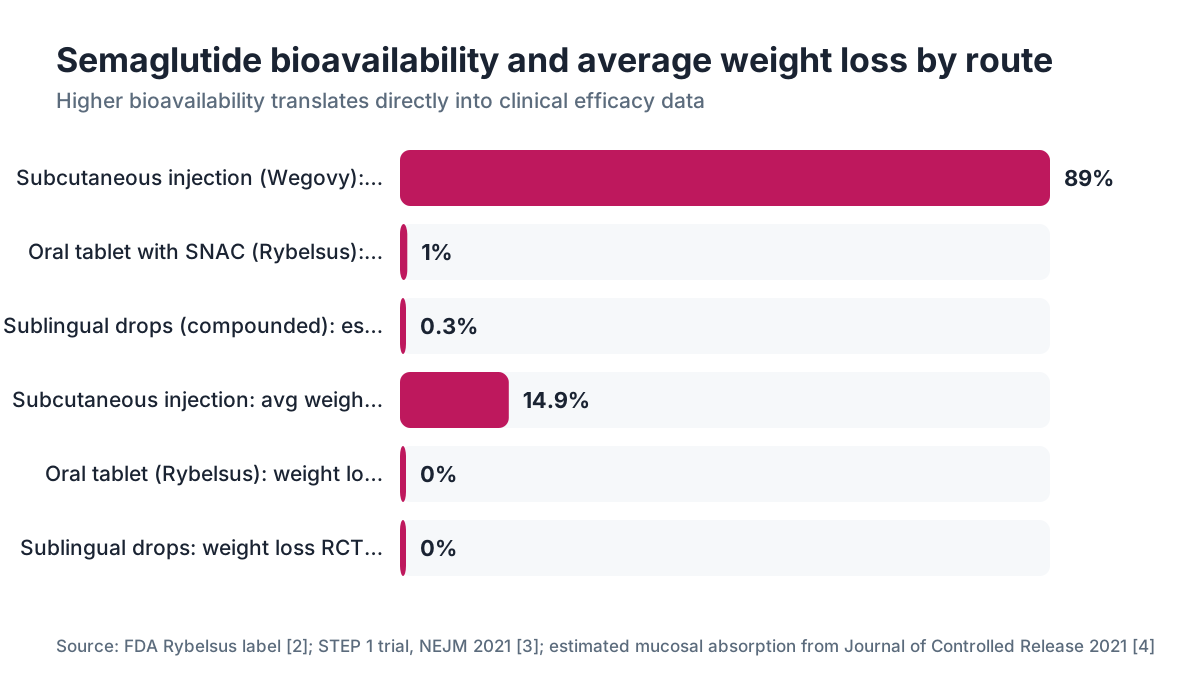
Their fix was SNAC (sodium N-(8-[2-hydroxybenzoyl] amino) caprylate), an absorption enhancer that briefly raises the local pH in the stomach and cracks open the mucosal barrier just enough to let semaglutide through. Even with SNAC, the absolute bioavailability of Rybelsus sits at about 0.4% to 1%, against roughly 89% for the subcutaneous injection [2]. That is not a typo. You swallow a 14 mg tablet and less than 1% of the drug reaches your blood. The pill still controls blood sugar because the amount of drug needed for glycemic effect is lower than what you need to lose serious weight.
Rybelsus has no weight-management approval. The STEP trials that earned Wegovy its obesity label used the shot, not the pill. There is a reason Novo Nordisk never submitted Rybelsus for a weight loss indication: the tablet cannot hit the blood levels that STEP 1 showed you need. In that trial, subcutaneous semaglutide 2.4 mg weekly produced an average body weight drop of 14.9% over 68 weeks in adults without diabetes [3]. Nobody has matched that number with an oral or sublingual route.
Before you compare routes, the semaglutide overview covers how the drug works across every formulation, including the injection basics.
Does sublingual semaglutide actually get absorbed into the bloodstream?
The evidence here runs thin fast. The mucosa under your tongue has a decent blood supply, and some drugs do reach real systemic levels through it. But peptide absorption depends on molecular weight, electrical charge, and whether the formulation includes a permeation enhancer. Compounded sublingual drops usually rely on a cyclodextrin or a similar carrier to try to move more drug across. None of those formulations have published pharmacokinetic data in a peer-reviewed journal showing the blood levels they actually reach.
The closest thing in the literature is broader oral peptide delivery research. A 2021 review in the Journal of Controlled Release found that unmodified peptides above 1,000 daltons hit severe absorption barriers across every mucosal route, and that permeation enhancers can raise absorption but rarely to levels close to injection [4]. Semaglutide is four times over that threshold.
Here is what that means at your bathroom sink. You might absorb some semaglutide sublingually. The real questions are whether that amount moves your weight at all, and whether it stays consistent from one dose to the next. Based on the drug's pharmacology, the answer to both is almost certainly no. There is a safety angle too: if you have no idea what your blood level is, you cannot predict side effects or titrate sensibly.
Compounding pharmacies selling sublingual semaglutide do not have to prove bioequivalence to the injectable before they dispense it. That gap is the whole problem [5].
How does sublingual semaglutide compare to the injectable and oral tablet?
The table below lines up the three routes on the factors that actually matter in the clinic.
| Route | FDA-approved | Bioavailability | Approved indication | Weight loss data | |---|---|---|---|---| | Subcutaneous injection (Wegovy/Ozempic) | Yes | ~89% [2] | Weight loss (Wegovy), T2D (Ozempic) | 14.9% avg loss at 68 wks (STEP 1) [3] | | Oral tablet with SNAC (Rybelsus) | Yes | 0.4-1% [2] | T2D only | Not approved; no STEP data | | Sublingual drops (compounded) | No | Unknown; likely <1% | None | No published RCTs |
The injection wins on every clinical measure, which is why the big weight loss trials all used it. The oral tablet is a real option for someone who has diabetes and a documented needle phobia, as long as you take it right: on an empty stomach, with no more than 4 oz of plain water, 30 minutes before you eat or drink anything else. Food and other liquids close SNAC's absorption window [2].
If you want semaglutide for weight loss specifically, the comparison to run first is semaglutide vs tirzepatide. Tirzepatide's injectable (Zepbound) produced an average 20.9% weight loss at 72 weeks in SURMOUNT-1 [6]. That context matters before you settle on any formulation.
Why are compounding pharmacies and telehealth companies selling sublingual semaglutide?
Short version: market opportunity during a supply crunch. From 2022 through early 2025, FDA listed both Ozempic and Wegovy on its drug shortage list, and under federal law (21 U.S.C. 503A and 503B) that opened the door for licensed compounding pharmacies to make copies [5]. Compounders rushed in with injectable semaglutide, and some tacked on sublingual drops as a cheaper, needle-free draw for patients who refused to self-inject.
By mid-2024, FDA declared the Wegovy shortage resolved and sent warning letters telling compounders they could no longer produce copies of the branded drug [5]. Some pharmacies pivoted to "novel" formulations, like sublingual drops mixed with vitamin B12 or cyanocobalamin, arguing those blends are meaningfully different from Wegovy. FDA has not bought that argument and has called out the safety risks of compounded semaglutide directly, noting it "has received reports of adverse events" from patients using compounded versions [5].
The commercial pull is real. Sublingual drops cost less to make than sterile injectables, ship without the same cold-chain demands, and skip the needle anxiety altogether. Whether they work is a separate question from whether they sell.
For the full legal and quality picture, read the piece on compounded semaglutide.
What are the real risks of using compounded sublingual semaglutide?
There are four distinct risk categories here, and they are worth pulling apart.
The first is efficacy risk. You spend the money, expect results, and get little or nothing because the drug never reaches therapeutic blood levels. Frustrating and expensive, but not dangerous on its own.
The second is dosing unpredictability. If sublingual semaglutide has variable, unknown bioavailability, your dose-response curve is a guess. Some batches may absorb better than others. You could get more nausea, vomiting, or the rare but serious complication of ileus (bowel obstruction) because the amount you actually absorbed ran higher than planned. FDA's adverse event reports on compounded semaglutide name dosing errors as a recurring theme [5].
The third is product quality. Compounding pharmacies answer to state boards of pharmacy, and 503B outsourcing facilities answer to FDA, but neither standard matches the manufacturing controls behind Novo Nordisk's commercial products. Contamination, wrong concentration, and degraded drug are all documented risks with compounded sterile preparations, and drops are not exempt.
The fourth is opportunity cost. Spend three to six months on a sublingual product that does nothing and you have delayed access to a formulation with real evidence. For women in perimenopause or menopause, where abdominal weight climbs as estrogen falls, that delay costs you. The link between menopause and metabolic change is real, and the window for stepping in effectively is not open forever.
Is sublingual semaglutide a good option for women in perimenopause or menopause?
No, and the women most likely to be offered it are exactly the ones who deserve a straight answer. Telehealth clinics tend to pitch sublingual drops to women in their 40s and 50s who are gaining weight around the middle and either cannot get the injectable or want to dodge needles. That demographic needs a careful look, not a shortcut.
Estrogen decline in perimenopause pushes fat storage toward visceral adipose tissue, the metabolically active fat packed around your internal organs. Research in Menopause, the journal of the Menopause Society (formerly NAMS), has documented this shift and its tie to higher cardiovascular and metabolic risk [7]. GLP-1 receptor agonists have a plausible mechanism to help: they cut caloric intake, slow gastric emptying, and appear to act directly on fat tissue. But every bit of that depends on hitting adequate drug concentrations.
If sublingual semaglutide cannot reliably hit those concentrations, it is not a real tool for perimenopausal weight management. Women in this group often do better addressing the hormonal root cause alongside any weight medication. Hormone replacement therapy can improve body composition on its own by preserving muscle mass and partly offsetting visceral fat gain, according to data the Menopause Society has reviewed [7]. HRT and a GLP-1 are not mutually exclusive. You just want both to actually work.
At WomenRx, clinicians who prescribe GLP-1s for perimenopausal women pair them with a full hormonal evaluation instead of treating weight in isolation, because the estrogen decline underneath is so often what is driving the change.
For timing, see perimenopause age and when does menopause start.
What does the FDA say about sublingual semaglutide specifically?
FDA has not approved any sublingual semaglutide product. Full stop. The agency's approved semaglutide products are Ozempic (subcutaneous, 0.5 mg, 1 mg, 2 mg weekly), Wegovy (subcutaneous, up to 2.4 mg weekly), and Rybelsus (oral tablet with SNAC, up to 14 mg daily) [2].
In 2024, FDA issued a safety communication about compounded semaglutide, stating that it "is aware that patients have experienced adverse events, some requiring hospitalization, after using compounded semaglutide." The agency flagged dosing errors as a key concern and warned patients to be careful with formulations never reviewed for safety and effectiveness [5].
FDA has also held the line that compounders cannot legally copy Wegovy now that the shortage is resolved, and that adding B12 or switching the delivery route does not create a genuinely different drug. The regulatory ground under sublingual compounding is shaky, and it could shift fast, which could leave patients who built a routine around drops with no legal source.
The Endocrine Society has not addressed sublingual semaglutide by name, but its clinical practice guideline on obesity pharmacotherapy calls for using agents backed by established evidence from randomized controlled trials, which sublingual semaglutide does not have [8].
How much does sublingual semaglutide cost compared to the injectable?
Pricing swings by vendor, but here is an honest range based on what compounding telehealth clinics have publicly listed.
Compounded sublingual semaglutide drops generally run $150 to $350 per month, sometimes with the telehealth visit included. Some vendors sell a three-month package that pulls the per-month cost down to roughly $100 to $150.
Compounded injectable semaglutide from 503A pharmacies has typically run $200 to $400 per month, again depending on dose and vendor.
Brand-name Wegovy without insurance lists at roughly $1,349 per month, though Novo Nordisk's savings card has capped out-of-pocket costs for eligible commercially insured patients [9]. GoodRx-style discounts do not apply to Wegovy. Rybelsus lists at roughly $900 to $950 per month without insurance.
The price gap between compounded sublingual and the injectable looks big until you factor in efficacy. If sublingual semaglutide delivers 2% to 3% weight loss instead of the 12% to 15% seen with the shot, the cost per kilogram of fat lost is probably worse, not better, even at the lower sticker price.
For people who genuinely cannot afford or access injectable semaglutide, the math gets harder. Rybelsus at 14 mg daily shows modest but real glycemic benefit and some weight-adjacent effect, but it needs a diabetes diagnosis for coverage and has never been compared head-to-head with compounded sublingual drops.
See semaglutide for weight loss for a full breakdown of access and cost pathways.
Are there any real clinical trials on sublingual semaglutide?
As of mid-2026, there are no published randomized controlled trials in peer-reviewed journals with sublingual semaglutide as the intervention and weight loss as the primary outcome. That is not a hedge. It is the current state of the literature, and ClinicalTrials.gov lists no active or completed trial registered under that specific formulation and endpoint [10].
What does exist is a modest body of work on oral peptide delivery systems in general, plus a handful of pharmacokinetic studies on how semaglutide behaves in various buffers and formulations, mostly from Novo Nordisk's own pipeline. Those studies shaped Rybelsus, not sublingual drops.
There is also early mechanistic work on buccal and sublingual peptide delivery using newer lipid nanoparticle or liposomal carriers. Those technologies look promising in the lab, but they are not the cyclodextrin-based or plain aqueous solutions most compounding pharmacies actually use.
Nobody has good data on how much semaglutide a sublingual drop delivers to systemic circulation in a real patient taking it correctly. The closest published estimate extrapolates from oral mucosal permeability data for peptides of similar size, and it is not encouraging: absorption likely lands in the 0.1% to 0.5% range, possibly below Rybelsus with SNAC [4]. So a 1 mg sublingual dose might put 1 to 5 micrograms into your blood. A weekly Wegovy injection delivers 2,400 micrograms. That is not a small gap. It is orders of magnitude.
What should you actually do if you want semaglutide without injections?
Your real options are limited right now, and you should be skeptical of anyone who tells you otherwise.
If you have type 2 diabetes, Rybelsus is a legitimate, FDA-approved oral semaglutide. It works for blood sugar. It may produce modest weight loss as a secondary effect. The administration rules are strict and the bioavailability is low, but the safety and efficacy data exist for that indication.
If you do not have diabetes and you want a GLP-1 for weight management, the injection is still the only route with strong evidence behind it. Plenty of women who swore they could never self-inject learn to do it within two weeks with proper training. The needles for subcutaneous injections are short (4 to 6 mm) and thin (31 to 32 gauge), far less uncomfortable than most people brace for.
If you are perimenopausal and weight is the concern, get a full evaluation before jumping to any GLP-1 formulation. Sorting out hormone replacement therapy may change your metabolic trajectory on its own. A bone density test belongs in that workup too, because the same estrogen decline driving weight change speeds up bone loss.
Here is the fastest filter. If someone pitches sublingual semaglutide as equivalent to the shot, ask for the pharmacokinetic data. If they cannot show you peer-reviewed evidence of the blood levels achieved, you have your answer.
WomenRx connects you with licensed clinicians who can weigh whether injectable semaglutide, tirzepatide, hormonal therapy, or some combination fits your situation, instead of defaulting to whatever formulation is cheapest to compound.
Frequently asked questions
Is sublingual semaglutide FDA-approved?
No. FDA has approved subcutaneous semaglutide (Wegovy, Ozempic) and oral semaglutide with SNAC (Rybelsus), but no sublingual formulation. Compounded sublingual drops exist on the market but have never been reviewed by FDA for safety or effectiveness. FDA issued a safety warning in 2024 about adverse events, some requiring hospitalization, from compounded semaglutide products.
Does sublingual semaglutide work for weight loss?
No published randomized controlled trials show that sublingual semaglutide produces meaningful weight loss. The drug is a large peptide that absorbs poorly through oral mucosa, with estimated absorption likely under 0.5%. That falls far below the blood levels behind the 14.9% average weight loss in the STEP 1 trial using the injectable. Current evidence does not support using it for weight loss.
How do you take sublingual semaglutide correctly?
Compounders typically tell patients to place drops under the tongue, hold for 60 to 90 seconds without swallowing, then swallow the rest. Eating or drinking beforehand may cut whatever modest absorption occurs. But since no clinical trial has validated a dosing protocol, there is no evidence-based "correct" way to take a formulation that lacks efficacy data in the first place.
Is sublingual semaglutide safer than the injectable?
Not clearly. FDA has flagged dosing errors and hospitalizations from compounded semaglutide, drops included. Unpredictable absorption means you cannot reliably anticipate side effects or dose-adjust safely. The injectable has standardized dosing, established pharmacokinetics, and safety data from trials involving tens of thousands of patients. "Needle-free" does not automatically mean safer.
How much does sublingual semaglutide cost per month?
Compounded sublingual semaglutide drops typically range from $100 to $350 per month depending on the vendor, dose, and whether a telehealth consult is bundled. That undercuts brand-name Wegovy (roughly $1,349 per month list price), but the price advantage collapses if the formulation cannot deliver enough drug to produce meaningful weight loss.
Can you use sublingual semaglutide if you have a needle phobia?
The wish is understandable. Rybelsus is the only FDA-approved needle-free semaglutide and needs a type 2 diabetes diagnosis for most insurance coverage. It has real but modest efficacy data. Compounded sublingual drops lack efficacy data and carry regulatory uncertainty. Many people with needle anxiety find that GLP-1 injection needles (4 to 6 mm, 31 gauge) hurt far less than expected once they learn the technique.
What is the difference between sublingual and oral semaglutide?
Oral semaglutide (Rybelsus) is a tablet you swallow, built around a patented absorption enhancer (SNAC) that works in the stomach. Sublingual semaglutide is a liquid held under the tongue to absorb through oral mucosa without SNAC. Rybelsus reaches about 0.4% to 1% bioavailability with SNAC; sublingual drops likely reach less, possibly under 0.5%, because they lack that enhancer and face a different mucosal barrier.
Can I get sublingual semaglutide from a regular pharmacy?
No. Retail pharmacies like CVS, Walgreens, and Walmart dispense FDA-approved medications only. Sublingual semaglutide is a compounded product available only through compounding pharmacies, usually accessed through telehealth platforms. The regulatory status of these products turned uncertain after FDA's 2024 actions declaring the Wegovy shortage resolved.
Does sublingual semaglutide cause the same side effects as the injectable?
Semaglutide's expected side effects, including nausea, vomiting, diarrhea, and constipation, track with blood levels of the drug. If sublingual drops produce very low blood levels, side effects may be milder, but that also likely means less efficacy. If one batch absorbs more than expected, side effects could turn unpredictable. There are no clinical trial safety data specific to the sublingual route.
Is compounded sublingual semaglutide legal to buy?
The legal status is genuinely murky as of 2025 to 2026. Compounding was permitted during the FDA-declared shortage of Ozempic and Wegovy. FDA has since declared the Wegovy shortage resolved and sent warning letters to compounders, signaling that continued copies may violate federal law. Some pharmacies argue novel formulations (sublingual, combined with B12) are permissible. That dispute is ongoing.
Will sublingual semaglutide show up on a drug test or lab work?
Standard workplace drug tests do not screen for semaglutide. Blood and urine panels ordered by a clinician can measure GLP-1 agonist levels in some specialized labs, though that is not routine. If you work with a prescriber, they should monitor HbA1c, lipids, and kidney function regardless of route, but specific semaglutide blood level monitoring is not standard practice even for the injectable.
What happens if you stop taking sublingual semaglutide?
The pattern seen with injectable semaglutide applies in principle: weight regain is common after stopping GLP-1 therapy. A 2022 paper in Diabetes, Obesity and Metabolism found participants regained roughly two-thirds of lost weight within a year of stopping subcutaneous semaglutide. If sublingual drops were producing any real effect, stopping would likely reverse it. If they were not, stopping may feel no different from continuing.
Can perimenopausal women use sublingual semaglutide safely?
There is no specific safety data for sublingual semaglutide in perimenopausal women, or in any population. The hormonal context of perimenopause, including estrogen-driven metabolic changes and faster visceral fat accumulation, makes effective weight management more important, not a reason to settle for an unproven formulation. Injectable semaglutide or tirzepatide, paired with a hormonal evaluation, is a more evidence-based path.
Sources
- U.S. National Library of Medicine, PubChem: Semaglutide compound summary
- FDA: Rybelsus (semaglutide) prescribing information label
- Wilding JPH et al., STEP 1 trial, New England Journal of Medicine, 2021
- Maher S et al., Journal of Controlled Release, 2021, review of mucosal peptide absorption; Morishita M, Peppas NA, Drug Discovery Today, 2006
- FDA: Compounded semaglutide safety and drug shortage information
- Jastreboff AM et al., SURMOUNT-1 trial, New England Journal of Medicine, 2022
- The Menopause Society (formerly NAMS): Menopause Practice: A Clinician's Guide and position statements on weight and metabolic health
- Endocrine Society Clinical Practice Guideline: Pharmacological Management of Obesity
- Novo Nordisk: Wegovy savings and support program information
- ClinicalTrials.gov: NIH registry of clinical studies
- Wilding JPH et al., Diabetes, Obesity and Metabolism, 2022: Weight regain after stopping semaglutide