Spotting during perimenopause: what's normal and what's not
TL;DR: Spotting during perimenopause is common and usually driven by erratic estrogen and progesterone swings. Most irregular bleeding is benign. But any spotting after 12 straight period-free months counts as postmenopausal bleeding and needs same-day evaluation. Cancer, polyps, and fibroids get ruled out before anyone blames your hormones. Age 45 or older with abnormal bleeding earns a biopsy.
What is perimenopause spotting and why does it happen?
Spotting during perimenopause is light, unscheduled bleeding that shows up between periods, lasts a day or two, or takes the place of what used to be a predictable monthly flow. It runs from a pale pink smear on toilet paper to a dark brown discharge that looks like old blood. Both ends of that range are common.
The cause is hormonal chaos. Starting in the late 30s and picking up speed through the mid-40s, the ovaries recruit follicles less reliably each cycle [1]. Some cycles skip ovulation entirely. When you don't ovulate, your body never makes the progesterone surge that normally thickens and then sheds the lining on schedule. Estrogen keeps building with no counterweight. The lining grows unevenly and sheds in patches instead of all at once. That patchy shedding is what you see as spotting.
Estrogen doesn't glide downward in a straight line either. It swings. A 2020 analysis in the journal Menopause tracked daily hormone profiles across the transition and found estradiol fluctuations in late perimenopause were larger than those seen in the early reproductive years [2]. High spikes stimulate the endometrium. Sharp drops trigger unexpected shedding. So bleeding feels random because, at the hormonal level, it mostly is.
Progesterone's decline matters just as much. Our article on progesterone explains how this hormone runs uterine cycling and why low levels leave the lining unstable.
What does normal perimenopausal spotting look like?
Normal is a slippery word in perimenopause. Still, some patterns are low-risk enough that clinicians won't rush you into a workup. The rule of thumb: occasional, cycle-linked, painless spotting is usually fine. Daily bleeding, soaking bleeding, or bleeding after 12 period-free months is not.
The STRAW+10 staging system, built by a group of menopause researchers and used by the North American Menopause Society, maps the bleeding patterns across the transition [3]. In early perimenopause (Stage -2), cycles vary in length but most are still recognizable. In late perimenopause (Stage -1), gaps of 60 days or more between periods become common, and spotting fills those gaps. STRAW+10 marks the start of late perimenopause at the first amenorrhea interval of 60 days or longer.
Inside those lines, these patterns are typical:
- Lighter periods than you used to have, sometimes two or three days of spotting instead of a full flow
- A period that starts late, with a few days of spotting before real flow begins
- Mid-cycle spotting that tracks the estrogen surge around ovulation
- An occasional month with no period, followed by a heavier-than-usual bleed
What leans toward normal: the spotting is occasional rather than daily, it loosely follows your cycle rhythm, and you have no pain, pressure, or foul-smelling discharge.
What leans away from normal: bleeding heavier than your heaviest period, soaking more than one pad an hour for two or more hours; consistent bleeding after sex; or any bleeding after you have gone 12 full months without a period.
When is spotting a sign of something serious?
Read this one slowly. Perimenopause does cause irregular bleeding, and that familiarity is exactly why dangerous conditions get waved off for too long.
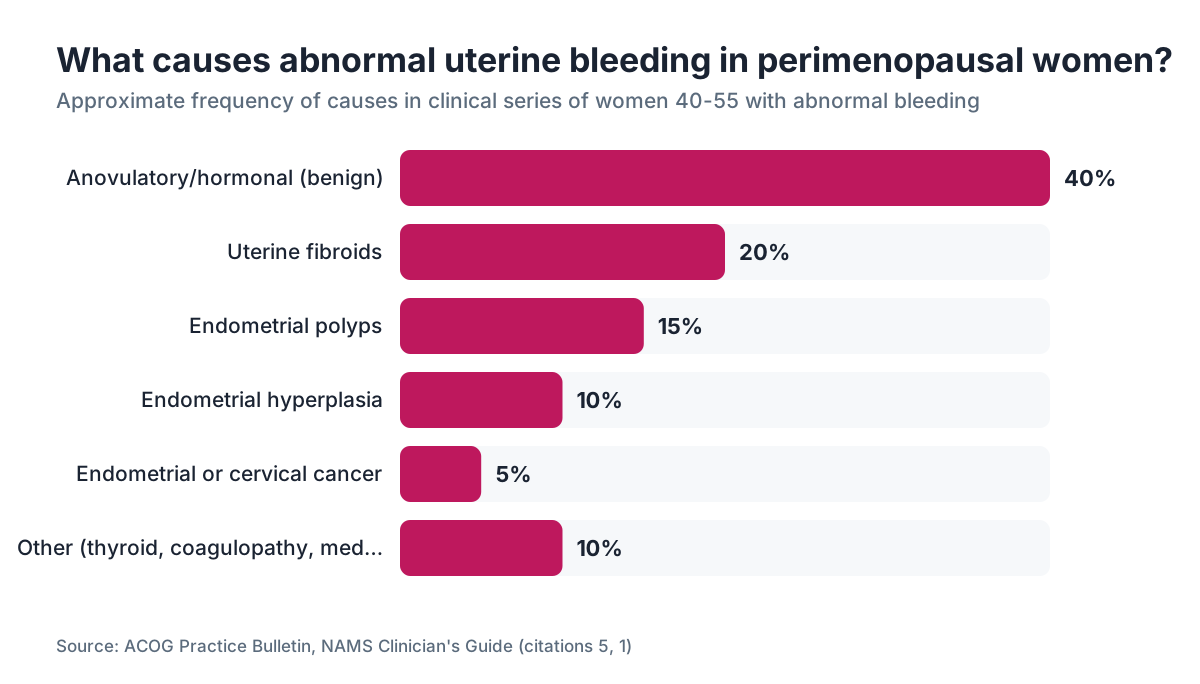
Endometrial cancer is the fourth most common cancer in American women, with about 67,880 new cases projected for 2024 by the National Cancer Institute [4]. Abnormal uterine bleeding is its most common symptom, and most women who get it are in their late 40s to early 60s. That is the perimenopause and early postmenopause window, dead center.
The American College of Obstetricians and Gynecologists recommends endometrial sampling (a biopsy) in any woman 45 or older with abnormal uterine bleeding, and in younger women with risk factors like obesity, polycystic ovary syndrome, diabetes, or a family history of colon cancer [5]. The age-45 line isn't arbitrary. That is where endometrial cancer incidence starts to climb.
Other causes that are not cancer but still need attention:
- Endometrial polyps: benign growths off the lining that bleed unpredictably and can occasionally carry precancerous changes
- Uterine fibroids: very common in the 40s, and a frequent cause of heavy or drawn-out bleeding
- Cervical problems: cervical polyps or, rarely, cervical cancer, which is why bleeding after sex always earns a look
- Bleeding disorders: conditions like von Willebrand disease often go undiagnosed until perimenopause turns up the volume
- Thyroid disease: both overactive and underactive thyroid throw off cycle timing and can pass for perimenopausal spotting, which is why a TSH belongs in any standard workup
Postmenopausal bleeding is its own category. Any bleeding after 12 straight period-free months is postmenopausal bleeding until proven otherwise. Studies put the endometrial cancer rate among postmenopausal women with bleeding at roughly 10% [6]. That number is too high to watch and wait.
How do doctors evaluate abnormal spotting in perimenopause?
The workup starts with a conversation: when did the bleeding start, how much, how often, what color, any pain, any bleeding after sex, any new medications? That history alone narrows things down fast.
From there, the standard tools:
Transvaginal ultrasound (TVUS): Measures endometrial thickness. In premenopausal and perimenopausal women the lining fluctuates normally, so thickness alone tells you less than it does after menopause. A very thick, irregular, or patchy-looking lining still pushes toward biopsy.
Endometrial biopsy: A thin catheter goes through the cervix and grabs a sample of the lining. It takes about two minutes in the office, feels like a strong menstrual cramp, and catches endometrial cancer around 90% of the time when the sample is adequate [5]. If there isn't enough tissue, hysteroscopy comes next.
Hysteroscopy with dilation and curettage (D&C): A slim camera goes into the uterus so the lining can be seen directly. Polyps and fibroids that hide from a blind biopsy show up here. It is both a diagnosis and a fix, since polyps can come out during the same procedure.
Lab work: A complete blood count checks for anemia, which flags more blood loss than a woman may realize. TSH rules out thyroid disease. Depending on age and how heavy the bleeding is, a coagulation panel may get added.
For most perimenopausal women with mild to moderate spotting and no red flags, a pelvic exam and TVUS are reasonable starting points [11]. If anything looks off, or if she is 45 or older and bleeding is abnormal by ACOG criteria, biopsy follows.
Can hormone therapy cause or stop spotting in perimenopause?
Yes to both. It depends on the regimen, the timing, and what the endometrium is doing underneath.
Hormone therapy can cause spotting, especially in the first three to six months of a new regimen. Continuous combined estrogen-progesterone therapy (both hormones daily) often triggers breakthrough spotting as the endometrium settles into a steady hormonal environment instead of a cycling one. It usually calms down by month three to six. If spotting drags past six months on continuous combined HT, or restarts after a stretch of stability, that needs evaluation.
Cyclic regimens, where progesterone runs 10 to 14 days a month, produce a scheduled withdrawal bleed at the end of the progestogen phase. That is expected and not a problem.
Hormone therapy can also quiet spotting down. When irregular bleeding comes purely from anovulatory cycles and unopposed estrogen, adding a progestogen steadies the lining and makes bleeding lighter or more predictable. Low-dose oral contraceptives deliver steady hormone levels and get used in perimenopause for the same reason, with a bonus: contraception. Perimenopausal women can still get pregnant until menopause is confirmed.
The levonorgestrel IUD (Mirena) earns its own mention. Its local progestogen release thins the endometrium a lot. Studies show it cuts menstrual bleeding volume by about 86% at 12 months compared with baseline [7]. For women who want bleeding control without systemic estrogen, it works well.
If you are weighing hormone therapy for bleeding or other symptoms, hormone replacement therapy and the estrogen patch are good next reads. A provider through WomenRx can review your bleeding history, order labs if needed, and talk through whether a hormonal approach fits.
See also progesterone for detail on how progestogen type and dose change uterine bleeding specifically.
What causes spotting between periods (mid-cycle bleeding)?
Mid-cycle spotting, bleeding around day 10 to 16 of a cycle, has a handful of distinct causes in perimenopausal women. Most are benign. A few are not.
Ovulatory spotting is the mildest. When a follicle ruptures to release an egg, the small estrogen surge right before ovulation and the quick drop after can trigger a day or two of light spotting. This happened in your 20s too. You may just never have noticed.
In perimenopause, erratic follicular activity means that estrogen fluctuation can happen at odd times. So the spotting can feel unrelated to any cycle rhythm, because the rhythm itself has gone unpredictable.
Cervical ectropion is another cause. The soft cells that normally line the inside of the cervical canal grow outward onto the cervical surface, where they are more fragile and bleed easily, often after sex or a Pap smear. It is benign, but it can look like something worse on exam, so a clinician needs to put it in context.
Polyps, endometrial or cervical, bleed on their own schedule regardless of cycle phase. A polyp that has outgrown its blood supply bleeds whenever it gets enough mechanical or hormonal nudging.
If mid-cycle spotting is new, heavy enough to need protection, or comes with pain, book a gynecology visit that same week.
Does spotting mean perimenopause is almost over?
No, not by itself. Spotting can start years before your final period.
The average perimenopause runs four to eight years [8]. A woman who notices her first irregular periods at 44 might not reach menopause until 51 or 52, right around the average age of menopause in the United States (51.4 years). Spotting and irregular bleeding are features of the whole transition, more than the last leg.
The character of the bleeding does shift as menopause gets closer. Early on, cycles vary but most still arrive. Later, gaps of two or more months become common, and the bleeds that come are often light. When gaps stretch to six months, then nine, then finally 12, you are near the finish. But spotting in any of those months resets nothing on paper. You still need 12 straight period-free months before menopause is official.
For where you sit in the timeline, perimenopause age and when does menopause start cover what the research says about onset and duration.
How heavy is too heavy? When spotting becomes hemorrhage
Spotting is light by definition. But the line between heavy perimenopausal bleeding and spotting blurs fast, and ignoring the heavy end has real consequences.
ACOG defines heavy menstrual bleeding as blood loss over 80 mL per cycle. Nobody measures their period in milliliters. Here is the practical version: soaking through a full pad or tampon in an hour or less, for two or more hours in a row [5]. Passing clots bigger than a quarter. Needing a pad and a tampon at the same time.
Any of those in a perimenopausal woman means same-day contact with a provider. Not a portal message. A call.
Iron-deficiency anemia is what chronically heavy periods do to you. Women adapt to the fatigue so gradually they miss how depleted they've gotten. A hemoglobin check at your annual visit is cheap and worth doing if your periods have run heavier than usual for more than a few cycles.
The table below sorts spotting from bleeding that needs a call.
What lifestyle factors make perimenopausal spotting worse?
Several things amp up hormonal instability, and bleeding follows. None of these are the whole story, but each one moves the needle.
Body weight: Fat tissue converts androgens into estrogen through peripheral aromatization. Women carrying more body fat run higher background estrogen, which can thicken the endometrium and raise the odds of irregular bleeding. It is also why obesity is an independent risk factor for endometrial hyperplasia and cancer [4].
Stress: Chronic stress raises cortisol, which suppresses the hypothalamic-pituitary-ovarian axis and disrupts the LH surge that ovulation depends on. No ovulation, no progesterone. No progesterone, unstable lining. Bleeding follows.
Thyroid dysfunction: Hypothyroidism slows the whole reproductive cascade and can cause heavy, irregular periods. Hyperthyroidism does the reverse and creates lighter, erratic cycles. Both can pass for perimenopausal spotting. A TSH test costs roughly $30 out of pocket and is worth it if thyroid symptoms are present.
Blood thinners and NSAIDs: Anticoagulants (warfarin, apixaban, rivaroxaban) increase bleeding by design. NSAIDs like ibuprofen inhibit thromboxane and can raise flow, though they also cut prostaglandin-driven cramping. Aspirin at cardioprotective doses can mildly raise menstrual blood loss. If you take any of these regularly, tell your gynecologist.
Alcohol: Regular drinking raises circulating estrogen by slowing hepatic estrogen metabolism. A study in Alcohol and Alcoholism found even moderate alcohol intake tracked with meaningfully higher serum estradiol in perimenopausal women [9]. Cutting back is a low-cost thing to try.
Smoking: Smoking is tied to earlier menopause (by one to two years on average) but also to more chaotic bleeding during the transition [8]. The mechanism runs through nicotine's effect on ovarian follicle development.
How is perimenopausal spotting treated?
Treatment depends entirely on the cause. There is no single protocol, and anyone who hands you one without a workup is guessing.
When the workup shows no structural problem (no polyps, fibroids, hyperplasia, or cancer) and the spotting is clearly hormonal, the options include:
Progestogen supplementation: Oral micronized progesterone (Prometrium) or a synthetic progestin, cyclic or continuous, steadies the endometrium. Cyclic use gives you a scheduled withdrawal bleed instead of random spotting, which many women prefer even if the bleed is a nuisance. See progesterone for how the types compare.
Low-dose combined oral contraceptives: Good for bleeding control, and they also blunt hot flashes and provide contraception. Off the table for women with contraindications (smokers over 35, a personal history of clot, certain cardiovascular conditions).
Levonorgestrel IUD (Mirena): Thins the endometrium locally with minimal systemic hormone. About 20% of users stop bleeding entirely within a year [7]. A strong choice if you want to skip systemic hormones.
Tranexamic acid: A non-hormonal pill taken only on heavy days that cuts blood loss by slowing fibrinolysis. Useful for an on-demand approach.
NSAIDs: Ibuprofen or naproxen on heavy-flow days cut blood loss by about 30 to 40% by blocking prostaglandins. A reasonable first move for mild to moderate heavy bleeding with no structural cause.
If a polyp turns up, hysteroscopic removal is simple and usually cures the bleeding it caused. If fibroids are the source, options run from uterine fibroid embolization to myomectomy to hysterectomy, depending on size, location, and whether you still want children.
For women exploring hormonal management of perimenopausal symptoms, a telehealth visit with WomenRx can include a review of your bleeding history and whether HT or something else fits. That conversation works best after you have had a pelvic exam and basic workup with your gynecologist, so the provider has something to build on.
What tests should you ask for at your next appointment?
If you are spotting and haven't seen anyone about it yet, here is a reasonable list to bring up.
A pelvic exam and Pap smear (if overdue) are the baseline. The exam can catch cervical polyps, cervical changes, or an enlarged uterus that hints at fibroids [11].
Transvaginal ultrasound gives you direct information on endometrial thickness and texture, ovarian cysts, and fibroid location. Most gynecology practices do it in-office or send you to radiology with a same-week turnaround.
If you are 45 or older with abnormal bleeding, push for an endometrial biopsy at the same visit when the ultrasound isn't clearly reassuring. Waiting for a second appointment adds delay for no benefit.
Lab work to request: TSH, complete blood count, and ferritin if you suspect anemia. With a personal or family history of bleeding disorders, ask about von Willebrand factor antigen and activity. Von Willebrand disease affects roughly 1% of the population and is often first caught during heavy perimenopausal bleeding [10].
A pregnancy test (beta-hCG) if there is any chance you're pregnant. Perimenopausal women often assume they can't be. They can, right up until 12 straight period-free months have passed.
Spotting after sex during perimenopause: when does it matter?
Post-coital bleeding gets its own section because it is both common and specific. One light episode with obvious dryness is low-risk. Anything repeated is not.
The mildest cause is genitourinary syndrome of menopause (GSM), the term that replaced vaginal atrophy. As estrogen drops, vaginal tissue thins and loses lubrication. Friction during sex causes small tears or surface bleeding. Very common, very treatable with local estrogen or vaginal moisturizers, and not dangerous.
Cervical ectropion (fragile columnar cells on the outer cervix) bleeds easily with contact. Benign.
Cervical polyps can bleed with contact too. Usually benign, but they should come out and go to pathology.
Cervical dysplasia and cervical cancer can also present as post-coital bleeding. Cervical cancer is less common in women who stay current on Pap smears and HPV testing, but it still happens. Bleeding after sex that repeats is not something to pin on dryness without a speculum exam.
The working rule: one episode of light spotting after sex, with clear vaginal dryness, is low-risk. Bleeding after sex that keeps happening, or comes with discharge or odor, needs a visit that same week.
Frequently asked questions
Is spotting normal during perimenopause?
Yes. Irregular spotting is very common in perimenopause and usually comes from fluctuating estrogen and progesterone driving unpredictable lining shedding. Normal does not mean ignore it. Any spotting that is heavy, happens after sex repeatedly, or occurs after 12 straight period-free months needs evaluation. Age 45 or older with abnormal bleeding earns an endometrial biopsy to rule out cancer.
When should I be worried about spotting during perimenopause?
Seek same-day evaluation for any bleeding after 12 months without a period, soaking a pad or tampon in under an hour for two or more consecutive hours, or bleeding with pelvic pain or pressure. See a provider within a week for repeated post-sex spotting, spotting with unusual discharge, or any new bleeding pattern in a woman 45 or older. A TSH and pelvic exam are reasonable first steps.
What does perimenopausal spotting look like?
It can be light pink or bright red blood, or dark brown discharge that is older blood. It usually lasts one to three days, needs nothing more than a panty liner, and can show up between cycles, in place of a full period, or at the start or end of one. Brown spotting is common and just means the blood took longer to travel through the vaginal canal.
Can perimenopause cause daily spotting?
Daily spotting is not typical even in perimenopause. Occasional or intermittent spotting is expected. Bleeding every single day points to an endometrial issue, cervical pathology, or a hormone imbalance that needs assessment. A pelvic exam, transvaginal ultrasound, and an endometrial biopsy in women 45 or older are the right next steps, not watchful waiting.
How long does spotting last in perimenopause?
A single spotting episode usually lasts one to three days. As a pattern, though, spotting can recur across the whole perimenopausal transition, which averages four to eight years. As menopause nears, the gaps between bleeds stretch out. The pattern has no fixed endpoint until you reach 12 straight months with no bleeding, at which point you are in menopause.
Does spotting during perimenopause mean I am close to menopause?
Not necessarily. Spotting can start years before your final period. The average perimenopause runs four to eight years. Late-stage perimenopause does bring longer gaps between bleeds and lighter flow, but spotting itself is not a reliable countdown. Cycles 60 or more days apart, per the STRAW+10 staging system, signal late perimenopause, but the final date is only confirmed looking back.
Can hormone therapy cause spotting in perimenopause?
Yes. Breakthrough spotting in the first three to six months of a new hormone therapy regimen is expected, especially with continuous combined estrogen-progesterone therapy. It usually settles as the endometrium adjusts. Spotting that starts after a stable stretch on HT, or continues past six months, warrants evaluation to rule out endometrial pathology before blaming the medication.
What is the difference between perimenopausal spotting and postmenopausal bleeding?
Perimenopausal spotting happens while you are still getting some periods, even irregular ones. Postmenopausal bleeding is any bleeding after 12 straight months with no period. Clinically they are very different. Postmenopausal bleeding carries roughly a 10% risk of endometrial cancer and needs urgent investigation, including transvaginal ultrasound and usually an endometrial biopsy, on the very first episode.
Can stress cause spotting during perimenopause?
Yes. Chronic stress raises cortisol, which suppresses the hypothalamic-pituitary-ovarian axis and can block ovulation. Anovulatory cycles make no progesterone, so estrogen goes unopposed. An unstable, estrogen-driven endometrium sheds irregularly, and you spot. Stress is a real physiological driver, not a vague excuse. Improving sleep and cortisol patterns lowers spotting frequency in some women.
Does spotting during perimenopause affect fertility?
Spotting itself does not affect fertility, but its usual cause, anovulatory cycles, does. If you are not ovulating consistently, conception is harder. Perimenopausal women can still get pregnant, especially early in the transition when ovulation still happens. If you are sexually active and not trying to conceive, use contraception until 12 straight months without a period confirm menopause.
What blood tests are useful for evaluating perimenopausal spotting?
A TSH rules out thyroid dysfunction, which mimics perimenopausal bleeding changes. A complete blood count and ferritin catch iron-deficiency anemia from chronic blood loss. FSH and estradiol help stage the transition but are not definitive on one draw because they swing day to day. If a bleeding disorder is suspected, von Willebrand factor antigen and activity fit. A beta-hCG rules out pregnancy.
Can losing weight reduce spotting in perimenopause?
Possibly, for women with excess fat tissue. Fat cells make estrogen through peripheral aromatization, which can create estrogen excess and thicken the lining. Reducing body fat lowers that background estrogen load. Obesity is also an independent risk factor for endometrial hyperplasia and cancer, so weight reduction carries safety benefits beyond bleeding control.
Is a Mirena IUD a good option for perimenopausal spotting?
For many women, yes. The levonorgestrel IUD thins the endometrium locally with minimal systemic hormone. Studies show it cuts menstrual bleeding volume by about 86% at 12 months and stops bleeding entirely in roughly 20% of users within the first year. It also provides contraception, which perimenopausal women still need. It is less useful if you need systemic estrogen for hot flashes or bone protection.
Should I get an endometrial biopsy for perimenopause spotting?
ACOG recommends endometrial sampling for any woman 45 or older with abnormal uterine bleeding, and for younger women with risk factors like obesity, PCOS, or a family history of colon cancer. You do not need a biopsy for every mild episode, but it is the right call when bleeding is heavy, unpredictable, or not clearly explained by your clinical picture. It takes about two minutes in the office.
Sources
- NAMS (North American Menopause Society), Menopause Practice: A Clinician's Guide
- Menopause (journal of NAMS), studies of estradiol variability across the menopausal transition
- Climacteric, Harlow et al. 2012, STRAW+10 staging system for reproductive aging
- National Cancer Institute, SEER Cancer Statistics, uterine (endometrial) cancer
- ACOG Practice Bulletin No. 128, Diagnosis of Abnormal Uterine Bleeding in Reproductive-Aged Women
- JAMA Internal Medicine, Breijer et al., postmenopausal bleeding and endometrial cancer risk
- Contraception journal, Andersson & Rybo 1990, levonorgestrel IUD and menstrual blood loss
- NIH / National Institute on Aging, What Is Menopause? and the menopausal transition
- Alcohol and Alcoholism, Dorgan et al., alcohol and estrogen in perimenopausal women
- CDC, von Willebrand Disease information page
- ACOG Committee Opinion No. 785, Screening for Gynecologic Conditions with Pelvic Examination