Semaglutide reconstitution calculator: how to mix and dose compounded semaglutide
TL;DR: To reconstitute semaglutide powder, you add bacteriostatic water to a vial of freeze-dried semaglutide, then draw your dose by volume. The most common concentration is 5 mg per mL (1 mL of water per 5 mg of powder), which makes a 0.25 mg dose equal 0.05 mL, or 5 units on a U-100 syringe. The right concentration depends on your prescribed dose and vial size. Confirm with your prescriber before injecting.
What is semaglutide reconstitution and why does it matter?
Compounded semaglutide arrives as a freeze-dried (lyophilized) powder, or sometimes a pre-mixed solution, depending on the pharmacy. When you get powder, it does nothing until you add a sterile liquid, usually bacteriostatic water (BAW). That mixing step is reconstitution. Get it wrong and your real dose changes even when your syringe markings look right.
This matters more than most people expect. A 2024 FDA safety communication warned that incorrect dosing of compounded semaglutide, including errors during self-reconstitution, has sent people to the hospital [1]. The errors are almost always math errors, not carelessness. Someone multiplies milligrams by the wrong factor and draws ten times the intended dose.
The math is simple once you understand three numbers: vial size (mg), volume of bacteriostatic water added (mL), and the resulting concentration (mg per mL). Everything after that is division.
Using brand-name Ozempic or Wegovy? You do not reconstitute anything. Those pens come pre-filled. This guide is for compounded semaglutide in powder vials, which is the form most telehealth patients receive while the branded pens sit on the FDA shortage list.
What supplies do you need before you reconstitute semaglutide?
You need four things. The semaglutide vial (labeled with its total mg content). Bacteriostatic water for injection, not sterile water and not saline, because bacteriostatic water contains 0.9% benzyl alcohol that inhibits microbial growth and extends the mixed vial's shelf life to roughly 28 days refrigerated. A syringe for reconstitution (a 1 mL or 3 mL luer-lock works). And a second insulin syringe calibrated in units for drawing your actual dose.
Skip sterile water. It has no preservative, so once you puncture the vial you have to use it right away. Bacteriostatic water is sold by most compounding pharmacies and some medical supply sites. Your pharmacy should include it. If not, you buy it separately.
You also want alcohol swabs, a sharps container, and a flat clean surface. That is the whole list. No special equipment.
One note on syringes. The one you inject with is almost always an insulin syringe marked in units (U-100 scale, 100 units per mL). Your dose comes prescribed in milligrams, so you convert milligrams to milliliters using your concentration, then read that volume off the unit scale. Section four walks through exactly how.
How do you calculate the right amount of bacteriostatic water to add?
The formula is short.
Concentration (mg/mL) = Vial size (mg) / Volume of BAW added (mL)
Most compounding pharmacies target 5 mg/mL because it keeps injection volumes small and the dose math clean. Here is how common vial sizes work out:
| Vial size | BAW to add | Resulting concentration | 0.25 mg dose volume | |---|---|---|---| | 2 mg | 0.4 mL | 5 mg/mL | 0.05 mL (5 units on U-100) | | 5 mg | 1.0 mL | 5 mg/mL | 0.05 mL (5 units on U-100) | | 10 mg | 2.0 mL | 5 mg/mL | 0.05 mL (5 units on U-100) | | 10 mg | 1.0 mL | 10 mg/mL | 0.025 mL (2.5 units on U-100) | | 5 mg | 2.0 mL | 2.5 mg/mL | 0.1 mL (10 units on U-100) |
For most patients, 5 mg/mL is the safest concentration to work with. At 2.5 mg/mL the injection volumes grow, but dose errors are easier to catch by eye. At 10 mg/mL the volumes get tiny (2.5 units on a standard syringe), and that is where a small slip turns dangerous.
Your pharmacy label should state the concentration they intended. If it does not, call and ask before you add any water. The instruction from your prescriber or pharmacy overrides any generic guidance, including this article.
Step-by-step reconstitution instructions for semaglutide powder vials
Step 1. Wash your hands with soap and water for at least 20 seconds.
Step 2. Let the semaglutide vial reach room temperature, about 30 minutes out of the refrigerator. Cold powder dissolves slower, and impatience tends to make people agitate the vial too hard.
Step 3. Swab the rubber stoppers on both the semaglutide vial and the bacteriostatic water vial with fresh alcohol swabs. Let them air dry for 10 seconds. Do not blow on them.
Step 4. Draw the calculated volume of BAW into your reconstitution syringe. Use the table above or your pharmacy's specific instruction.
Step 5. Insert the needle into the semaglutide vial at an angle and inject the BAW slowly down the inside wall of the vial. Do not squirt it directly onto the powder cake. Direct pressure can denature (break) the peptide.
Step 6. Do not shake the vial. Swirl it gently in circles for 15 to 20 seconds, then let it sit for 2 to 3 minutes. Swirl again. The solution should be clear and colorless. Any cloudiness, particles, or color change means the vial should not be used.
Step 7. Label the vial with the date reconstituted and the concentration (mg/mL). Refrigerate immediately at 36 to 46 degrees Fahrenheit (2 to 8 degrees Celsius). Use within 28 days [2].
Step 8. To draw your dose, swab the stopper again, insert your insulin syringe, invert the vial, and pull slightly past your target volume. Tap out any air bubbles, then push the plunger to the exact target. Inject subcutaneously into the abdomen, thigh, or upper arm, and rotate your sites.
How do you convert your prescribed semaglutide dose (mg) into syringe units?
This is where most errors happen, so slow down here.
Standard U-100 insulin syringes are calibrated so 100 units equals 1.0 mL. That means 1 unit = 0.01 mL.
Conversion formula: Units to draw = (Dose in mg / Concentration in mg per mL) x 100
Examples at 5 mg/mL concentration:
| Prescribed dose | Calculation | Units to draw | |---|---|---| | 0.25 mg | (0.25 / 5) x 100 | 5 units | | 0.5 mg | (0.5 / 5) x 100 | 10 units | | 1.0 mg | (1.0 / 5) x 100 | 20 units | | 1.7 mg | (1.7 / 5) x 100 | 34 units | | 2.4 mg | (2.4 / 5) x 100 | 48 units |
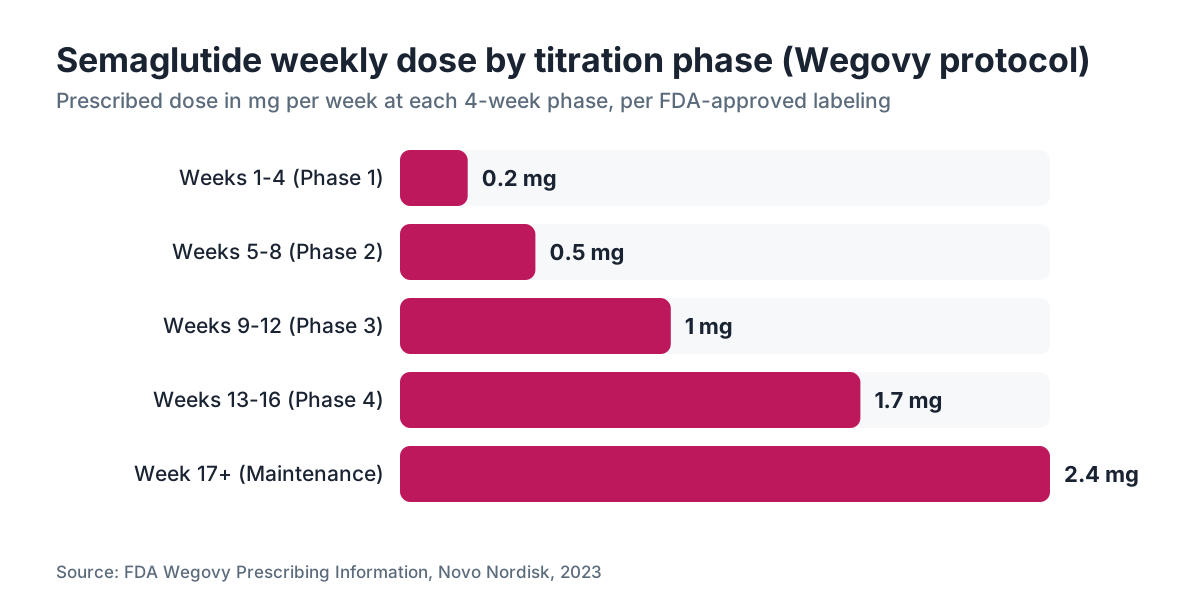
The titration schedule used in the STEP trials started at 0.25 mg once weekly for four weeks, then stepped up every four weeks toward a maintenance dose of 2.4 mg weekly for weight management (Wegovy labeling) [3]. Compounded versions often copy the same ladder.
If your prescribed concentration is not 5 mg/mL, the formula still works. You just swap in your actual number. At 10 mg/mL, a 0.25 mg dose is (0.25/10) x 100 = 2.5 units, a very small volume. At 2.5 mg/mL, the same dose is (0.25/2.5) x 100 = 10 units, which is easier to see on the syringe.
Women managing perimenopause symptoms alongside GLP-1 therapy have an extra reason to nail dose accuracy, because hormonal shifts can change GI motility and lower the nausea threshold. For how GLP-1s interact with perimenopausal physiology, the piece on semaglutide for weight loss covers that connection.
What concentration should you ask your compounding pharmacy for?
If you get to choose, ask for 5 mg/mL. It keeps your injection volumes between 0.05 mL and 0.48 mL across the full titration range, which is comfortable and readable on standard 0.3 mL and 0.5 mL insulin syringes.
There are real reasons a pharmacy might mix differently. Some providers prefer 2 mg/mL for patients who are highly sensitive to dose changes, since larger volumes measure more precisely at low doses. Others use 8 mg/mL or 10 mg/mL to shrink injection volume at higher maintenance doses.
The FDA has not approved any specific concentration for compounded semaglutide, because compounded drugs are not FDA-approved products [1]. Agency guidance says compounders must show the product is not essentially a copy of an approved drug and meets applicable quality standards. What that means for you: your pharmacy's concentration is their clinical call, and your prescriber should confirm it fits your dose range before you mix.
One thing to never do: trying to concentrate the solution after mixing by letting liquid evaporate. The peptide degrades at room temperature, and you cannot reliably raise concentration that way.
How long does reconstituted semaglutide last and how should you store it?
The FDA-approved Wegovy and Ozempic labels say that once the pen is in use, it can be stored at room temperature (up to 77 degrees Fahrenheit, 25 degrees Celsius) or in the refrigerator for up to 56 days [2]. Those are pre-mixed, sealed, device-controlled formulations.
Compounded reconstituted semaglutide is a different animal. The standard guidance from compounding pharmacies is 28 days refrigerated at 36 to 46 degrees Fahrenheit (2 to 8 degrees Celsius). Some pharmacies specify shorter windows. Go by the date you wrote on the vial and discard on day 28 no matter how much is left.
Do not freeze reconstituted semaglutide. Freezing can cause peptide aggregation (clumping) that does not always reverse on thawing, and an aggregated solution can look clear while delivering a fraction of the intended dose.
Unopened powder vials should be refrigerated per your pharmacy's label. Most specify 2 to 8 degrees Celsius. If a vial sat at room temperature during shipping, ask your pharmacy whether it is still within specification.
Light degrades peptides. Keep the vial in its box or wrapped in foil when it is not in use.
What are the most common reconstitution mistakes, and how do you avoid them?
Mistake 1: Confusing the vial concentration with the dose. The vial says '10 mg.' That is the total content, not the dose. Add 2 mL to that 10 mg vial and your concentration is 5 mg/mL, so a 0.25 mg dose is 5 units. Draw 10 units and you have taken 0.5 mg, double the starting dose.
Mistake 2: Using a U-40 syringe instead of a U-100 syringe. U-40 syringes are less common in the US but they exist. A 5-unit mark on a U-40 syringe holds 0.125 mL, not 0.05 mL. Grab the wrong syringe and your math falls apart.
Mistake 3: Adding too much or too little BAW because the measurement looked close enough. A 0.1 mL error on a 1 mL reconstitution shifts your concentration by 10%. Over a 28-day vial, that compounds. Use a syringe, never a dropper or a teaspoon.
Mistake 4: Shaking the vial. Shaking introduces bubbles and shear force that can break the peptide structure. Swirl only.
Mistake 5: Skipping the visual inspection. A cloudy or particle-filled solution is contaminated or degraded. Do not inject it. Contact your pharmacy.
The FDA's 2024 communication flagged dosing errors with compounded GLP-1 products as a serious safety concern, with reports of nausea, vomiting, and hospitalizations tied to ten-fold dosing mistakes [1]. The risk is real. Check your math twice before every draw.
Is compounded semaglutide the same as Ozempic or Wegovy?
No, and the FDA has said so plainly. Compounded semaglutide is not FDA-approved. It is made under section 503A (patient-specific pharmacy compounding) or 503B (outsourcing facilities) of the Federal Food, Drug, and Cosmetic Act [4]. The FDA does not verify the potency, sterility, or stability of compounded products the way it verifies approved drugs.
The agency added semaglutide to its drug shortage list in 2022, which opened a legal window for compounders to make copies. As of early 2025, the FDA was evaluating whether the shortage designation should be lifted, which would remove the legal basis for compounding [8]. That regulatory picture is still moving.
Clinically, compounded semaglutide contains the same active peptide as Ozempic and Wegovy: semaglutide, a GLP-1 receptor agonist that slows gastric emptying, cuts appetite, and improves insulin sensitivity. The STEP 1 trial showed mean weight loss of 14.9% over 68 weeks with 2.4 mg weekly semaglutide versus 2.4% with placebo [3]. Those results came from the branded formulation, not compounded versions.
If you are choosing between molecules, the comparison with tirzepatide is worth reading. See semaglutide vs tirzepatide for the full breakdown.
At WomenRx, clinicians who prescribe compounded semaglutide provide written reconstitution instructions matched to your vial concentration, so you are not left guessing the math. That kind of prescriber support is what you should expect from any telehealth provider running GLP-1 therapy.
How does the semaglutide titration schedule affect how you reconstitute each vial?
Because your dose changes every four weeks, each dose change may pull a different draw volume from the same concentration vial. The concentration stays put. The volume does not.
At 5 mg/mL, a 5 mg vial gives you exactly 20 weekly doses of 0.25 mg, or 10 doses of 0.5 mg. If you titrate up mid-vial, do the math before you start so you know how many doses remain.
The FDA-approved Wegovy titration is 0.25 mg weekly for weeks 1 to 4, then 0.5 mg for weeks 5 to 8, then 1.0 mg for weeks 9 to 12, then 1.7 mg for weeks 13 to 16, then 2.4 mg maintenance [2]. Most compounded prescriptions follow a similar ladder, sometimes slower depending on tolerability.
Planning tip: at 5 mg/mL with a 10 mg vial, you have 40 doses of 0.25 mg or 20 doses of 0.5 mg. Take 0.25 mg for four weeks (4 doses), then step to 0.5 mg, and you have 16 doses of 0.5 mg left before a new vial. Write that out before you reconstitute so nothing surprises you.
Women in perimenopause or early menopause sometimes need the titration to move slower, because estrogen changes can amplify GI side effects. For how hormonal status interacts with GLP-1 tolerability, read about perimenopause alongside your GLP-1 plan.
What does the FDA say about safety risks with compounded semaglutide?
The FDA issued a safety communication in 2024 about compounded GLP-1 receptor agonists, warning of adverse events including nausea, vomiting, headache, and hospitalizations. The agency attributed many events to dosing errors: patients or providers confusing mg with units, using the wrong syringe calibration, or working from a concentration different from what they expected [1].
The agency's statement warns that patients have been "hospitalized, potentially due to a dosing error," a direct quote from the FDA communication cited here [1].
The FDA also cautions that compounded products may contain salt forms of semaglutide (semaglutide sodium or semaglutide acetate) instead of the base semaglutide used in approved products. The clinical equivalence of these salt forms has not been established [10].
Sterility is a separate worry. Compounded injectables carry a contamination risk that factory-sealed pens do not. The 503B outsourcing facility framework provides more oversight than 503A pharmacy compounding. Asking your pharmacy whether they operate under 503A or 503B, and whether they run sterility testing on finished lots, is a fair question.
None of this means compounded semaglutide is inherently unsafe. Millions of prescriptions have been dispensed without incident. It means you source from a reputable pharmacy, confirm your concentration in writing, and check your math every single time.
Can you use a semaglutide reconstitution calculator app or tool?
Several telehealth platforms and independent developers have built web calculators where you enter vial size, BAW volume, and prescribed dose, and the tool spits out how many units to draw. These cut down on arithmetic errors and work fine as a double-check.
The catch is that no calculator replaces your prescriber's written instruction. If the calculator disagrees with your pharmacy label, call before injecting. Do not trust an anonymous online tool over a verified prescription.
When you evaluate a calculator, look for three inputs: total mg in vial, mL of BAW added, and prescribed dose in mg. Those three numbers fully determine the answer. A calculator that skips one of them is making an assumption that may not match your vial.
Some compounding pharmacies include printed dosing cards or QR-code calculators specific to their concentration. That is the most reliable option, because it uses the actual concentration of the vial you received.
For the underlying semaglutide pharmacology and clinical evidence, that reference article covers the mechanism, approved indications, and how the GLP-1 receptor works in women.
Frequently asked questions
How much bacteriostatic water do I add to a 5 mg semaglutide vial?
Add 1.0 mL of bacteriostatic water to a 5 mg vial to get 5 mg/mL. At that concentration, a 0.25 mg starting dose equals 0.05 mL, which is 5 units on a standard U-100 insulin syringe. Confirm with your pharmacy that 5 mg/mL is the intended concentration for your specific vial before mixing.
How do I convert my semaglutide dose in mg to units on an insulin syringe?
Use this formula: Units = (dose in mg divided by concentration in mg/mL) multiplied by 100. At 5 mg/mL, a 0.5 mg dose is (0.5 / 5) x 100 = 10 units. At 10 mg/mL, the same dose is 5 units. Always check which concentration your pharmacy mixed before drawing.
How long does reconstituted compounded semaglutide stay good in the refrigerator?
The standard guidance for reconstituted compounded semaglutide is 28 days refrigerated at 36 to 46 degrees Fahrenheit (2 to 8 degrees Celsius). Write the reconstitution date on the vial label. Discard on day 28 regardless of remaining volume. Do not freeze the reconstituted solution, as freezing can cause peptide aggregation.
What type of water do I use to reconstitute semaglutide?
Use bacteriostatic water for injection (0.9% benzyl alcohol). Do not use plain sterile water, tap water, or saline. Bacteriostatic water contains benzyl alcohol as a preservative that inhibits microbial growth in the opened vial over the 28-day use period. Sterile water without preservative would force you to use the vial within hours of mixing.
What does a 5 mg/mL semaglutide concentration mean for my dosing?
It means every 1 mL of solution contains 5 mg of semaglutide. To take 0.25 mg, you draw 0.05 mL (5 units on a U-100 syringe). To take 1.0 mg, you draw 0.2 mL (20 units). The concentration is set by how much bacteriostatic water was added to the powder vial and should appear on your pharmacy label.
Can I shake a semaglutide vial to dissolve the powder faster?
No. Shaking introduces shear force and air bubbles that can damage the peptide structure. Swirl the vial gently for 15 to 20 seconds after adding bacteriostatic water, let it rest for 2 to 3 minutes, then swirl again. The solution should turn clear. If it stays cloudy or has particles, do not inject it and contact your pharmacy.
Is compounded semaglutide powder the same as Ozempic or Wegovy?
The active peptide is the same molecule, semaglutide. But compounded versions are not FDA-approved. The FDA does not verify their potency, sterility, or stability the way it verifies branded products. Some compounded versions use salt forms (semaglutide sodium or acetate) whose clinical equivalence to the base semaglutide in Ozempic and Wegovy has not been established.
What are the most dangerous semaglutide reconstitution errors?
The most dangerous error is a ten-fold overdose from confusing the vial's total mg content with the dose, or using the wrong syringe calibration. The FDA has documented hospitalizations from this mistake. Other serious errors include using the wrong concentration, using sterile water instead of bacteriostatic water, and injecting a cloudy or contaminated solution. Confirm concentration and re-check your unit math before every injection.
Do I need a new reconstitution calculation every time I titrate my dose up?
No, the concentration stays the same once you've mixed the vial. But your draw volume changes. If you've been drawing 5 units for 0.25 mg at 5 mg/mL and your prescriber increases your dose to 0.5 mg, you now draw 10 units from the same vial. Recalculate your units every time your prescribed dose changes, even though the concentration hasn't.
What syringe size should I use to inject compounded semaglutide?
A 0.3 mL or 0.5 mL U-100 insulin syringe with a 28 to 31 gauge needle works for most doses up through 1.0 mg at 5 mg/mL. For doses above 1.0 mg, a 1.0 mL U-100 insulin syringe gives you enough capacity. Use the shortest needle you can (6 to 8 mm) for subcutaneous injection into abdomen, thigh, or upper arm.
How do I know if my semaglutide solution has gone bad?
A good reconstituted semaglutide solution is clear, colorless, and free of particles. Discard the vial if you see cloudiness, any color tint (yellow or brown), visible particles or flakes, or if it has been more than 28 days since reconstitution. Also discard if the vial sat out of refrigeration for more than a few hours or accidentally froze.
Can semaglutide be compounded with other peptides or vitamins in the same vial?
Some pharmacies offer combination vials, for example semaglutide with B12. Whether this is appropriate depends on chemical compatibility and your prescriber's clinical decision. The FDA has not evaluated such combinations. If you receive a combination vial, the reconstitution instructions from your specific pharmacy apply. Do not mix vials from different sources on your own.
Does my dose calculation change if I use a U-40 syringe instead of a U-100 syringe?
Yes, significantly. A U-40 syringe has 40 units per mL instead of 100 units per mL. Using U-40 unit markings with U-100 math will cause you to draw 2.5 times the intended volume. U-100 syringes are standard in the US for insulin and are what compounding pharmacies assume you are using. Confirm your syringe calibration before every reconstitution.
Should women in perimenopause start at a lower semaglutide dose?
The FDA-approved starting dose for both Ozempic and Wegovy is 0.25 mg weekly regardless of menopausal status, and most compounded prescriptions follow the same starting point. Perimenopausal women may have heightened GI sensitivity from fluctuating estrogen, so some clinicians extend the time at each dose step rather than lowering the starting dose. Discuss your hormonal status with your prescriber before starting.
Sources
- FDA, 'Medications containing semaglutide marketed for type 2 diabetes or weight loss' safety communication (2024)
- FDA, Wegovy (semaglutide) Prescribing Information, Novo Nordisk (2023)
- Wilding JPH et al., 'Once-weekly semaglutide in adults with overweight or obesity' (STEP 1), NEJM 2021;384:989-1002
- US FDA, 'Compounding and the FDA: questions and answers' (503A, 503B framework)
- FDA, Ozempic (semaglutide) Prescribing Information, Novo Nordisk (2023)
- US Pharmacopeia, USP <797> Pharmaceutical Compounding Sterile Preparations
- Endocrine Society Clinical Practice Guideline, 'Pharmacological management of obesity'
- FDA, Drug Shortages Database, semaglutide entry
- Davies M et al., 'Semaglutide 2.4 mg once a week in adults with overweight or obesity, and type 2 diabetes (STEP 2)', Lancet 2021;397:971-984
- FDA, 'FDA alerts health care providers, compounders, and patients about the risks of compounded semaglutide products' (2023)