Semaglutide dose for weight loss: the complete guide
TL;DR: Wegovy starts at 0.25 mg weekly and climbs over 16 weeks to the approved maintenance dose of 2.4 mg weekly. In the STEP 1 trial, that dose produced 14.9% average body weight loss over 68 weeks. The slow escalation exists to blunt nausea, not to drive weight loss. The 0.25 mg and 0.5 mg steps are ramp-up doses only.
What is the approved semaglutide dose for weight loss?
The FDA approved semaglutide 2.4 mg once weekly, sold as Wegovy, for chronic weight management in June 2021 [1]. That 2.4 mg dose is the only FDA-approved maintenance dose for weight loss in adults. Ozempic, a separate product (semaglutide 0.5 mg, 1 mg, and 2 mg), is approved for type 2 diabetes, not weight loss, though physicians do prescribe it off-label.
The labeled indication for Wegovy is adults with a BMI of 30 or higher, or a BMI of 27 or higher plus at least one weight-related condition such as high blood pressure, type 2 diabetes, or high cholesterol [1]. In March 2024 the FDA also cleared Wegovy to reduce the risk of cardiovascular events in adults with obesity or overweight and established heart disease, based on the SELECT trial.
The 2.4 mg dose matters because that is where the real weight loss showed up. Lower doses during escalation do trim some weight, but the phase 3 STEP trials were built around 2.4 mg as the target. If you read somewhere that 1 mg is a "therapeutic dose" for weight loss, that number comes from diabetes data, not from dedicated weight-loss trials.
What is the semaglutide starting dose for weight loss?
You start at 0.25 mg once weekly for the first four weeks. That dose does almost nothing for weight loss by itself. Its job is to let your gut adjust so that by the time you reach therapeutic doses, nausea and vomiting are manageable.
Here is the FDA-approved escalation schedule from the Wegovy prescribing information [1]:
| Week | Dose | |------|------| | 1-4 | 0.25 mg once weekly | | 5-8 | 0.5 mg once weekly | | 9-12 | 1.0 mg once weekly | | 13-16 | 1.7 mg once weekly | | 17+ | 2.4 mg once weekly (maintenance) |
So you are not at the full dose until week 17. Some people tolerate the ramp well and feel impatient. Others need to slow it down when side effects at a given step get rough. The label allows staying at a lower dose longer before stepping up.
One detail worth knowing. If you cannot tolerate 2.4 mg after at least four weeks at that level, the label lets you drop back to 1.7 mg. A small group of people settle in at 1.7 mg for the long haul, and there is meaningful weight loss at that dose too, just somewhat less than 2.4 mg on average.
What is the maximum dose of semaglutide for weight loss?
The maximum approved dose of semaglutide for weight loss is 2.4 mg once weekly [1]. There is no approved dose above that, and going higher sits outside the labeling.
This question comes up because compounded semaglutide, which flooded the market during the Wegovy shortage, was sometimes dosed differently by prescribers, occasionally above 2.4 mg. That practice is off-label. Nobody has good phase 3 data on semaglutide doses above 2.4 mg for weight loss in humans. The closest analogy is tirzepatide, which goes up to 15 mg, but that is a different drug with a different mechanism.
For Ozempic used off-label for weight loss, the maximum approved diabetes dose is 2 mg weekly. Some prescribers reached for that 2 mg dose during the Wegovy shortage, but it still sits below the Wegovy 2.4 mg target. Learn more about compounded semaglutide if that option is on your radar, because the rules there shifted hard in 2025.
How much weight can you actually lose on semaglutide 2.4 mg?
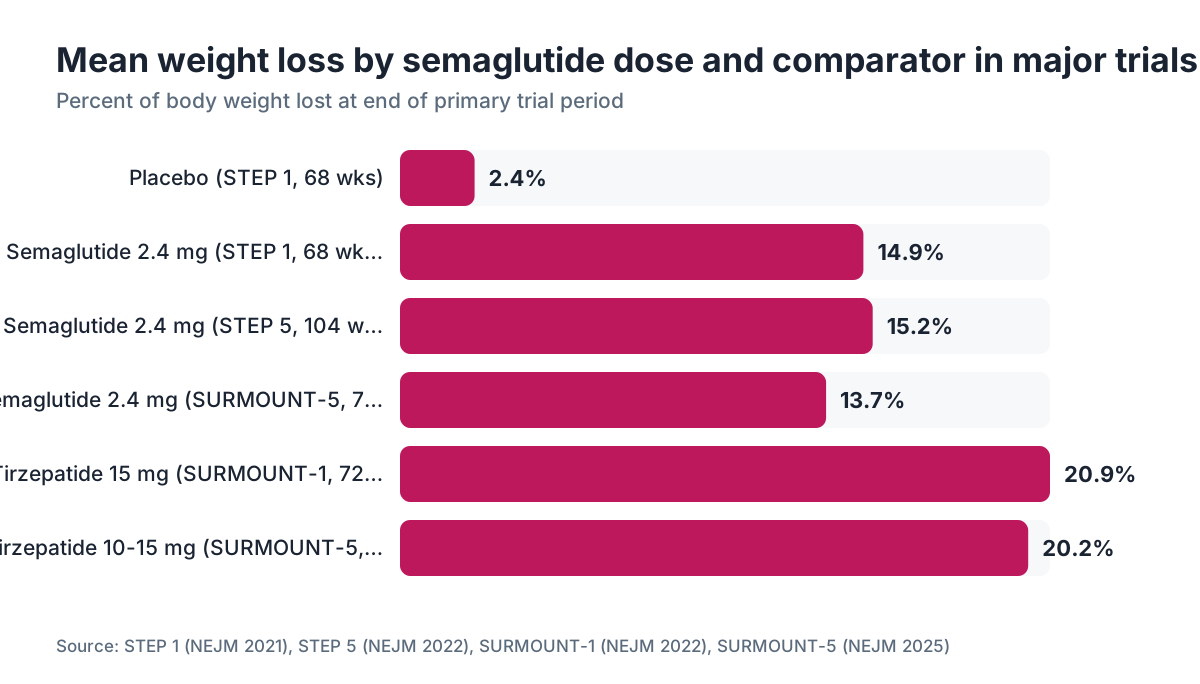
The STEP trials (Semaglutide Treatment Effect in People with Obesity) are the evidence base here. STEP 1, published in the New England Journal of Medicine in 2021, enrolled 1,961 adults without type 2 diabetes. At 68 weeks, participants on 2.4 mg semaglutide lost an average of 14.9% of body weight versus 2.4% for placebo [2].
STEP 4 showed what happens when you quit. Participants who had lost weight on semaglutide were randomized to continue or switch to placebo. Those who kept going lost another 7.9% of body weight. Those who switched to placebo regained about two-thirds of their prior weight loss within a year [2]. That is the clearest signal that semaglutide is a long-term medication for a chronic condition, not a short course.
There is no large trial that breaks results out by menopausal status, which is a real gap. STEP 5 ran for 104 weeks and showed 15.2% mean weight loss, so the effect holds past the initial 68-week window [8]. Individual results scatter widely. About a third of STEP 1 participants lost 20% or more of body weight, and about 13% lost less than 5%. "Average" hides a lot.
Age and menopausal status shape results in practice even when trials do not measure it cleanly. Women in perimenopause and menopause often find weight harder to shed because of falling estrogen and the metabolic changes that ride along with it. If that is you, reading about hormone replacement therapy alongside GLP-1 therapy is worth your time, because the two are not mutually exclusive.
Tirzepatide vs semaglutide for weight loss: which dose wins?
This is the most-asked comparison right now, and the honest answer is that tirzepatide (Zepbound, Mounjaro) produces greater average weight loss than semaglutide at their respective approved doses.
SURMOUNT-1 showed 20.9% mean weight loss on tirzepatide 15 mg over 72 weeks, against 14.9% for semaglutide 2.4 mg at 68 weeks in STEP 1 [3]. Those trials were not head-to-head, so it is an indirect comparison. Different enrollment criteria, different lengths, different populations.
SURMOUNT-5 ran the direct comparison in adults with obesity without diabetes. Results published in 2025 showed tirzepatide 10 mg or 15 mg produced 20.2% weight loss versus 13.7% for semaglutide 2.4 mg at 72 weeks, roughly 47% more weight loss with tirzepatide [4]. That difference is real and clinically meaningful.
Why does tirzepatide do more? It hits two receptors, GIP and GLP-1. Semaglutide hits GLP-1 only. GIP activation appears to add metabolic effect on top of GLP-1. See the full breakdown in semaglutide vs tirzepatide.
| Drug | Class | Max approved dose (weight loss) | Mean weight loss (primary trial) | |------|-------|----------------------------------|----------------------------------| | Semaglutide (Wegovy) | GLP-1 agonist | 2.4 mg weekly | 14.9% (STEP 1, 68 wks) [2] | | Tirzepatide (Zepbound) | GIP/GLP-1 dual agonist | 15 mg weekly | 20.9% (SURMOUNT-1, 72 wks) [3] |
For women who have not done well on semaglutide, or who want more, the tirzepatide data is hard to argue with. Side effect profiles look similar (mostly GI: nausea, vomiting, diarrhea, constipation), though some women tolerate one better than the other and there is no reliable way to predict which way that breaks for any individual.
Does the dose need to be different for women than for men?
The FDA-approved dosing is the same regardless of sex. There is no sex-stratified dosing in the Wegovy label [1]. Body weight, body composition, kidney function, and hormonal status all shape drug response, and women on average carry more body fat and less lean mass than men at the same BMI, which changes how GLP-1 agonists behave.
The STEP trials enrolled roughly 75% women, so the primary efficacy data is not male-dominated. Women in STEP 1 lost about 15.8% of body weight versus roughly 13.4% for men, a hint that women may hold a slight edge on average, though this was not the primary analysis and the confidence intervals overlapped a lot.
Menopause matters here in a concrete way. Falling estrogen pushes fat toward the abdomen, raises insulin resistance, and slows resting metabolic rate. None of that makes semaglutide useless, but it does mean you should calibrate expectations. Women also using hormone replacement therapy may find the combination helps with the metabolic resistance that comes with low estrogen, though no large randomized trial has studied HRT plus GLP-1 in perimenopausal women.
WomenRx is one of the telehealth providers working specifically at this intersection of hormones and GLP-1 therapy in women, which matters if you want a clinician who already understands both sides of the conversation.
What happens if you miss a dose or need to restart?
Missing a single dose is common. The prescribing information is specific: if you miss a dose and your next scheduled dose is more than two days away, take the missed dose as soon as you can. If the next dose is less than two days away, skip the missed one and resume your schedule [1]. Never take two doses in the same week.
Restarting after a gap takes more thought. If you have been off semaglutide for more than about four weeks, most prescribers restart the escalation from 0.25 mg rather than jump back to where you left off. The GI side effects tend to come roaring back if you skip the ramp after a long break.
Shortages forced many people into breaks they did not choose. The STEP 4 finding is sobering here: weight regain after stopping is real and fast. If you had to stop for shortage or cost and are restarting, plan for the full 16-week escalation before you are back at your therapeutic dose.
Does dose affect side effects, and how do women manage them?
Yes. Dose tracks directly with side effect intensity. The common side effects, nausea, vomiting, diarrhea, and constipation, show up more often and hit harder at higher doses. That is exactly why the slow escalation exists [1].
In STEP 1, 44% of participants on semaglutide reported nausea versus 16% on placebo. Vomiting hit 24% versus 6%. Most GI side effects were mild to moderate and peaked early in escalation before easing.
For women, a few patterns show up in practice. Nausea is often worst in the first few days after each injection. Dosing at bedtime instead of morning can cut waking-hour nausea for some people. Smaller, lower-fat meals help. Ginger tea has no trial behind it but it is harmless, and plenty of women swear by it.
Two side effects get less attention: hair thinning (telogen effluvium from rapid caloric restriction rather than a direct drug effect) and muscle loss. Losing weight fast on any method, semaglutide included, can pull about 25-40% of that loss from lean mass rather than fat. Protein intake in the range of 1.2-1.6 g per kg of body weight per day during weight loss, plus resistance training, helps hold onto muscle [9]. This matters more as women age, especially around menopause, when muscle is already slipping.
Pancreatitis and thyroid tumors sit in the FDA boxed warning [1]. These are rare but real. Women with a personal or family history of medullary thyroid carcinoma or MEN2 syndrome should not use semaglutide.
How does compounded semaglutide dosing differ from brand-name Wegovy?
Compounded semaglutide was widely available during the Wegovy shortage that ran from roughly 2022 to 2025, while the FDA listed Wegovy as in shortage. Compounders used semaglutide base (not the same as the branded salt form) and their own dosing protocols.
Dosing varied a lot. Some compounders followed the same 0.25 / 0.5 / 1.0 / 1.7 / 2.4 mg schedule as Wegovy. Others used different titrations, and some offered doses above 2.4 mg. No federal body approved a standardized compounded protocol, and potency can differ between compounders.
The FDA declared the semaglutide shortage resolved in early 2025, which triggered enforcement against compounders. By mid-2025 the agency had told most 503A and 503B compounders to stop making copies of semaglutide for non-personalized use. The situation kept moving through 2026. If you were on compounded semaglutide and want to move to Wegovy or another option, the dosing conversation has to happen with your prescriber directly, because there is no standard conversion. Read the full picture at compounded semaglutide.
What does semaglutide cost at different doses, and does dose affect your out-of-pocket?
Wegovy's list price is about $1,349 per month regardless of dose, because the auto-injector pens sell as a fixed package [6]. You do not pay less at 0.25 mg than at 2.4 mg, since each dose tier comes in its own pen. Cash price stays flat throughout escalation.
Insurance coverage swings wildly. Medicare Part D is barred from covering drugs used only for weight loss under the statute, though the Treat and Reduce Obesity Act has been introduced in Congress repeatedly to change that [7]. Some Medicare Advantage plans now cover Wegovy for the cardiovascular indication after that use was approved. Commercial coverage rose after the heart approval, but it still comes down to your employer plan.
Novo Nordisk's Wegovy savings card can drop out-of-pocket to roughly $0-25 a month for eligible commercially insured patients. Cash-pay patients with no coverage face the full list price. Some people use GoodRx or similar tools for off-label Ozempic (sometimes cheaper on certain plans), though pharmacy availability comes and goes.
Tirzepatide (Zepbound) has a similar list range, roughly $1,060-$1,350 a month, and Eli Lilly sells single-dose vials at lower self-pay price points through LillyDirect, a real access improvement that landed in 2024.
When should you talk to a doctor about adjusting your semaglutide dose?
A few situations genuinely call for a dose conversation rather than waiting it out.
First, a plateau before you reach 2.4 mg. Some prescribers slow the ramp when weight loss is good and side effects bite. But if you have been at 1.7 mg for 12 or more weeks and the scale has stalled, pushing to 2.4 mg is worth raising.
Second, side effects at any step severe enough to hit daily function. Persistent vomiting, dehydration, or an inability to eat are reasons to pause the ramp, not power through. Pancreatitis is rare but real. Severe abdominal pain radiating to the back means stop and call your provider now.
Third, less than 5% weight loss after 16 to 20 weeks at 2.4 mg. The label gives no firm discontinuation threshold, but losing under 5% after months at full dose usually signals that semaglutide may not be the right tool, or that other factors (diet, sleep, thyroid, other medications) need attention first. Switching to tirzepatide is a reasonable conversation at that point.
For women in perimenopause or menopause, hormonal factors can genuinely dampen drug response. If you have not had a workup covering thyroid function, estrogen levels, and sleep quality, fill those gaps before you conclude that semaglutide just does not work for you. WomenRx providers look at the whole hormonal picture when women are not getting the response they expected from GLP-1 therapy.
How long do you stay on semaglutide, and does your dose change over time?
The FDA-approved indication is chronic weight management, which means regulators and the trial data both treat this as a long-term medication [1]. There is no approved off-ramp or planned discontinuation built into the label.
In practice, most people who respond well stay on the 2.4 mg maintenance dose indefinitely unless a side effect, cost, shortage, or health change forces a stop. The STEP 4 weight-regain data makes the case for staying on it plainly [2].
Some patients and prescribers try dropping from 2.4 mg to 1.7 mg after big weight loss and stable weight, to see whether the loss holds. No controlled trial has tested that approach. The answer likely varies by individual metabolism and deserves close weight tracking if you go there.
For women who started semaglutide because of menopausal weight gain and later begin HRT, the metabolic and appetite effects of estrogen (which tends to reduce visceral fat accumulation) may stack with GLP-1 therapy. Whether that allows a lower dose is an honest "we do not have the data" situation. It is plausible clinically. The evidence is not there yet.
Frequently asked questions
What is the starting dose of semaglutide for weight loss?
The starting dose is 0.25 mg once weekly for the first four weeks. It is not meant to produce weight loss. It is a ramp-up dose to blunt GI side effects like nausea and vomiting before you climb to therapeutic doses. You move to 0.5 mg at week five and keep escalating every four weeks until you hit the 2.4 mg maintenance dose at week 17.
What is the maximum dose of semaglutide approved for weight loss?
The FDA-approved maximum for weight loss is 2.4 mg once weekly (Wegovy). That is higher than the diabetes maximum (Ozempic tops out at 2 mg). Going above 2.4 mg sits outside the approved labeling and has not been studied in large phase 3 weight-loss trials.
How long does the semaglutide dose escalation take?
The full climb from 0.25 mg to the 2.4 mg maintenance dose takes 16 weeks across four steps. You spend four weeks at each level: 0.25 mg, 0.5 mg, 1.0 mg, 1.7 mg, then 2.4 mg. If side effects are severe at any step, your prescriber can hold you there longer before moving up.
Can you lose weight on the lower semaglutide doses before reaching 2.4 mg?
Yes, many people lose some weight during escalation, especially at 1.0 mg and 1.7 mg. The STEP trials found real effects at lower doses too. But the primary efficacy evidence and the FDA-approved weight-loss dose is 2.4 mg. The escalation doses are not treated as therapeutic targets for weight loss in the labeling.
Is tirzepatide or semaglutide better for weight loss?
Head-to-head data from SURMOUNT-5 (2025) shows tirzepatide produces about 47% more weight loss than semaglutide: 20.2% mean body weight loss versus 13.7% at 72 weeks. Tirzepatide works on two receptors (GIP and GLP-1) versus semaglutide's one. Side effect profiles are similar. Tirzepatide is generally preferred when someone needs more weight loss, though coverage and access vary.
What happens if you can't tolerate the 2.4 mg dose of semaglutide?
The Wegovy label lets you drop back to 1.7 mg if 2.4 mg is intolerable. A meaningful number of trial patients stayed on 1.7 mg. Weight loss at 1.7 mg runs somewhat lower than 2.4 mg on average, but it is not zero. Your prescriber can also slow the escalation if nausea or vomiting is severe at any step.
Does semaglutide dose need to be adjusted for menopausal women?
The FDA-approved dosing is the same regardless of menopausal status. There is no label-based adjustment. In practice, some menopausal women find weight loss harder even at full dose because of the metabolic changes driven by low estrogen, including higher insulin resistance and shifting fat distribution. That is a reason to address hormonal factors alongside GLP-1 therapy, not to push semaglutide above the approved dose.
What if I miss a semaglutide injection?
If your next scheduled dose is more than two days away, take the missed dose as soon as you remember. If your next dose is within two days, skip the missed one and stay on schedule. Never take two doses in the same week. If you have been off semaglutide for more than four weeks, most prescribers restart escalation from 0.25 mg rather than jump to your previous dose.
Is 0.5 mg or 1 mg semaglutide enough for weight loss?
Those doses produce some weight loss but count as transitional ramp-up steps, not maintenance targets for weight loss in the Wegovy approval. The 1 mg dose is a diabetes dose for Ozempic (now up to 2 mg), and some prescribers use it off-label for weight loss. But the STEP trials targeted 2.4 mg, and that is where the 14.9% average weight loss was reached.
How does compounded semaglutide dosing compare to Wegovy?
Compounders used various titration schedules and some went above the 2.4 mg Wegovy maximum. There is no standardized compounded protocol. Potency also varies between compounders since they use semaglutide base rather than the branded salt. The FDA moved to restrict compounded semaglutide in 2025 after declaring the shortage resolved. If you are moving from compounded to branded, work out dosing with your prescriber directly.
Do men and women lose different amounts of weight on the same semaglutide dose?
In STEP 1, women lost slightly more than men on average (about 15.8% versus 13.4%), though that was not the primary analysis and the ranges overlapped widely. The approved dose is the same for everyone. Individual variation dwarfs any average sex difference, and starting weight, diet, activity, sleep, and hormonal status all shape results.
Can semaglutide dose be reduced once you've reached your weight loss goal?
There is no approved dose-reduction protocol in the Wegovy label. The indication is chronic weight management, which implies long-term use. Some clinicians try dropping from 2.4 mg to 1.7 mg after weight stabilizes to find the minimum effective dose for a given patient. STEP 4 data makes clear that stopping entirely usually brings significant weight regain within one year.
How much does semaglutide cost per dose?
Wegovy's list price is about $1,349 per month regardless of dose tier, since each escalation step comes in its own pen. Novo Nordisk's savings card can cut cost to near zero for eligible commercially insured patients. Medicare cannot cover Wegovy for weight loss under current law. Cash-pay patients face the full list price unless they use discount programs.
What are the warning signs that you need to stop semaglutide regardless of dose?
Stop and seek care immediately for severe abdominal pain radiating to the back (possible pancreatitis), a lump or swelling in your neck (possible thyroid tumor), or signs of an allergic reaction. The FDA boxed warning flags medullary thyroid carcinoma risk specifically. Persistent vomiting that stops you drinking fluids is also a reason to contact your provider before continuing.
Sources
- FDA, Wegovy (semaglutide) Prescribing Information
- Wilding JPH et al., New England Journal of Medicine, 2021 (STEP 1 trial)
- Jastreboff AM et al., New England Journal of Medicine, 2022 (SURMOUNT-1 trial)
- Aronne LJ et al., New England Journal of Medicine, 2025 (SURMOUNT-5 trial)
- Novo Nordisk, Wegovy list price information (NovoCare)
- Consolidated Appropriations Act 2021 and Treat and Reduce Obesity Act (Medicare exclusion for weight-loss drugs)
- Garvey WT et al., New England Journal of Medicine, 2022 (STEP 5 trial)
- Endocrine Society, Clinical Practice Guidelines