Semaglutide and cyanocobalamin: why B12 matters on GLP-1 therapy
TL;DR: Semaglutide cuts food intake enough to slowly drain your vitamin B12 (cyanocobalamin) over months. Some compounded semaglutide adds cyanocobalamin right into the vial, but the FDA flagged that as untested and potentially unsafe. Women on semaglutide should check B12 every 6 to 12 months and supplement orally if levels drop below 300 pg/mL.
What is the connection between semaglutide and cyanocobalamin?
Semaglutide is a GLP-1 receptor agonist approved for type 2 diabetes (Ozempic) and chronic weight management (Wegovy). It slows gastric emptying and cuts appetite so hard that many women on therapeutic doses eat 30 to 40% fewer calories than before [1]. Cyanocobalamin is the synthetic, shelf-stable form of vitamin B12, found in fortified foods, most oral supplements, and nearly every injectable B12 product.
The link is simple. Eat much less, absorb much less B12. B12 lives almost entirely in animal products, and your body pulls it out of food using a stomach protein called intrinsic factor. Anything that shrinks food volume or drops gastric acid can break that step. Deficiency builds slowly because the liver holds 2 to 5 years' worth, so most women on semaglutide feel fine for a year or more. That's the exact window when a quiet deficiency starts doing neurological damage [2].
There's a second, more direct pathway. Some compounding pharmacies now add cyanocobalamin straight into semaglutide vials and sell the mix as a way to head off deficiency. The FDA put out a safety alert in 2024 about this, and the reasoning is worth reading. Combining two drugs in one vial raises stability and sterility questions nobody has answered. No semaglutide-cyanocobalamin combination is FDA-approved in any form [3].
Does semaglutide actually cause B12 deficiency?
Long-term B12 data from the STEP trials is thin, because those trials weren't built to track micronutrients over time. The indirect evidence is strong though. STEP 1, published in the New England Journal of Medicine in 2021, showed participants on 2.4 mg semaglutide lost an average of 14.9% of body weight over 68 weeks [4]. That much caloric restriction, held for over a year, is a known B12-depletion risk in the bariatric surgery literature.
A 2022 analysis in Obesity Reviews on micronutrient deficiencies after GLP-1-driven weight loss found B12 deficiency rates climbed sharply in people eating fewer than 1,200 calories per day for long stretches. Semaglutide routinely pushes intake below that line in its most effective users [5].
GLP-1 receptors also sit on gastric parietal cells, the cells that make intrinsic factor. Animal studies hint that GLP-1 agonism may slightly reduce intrinsic factor output, though human data is scarce. Nobody has good controlled data on this yet. The concern is mechanistically plausible, not proven.
Here's the honest read: B12 deficiency is a real, underappreciated risk on long-term semaglutide, and it hits hardest in women over 50, who already start with lower intrinsic factor output.
What are the symptoms of B12 deficiency women on semaglutide should watch for?
The trap is that early B12 deficiency looks a lot like ordinary semaglutide side effects and perimenopause. Fatigue, brain fog, mood swings, and tingling in the hands and feet all have multiple causes in a woman in her 40s or 50s.
Classic B12 deficiency symptoms include:
- Numbness or tingling in hands and feet (peripheral neuropathy)
- Memory problems and slowed thinking
- Fatigue that sleep doesn't fix
- Glossitis (smooth, painful tongue)
- Megaloblastic anemia (large, immature red blood cells)
- Depression or irritability
- Balance problems in severe cases
The neurological symptoms are the dangerous ones, because they can turn permanent if deficiency runs long enough. Anemia shows up more readily on routine bloodwork, but nerve damage can arrive before anemia does. A normal CBC does not rule out a problem [12].
Perimenopause and menopause stack the risk higher. Estrogen decline affects gastric acid production over time, and plenty of women this age already take proton pump inhibitors for reflux, which cut B12 absorption further. If you're on semaglutide and a PPI at the same time, B12 monitoring isn't optional. For more on how hormonal shifts change nutrient absorption, see our overview of perimenopause age.
What B12 level is considered deficient, and what should women on semaglutide aim for?
Reference ranges vary by lab, but the standard US deficiency cutoff is a serum B12 below 200 pg/mL. Most endocrinologists and functional medicine practitioners treating GLP-1 patients now use a stricter bar: below 300 pg/mL calls for action, and optimal sits around 400 to 800 pg/mL [2].
For women on semaglutide, aim to hold above 400 pg/mL on repeat testing. A single low reading needs context, because serum B12 bounces around and a recent B12-rich meal or supplement can push a result artificially high. If serum B12 is borderline, add methylmalonic acid (MMA) and homocysteine. Elevated MMA is the most sensitive functional marker of true B12 shortage at the tissue level.
Timing matters. Test before you start semaglutide for a baseline, then recheck at 6 and 12 months. If you eat well and supplement, once a year is probably enough. If your intake is very restricted or you're postmenopausal, every 6 months is smarter.
| Serum B12 Level (pg/mL) | Interpretation | Action | |---|---|---| | Below 200 | Deficient | Treat, investigate cause | | 200-299 | Low-normal (functional deficiency possible) | Supplement, recheck in 3 months | | 300-399 | Borderline | Supplement orally, monitor | | 400-800 | Optimal | Maintain diet/supplement | | Above 800 | High-normal | Usually fine; check if supplement dose is excessive |
Is the cyanocobalamin added to compounded semaglutide vials safe?
Slow down and read this part carefully. The FDA issued a statement in October 2024 warning consumers and providers about compounded semaglutide products that carry added ingredients missing from FDA-approved versions, including cyanocobalamin (B12), niacinamide, and others [3]. The agency's worry isn't that cyanocobalamin is dangerous by itself. It's that adding it to a vial of semaglutide creates a combination nobody has tested for:
- Chemical stability (does cyanocobalamin degrade semaglutide over time?)
- Sterility under real-world storage
- Interaction at the injection site
- Accurate dosing of both compounds
The FDA's language was blunt: compounded drugs "are not FDA-approved" and "do not have the same safety, effectiveness, and quality assurances as FDA-approved drugs" [3]. That doesn't automatically make the combination harmful. It means no one has done the work to prove it's safe or effective.
If you're weighing compounded semaglutide, the safer play is a compounded product that holds only semaglutide, plus cyanocobalamin taken separately as an oral or sublingual supplement. That way each compound is dosed on its own, stored on its own, and studied on its own. Mixing them in one syringe solves a real problem (B12 depletion) with a solution nobody has validated.
What form of B12 supplement is best: cyanocobalamin, methylcobalamin, or something else?
Cyanocobalamin is the cheapest, most shelf-stable, and most studied form of B12. It's what's in most multivitamins and nearly all injectable B12. Your body converts it into the active forms (methylcobalamin and adenosylcobalamin) before use. For most people that conversion runs fine.
Methylcobalamin arrives already active and skips a metabolic step. It's preferred for people with MTHFR gene variants, certain neurological conditions, or anyone who wants to skip the cyanide moiety in cyanocobalamin. The amount of cyanide released is tiny and not clinically significant in healthy people, but the preference is reasonable.
Hydroxocobalamin is the form used in intramuscular injections for severe deficiency, because it lingers in the body longer than cyanocobalamin injections.
For oral supplementation in a woman on semaglutide with no diagnosed absorption problem:
- 1,000 mcg per day of either cyanocobalamin or methylcobalamin orally is a standard replacement dose
- Sublingual tablets absorb somewhat better than swallowed ones, because they partly bypass intrinsic factor
- If absorption is truly broken (elevated MMA despite oral dosing), monthly intramuscular B12 injections of 1,000 mcg are the fix
The RDA for B12 in women is 2.4 mcg per day. That sounds tiny, and it is. The reason 1,000 mcg supplements still work even with poor absorption is that roughly 1% of any dose slips in passively through the gut lining without intrinsic factor [2]. High oral doses ride that passive pathway.
How does semaglutide-related B12 depletion compare to metformin-related B12 depletion?
Worth spelling out, because a lot of women with type 2 diabetes or insulin resistance take semaglutide and metformin together. Metformin is one of the best-documented B12 thieves of any drug. It blocks ileal absorption of the B12-intrinsic factor complex, and deficiency rates of 5 to 30% show up depending on the study population and how long people have been on it [6].
The American Diabetes Association's Standards of Care put it plainly: "Vitamin B12 deficiency should be considered in patients treated with metformin," with a recommendation for periodic B12 measurement in these patients [7]. That's explicit clinical guidance. For semaglutide alone, the major society documents don't offer the same explicit language yet, though the mechanistic case is strong.
On both drugs, the risk adds up. Metformin depletes B12 through ileal absorption blockade. Semaglutide depletes it through reduced intake and possibly reduced intrinsic factor. Women on both should test B12 at least once a year, more often if intake is severely cut. For how semaglutide for weight loss fits the wider clinical picture, that article covers dosing and monitoring in detail.
Do women in menopause or perimenopause have higher B12 depletion risk on semaglutide?
Yes, and the risks pile on top of each other. Women in perimenopause and menopause face several converging factors:
- Gastric acid production drops with age, cutting B12 absorption from food.
- Estrogen decline may affect gastric motility and mucosal health, though direct evidence on intrinsic factor secretion is limited.
- Atrophic gastritis, which destroys parietal cells, gets more common after 50 and is often silent.
- PPI use for reflux (itself more common after menopause) suppresses acid and B12 absorption further.
- Semaglutide then adds a fifth layer by cutting food intake substantially.
Estrogen itself may offer a modest protective effect on gastric mucosal health, so women not on hormone replacement therapy may have somewhat worse gastric function than those who are. The evidence is indirect. Still, it's one more reason the conversation about hormone replacement therapy and metabolic health belongs in the same room.
Picture a postmenopausal woman starting semaglutide who has been on a PPI for five years and eats mostly plants. She's genuinely high-risk for B12 deficiency. She should test before starting, supplement from day one, and recheck at six months. The symptom overlap with menopause makes bedside detection unreliable without labs. Our article on menopause covers more on how hormonal change creates nutritional vulnerabilities.
What does current clinical practice look like for B12 monitoring on semaglutide?
Honest answer: it's all over the map. There's no FDA label requirement to monitor B12 on Wegovy or Ozempic. The prescribing information for both doesn't mention B12 [1]. Most primary care prescribers run whatever their standard metabolic panel covers, which usually skips B12 unless someone orders it.
Endocrinologists who focus on obesity medicine tend to be more proactive. The Obesity Medicine Association and the American Society for Metabolic and Bariatric Surgery have recommended B12 monitoring for patients on medically supervised very-low-calorie programs, though those guidelines predate the GLP-1 era and haven't been formally updated for semaglutide [8].
In practice, the most rigorous providers order:
- Baseline metabolic panel plus B12, folate, iron studies, and 25-OH vitamin D before starting semaglutide
- Recheck at 6 and 12 months
- Supplemental B12 (1,000 mcg oral daily) empirically for anyone below 400 pg/mL or eating fewer than 1,000 calories per day consistently
WomenRx follows this framework for women in its GLP-1 programs, treating B12 as part of routine nutritional oversight rather than an afterthought. If your semaglutide provider has never mentioned B12, raise it at your next visit.
Are there foods that can help maintain B12 levels while on semaglutide?
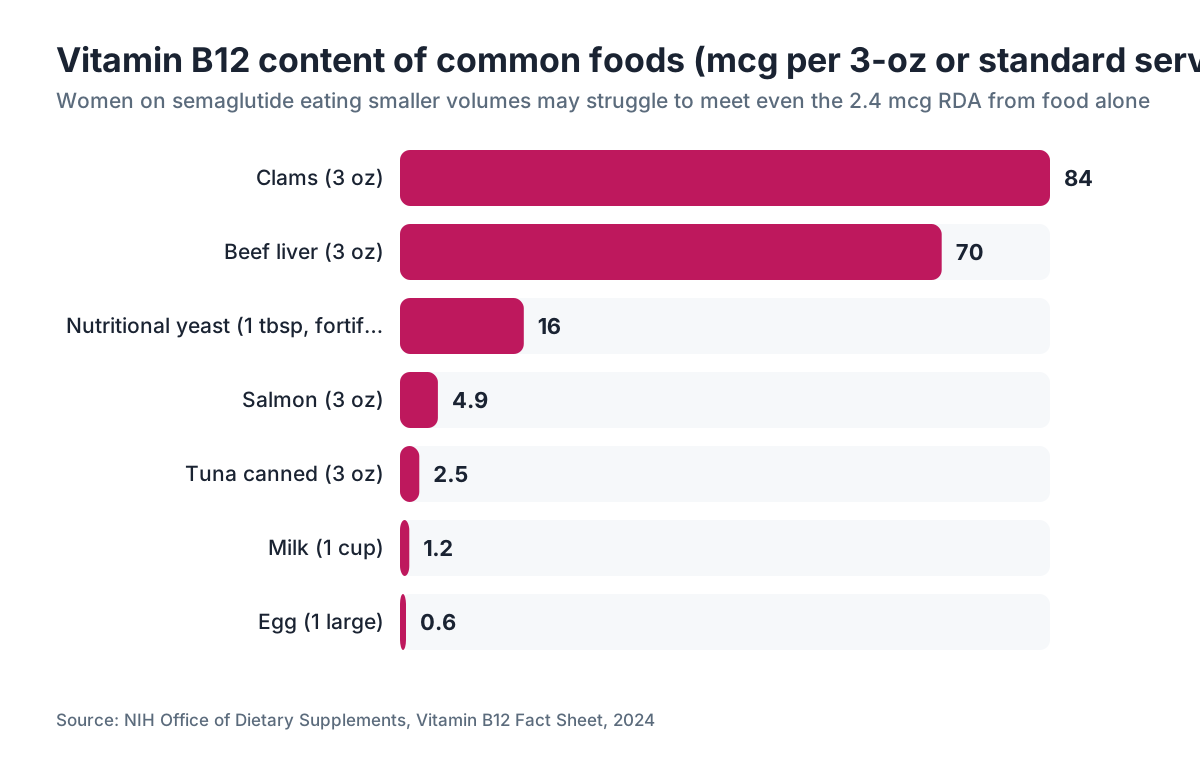
Yes, with a catch: semaglutide suppresses appetite enough that food volume alone rarely holds B12 steady in the first year. Even so, loading the smaller meals you do eat with high-B12 foods is worth the effort.
Highest B12 foods per serving:
- Clams: 84 mcg per 3-oz serving (one of the richest natural sources anywhere)
- Beef liver: 70 mcg per 3-oz serving
- Nutritional yeast (fortified): 8 to 24 mcg per tablespoon, by brand
- Salmon: 4.9 mcg per 3-oz serving
- Tuna (canned): 2.5 mcg per 3-oz serving
- Eggs: 0.6 mcg per egg
- Dairy: 1.2 mcg per cup of milk
The RDA is 2.4 mcg per day, but that's the floor for a healthy person with normal absorption. Women on semaglutide who eat smaller volumes and may have absorption trouble need to aim higher, which is exactly why supplementation beats relying on diet alone.
Vegan and vegetarian women on semaglutide carry the highest risk, because plant foods hold essentially no B12. They should supplement and monitor without exception.
What should you ask your doctor about B12 before starting or continuing semaglutide?
Walk in with these specific questions:
- Can you order a baseline B12, methylmalonic acid, and homocysteine before I start?
- At what level would you recommend supplementing, and what form and dose?
- Should I be on oral B12 prophylactically given my diet and age?
- If I'm also on metformin, are you monitoring B12 for that reason too?
- How often do you recheck micronutrients in patients on semaglutide long-term?
If the answer to most of these is "I haven't really thought about that," you're not necessarily getting bad care. You're getting the current average, which lags behind where the evidence points. A proactive provider has a protocol. If yours doesn't, ask for one, or find a practice that specializes in GLP-1 management. Our semaglutide vs tirzepatide article compares clinical approaches, including monitoring differences between the two agents.
Can you take cyanocobalamin and semaglutide together safely as separate medications?
Yes. There's no known pharmacokinetic interaction between cyanocobalamin (taken orally, sublingually, or by intramuscular injection as its own product) and semaglutide. They work through entirely different mechanisms, with no meaningful overlap in metabolism or clearance.
The FDA's safety concern is specifically about combining them in one vial (a compounded injectable), not about taking them as separate medications. A 1,000 mcg sublingual B12 tablet daily alongside a weekly semaglutide injection is safe, evidence-supported, and the right move if your levels are trending down.
Timing barely matters for oral B12. Take it whenever you'll actually remember. The semaglutide injection is weekly and subcutaneous. Your oral B12 is daily and goes through the gut. There's nothing to manage between them.
If you're on GLP-1 therapy and also thinking about bone health (another quiet nutritional risk with caloric restriction), our bone density test article explains when to screen and what to watch. B12 deficiency and bone loss often travel together in women on very restricted diets for a long time.
Frequently asked questions
Why do compounding pharmacies add cyanocobalamin to semaglutide?
Compounding pharmacies add cyanocobalamin to semaglutide vials to sell a combined product that addresses B12 depletion alongside GLP-1 therapy. The rationale is real: semaglutide does cut B12 intake. But the FDA flagged the practice in 2024 because the combination hasn't been tested for stability, sterility, or dosing accuracy. The safer route is separate oral B12 supplementation alongside semaglutide.
How soon can B12 deficiency develop on semaglutide?
The liver holds 2 to 5 years of B12, so symptomatic deficiency from reduced intake alone usually takes 12 to 24 months to surface. Serum B12 can start dropping within 6 months of severe caloric restriction. Women who begin semaglutide already low (common in vegetarians, vegans, or long-term PPI users) can become deficient faster, sometimes within 6 to 9 months.
Is cyanocobalamin or methylcobalamin better for women on semaglutide?
Both work for most women. Cyanocobalamin is cheaper, more stable, and has a longer evidence base. Methylcobalamin is the active form and is preferred for anyone with MTHFR gene variants or neurological symptoms. Either at 1,000 mcg per day orally is an appropriate dose. If serum B12 stays low despite oral dosing, elevated methylmalonic acid confirms a true absorption deficit and monthly intramuscular injections become the better option.
Does semaglutide affect intrinsic factor production?
GLP-1 receptors sit on gastric parietal cells, which produce intrinsic factor. Animal studies hint that GLP-1 agonism may slightly reduce intrinsic factor secretion. Human data is currently limited and this mechanism isn't proven in clinical trials. The main B12 risk with semaglutide remains reduced food intake rather than direct suppression of intrinsic factor, though the two risks may be additive.
What B12 level should I aim for while taking semaglutide?
Most practitioners treating GLP-1 patients target a serum B12 above 400 pg/mL. The conventional deficiency cutoff is below 200 pg/mL, but functional deficiency with neurological effects can happen at 200 to 300 pg/mL. If your result is borderline, add methylmalonic acid and homocysteine testing for a clearer picture of true tissue-level B12 status.
Should I take B12 supplements prophylactically when I start semaglutide?
If you're over 50, vegetarian or vegan, on a PPI, or on metformin, starting B12 supplementation from day one of semaglutide makes clinical sense. For younger women with no absorption risk factors and a B12-rich diet, testing at baseline and 6 months is reasonable before committing to daily supplementation. The supplement is cheap and low-risk, so prophylaxis is defensible for most women.
Can low B12 cause the brain fog and fatigue I experience on semaglutide?
Yes, and this overlap is a real diagnostic challenge. Brain fog and fatigue are common semaglutide side effects in the first few months, and they're also classic early B12 deficiency symptoms. If fatigue or cognitive symptoms persist past the initial adjustment period (roughly 8 to 12 weeks), checking B12, iron, thyroid, and other nutrient levels is worth doing rather than blaming the medication for everything.
Is the FDA-approved version of semaglutide safer than compounded semaglutide with cyanocobalamin?
Yes, for the specific question of B12 additives. FDA-approved Wegovy and Ozempic contain only semaglutide in a tested, stable formulation. Compounded semaglutide with cyanocobalamin added hasn't gone through the same stability or safety testing. The FDA's 2024 alert explicitly named compounded products with added ingredients as a concern. This doesn't make all compounded semaglutide unsafe, but added ingredients create unstudied variables.
Do I need B12 shots or are oral supplements enough?
Oral B12 at 1,000 mcg per day works for most people, even those with moderate absorption problems, because about 1% of any oral dose absorbs passively without intrinsic factor. If your serum B12 stays low despite consistent oral supplementation and methylmalonic acid stays elevated, intramuscular B12 injections (typically 1,000 mcg monthly) are more effective and bypass the absorption problem entirely.
Does weight loss from semaglutide affect B12 differently than other types of weight loss?
The B12 risk from semaglutide is mostly a food intake problem, not a direct drug effect, which makes it similar to any approach that severely restricts calories for a long time. Post-bariatric surgery patients have well-documented B12 deficiency for the same reason. The difference is that semaglutide patients often don't see themselves as being on a 'diet,' so they may never get counseled on micronutrient risks the way surgical patients routinely are.
How does metformin combined with semaglutide affect B12 levels?
The risks are additive. Metformin depletes B12 by blocking ileal absorption of the B12-intrinsic factor complex, an effect documented over decades. Semaglutide reduces B12 intake through appetite suppression. Women on both drugs face two depletion mechanisms at once and should test B12 at least every 6 to 12 months. The American Diabetes Association explicitly recommends periodic B12 testing for all metformin users.
Can I get enough B12 from diet alone while taking semaglutide?
Possibly, if you eat animal products regularly, your intake hasn't dropped much, and you're under 50 with no absorption issues. In practice, women hitting meaningful weight loss on semaglutide (the 10 to 15% range seen in STEP trials) are usually eating far less food, so dietary B12 sufficiency is hard to maintain without intentional effort. Supplementation is a safer default for most.
Should I test for B12 before starting semaglutide?
Yes. A baseline serum B12 before starting semaglutide tells you where you begin and flags women who are already low before any drug effect. Low baseline B12 is common: studies estimate 6% of US adults under 60 are deficient, rising to nearly 20% over age 60. Knowing your baseline makes the 6- and 12-month follow-up data far more useful.
Sources
- FDA, Wegovy (semaglutide) prescribing information
- NIH Office of Dietary Supplements, Vitamin B12 Fact Sheet for Health Professionals
- FDA, Safety Alert on Compounded Semaglutide Products with Added Ingredients (2024)
- Wilding JPH et al., STEP 1 Trial, New England Journal of Medicine, 2021
- Mechanick JI et al., Obesity Reviews, 2022, micronutrient deficiencies in GLP-1-induced weight loss
- Reinstatler L et al., Diabetes Care, 2012, Metformin and vitamin B12 deficiency
- American Diabetes Association, Standards of Medical Care in Diabetes, 2024
- American Society for Metabolic and Bariatric Surgery, Nutrition Guidelines, 2019
- NIH Office of Dietary Supplements, Vitamin B12 Fact Sheet, dietary sources table
- Allen LH, American Journal of Clinical Nutrition, 2009, prevalence of B12 deficiency in US adults
- FDA, Ozempic (semaglutide) prescribing information
- Langan RC, Goodbred AJ, American Family Physician, 2017, Vitamin B12 deficiency recognition and management