Semaglutide cost: what you'll actually pay in 2025
TL;DR: Brand-name semaglutide (Ozempic, Wegovy) costs $900, $1,350 per month without insurance in the U.S. Compounded semaglutide runs $150, $500 per month through telehealth, though its legal status shifted in 2025. With commercial insurance and a Novo Nordisk savings card, some patients pay as little as $25 monthly. Your final cost depends on diagnosis, plan design, and formulation.
What does semaglutide cost without insurance?
Without insurance, semaglutide is expensive. Full stop.
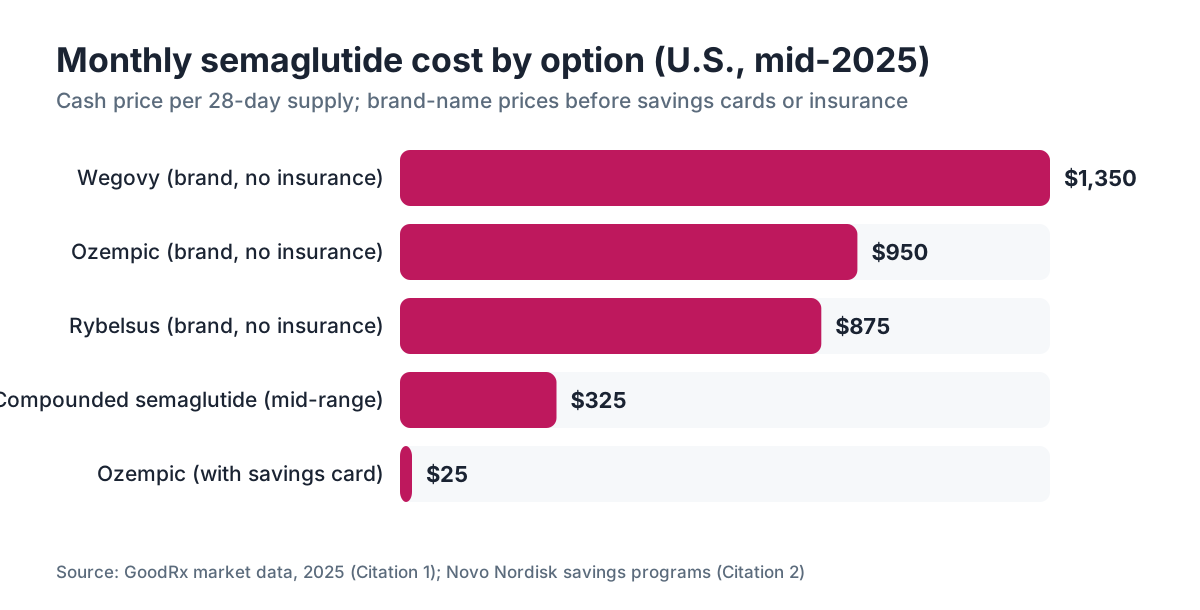
Wegovy (semaglutide 2.4 mg, approved for weight management) lists at roughly $1,350 per 28-day supply at most U.S. retail pharmacies as of mid-2025 [1]. Ozempic (semaglutide 0.5 to 2 mg, approved for type 2 diabetes) lists at approximately $900, $1,000 for a four-week supply [1]. Rybelsus, the oral tablet at 3 to 14 mg, runs about $800, $900 monthly without a discount [1].
None of those figures include the prescriber visit, labs, or shipping if you're going through a telehealth service. Budget an extra $50, $200 upfront for a first consultation, depending on the platform.
The blunt answer: brand-name semaglutide costs roughly $10,000, $16,000 per year if you're paying cash. That's not a typo. It's the single biggest reason the compounded market grew as fast as it did.
How much does semaglutide cost per month with insurance?
Insurance changes everything, and it's wildly inconsistent from one plan to the next.
For Ozempic prescribed for type 2 diabetes, many commercial plans cover it after a prior authorization. Out-of-pocket with coverage typically lands between $25 and $200 per month depending on your tier and deductible. Novo Nordisk's savings card for Ozempic can bring the cost as low as $25/month for eligible commercially insured patients [2].
Wegovy coverage is where things get messy. The drug is FDA-approved for weight management, but as of 2025 Medicare Part D still does not cover it for weight loss alone. The Inflation Reduction Act of 2022 opened a narrow door for cardiovascular risk reduction, yet standalone obesity coverage under Medicare stays limited [3]. Many commercial plans started covering Wegovy after the SELECT trial showed a 20% reduction in major cardiovascular events [4], but employers can and do exclude it. Read your Summary of Benefits and Coverage document rather than trusting a customer service rep's verbal answer.
Medicaid coverage varies by state. Some state programs cover GLP-1 agonists for diabetes. Far fewer cover them for weight management.
Here's the practical read. If you have commercial insurance and a diabetes diagnosis, you have a real shot at affordable Ozempic. If you want Wegovy for weight loss and you're on Medicare or a bare-bones employer plan, expect to pay out of pocket or look at alternatives.
How much does compounded semaglutide cost?
Compounded semaglutide is the lower-cost option most women are actually asking about, and the range is wide: roughly $150, $500 per month, depending on dose, the compounding pharmacy, and the platform [5].
Here's the context you need. The FDA placed semaglutide on the drug shortage list in 2022 and kept it there through 2024 [5]. While a drug is on the shortage list, FDA policy allows 503A (patient-specific) and 503B (outsourcing facility) compounders to produce copies. That's the legal basis for the market that exploded over the past two years.
Then the ground shifted. The FDA removed Wegovy from the shortage list in March 2025 and sent warning letters to compounders [5]. The 503B outsourcing facilities got until May 22, 2025 to wind down production, and 503A patient-specific compounders faced an earlier deadline. By mid-2025 the legal landscape is in active flux, so confirm current FDA status before you order. Compounded semaglutide carries its own regulatory risks worth understanding fully.
When compounded semaglutide is available and legal, the price gap is real. A 503B compounded dose through a telehealth platform might run $199, $299/month at maintenance, against $1,000+ for Wegovy. For a woman who needs treatment for years, that difference compounds fast.
WomenRx offers GLP-1 consultations for women, including evaluation for semaglutide, and can walk through current compounding options based on your clinical picture. Confirm price and availability at the time of your visit, because this space moves week to week.
One thing to watch: some compounders add B12, glycine, or other ingredients with no clinical evidence behind them. The FDA has flagged unapproved combination products as a safety concern. Stick to a pharmacy that can show FDA registration as a 503B facility, or a valid 503A prescription from a licensed prescriber.
What does the Novo Nordisk savings program actually cover?
Novo Nordisk runs two patient assistance programs you should know about.
The Ozempic savings card applies to commercially insured patients (not Medicare, not Medicaid) and can cap your monthly cost at $25 [2]. It has income and insurance requirements, and it resets on a per-calendar-year limit. Apply at the Novo Nordisk website directly.
The Wegovy savings program works similarly for commercially insured patients, aiming at a $0 or low copay for the first several months, with income caps buried in the fine print [2]. Novo Nordisk also runs a Patient Assistance Program for uninsured or underinsured patients with incomes below roughly 400% of the federal poverty level, which can mean free medication.
Neither program works if you stack a GoodRx or discount card alongside it. And neither helps Medicare patients. If you're on Medicare Part D, check whether your specific plan added semaglutide for cardiovascular risk reduction under the expanded indication the FDA approved in March 2024 [4]. That's your one realistic path to coverage.
Semaglutide cost comparison: Ozempic vs Wegovy vs Rybelsus vs compounded
The table below shows real U.S. list prices and typical out-of-pocket ranges as of mid-2025. List price is the starting point before any insurance, coupon, or assistance program touches it.
| Formulation | Active ingredient | Approved use | List price/month | With savings card | Compounded alternative available? | |---|---|---|---|---|---| | Ozempic (injectable) | Semaglutide 0.5 to 2 mg | Type 2 diabetes | ~$950 | ~$25 (commercial ins.) | Historically yes; check current FDA status | | Wegovy (injectable) | Semaglutide 2.4 mg | Weight management | ~$1,350 | $0, $25 (commercial ins.) | Historically yes; check current FDA status | | Rybelsus (oral) | Semaglutide 3 to 14 mg | Type 2 diabetes | ~$850 | ~$10, $50 (commercial ins.) | Not widely compounded | | Compounded semaglutide | Semaglutide (varies) | Per prescriber | $150, $500 | No savings card applies | N/A (this is the alternative) |
Sources: GoodRx market data [1], Novo Nordisk savings programs [2], FDA shortage list [5].
Weighing tirzepatide instead? The comparison shifts. Semaglutide vs tirzepatide covers efficacy and cost side by side. The short version: brand-name Zepbound (tirzepatide for obesity) lists at about $1,060, $1,100/month, compounded tirzepatide tracks close to compounded semaglutide in price, and the SURMOUNT-1 trial showed greater average weight loss with tirzepatide at the highest dose [6].
How do GLP-1 costs compare to HRT costs per month?
Many women researching semaglutide are also managing perimenopause or menopause, so this question comes up constantly. How much does HRT cost per month next to a GLP-1?
Hormone replacement therapy is dramatically cheaper. It isn't close.
Estrogen-only patches (Vivelle-Dot or its generics) typically run $30, $80 per month with insurance and $60, $120 cash, depending on dose and pharmacy [7]. Combination estrogen-progestogen pills or patches land in a similar range. Bioidentical compounded HRT, which is not FDA-approved as a finished product, can run $50, $150/month through compounding pharmacies [7]. If your prescriber adds oral micronized progesterone (Prometrium or generic), that's typically $20, $60 more per month.
A complete HRT regimen for a woman in menopause, an estrogen patch plus micronized progesterone, commonly costs $50, $180 per month total at cash price. With insurance, many women pay under $50 for both.
The contrast with semaglutide is stark. A woman using Wegovy out of pocket alongside HRT could spend $1,400, $1,550 per month on medications alone. That's a real planning number, not an afterthought.
Our full hormone replacement therapy guide goes deeper on pricing, coverage, and what the evidence actually says.
For women in perimenopause or menopause, the link between estrogen and weight gain matters clinically too. Falling estrogen is associated with more visceral fat and metabolic shifts, which is one reason some clinicians now consider GLP-1 therapy alongside HRT rather than instead of it.
Does insurance cover semaglutide for weight loss specifically?
This is the knottiest part of the whole cost picture, and the honest answer is: sometimes, and it hinges on three things.
First, your diagnosis. Insurers cover semaglutide far more readily when the ICD-10 code is E11 (type 2 diabetes) than when it's Z68.x (BMI-related obesity). Even a correctly written Wegovy prescription for weight management may need BMI over 30 (or over 27 with a comorbidity like hypertension, sleep apnea, or cardiovascular disease) before a plan authorizes it. The FDA label for Wegovy requires BMI of 30+ or 27+ with a weight-related condition [8].
Second, your employer's benefit design. Large self-insured employers set their own drug tiers. Many added GLP-1 coverage in 2023 to 2024. A meaningful number are pulling it back now over cost. Your HR benefits document is the only reliable source.
Third, your plan's prior authorization process. Even covered drugs often demand documentation that you've tried and failed other weight-loss interventions, that you carry qualifying comorbidities, and sometimes a prescriber letter of medical necessity.
For semaglutide for weight loss, the STEP 1 trial in the New England Journal of Medicine reported a mean weight reduction of 14.9% at 68 weeks [9]. That efficacy data is exactly what prescribers attach to prior authorization appeals. If your first PA gets denied, an appeal with this data attached succeeds more often than people expect.
What's the real total cost of semaglutide over time?
People fixate on the monthly number. The cost question that actually matters is: how long do you take it?
The STEP 1 extension found that participants who stopped semaglutide regained about two-thirds of their lost weight within a year [9]. That makes semaglutide a long-term maintenance drug, not a short course, and it changes the math completely.
On Wegovy at full cash price for two years, you're looking at $24,000, $32,000. Most families can't absorb that. On compounded semaglutide at $250/month, two years is $6,000. Still real money, but closer to what people budget for a chronic condition that needs ongoing treatment.
Some prescribers use dose-tapering strategies on maintenance, dropping from 2.4 mg to 1.7 mg or 1 mg once a patient hits a weight goal. No large randomized trial has tested lowest-effective-dose maintenance head to head, but smaller studies and clinical experience point to durable maintenance at lower doses in some patients. Your prescriber's approach here has a real dollar impact.
Coverage rarely stays automatic. Many plans require reauthorization every 6 or 12 months with evidence that you've held at least 5% weight loss.
Are there cheaper GLP-1 alternatives to semaglutide?
Yes, though none of them are identical swaps.
Liraglutide (Saxenda for weight management, Victoza for diabetes) is an older GLP-1 agonist now available as a generic in some markets. Saxenda listed at about $1,300, $1,400/month as a brand historically, but generic liraglutide introduced in 2024 has brought cash prices to roughly $200, $400/month at some pharmacies. Efficacy is lower: the SCALE trial found about 5 to 8% average weight loss versus 15% with semaglutide [9].
Tirzepatide (Zepbound, Mounjaro) isn't cheaper at brand-name list price, but compounded tirzepatide follows a price path close to compounded semaglutide. If you're a candidate for either drug, semaglutide vs tirzepatide is worth reading before you commit.
Bupropion/naltrexone (Contrave) and phentermine/topiramate (Qsymia) run substantially cheaper at $50, $200/month generic, but average weight loss is lower (6 to 10%) and the side effect profiles differ.
No GLP-1 option is both cheap and as effective as semaglutide at 2.4 mg. The cost-efficacy tradeoff is real, and worth a frank conversation with your prescriber.
How to actually lower your semaglutide cost: practical steps
Here's what's worth trying, roughly in order of impact.
-
Read your insurance benefits document, not a phone rep's summary. Find the specific formulary tier for Wegovy or Ozempic, and the prior authorization criteria. People pay full price for months because they assumed coverage was impossible.
-
Apply for the Novo Nordisk savings card if you're commercially insured. This is the highest-impact single step for insured patients and takes about 10 minutes at the Novo Nordisk website [2].
-
Ask your prescriber whether an Ozempic prescription (diabetes indication) fits your clinical situation. If you have type 2 diabetes or prediabetes with significant insulin resistance, Ozempic may be covered where Wegovy isn't. That's a clinical decision, not a workaround.
-
Explore compounded semaglutide while it remains legally available. Confirm the compounder's 503A or 503B status, the current FDA shortage status, and that a licensed prescriber wrote your prescription. Never buy semaglutide from a source that doesn't require one. The FDA has documented counterfeit and adulterated products in the non-prescription market [5].
-
Apply for Novo Nordisk's Patient Assistance Program if you're uninsured or underinsured below the income threshold. Approved patients can get medication at no cost.
-
Consider dose optimization. Once you've reached your weight goal, ask whether a lower maintenance dose holds your results. Fewer milligrams means a lower monthly bill.
WomenRx helps women work through exactly this kind of clinical and cost picture, especially for those managing GLP-1 therapy alongside hormonal changes in perimenopause or menopause. One visit can clarify which path makes the most financial and medical sense for you.
What does semaglutide cost at major pharmacies and telehealth platforms?
Real-world prices vary more than the list price suggests, because pharmacies set their own cash prices and telehealth platforms bundle consultation fees differently.
At major retail pharmacies (CVS, Walgreens, Kroger, Costco), Wegovy's cash price per 28-day pack ranges from roughly $1,300 to $1,400 as of mid-2025 [1]. GoodRx and similar discount tools rarely bring that below $1,100, $1,200 for Wegovy, because the manufacturer savings card is usually the better deal if you have commercial insurance.
For Ozempic, GoodRx prices at major pharmacies range from about $800 to $1,000 for a 28-day supply without insurance [1].
Telehealth platforms that prescribe compounded semaglutide typically fold the consultation fee into the first-month price, then charge $149, $499/month for the medication thereafter, depending on dose. The titration schedule matters: you usually start at a sub-therapeutic dose (0.25 mg or 0.5 mg weekly) and work up to 1 mg, 1.7 mg, or 2.4 mg over several months, so early months cost less than maintenance.
Costco's pharmacy has historically had some of the lowest cash prices among major retailers for brand-name GLP-1s, though it requires a Costco membership. Call your local Costco pharmacy before filling elsewhere if you're paying cash.
Frequently asked questions
How much does semaglutide cost per month on average?
At list price, Wegovy runs about $1,350/month and Ozempic about $950/month. With a Novo Nordisk savings card and commercial insurance, many patients pay $25, $50/month. Compounded semaglutide, where legally available, costs roughly $150, $500/month depending on dose and pharmacy. The right number for you depends almost entirely on your insurance and which formulation you're prescribed.
Is semaglutide covered by Medicare?
Medicare Part D does not currently cover semaglutide for weight loss alone. After the SELECT trial, the FDA approved Wegovy in March 2024 to reduce cardiovascular events in adults with obesity and established cardiovascular disease. Some Part D plans now cover it for that specific indication. For diabetes, Medicare covers Ozempic under Part D in most cases, subject to your plan's formulary and prior authorization.
What is the cost of semaglutide without insurance?
Without insurance or any discount program, Wegovy costs approximately $1,300, $1,400 per 28-day supply and Ozempic costs $900, $1,000. Over a full year that's roughly $11,000, $17,000. Compounded semaglutide was available at $150, $500/month through telehealth and specialty pharmacies while on the FDA shortage list, though legal availability changed in 2025. Verify current FDA status before ordering compounded versions.
How much does HRT cost per month?
Hormone replacement therapy costs far less than semaglutide. An estrogen patch (generic) runs $30, $80/month; oral micronized progesterone adds $20, $60. A complete regimen commonly costs $50, $180/month at cash price, and under $50 with most commercial insurance. Compounded bioidentical HRT typically costs $50, $150/month. These figures cover the medications alone, not prescriber visits or labs.
Can I use GoodRx to lower my semaglutide cost?
GoodRx can trim the cash price on Ozempic by 10 to 20% at some pharmacies, but the Novo Nordisk manufacturer savings card almost always beats it if you have commercial insurance. You can't combine GoodRx and a manufacturer savings card at the same pharmacy visit. For Wegovy, GoodRx discounts are minimal because the drug is newer and in high demand. Compare both before filling.
Is compounded semaglutide safe and legal?
Compounded semaglutide was legally produced under FDA shortage exemptions from 2022 through early 2025. The FDA removed Wegovy from the shortage list in March 2025 and required compounders to stop production on a phased schedule. As of mid-2025, its legal availability is in transition. The FDA has also documented adulterated and counterfeit semaglutide sold online without prescriptions. If you pursue it, use only an FDA-registered 503A or 503B facility with a valid prescription.
Does prior authorization for semaglutide often get denied?
First requests for Wegovy get denied often, especially when documentation is thin. Common required elements: BMI over 30 or over 27 with a qualifying comorbidity, evidence of prior weight-loss attempts, and a letter of medical necessity. Appeal success climbs when the prescriber submits the SELECT or STEP trial efficacy data alongside the clinical letter. Don't abandon coverage after one denial.
How does tirzepatide cost compare to semaglutide?
Brand-name Zepbound (tirzepatide for weight management) lists at roughly $1,060, $1,100/month, slightly more than Ozempic and slightly less than Wegovy. Compounded tirzepatide follows a range close to compounded semaglutide ($150, $500/month). The SURMOUNT-1 trial showed higher average weight loss with tirzepatide at 15 mg than semaglutide at 2.4 mg, so cost per unit of weight loss may favor tirzepatide for some patients.
Will my employer insurance cover semaglutide for weight loss in 2025?
It depends on your employer's benefit design. Large self-insured employers make their own formulary calls. Coverage for GLP-1s for obesity expanded through 2023 to 2024, then some employers began restricting it in 2025 over high costs. Check your Summary of Benefits and Coverage document or ask HR for the specific formulary tier and prior authorization rules. Don't rely on a verbal answer from a benefits hotline.
What is the Novo Nordisk Patient Assistance Program and who qualifies?
Novo Nordisk runs a Patient Assistance Program for uninsured or underinsured U.S. residents who meet income criteria, generally below 400% of the federal poverty level. Eligible patients may receive Ozempic or Wegovy at no cost. Apply through the Novo Nordisk website or have your prescriber's office submit it. Approval typically takes 2 to 4 weeks and must be renewed periodically.
How long do you have to take semaglutide to see results?
Most patients see meaningful weight loss by weeks 12 to 16 of the full therapeutic dose. The STEP 1 trial ran 68 weeks and showed 14.9% average weight loss at completion. Stopping semaglutide typically leads to regaining most of the lost weight within 12 months, based on the STEP 1 extension data. That long-term trajectory matters enormously for cost planning: this is realistically a multi-year medication for most patients who respond well.
Can I get semaglutide cheaper if I only need a low dose?
Yes. The titration schedule starts at 0.25 mg weekly for 4 weeks, then 0.5 mg, then steps up gradually to a maximum of 2.4 mg. Compounded semaglutide cost is dose-dependent, so early titration months cost less. Some patients hold adequate weight control at 1 mg or 1.7 mg rather than the maximum. If your prescriber agrees, staying at a lower effective dose can cut your monthly cost by 30 to 50%.
Does semaglutide interact with hormone therapy or affect women differently?
There's no major pharmacokinetic interaction between semaglutide and estrogen or progesterone at standard HRT doses. Women in perimenopause and menopause often gain weight as estrogen declines, and some clinicians prescribe both HRT and a GLP-1 to address the hormonal and metabolic sides at once. The clinical evidence specifically on semaglutide in perimenopausal women is limited; most STEP trial data doesn't break out menopausal status separately.
Are there generic semaglutide options available in the U.S.?
No FDA-approved generic semaglutide exists in the U.S. as of mid-2025. Novo Nordisk's patents cover the molecule and formulation and don't expire in the U.S. until the early 2030s. Compounded semaglutide is not a generic; it's a copy made under shortage exemption rules, a legally distinct category. Generic semaglutide will likely reach Denmark and some other markets before the U.S.
Sources
- GoodRx, Ozempic and Wegovy pricing pages
- Novo Nordisk, Patient savings programs for Ozempic and Wegovy
- CMS, Medicare Part D and obesity drug coverage
- FDA, FDA approves first treatment to reduce serious heart problems specifically in adults with obesity or overweight (March 2024)
- FDA, Drug Shortages and compounding guidance for semaglutide
- Jastreboff AM et al., Tirzepatide Once Weekly for the Treatment of Obesity (SURMOUNT-1), New England Journal of Medicine, 2022
- The Menopause Society (NAMS), Hormone Therapy Position Statement 2022
- FDA, Wegovy (semaglutide) prescribing information and label
- Wilding JPH et al., Once-Weekly Semaglutide in Adults with Overweight or Obesity (STEP 1), New England Journal of Medicine, 2021
- Endocrine Society, Clinical Practice Guideline on Pharmacological Management of Obesity, 2023