Semaglutide 2.5 mg/ml dosage chart: how to read and use it
TL;DR: At 2.5 mg/ml, a 0.25 mg starting dose equals 0.1 ml, and every dose scales linearly up to 2.5 mg (1.0 ml). Divide your milligram dose by 2.5 to get the volume you draw. This chart maps every standard titration step, and it explains why many women in perimenopause and menopause stay longer at lower doses.
What does 2.5 mg/ml mean on a semaglutide vial?
The number on your vial tells you how many milligrams of active drug sit in each milliliter of liquid. A 2.5 mg/ml vial means every 1.0 ml holds exactly 2.5 mg of semaglutide. That one fact converts any prescribed dose into a syringe volume.
This concentration got popular because the math lands clean at the starting dose. The FDA-approved Ozempic pen starts patients at 0.25 mg per week [1], and at 2.5 mg/ml that dose is exactly 0.1 ml. Small, easy to measure on a standard 1 ml insulin syringe, hard to botch.
Compounded semaglutide comes in different strengths depending on the pharmacy. You will also see 1 mg/ml, 5 mg/ml, and 10 mg/ml vials. The milligram dose your prescriber orders stays the same across all of them. The volume you draw does not. Never carry a volume from one vial over to a different concentration. Recalculate every single time.
The formula: Volume (ml) = Dose (mg) divided by Concentration (mg/ml). At 2.5 mg/ml, divide your milligram dose by 2.5 to get the ml you draw. That is the whole game.
Semaglutide 2.5 mg/ml dosage chart: full titration table
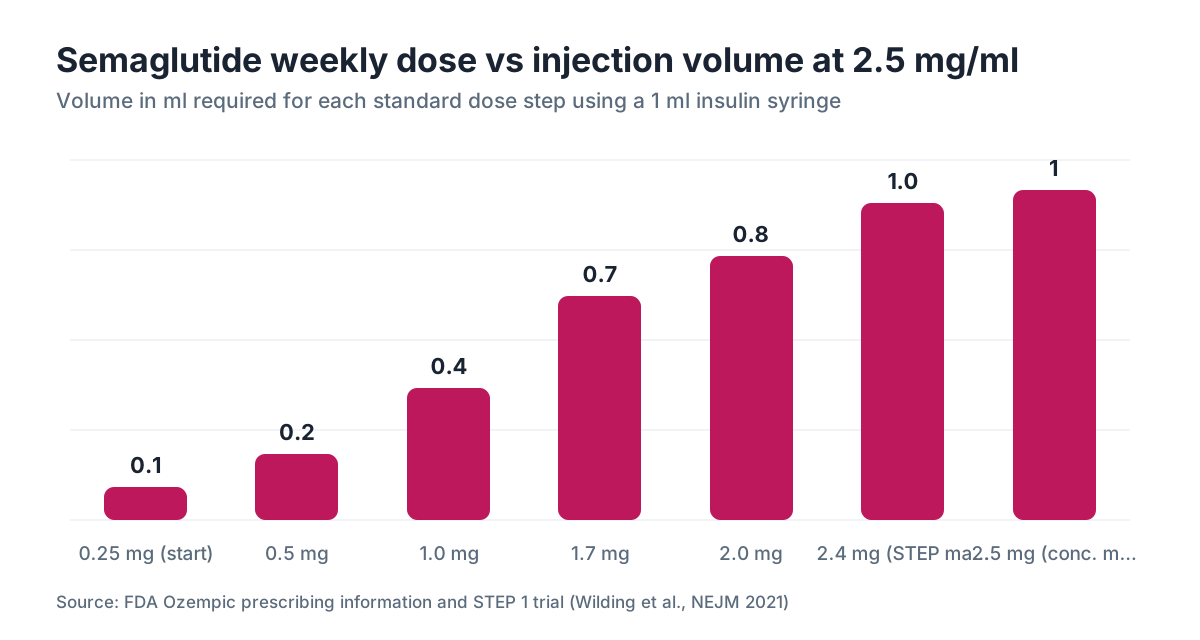
The table below maps every standard weekly dose to its injection volume at 2.5 mg/ml. The titration ladder follows the STEP 1 trial protocol, which moved patients from 0.25 mg to 2.4 mg over 16 to 20 weeks [2]. Compounding prescribers usually copy that schedule, and some stretch it out for women who react hard to the GI side effects.
| Dose (mg/week) | Volume at 2.5 mg/ml (ml) | Typical week range | Phase | |---|---|---|---| | 0.25 | 0.10 | Weeks 1 to 4 | Initiation | | 0.5 | 0.20 | Weeks 5 to 8 | Titration 1 | | 1.0 | 0.40 | Weeks 9 to 12 | Titration 2 | | 1.7 | 0.68 | Weeks 13 to 16 | Titration 3 | | 2.0 | 0.80 | Weeks 17 to 20 | Titration 4 | | 2.4 | 0.96 | Week 20+ | Maintenance (STEP protocol) | | 2.5 | 1.00 | Varies | Max at this concentration |
Three things to read carefully. First, 2.4 mg is the highest dose the STEP obesity trials studied [2], and it draws to 0.96 ml here. Second, 2.5 mg is the ceiling you can pull from a 2.5 mg/ml vial without exceeding 1.0 ml, the full capacity of a standard 1 ml syringe. Some prescribers round to 2.5 mg because the volume is tidy. Third, plenty of people never reach the top. In STEP 1, roughly 8% of participants could not tolerate escalation to 2.4 mg and settled at lower maintenance doses [2]. That is not failing. That is finding your dose.
For women in perimenopause or past menopause, prescribers at practices like WomenRx often stretch each step to 6 or even 8 weeks instead of 4. Estrogen decline already stresses the gut, and nausea tolerance swings widely from one woman to the next. No published RCT mandates a 4-week step. The Ozempic label says to escalate "after at least 4 weeks" [1], which makes 4 weeks the floor, not the target.
How do you draw the correct volume with an insulin syringe?
Most compounded semaglutide goes in with a 1 ml (100-unit) insulin syringe. The barrel prints two scales: milliliters (0 to 1.0) and units (0 to 100). At 2.5 mg/ml, you read the milliliter scale. Ignore the unit scale.
For 0.25 mg, pull the plunger to the 0.10 ml line. For 0.5 mg, pull to 0.20 ml. The relationship holds straight up the range. If your syringe only shows units, remember 10 units equals 0.10 ml on a standard 1 ml syringe. So 0.25 mg is 10 units, 0.5 mg is 20 units, 1.0 mg is 40 units, and so on.
Needle gauge matters too. A 29-gauge or 31-gauge needle, 4 mm to 6 mm long, is standard for subcutaneous injection. Inject into subcutaneous fat on the abdomen, outer thigh, or back of the upper arm. Rotate sites weekly to avoid lipodystrophy. The FDA label for Ozempic specifies subcutaneous injection only [1].
One practical habit: after drawing up, hold the syringe upright, tap it so any air bubble floats to the top, then nudge the plunger until the bubble clears. Air in the barrel displaces drug. At these volumes, even a 0.02 ml bubble is a real chunk of a 0.10 ml dose. Clear it every time.
What if my prescription is written in units rather than milligrams?
This confusion causes real dosing errors, so stop and sort it out. Semaglutide is dosed in milligrams. Insulin is dosed in units. They are not the same thing. If a pharmacy label or a prescription writes your semaglutide dose in "units," ask for clarification before you inject anything, because that language is wrong for a GLP-1 receptor agonist.
The "units" on an insulin syringe barrel are just a volume marker built for U-100 insulin (100 units per ml). On that same syringe, 10 unit marks equal exactly 0.10 ml. So when a compounded dosing chart uses "10 units" as shorthand for 0.10 ml at 2.5 mg/ml, it means draw to the 10-unit line, which is 0.10 ml, which delivers 0.25 mg. The word "units" describes a line on the barrel, not a dose of drug.
Confirm two numbers with your prescriber or pharmacist and write both down: my dose in milligrams, and the volume in milliliters I draw at the concentration on this vial. Switch to a different vial concentration later? Reconfirm the volume even when the milligram dose has not budged.
How does the titration schedule change for women in menopause or perimenopause?
Women in menopause or perimenopause often have a rougher ride with semaglutide's GI side effects than the trial averages suggest. The STEP 1 trial enrolled a mixed-sex population, and the published subgroup data do not stratify by menopausal status in any way that gives clean numbers [2]. What we have is clinical experience plus a plausible mechanism.
Estrogen supports gut motility and gastric emptying. As estrogen falls in perimenopause, some women develop slower emptying and a jumpier gut before they ever touch a GLP-1. Semaglutide slows gastric emptying further, which is part of how it cuts appetite [3]. Stack those two effects and the nausea, bloating, and early fullness can hit harder than they do in premenopausal women.
So the practical move: many clinicians in women's hormonal health hold each step for 6 to 8 weeks instead of 4, and they park you at the dose where nausea settles rather than pushing for the ceiling. STEP 1 showed that even 1.0 mg weekly produced meaningful weight loss, though the 2.4 mg group lost more on average [2].
Women also on hormone replacement therapy may tolerate the ramp better. Estrogen replacement tends to normalize gastric function, and some observational data suggest women on HRT lose weight with GLP-1s at rates similar to women who are not. No dedicated RCT has tested that interaction, so nobody has hard data, but the rationale holds up.
See also: semaglutide for weight loss for a wider look at how GLP-1s behave in women.
What are the most common dosing mistakes at the 2.5 mg/ml concentration?
The most dangerous mistake is carrying a volume over from a different concentration. Say you used a 5 mg/ml vial and drew 0.10 ml for your 0.5 mg dose, then switch to 2.5 mg/ml without recalculating. You just injected 0.25 mg instead of 0.5 mg. Flip it the other way: you used a 1 mg/ml vial and drew 0.50 ml for 0.5 mg, then switch to 2.5 mg/ml and draw the same 0.50 ml. Now you injected 1.25 mg, more than double what you meant to. Overdosing semaglutide brings severe nausea, vomiting, and, alongside other medications, symptomatic hypoglycemia.
Second mistake: misreading the syringe scale. On some syringes the 0.5 ml mark and the 50-unit mark sit almost on top of each other, and they point at the same physical volume. The trap is thinking "units" means something pharmacological. At 2.5 mg/ml, the 50-unit line (0.50 ml) delivers 1.25 mg, not 0.5 mg.
Third mistake: skipping a dose, then doubling up. Semaglutide has a half-life around one week [1], so one missed dose does not tank your drug levels. The FDA label says inject the missed dose as soon as you remember, as long as your next scheduled dose is at least two days out. If the next dose falls within two days, skip the missed one and resume your schedule [1]. Never inject two doses in a single week.
Fourth mistake: storing it wrong. Compounded semaglutide belongs in the refrigerator (36 to 46 degrees F) and is typically stable for 28 to 30 days after reconstitution, though that varies by formulation. Read the beyond-use date on your vial label and go by that number.
How does 2.5 mg/ml compare to other common compounded concentrations?
The table below shows the same milligram doses as injection volumes across four concentrations you are likely to run into.
| Dose (mg) | 1 mg/ml (ml) | 2.5 mg/ml (ml) | 5 mg/ml (ml) | 10 mg/ml (ml) | |---|---|---|---|---| | 0.25 | 0.25 | 0.10 | 0.05 | 0.025 | | 0.5 | 0.50 | 0.20 | 0.10 | 0.05 | | 1.0 | 1.00 | 0.40 | 0.20 | 0.10 | | 1.7 | 1.70* | 0.68 | 0.34 | 0.17 | | 2.0 | 2.00* | 0.80 | 0.40 | 0.20 | | 2.4 | 2.40* | 0.96 | 0.48 | 0.24 |
*Volumes above 1.0 ml need multiple injections or a larger syringe.
At 1 mg/ml, higher doses stop fitting in a standard 1 ml syringe, which is one reason 2.5 mg/ml wins: it packs the full STEP dose range into a single draw. At 10 mg/ml, the volumes get so tiny (0.025 ml for the starting dose) that measuring them accurately on an insulin syringe is genuinely hard.
For how compounded semaglutide differs from brand-name Ozempic and Wegovy, including regulatory status and what to ask your pharmacy, that article has the full picture.
What should I expect in terms of weight loss at each dose level?
STEP 1 is the clearest reference we have. At 2.4 mg weekly over 68 weeks, participants lost an average of 14.9% of body weight versus 2.4% on placebo [2]. The trial enrolled adults with a BMI of 30 or above, or 27 or above with at least one weight-related condition.
The dose-response curve is real but not a straight line. Going from 0.5 mg to 1.0 mg adds meaningful efficacy. Going from 1.7 mg to 2.4 mg adds less on a percentage basis, though the difference stayed statistically and clinically significant in the trial data [2].
For women specifically, a 2023 analysis in JAMA Internal Medicine found that menopausal status did not significantly change the weight loss response to GLP-1 receptor agonists in a pooled analysis, though the confidence intervals were wide enough that individual variation matters a lot [4]. Nobody has good sex-stratified dose-response data from a trial built to answer that question.
What the data do support: most weight loss lands during active escalation and the first 6 to 12 months of maintenance. Plateaus are normal. They reflect your body defending a new weight set point, not the drug quitting. If you plateau at 1.0 mg, moving up to 2.4 mg may help. But some women lose the same amount at 1.0 mg with far fewer side effects, and there is no prize for reaching the top of the chart.
For a head-to-head with tirzepatide (different dose thresholds, different efficacy profile), see semaglutide vs tirzepatide.
Are there dose adjustments for kidney or liver problems?
The FDA label for Ozempic states that no dose adjustment is needed for renal impairment, including end-stage renal disease [1]. Same for hepatic impairment. Semaglutide breaks down through general proteolytic degradation, not cytochrome P450 enzymes or hepatic first-pass, so liver function does not meaningfully change how fast you clear it.
That said, if you have significant kidney or liver disease, your prescriber should know. GI side effects (nausea, vomiting, diarrhea) can dehydrate you, and dehydration stresses the kidneys. The FDA label includes a precaution to monitor renal function in patients who hit severe GI symptoms [1].
Body weight itself is not a standard basis for adjusting the semaglutide dose the way it is for some chemotherapy drugs. The STEP trials enrolled people across a wide BMI range and used the same fixed escalation for everyone [2]. Age above 65 is not a basis for a lower dose either, though older adults tend to feel GI effects more and often do better on the slower titration.
What does the FDA say about compounded semaglutide at this concentration?
Compounded semaglutide sits in a specific and shifting regulatory space. While the FDA-approved products (Ozempic and Wegovy) were on the FDA drug shortage list, 503A and 503B compounding pharmacies were legally allowed to compound semaglutide under federal law [5]. The FDA removed semaglutide from the shortage list in early 2025, and that changed everything.
As of this writing, the FDA has taken the position that compounded semaglutide is no longer generally permissible now that the shortage is resolved, though legal challenges from compounding pharmacies and prescribers were ongoing [5]. The situation is genuinely fluid. Verify current status with your prescriber or pharmacy.
The 2.5 mg/ml concentration is not named in any FDA guidance as required or prohibited. Compounding pharmacies set concentrations based on clinical convenience and their own stability data. The FDA does not publish approved concentration ranges for compounded products the way it does for approved drugs.
The line worth quoting from FDA guidance is that compounded drugs are not FDA-approved and "may not meet the same quality standards" as approved products [5]. That does not make them unsafe. It means the quality rides on the specific pharmacy's testing and process.
If you are already using compounded semaglutide, the chart above applies no matter the regulatory status. The concentration math does not care where the drug came from. Your clinical reference stays the STEP trial schedule [2] and the Ozempic label [1].
How does semaglutide affect bone density, a concern for women over 40?
Weight loss from any cause, GLP-1-driven included, can pull down bone mineral density. That matters for women over 40, especially those in perimenopause or postmenopause, where falling estrogen already speeds bone loss on its own.
STEP 1 reported bone mineral density (BMD) as a secondary endpoint. At 68 weeks, participants on semaglutide 2.4 mg showed small decreases in total hip BMD versus placebo, though the differences were modest and the clinical meaning in otherwise healthy adults stayed uncertain [2]. A 2023 review in Obesity Reviews pooled GLP-1 trial data and found the bone loss tied to GLP-1 use was smaller than what usually comes with the same amount of weight lost through diet alone, which points to a partial bone-protective effect independent of weight [6].
The practical message: if you are over 45 and using semaglutide for weight loss, get a baseline bone density test if you have not had one. Keep calcium and vitamin D adequate. The Institute of Medicine recommends 1,200 mg calcium and 600 to 800 IU vitamin D daily for women over 50 [7]. If you are on hormone replacement therapy, that helps your bones, since estrogen is the main regulator of bone turnover in women.
WomenRx sees many women running GLP-1 therapy alongside HRT, and the two are generally compatible. Estrogen does not change semaglutide pharmacokinetics in any clinically meaningful way based on the data we have.
How long does a typical vial last at common doses?
Vial size depends on the pharmacy, but 2 ml and 3 ml vials are common at 2.5 mg/ml. Here is how long each size lasts at different maintenance doses.
| Vial size | Total drug (mg) | Doses at 0.5 mg/week | Doses at 1.0 mg/week | Doses at 2.0 mg/week | |---|---|---|---|---| | 1 ml vial | 2.5 mg | ~5 weeks | ~2.5 weeks | ~1.25 weeks | | 2 ml vial | 5 mg | ~10 weeks | ~5 weeks | ~2.5 weeks | | 3 ml vial | 7.5 mg | ~15 weeks | ~7.5 weeks | ~3.75 weeks | | 4 ml vial | 10 mg | ~20 weeks | ~10 weeks | ~5 weeks |
Those numbers assume zero waste, which is optimistic. In practice you lose a little to dead space in the needle and syringe, usually 0.02 to 0.05 ml per injection. At low doses where the draw is only 0.10 ml, that dead-space loss eats 20 to 50% of your dose if you are not tracking it. Ask your pharmacy whether the fill volume accounts for it.
The beyond-use date (BUD) stamped on the vial is the other limit. If your BUD is 28 days and you use 0.5 mg per week, a 2 ml vial holds 10 doses but you can only safely use it for about 4 before the BUD passes. Match the vial size to your dose and your usage window, or you pour money down the sink.
Frequently asked questions
What is the starting dose of semaglutide at 2.5 mg/ml?
The standard starting dose is 0.25 mg per week, which equals 0.10 ml at 2.5 mg/ml. This initiation dose runs for the first four weeks so your body can adjust. It is not a therapeutic dose for weight loss; it is a tolerance-building step. The Ozempic FDA label specifies this starting dose before escalation to 0.5 mg after four weeks.
How do I calculate my injection volume at 2.5 mg/ml?
Divide your prescribed milligram dose by 2.5. So 0.5 mg divided by 2.5 equals 0.20 ml. For 1.0 mg, that is 0.40 ml. For 2.4 mg, that is 0.96 ml. Write the formula on a notecard and keep it with your supplies. Recalculate every time your vial concentration changes.
Can I use a 1 ml insulin syringe for semaglutide 2.5 mg/ml?
Yes. A 1 ml insulin syringe is the standard tool for subcutaneous semaglutide. At 2.5 mg/ml, the full titration range from 0.25 mg to 2.5 mg needs only 0.10 ml to 1.00 ml, which fits comfortably. Use the milliliter scale, not the unit scale, to read your volume accurately.
What happens if I accidentally inject the wrong volume?
A small error of 0.01 to 0.02 ml is unlikely to hurt you. A bigger one, especially overdosing by 0.20 ml or more, can cause significant nausea, vomiting, and in rare cases symptomatic low blood sugar, particularly if you take other glucose-lowering medications. If you suspect a large overdose, call your prescriber or a poison control center. Resume future doses on your normal schedule.
Why do some women stay at a lower dose instead of going to 2.4 mg?
Side effect tolerance, not therapeutic necessity, is usually why. Nausea and gastroparesis-like symptoms rise with the dose. Some women hit their weight loss goals at 0.5 mg or 1.0 mg weekly with far fewer side effects than at 2.4 mg. STEP 1 showed meaningful weight loss at every active dose studied, not only at the maximum.
Is compounded semaglutide at 2.5 mg/ml FDA approved?
No. Compounded semaglutide is not FDA approved at any concentration. The FDA-approved semaglutide products are Ozempic (type 2 diabetes), Wegovy (obesity), and Rybelsus (oral). Compounded versions were permitted during FDA-declared shortages. The FDA removed semaglutide from its shortage list in early 2025, and the status of new compounded prescriptions has been contested since.
How is the 2.5 mg/ml dose different from Wegovy's dose?
Wegovy's maximum dose is 2.4 mg per week, delivered by an auto-injector pen at a fixed concentration [8]. Compounded semaglutide at 2.5 mg/ml is drawn by hand into a syringe, and the top practical dose is 2.5 mg per 1.0 ml draw. The milligram doses are nearly identical. The difference is the delivery device, the source, and the regulatory status.
Does semaglutide dosing change if I'm also taking hormone replacement therapy?
There is no pharmacokinetic interaction between semaglutide and estrogen or progesterone that forces a dose change. Clinically, women on HRT may handle GI side effects better because estrogen supports normal gastric motility. No published RCT has studied HRT plus semaglutide dosing, so the titration schedule stays the same. Tell your prescriber about every medication you take.
How often do I inject semaglutide at this concentration?
Once weekly. Semaglutide has a half-life of about seven days, which is why weekly dosing keeps blood levels steady. Inject on the same day each week. You can shift the day by up to two days if you need to, with no clinical consequence. Never inject more than once per week at standard doses.
What are signs that my dose is too high?
Persistent nausea lasting more than two to three days after an injection, vomiting that stops you eating or drinking normally, severe abdominal pain, or diarrhea that dehydrates you are all signs the dose may be too high for your current tolerance. Contact your prescriber. The usual fix is to drop back to the previous lower dose for one to two months before trying to re-escalate.
Can I split a weekly dose into two smaller injections per week?
The entire evidence base for semaglutide is built on once-weekly dosing. No published data supports split dosing for efficacy or tolerability at the same weekly total. Some prescribers experiment with split dosing to manage side effects, but that is off-label relative to any studied protocol. Talk to your prescriber before changing your injection frequency.
How do I store semaglutide at 2.5 mg/ml between injections?
Refrigerate the vial between 36 and 46 degrees F (2 to 8 degrees C) and keep it out of direct light. Most compounding pharmacies assign a beyond-use date of 28 to 30 days after dispensing, though some formulations last longer. Do not freeze it. Inspect the solution before each use: it should be clear and colorless. Discard it if it looks cloudy or holds particles.
Sources
- FDA, Ozempic (semaglutide) prescribing information
- Wilding JPH et al., STEP 1 trial, New England Journal of Medicine 2021
- Nauck MA, Meier JJ. GLP-1 receptor agonists and gastric emptying. Gut 2019
- Wharton S et al., JAMA Internal Medicine 2023, menopausal status and GLP-1 weight loss
- FDA, guidance on compounding and drug shortages, 2025
- Khader M et al., GLP-1 receptor agonists and bone mineral density, Obesity Reviews 2023
- National Institutes of Health, Office of Dietary Supplements, Calcium Fact Sheet
- FDA, Wegovy (semaglutide 2.4 mg) prescribing information
- FDA, Drug Shortages database
- North American Menopause Society, position statement on obesity and menopause