Progesterone levels: what's normal, what's low, and what to do
TL;DR: Normal progesterone runs from under 1 ng/mL in the follicular phase to 6 to 25 ng/mL mid-luteal, then drops to near zero at menopause. The number means nothing without cycle day, age, and symptoms attached to it. Low progesterone shows up as irregular cycles, broken sleep, and cyclical anxiety. Testing and treatment both exist.
What are normal progesterone levels in women?
There is no single normal progesterone number. The value swings hard depending on where you are in your cycle, whether you're pregnant, and whether you've reached menopause.
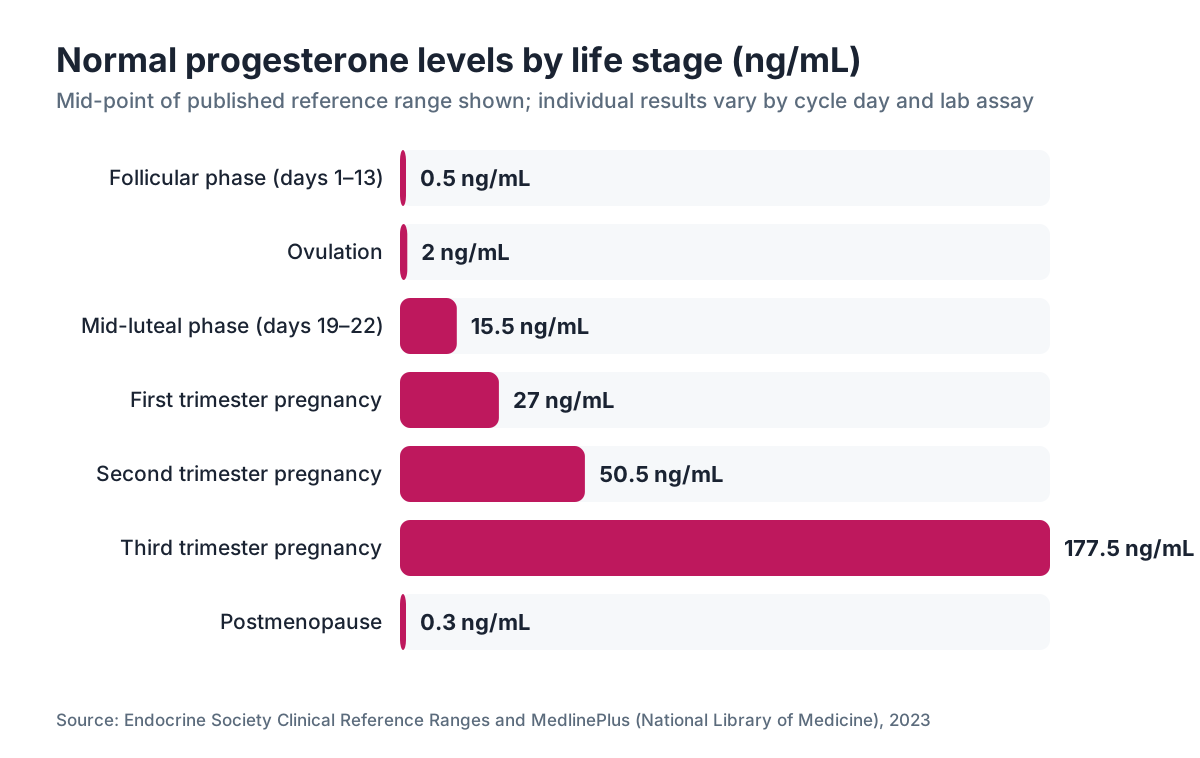
The Endocrine Society's reference ranges, used in most clinical practice, break down roughly like this [1]:
| Phase or status | Progesterone (ng/mL) | |---|---| | Follicular phase (days 1 to 13) | < 1 | | Ovulation | 1 to 3 | | Mid-luteal phase (days 19 to 22) | 6 to 25 | | Pregnancy, first trimester | 10 to 44 | | Pregnancy, second trimester | 19 to 82 | | Pregnancy, third trimester | 65 to 290 | | Postmenopause | < 0.5 |
The mid-luteal peak is the one that carries clinical weight. A level below 6 ng/mL drawn on day 21 of a 28-day cycle suggests ovulation either didn't happen or was weak. Above about 10 ng/mL on that same day is a confident sign an egg was released. Between 3 and 6 ng/mL is a gray zone. Repeat it.
Labs report progesterone in ng/mL (the US standard) or nmol/L (common in Canada and the UK). Multiply ng/mL by 3.18 to get nmol/L. A mid-luteal level of 10 ng/mL equals roughly 32 nmol/L.
Why do progesterone levels change so much across the menstrual cycle?
Progesterone comes mostly from the corpus luteum, the temporary gland that forms from the follicle after it releases an egg. Before ovulation, blood progesterone is very low because that gland doesn't exist yet. After ovulation, the corpus luteum ramps up fast and peaks around day 21 in a textbook 28-day cycle. If a fertilized egg doesn't implant, the corpus luteum dissolves, progesterone drops, and the uterine lining sheds [2].
That collapse in progesterone is what triggers your period. It also drives the mood and sleep changes many women feel in the days beforehand. Progesterone binds GABA receptors in the brain through its metabolite allopregnanolone, which is why a sharp drop can bring anxiety, poor sleep, and irritability [3].
During pregnancy, the placenta takes over progesterone production around week 10. That's why levels climb through the third trimester instead of cycling.
After menopause, ovulation stops and the corpus luteum no longer forms. Progesterone falls to near zero. That's normal physiology. It becomes relevant when women take estrogen as hormone therapy, because estrogen without progesterone raises endometrial cancer risk [4].
What does low progesterone look like, and how is it diagnosed?
Low progesterone rarely announces itself. Its symptoms overlap with a dozen other things, which is a big part of why it goes unnamed for years.
Common signs include irregular or absent periods, a luteal phase shorter than 10 days (track it with a basal body temperature chart or ovulation strips), PMS that lands hard in the week before your period, trouble conceiving, early miscarriage, poor sleep in the two weeks before your period, and mood swings that follow your menstrual calendar.
Diagnosis is a blood test, but timing decides everything. A progesterone level drawn on day 3, or whenever an appointment happened to open up, tells you almost nothing. For a result that means something you need a mid-luteal draw, roughly 7 days after confirmed ovulation. In a 28-day cycle that's around day 21. In a 35-day cycle it's around day 28. If your cycles are irregular, track ovulation with an LH strip and draw blood 7 days later. That beats counting from day 1 [1].
A single mid-luteal level below 6 ng/mL warrants a repeat test. Two low readings plus matching symptoms is usually enough to start a real conversation about treatment.
What happens to progesterone levels during perimenopause?
Perimenopause is where progesterone falls apart first. Estrogen often stays steady or even spikes early on, but progesterone starts sliding years before periods stop, because ovulation gets erratic [5].
No ovulation, no corpus luteum. No corpus luteum, no progesterone surge that month. You can still bleed on schedule, but if you didn't ovulate, your progesterone stayed follicular-phase low the entire cycle. That's an anovulatory cycle, and it gets more common through your 40s [11].
The practical result: estrogen and progesterone fall out of sync. Estrogen keeps building the uterine lining without progesterone to balance it. That can mean heavier, longer, or more irregular periods, and over time it raises the risk of endometrial hyperplasia if nobody addresses it [4].
Here's the trap. A perimenopausal woman's mid-luteal progesterone might look perfectly fine the month she ovulated and crash the next month when she didn't. One number lies. Serial testing, or tracking alongside cycle symptoms, gives you a far cleaner picture.
If you want the timeline, perimenopause age and when does menopause start cover what to expect and roughly when.
What are normal testosterone levels for women, and how does that connect to progesterone?
Testosterone earns a spot here because labs often test it alongside progesterone, and patients ask about both in the same visit.
Normal testosterone for women sits far below male levels. The Endocrine Society puts the premenopausal range around 15 to 70 ng/dL by standard immunoassay, though reference ranges shift by lab [6]. Some labs report in pg/mL or nmol/L; 1 ng/dL equals about 34.7 pmol/L.
| Life stage | Total testosterone (ng/dL) | |---|---| | Premenopausal (peak reproductive years) | 15 to 70 | | Perimenopause | 10 to 55 | | Postmenopause (no therapy) | 7 to 40 |
These numbers vary a lot between labs and assays. The immunoassay tests most commercial labs run are not accurate at the low concentrations typical in women. Mass spectrometry (LC-MS/MS) is more reliable but harder to find [6].
Testosterone on the low end can cause low libido, fatigue, trouble building muscle, and mood changes, but those symptoms point everywhere. The Endocrine Society does not recommend routine testosterone testing unless those symptoms are present, because assay noise makes an isolated low-normal result hard to act on.
Progesterone and testosterone don't regulate each other directly. They share the same steroidogenesis pathway and both fall with age, which is why a full female hormone panel usually includes both.
What progesterone level confirms ovulation?
A mid-luteal progesterone above 3 ng/mL confirms ovulation happened. Fertility medicine usually wants 6 to 10 ng/mL to call the luteal phase adequate, which is a higher bar than ovulation alone [7].
A level of 3 ng/mL says an egg was probably released but the corpus luteum may be weak. A level of 10 ng/mL or higher says ovulation happened and the luteal phase looks healthy. Fertility specialists often want to see 15 to 20 ng/mL in a cycle running ovulation induction drugs.
One study in Fertility and Sterility found natural conception cycles averaged mid-luteal progesterone around 15 ng/mL, with a wide spread [7]. Cycles that ended in early pregnancy loss tended to run lower, though that's correlation, not proof of cause.
If you're tracking for fertility and your mid-luteal levels sit under 10 ng/mL again and again, take that to your OB or reproductive endocrinologist before you assume you need supplementation. Low readings can reflect anovulation, a short luteal phase, or ordinary cycle-to-cycle variability.
What progesterone levels indicate the need for hormone replacement therapy?
Progesterone levels alone don't decide whether you need hormone therapy. That call runs on symptoms, estrogen levels, menopause status, and uterine health, not a progesterone number sitting by itself.
Here's where the numbers do matter. Postmenopausal women on systemic estrogen who still have a uterus need progesterone (or a synthetic progestogen) to protect the endometrium. The Menopause Society guidance is blunt: unopposed estrogen in a woman with a uterus raises endometrial cancer risk and isn't appropriate [4]. Your progesterone blood level doesn't change that. What matters is whether you're taking it.
Women prescribed oral micronized progesterone (brand name Prometrium) or a progestogen IUD like Mirena as part of hormone therapy usually won't show mid-luteal surges on testing, because they aren't cycling anymore. Their blood levels reflect the dose, not a natural rhythm.
For a perimenopausal woman weighing hormone therapy, a serum progesterone alongside FSH and estradiol helps map how far the transition has moved. An FSH consistently above 40 mIU/mL with low estradiol and low progesterone, in a symptomatic woman, points strongly toward menopause [12].
See what's available and how it works at hormone replacement therapy and estrogen patch.
How is progesterone tested, and what affects accuracy?
Progesterone comes from a standard blood draw. No saliva or urine test for progesterone holds up clinically; both correlate poorly with serum levels and shouldn't drive treatment decisions [8].
Timing is the biggest threat to accuracy. Because progesterone peaks mid-luteal, a draw at the wrong cycle day can read abnormally low in a completely healthy woman. Record the cycle day, and if you can, note whether you confirmed ovulation with an LH strip or basal body temperature before the draw.
Fasting isn't required. The test is stable enough that time of day matters less than cycle day, though some labs flag a slight diurnal variation.
Things that can artificially suppress a progesterone result: hormonal contraception (the pill, patch, or hormonal IUD suppresses ovulation and the progesterone surge with it), recent miscarriage or delivery (levels fall fast), and stress-related hypothalamic suppression that delays or blocks ovulation.
Things that can push it up: the early weeks of pregnancy (rule this out before treating low progesterone), congenital adrenal hyperplasia (rare but real), and progesterone supplements the patient is already taking and forgot to mention.
What are treatment options for low progesterone?
Treatment depends on why progesterone is low and which symptoms you're chasing.
For women trying to conceive with a luteal phase defect, vaginal progesterone (brands Endometrin, Crinone) or oral micronized progesterone (Prometrium) are the usual choices. The FDA has approved progesterone to support embryo implantation in assisted reproductive technology cycles [9]. For natural cycles with borderline luteal levels, the evidence thins out; some reproductive endocrinologists use it empirically, others investigate anovulation first.
For perimenopausal women whose symptoms track with low progesterone (irregular cycles, poor sleep, luteal-phase anxiety), low-dose oral micronized progesterone at 100 mg before bed is sometimes prescribed. The sedative effect comes from allopregnanolone, and in women with perimenopausal insomnia that's usually a feature, not a bug.
For postmenopausal women on systemic estrogen, progesterone protects the uterine lining. It isn't there to rebuild a natural cycle. Dose and delivery depend on the estrogen regimen: continuous daily low-dose versus cyclic higher-dose.
Before starting any of these, get a clear read on your hormone panel. A telehealth provider like WomenRx can order baseline labs and interpret them against your symptoms without the usual wait for a specialist slot.
For how progesterone fits into the larger menopause picture, progesterone and menopause are the two best starting points.
Can progesterone levels help predict or confirm menopause?
Progesterone doesn't confirm menopause the way FSH does. But a persistently undetectable progesterone (below 0.5 ng/mL), paired with matching estradiol and FSH, in a woman over 45 who has missed 12 straight periods, supports the diagnosis.
Menopause is defined as 12 consecutive months without a period and no other medical cause. That's a clinical and historical diagnosis, not a lab value [5]. ACOG notes that FSH above 40 mIU/mL on two readings more than two months apart is commonly used to support the diagnosis in symptomatic women, but a single FSH or a single progesterone shouldn't make the call [12].
Progesterone testing earns its keep in the perimenopausal years before that 12-month mark, when cycles are irregular and it's hard to tell whether a missed period was anovulatory (progesterone never rose) or an early pregnancy (progesterone would be up). Running a pregnancy test and a progesterone level together at that point is sensible.
For typical menopause timing and the age range when most women start noticing changes, menopause age has the population data.
What does a progesterone level tell you about bone density and cardiovascular risk?
Progesterone's relationship with bone is real but only partly understood. Estrogen gets most of the credit for slowing bone loss after menopause, yet progesterone receptors sit on osteoblasts (the bone-building cells), and some research suggests progesterone may support bone formation rather than just slow breakdown [10].
A 2018 review in Climacteric noted that animal and early human data suggest progesterone may stimulate osteoblast activity, though the clinical evidence in postmenopausal women isn't as clean as the estrogen data. Nobody has solid randomized trial data on progesterone-only therapy and fracture prevention after menopause. That's the honest state of it.
On the cardiovascular side, the type of progestogen matters. Synthetic progestins like medroxyprogesterone acetate (MPA) have been linked to less favorable lipid profiles and may partly offset estrogen's cardiovascular benefit in some studies. Oral micronized bioidentical progesterone looks more neutral, though the data isn't strong enough for firm claims [4].
If you're worried about bone density after menopause, get a baseline bone density test, ideally at menopause or earlier if you carry risk factors.
Frequently asked questions
What is a normal progesterone level on day 21 of a 28-day cycle?
A mid-luteal progesterone drawn around day 21 should land between 6 and 25 ng/mL in a cycle where ovulation occurred. Above 10 ng/mL confirms ovulation confidently. Below 3 ng/mL on day 21 suggests ovulation didn't happen or the corpus luteum is underperforming. The range is wide because progesterone pulses throughout the day.
Can progesterone levels tell me if I'm in perimenopause?
Not on their own. A low mid-luteal progesterone can flag an anovulatory cycle, which gets more common in perimenopause, but it doesn't confirm perimenopause by itself. FSH and estradiol levels, plus your cycle history and symptoms, give a fuller picture. Perimenopause is a clinical diagnosis, not a single lab value.
What is the normal range of testosterone levels for women?
The Endocrine Society puts normal total testosterone for premenopausal women at roughly 15 to 70 ng/dL. Postmenopausal women usually run lower, around 7 to 40 ng/dL. These ranges vary by lab and assay. Immunoassay tests are less accurate at the low concentrations typical in women; mass spectrometry gives more reliable results.
How do I know if my progesterone is low without getting a blood test?
You can't be certain without a blood test, but symptom patterns hint at it. A luteal phase shorter than 10 days (trackable with basal body temperature), PMS that worsens the week before your period, poor sleep in the second half of your cycle, and irregular periods all fit low progesterone. These overlap with thyroid issues and other conditions, so a blood test is still the right move.
Does low progesterone cause weight gain?
Directly, probably not much. But low progesterone alongside relatively higher estrogen can cause water retention and bloating that feels like weight gain. Low progesterone also disrupts sleep, and chronic poor sleep raises cortisol, which can add abdominal fat over time. The link is indirect, not simple cause and effect.
What progesterone level is considered too high?
Outside pregnancy, a progesterone level above 25 ng/mL in a non-pregnant woman is unusual and worth investigating. Very high levels can point to congenital adrenal hyperplasia, a luteinized unruptured follicle (where the follicle luteinizes without releasing an egg), or progesterone supplements. In early pregnancy, rising levels above 25 ng/mL are normal and reassuring.
Is saliva testing accurate for measuring progesterone levels?
No. Saliva progesterone tests don't reliably reflect serum concentrations and shouldn't guide clinical decisions. The Endocrine Society and most clinical guidelines recommend serum (blood) testing only. Saliva tests are especially unreliable in women using topical or vaginal progesterone, since those raise salivary progesterone out of proportion to blood levels.
What progesterone level indicates pregnancy?
No single threshold confirms pregnancy, but a progesterone above 25 ng/mL in a woman with a positive pregnancy test suggests a normally progressing intrauterine pregnancy. Levels below 5 ng/mL in a confirmed pregnancy carry a high risk of ectopic pregnancy or miscarriage. Levels between 5 and 25 ng/mL need serial monitoring alongside quantitative hCG.
What are normal testosterone levels for women after menopause?
Postmenopausal women usually have total testosterone between 7 and 40 ng/dL, versus 15 to 70 ng/dL premenopausally. The decline is gradual through the 40s and 50s, not a sudden drop at the transition. Low testosterone after menopause is linked to reduced libido and fatigue, though the Endocrine Society recommends against treating on a lab value alone without matching symptoms.
How often should I test my progesterone levels?
For routine monitoring in a symptomatic perimenopausal woman, once or twice a year is usually enough to track trends, always timed to mid-luteal phase. If you're actively trying to conceive and checking luteal adequacy, monthly mid-luteal testing over 2 to 3 cycles beats a single result. Women already on hormone therapy rarely need progesterone monitoring unless symptoms change.
Can progesterone levels affect anxiety and depression?
Yes, through progesterone's metabolite allopregnanolone, which acts on GABA receptors in the brain. When progesterone drops sharply in the late luteal phase, lower allopregnanolone activity can trigger anxiety, irritability, and low mood. This is the likely mechanism behind PMDD and some perimenopausal mood symptoms. A progesterone blood level doesn't capture allopregnanolone directly, but the timing of symptoms often points here.
What is the difference between bioidentical progesterone and synthetic progestins?
Bioidentical progesterone (oral micronized progesterone, brand name Prometrium) has the same molecular structure as the progesterone your ovaries make. Synthetic progestins like medroxyprogesterone acetate (MPA) or norethisterone are structurally different and bind other receptors, which is why their side effect profiles differ. The Women's Health Initiative used MPA; observational data suggest oral micronized progesterone may carry a more favorable cardiovascular and breast risk profile, though head-to-head trial data are limited.
Does stress affect progesterone levels?
Yes. Chronic stress raises cortisol, which is built from the same precursor (pregnenolone) as progesterone. High cortisol demand can pull pregnenolone away from progesterone synthesis, an idea sometimes called the 'pregnenolone steal.' More to the point, stress-related hypothalamic suppression can delay or block ovulation, so no corpus luteum forms and mid-luteal progesterone stays near zero that cycle.
Sources
- Endocrine Society, Clinical Practice Guideline on Hormone Testing
- MedlinePlus (U.S. National Library of Medicine), Progesterone Test
- Bäckström T et al., GABA-A receptor-modulating steroids in relation to the menstrual cycle, Hormones and Behavior, 2014
- The Menopause Society (formerly NAMS), 2022 Hormone Therapy Position Statement
- National Institute on Aging (NIA), Menopause
- Endocrine Society Clinical Practice Guideline, Androgen Therapy in Women, Journal of Clinical Endocrinology & Metabolism, 2014
- Jordan J et al., Progesterone and conception, Fertility and Sterility, 2015
- Endocrine Society, Position Statement on Salivary Hormone Testing
- FDA, Prometrium (progesterone, USP) Prescribing Information
- Prior JC, Progesterone for the prevention and treatment of osteoporosis in women, Climacteric, 2018
- CDC, Reproductive Health: Infertility FAQs
- American College of Obstetricians and Gynecologists (ACOG), Committee Opinion on Hormone Therapy in Perimenopause and Menopause