Progesterone for sleep: does it actually work and how much do you need?
TL;DR: Oral micronized progesterone (brand name Prometrium) improves sleep quality in perimenopausal and menopausal women by converting to a metabolite called allopregnanolone that calms the brain via GABA receptors. The effect is dose-dependent, typically appears at 100-300 mg taken at bedtime, and is strongest with oral rather than topical forms. It does not work the same way in women who still have high natural progesterone levels.
Why do so many women lose sleep during perimenopause and menopause?
Sleep falls apart for a lot of women in their 40s and 50s, and progesterone is one of the main reasons nobody explains clearly. The standard story blames hot flashes. That is only part of it. Even women who are not sweating through their sheets report broken sleep, waking at 3 am, and a mind that will not shut off.
Progesterone drops earlier and faster in perimenopause than estrogen does. A woman can still have regular periods and already carry progesterone levels well below what she made at 30. That drop matters for sleep because progesterone, and specifically one of its metabolites, has a direct sedating effect on the brain that has nothing to do with reproduction.
Estrogen loss drives hot flashes, which absolutely disrupt sleep. But the loss of progesterone's calming effect on the brain is a separate mechanism. It can cause insomnia on its own, even when hot flashes are mild [1]. Women and their doctors miss this because the conversation about menopause and sleep usually stops at "hot flashes wake you up," full stop.
How does progesterone actually improve sleep? The GABA connection explained
Progesterone itself is not the sleep agent. Its metabolite, allopregnanolone (also called 3-alpha, 5-alpha-tetrahydroprogesterone), is what acts on the brain. Allopregnanolone is a potent positive allosteric modulator of GABA-A receptors, which means it makes gamma-aminobutyric acid, the brain's main inhibitory neurotransmitter, work more effectively [2].
GABA-A is the same receptor system that benzodiazepines and alcohol target. Allopregnanolone hits a slightly different binding site, but the downstream effect is similar: neural activity quiets, anxiety drops, and falling asleep gets easier. This is not a minor or theoretical effect. The brain is genuinely sedated by this mechanism, which is why oral progesterone taken at night causes drowsiness as a predictable side effect.
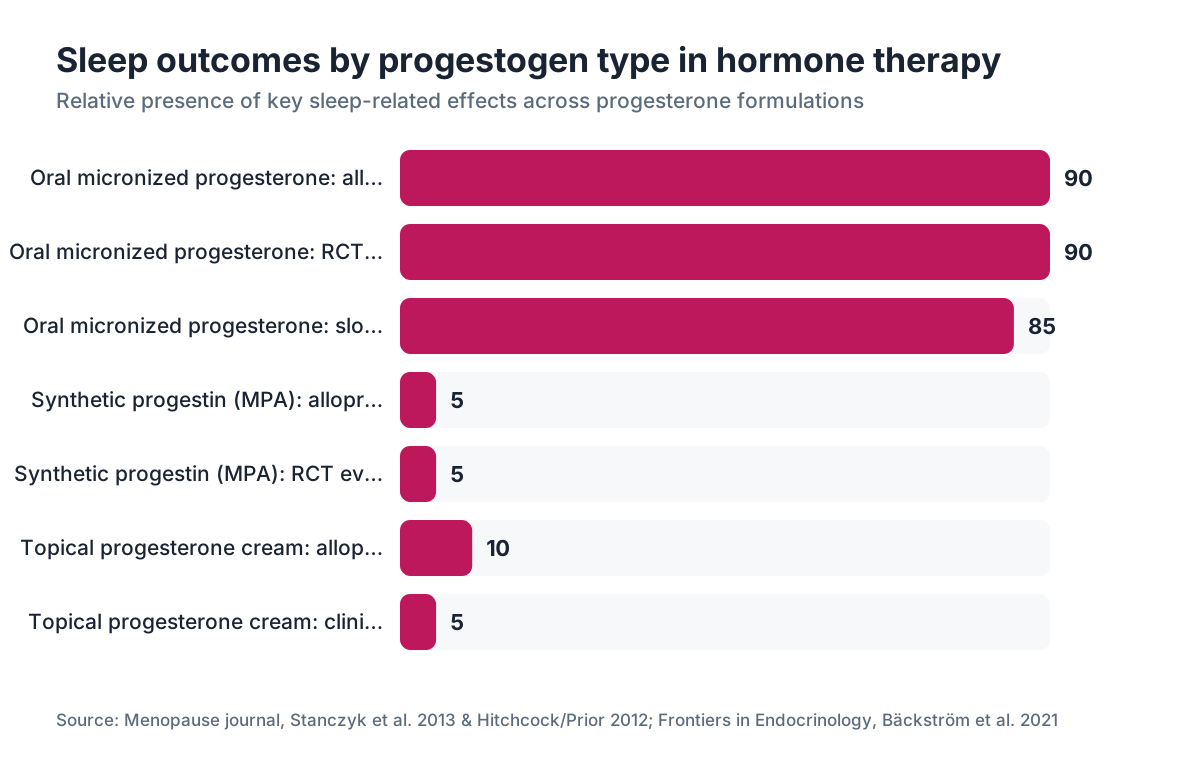
The key word here is oral. When you swallow micronized progesterone, your gut and liver convert a meaningful chunk of it into allopregnanolone on the first pass through your system. That first-pass conversion is what produces the sleep benefit. Progesterone delivered through skin as a cream or gel skips that conversion, so allopregnanolone levels in the brain stay much lower [3]. Vaginal progesterone also bypasses first-pass metabolism. The route of administration is the whole game for women taking progesterone specifically to sleep better.
The North American Menopause Society (NAMS) has noted in its practice guidelines that "oral micronized progesterone has a sedative effect, which can be used therapeutically," distinguishing it from progestins like medroxyprogesterone acetate that do not produce the same effect on the brain [4].
What does the research actually show about progesterone and sleep quality?
The evidence is genuinely encouraging, though it is not as large as the research on GLP-1 drugs or antidepressants. A few well-designed studies are worth knowing.
A 2012 randomized controlled trial published in Menopause (the journal of NAMS) studied 101 perimenopausal women with sleep disturbance. Women who took 300 mg of oral micronized progesterone for 3 months reported better sleep quality, fewer nighttime awakenings, and better next-day functioning compared to placebo. The authors concluded that oral micronized progesterone "improved subjective sleep quality in perimenopausal women with sleep disturbances" [5].
Polysomnography studies, which measure actual sleep architecture instead of just what women report, show that progesterone increases the share of time spent in slow-wave sleep (the deep, restorative stage) and cuts the time spent in lighter sleep stages [6]. That fits what the allopregnanolone mechanism would predict, since GABA enhancement tends to push toward deeper sleep.
A 2018 analysis of Women's Health Initiative data found that women using hormone therapy with oral progesterone had better sleep outcomes than those using combination pills with synthetic progestins. That points to allopregnanolone production, not progesterone itself, as the mechanism, because synthetic progestins do not convert to allopregnanolone [1].
Nobody has clean long-term data on whether the sleep benefit holds at years 3, 5, or 10 of use. The longest well-controlled trials run to about 12 months. That is an honest gap in the evidence.
| Outcome | Oral micronized progesterone | Synthetic progestins (e.g., MPA) | Topical progesterone cream | |---|---|---|---| | Allopregnanolone production | High (first-pass conversion) | None | Very low | | Subjective sleep improvement | Yes, in RCTs | Unclear or negative | Not well studied | | Slow-wave sleep increase | Yes (polysomnography) | No evidence | No evidence | | Hot flash effect | Modest | Modest | Minimal | | Sedation next day | Possible at 300 mg | Rare | Uncommon |
What is the right dose of progesterone for sleep?
For women using oral micronized progesterone as part of hormone therapy, the standard FDA-approved dose is 200 mg at bedtime for 12 days per month (cyclic regimens) or 100 mg nightly continuously [7]. The sleep benefit shows up at both doses, but the 200-300 mg range tends to produce stronger sedation.
Some clinicians prescribe 300 mg nightly off-label for women whose main complaint is sleep, especially when estrogen already controls hot flashes and the only thing left is insomnia. That is a real clinical practice pattern, not fringe medicine, but it is above the FDA-labeled dose.
At 100 mg, most women notice mild sleepiness for the first 2-4 weeks and then habituate somewhat. At 300 mg, next-morning grogginess is more common, particularly in the first month. This is not dangerous. It matters for women who drive early or need to be sharp at 6 am.
Women who still have a uterus need progesterone as part of hormone therapy to protect the uterine lining from estrogen-driven overgrowth. For them, the dose is set partly by uterine safety and partly by symptoms. Women who have had a hysterectomy do not need progesterone for uterine protection, but some clinicians still prescribe it for sleep or mood, which the mechanism supports even though it is off-label.
There is no validated therapeutic range for allopregnanolone in blood, so dosing is guided by symptom response and tolerability, not lab numbers. Blood progesterone levels reflect progesterone itself, not its brain-active metabolites, so chasing a specific serum number to fix sleep is not evidence-based.
Oral progesterone vs. topical cream for sleep: which form works?
Oral micronized progesterone works. Topical cream almost certainly does not produce a meaningful sleep benefit, and this is one place where the science is clear enough to have a firm opinion.
The reason is first-pass metabolism. Gut and liver enzymes convert a large fraction of oral progesterone into allopregnanolone before it reaches general circulation. That conversion raises allopregnanolone levels in the brain into the range that sedates. Skin absorption delivers progesterone straight into the bloodstream without passing through the liver first, so allopregnanolone formation stays much lower [3].
Some over-the-counter progesterone creams are marketed specifically for sleep or "hormone balance." No good clinical trial supports sleep improvement from topical progesterone cream, and the biochemistry explains why: you simply are not making enough allopregnanolone through that route. Buying progesterone cream for sleep means spending money on something that misses the mechanism entirely.
Vaginal progesterone (Endometrin, Crinone gel, compounded suppositories) also largely bypasses first-pass metabolism. It works for uterine protection and for holding a pregnancy, but it is the wrong choice for sleep.
Compounded oral progesterone in oil capsules, similar to Prometrium, should behave the same way as brand-name oral micronized progesterone if the particle size and oil vehicle match, though compounded products are not tested for bioequivalence by the FDA [7]. That is a real uncertainty with compounding: you cannot be as confident in absorption.
If you are treating insomnia with progesterone, oral micronized progesterone at bedtime is the only form with clinical trial evidence behind it. That is not a marketing claim. It is what the data support.
Who is most likely to benefit from progesterone for sleep?
The women most likely to see real sleep improvement from oral progesterone fall into a few clear groups.
Perimenopausal women with irregular cycles and new sleep problems are strong candidates. Their progesterone production is already dropping (progesterone comes from the corpus luteum after ovulation, and ovulation gets less reliable in perimenopause), while their estrogen may still swing unpredictably. Adding oral progesterone steadies the GABA-calming signal their ovaries no longer produce on schedule [1].
Postmenopausal women on estrogen-based hormone therapy who still sleep badly are another clear group. If estrogen controls hot flashes but sleep stays fragmented, adding or raising oral progesterone is a logical next step with real biological rationale.
Women with anxiety-driven insomnia, the kind where they lie awake with racing thoughts instead of waking from sweat, often respond especially well because the GABA mechanism speaks directly to that neural overactivity.
Premenopausal women with normal progesterone during the luteal phase are less likely to benefit, because their allopregnanolone already sits in the physiological range. Some women with premenstrual dysphoric disorder (PMDD) are actually more sensitive to allopregnanolone swings and can have paradoxical anxiety responses to progesterone. This is not a one-size-fits-all recommendation.
Progesterone is not a first-line treatment for primary insomnia unrelated to hormonal change. A 40-year-old with normal hormone levels and no perimenopause symptoms who has insomnia should try cognitive behavioral therapy for insomnia (CBT-I) first, which has the strongest evidence base, before any hormonal intervention [6].
Are there risks or side effects of using progesterone for sleep?
Oral micronized progesterone is generally well-tolerated, but it is not free of side effects or risks.
The most common side effects are sedation and dizziness, which is exactly what the mechanism predicts. Taking it at bedtime keeps daytime impairment down for most women. Some report grogginess the next morning, especially at 300 mg. Plan around driving or operating heavy machinery before the sedation fully clears in those first few weeks.
Gastrointestinal effects, mostly nausea and bloating, hit some women. Prometrium capsules contain peanut oil, which matters for anyone with a peanut allergy. This is stated plainly in the FDA prescribing information; women with peanut allergy should not use Prometrium and should ask their prescriber about alternatives [7].
Progesterone slightly raises the risk of urinary tract infections in some studies and can cause breast tenderness. These effects are usually mild and often fade within the first few months.
The cardiovascular and cancer risk picture for progesterone is substantially better than for synthetic progestins like medroxyprogesterone acetate (MPA). The Women's Health Initiative study that raised alarms about hormone therapy in 2002 used conjugated equine estrogen plus MPA, not progesterone. Observational and mechanistic data suggest oral micronized progesterone has a neutral or more favorable cardiovascular and breast cancer profile than MPA, though large randomized trials comparing the two head to head over many years do not exist [4].
Progesterone is not appropriate for general use in the first trimester of pregnancy (it is used in specific fertility contexts under close supervision). It should not be used in women with unexplained vaginal bleeding, severe liver disease, or known or suspected breast cancer. These contraindications are in the prescribing label [7].
If you are considering progesterone specifically for sleep, talking to a clinician who focuses on women's hormones is worthwhile. Telehealth platforms like WomenRx that work only in women's hormone therapy can often evaluate this faster than waiting for a general gynecology appointment.
See our full overview of progesterone for a deeper look at safety data.
How long does it take for progesterone to improve sleep?
Most women feel the sedating effect of oral progesterone on the very first night. That is not placebo. The allopregnanolone mechanism is fast, acting on GABA receptors within hours of the dose, so the acute effect on falling asleep is genuinely quick.
Meaningful improvement in overall sleep quality, the sense that you are consistently sleeping better and waking less, tends to settle in over 4-8 weeks as the body adjusts to a steady progesterone signal. Some women partly habituate to the sedation over the first month, meaning they feel less groggy but still sleep better. That is usually the outcome you want.
The 2012 Menopause journal RCT mentioned above ran for 3 months, and statistically significant sleep improvement showed up at the end of that period [5]. Clinical experience suggests gains can keep building over several months as the broader hormonal picture stabilizes.
If you have taken oral progesterone for 3 months and sleep has not improved much, one of three things is going on: the dose needs adjusting, the formulation is not absorbing well, or the real driver of your insomnia is something other than low progesterone. Sleep apnea, thyroid trouble, and iron deficiency are common causes of poor sleep in perimenopausal women that have nothing to do with progesterone and will not respond to it.
Can progesterone replace sleep medications like Ambien or trazodone?
For some women, yes, oral progesterone at bedtime sedates enough to make sleep medications unnecessary. For others, it works alongside them rather than replacing them. Here is the honest part: no head-to-head randomized trial compares oral progesterone to zolpidem or trazodone for menopausal insomnia.
The practical case for trying progesterone first (when it is indicated for hormone therapy anyway) is that it treats a root cause instead of just chemically sedating the brain. If poor sleep comes from a progesterone-allopregnanolone deficiency, replacing progesterone is the more logical move.
Zolpidem (Ambien) also works through GABA-A receptors, but it carries next-day cognitive impairment, tolerance, dependence, and, at higher doses, complex sleep behaviors. The FDA has required labeling changes several times to address these risks [7]. Progesterone, though also sedating, does not carry the same dependence liability or abuse potential.
Trazodone is an antidepressant used off-label for sleep. It does nothing for hormonal root causes. Many women on trazodone for menopausal insomnia are treating a hormone deficiency with a psychiatric drug, which works but is not the most targeted approach.
CBT-I (cognitive behavioral therapy for insomnia) remains the gold standard for chronic insomnia by clinical guideline consensus, and it does not interact with any hormonal regimen. For perimenopausal and menopausal women, pairing CBT-I with appropriately prescribed oral progesterone is probably the most evidence-supported approach, though I will be direct that no large trial has tested the combination formally.
For context on the full landscape of menopause care, including non-hormonal options, see our menopause overview.
Does progesterone help with other menopause symptoms alongside sleep?
Yes, and that is part of why oral progesterone makes sense for many perimenopausal and menopausal women even if sleep were not the point.
Progesterone taken as part of hormone therapy protects the uterine lining in women using systemic estrogen. That is its primary clinical job. But the effects on the brain reach past sleep: many women report less anxiety, steadier mood, and a calmer baseline during the luteal phase (or during progesterone therapy) compared to when progesterone runs low [2]. The allopregnanolone mechanism matters for anxiety as much as for sleep.
Oral progesterone has modest but real effects on hot flashes and night sweats when used alone. It is not as strong as estrogen for those symptoms, but for women who cannot take estrogen (history of certain hormone-sensitive cancers, clotting disorders, or personal preference), progesterone-only approaches can cut hot flash frequency by roughly 50-60% in some small trials. The Menopause journal published a Canadian trial (the Hitchcock study) in 2011 showing this effect [5].
Bone protection is mainly an estrogen story. Progesterone's role in bone density is smaller and less well established. Women worried about bone density should read our bone density test information and discuss estrogen-based therapy with their clinician.
Progesterone does not meaningfully help with genitourinary symptoms of menopause (vaginal dryness, urinary urgency, discomfort with sex). Those need local or systemic estrogen. See our estrogen patch article for more on that.
For a wider view of what shifts hormonally during this transition, see our pieces on perimenopause age and when does menopause start.
How do you get a prescription for oral progesterone?
Oral micronized progesterone (Prometrium, or a compounded equivalent) requires a prescription in the United States. You cannot buy it over the counter, though low-dose progesterone creams are available without a prescription (and as covered above, those do not produce a meaningful sleep benefit).
The prescription pathway is straightforward. A primary care doctor, OB-GYN, or menopause specialist can prescribe it. If you have a uterus and are already on systemic estrogen, your prescriber should already be offering a progestogen. If progesterone has not come up, ask specifically about oral micronized progesterone rather than accepting a synthetic progestin by default, and ask about bedtime dosing if sleep is a concern.
For women not yet on hormone therapy who want to start, getting an evaluation first makes sense. A clinician needs to review your symptoms, history, and any contraindications before prescribing. Telehealth has made this faster: platforms focused on women's hormonal health, including WomenRx, can run the evaluation and issue a prescription (when appropriate) without the 3-to-6-month wait many gynecology practices now have.
Generic oral micronized progesterone costs roughly $30-70 for a 30-day supply at most pharmacies with a GoodRx coupon or similar discount. Brand-name Prometrium runs much higher, around $150-250 per month without insurance, and coverage varies widely. Compounded progesterone in oil capsules can beat brand-name Prometrium on price but requires choosing a reputable pharmacy.
See our hormone replacement therapy guide for a fuller picture of how progesterone fits into a complete HRT regimen.
What should you know about progesterone and sleep apnea?
This is a genuinely interesting area where the science is more complicated than most people expect.
Progesterone stimulates breathing, working through progesterone receptors in the brainstem. Premenopausal women have lower rates of obstructive sleep apnea than men partly because progesterone keeps upper airway muscle tone higher and drives steadier respiratory effort. After menopause, when progesterone drops, women's sleep apnea rates climb toward those of men the same age [6].
That raises a logical question: could oral progesterone therapy reduce sleep apnea in postmenopausal women? A few small studies have looked, and the results are mixed. Some show a modest drop in the apnea-hypopnea index (breathing interruptions per hour). Others show nothing significant. The evidence is not strong enough to recommend progesterone as a treatment for sleep apnea, and CPAP (continuous positive airway pressure) remains the standard of care for moderate-to-severe obstructive sleep apnea regardless of hormonal status [6].
The practical takeaway: if a perimenopausal or menopausal woman sleeps poorly and does not respond to oral progesterone or other hormone therapy as expected, get sleep apnea evaluated. It is underdiagnosed in women because their symptoms are often quieter than men's (fatigue, insomnia, and mood problems rather than loud snoring). A sleep study is the only way to know for sure.
Frequently asked questions
Does oral progesterone make you sleepy the same night you take it?
Yes, in most cases. The conversion to allopregnanolone happens within a few hours of the dose, and GABA-receptor activation is fast. Most women notice sedation on night one. That is why clinicians consistently advise taking it at bedtime rather than in the morning. The acute sedation is not placebo; it is the same mechanism that makes benzodiazepines work, just through a slightly different receptor site.
Can progesterone cream help with sleep the same way oral progesterone does?
No. Topical progesterone cream bypasses first-pass liver metabolism, so it produces very little allopregnanolone, the metabolite that actually calms the brain via GABA receptors. Over-the-counter progesterone creams marketed for sleep or hormone balance lack clinical trial evidence for sleep improvement, and the biochemistry explains why they would not work through the same mechanism as oral micronized progesterone.
What is allopregnanolone and why does it matter for sleep?
Allopregnanolone is a metabolite produced when the body breaks down progesterone, especially through first-pass liver metabolism after an oral dose. It binds to GABA-A receptors in the brain, the same targets as benzodiazepines and alcohol, making inhibitory signaling more effective. The result is less neural excitation, lower anxiety, and easier sleep onset. It also increases time spent in slow-wave (deep) sleep as measured by polysomnography.
Is Prometrium the same as progesterone, or is it different?
Prometrium is the brand name for oral micronized progesterone. It contains bioidentical progesterone (chemically identical to what the ovaries produce) suspended in peanut oil in a gelatin capsule. The FDA approved it for use in postmenopausal women on estrogen therapy. Generic oral micronized progesterone is the same active ingredient and should behave similarly. Both produce allopregnanolone after ingestion, which is why they help with sleep.
How much progesterone should I take for sleep specifically?
FDA-labeled doses are 100 mg nightly (continuous) or 200 mg nightly for 12 days per cycle. Some clinicians prescribe 300 mg nightly off-label when sleep is the primary concern. Higher doses produce stronger sedation but also more next-morning grogginess, especially in the first month. There is no validated blood level that corresponds to optimal sleep benefit, so dosing is based on symptom response.
Will progesterone help me sleep if I am still having periods?
Possibly, if your progesterone production is already declining due to less consistent ovulation, which is common in perimenopause even with regular periods. If you are under 40 with no signs of perimenopause and otherwise normal hormone levels, progesterone supplementation is less likely to add sleep benefit because your allopregnanolone already sits in the physiological range. Premenopausal women with PMDD can sometimes have paradoxical anxiety responses to progesterone.
Is progesterone safe to take long term for sleep?
Long-term safety data for oral micronized progesterone is reassuring compared to synthetic progestins. Observational evidence suggests a more favorable cardiovascular and breast cancer risk profile than medroxyprogesterone acetate. NAMS and the Endocrine Society both consider hormone therapy, including progesterone, appropriate for healthy women under 60 or within 10 years of menopause onset. Longer-term randomized trial data beyond 5 years are limited, so this remains an area of ongoing monitoring.
Can men use progesterone for sleep?
Men do produce small amounts of progesterone and have GABA-A receptors that respond to allopregnanolone. Some integrative medicine practitioners prescribe progesterone off-label for sleep in men. But clinical trial evidence for this use is essentially absent, and the hormonal context is very different from menopausal women. This article focuses on women because that is where the evidence exists.
What is the difference between progesterone and progestins for sleep?
Progesterone is the bioidentical hormone that converts to allopregnanolone in the liver and acts on GABA-A receptors to promote sleep. Synthetic progestins like medroxyprogesterone acetate (MPA) or norethindrone do not convert to allopregnanolone and do not produce the same sedating, GABA-calming effect. Women seeking sleep benefit from the progestogen part of hormone therapy should request oral micronized progesterone, not a synthetic progestin.
Do I need to take estrogen alongside progesterone, or can I use progesterone alone for sleep?
If you have a uterus and are taking systemic estrogen, you must also take a progestogen (including progesterone) to protect the uterine lining. But progesterone can be used alone, without estrogen, for sleep and other symptoms. The Canadian Hitchcock trial showed oral micronized progesterone at 300 mg reduced hot flashes and improved sleep without estrogen in perimenopausal women. Whether to use it alone or combined with estrogen depends on your full symptom picture.
What happens to sleep if I stop taking progesterone suddenly?
Stopping progesterone abruptly can cause rebound insomnia and anxiety because the brain has adjusted to higher allopregnanolone levels. This is not as severe as stopping benzodiazepines, but it is real and worth planning for. Tapering down over 2-4 weeks is generally the sensible approach. Discuss a discontinuation plan with your prescribing clinician rather than stopping cold.
Can progesterone help with night sweats or just with sleep onset?
Both, to a degree. Progesterone has modest effects on the hypothalamic thermoregulatory set point that drives hot flashes and night sweats, though this effect is weaker than estrogen's. For women who wake specifically from drenching sweats, estrogen is the more targeted treatment. Progesterone's sleep benefit is more about sleep architecture and reducing nighttime arousal than directly suppressing the hot flash mechanism.
Is progesterone for sleep covered by insurance?
Usually yes, when prescribed as part of hormone therapy for a diagnosed condition like menopause. Coverage varies by plan. Generic oral micronized progesterone, the least expensive option, costs roughly $30-70 per month with a discount card at most chain pharmacies even without insurance. Brand-name Prometrium can cost $150-250 monthly without coverage. Prior authorization is sometimes required; your prescribing clinician's office can help with that documentation.
Sources
- Menopause (NAMS journal), Ensrud et al., 2018, Sleep disturbances and hormone therapy in WHI
- Frontiers in Endocrinology, Bäckström et al., 2021, Allopregnanolone and GABA-A receptors
- Menopause (NAMS journal), Stanczyk et al., 2013, Pharmacokinetics of progesterone formulations
- North American Menopause Society, Menopause Practice Guidelines 2022
- Menopause (NAMS journal), Hitchcock & Prior, 2012, Progesterone for sleep in perimenopausal women RCT
- Journal of Clinical Sleep Medicine, Mirer et al., 2017, Menopause, hormones, and sleep apnea review
- FDA, Prometrium (progesterone) prescribing information
- Endocrine Society, Clinical Practice Guideline on Menopause, 2015
- Journal of Clinical Endocrinology and Metabolism, Caufriez et al., 2011, Progesterone and sleep quality
- FDA, Zolpidem prescribing information and safety labeling changes
- NIH National Institute on Aging, Sleep problems in menopause
- Sleep Medicine Reviews, Polo-Kantola et al., 2014, Hormone therapy and sleep quality systematic review