Premenopause vs perimenopause: what's actually different
TL;DR: Premenopause is your whole reproductive life before the transition starts, with regular cycles and predictable hormones. Perimenopause is the active transition, usually starting in your 40s, when estrogen and progesterone swing unpredictably and symptoms like irregular periods, hot flashes, and 3 a.m. waking show up. Same-sounding words, completely different biology.
What does premenopause actually mean?
Premenopause is the whole stretch of your reproductive life before the transition starts. Cycles are regular (or close to it), ovulation happens most months, and hormone levels stay inside what the Endocrine Society calls the normal premenopausal range: estradiol roughly 15 to 350 pg/mL depending on where you are in your cycle, and FSH below 10 IU/L in the early follicular phase [1].
That's a wide window. A 22-year-old and a 38-year-old with perfectly regular periods are both premenopausal. The word describes a status, not a countdown.
Here's where people get tripped up. Premenopause is not a symptom phase. If you're having hot flashes, erratic cycles, or waking at 3 a.m. drenched in sweat, you are almost certainly no longer premenopausal. Those symptoms belong to perimenopause. The confusion happens because no one sits a woman down at 40 and explains what comes next.
Some clinicians use premenopause loosely to mean 'before menopause' in a broad colloquial sense, which muddies things further. The precise definition, from the Stages of Reproductive Aging Workshop (STRAW+10), keeps the term for women in reproductive stages before any transition begins [2].
What is perimenopause and when does it start?
Perimenopause is the transition leading up to menopause. It starts when your ovaries begin producing less consistent estrogen and progesterone, and it ends 12 months after your final period. That 12-month mark is the moment menopause is officially reached [2].
Most women enter perimenopause between ages 45 and 55. The SWAN cohort (Study of Women's Health Across the Nation) puts average onset around age 47, with the full transition lasting 4 to 8 years [3]. Some women start in their late 30s. Onset before 40 is a separate diagnosis called primary ovarian insufficiency (POI), not early perimenopause.
The defining event is hormonal chaos, not a tidy decline. Estrogen does not slide down a ramp. It spikes and crashes, sometimes hitting higher peaks than in your 30s before it eventually falls. That erratic pattern drives the symptoms. FSH climbs because the pituitary is working harder to recruit follicles that no longer respond well.
Not every woman notices the start. Some sail through early perimenopause with nothing worse than slightly longer cycles. Others get hit hard by broken sleep and mood swings before they've missed a single period. The range is genuinely that wide.
You can read more about perimenopause age and when menopause starts to see the full timeline.
How are premenopause and perimenopause different? A side-by-side comparison
The cleanest way to separate these stages is to look at your hormones, your cycles, and your body at the same time.
| Feature | Premenopause | Perimenopause | |---|---|---| | Cycle regularity | Regular (21-35 days) | Irregular, lengthening, or skipped | | Ovulation | Most cycles | Sporadic, declining | | Estrogen pattern | Cyclical, predictable | Fluctuating, unpredictable | | FSH level | Below 10 IU/L (early follicular) | Rising, often above 10-25 IU/L [1] | | AMH (ovarian reserve) | Normal for age | Low or undetectable | | Hot flashes | Rare | Common (up to 80% of women) [4] | | Sleep disruption | Occasional | Frequent, hormonally driven | | Mood changes | PMS-pattern | Anxiety, depression, mood lability | | Fertility | Present | Declining but not zero | | Pregnancy risk | Normal | Lower but real until 12 months after final period | | Bone density change | Stable or slow decline | Accelerated loss begins [5] | | Hormone therapy need | Usually none | Sometimes indicated |
The practical difference is simple. In premenopause, your body runs a reasonably predictable hormonal program. In perimenopause, that program is rewriting itself in real time, and the errors are what you feel.
One number to keep: the North American Menopause Society (NAMS) reports that vasomotor symptoms (hot flashes and night sweats) affect up to 80% of women during the transition, and about 25% rate them severe enough to disrupt daily life [4].
What symptoms belong to perimenopause and not premenopause?
Premenopause, by definition, has no menopausal symptoms. If you recognize the list below, perimenopause is probably in play.
Cycle changes come first for most women. Periods that ran 28 days start stretching to 35 or 40. Then you skip a month. Some women get the opposite pattern first: shorter, heavier cycles before the lengthening starts. Both count as normal perimenopause.
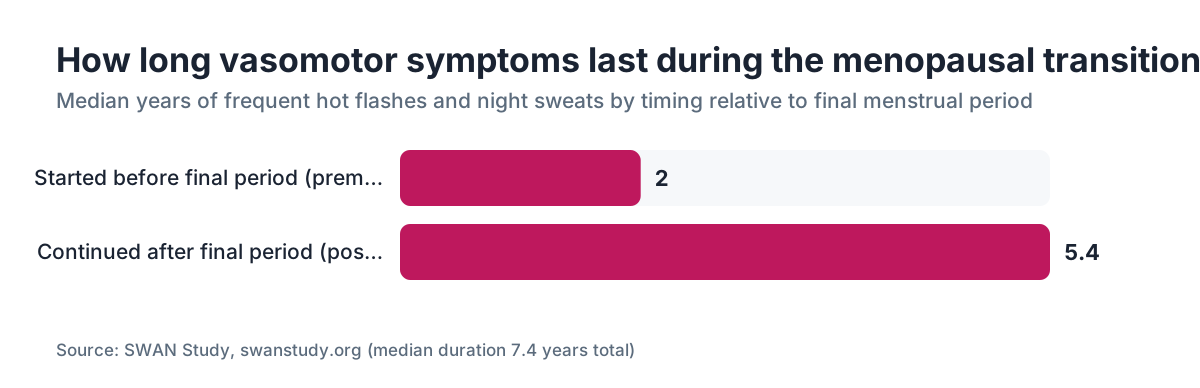
Vasomotor symptoms are the signature of the transition. Hot flashes usually last 1 to 5 minutes and can hit a few times a day or dozens. Night sweats are the same thing after dark. SWAN followed women for over a decade and found the median duration of frequent vasomotor symptoms was 7.4 years, beginning about 2 years before the final period and running well past it [3].
Sleep often breaks before women connect the dots. Waking between 2 and 4 a.m. and not getting back down is a pattern clinicians tie to falling progesterone. Progesterone acts on GABA receptors in the brain, so when it drops, sleep architecture falls apart.
Brain fog, memory blips, trouble concentrating. Real symptoms, badly underreported, usually blamed on stress or age.
Mood changes earn their own line. Women with a history of PMS or postpartum depression are more vulnerable during the transition. Depression risk rises: a longitudinal study in JAMA Internal Medicine found perimenopausal women had roughly twice the odds of depressive symptoms compared to premenopausal women [6].
Genitourinary symptoms show up too: vaginal dryness, more frequent urinary tract infections, new bladder urgency. These tend to emerge in late perimenopause and worsen after menopause. Menopause covers what happens once the transition finishes.
Can you be in perimenopause and still have regular periods?
Yes. Early perimenopause (Stage -2 in the STRAW+10 classification) is defined by subtle cycle changes, not full-blown irregularity [2]. A woman whose cycles shift from 28 days to 32 or 34 can be in early perimenopause, especially if her FSH has started climbing or hot flashes have arrived.
This is one of the most disorienting parts of the transition. Women expect a clear signal. A missed period feels definitive. But the biology whispers for years before it shouts.
STRAW+10 defines early perimenopause as a persistent difference of 7 or more days in cycle length between consecutive cycles. Late perimenopause starts when you have 60 or more days between periods [2]. By the time cycles are that far apart, most women are close to their final one.
Some women hit early perimenopause while their labs still read 'normal' to a provider who ordered a single day-3 FSH. FSH bounces day to day this early, so one normal result rules out nothing.
How do you know which stage you're in? Tests and signals that help
No single test cleanly sorts premenopause from perimenopause. Diagnosis is mostly clinical: your age, your cycle history, and your symptoms tell most of the story. Labs add supporting detail.
FSH (follicle-stimulating hormone) rises as the ovaries stop responding. An FSH above 10 IU/L on day 2-3 of your cycle is worth discussing. Above 25-30 IU/L with symptoms points strongly at late perimenopause or menopause. But FSH swings so much during the transition that NAMS recommends against diagnosing off a single value [4].
Estradiol (E2) can read low, normal, or high in perimenopause depending on the day. One low value confirms nothing. One high value rules out nothing.
AMH (anti-Mullerian hormone) reflects ovarian reserve more steadily than FSH because it doesn't shift across the cycle. Very low AMH points to earlier menopause, but it doesn't diagnose perimenopause on its own.
A bone density scan (bone density test) is worth considering by your mid-40s if you're in late perimenopause or carry osteoporosis risk factors. Estrogen guards bone, and loss speeds up during the transition: women can lose 1-2% of bone density a year around the final period [5].
Thyroid trouble and pregnancy both mimic perimenopause closely. Rule out both before you pin symptoms on the transition.
What hormone changes happen in each stage?
In premenopause, the HPO axis (hypothalamic-pituitary-ovarian axis) runs the way it was built to. The hypothalamus releases GnRH in pulses. The pituitary answers with FSH and LH. The ovaries make estrogen and progesterone on a predictable monthly rhythm. Estradiol peaks around ovulation, progesterone rises in the luteal phase, and both fall before your period.
Perimenopause breaks this loop. The ovaries respond less reliably. Some cycles are anovulatory (no egg released), so progesterone (only made in real amounts after ovulation) drops even when a period still shows up. That's why low progesterone is often the first hormonal shift in early perimenopause, and why PMS-type symptoms get worse before any obvious estrogen change appears.
Estrogen then goes erratic. In early perimenopause, estradiol can run higher than it did in your 30s, with dramatic spikes that cause breast tenderness and bloating. In late perimenopause, average estradiol falls below 30 pg/mL, and by postmenopause it typically sits below 10 pg/mL [1].
Testosterone declines slowly across your entire reproductive life. It doesn't crash at menopause the way estrogen does. But the loss still matters for libido, energy, and muscle.
Inhibin B, made by your follicles, drops early in the transition. That's one reason FSH climbs: the pituitary loses the ovarian signal that used to hold it back.
Does weight gain happen differently in premenopause vs perimenopause?
Perimenopause weight gain is a different animal from ordinary middle-age weight gain, and the difference is clinical, more than cosmetic. In premenopause, weight follows the usual rules of any decade: calories, activity, sleep, and metabolic health run the show.
In perimenopause, the hormones change where fat lands and how well you burn it. Falling estrogen moves fat off the hips and thighs (subcutaneous) and onto the abdomen (visceral). Visceral fat is metabolically active in a bad way. It drives insulin resistance, inflammation, and cardiovascular risk.
SWAN documented an average gain of about 1.5 kg (3.3 lbs) per year during the transition, with belly fat rising even in women whose total weight barely moved [3].
GLP-1 receptor agonists like semaglutide are increasingly used by perimenopausal women fighting exactly this kind of weight gain that ignores their old strategies. The STEP 1 trial reported average weight loss of 14.9% with semaglutide 2.4 mg over 68 weeks, versus 2.4% on placebo [7], which can shift both total weight and abdominal fat. If you're weighing this option, semaglutide for weight loss covers the evidence and what to expect.
WomenRx works specifically with women dealing with hormonal weight gain during perimenopause and offers both hormone evaluation and GLP-1 prescribing when it fits.
Estrogen therapy has documented effects on body composition too. Studies consistently show systemic estrogen blunts the visceral fat gain that comes with menopause [8].
When should you start thinking about hormone replacement therapy?
For premenopausal women with no symptoms, hormone therapy is generally not indicated. Regular cycles and normal labs mean the system is working. Leave it alone.
Perimenopause changes the math. NAMS states in its position statement that for healthy women under 60, or within 10 years of menopause onset, the benefits of hormone therapy outweigh the risks for treating vasomotor symptoms and preventing bone loss [4]. The evidence is strongest for women who start early in the transition, not decades later.
The type of therapy matters. Hormone replacement therapy can be estrogen alone (for women without a uterus), combined estrogen and progesterone (for women with a uterus, to protect the lining), or other formulations. Progesterone type matters too: body-identical micronized progesterone carries a different risk profile than synthetic progestins.
An estrogen patch delivers estrogen through the skin, skipping the liver, which sidesteps the small clotting-risk bump linked to oral estrogen. That's a real distinction for women who already carry cardiovascular risk.
Start the conversation earlier than most women expect. Waiting until symptoms are severe means years of avoidable misery and can mean missing the window when bone and cardiovascular benefits are most reachable.
To see the full arc of what follows perimenopause, menopause age covers the range of ages at which women hit the 12-month mark.
Can you be in perimenopause without knowing it?
Absolutely. This might be the most missed reality of the whole transition.
Early perimenopause can be silent. Cycles shift a little. Mood swings get blamed on work or a hard year. Broken sleep gets called anxiety. Brain fog gets waved off as a busy life. For a lot of women, the first time a provider names the whole cluster as perimenopause, they feel two things at once: relief (so there's a reason) and anger (why did nobody tell me?).
Average onset is 47, but some women start in their late 30s. A 39-year-old with newly irregular cycles, worsening PMS, and fresh anxiety may already be in early perimenopause. If she sees providers who assume she's too young, the diagnosis gets missed.
Signs that are easy to blame on something else: worsening PMS in your late 30s or 40s, new or worse migraines (especially menstrual ones), heavier periods before they turn irregular, and sudden insomnia that doesn't match your usual sleep.
If that's you, ask your provider directly for FSH, estradiol, and AMH drawn on day 2 or 3 of your cycle, and ask them to apply the STRAW+10 staging framework to your history. That turns a vague appointment into a useful one.
What about fertility in premenopause vs perimenopause?
Premenopause means full reproductive capacity, though fertility falls with age across the premenopausal years. A 38-year-old premenopausal woman has meaningfully lower fertility than a 28-year-old, even with regular cycles, because egg quality and quantity decline through the 30s.
In perimenopause, fertility drops sharply but isn't zero until menopause is confirmed. This genuinely surprises women: you can have an irregular, unpredictable cycle and still ovulate now and then. Accidental pregnancies do happen in perimenopause, which is why contraception is recommended until 12 months after the last period if you don't want to conceive.
The CDC and ACOG both note that while perimenopause sharply reduces fertility, contraception should continue until menopause is confirmed [9]. For women who do want to conceive in perimenopause, a reproductive endocrinology consult makes sense, because the window closes fast once the transition begins.
One practical wrinkle for women on hormonal contraception: the pill can mask perimenopause and suppress the cycle changes that would otherwise flag it. Coming off hormonal birth control in your late 40s is often when women first notice symptoms that were already there, just hidden.
What lifestyle changes actually help during the perimenopausal transition?
The honest answer: lifestyle moves the needle more than most women expect, and less than they'd like.
Resistance training is the single highest-value habit of the transition. Estrogen is anabolic, so its decline speeds up muscle loss (sarcopenia) and bone loss. Lifting counteracts both. Trials consistently show gains in bone density and body composition from progressive resistance training in perimenopausal women, though the effect is modest next to hormone therapy [5].
Sleep hygiene becomes serious business, not aspirational advice. A cooler bedroom matters more than it did in your 30s, because even mild room warmth can set off night sweats. Alcohol reliably worsens both hot flashes and sleep in perimenopause, even at amounts that never bothered you before.
Stress reduction is not optional. Cortisol directly suppresses progesterone. Chronic stress can deepen the progesterone deficit that already defines early perimenopause.
Diet shifts that help: adequate protein (at least 1.2 g/kg body weight to protect muscle), fewer refined carbs to fight rising insulin resistance, and enough calcium and vitamin D for bone. The NIH recommends 1,200 mg of calcium daily for women over 50 [10].
Nobody has great data on most supplements marketed for menopause. The closest credible evidence is for isoflavones (plant estrogens), where some trials but not all show a modest drop in hot flash frequency. The effect is far weaker than prescription estrogen.
Frequently asked questions
Is premenopause the same as perimenopause?
No. Premenopause describes the years before any transition begins, when cycles are regular and hormones follow a predictable pattern. Perimenopause is the active transition, defined by hormonal fluctuations, changing cycles, and symptoms like hot flashes and broken sleep. The two get used interchangeably in casual talk, but they describe completely different biological states.
What age does perimenopause usually start?
Most women begin between ages 45 and 55. The SWAN study found average onset around age 47, with the transition lasting 4 to 8 years. Some women start in their late 30s or early 40s, which is early perimenopause. Onset before 40 is classified as primary ovarian insufficiency, a separate diagnosis that needs its own workup.
How do I know if I'm premenopausal or perimenopausal?
If your cycles are regular and you have no menopausal symptoms, you're likely still premenopausal. If your cycles are changing (longer, shorter, heavier, or skipped), or you're having hot flashes, night sweats, broken sleep, or mood swings, perimenopause is probable. FSH, estradiol, and AMH add supporting information but aren't definitive alone. Clinical history and symptoms drive the diagnosis.
Can perimenopause symptoms start while periods are still regular?
Yes. Early perimenopause, Stage -2 in the STRAW+10 framework, can happen with only subtle cycle changes, like cycles shifting from 28 to 34 days. Symptoms like worsening PMS, new insomnia, or mood swings can appear before periods turn obviously irregular. The transition starts in the hormones before it shows up clearly in the cycle.
What is the difference between premenopause and menopause?
Premenopause is the reproductive years before any transition starts. Menopause is a single point in time: 12 consecutive months with no period, confirmed only in hindsight. Perimenopause sits between them, the transition that usually lasts 4 to 8 years. After the 12-month mark, a woman is postmenopausal for the rest of her life.
What are the first signs that perimenopause is starting?
The earliest signs are often subtle: cycles shifting by 7 or more days from your usual pattern, worsening PMS, more intense premenstrual mood symptoms, and sleep changes, especially early morning waking. Hot flashes and night sweats usually come later. Some women notice breast tenderness or more headaches before cycle irregularity is obvious.
Can you get pregnant in perimenopause?
Yes, though fertility is much lower. Ovulation can still happen during perimenopause even with irregular cycles, so accidental pregnancy is possible. Both the CDC and ACOG recommend continuing contraception until menopause is confirmed by 12 months without a period. If you actively want to conceive, a reproductive endocrinologist can assess your remaining ovarian reserve and options.
Does perimenopause cause weight gain?
Perimenopause changes where fat is stored more than it simply adds pounds. Falling estrogen pushes fat toward the abdomen (visceral) even when total weight barely moves. The SWAN study documented about 1.5 kg of gain per year during the transition. This fat shift raises cardiovascular and metabolic risk, which is one reason the transition is a good time to address body composition head-on.
How long does perimenopause last?
On average, 4 to 8 years, though it can run from a few months to more than a decade. SWAN data show the median duration of vasomotor symptoms (hot flashes and night sweats) is about 7.4 years, starting before the final period and often continuing for years after. Late perimenopause, defined by cycles 60 or more days apart, is usually the last phase before menopause.
Should I start hormone therapy during perimenopause?
NAMS guidance supports hormone therapy for healthy women under 60, or within 10 years of menopause onset, who have bothersome vasomotor symptoms or are at risk for bone loss. Starting earlier in the transition generally means better outcomes than waiting. The right formulation depends on your symptoms, uterine status, and risk profile. Make this decision with a provider who knows your full history.
What blood tests confirm perimenopause?
No single test confirms it definitively. FSH above 10 IU/L on day 2-3 of the cycle is suggestive, and levels above 25-30 IU/L with symptoms point strongly at late perimenopause. NAMS advises against relying on a single FSH value because it swings widely during the transition. AMH gives more stable insight into ovarian reserve. Thyroid function and pregnancy should also be checked, since both mimic perimenopause.
Is perimenopause different if you've never had PMS?
Women with no significant PMS history can still have pronounced perimenopause symptoms. That said, women with a history of severe PMS or premenstrual dysphoric disorder (PMDD) appear more sensitive to hormonal swings and may have more intense mood symptoms during the transition. The underlying mechanism, sensitivity to rapid estrogen and progesterone shifts, is similar in both.
Can stress push you from premenopause into perimenopause early?
Chronic stress doesn't directly cause perimenopause, which is driven by the depletion of ovarian follicles. But stress can worsen symptoms by suppressing progesterone through cortisol, and extreme physical stressors like very low body weight or heavy athletic training can disrupt the HPO axis and cause cycle changes that mimic early perimenopause. Stress management genuinely matters for how bad the transition feels.
What happens to bone density during perimenopause vs premenopause?
Bone density is relatively stable in premenopause, with a slow natural decline starting in the mid-30s. In perimenopause, loss speeds up sharply: women can lose 1 to 2 percent of bone density a year in the years around the final period. This tracks directly with declining estrogen, the key regulator of osteoclast activity. A bone density scan by your mid-40s gives you a baseline to track against.
Sources
- Endocrine Society, Clinical Practice Guideline on Menopause
- Menopause (Journal of NAMS), STRAW+10 Staging System for Reproductive Aging
- SWAN Study (Study of Women's Health Across the Nation), University of Michigan
- North American Menopause Society (NAMS), Menopause Practice Guidelines
- JAMA Internal Medicine, Depressive symptoms and perimenopause (Cohen et al.)
- STEP 1 Trial, New England Journal of Medicine (Wilding et al., 2021)
- Menopause (Journal of NAMS), Estrogen therapy and body composition
- CDC, Contraception for Perimenopausal Women
- NIH Office of Dietary Supplements, Calcium Fact Sheet for Health Professionals
- FDA, Drug Labeling for Hormone Therapy Products