Perimenopause test: what actually works and what doesn't
TL;DR: No single blood test reliably diagnoses perimenopause. FSH and estradiol swing too much for one draw to be definitive. NAMS and the Endocrine Society diagnose perimenopause mainly by symptoms and menstrual history in women over 40. Labs help rule out thyroid disease, pregnancy, and other causes, but they don't replace the clinical picture.
What is a perimenopause test, and does one actually exist?
Short answer: not really. There is no single test that says "you are in perimenopause" the way a pregnancy test says you're pregnant. What clinicians actually do is combine your menstrual history, your symptom pattern, and selective bloodwork to rule out other explanations. The diagnosis is clinical.
Perimenopause is the transition to menopause. It starts with irregular cycles and ends one year after the final menstrual period. [1] That transition lasts anywhere from two to twelve years, averaging around four. [1] During that whole stretch, hormone levels are not declining in a smooth line. They swing. Estradiol can be wildly elevated one month and low the next. FSH bounces. That variability is exactly why a one-time blood draw often misleads more than it helps.
The North American Menopause Society states that perimenopause is diagnosed by menstrual irregularity and symptoms in women 40 and older, with laboratory testing reserved for specific clinical questions rather than routine confirmation. [2] The Endocrine Society takes the same position. [3] Knowing that upfront saves a lot of money and confusion.
Which blood tests do doctors order, and what do they actually measure?
Even though no test is definitive, several labs come up in perimenopause workups. Here is what each one measures, what it can tell you, and where it falls short.
FSH (follicle-stimulating hormone) is the most commonly ordered. As ovarian reserve declines, the pituitary pumps out more FSH trying to stimulate the ovaries. An FSH above 25 IU/L on day 2 or 3 of the cycle, confirmed on a second draw at least four to six weeks apart, is consistent with perimenopause or early menopause. [3] A single elevated FSH, though, means almost nothing. You can have an FSH of 45 one month and 12 the next during perimenopause.
Estradiol (E2) reflects current ovarian output. In perimenopause, estradiol actually runs high and erratic early in the transition before eventually declining. A low estradiol alongside a high FSH strengthens the picture of late perimenopause. A normal or high estradiol does not rule it out.
AMH (anti-Müllerian hormone) reflects the remaining follicle pool. It declines more steadily than FSH or estradiol, which makes it a more reliable marker of ovarian reserve trajectory. But AMH is not a standard perimenopause diagnostic, and reference ranges by age are still being refined. [4] It shows up far more in fertility medicine than in menopause diagnosis.
Thyroid-stimulating hormone (TSH) is worth ordering because thyroid dysfunction, especially hypothyroidism, overlaps almost symptom-for-symptom with perimenopause: fatigue, weight gain, irregular periods, mood changes, sleep disruption. About 5 percent of women 40 to 60 have undiagnosed hypothyroidism. [5] This is one of the most useful tests in the workup because it's actionable and commonly abnormal.
Testosterone (free and total) is not part of the standard perimenopause panel, but clinicians who focus on women's hormones often include it because low testosterone contributes to low libido, fatigue, and cognitive fog, all of which show up in perimenopause. There is no FDA-approved testosterone product for women in the U.S., which is a separate conversation, but knowing the level is still informative.
Beta-hCG (pregnancy test) should be checked in any woman with irregular bleeding who could be pregnant. Perimenopause does not make you infertile. Ovulation is erratic, not absent.
What do normal perimenopause lab ranges look like?
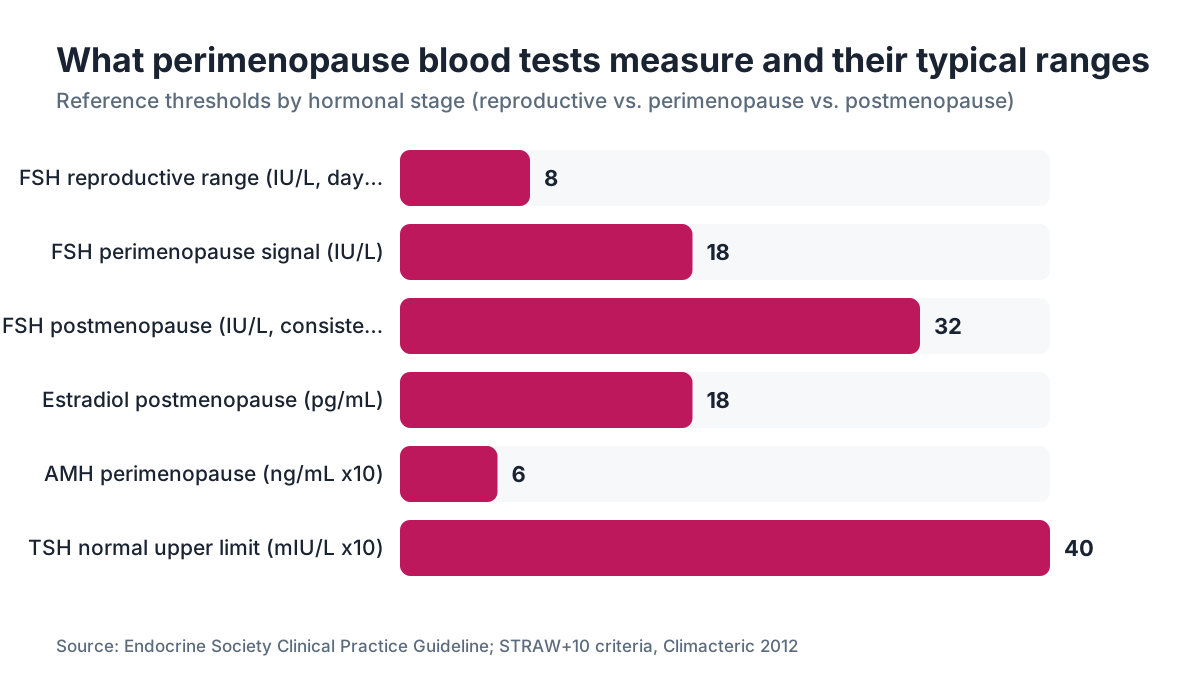
The table below shows typical reference ranges and what elevated or low values suggest in a perimenopausal context. These are general benchmarks, not diagnostic cutoffs, and they should always be read alongside symptoms and cycle history.
| Test | Reproductive range | Perimenopause signal | Postmenopause range | |---|---|---|---| | FSH | 3-10 IU/L (follicular) | >10-25 IU/L, variable | >25-40 IU/L consistently | | Estradiol | 30-400 pg/mL (varies by cycle) | Erratic, often elevated early | <30 pg/mL | | AMH | 1.0-3.5 ng/mL (age 35-40) | 0.2-1.0 ng/mL | <0.1 ng/mL | | TSH | 0.4-4.0 mIU/L | Same; abnormal = thyroid issue | Same | | LH | 2-15 IU/L | Rising, variable | >15-30 IU/L |
Sources: Endocrine Society Clinical Practice Guideline [3], NAMS 2023 position statement [2]. These ranges vary slightly by lab and assay. Your clinician's lab report will include its own reference intervals.
Here's one thing worth knowing. The Stages of Reproductive Aging Workshop (STRAW+10) criteria, published in 2012 and still the standard framework, use an FSH threshold above 25 IU/L on a random draw as a marker of late menopausal transition. [6] STRAW+10 also names cycle irregularity, specifically a variation of 7 or more days in consecutive cycles, as the first clinical sign of early perimenopause, before any hormone level changes. [6]
Are at-home perimenopause test kits reliable?
Several over-the-counter kits now let you test FSH at home using a urine dipstick. The FDA authorized some of these, including the Clearblue Menopause Stage Indicator and similar devices, as aids for identifying menopausal stage. [7] They measure urinary FSH and LH.
Here's the honest assessment. They can detect elevated FSH, and a persistently elevated result over multiple tests is consistent with menopausal transition. But the same variability problem applies. One elevated urine FSH test tells you your FSH was elevated that morning. It does not confirm perimenopause. The FDA authorized these to "aid in identifying" menopausal status, not to diagnose it. [7]
At-home hormone panels from direct-to-consumer labs (dried blood spot or fingerstick) add estradiol, progesterone, AMH, and sometimes cortisol and DHEA-S. The testing technology is generally legitimate. The interpretation problem remains: what do you do with an estradiol of 280 pg/mL and a progesterone of 0.4 ng/mL? Without a clinician who understands the context, the number is just a number.
If you want to spend money on at-home testing, the most defensible choice is a kit that includes TSH alongside FSH, because at least one of those results (TSH) has a clear action threshold. Companies like Everlywell and Labcorp OnDemand offer panels where results go through a physician review process. That's worth more than raw numbers with no interpretation.
My honest take: skip the urine dipstick FSH kits unless you're curious. Spend the $150 to $300 on a proper blood draw through your doctor or a telehealth platform and get the interpretation alongside the numbers.
How does a doctor actually diagnose perimenopause, step by step?
Walk into a well-trained clinician's office at 44 with hot flashes, sleep disruption, and a cycle that now comes every 23 days instead of every 28, and here is roughly what happens.
First, they take a menstrual history. When did cycles become irregular? How irregular? STRAW+10 stage 1 (early transition) is defined by at least a 7-day difference in cycle length in consecutive cycles. Stage 2 (late transition) includes amenorrhea of 60 days or more. [6] That staging guides the conversation.
Second, they screen for other causes. TSH rules out thyroid dysfunction. A pregnancy test rules out pregnancy. If bleeding is heavy or irregular, they may order a pelvic ultrasound to check endometrial thickness and rule out polyps, fibroids, or hyperplasia.
Third, they may check FSH and estradiol on cycle day 2 or 3 if your cycles are still somewhat regular, or on any day if they're not. They may also check AMH if ovarian reserve is a clinical question.
Fourth, and this is the part most women don't expect, they may decide not to order any hormones at all. In a woman 45 or older with classic symptoms and menstrual irregularity, the clinical picture is enough. The NAMS 2023 Menopause Practice guideline says most symptomatic women in this age group can start treatment without confirmatory labs. [2]
Fifth, if symptoms are severe, they assess treatment needs: hormone therapy candidacy, bone density baseline, cardiovascular risk. Those are separate conversations, but they happen at the same visit. A bone density test may be appropriate depending on risk factors, since estrogen loss speeds up bone loss during perimenopause.
What symptoms should prompt you to get tested?
The classic list includes hot flashes and night sweats (vasomotor symptoms), irregular periods, sleep disruption, vaginal dryness, mood changes, and brain fog. But the symptom that actually sends most women to a doctor is the irregular period, because it's concrete and measurable.
Perimenopause symptoms typically begin two to eight years before the final menstrual period, and in the U.S. the average age of menopause is 51.4 years. [1] So most women start noticing symptoms in their mid-to-late 40s, though some start as early as the late 30s.
A few symptoms should prompt faster evaluation rather than watchful waiting:
- Heavy or prolonged bleeding (soaking a pad or tampon more than hourly for several hours) needs workup for structural causes regardless of your hormone status.
- Bleeding after 12 consecutive months of no periods means you're postmenopausal, and any bleeding is abnormal until proven otherwise.
- Symptoms starting before age 40 need workup for premature ovarian insufficiency (POI), which carries different implications for bone and cardiovascular health than typical perimenopause.
- Symptoms alongside significant weight gain, hair loss, severe fatigue, or cold intolerance strongly suggest thyroid disease and need TSH testing first.
If your main symptom is irregular periods and you're 40 to 45, you're probably in early perimenopause and the clinical picture is often enough. If you're 38 and your periods have gone erratic with hot flashes, you need a fuller workup.
Can perimenopause be diagnosed at 35 or 40?
Perimenopause before age 40 is not perimenopause. It's premature ovarian insufficiency (POI), once called premature ovarian failure, and it affects roughly 1 in 100 women under 40. [8] It has different causes (autoimmune, genetic, chemotherapy-related, or idiopathic) and different stakes. Women with POI carry a much higher risk of osteoporosis and cardiovascular disease than women who reach menopause around 51. [8] Hormone therapy is strongly recommended in POI until at least age 50.
For women 40 to 44, the term is "early menopause," and it warrants the same evaluation as POI: karyotype if no clear cause is found, an autoimmune antibody panel, and assessment of cardiovascular and bone health. [3]
For women 45 and older, the clinical diagnosis of perimenopause is on solid ground if cycles are irregular and symptoms are present. The perimenopause age question is worth understanding in detail if you think you're transitioning earlier than expected.
How do you test for perimenopause at home before seeing a doctor?
You can do a few things yourself that are genuinely informative. Track your cycles with an app or paper calendar for at least three months, noting length, flow heaviness, and spotting. A variation of 7 or more days between cycles is the earliest clinical sign of perimenopause under the STRAW+10 criteria. [6] That data will be the first thing your doctor asks about.
Track your symptoms systematically. The Menopause Rating Scale (MRS) and the Greene Climacteric Scale are validated tools, and both are freely available online. Fill one out before your appointment. It gives your doctor a quantitative baseline and helps you say what's actually happening beyond "I feel awful."
If you want a preliminary blood test, you can order your own labs through direct-to-consumer services like Labcorp OnDemand or Quest Diagnostics MyQuest in most U.S. states without a physician order. A basic panel covering FSH, estradiol, TSH, and a metabolic panel costs roughly $150 to $350 depending on which tests you include and which service you use. Take those results to your physician, not as a diagnosis, but as a starting point for the conversation.
One thing I'd avoid: reading too much into a single panel drawn on a random cycle day. The numbers mean more to your doctor when paired with your symptom and cycle history than they will to you staring at them alone at 11pm.
How is perimenopause different from menopause, and does the test differ?
Menopause is a moment: twelve consecutive months without a period. Everything before that moment (when cycles are changing but haven't stopped) is perimenopause. Everything after is postmenopause. [1]
Testing does differ slightly. In postmenopause, FSH is consistently above 30-40 IU/L and estradiol is consistently low, so the lab picture is cleaner. One blood draw is more informative because the variability has settled. In perimenopause, you often need serial measurements or clinical judgment rather than a single data point.
The difference matters for treatment too. A woman in early perimenopause with hot flashes has different options than a woman two years postmenopause. For a full look at what changes after that final period, the menopause article covers it. When does menopause start is a related question that overlaps with perimenopause onset.
One number to keep: FSH stays above 25-30 IU/L consistently once true menopause is established, while in perimenopause it swings both above and below that threshold. [3]
What should you do with your test results?
If your FSH comes back elevated and your estradiol is low, that pattern is consistent with late perimenopause or early menopause. It supports, but does not prove, the diagnosis. Pair it with your symptom picture.
If your TSH is abnormal, that's an actionable finding regardless of your perimenopausal status. Hypothyroidism (TSH above 4.0-4.5 mIU/L in most lab references) is treated with levothyroxine, and fixing it often clears a large chunk of what felt like perimenopause symptoms.
If your AMH is very low for your age and your FSH is elevated, that combination points to a smaller remaining follicle pool. For a woman trying to conceive, that's urgent information. For a woman not trying to conceive, it confirms that menopause may arrive sooner than average, which helps with planning discussions about hormone therapy.
Here's the part that trips people up. If everything comes back in the normal reproductive range but you still feel terrible, that does not mean you're not in perimenopause. Hormone levels can be entirely normal during early perimenopause because the cycle irregularity, not the absolute levels, is the first signal. In that case, your symptoms and cycle history are the data that matter.
This is where working with a clinician who specializes in women's hormones pays off. A platform like WomenRx can read your labs in context rather than against population norms that ignore your symptoms entirely. If you end up considering hormone replacement therapy or an estrogen patch, those decisions should be made with someone who has the full picture.
What questions should you ask your doctor at your perimenopause appointment?
Go in with specific questions. Vague check-ins get vague answers.
Ask about cycle history first: "Based on my cycle log, what stage of transition do you think I'm in?" That grounds everything that follows.
Ask about thyroid specifically: "Have you ruled out thyroid disease?" Even if they ordered a TSH, saying it out loud makes sure the result got reviewed.
Ask about bone health. Estrogen loss speeds up bone density decline, and it starts in perimenopause, faster than after menopause. If you haven't had a bone density test, ask when that's appropriate for you.
Ask about the risk-benefit conversation for hormone therapy. The 2023 NAMS hormone therapy position statement says that for healthy women under 60 or within 10 years of menopause onset, the benefits of hormone therapy for vasomotor symptoms outweigh the risks for most women without contraindications. [2] Ask your doctor where you fall.
Ask about testosterone. It gets waved off at standard gynecology appointments because there's no FDA-approved female product. A clinician who takes women's hormones seriously will at least measure and discuss it.
And if your symptoms include big weight changes or metabolic issues alongside perimenopause, that's worth a separate conversation. There is growing evidence that the menopausal transition speeds up visceral fat accumulation, and some women in this window are good candidates for metabolic support including GLP-1 medications. A detailed look at semaglutide for weight loss and progesterone changes during perimenopause are both relevant reads if you're sorting out what's driving what.
How much does perimenopause testing cost?
Cost varies a lot depending on whether you use insurance, a direct-to-consumer lab, or a telehealth platform.
Through insurance with a physician order, the tests themselves (FSH, estradiol, TSH) are usually covered under standard diagnostic workup, though cost-sharing depends on your plan. You may owe $0 to $50 copay if the visit is for a relevant diagnostic purpose.
Without insurance or with a high-deductible plan, direct-to-consumer pricing is fairly transparent now. A basic FSH plus estradiol panel through Labcorp OnDemand runs roughly $40 to $80. Adding TSH, LH, and AMH brings most panels to $150 to $250. A full female hormone panel with testosterone, DHEA-S, cortisol, and thyroid function typically costs $250 to $400. These prices shift, so check current pricing directly with the lab service.
At-home urine FSH kits cost $15 to $30 at retail pharmacies and are generally not covered by insurance.
One thing to factor in: the test almost always costs less than the appointment to interpret it. Telehealth platforms can cut that interpretation cost, with visits for hormone evaluation typically running $75 to $200 depending on the platform and state. Some platforms fold lab review into a subscription.
Frequently asked questions
Can a blood test confirm perimenopause?
Not definitively. FSH and estradiol fluctuate too much during perimenopause for a single blood draw to confirm the diagnosis. NAMS and the Endocrine Society both diagnose perimenopause based on symptoms and menstrual irregularity in women over 40, with labs used to rule out other causes like thyroid disease or pregnancy rather than to confirm perimenopause itself.
What FSH level indicates perimenopause?
An FSH consistently above 10-25 IU/L is associated with early menopausal transition, and above 25-30 IU/L on two draws at least four to six weeks apart suggests late transition or menopause. But FSH swings widely in perimenopause. A single elevated reading, even above 40 IU/L, does not confirm perimenopause without a confirming draw and the clinical picture.
What is the most accurate test for perimenopause?
No single test is definitively accurate. Clinically, the most informative combination is menstrual cycle tracking plus FSH on two separate draws plus TSH to rule out thyroid disease. AMH is more stable than FSH and reflects ovarian reserve, but it's not a standard diagnostic tool for perimenopause. Your symptom history is often more informative than any single lab value.
Can you test for perimenopause at home?
You can. Urine FSH dipstick kits (FDA-authorized) detect elevated FSH and may be consistent with perimenopause if repeatedly elevated. Direct-to-consumer blood panels from services like Labcorp OnDemand let you test FSH, estradiol, AMH, and TSH for $150-$400. The technology is legitimate; the gap is interpretation. Raw numbers without clinical context can be misleading.
How do I know if I'm in perimenopause or just stressed?
Stress can cause irregular periods and mimic some perimenopause symptoms, but hot flashes and night sweats in women over 40 with menstrual changes are far more likely perimenopause than stress alone. A TSH to rule out thyroid dysfunction plus tracking your cycle length over three months will help distinguish the two. A clinician familiar with women's hormones can sort this out in one visit.
Does a normal hormone test rule out perimenopause?
No. In early perimenopause, FSH and estradiol are often in the normal reproductive range because the transition starts with cycle irregularity before hormone levels shift much. A normal FSH on one draw is common in perimenopause. NAMS states plainly that normal labs do not rule out perimenopause in a symptomatic woman over 40 with irregular cycles.
What is AMH and should I test it for perimenopause?
AMH (anti-Müllerian hormone) reflects the remaining follicle pool in the ovaries and declines more steadily than FSH or estradiol, which makes it a more consistent marker of ovarian reserve. It's not a standard perimenopause diagnostic, but a low AMH for your age suggests the transition may arrive sooner than average. It's most useful for fertility planning; for menopause diagnosis, it's supplementary.
Should I test progesterone during perimenopause?
Progesterone testing is not part of the standard perimenopause diagnostic workup, but it's informative for understanding cycle quality. In perimenopause, cycles are often anovulatory, meaning no egg is released and progesterone doesn't rise. A mid-luteal progesterone below 3 ng/mL confirms anovulation. This matters if you're considering progesterone supplementation or have concerns about unopposed estrogen. More on this at the progesterone article.
What age should I start testing for perimenopause?
There is no screening age for perimenopause in current guidelines. Testing is driven by symptoms and cycle changes, not a calendar. If you're 40 or older with irregular cycles, hot flashes, sleep disruption, or other suggestive symptoms, that's when evaluation makes sense. If symptoms start before 40, the evaluation focuses on ruling out premature ovarian insufficiency, which has different health implications.
Is the Clearblue Menopause Stage Indicator test accurate?
The Clearblue Menopause Stage Indicator measures urinary FSH and LH over time and was FDA-authorized as an aid for identifying menopausal stage, not as a diagnostic device. It performs better over multiple tests than a single reading. The same variability caveat applies: elevated results are consistent with perimenopause but not confirmatory. It's a reasonable starting point, not a diagnosis.
How is perimenopause testing different from menopause testing?
In postmenopause, hormone levels are consistently low estradiol and consistently high FSH, making a single blood draw more interpretable. In perimenopause, levels swing widely, so serial draws or clinical diagnosis based on symptoms are more reliable than any single lab. The clinical definition of menopause, twelve consecutive months without a period, doesn't require a lab at all.
Can perimenopause tests help decide if I need hormone therapy?
Labs inform but don't decide. A clinician weighs symptom severity, your menstrual stage, bone health, cardiovascular risk, and personal history alongside any labs before discussing hormone therapy. NAMS's 2023 position states that most symptomatic women under 60 or within 10 years of menopause onset can discuss hormone therapy without waiting for confirmatory lab values.
Does insurance cover perimenopause blood tests?
Usually yes, when ordered by a physician for a diagnostic purpose. FSH, estradiol, and TSH ordered during a visit for irregular bleeding or menopausal symptoms are typically covered under standard diagnostic labs, subject to your plan's cost-sharing. AMH is less consistently covered and may be billed as a fertility-related test. Direct-to-consumer labs without a physician order are generally not covered.
What happens if I test during the wrong part of my cycle?
It matters, especially for FSH and estradiol. FSH is most interpretable on days 2-3 of the menstrual cycle (early follicular phase). Estradiol at mid-cycle will be at its peak. Progesterone is only interpretable seven days before the expected next period. If your cycles are too irregular to time accurately, the results are harder to read, which is one more reason clinical context beats a single number.
Sources
- NIH National Institute on Aging, Menopause overview
- NAMS, 2023 Menopause Practice: A Clinician's Guide (position statement)
- Endocrine Society, Clinical Practice Guideline: Treatment of Symptoms of the Menopause
- Fertility and Sterility, AMH as a marker of ovarian reserve across reproductive lifespan
- NIH National Institute of Diabetes and Digestive and Kidney Diseases, Hypothyroidism
- Harlow et al., STRAW+10 Staging System, Climacteric 2012
- U.S. FDA, De Novo classification for Clearblue Menopause Stage Indicator
- NIH National Institute of Child Health and Human Development, Primary Ovarian Insufficiency
- Obstetrics and Gynecology, ACOG Practice Bulletin on Management of Menopausal Symptoms