Perimenopause spotting instead of a period: what's normal and what's not
TL;DR: During perimenopause, spotting instead of a full period is common and usually tied to erratic estrogen and low or absent progesterone. Most episodes are benign, but spotting after sex, spotting that soaks a pad, or any bleeding after 12 months of no periods needs a workup to rule out uterine cancer or polyps. See a clinician if you're unsure.
What is perimenopause spotting and why does it happen?
Perimenopause spotting is light, irregular bleeding that shows up when you'd normally expect either a full period or nothing at all. It can look like a few drops of pink or brown discharge, a smear on toilet paper, or a day or two of very light flow that never builds into an actual period.
The root cause is hormonal chaos. In the years leading up to menopause, your ovaries start skipping ovulation, sometimes for months at a stretch [1]. When you don't ovulate, your body still makes estrogen, but it produces little or no progesterone. Progesterone is the hormone that stabilizes the uterine lining and triggers a clean, organized shed. Without it, the lining builds up unevenly and then sheds in unpredictable bits, which is what you experience as spotting [2].
Estrogen itself swings wildly too. A surge thickens the lining fast. A sudden drop makes part of it shed before a full period is ready to come. Neither produces the rhythmic, predictable bleed of your reproductive years. The result can be anything from a light spot every few weeks to months of nothing followed by a heavy gush.
This is different from the spotting some women notice mid-cycle in their 20s or 30s, which is usually a sign of ovulation. Perimenopausal spotting is less predictable and often appears in place of a period rather than alongside one.
How common is irregular bleeding in perimenopause?
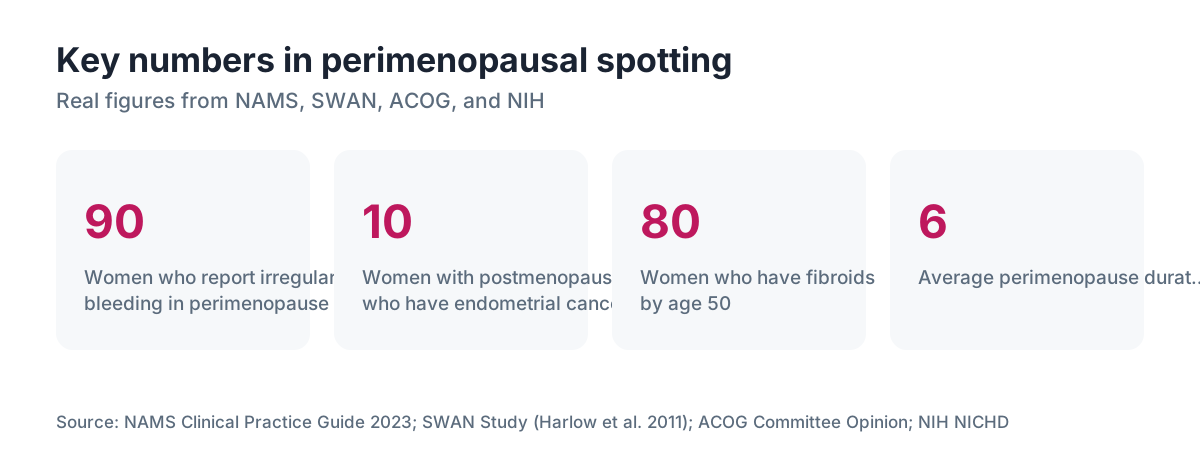
Very common. The SWAN study (Study of Women's Health Across the Nation), which followed over 3,000 women through the menopausal transition, found that more than 90% of women report at least one episode of irregular bleeding in the three to five years before their final period [3]. Spotting instead of a full period is one of the most frequently reported patterns.
The North American Menopause Society (NAMS) describes changes in menstrual bleeding as the hallmark symptom of perimenopause, often beginning years before hot flashes or sleep problems appear [1]. For many women, the first sign that something hormonal is shifting is a period that is shorter, lighter, or replaced entirely by a day or two of spotting.
Age matters here. Perimenopause usually begins in the early-to-mid 40s, though it can start as early as the late 30s perimenopause age. The transition typically lasts four to eight years before the final menstrual period, which by definition marks menopause.
So if you're 43, your periods have gotten shorter and lighter, and now you're seeing spotting where a period used to be, you're almost certainly in perimenopause. But common does not mean ignore it. The frequency of benign perimenopausal spotting is exactly why it's easy to miss a problem hiding behind it.
What does normal perimenopausal spotting look like?
Normal perimenopausal spotting tends to be light, and it can be pink, red, or brown. Brown spotting usually means older blood that took a while to exit, which happens when the lining sheds slowly or in small amounts. Pink spotting often reflects fresh blood mixed with cervical mucus.
A typical benign pattern might be: your period is due, you get a day or two of light spotting, then nothing, and the next month you either have a full period or nothing again. Or your periods gradually shrink over several cycles until they're just spotting and then eventually stop entirely.
What makes spotting normal in perimenopause is that it's light, doesn't soak a pad or liner, doesn't last more than a few days, and comes without pain, unusual odor, or bleeding after sex. NAMS clinical guidance notes that while cycle irregularity is expected, any single episode of heavy bleeding, defined as soaking a pad or tampon in an hour or less for two or more consecutive hours, warrants evaluation [1].
Timing also matters. Spotting that occurs somewhat predictably around where your period used to come is more likely to be hormonal. Spotting that appears at completely random times, mid-cycle, after sex, or after a long gap, needs a closer look.
When is spotting a warning sign of something more serious?
This is the question that matters most. Spotting is a warning sign when it doesn't fit the light, infrequent, roughly cycle-timed pattern, or when it happens after menopause.
Postmenopausal bleeding (any bleeding after 12 consecutive months with no period) is never normal and should be evaluated promptly [4]. The American College of Obstetricians and Gynecologists (ACOG) reports that postmenopausal bleeding is the presenting symptom in approximately 90% of women with endometrial (uterine) cancer [4]. That statistic sounds alarming, but it also means most women with postmenopausal bleeding do NOT have cancer. Studies find endometrial cancer in roughly 9 to 10% of women who present with postmenopausal bleeding [4]. The point isn't to panic. It's to get evaluated.
During perimenopause itself, spotting that warrants a call to your clinician includes:
- Bleeding after sex (postcoital bleeding), which can signal cervical polyps, cervical ectropion, or rarely cervical cancer
- Spotting with pelvic pain or pressure, which may point to fibroids or adenomyosis
- Bleeding that gets heavier over time rather than lighter, which can indicate endometrial hyperplasia (thickening of the uterine lining that can be a precursor to cancer)
- Spotting every week or more frequently, even if each episode is light
- Any bleeding with unusual discharge, which might indicate infection
Uterine fibroids affect an estimated 70 to 80% of women by age 50 and are a frequent cause of abnormal bleeding during perimenopause [5]. Endometrial polyps are common in this age group too and can cause spotting. Both are treatable.
Here's the rule most gynecologists use in practice. If you're not sure whether the spotting is normal perimenopause or something that needs evaluation, get the evaluation. A transvaginal ultrasound and possibly an endometrial biopsy can answer the question quickly.
What tests will a doctor order for perimenopausal spotting?
Your clinician has a few reliable tools to figure out what's driving the spotting.
First, they'll take a history. They want to know: How often does it happen? How much blood? Any pattern? Any pain, bloating, or discharge? What medications or supplements are you taking? This alone rules out a lot.
Next, most clinicians will order or perform:
Transvaginal ultrasound. This measures the thickness of your endometrial lining. A lining thicker than 4 to 5 mm in a postmenopausal woman is a threshold that typically triggers further investigation [4]. In a perimenopausal woman who is still cycling, the threshold is less fixed because the lining legitimately thickens during the cycle, but the ultrasound can still reveal fibroids, polyps, or other structural problems.
Endometrial biopsy. A small sample of the uterine lining is taken in-office to rule out hyperplasia or cancer. It's uncomfortable for a minute or two but gives direct tissue information. The Endocrine Society and ACOG both recommend this for unexplained irregular bleeding that doesn't respond to treatment or in women with risk factors for endometrial cancer (obesity, diabetes, family history, or use of unopposed estrogen) [4][6].
Hormonal labs. FSH (follicle-stimulating hormone) and estradiol can help confirm you're in perimenopause, though these numbers fluctuate a lot and a single result doesn't tell the whole story. A high FSH (over 40 mIU/mL on two tests taken at least a month apart) combined with no period for 12 months confirms menopause [1].
Cervical exam and Pap smear. If you haven't had one recently and you have postcoital spotting, your clinician will want to see the cervix.
Sonohysterography or hysteroscopy. If the ultrasound suggests a polyp or fibroid, a sonohysterogram (saline infusion ultrasound) or a hysteroscopy (camera into the uterus) gives a better look and can allow for same-time removal of polyps.
Can hormones cause or worsen spotting in perimenopause?
Yes, and this trips up a lot of women who start hormone therapy hoping to regulate their cycles.
If you're taking estrogen without adequate progesterone (or progestin), you can get irregular breakthrough bleeding. Unopposed estrogen thickens the endometrial lining, which then sheds unevenly [2]. This is why anyone who has a uterus and takes systemic estrogen must also take progesterone, either cyclically or continuously, to protect the lining [6]. Micronized progesterone (like Prometrium) taken continuously at 100 mg per night is one common approach. Cyclical progesterone at higher doses is another progesterone.
During the first three to six months of any hormonal regimen, including combination estrogen-progesterone therapy, breakthrough spotting is common as the uterus adjusts. NAMS guidance describes this as an expected side effect rather than a sign of a problem, as long as it resolves within that window and the lining has been evaluated [1]. If spotting persists beyond six months on HRT, that warrants re-evaluation.
Birth control pills, the hormonal IUD, and the progestin-only pill are also used during perimenopause to regulate bleeding. The hormonal IUD (levonorgestrel-releasing, like Mirena) often causes spotting in the first three to six months before periods become very light or stop entirely. This is a known and generally benign effect of local progestin exposure on the endometrium.
Women using continuous combined hormone replacement therapy often find that spotting decreases over time, and many reach complete amenorrhea (no bleeding at all). Cyclic regimens, where progesterone is taken for 10 to 14 days per month, usually produce a predictable withdrawal bleed. That's not the same as a true menstrual period, but it can look like one.
Spotting caused by hormone therapy is usually a dosing and timing issue your clinician can fix. Spotting that starts on HRT and doesn't fit the expected pattern should be investigated like any other unexplained spotting.
How do you know if spotting means your period is gone for good?
This is genuinely hard to know in real time. The only way to confirm menopause is looking backward: 12 consecutive months with no period, including no spotting [1]. Until that 12-month mark passes without a single bleed, you're still technically in perimenopause.
Some patterns suggest you're getting close. Cycles that have stretched to 60, 90, or 120 days with only spotting instead of real periods often come less than a year before the final menstrual period. FSH consistently over 40 mIU/mL and estradiol under 30 pg/mL suggest very little ovarian reserve, though hormone levels alone don't confirm menopause.
If you go six months with only spotting and then have nothing, you might assume you're done. Then you get one more light bleed at month eight, and the clock resets. This is frustrating but normal. Some women have intermittent spotting for two or three years before their final period.
For practical purposes, clinicians advise continuing contraception if pregnancy is a concern until you've had 12 months of no bleeding at all, because ovulation can still happen even with very irregular cycles [1]. The average age of the final menstrual period in the US is 51 to 52 when does menopause start. So if you're in your late 40s and seeing only spotting, you're likely in the later stages of perimenopause but not quite through yet.
What treatment options help with perimenopausal spotting?
Treatment depends entirely on the cause. If the workup shows the spotting is purely hormonal with no structural problem, these are the main options:
Low-dose hormonal contraceptives. Combined oral contraceptives (low-dose pills), the patch, or the vaginal ring regulate the cycle by overriding erratic ovarian hormone production. This is often the first-line approach for perimenopausal women under 50 who are bothered by irregular bleeding and don't have contraindications. The pill also provides contraception, which matters because perimenopausal women can still get pregnant.
Progesterone therapy. For women who can't or don't want to take estrogen, cyclical progesterone (oral micronized progesterone 200 mg for 10 to 14 days per month) can organize the endometrial lining and produce a more predictable withdrawal bleed. This is especially useful if low progesterone from anovulatory cycles is the main driver.
Hormonal IUD. The levonorgestrel IUD (Mirena, Kyleena) is highly effective at reducing or stopping uterine bleeding. It's particularly useful for women with fibroids or heavy bleeding alongside spotting. It also provides contraception.
Systemic hormone therapy. For women who are also dealing with hot flashes, sleep disruption, or vaginal symptoms, a full estrogen-plus-progesterone regimen addresses multiple symptoms at once. An estrogen patch combined with oral micronized progesterone is a common combination. A telehealth service like WomenRx can evaluate whether hormone therapy makes sense for your symptom picture and order labs without making you wait months for an in-person appointment.
Treating structural causes. If polyps or fibroids are found, removal is often curative. Hysteroscopic polypectomy is a brief outpatient procedure. Fibroid treatment ranges from watchful waiting to uterine fibroid embolization to myomectomy, depending on size and symptoms.
Nonsteroidal anti-inflammatory drugs (NSAIDs). Ibuprofen and naproxen can reduce prostaglandin-driven heavy bleeding when taken during episodes, though they don't touch the underlying hormonal cause.
No single approach works for everyone. If the first intervention doesn't help or causes its own side effects, go back to your clinician rather than tolerating the spotting indefinitely.
Can lifestyle factors affect spotting during perimenopause?
They can, though they're rarely the primary driver. A few connections are worth knowing.
Weight. Body fat is metabolically active and converts androgens to estrogen through a process called aromatization. Women with more body fat tend to have higher circulating estrogen, which can contribute to endometrial thickening and irregular bleeding [5]. This is also why obesity is a risk factor for endometrial hyperplasia and endometrial cancer. It doesn't mean being heavier causes spotting, but changes in body composition can shift the hormonal picture.
Stress. High cortisol from chronic stress can suppress GnRH and LH signaling, which further disrupts ovulation in women who are already anovulatory. This can amplify the hormonal imbalance driving spotting.
Thyroid function. Hypothyroidism is common in women over 40 and can cause irregular menstrual bleeding that looks a lot like perimenopausal spotting. If you haven't had a TSH checked recently, include it in your workup. The two conditions can coexist and compound each other.
Blood clotting factors. Von Willebrand disease and other inherited bleeding disorders are underdiagnosed in women and can cause abnormal uterine bleeding across all reproductive life stages [10]. If you've always had heavy or irregular periods, ask your clinician whether a bleeding disorder workup has ever been done.
Exercise and low body weight. On the other end, very low body fat from intense exercise or restrictive eating can suppress estrogen production and cause spotting or skipped periods through a different mechanism: hypothalamic amenorrhea. This is less common in perimenopausal women but relevant for those who are very athletic or have a history of disordered eating.
What's the difference between perimenopause spotting and implantation bleeding?
If you're in perimenopause, you can still ovulate, and you can still get pregnant. This is more likely in early perimenopause when cycles are irregular but ovulation still happens occasionally.
Implantation bleeding typically occurs 10 to 14 days after ovulation, roughly a week before a missed period would be expected. It's usually very light pink or brown, lasts one to three days, and doesn't build into heavier flow. It can be nearly impossible to tell apart from perimenopausal spotting by appearance alone.
If there's any chance of pregnancy and you've had unprotected sex, take a home pregnancy test before you chalk spotting up to perimenopause. A urine hCG test is accurate from the first day of a missed period and often a few days earlier with sensitive tests. Don't assume spotting is just perimenopause until you've ruled out pregnancy, especially if cycles are irregular and you're not tracking ovulation.
Ectopic pregnancy can also cause light spotting combined with one-sided pelvic pain. That's a medical emergency. If you have those symptoms together and there's any possibility of pregnancy, go to an emergency room.
How do risk factors for endometrial cancer change your approach to perimenopausal spotting?
Most perimenopausal spotting is benign. But knowing your personal risk for endometrial cancer changes how aggressively you (and your clinician) should investigate it.
The main risk factors for endometrial cancer are obesity (body mass index over 30), never having been pregnant, late menopause (after age 55), diabetes, hypertension, a personal or family history of Lynch syndrome or hereditary colon cancer, and prior use of tamoxifen (used for breast cancer treatment) [7]. The Endocrine Society notes that women with polycystic ovary syndrome (PCOS) also carry elevated risk because of chronic anovulation and unopposed estrogen exposure over many years [6].
If you have several of these risk factors, your threshold for getting an endometrial biopsy should be lower. Some guidelines recommend biopsy in women over 45 with abnormal uterine bleeding and any risk factor, rather than waiting to see if the bleeding resolves [4].
On the other end, a healthy-weight woman in her mid-40s who has been pregnant, has new spotting, no other symptoms, and a normal ultrasound lining measurement has a very low probability of endometrial cancer. A watchful approach with a plan to re-evaluate if the spotting changes is reasonable in that context.
There's no one-size-fits-all management here. Your individual risk profile should guide how thorough the initial workup needs to be.
How long does perimenopausal spotting usually last?
Perimenopause itself lasts an average of four to eight years, though the range is wide (two to twelve years in some studies) [1][3]. During that time, spotting patterns tend to evolve.
Early perimenopause often brings shorter, lighter periods rather than spotting. True spotting in place of a period tends to increase as you move into late perimenopause, the phase defined by cycles stretching to 60 days or more [3]. The SWAN study used 60-day gaps in bleeding as the marker for the late perimenopause phase, and most women enter this phase one to three years before their final period [3].
Here's the practical read. If you're 48, seeing spotting instead of real periods, and the spotting is getting lighter and less frequent over several cycles, that trajectory suggests you're moving toward menopause. If the spotting is staying the same or getting heavier, that's a different signal.
Once menopause is confirmed (12 months of no bleeding), any bleeding at all stops being perimenopausal spotting and becomes postmenopausal bleeding, which always needs evaluation [4]. Women on hormone therapy may keep having scheduled withdrawal bleeds or occasional breakthrough spotting, but that's a different clinical category.
For most women, the spotting-instead-of-period phase lasts one to three years before periods stop entirely. There's no reliable way to predict exactly when your final period will come.
Frequently asked questions
Is spotting instead of a period a sign of perimenopause?
Yes, it's one of the most common patterns. When ovulation becomes irregular, progesterone production drops and the uterine lining sheds unpredictably, producing spotting instead of a full period. This typically starts in the early-to-mid 40s. Spotting can also come from polyps, fibroids, thyroid problems, or rarely from something more serious, so a clinical workup is reasonable if you're unsure.
When should I worry about spotting during perimenopause?
Call your clinician if spotting is heavy enough to soak a pad, occurs after sex, comes with pelvic pain, appears after 12 months of no bleeding, or keeps getting more frequent over several months. These patterns need a transvaginal ultrasound and possibly an endometrial biopsy to rule out polyps, hyperplasia, or cancer. Light, occasional spotting around where your period used to come is usually benign but worth mentioning at your next visit.
Can perimenopausal spotting look like a normal period?
Occasionally yes. Some perimenopausal episodes start as spotting and build into a light period over a day or two. Others stay as spotting the whole time. The distinguishing feature isn't always the appearance but the pattern: perimenopausal bleeding is unpredictable in timing, often lighter, and increasingly replaced by spotting or nothing as the transition progresses.
Can you get pregnant if you're only spotting instead of having a period?
Yes. Ovulation can still happen in perimenopause even when cycles are very irregular and periods have been replaced by spotting. You're not protected from pregnancy until you've had 12 consecutive months with no bleeding at all. Use contraception consistently if pregnancy is not your goal, and take a home pregnancy test if spotting could plausibly be implantation bleeding from an unplanned conception.
What does brown spotting instead of a period mean in perimenopause?
Brown spotting is old blood. It usually means the uterine lining shed slowly or in small amounts, and the blood oxidized before it exited the body. This is common and generally benign during perimenopause, especially if it happens around when your period would have been expected. Persistent brown spotting, brown discharge with odor, or brown bleeding after sex should still be evaluated to rule out infection or structural causes.
Does spotting instead of a period mean my period is ending?
It can, but it doesn't mean your period is done for good. Many women spend one to three years in a late perimenopausal phase where periods become sporadic and light before stopping entirely. The only way to confirm the final period is to count 12 months backward from a bleeding-free anniversary. Until that 12-month mark passes without a single bleed, you haven't technically reached menopause.
Should I take progesterone for perimenopausal spotting?
Possibly. If anovulation and low progesterone are driving the spotting, cyclical oral micronized progesterone (typically 200 mg for 10 to 14 days per month) can organize the lining and produce a more predictable bleed. It also protects against endometrial thickening from unopposed estrogen. This needs a clinician's evaluation first, because progesterone doesn't fix structural causes like polyps and isn't appropriate in all situations.
Can the hormonal IUD stop perimenopausal spotting?
It often can, over time. The levonorgestrel-releasing IUD (Mirena) delivers progestin locally to the uterus, which thins the lining and reduces bleeding. Expect three to six months of irregular spotting after insertion before the benefit sets in. After that, most users see a big drop in bleeding or no periods at all. It also provides contraception during perimenopause, which many women don't realize they still need.
What's the difference between perimenopause spotting and postmenopausal bleeding?
Perimenopause spotting happens while you're still in the menopausal transition, meaning you've had at least one period in the past 12 months. Postmenopausal bleeding is any bleeding after 12 full consecutive months with no period. That distinction matters enormously: postmenopausal bleeding needs prompt evaluation every time because it's the main presenting symptom of endometrial cancer, even though most cases turn out to be benign.
Can stress cause spotting in perimenopause?
Stress alone rarely causes spotting, but it can worsen the hormonal disruption already present in perimenopause. High cortisol suppresses the brain signaling that triggers ovulation, which can deepen the anovulatory pattern driving irregular bleeding. In a woman whose cycles are already unpredictable, a major stressor can tip a borderline cycle into full anovulation and produce spotting. It's a contributing factor, not usually the sole cause.
What blood tests help diagnose perimenopausal spotting?
FSH and estradiol can suggest where you are in the transition, though a single measurement isn't definitive because levels fluctuate daily. TSH rules out thyroid disease, which mimics perimenopausal bleeding. A CBC checks for anemia from blood loss. If pregnancy is possible, a urine or serum hCG test is essential. For women with a long history of heavy or irregular periods, a bleeding disorder panel including von Willebrand factor may also be relevant.
Does spotting during perimenopause increase cancer risk?
Spotting itself doesn't increase cancer risk, but the hormonal pattern behind it (chronic anovulation with unopposed estrogen and no progesterone) can, over time, raise the risk of endometrial hyperplasia. This is why getting a workup when spotting is irregular or unexplained matters. Treating anovulatory cycles with progesterone protects the endometrium. Women with obesity, PCOS, diabetes, or a family history of Lynch syndrome should be especially vigilant.
Can I track perimenopausal spotting to help my doctor?
Absolutely, and it's one of the most useful things you can do. Keep a simple calendar or use a period-tracking app to log every episode of spotting or bleeding, including the date, estimated volume (spotting, light, moderate, heavy), color (pink, red, brown), and any associated symptoms. Three to six months of records helps your clinician tell a benign perimenopausal pattern from something that needs a faster workup.
What is a normal FSH level during perimenopause?
FSH levels fluctuate a lot during perimenopause and are not reliable on a single measurement. Early perimenopause may show FSH in the range of 10 to 20 mIU/mL. Late perimenopause and the approach to menopause often push FSH consistently above 25 to 40 mIU/mL. An FSH over 40 mIU/mL on two tests at least a month apart, combined with 12 months of no periods, is consistent with confirmed menopause according to NAMS guidelines.
Sources
- North American Menopause Society (NAMS), Menopause Practice: A Clinician's Guide
- Endocrine Society, Hormone Health Network: Progesterone and the Menstrual Cycle
- Study of Women's Health Across the Nation (SWAN), Archives of Internal Medicine 2011 (Harlow et al.)
- American College of Obstetricians and Gynecologists (ACOG), Committee Opinion on Endometrial Intraepithelial Neoplasia and Abnormal Uterine Bleeding
- National Institutes of Health, National Institute of Child Health and Human Development: Uterine Fibroids
- Endocrine Society, Clinical Practice Guideline: Management of Menopause
- NIH National Cancer Institute, Endometrial Cancer Prevention (PDQ)
- NAMS, Menopause journal: Staging Reproductive Aging Workshop (STRAW+10) criteria
- FDA, Drug label for Prometrium (micronized progesterone) 100 mg capsules
- CDC National Center for Health Statistics, Women's Health Data
- American Society for Reproductive Medicine (ASRM), Practice Committee Opinion: Diagnosis of Premature Ovarian Insufficiency