Perimenopause spotting: what's normal, what's not, and when to call your doctor
TL;DR: Spotting during perimenopause is common, driven by swinging estrogen and low progesterone that throw off the normal shedding of your uterine lining. Most irregular bleeding is benign. But soaking a pad hourly, bleeding after sex, or any bleeding 12 months past your last period needs prompt evaluation to rule out polyps, fibroids, or endometrial cancer.
What is perimenopause spotting and why does it happen?
Perimenopause spotting is any light, irregular vaginal bleeding that shows up outside your expected period during the years before menopause. It can be a few drops when you wipe, a pinkish or brownish tinge in your underwear, or a brief bleed a week before or after your regular cycle. It's one of the most reported symptoms of the transition.
The cause is hormonal chaos. Estrogen rises and falls erratically, and progesterone drops relative to it. During a normal cycle, the uterine lining (endometrium) builds under estrogen and then sheds predictably when progesterone falls after ovulation. In perimenopause, ovulation gets inconsistent. Some cycles you ovulate; many you don't. Without ovulation, your ovaries never form the corpus luteum, so progesterone never rises to its usual level. Estrogen, meanwhile, can spike high before crashing. The lining builds unevenly and sheds at random times, in random amounts [1].
That's why spotting when you wipe, between periods, or at completely unexpected intervals is so common. It doesn't always look like a real period. It can be rust-colored or brown (older blood moving slowly through the cervix), bright red, or barely there. The pattern changes month to month, and that shifting itself is a defining feature of perimenopause.
Perimenopause usually begins in a woman's mid-to-late 40s, though it can start in the late 30s, and lasts an average of 4 to 8 years before the final period [2]. To place yourself on that timeline, the article on perimenopause age covers diagnostic criteria and average onset in detail.
What does normal perimenopause spotting look like?
"Normal" covers an enormous span here, and that breadth is part of what makes perimenopause so disorienting. Cycles shorten. Cycles lengthen. Periods get lighter, then heavier, then lighter again. None of it settles.
Normal perimenopausal patterns include: cycles less than 21 days apart, cycles more than 35 days apart, periods lighter than before, periods heavier than before, bleeding that runs longer or shorter than your old norm, and spotting mid-cycle or between periods. The SWAN study, a longitudinal project following over 3,000 women through the transition, found that irregular bleeding was the defining feature of late perimenopause, with women hitting at least 60 consecutive days without a period in that stage [3].
Spotting means light bleeding that doesn't fill a pad or tampon. Brown spotting is usually old blood that moved slowly out of the uterus. Pink spotting is a small amount of fresh blood mixed with discharge. Both can appear between periods, after physical activity, or with no trigger at all.
One concrete benchmark from NAMS (the North American Menopause Society): bleeding no more than 10 days longer than your usual cycle, or skipping a period for less than 60 days, falls within the expected early perimenopausal pattern [4]. Once you're having 60-day gaps, you're typically in late perimenopause.
The distinction that matters most isn't color or timing. It's quantity, and what else is happening alongside it.
How much spotting is too much in perimenopause?
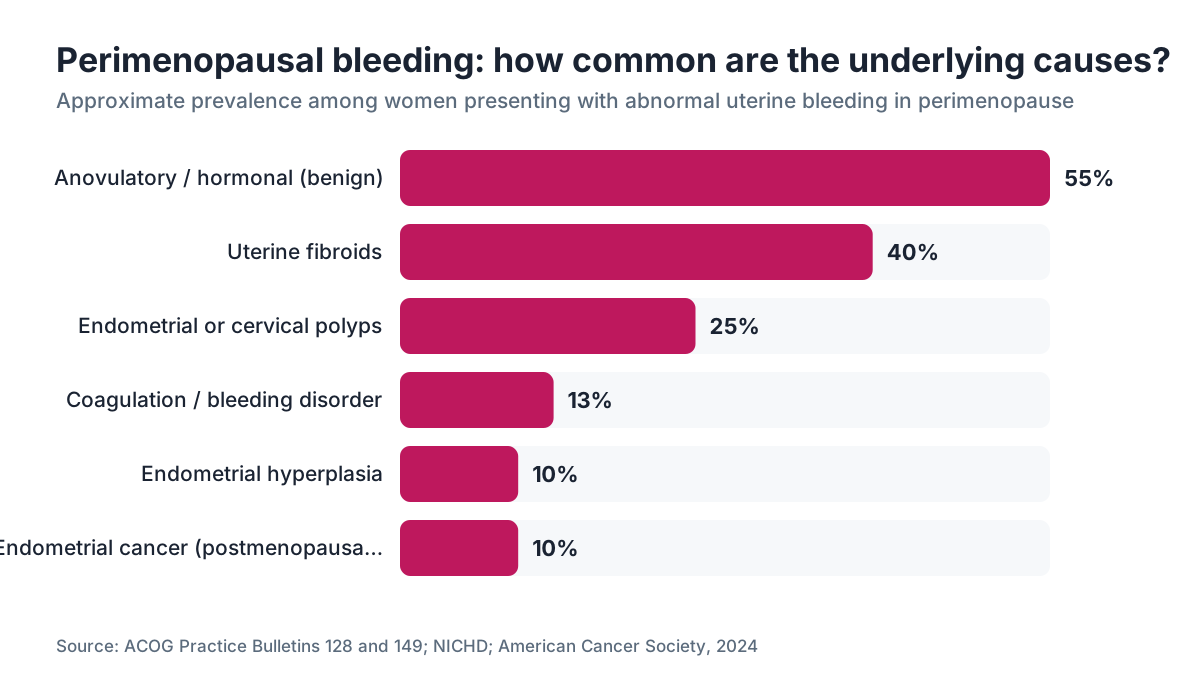
The clinical threshold that should prompt same-week evaluation is soaking through a pad or tampon every hour for two or more hours in a row. That level, called heavy menstrual bleeding or menorrhagia, affects roughly 25% of women during perimenopause and needs a workup no matter how convinced you are it's hormonal [5].
Beyond volume, several patterns are red flags:
Spotting after sex (postcoital bleeding). This is never a normal perimenopausal symptom. It can point to cervical polyps, cervicitis, vaginal atrophy with fragile tissue, or, less commonly, cervical cancer. It needs a pelvic exam and cervical evaluation.
Spotting more than 12 months after your last period. Once you've gone a full year without bleeding, you're postmenopausal by definition. Any return of bleeding is postmenopausal bleeding and calls for endometrial biopsy to rule out endometrial cancer. This one is non-negotiable. The American College of Obstetricians and Gynecologists states clearly that postmenopausal bleeding should be evaluated with endometrial sampling or transvaginal ultrasound [6].
Bleeding that gets progressively heavier over several cycles. A steady climb in flow is more suspicious than one heavy period.
Spotting with pelvic pain, pressure, or bloating. Together, these can point to fibroids, polyps, or, less commonly, ovarian problems.
Spotting in a woman on combined hormone therapy. Unexpected breakthrough bleeding after the first few months of HRT should be checked, not assumed hormonal.
A rough table of when to watch versus when to act:
| Pattern | Action | |---|---| | Light spotting between cycles, no other symptoms | Track for 2-3 months; mention at next visit | | Spotting when wiping only, < 3 days | Monitor; discuss with provider | | Soaking 1+ pad/hour for 2+ hours | Call provider same day | | Any bleeding after 12 months with no period | Urgent evaluation, endometrial biopsy | | Postcoital spotting (after sex) | Pelvic exam within 1-2 weeks | | Spotting with pelvic pain or pressure | Prompt evaluation for fibroids/polyps |
What causes perimenopause spotting beyond hormone fluctuations?
Hormones are the most common cause, but not the only one. A full evaluation matters because some causes need specific treatment.
Uterine polyps. These small, soft growths on the uterine lining are common in the perimenopausal years and a frequent source of irregular spotting and bleeding between periods. Most are benign, but a small percentage can harbor atypical or malignant cells. They show up on transvaginal ultrasound or sonohysterography and come out easily with hysteroscopy.
Uterine fibroids. These are benign muscle tumors of the uterine wall. They affect an estimated 70-80% of women by age 50, though not all cause symptoms [7]. Submucosal fibroids, the type that push into the uterine cavity, are the ones most likely to cause heavy or irregular bleeding.
Endometrial hyperplasia. When estrogen goes unopposed by progesterone for long stretches, the lining can overgrow. This overgrowth can progress to endometrial cancer if left alone. It's one reason perimenopausal women with an intact uterus who take estrogen must also take a progestogen.
Endometrial cancer. The average age at diagnosis is 60, which puts perimenopause and early postmenopause squarely in the window of risk. Irregular or heavy bleeding is the presenting symptom in roughly 90% of cases [6]. Caught early, while the cancer is still confined to the uterus, the 5-year survival rate is above 95%.
Cervical causes. Cervical polyps, infections (including sexually transmitted ones like chlamydia or gonorrhea), or, rarely, cervical cancer can all cause spotting, especially after sex.
Thyroid dysfunction. Both an underactive and an overactive thyroid disrupt menstrual cycles. A TSH level is often part of a bleeding workup because thyroid disease is common at this age and easy to treat.
Bleeding disorders. Von Willebrand disease and platelet disorders can cause heavy periods for years but sometimes go undiagnosed until bleeding worsens in perimenopause. About 13% of women with heavy menstrual bleeding have an underlying coagulation disorder [5].
How is perimenopause spotting diagnosed and evaluated?
When you see a provider about abnormal bleeding, expect a structured workup, not a quick pat on the head.
It starts with a detailed history: your cycle pattern before perimenopause, how the bleeding has changed, symptoms alongside it, current medications, and family history of gynecologic cancers. Your provider will ask you to describe volume (pads or tampons per day), duration, and timing relative to your cycle.
Lab work usually includes FSH and estradiol (to confirm the perimenopausal hormonal pattern), a complete blood count (to check for anemia from chronic blood loss), TSH, and sometimes a pregnancy test, because perimenopausal women can and do get pregnant.
Transvaginal ultrasound is the first-line imaging tool. It measures the endometrial stripe (the thickness of the uterine lining) and looks for polyps, fibroids, and other structural problems. An endometrial stripe thicker than 4-5 mm in a postmenopausal woman generally prompts biopsy. In perimenopausal women the threshold is looser, because the lining changes with cycle phase, but persistent thickening is a concern.
Endometrial biopsy happens in the office with a thin catheter. It samples the lining directly and is the definitive way to rule out hyperplasia or cancer. It isn't comfortable, but it's quick: usually 30 to 60 seconds of cramping.
Sonohysterography (saline infusion sonography) adds fluid to the uterine cavity during ultrasound to show polyps more clearly. Hysteroscopy lets a provider look inside the uterus with a small camera, and it can be both diagnostic and treatment in one sitting (polyps can come out on the spot).
What treatments actually help perimenopause spotting?
Treatment depends on the cause and how much the bleeding is affecting your life. There's no single answer. The right choice shifts with your symptom burden, your other health considerations, and whether you also have hot flashes or wrecked sleep.
Hormonal options:
Low-dose hormonal contraceptives (combined pills, the patch, the ring) work well for regulating perimenopausal bleeding. They quiet the hormonal swings, create predictable withdrawal bleeds, and cut hot flashes too. The 2023 NAMS position statement on hormonal contraception in perimenopause supports this use for healthy, non-smoking women under 50 without cardiovascular contraindications [4].
The levonorgestrel intrauterine device (Mirena) is especially effective for heavy bleeding. It delivers a small amount of progesterone straight to the uterine lining, thinning it out. Multiple trials show it cuts menstrual blood loss by 70-90% at 12 months [8].
Menopausal hormone therapy (MHT), often called hormone replacement therapy, uses lower doses than contraceptives and aims to manage symptoms rather than suppress ovulation. Cyclic regimens produce predictable monthly bleeds. Continuous combined regimens (estrogen plus daily progestogen) aim for no bleeding at all, but breakthrough spotting is common in the first 3 to 6 months. If you're weighing an estrogen patch, understand that breakthrough pattern before you start.
For women who've finished their evaluation and just want steadier cycles, cyclic progesterone (oral micronized progesterone for 10 to 14 days a month) can regularize the shedding and quiet erratic spotting.
Non-hormonal options:
Tranexamic acid is a non-hormonal antifibrinolytic you take only on heavy flow days. It cuts blood loss by about 40-50% without touching hormone levels [5]. A good pick for women who can't or won't use hormonal therapy.
NSAIDs (ibuprofen, naproxen) taken during heavy flow reduce prostaglandin-driven bleeding by roughly 20-30%. Less effective than the other options, but cheap and low-risk.
Procedural options:
Endometrial ablation destroys the uterine lining and reduces or ends periods in 80-90% of women. It fits women who are done with childbearing and have ruled out structural and malignant causes. It is not a treatment for cancer or hyperplasia.
Hysteroscopic polypectomy removes polyps. Myomectomy or uterine fibroid embolization handles symptomatic fibroids.
Hysterectomy is the definitive fix and ends bleeding entirely, but it's major surgery with real risks and recovery time. It's reasonable for women with severe symptoms, fibroids, or hyperplasia who've completed childbearing and haven't responded to gentler measures.
If you're sorting through these and want guidance from a clinician who handles the whole span, WomenRx offers telehealth consultations with providers who focus on perimenopausal hormone management and can order the labs and imaging referrals you need.
Can hormone therapy cause or worsen perimenopause spotting?
Yes, and it confuses a lot of women. Starting hormone replacement therapy often causes breakthrough spotting, especially in the first 3 to 6 months. That's an expected side effect of the uterine lining adjusting to the new hormonal environment, not necessarily a sign something is wrong.
Breakthrough bleeding is more common with:
- Continuous combined regimens (daily estrogen plus daily progestogen) than with cyclic regimens
- Lower-dose estrogen formulations
- Inconsistent adherence (missing doses, then doubling up)
- Transdermal estrogen plus oral progesterone combinations in some women
If breakthrough bleeding runs past 6 months on a stable HRT regimen, or turns heavy or irregular, that warrants evaluation. The worry is that unexpected endometrial thickening could be building despite the progestogen. That's more likely when the progestogen dose is too low relative to the estrogen dose.
The FDA's labeling for menopausal estrogens requires that women with a uterus receive adequate progestogen to prevent endometrial hyperplasia [9]. "Unopposed estrogen," meaning estrogen without progestogen in a woman with a uterus, is a known risk factor for endometrial cancer, which is why the pairing is standard of care.
If you recently changed your HRT formulation and new spotting appeared, that timing connection means something. Report it to your prescriber quickly rather than waiting it out.
Does perimenopause spotting when wiping mean something different?
Noticing a little blood only when you wipe, with nothing on your underwear or a pad, is extremely common in perimenopause. It usually just means the volume is small. The source and the significance depend on context.
Spotting when wiping that's brown or pinkish and shows up mid-cycle is almost always uterine: a small, irregular shed from the endometrium. If it clears within a day or two and nothing else is going on, it's typically a benign perimenopausal pattern.
Spotting when wiping after sex is a different story. Even a trace warrants a pelvic exam, because postcoital bleeding points to the cervix or vaginal walls more than the uterus. Perimenopausal and postmenopausal women often develop vaginal atrophy (now called genitourinary syndrome of menopause, or GSM), where falling estrogen thins and dries vaginal tissue, leaving it fragile and prone to small tears during sex. This kind of spotting responds well to local vaginal estrogen.
Spotting when wiping that's bright red and happens more than a year after your last period is postmenopausal bleeding. Same rules apply: it needs evaluation, not observation.
One practical note. If you track your cycle with an app or a paper diary, log these wipe-only episodes too. The pattern over several months tells your provider far more than one episode you're trying to recall from memory.
What is the connection between perimenopause spotting and endometrial cancer risk?
This is the question sitting behind every conversation about perimenopausal bleeding, and it deserves a straight answer.
Endometrial cancer is the most common gynecologic cancer in the United States, with about 67,880 new cases estimated in 2024 [10]. The median age at diagnosis is 63, but perimenopause is the window when the conditions that drive risk, long estrogen exposure without enough progesterone, are most active.
The good news: most perimenopausal spotting is benign. Studies of women presenting with postmenopausal bleeding (the higher-risk group) find endometrial cancer in roughly 10% of cases [6]. In perimenopausal women the rate is lower, because the bleeding is more often anovulatory than malignant.
Risk factors that raise the odds spotting has a serious cause:
- Obesity (BMI above 30; fat tissue produces estrone, a form of estrogen)
- Never having been pregnant
- Diabetes
- Polycystic ovary syndrome (PCOS), which causes chronic anovulation
- Long-term tamoxifen use
- Family history of Lynch syndrome or hereditary endometrial cancer
- Prior endometrial hyperplasia
If you have two or more of these and you're bleeding irregularly, the evaluation above isn't optional. This is exactly the setting where catching a problem early changes the outcome substantially.
For women with a Lynch syndrome diagnosis or a strong family history, some gynecologic oncologists recommend annual endometrial sampling starting in the 30s or 40s, though guidelines vary. Talk to a provider with specific expertise here.
Can lifestyle factors affect perimenopause spotting?
Some can, though the effect is smaller than hormonal shifts and structural causes.
Body weight. Fat tissue converts androgens into estrone, a weaker estrogen. In women carrying more weight, this extra estrogen can thicken the uterine lining further and add to heavier or irregular bleeding. Weight loss, even a modest amount, has been shown to reduce heavy menstrual bleeding in women with higher body weight. Some women using semaglutide for weight loss during perimenopause report shifts in their menstrual patterns; that's likely an indirect effect of estrogen falling as fat mass drops.
Stress. Serious physical or psychological stress suppresses the HPG axis (the hormone pathway that controls ovulation), pushing you into anovulatory cycles that raise spotting risk.
Intense exercise. Extreme exercise can suppress ovulation the way stress does, though moderate exercise is generally neutral to helpful for menstrual regularity.
NSAIDs and blood thinners. Regular ibuprofen or naproxen can shift bleeding patterns. Anticoagulants (warfarin, apixaban, rivaroxaban) and even daily aspirin can noticeably increase menstrual blood loss.
Herbal supplements. Black cohosh, soy isoflavones, and other phytoestrogens get marketed for perimenopausal symptoms. Their effect on bleeding is poorly studied. Some women report changes with high-dose phytoestrogens. The evidence isn't strong enough to recommend either way.
Tracking doesn't only help your provider. It can surface patterns you'd otherwise miss, like bleeding that lines up with high-stress weeks or with a specific supplement you started.
When should you see a doctor about perimenopause spotting?
The short answer: sooner than you probably think.
Many women brush off perimenopausal bleeding because they've read that irregular periods are expected, which is true. But "expected" doesn't mean "no evaluation needed." The trap is that the benign hormone-driven causes and the dangerous ones can look identical from the outside.
See a provider within 1 to 2 weeks for:
- Any spotting or bleeding after 12 months without a period
- Spotting after sex, even once
- Bleeding that soaks a pad or tampon every hour for 2 or more hours
- Spotting with pelvic pain, pressure, or bloating
- Spotting on continuous HRT that lingers past 6 months
Mention at your next routine visit (within 1 to 3 months):
- New or changed spotting between periods going on for less than 2-3 months
- Cycles that suddenly got much shorter or much longer
- Periods consistently heavier than your old baseline
Don't just wait and see for:
- Any bleeding pattern that makes you anxious, no matter how "normal" it sounds
- Bleeding that's hurting your quality of life (fatigue or breathlessness from anemia, planning your week around heavy days)
WomenRx connects women with clinicians who understand the full perimenopausal picture and can coordinate the lab and imaging workup remotely in most cases. The article on when does menopause start has more on how providers stage the transition, which helps frame the conversation about your bleeding.
You know your body. Unexplained changes in bleeding deserve an explanation, not a dismissal.
Frequently asked questions
Is spotting between periods normal during perimenopause?
Yes, spotting between periods is one of the most common perimenopausal symptoms. Erratic estrogen and low progesterone make the uterine lining shed unpredictably. Still, normal doesn't mean unexamined. If spotting is new, worsening, or comes with pain or bleeding after sex, see a provider to rule out polyps, fibroids, or endometrial problems.
How do I know if my spotting is perimenopause or pregnancy?
Perimenopausal women can still ovulate and conceive, so pregnancy is possible even with irregular cycles. Implantation bleeding is typically very light, pink or brown, and shows up around 10 to 14 days after conception. A home pregnancy test or a serum beta-hCG from your provider is the only way to know. Don't assume spotting is perimenopause without ruling out pregnancy first, especially if you're not using contraception.
What does perimenopause spotting look like compared to a real period?
Perimenopausal spotting is usually lighter than a period: a few drops, brown or pinkish discharge, or light bleeding that doesn't fill a pad. A real period puts out enough flow to need a pad or tampon and usually lasts 3 to 7 days. In perimenopause the line blurs: some bleeds are light like spotting, others are heavier than your usual period. The key is tracking change from your personal baseline.
Can perimenopause spotting last for months?
Yes. Some women have irregular spotting for months at a stretch, alternating with longer gaps or heavier bleeds. The transition averages 4 to 8 years, and erratic bleeding is characteristic of the late stages. But if spotting runs continuously for more than 3 months with no clear hormonal explanation, or keeps getting heavier, an evaluation including ultrasound and possibly endometrial biopsy is appropriate.
Should I be worried about brown spotting during perimenopause?
Brown spotting is usually old blood that moved slowly through the cervix after the uterus shed a little lining. It's very common in perimenopause and, on its own, isn't a red flag. If brown spotting is your only symptom, mention it at your next visit; it doesn't usually need urgent evaluation. If it follows 12 or more months without any bleeding, that changes everything and needs prompt assessment.
Can stress cause spotting in perimenopause?
Yes. Serious stress suppresses the hypothalamic-pituitary-gonadal axis, disrupting ovulation. Without ovulation, progesterone doesn't rise to its normal level, and the uterine lining can shed erratically. That's one reason perimenopausal women in high-stress stretches often notice worse cycle irregularity. Stress is a contributing factor, not the whole story, so it shouldn't replace ruling out structural or hormonal causes.
Does perimenopause spotting get worse before it stops?
For many women, yes. Heavy or unpredictable bleeding often intensifies in the late perimenopausal stage, the year or two right before the final period, before cycles eventually stop. The SWAN study found that the late transition (marked by 60-day gaps between periods) went with the most erratic bleeding patterns. Most women find their bleeding gets less frequent and lighter in the final months before menopause.
What is the difference between perimenopause spotting and postmenopausal bleeding?
Perimenopause spotting happens while you still get periods, even irregular ones. Postmenopausal bleeding, by definition, happens after 12 consecutive months with no period. Postmenopausal bleeding is always abnormal and needs evaluation, because the risk of endometrial cancer is meaningfully higher. About 10% of women with postmenopausal bleeding turn out to have endometrial cancer, compared to a much lower rate in perimenopausal women with irregular cycles.
Can low progesterone cause spotting in perimenopause?
Yes, this is one of the main mechanisms. In perimenopause, anovulatory cycles (cycles where you don't ovulate) mean the corpus luteum never forms, so progesterone stays low. Without enough progesterone to stabilize the uterine lining, it sheds irregularly, causing spotting or breakthrough bleeding. That's why cyclic progesterone supplementation, either oral micronized progesterone or a progestin-containing IUD, often reduces or ends irregular spotting.
What tests diagnose the cause of perimenopause spotting?
The standard workup includes FSH, estradiol, TSH, a complete blood count, and a pregnancy test. Transvaginal ultrasound checks endometrial thickness and looks for fibroids or polyps. If the lining looks thickened or irregular, an endometrial biopsy done in the office rules out hyperplasia or cancer. Sonohysterography (saline-infused ultrasound) or hysteroscopy may follow if polyps are suspected.
How long does perimenopause spotting typically last before periods stop completely?
There's no fixed timeline. The transition averages 4 to 8 years overall. Irregular spotting and bleeding often intensify in the 1 to 2 years before the final period, then bleeding episodes get less frequent. Once you've had 12 consecutive months with no bleeding, you're officially postmenopausal. Some women reach that point fairly quickly; others bleed irregularly for 8 to 10 years before cycles fully stop.
Can fibroids cause spotting during perimenopause?
Yes, and it's a very common combination. Fibroids affect 70-80% of women by age 50, and submucosal fibroids (those pushing into the uterine cavity) are especially likely to cause heavy and irregular bleeding. Perimenopause itself can make fibroids fluctuate in size as estrogen shifts. An ultrasound can identify them; treatment ranges from a levonorgestrel IUD to myomectomy or fibroid embolization, depending on size, location, and severity.
Is spotting a sign that menopause is close?
Growing irregularity, including spotting between periods or cycles with 60-day gaps, generally signals late perimenopause, meaning menopause is likely within a few years. But timelines vary a lot. FSH can give a rough read: persistently high FSH (above 25-30 IU/L on day 2-3 of the cycle) suggests declining ovarian reserve, though a single measurement isn't definitive. Your cycle history over 12 to 24 months is more predictive than any one hormone test.
Does perimenopause spotting require treatment if it's light?
Light spotting that's clearly perimenopausal, has been evaluated, and isn't hurting your quality of life doesn't need active treatment. Watchful waiting with good tracking is a legitimate choice. Treatment makes sense when bleeding is heavy enough to cause anemia, disrupts daily life, comes from a structural cause (polyp, fibroid), or when you simply want more predictability. The decision is yours, informed by a complete evaluation.
Sources
- NAMS (North American Menopause Society), Menopause journal: Physiology of the menopausal transition
- NIH Office on Women's Health, Menopause basics
- SWAN (Study of Women's Health Across the Nation), NIH-funded longitudinal cohort, NEJM and related publications
- NAMS 2023 Position Statement on Hormonal Contraception in Perimenopausal Women
- ACOG Practice Bulletin No. 128: Diagnosis of Abnormal Uterine Bleeding in Reproductive-Aged Women
- ACOG Practice Bulletin No. 149: Endometrial Cancer
- National Institute of Child Health and Human Development (NICHD), Uterine fibroids
- Endocrine Society Clinical Practice Guideline: Management of Menopause
- FDA, Approved labeling for menopausal estrogen therapies (Prescribing Information)
- American Cancer Society, Cancer Facts and Figures 2024
- CDC, Reproductive Health: Heavy Menstrual Bleeding