Perimenopause and pregnancy: can you still get pregnant?
TL;DR: You can get pregnant during perimenopause, and plenty of women do without realizing it. The symptoms overlap almost exactly: irregular cycles, fatigue, breast tenderness, nausea. Fertility drops sharply after 40, but pregnancy stays possible until you hit 12 straight months with no period, the clinical mark of menopause. Until then, treat yourself as fertile.
Can you actually get pregnant during perimenopause?
Yes. The biology is simple even when it surprises people: perimenopause is a transition, not a stop sign. Your ovaries still release eggs, just on an unreliable schedule. If ovulation happens even once in a while, pregnancy is possible.[1]
Menopause has a specific clinical definition: 12 consecutive months without a menstrual period.[2] Until you reach that mark, you have not finished the transition. A skipped period or two proves nothing. A woman who has gone ten months without bleeding can still ovulate in month eleven and conceive.
Data from the CDC National Center for Health Statistics show U.S. birth rates for women 40 to 44 have climbed steadily since the 1980s, and births to women 45 and older, while rare, still number in the thousands every year.[3] Many were unplanned. Many of those women thought they were done.
Here is the rule I give: until a doctor confirms you have reached menopause, treat yourself as fertile.
What is perimenopause, and when does it start?
Perimenopause is the hormonal runway leading into menopause. It can begin anywhere from the late 30s to the mid-50s, with average onset around age 47.[2] Most women spend four to eight years in it, though for some the range stretches from two to twelve years.[1]
During this stretch, estrogen and progesterone swing around instead of easing down in a clean line. Those swings drive the symptoms women label "the change": irregular cycles, hot flashes, broken sleep, mood shifts, and a moving target of a libido. [See also: perimenopause age for a fuller breakdown of timing.]
That same hormonal noise is exactly what makes it hard to read your own body. A strange cycle or a wave of nausea could mean your hormones are shifting. It could mean you are pregnant. The two states share more symptoms than most women expect.
Perimenopause symptoms vs pregnancy symptoms: how do they compare?
This is the question that brings most women to this page, and the honest answer is that the overlap is wide enough that a pregnancy test is almost always your first move.
| Symptom | Perimenopause | Early Pregnancy | |---|---|---| | Missed or irregular period | Very common | Classic sign | | Breast tenderness | Common | Very common | | Fatigue | Common | Very common | | Nausea | Occasional | Very common (especially morning) | | Bloating | Common | Common | | Mood changes / irritability | Very common | Common | | Hot flashes / night sweats | Very common | Occasional | | Frequent urination | Occasional | Common | | Weight changes | Common | Common | | Vaginal dryness | Common | Less common | | Heightened sense of smell | Uncommon | Common |
A few patterns tilt the odds. Hot flashes and night sweats that wake you from sleep point far more to perimenopause than pregnancy.[2] A sudden, nearly nauseating sensitivity to smells leans pregnancy. Vaginal dryness and a flat sex drive lean perimenopause. None of these settles it.
The only reliable answer is a urine or blood test. A pharmacy urine test detects hCG as early as 10 to 14 days after ovulation. A blood test (beta-hCG) at your doctor's office catches pregnancy even earlier and gives a number your provider can track over time.[4]
If the test is negative and your symptoms stick around or get worse, your next call is to your OB-GYN or a menopause specialist to check your hormone levels.
What are the risks of getting pregnant in perimenopause?
Pregnancy after 40 carries documented risks for both mother and baby. This is not meant to scare you. You deserve the actual numbers.
For the mother, age raises the odds of gestational diabetes, preeclampsia, placenta previa, and preterm labor. A 2018 analysis in JAMA Internal Medicine found women delivering at 40 or older had significantly higher rates of cesarean delivery and maternal complications than women delivering in their 30s.[5]
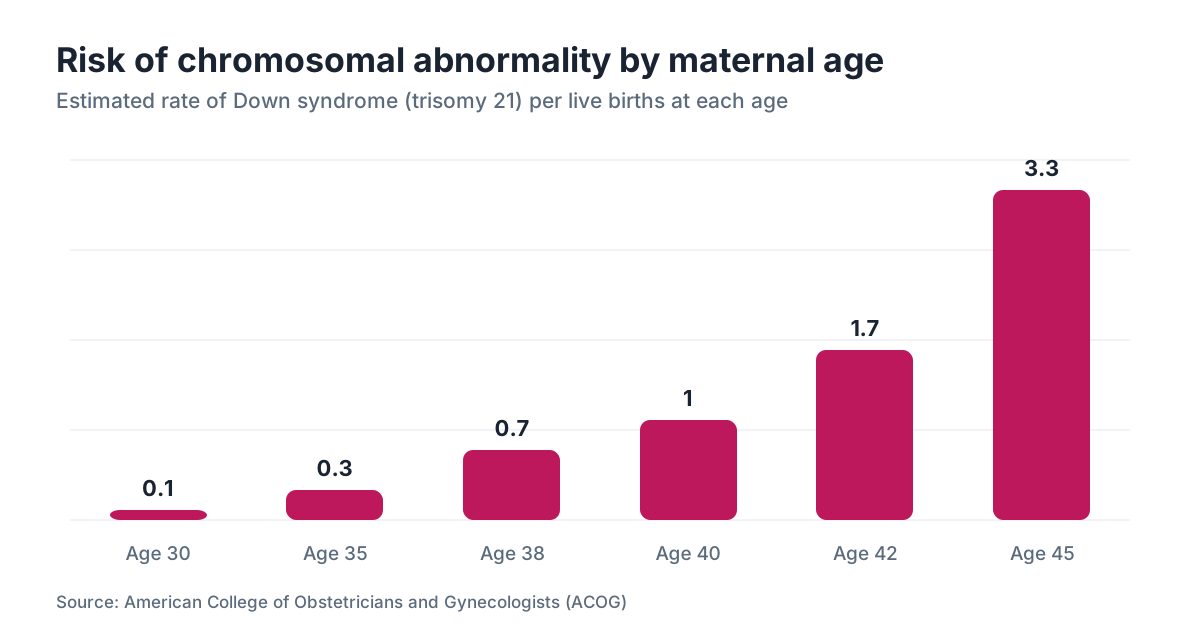
For the baby, the most talked-about risk is chromosomal. The rate of Down syndrome (trisomy 21) rises from roughly 1 in 1,000 at age 30 to about 1 in 100 at age 40, and around 1 in 30 at age 45, per the American College of Obstetricians and Gynecologists.[4] The rate for all chromosomal abnormalities follows a similar curve.
Miscarriage climbs steeply too. By age 40, the miscarriage rate for recognized pregnancies runs 40 to 50 percent, against roughly 10 to 15 percent at age 25.[4]
None of this makes pregnancy after 40 uniformly dangerous. Healthy babies arrive to older mothers every day. It does mean prenatal care needs to start early, that genetic counseling and testing (cell-free DNA screening or chorionic villus sampling) is worth discussing, and that the pregnancy belongs with a provider who handles high-risk obstetrics.
Do you still need birth control during perimenopause?
Yes, until you have logged 12 straight months without a period.[2] This is not a formality. The North American Menopause Society states that contraception is recommended through the menopause transition for women who do not want to conceive, because ovulation can happen unpredictably even when cycles are all over the map.[1]
Your choice of method matters here, because some options pull double duty. Low-dose combined hormonal contraceptives (pills, patches, rings) suppress ovulation and also tame heavy or erratic bleeding, hot flashes, and bone loss in healthy nonsmokers under 50. The FDA cautions that combined estrogen-progestin contraceptives raise cardiovascular risk in smokers over 35, so that conversation with your provider is a real one.[6]
The hormonal IUD (levonorgestrel-releasing, like Mirena) is another perimenopause favorite. It prevents pregnancy, cuts heavy bleeding, and delivers progestin locally with little systemic absorption. It will not tell you when you have reached menopause, though, because it suppresses periods no matter what your ovaries are doing.[1]
Barrier methods (condoms, diaphragm with spermicide) still work but carry higher typical-use failure rates. Permanent sterilization is effective and, obviously, permanent.
Once you cross 12 period-free months and menopause is confirmed, you can stop contraception. If you then want hormone therapy for symptoms, that is a separate conversation entirely. [See the overview of hormone replacement therapy to understand the distinction.]
How does perimenopause affect fertility specifically?
Fertility drops in perimenopause for two linked reasons: egg quantity and egg quality both fall with age.
Every woman is born with a fixed number of eggs, and that reserve (the ovarian reserve) depletes from birth onward. By the early 40s, most women have fewer than 5 percent of the eggs they started with.[4] FSH (follicle-stimulating hormone) rises as the pituitary works harder to recruit follicles, and AMH (anti-Müllerian hormone) falls as the reserve shrinks. Both are measurable, and your OB-GYN or a reproductive endocrinologist can test them.
Egg quality slides too. The mitochondria inside older eggs struggle to power the energy demands of early cell division, which is why chromosomal errors and early miscarriage rise.
This does not make conception impossible. It makes it slower on average, with a lower per-cycle chance (roughly 5 percent per cycle at 40 versus 20 to 25 percent in the mid-20s), and it means the pregnancies that do take need closer monitoring.[4]
If you want to conceive during perimenopause and it is not happening, a reproductive endocrinology evaluation is the right step. Assisted reproductive technologies, including IVF with your own eggs or with donor eggs, are worth discussing with a specialist. That sits outside a general hormone provider's lane, but your gynecologist can refer you.
What hormone levels tell you whether you're in perimenopause or might be pregnant?
A handful of blood tests can sort out what is happening. Here is what each one tells you.
For pregnancy, a quantitative beta-hCG is definitive. If hCG is rising (it roughly doubles every 48 to 72 hours in a healthy early pregnancy), you are pregnant.[4] If it reads zero or negligible, you are not.
For perimenopause status, FSH, estradiol, and LH make up the standard panel. FSH consistently above 10 mIU/mL starts to suggest declining ovarian reserve. FSH consistently above 30 to 40 mIU/mL on two draws taken 4 to 6 weeks apart, plus absent periods, points to approaching or completed menopause.[2] The Endocrine Society notes that FSH bounces around during perimenopause and a single high reading is not diagnostic.[7]
AMH (anti-Müllerian hormone) gives a steadier read on ovarian reserve and barely moves across the menstrual cycle, which makes it handy when cycles are irregular.[7]
Check thyroid function (TSH) at the same time. Hypothyroidism is more common in women over 40 and its symptoms (fatigue, weight gain, irregular periods, brain fog) overlap heavily with both perimenopause and early pregnancy. A low TSH can also complicate a pregnancy.
If you are using a telehealth provider like WomenRx to manage perimenopausal symptoms, ask for a full panel including hCG whenever pregnancy is even remotely possible before you start or adjust hormone therapy.
Can you be in perimenopause and pregnant at the same time?
Yes, and it catches people off guard. You can be in the perimenopause transition, hormonally and symptomatically, and be pregnant at the same time. Perimenopause is not a switch. It is a slow hormonal drift. Ovulate during that drift, fertilize that egg, and you are pregnant.
What muddies the water is that perimenopausal women tend to wave off pregnancy symptoms as "just my hormones acting up." Nausea in perimenopause is real. Fatigue is real. A missed period is almost expected. So a woman who is actually pregnant may not clock it for weeks, sometimes months.
This happens often enough that OB-GYNs and midwives routinely make a pregnancy test the first step whenever a perimenopausal woman reports a new cluster of symptoms or a period running well past her new irregular baseline.
If you are in perimenopause, off reliable contraception, and you notice anything that could be pregnancy, test first. It takes two minutes and clears the uncertainty.
What happens to progesterone during perimenopause and how does that affect pregnancy risk?
Progesterone comes from the corpus luteum after ovulation, and it is the hormone that holds an early pregnancy together. During perimenopause, progesterone turns erratic because ovulation itself turns erratic. Cycles with no ovulation (anovulatory cycles) produce no luteal-phase progesterone at all.
Low luteal-phase progesterone (a luteal phase defect) is one reason miscarriage climbs in the perimenopausal years. The embryo can implant, but without enough progesterone the uterine lining will not hold it. That is why reproductive endocrinologists sometimes prescribe progesterone support in early pregnancies for women over 40.
For perimenopausal women who are not trying to conceive, low progesterone paired with ongoing estrogen creates a state called estrogen dominance, which drives heavy or drawn-out periods, worse PMS-type symptoms, and changes in the uterine lining. [See the dedicated article on progesterone for a full breakdown of testing and treatment.]
Knowing your progesterone status matters whether you are trying to conceive, trying to avoid it, or just trying to work out why your cycles stopped making sense.
What should you do if you think you might be pregnant in perimenopause?
Take a home pregnancy test first. Modern urine tests are more than 99 percent accurate when used correctly starting on the day of a missed period.[4] If your cycles are irregular, wait at least two to three weeks after any unprotected sex before testing for the most reliable result.
Positive? Call your OB-GYN or midwife that day. Do not sit on it until a routine appointment. Pregnancy in perimenopause is high-risk by age alone, and early ultrasound dating, early prenatal labs, and a talk about genetic screening all need to happen sooner rather than later.
Negative but still worried? A quantitative blood hCG from your doctor is more sensitive and removes the last of the doubt. Ask for thyroid function and a basic hormone panel at the same visit.
Negative with symptoms that point toward perimenopause? Your provider can check FSH, estradiol, and AMH to place you in the transition. From there, a conversation about symptom management (lifestyle changes, hormone therapy, or other options) makes sense. [The when does menopause start article maps the typical hormone trajectory if you want context.]
One warning: do not self-manage with over-the-counter supplements or hormone creams before ruling out pregnancy. Some botanicals marketed for menopause (black cohosh, red clover isoflavones) have not been studied properly in pregnancy and should be avoided until you know your status.
Does hormone therapy for perimenopause affect pregnancy or fertility tests?
Many women ask this before starting hormone therapy, and the answer has a few moving parts.
Hormone therapy for perimenopause, meaning low-dose estrogen with or without progesterone, does not reliably prevent ovulation and is not a contraceptive. That distinction matters enormously, because hormonal contraceptives are dosed specifically to shut ovulation down.[1] If you are on an estrogen patch or oral estrogen for hot flashes and you are not using separate contraception, you are not protected from pregnancy.
Hormone therapy also skews FSH and estradiol readings. Exogenous estrogen suppresses FSH artificially, which can make you look pre-menopausal even when you are not. NAMS recommends stopping hormone therapy for at least 2 to 4 weeks before testing FSH if you want an accurate picture of ovarian function.[1]
Progesterone-containing therapies (oral micronized progesterone, progestin creams) do not touch hCG testing. A pregnancy test stays valid while you are on hormone therapy.
If you want to use WomenRx or any telehealth provider for hormone therapy during perimenopause, make sure your intake covers pregnancy history, current contraception, and a recent hCG or pregnancy test if there is any chance of pregnancy. Starting exogenous estrogen in an unrecognized early pregnancy is exactly what every provider works to avoid.
When is perimenopause actually over, and when can you stop worrying about pregnancy?
The finish line is 12 consecutive months without a menstrual period.[2] That date is menopause. After it, the chance of spontaneous ovulation and pregnancy drops to essentially zero, and you no longer need contraception to prevent pregnancy.
FSH persistently above 30 to 40 mIU/mL on two measurements backs up the picture, but symptom and menstrual history drive the clinical definition.[7] Age matters too: most women reach menopause between 45 and 55, with the U.S. median around 51 to 52.[2]
Premature menopause (before 40) or early menopause (40 to 44) changes the math. Women who hit either should get hormone levels confirmed, because premature ovarian insufficiency (POI) is not the same as natural perimenopause and carries its own management implications, including for bone density. [A bone density test is typically recommended at menopause, especially with early or surgical menopause.]
Until that 12-month mark, stay consistent with whatever contraception you and your provider settled on. Nobody wants a surprise pregnancy at 48 because month eleven had one quiet, symptomless ovulation.
Frequently asked questions
Can a pregnancy test give a false negative during perimenopause?
A urine test measures hCG, a hormone only present in pregnancy. Perimenopause does not make hCG, so perimenopausal hormones cannot confuse the test itself. False negatives come from testing too early (before hCG is high enough to detect) or from diluted urine. If you suspect pregnancy and get a negative, retest in 48 to 72 hours or ask your doctor for a blood hCG, which is more sensitive.
What does a perimenopausal pregnancy feel like compared to a regular pregnancy?
The physical experience of pregnancy does not change with your transition stage. Morning nausea, breast tenderness, fatigue, and frequent urination feel the same at 44 as at 28. The difference is the backdrop: perimenopausal women may already have some of those symptoms from hormonal swings, which masks the shift. Many women only realize they were pregnant when they miscarry or when an ultrasound at a routine visit finds a gestational sac.
Is it safe to use hormone therapy if I might become pregnant?
No. Menopausal hormone therapy (estrogen with or without progesterone) is contraindicated in pregnancy. It is also not a contraceptive, so it does not prevent pregnancy. If there is any chance you could conceive, use reliable contraception alongside any hormone therapy. Tell your provider your contraceptive status before starting so the two are coordinated.
At what age does fertility drop most sharply for perimenopausal women?
Fertility declines gradually through the 30s, then drops more steeply after 37 to 38. By 40, the per-cycle chance of natural conception is roughly 5 percent, against 20 to 25 percent in the mid-20s. After 44, spontaneous conception is uncommon but not impossible. The American College of Obstetricians and Gynecologists notes the miscarriage rate reaches 40 to 50 percent by age 40, which further lowers the odds of a live birth.
Can you go through perimenopause symptoms and then have a regular period come back?
Yes, and it is one of the more disorienting parts of perimenopause. Skipping periods for several months and then having a regular cycle return is completely normal. It can happen more than once over the years before menopause is complete. Each returning period means ovulation may have occurred, which means fertility is still in play. The 12-consecutive-months rule exists precisely for this pattern.
What genetic tests are available if I get pregnant during perimenopause?
Cell-free DNA screening (also called NIPT) is a blood test that screens for chromosomal abnormalities including Down syndrome from around 10 weeks. It is more sensitive than first-trimester combined screening. Diagnostic tests like chorionic villus sampling (CVS, at 10 to 13 weeks) and amniocentesis (at 15 to 20 weeks) give definitive chromosomal results. ACOG recommends offering diagnostic testing to all pregnant women, and especially to those over 35.
How do hot flashes differ in perimenopause versus early pregnancy?
Perimenopausal hot flashes tend to be sudden, intense, and frequent, often waking women as night sweats. In early pregnancy, some women feel warmth or flushing from increased blood volume and metabolic changes, but classic hot flashes are not a primary pregnancy symptom. Frequent, drenching hot flashes point toward perimenopause. Even so, a pregnancy test is still the cleanest way to settle the question.
What birth control options are best for perimenopausal women?
It depends on your health history, whether you smoke, and whether you want the method to also manage symptoms. Low-dose combined hormonal contraceptives work well for healthy nonsmokers under 50 and can reduce hot flashes and heavy bleeding. The levonorgestrel IUD (Mirena) is widely recommended because it cuts heavy periods with minimal systemic hormones. Progestin-only pills suit smokers or those with cardiovascular risk factors. Discuss specifics with your OB-GYN.
Does perimenopause affect IVF success rates?
Yes, significantly. IVF with your own eggs follows the same age-related decline as natural conception: live birth rates per egg retrieval drop from roughly 30 to 40 percent at 35 to under 5 to 10 percent at 43 to 44, per CDC ART data. IVF with donor eggs from a younger woman produces much higher success rates regardless of the recipient's age. A reproductive endocrinologist can review your ovarian reserve markers for a more individualized estimate.
Can irregular periods in perimenopause make it hard to know when to test for pregnancy?
Absolutely. When cycles run 21 to 60 days or vanish for months, there is no reliable "day 28" to test on. The practical guidance: test any time you have had unprotected sex and notice new or worsening symptoms that could mean pregnancy, especially breast tenderness, nausea, or unusual fatigue. Wait at least two to three weeks after the encounter for the most accurate urine result, or ask for a blood hCG sooner.
What is the difference between perimenopause and premature ovarian insufficiency?
Perimenopause is the natural transition, usually in the mid-40s to early 50s, driven by declining ovarian reserve over time. Premature ovarian insufficiency (POI) is loss of normal ovarian function before age 40, affecting roughly 1 percent of women. POI has different causes (autoimmune, genetic, iatrogenic) and different needs, including hormone therapy that continues at least to the average age of menopause for bone and cardiovascular protection. An FSH above 25 to 40 on two tests weeks apart, plus absent periods before 40, warrants a POI evaluation.
If I've already had a tubal ligation, do I still need to think about perimenopause pregnancy?
Tubal ligation has a reported failure rate of about 0.5 percent over 10 years, so it is highly effective but not perfect. It also does not protect against ectopic pregnancy if failure occurs. If you have had a tubal ligation and notice pregnancy symptoms in perimenopause, testing is still reasonable. Ectopic pregnancy in particular is easy to miss and is a medical emergency, so any positive test after tubal ligation needs urgent evaluation.
How long does perimenopause last on average?
On average, perimenopause lasts four to eight years, but the range is wide. Some women move through in two to three years; others have symptoms for ten to twelve years before reaching the 12-consecutive-month mark that defines menopause. Early perimenopause often starts with subtle cycle changes and worse PMS, while late perimenopause brings longer gaps between periods. The Study of Women's Health Across the Nation (SWAN) found a median duration of about 7.4 years from first irregular cycles to final period.
Sources
- North American Menopause Society (NAMS), Menopause Practice: A Clinician's Guide
- National Institute on Aging (NIA), Menopause overview
- CDC National Center for Health Statistics, Births: Final Data
- American College of Obstetricians and Gynecologists (ACOG), FAQ: Having a Baby After Age 35
- JAMA Internal Medicine, study on maternal age and delivery complications, 2018
- U.S. Food and Drug Administration (FDA), combined hormonal contraceptive labeling and safety information
- Endocrine Society, Clinical Practice Guideline: Treatment of Symptoms of the Menopause
- CDC Assisted Reproductive Technology (ART) National Summary Report
- Study of Women's Health Across the Nation (SWAN), University of Michigan Institute for Social Research
- ACOG, clinical guidance on sterilization