Perimenopause periods: what's normal and what's not
TL;DR: Perimenopause periods turn unpredictable because estrogen and progesterone swing hard before your final period. Cycles shorten, lengthen, skip, or flood. The phase usually runs 4 to 10 years and starts in the mid-40s for most women. Heavy bleeding, spotting between periods, and wildly variable cycle lengths are all common, but some patterns do need a doctor's eyes.
What actually happens to your period during perimenopause?
Short answer: your periods stop being predictable in almost every way, and that's by design. Perimenopause begins when your ovaries make less estrogen and your cycles stop ovulating reliably. Without steady ovulation, progesterone output drops, and the hormonal choreography that once gave you a 28-day cycle comes apart.
The North American Menopause Society (NAMS) describes perimenopause as the transition that covers "changes beginning with the first clinical, biological, and endocrinological features of the approaching menopause and ends 12 months after the final menstrual period" [1]. That 12-month mark is when you're officially in menopause.
In practice, your uterine lining may build up longer than usual between periods (heavier flow), or shed too soon (spotting or a short cycle). Estrogen surges can thicken the lining a lot before it finally releases, which is why flooding, clots, and prolonged bleeding are among the most common complaints women bring to their doctors in their 40s.
Two hormones drive most of what you're feeling. Estrogen grows the lining. Progesterone stops that growth and triggers an orderly shed. When progesterone falls short because ovulation didn't happen, the lining keeps building. That's anovulatory bleeding, and it's everywhere in perimenopause. You're still bleeding, but the pattern behind it has changed.
What are the most common period changes in perimenopause?
No two women get the same experience, but research points to a predictable cluster of changes. The Study of Women's Health Across the Nation (SWAN), a large longitudinal study, tracked menstrual patterns in over 3,000 premenopausal women and found that irregular cycles marked early perimenopause, with cycle length variability of 7 or more days as the defining criterion [2].
Here's what that looks like in real life:
Cycle length gets unpredictable. A 21-day cycle, then a 45-day cycle, then a 30-day cycle. No reliable pattern anymore.
Periods can get heavier. Because progesterone runs lower relative to estrogen, the lining can thicken more than usual before shedding. Soaking through a pad or tampon every hour for several hours, or passing clots larger than a quarter, is something to flag with your doctor.
Periods can get lighter. Some cycles become barely-there spotting as ovarian function keeps declining.
Skipping periods entirely. A late period in perimenopause is often just a skipped or delayed ovulation. Going 60 days between periods still sits in the perimenopause range, though you'd want to rule out pregnancy.
Spotting between periods. Irregular estrogen surges cause mid-cycle spotting that feels alarming but is often harmless.
Shorter luteal phases. The gap between ovulation and your period can shrink, which is why some women watch their cycles drop to 21 days or less.
The SWAN data also found that women in late perimenopause (defined by 3 to 11 months of amenorrhea) were more likely to have long stretches with no period followed by a sudden, sometimes heavy bleed [2].
How long does perimenopause last, and when do periods finally stop?
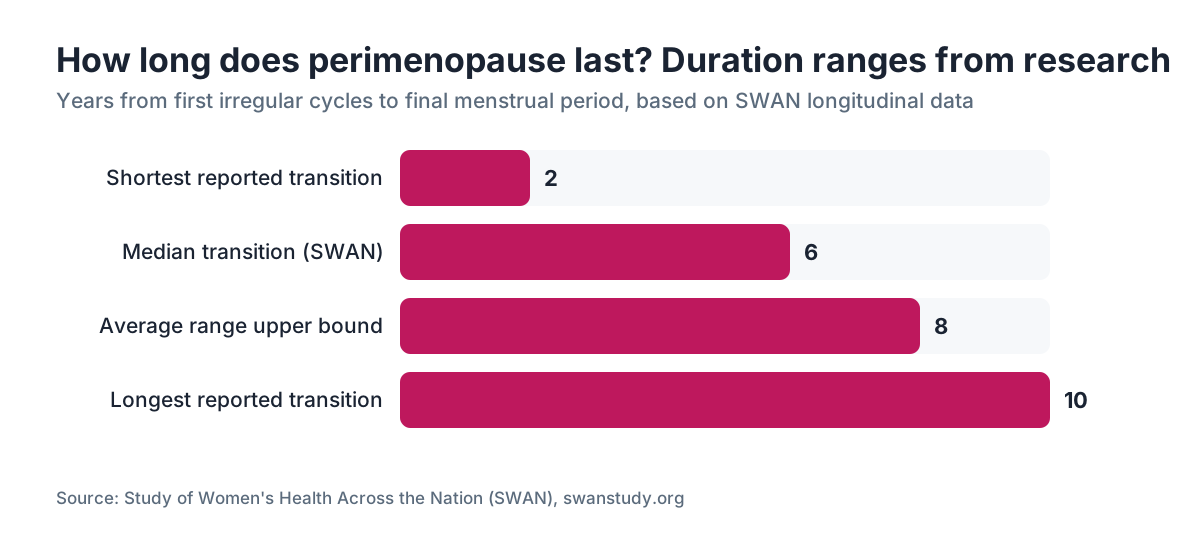
The average duration of perimenopause is 4 to 8 years. Some women get through it in as few as 2 years, others take as long as 10 [1]. The SWAN study found the median menopausal transition ran about 5.8 years from the first sign of irregular cycles to the final menstrual period [2].
Periods officially stop when you've gone 12 straight months without one. That 12-month point is retroactively called your menopause date. Until you hit it, a period can still show up, even after several months of nothing. This catches many women off guard. They assume a 6-month dry stretch means they're done, then a period arrives.
For most women in the US, the average age at menopause (the final period) is 51 [3]. So perimenopause for an average woman might begin around 45 to 46, though it can start in the late 30s for some. Smoking, certain cancer treatments, and a parent who went through early menopause all raise the odds of an earlier transition. See our article on perimenopause age for the full breakdown of timing factors.
If your periods stop before age 40, that's a different situation called primary ovarian insufficiency (POI), not perimenopause, and it needs its own evaluation [12].
What does a late period in perimenopause mean?
A late period in perimenopause usually means one of two things: a late ovulation, or no ovulation at all that cycle. Both are normal parts of the transition. As your ovaries get less consistent, the timing of ovulation shifts around, and sometimes it skips entirely, which delays or erases that cycle's bleed.
But a late period does not mean you can't get pregnant. Perimenopause is not infertility. You can still ovulate sporadically, even with irregular cycles. If you've had unprotected sex and your period is late, take a pregnancy test before you blame perimenopause. ACOG recommends continuing contraception until 12 months after the final menstrual period if pregnancy prevention matters to you [4].
Other things can delay a period during perimenopause: heavy stress, big weight changes, thyroid trouble, and elevated prolactin. If your TSH comes back abnormal or your doctor spots other symptoms, those are worth ruling out alongside the perimenopause picture.
A late period that stretches to 60 or 90 days and then returns as a very heavy bleed fits an anovulatory cycle followed by a buildup-heavy shed. Annoying, but usually not dangerous. A late period followed by ongoing irregular spotting, especially with pelvic pain, is something to evaluate more urgently.
How heavy is too heavy? When does perimenopause bleeding need medical attention?
Heavy menstrual bleeding (HMB) is one of the most common reasons women in perimenopause see a gynecologist. The clinical threshold is losing more than 80 mL of blood per cycle, but honestly, nobody measures that. The practical markers: soaking through a pad or super tampon every hour for 2 or more hours running, passing clots larger than a quarter, bleeding longer than 7 days, or bleeding that wrecks your daily life [5].
The American College of Obstetricians and Gynecologists (ACOG) states that any postmenopausal bleeding, or abnormal uterine bleeding in women aged 45 and older, warrants evaluation to rule out endometrial hyperplasia or carcinoma [4]. So while heavy bleeding is common in perimenopause, it's not something to just wait out without at least a conversation with your provider.
Evaluation usually starts with a pelvic ultrasound to check uterine lining thickness and rule out fibroids or polyps. An endometrial biopsy may follow if the lining looks thick or irregular. Fibroids are everywhere during the perimenopausal years and drive a lot of worsening heavy bleeding, as does endometrial hyperplasia (a thickened lining that can be precancerous).
Signs that need prompt attention:
- Bleeding so heavy you're changing protection every 30 minutes
- Feeling faint, short of breath, or unusually tired (signs of anemia from blood loss)
- Bleeding with severe pelvic pain
- Spotting or bleeding after sex
- Any bleeding that restarts after 12 months without a period (that's postmenopausal bleeding and needs same-week evaluation)
Iron-deficiency anemia is a real risk with heavy perimenopausal bleeding. If you're consistently having very heavy periods, ask your doctor to check a CBC and ferritin.
What do perimenopause periods look like compared to regular periods? (A comparison)
It helps to see the differences laid out. The table below compares typical reproductive-age periods to what's common in perimenopause, based on SWAN data and NAMS clinical guidance [1][2].
| Feature | Typical reproductive years | Perimenopause | |---|---|---| | Cycle length | 24 to 38 days, consistent | Variable: 21 to 60+ days, unpredictable | | Flow | Moderate, consistent | Heavy, light, or flooding; varies cycle to cycle | | Duration | 4 to 7 days | May be shorter or longer; can exceed 7 days | | Spotting between periods | Occasional at ovulation | More frequent; irregular estrogen surges | | Clots | Small clots sometimes normal | Larger clots more common | | PMS symptoms | Predictable pattern | May worsen; timing becomes unpredictable | | Skipped periods | Rare (unless pregnant) | Common; can skip for 2 to 3 months | | Ovulation | Regular | Irregular; some cycles anovulatory |
The biggest practical takeaway: in perimenopause, your period is no longer a reliable signal about anything. It can't tell you whether you ovulated, when you ovulated, or when the next one will come.
Can perimenopause period symptoms be managed, and how?
Yes. You don't have to just endure it. The options run from hormonal to non-hormonal, and the right choice depends on what bothers you most, your other health factors, and whether you want or need contraception.
Hormonal IUD (like Mirena). One of the most effective options for heavy bleeding in perimenopause. It releases a small amount of levonorgestrel locally into the uterus, which thins the lining a lot. Many women see a 90% drop in blood loss [5]. It also gives you contraception. ACOG treats it as first-line for HMB in this age group.
Combined oral contraceptives. Low-dose birth control pills can regulate cycles and cut flow, and they also help other perimenopause symptoms like hot flashes. They're generally used until age 50 or 51 in healthy non-smoking women, then switched to menopause hormone therapy if needed.
Progesterone-only therapy. If your irregular cycles come from low progesterone and anovulation, cyclic oral progesterone (or a progesterone-based approach) can help steady the lining and cut heavy bleeding. This is common in perimenopausal women who aren't good candidates for estrogen-containing methods. Learn more about how progesterone works in this context at our progesterone overview.
Menopausal hormone therapy (MHT). Once you're in late perimenopause and symptoms beyond bleeding get significant, MHT becomes a real option. Estrogen plus progesterone can stabilize cycles, reduce hot flashes, and protect bone density. The hormone replacement therapy article covers the benefit and risk profile in detail, including the Women's Health Initiative context.
NSAIDs. Over-the-counter ibuprofen or naproxen, taken at the start of your period, can cut flow by 25 to 35% and is a useful short-term move [5].
Tranexamic acid. A prescription non-hormonal option that reduces blood loss by keeping clots from breaking down. You take it only on heavy bleeding days.
Endometrial ablation. A procedure that destroys the uterine lining. Very effective for heavy bleeding but ends fertility. Right only if you're certain you don't want pregnancy and fibroids or polyps aren't driving the bleeding.
For women managing perimenopause symptoms alongside weight gain, which often intensifies during this transition, telehealth platforms like WomenRx can help you look at the full hormonal picture, including whether hormone replacement therapy or a GLP-1 medication fits your needs.
Does weight gain during perimenopause affect your periods?
It can, in both directions. Fat tissue makes estrogen (specifically estrone) through a process called peripheral aromatization. In women with more body fat, this extra estrogen source can push the uterine lining to keep thickening even as ovarian estrogen swings around, which worsens heavy or prolonged bleeding.
Obesity also links to higher rates of anovulatory cycles and heavier periods in perimenopausal women. A large analysis published in the journal Menopause found higher BMI correlated with heavier menstrual bleeding and longer cycles during the transition [6].
That's one reason the perimenopausal years, when weight gain tends to speed up from metabolic changes and muscle loss, can create a feedback loop: more fat means more estrogen exposure, which can mean heavier bleeding and more irregular cycles.
From the other direction: losing weight during perimenopause can sometimes normalize cycles or reduce flow in women who had anovulatory heavy bleeding. It's not guaranteed and it depends on how far along the transition you are, but the mechanism is real. GLP-1 medications like semaglutide are used more and more for weight management at this life stage. Read our semaglutide for weight loss overview for how that works, keeping in mind GLP-1s don't directly treat menstrual symptoms.
How do you know if missed periods are perimenopause or something else?
Missed or irregular periods in your 40s are most often perimenopause, but a few other causes deserve a look before you assume. The differential is actually short:
Pregnancy. As noted above, you can still conceive in perimenopause. A home pregnancy test takes 2 minutes and is worth doing.
Thyroid dysfunction. Both hypothyroidism and hyperthyroidism can disrupt cycles. Hypothyroidism in particular causes heavy, irregular periods and shows up more in women over 40. A simple TSH blood test rules it out.
Hyperprolactinemia. Elevated prolactin (from a benign pituitary adenoma or certain medications) can shut down cycles. Prolactin level is part of a standard workup for missed periods.
Polycystic ovary syndrome (PCOS). Women with PCOS have irregular periods throughout their reproductive years, and the picture can overlap with perimenopause. A history of irregular cycles before your 40s is a clue.
Eating disorders or very low body weight. Hypothalamic amenorrhea from caloric restriction or heavy exercise suppresses ovulation and can cause missed periods at any age.
Medications. Antipsychotics, some antidepressants, and hormonal contraceptives can all shift cycle regularity.
The bloodwork that sorts this out includes FSH, estradiol, TSH, prolactin, and sometimes AMH (anti-Müllerian hormone, a marker of ovarian reserve). An FSH above 25 IU/L on day 2-3 of a cycle suggests diminished ovarian reserve; an FSH consistently above 40 IU/L with low estradiol points to menopause [3][10]. A single FSH result isn't definitive because FSH swings a lot during perimenopause. That's why NAMS advises against using a single FSH to diagnose perimenopause [1].
What about spotting between periods, or bleeding after sex?
Mid-cycle spotting in perimenopause is common and usually harmless. As estrogen fluctuates and rises sharply, it can stimulate the uterine lining enough to cause a little bleeding, much like what some women get at ovulation in their regular cycles. It's typically light, short (a day or two), and pinkish or brownish.
Spotting after sex is different. It's more likely to come from the cervix or vaginal walls than the uterus, and in perimenopausal women it can reflect genitourinary syndrome of menopause (GSM), where declining estrogen thins vaginal tissue and makes it more fragile. GSM affects roughly half of postmenopausal women and a good share of women in late perimenopause [7]. Local estrogen (vaginal cream, ring, or tablet) treats this well without meaningful systemic absorption.
Bleeding after sex that's heavy, persistent, or comes with unusual discharge is a reason to see your doctor promptly. Cervical polyps, cervical changes, and cervical cancer can all present this way and are not related to perimenopause. A Pap smear and pelvic exam are the starting point.
Any bleeding after you've gone 12 months without a period, including spotting after sex, is postmenopausal bleeding until proven otherwise and needs evaluation within days to weeks, not months. Endometrial cancer is the concern, and it's highly treatable when caught early.
What can help you track and predict perimenopause periods?
The blunt truth: you can't fully predict perimenopause periods. But tracking them still helps a lot, both for spotting patterns and for handing your doctor useful information.
A symptom and cycle diary, or any period-tracking app, is the starting point. Note cycle length, flow heaviness (light, moderate, heavy, flooding), clot size, spotting days, and other symptoms (hot flashes, sleep disruption, mood shifts). After 3 to 6 months of data, patterns often surface even inside the chaos.
Basal body temperature (BBT) tracking can tell you whether you're still ovulating in a given cycle. If your BBT rises (typically 0.2 to 0.5 degrees Fahrenheit) and holds for at least 10 days, you ovulated. A cycle with no temperature rise was likely anovulatory. This matters if contraception is relevant to you.
Over-the-counter LH strips (ovulation tests) also work in perimenopause, with one caveat: rising FSH levels can trigger false-positive LH readings, so a single positive strip isn't as reliable as it was in your 30s.
For the broader picture of where you sit in the transition, blood tests every 6 to 12 months can give your doctor a snapshot. Understanding when does menopause start for your particular trajectory matters for planning.
One thing worth knowing: perimenopause is a good time to start thinking about bone density. Estrogen protects bone, and as levels drop, bone loss speeds up. The bone density test article covers when DEXA screening is recommended, which matters for any woman in late perimenopause.
What's the link between perimenopause periods and menopause hormone therapy?
This is where many women get confused. Hormone therapy during perimenopause looks different from hormone therapy after menopause. During perimenopause, your ovaries still make some estrogen, sometimes in big surges. Add a standard postmenopausal dose of estrogen on top of that and you can get more irregular bleeding, not less.
The approach during perimenopause is usually to work with your cycle instead of against it. For women still having periods, progestogen matters, because any estrogen therapy has to be balanced with enough progesterone to protect the uterine lining from thickening. Unopposed estrogen in a woman with a uterus raises endometrial cancer risk.
Oral contraceptives are often preferred in early to mid-perimenopause for women who also need contraception, because they suppress the erratic ovarian hormones entirely and give a predictable withdrawal bleed. As women move into late perimenopause, lower-dose MHT fits better.
The estrogen patch is one delivery method that gives steady estrogen without the liver-first metabolism of oral estrogen, which some evidence suggests is easier on cardiovascular risk. NAMS notes in its 2022 Hormone Therapy Position Statement that "transdermal estradiol may be associated with a lower risk of venous thromboembolism and stroke compared with oral estrogen" [8].
If you're weighing hormone therapy and want a clear-eyed look at the risks and benefits specific to perimenopause timing, the NAMS 2022 position statement is the best primary source to read, or to bring to your provider. WomenRx providers can also evaluate your specific hormone picture and discuss options, including whether MHT, progesterone-only therapy, or another approach fits your history.
Frequently asked questions
Can I get pregnant if my period is irregular during perimenopause?
Yes. Irregular periods in perimenopause mean ovulation is unpredictable, not absent. You can still ovulate and conceive, even with cycles 60 days apart or longer. ACOG recommends contraception until you've gone 12 straight months without a period if you want to avoid pregnancy. A home pregnancy test is warranted any time a period is late and you've had unprotected sex.
How long can perimenopause periods last?
Individual periods can run anywhere from 2 to 10 or more days during perimenopause, versus the typical 4 to 7 days. Prolonged bleeding (more than 7 to 8 days per cycle) that's also heavy warrants evaluation to rule out endometrial hyperplasia, fibroids, or polyps. Lighter spotting that lasts longer is more often just hormonal irregularity, but worth mentioning to your doctor.
Is it normal to skip 2 or 3 months and then have a period in perimenopause?
Yes, this is one of the hallmark patterns of late perimenopause. Your ovaries make less estrogen and ovulate less reliably, so months can pass with no real hormonal trigger for a bleed. When the lining finally does shed, it can be heavier than your prior periods because it had more time to build up. Report very heavy or prolonged bleeds to your provider.
What blood tests confirm perimenopause?
FSH, estradiol, and TSH are the most useful starting tests. An FSH consistently above 25 IU/L (especially above 40 IU/L) with low estradiol suggests the ovaries are declining. FSH swings dramatically during perimenopause though, so NAMS advises against using a single result to diagnose the transition. AMH and antral follicle count can also estimate remaining ovarian reserve. Repeat testing over time tells you more than one snapshot.
Can stress cause missed periods that look like perimenopause?
Yes. Significant physical or psychological stress suppresses GnRH pulsatility in the hypothalamus, which can delay or prevent ovulation and cause missed periods at any age. This is called hypothalamic amenorrhea. If missed periods come with major life stress, heavy exercise, or low body weight, those factors are worth addressing. Thyroid and prolactin levels should also be checked before you pin everything on perimenopause.
Why are my periods heavier than ever now that I'm in my 40s?
Anovulatory cycles are the main culprit. Without ovulation, your body makes little progesterone, so the uterine lining keeps building rather than shedding on schedule. When it finally does shed, the heavier flow reflects that extra buildup. Fibroids, which also become more common and can enlarge during perimenopause from estrogen exposure, are another frequent cause. A pelvic ultrasound is the first diagnostic step for new or worsening heavy bleeding.
Is brown discharge or spotting between periods a sign of perimenopause?
Often yes. Brown discharge or spotting between periods in your 40s is frequently just older blood shedding from minor hormonal shifts or a slightly irregular lining. It's one of the more common early signs of perimenopause. But spotting after sex, spotting that's heavy or persistent, or any bleeding after 12 months without a period needs medical evaluation to rule out cervical or endometrial causes.
At what age do periods usually become irregular due to perimenopause?
Most women notice the first cycle irregularities in their mid-to-late 40s, with the average around 45 to 47. The SWAN study found that the shift from regular cycles to irregular ones (defined as 7 or more days of variability in cycle length) marks the start of the menopausal transition. Some women notice changes as early as their late 30s, particularly those with a family history of early menopause or who smoke.
Can the perimenopause transition cause periods to stop and then come back months later?
Yes, and this is one of the most confusing parts. You may go 4, 5, or even 8 months without a period and then have one, which resets the 12-month clock for official menopause. Until 12 straight months without any bleeding have passed, you have not reached menopause. Any bleeding after that 12-month mark is postmenopausal bleeding and needs prompt evaluation regardless of how light it is.
Does hormone therapy stop perimenopause periods entirely?
It depends on the type. Combined oral contraceptives typically produce a predictable withdrawal bleed each month and suppress the erratic natural cycles. A hormonal IUD often reduces or eliminates periods. Standard postmenopausal HRT regimens (continuous combined estrogen plus progestogen) often result in no bleed after a few months, though irregular spotting is common in the first 3 to 6 months of use. Sequential HRT (estrogen daily, progestogen for part of the month) produces a monthly withdrawal bleed by design.
When should I go to the ER for perimenopause bleeding?
Go to the emergency room if you're soaking a pad every 15 to 30 minutes for more than an hour, passing very large clots continuously, feeling faint, dizzy, or short of breath, or if you have significant pelvic pain alongside heavy bleeding. These can signal hemorrhage severe enough to cause dangerous anemia. Severe bleeding with a sudden onset (rather than gradually worsening) is also a prompt for urgent evaluation, since it may reflect a cause other than hormonal irregularity.
Do fibroids get worse during perimenopause, and how does that affect periods?
Fibroids are estrogen-sensitive benign uterine tumors, and the fluctuating, sometimes high estrogen levels of perimenopause can push them to grow or turn more symptomatic. Submucosal fibroids (those that protrude into the uterine cavity) link particularly to heavy and prolonged bleeding. After menopause, fibroids typically shrink as estrogen falls. If you have fibroids and your bleeding is worsening in perimenopause, treatment options include the hormonal IUD, uterine fibroid embolization, or surgery.
Can diet or lifestyle changes help regulate periods during perimenopause?
Somewhat. Keeping a healthy weight reduces excess peripheral estrogen from fat tissue, which can cut heavy anovulatory bleeding. Reducing alcohol (which raises estrogen levels) and avoiding extreme caloric restriction (which can trigger hypothalamic amenorrhea) both matter. Some research suggests isoflavone-rich diets may weakly modulate estrogen activity, but the evidence for real cycle regulation from diet alone is thin. Lifestyle changes work best as support for, not a replacement of, medical management.
Sources
- North American Menopause Society (NAMS), Menopause 101: A Primer for the Menopausal Years
- Study of Women's Health Across the Nation (SWAN), NIH-funded longitudinal cohort
- National Institute on Aging (NIA), Menopause
- American College of Obstetricians and Gynecologists (ACOG), Practice Bulletin on Abnormal Uterine Bleeding
- ACOG, Heavy Menstrual Bleeding Patient FAQ and Clinical Guidelines
- Menopause: The Journal of The North American Menopause Society
- NAMS, 2020 Genitourinary Syndrome of Menopause Position Statement
- NAMS, 2022 Hormone Therapy Position Statement, published in Menopause journal
- CDC National Center for Health Statistics, Reproductive Health Data
- Endocrine Society Clinical Practice Guideline, Menopause and Perimenopause
- NIH Office of Research on Women's Health, Women's Health and Hormones
- ACOG, Primary Ovarian Insufficiency in Adolescents and Young Women, Committee Opinion