Perimenopause period every 2 weeks: what's normal and what needs attention
TL;DR: Periods every 2 weeks are common in perimenopause. Erratic ovulation and falling progesterone shorten cycles, and about 25% of perimenopausal women have cycles of 25 days or fewer at some point (SWAN). Most short cycles are benign. But cycles under 21 days, or heavy bleeding, can also mean polyps, fibroids, or rarely endometrial cancer, so they need a clinical workup.
Why is my period coming every 2 weeks in perimenopause?
Short answer: your ovaries have gone unpredictable, and progesterone is not keeping up.
During your reproductive years, a fairly reliable hormonal rhythm runs the show. An egg matures, you ovulate, progesterone rises for about 12 to 14 days, and if there's no pregnancy, progesterone drops and you bleed. That window is what gives most women a 25 to 30 day cycle.
In perimenopause, estrogen swings hard while progesterone production falls [1]. Some months you ovulate on schedule. Some months you ovulate early, cutting the whole cycle short. Some months you don't ovulate at all, then get a delayed, sometimes heavy, bleed when estrogen finally drops. The result is a cycle that can land anywhere from 14 to 60 days, sometimes inside the same three months.
A period every two weeks usually means one of two things. Either you're ovulating very early, which shortens the first half of the cycle, or you're bleeding mid-cycle because an estrogen surge briefly thickened the lining before dropping off. Both can happen in the same woman. Sometimes in the same month.
The North American Menopause Society defines the shift into perimenopause partly by cycle variability of 7 or more days from your normal, which can go either direction [1]. A 14-day cycle is roughly a 50% shortening for someone whose baseline was 28 days. That still sits inside the range NAMS counts as normal menopausal transition.
How common is frequent or short-cycle bleeding in perimenopause?
More common than most women expect.
The Study of Women's Health Across the Nation (SWAN) followed over 3,300 women from premenopause through menopause. It found that shortened cycles, defined as under 25 days, occurred in roughly 25% of women during early perimenopause [2]. Cycle length swings of more than 7 days hit the majority of women at some point in the transition.
Here's the part that surprises people: cycles don't just get longer as menopause approaches. SWAN data show early perimenopause is more often marked by shorter cycles, while late perimenopause drifts toward longer, skipped cycles before periods stop for good [2]. So a woman in her early-to-mid 40s getting her period every 2 weeks is often in the earliest, most chaotic stretch of the whole thing.
About 18% of women in the Melbourne Women's Midlife Health Project reported spotting or bleeding between periods at least once during the perimenopause years, and a meaningful share had it more than once [3]. That's spotting stacked on top of regular bleeding, which can make periods feel nonstop.
The hormonal turbulence is real and it's common. That doesn't mean you ignore it. It means you're not alone in it.
What does a normal perimenopausal cycle actually look like?
There is no single normal. That's the honest answer.
What counts as within the expected range: cycles anywhere from 21 to 45 days, cycles that shift unpredictably month to month, flows heavier or lighter than you're used to, and occasional spotting between periods.
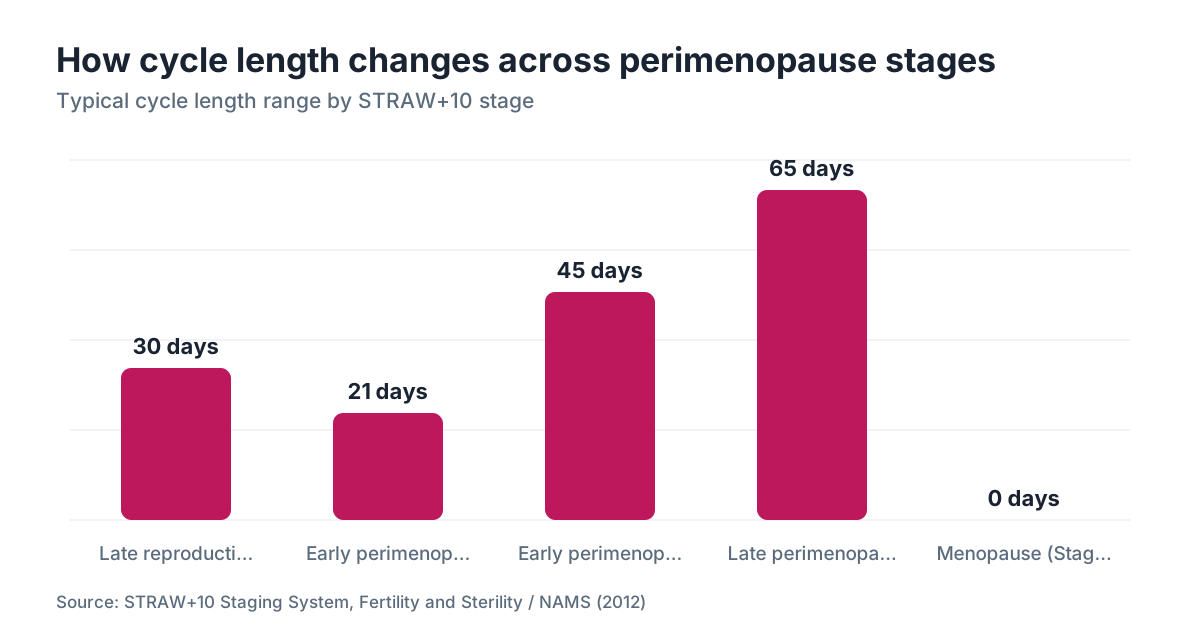
The table below shows how cycle characteristics shift across the stages of the transition, based on the STRAW+10 staging system used by NAMS and the Endocrine Society [4].
| Stage | What's happening | Typical cycle change | |---|---|---| | Late reproductive (Stage -3) | Subtle FSH rise, ovulation intact | Cycles may shorten slightly; 25-35 days | | Early perimenopause (Stage -2) | Erratic ovulation, estrogen fluctuates | Variable: 21-45+ days; some very short | | Late perimenopause (Stage -1) | Ovulation rare, progesterone low | Long gaps 60+ days, heavy bleeds | | Menopause (Stage 0) | 12 consecutive months with no period | No bleeding |
Twenty-one days is the clinical line most gynecologists draw. Anything shorter than that, or bleeding between clearly separate cycles, should prompt a workup. That's not alarmism. It's just where the risk profile starts to shift away from pure hormonal noise and toward structural or cellular causes worth ruling out.
When is frequent bleeding in perimenopause a warning sign?
Most frequent periods in perimenopause are hormonal. Some are not, and the ones that aren't are the reason a workup matters.
Uterine polyps are benign growths of the endometrial lining, more common as years of estrogen exposure add up. They often cause irregular or between-period bleeding and can look, from the inside, exactly like perimenopause. Fibroids, benign muscle tumors, also cause heavy or frequent bleeding and tend to peak in size and symptoms during the perimenopausal years before shrinking after menopause [5].
Endometrial hyperplasia is when the lining overgrows from unopposed estrogen (estrogen without enough progesterone to balance it). It causes abnormal bleeding and, left alone, can progress to endometrial cancer in a subset of cases [6]. The American College of Obstetricians and Gynecologists notes that endometrial cancer risk climbs with age, obesity, diabetes, and conditions involving chronic excess estrogen [6].
The signs that call for a prompt evaluation instead of watchful waiting:
- Bleeding that soaks a pad or tampon every hour for two or more hours in a row
- Cycles consistently shorter than 21 days
- Spotting or bleeding after sex
- Any bleeding after 12 straight months without a period (that's postmenopausal bleeding, which always needs investigation)
- Bleeding with pelvic pain, pressure, or abnormal discharge
None of these automatically means cancer. They mean you need a workup, usually a pelvic ultrasound and often an endometrial biopsy, to find out what's driving the bleeding.
What causes cycles to suddenly shorten so dramatically?
It comes down to estrogen and the follicular phase.
Your cycle has two halves. The follicular phase runs from the start of your period to ovulation. The luteal phase runs from ovulation to your next period. The luteal phase is remarkably steady, almost always 12 to 14 days. What varies is the follicular phase.
In perimenopause, FSH (follicle-stimulating hormone) rises because the ovaries respond less to signaling. Higher FSH sometimes pushes follicles to mature faster than normal, moving ovulation earlier, which collapses the whole cycle. A follicular phase of 5 to 7 days instead of the usual 12 to 14 produces a cycle of 18 to 22 days [2].
At the same time, low progesterone in the luteal phase means the lining loses its support. Even if you ovulate right on schedule, the lining can start breaking down before the full two weeks are up. That looks like a short cycle but is really a shortened luteal phase.
Both mechanisms can run at once. That's part of why cycle tracking apps built for regularly cycling women are basically useless here. They assume stable luteal phases and predictable ovulation. Neither one holds in perimenopause.
How much blood loss is too much with frequent periods?
Heavy menstrual bleeding is a real clinical diagnosis, and it's badly undertreated in perimenopausal women who assume it's just part of the deal.
The formal definition: heavy menstrual bleeding means losing more than 80 mL of blood per cycle. Nobody actually measures that. The practical proxy is soaking through a regular pad or tampon every hour for more than two hours in a row, passing clots larger than a quarter, or bleeding for more than 7 days [5].
When periods come every two weeks, even moderate bleeding stacks up fast. Two cycles a month at 60 mL each is 120 mL, enough to cause iron-deficiency anemia. Iron-deficiency anemia from menstrual loss is one of the most common and most missed conditions in women in their 40s. The symptoms (fatigue, brain fog, breathlessness, cold intolerance) overlap so heavily with perimenopause that it's easy to blame hormones when the real problem is blood loss.
If you're bleeding every two weeks, ask your doctor to check a complete blood count and a ferritin level at your next visit. Ferritin drops before hemoglobin does, so it flags low iron earlier [5].
Treating the anemia often lifts energy and clears the mental fog before you touch a single hormone.
What tests do doctors run for frequent or abnormal perimenopausal bleeding?
A good workup covers three areas: hormonal, structural, and cellular.
On the hormonal side, your doctor may check FSH, LH, estradiol, and progesterone at specific points in your cycle. A thyroid panel is standard because both hypothyroidism and hyperthyroidism cause menstrual irregularity that can mimic perimenopause [7]. Prolactin gets checked if there's any breast discharge. A complete blood count and ferritin screen for anemia from blood loss.
Structurally, a transvaginal ultrasound is the first-line imaging test. It picks up fibroids, polyps, and an abnormally thick endometrial lining. Endometrial thickness above 4 to 5 mm in a postmenopausal woman, or above a set threshold in a perimenopausal woman with abnormal bleeding, is a reason for further evaluation [6]. Saline-infused sonohysterography, where saline goes into the uterus before the ultrasound, gives a clearer view of the cavity and catches small polyps that plain ultrasound misses.
Cellularly, an endometrial biopsy samples the lining directly to check for hyperplasia or cancer. It's an office procedure, uncomfortable but quick, and it gives tissue-level answers imaging can't.
Not every woman with a short cycle needs all of this. A 42-year-old with a recent normal Pap and cycles that slid from 28 to 22 days without other symptoms sits in a different category than a 49-year-old with 14-day cycles, heavy flow, and spotting in between. Your clinician should triage on the full picture, not one number.
Can hormone therapy regulate periods that are coming every 2 weeks?
Yes, and for many women it's the most direct fix.
The core problem behind most short perimenopausal cycles is too little progesterone relative to estrogen. Adding progesterone, as oral micronized progesterone, a progesterone IUD, or a combined estrogen-progesterone regimen, gives the lining a stable scaffold and stops the early, disorganized shedding that drives frequent bleeding [8].
A progesterone IUD (the 52 mg levonorgestrel device) works especially well for heavy and frequent perimenopausal bleeding. Studies show it cuts menstrual blood loss by over 90% in women with heavy bleeding, and it's often used as first-line treatment even before the diagnostic workup is finished [8]. It also provides contraception, which matters because perimenopausal women can still ovulate and get pregnant.
Oral micronized progesterone (Prometrium) taken cyclically, usually 200 mg for 12 to 14 days each month, can steady cycles and pull down the estrogen-dominant state behind frequent bleeding. Learn more about how progesterone works in perimenopause and what forms are available.
Full hormone replacement therapy with estrogen plus progesterone fits women who also have real vasomotor symptoms like hot flashes and night sweats alongside the cycle chaos. Hormone replacement therapy isn't reserved for postmenopausal women. It works in perimenopause with the right dose and formulation. An estrogen patch paired with cyclic or continuous progesterone is one common approach.
WomenRx clinicians do exactly this kind of hormonal balancing with perimenopausal patients, reading symptoms, cycle pattern, and labs together to land on a regimen that fits. Worth knowing if a doctor has waved you off and told you to wait it out.
Non-hormonal options exist too. NSAIDs like ibuprofen, taken at the start of bleeding, cut menstrual blood loss by about 20 to 30% and help with cramping [5]. Tranexamic acid is a prescription that reduces bleeding without touching hormones. Neither one fixes cycle frequency, but both shrink the volume of each bleed.
What does perimenopause do to cycles over time, and when does it end?
The timeline is genuinely all over the map, and that's not a dodge.
Most women enter perimenopause in their mid-40s, though it can start in the late 30s, and the average age at the final period in the US is 51 to 52 [9]. The transition lasts a median of about 4 to 5 years but runs from 1 to over 10 years depending on the woman.
Early perimenopause, the phase tied to short, frequent cycles, usually lasts 2 to 3 years. Late perimenopause, with its longer gaps and skipped periods, comes next. Menopause itself is 12 consecutive months without any period.
See our article on perimenopause age for a closer look at when the transition starts and what speeds it up, and when does menopause start if you're trying to figure out where you are.
Frequent periods early on don't predict a long or rough transition. Some women ride out short-cycle chaos for a year, then move fast to skipped cycles and menopause. Others have variable cycles for most of a decade. No test reliably tells you which group you're in, though anti-Mullerian hormone (AMH) and antral follicle count on ultrasound give a rough read on remaining ovarian reserve.
What does seem to speed things up: smoking (linked to menopause arriving 1 to 2 years earlier), being underweight, certain chemotherapies, and removal of the ovaries. What slows it down is less clear, though some data suggest oral contraceptives during perimenopause don't delay the final period but do mask natural cycle variability [9].
Can perimenopause cause periods every 2 weeks even if I'm only in my late 30s?
Yes. Perimenopause before 40 gets called early menopause or, if ovarian function drops off sharply, primary ovarian insufficiency (POI).
About 1% of women reach menopause before age 40, and a larger group, roughly 10%, hit early perimenopause with irregular cycles in their late 30s [10]. This gets missed a lot, because plenty of clinicians don't think hormonal transition in a 38-year-old with irregular cycles and go hunting for other causes first.
POI is a separate diagnosis from perimenopause and carries different stakes, especially for bone density and cardiovascular health, because estrogen deficiency runs longer at a younger age. If you're under 40 with cycles that have turned frequent, irregular, or very short, FSH and estradiol testing is the right move. An FSH over 25 to 40 IU/L on two draws at least a month apart, in a woman under 40, supports a POI diagnosis [10].
A bone density test is often recommended earlier than the standard screening age of 65 for women with POI or early perimenopause, because estrogen loss speeds up bone breakdown and the longer the gap, the more bone goes.
If you're in your late 30s and your periods have gone haywire, don't let anyone tell you you're too young for this to be hormonal. Get the labs.
Do GLP-1 medications affect menstrual cycle frequency in perimenopause?
This is a newer area and the data is still thin, but it comes up in the clinic.
GLP-1 receptor agonists like semaglutide and tirzepatide drive real weight loss in many women. Weight loss changes estrogen metabolism, because fat tissue itself makes estrogen. Losing body fat, especially visceral fat, lowers peripheral estrogen and can shift the hormonal balance in ways that change cycle patterns [11].
In practice, some women on GLP-1s find their periods become more regular as they lose weight, particularly if the irregularity was tied to obesity, insulin resistance, or PCOS. Others get temporary cycle disruption during the fast weight-loss stretch.
For perimenopausal women, the interaction is complicated. If GLP-1-driven weight loss cuts peripheral estrogen, it could tip a borderline woman into more obvious transition symptoms. If insulin resistance was part of the cycle chaos, easing it could improve regularity instead.
Nobody has published a perimenopausal subgroup analysis on cycle effects from the big GLP-1 trials. The STEP trials with semaglutide and the SURMOUNT trials with tirzepatide tracked weight, not menstrual cycle characteristics, as primary endpoints [11].
If you're on a GLP-1 and your cycle changes, bring it to your prescriber and look at it against your full hormonal picture. Read more about semaglutide or compare options at semaglutide vs tirzepatide if this fits your situation.
What should I track to help my doctor figure out what's happening?
Tracking changes the outcome. Your clinician is deciding inside a 15-minute visit. What you walk in with shapes what they can do.
The minimum useful tracking for frequent perimenopausal periods:
-
Cycle start dates. Any calendar app works. Log the date of first real bleeding, not spotting, for at least 3 months.
-
Flow volume. Not lab measurements, practical ones: pads or tampons fully soaked per day, whether you're passing clots and how big, whether you're leaking through to clothing.
-
Symptom overlap. Note hot flashes, sleep disruption, mood changes, and brain fog. These tell your clinician where you are in the transition and whether vasomotor symptoms point to systemic low estrogen.
-
Between-period bleeding or spotting. Any blood between clear periods, or after sex, logged by date.
-
Medications and supplements. Some supplements, including high-dose fish oil, vitamin E, and ginkgo, can lengthen bleeding time. Blood thinners obviously affect flow. Bring the full list.
Free period apps like Clue let you log cycle length and symptoms and can spit out a report you actually hand to your doctor. The apps won't predict your cycle in perimenopause, but they'll give you a clean record, which is the point.
When should I see a doctor versus waiting to see if frequent periods resolve on their own?
See a doctor now if any of these are true: you're soaking through protection at one per hour for two or more hours, your cycles have run under 21 days for three months straight, you have any bleeding after 12 months without a period, you bleed after sex, you're wiped out with fatigue and breathlessness that smell like anemia, or you're under 40 with cycle changes (see the POI section above).
Wait-and-see is reasonable for cycles of 21 to 25 days without heavy flow, without spotting between periods, and without other symptoms, for a few months. If they normalize, you likely rode out an early hormonal blip that settled. If they don't, get evaluated.
The honest truth is that most frequent perimenopausal bleeding is benign. But the causes that aren't, including endometrial hyperplasia and early endometrial cancer, are almost always curable when caught early and much harder to treat when caught late [6]. An office visit and an ultrasound are a small price to rule out the serious stuff.
Your doctor shouldn't brush you off with "that's just perimenopause" without at least taking a full history, confirming there's no red-flag pattern, and checking basic labs. If that's the answer you're getting, go get a second opinion or a specialist in women's hormonal health.
Frequently asked questions
Is it normal to get your period every 2 weeks in perimenopause?
Yes, it can be normal. About 25% of perimenopausal women have cycles shorter than 25 days at some point during the transition, per SWAN data. Erratic ovulation and low progesterone shorten cycles. That said, consistently bleeding every 14 days, or heavy bleeding at that frequency, warrants a workup to rule out polyps, fibroids, or endometrial issues.
How long can frequent periods in perimenopause last before they stop?
Early perimenopause, when short and erratic cycles peak, usually lasts 2 to 3 years before shifting to a phase of longer, skipped cycles. Total perimenopause runs from 1 to 10 years, with a median around 4 to 5 years. No reliable test predicts exactly how long your transition will take.
Can perimenopause periods every 2 weeks cause anemia?
Yes. Two moderate bleeds a month add up fast. Losing more than 80 mL total per month counts as heavy and can deplete iron stores. Ask your doctor to check a complete blood count and ferritin. Ferritin drops before hemoglobin falls, so it catches iron deficiency earlier. Fatigue and brain fog from anemia often get mistaken for hormonal symptoms.
What is the difference between perimenopause bleeding and abnormal uterine bleeding?
Perimenopause causes cycle irregularity through hormonal change; abnormal uterine bleeding is a clinical term for bleeding outside normal parameters, whatever the cause. The two overlap. Perimenopausal shifts can produce abnormal uterine bleeding, but so can polyps, fibroids, hyperplasia, and cancer. A diagnosis of perimenopausal irregular bleeding should only stand after structural and cellular causes are ruled out.
Can stress cause periods every 2 weeks during perimenopause?
Stress can disrupt the hypothalamic-pituitary-ovarian axis, affecting when or whether you ovulate. In perimenopause, when the system is already unstable, heavy stress may speed up hormonal fluctuation and shorten cycles further. But stress alone rarely explains cycles of 14 days. It's a contributing factor, not usually the main cause.
Should I use birth control for frequent perimenopausal periods?
Hormonal contraception, particularly low-dose combination pills or a progesterone IUD, can regulate cycle frequency and cut bleeding volume in perimenopausal women. A 52 mg levonorgestrel IUD reduces menstrual blood loss by over 90% and also provides contraception, which matters because ovulation still happens on and off in perimenopause. Discuss options with your clinician based on your cardiovascular risk profile.
Will progesterone stop periods coming every 2 weeks?
Progesterone, especially oral micronized progesterone or a progesterone IUD, targets the hormonal imbalance behind most short perimenopausal cycles. Cyclic oral progesterone taken 12 to 14 days a month gives the lining a stable progesterone window and prevents early breakdown. A progesterone IUD delivers progesterone locally in the uterus and usually reduces or stops bleeding over time. Results vary by person and dose.
At what age do perimenopausal periods every 2 weeks typically start?
Most women enter early perimenopause, when frequent and short cycles peak, in their mid-40s. Symptoms can start in the late 30s. Women under 40 with cycle changes should be checked for primary ovarian insufficiency, a distinct condition with different management. The average age of the final period in US women is 51 to 52.
Can thyroid problems cause periods every 2 weeks and be confused with perimenopause?
Yes. Both hypothyroidism and hyperthyroidism cause menstrual irregularity, including shorter or more frequent cycles. Thyroid dysfunction is common in women in their 40s and 50s, right when perimenopause hits. A standard perimenopausal workup should include TSH testing to separate hormonal causes from thyroid-driven cycle disruption. Both can happen at once.
How do I know if my frequent periods are perimenopause or something more serious?
Red flags worth more than reassurance: cycles consistently under 21 days, soaking protection hourly for two or more hours, spotting after sex, bleeding after 12 months without a period, or pelvic pain with bleeding. A transvaginal ultrasound and endometrial biopsy rule out polyps, fibroids, hyperplasia, and cancer. Perimenopause is a diagnosis of exclusion for abnormal bleeding patterns.
Can losing weight on a GLP-1 drug change my cycle in perimenopause?
Possibly. Fat tissue produces estrogen, so major weight loss from GLP-1 medications like semaglutide or tirzepatide can shift estrogen levels. Some women report more regular cycles; others get temporary disruption during rapid loss. No clinical trial has specifically tracked menstrual cycle changes in perimenopausal women on GLP-1s as a primary outcome. Bring any cycle changes to your prescriber.
What is the STRAW+10 staging system and how does it apply to frequent periods?
STRAW+10 is the clinical staging framework for the menopausal transition, developed by NAMS and the Endocrine Society. It defines early perimenopause (Stage -2) as cycle variability of 7 or more days from normal, and late perimenopause (Stage -1) as 60 or more days between cycles. Frequent short cycles usually place a woman in Stage -2, the earliest perimenopausal stage.
Is it possible to get pregnant if I'm having periods every 2 weeks in perimenopause?
Yes. Irregular, frequent cycles suggest you're still ovulating at least some of the time, which means pregnancy is possible. Perimenopausal women often underestimate this. Contraception is appropriate until you've had 12 consecutive months without a period if you're under 50, or 6 months if you're over 50 (though 12 months is the safer standard most clinicians use).
Sources
- North American Menopause Society (NAMS), Menopause Practice: A Clinician's Guide
- Study of Women's Health Across the Nation (SWAN), published in Obstetrics & Gynecology
- Melbourne Women's Midlife Health Project, Maturitas journal
- STRAW+10 staging system, Fertility and Sterility / NAMS joint publication
- American College of Obstetricians and Gynecologists (ACOG), Practice Bulletin on Heavy Menstrual Bleeding
- ACOG, Practice Bulletin on Endometrial Cancer and Endometrial Hyperplasia
- American Thyroid Association, Guidelines for Management of Thyroid Dysfunction
- Endocrine Society, Clinical Practice Guideline on Menopause
- National Institute on Aging (NIA), Menopause overview
- European Society of Human Reproduction and Embryology (ESHRE), Guideline on Primary Ovarian Insufficiency
- NEJM, STEP 1 Trial: Once-Weekly Semaglutide in Adults with Overweight or Obesity