Perimenopause period changes: what's normal and what's not
TL;DR: Perimenopause usually starts in the mid-to-late 40s and scrambles your cycle: heavier or lighter flow, longer or shorter cycles, skipped months, mid-cycle spotting. Erratic estrogen and falling progesterone drive it. Most of it is normal. But flooding, cycles under 21 days, or any bleeding after 12 period-free months always needs a doctor's eyes.
What actually happens to your period during perimenopause?
Your cycle runs on a conversation between your brain and your ovaries. Every month the hypothalamus signals the pituitary, the pituitary releases FSH (follicle-stimulating hormone) and LH, and the ovaries answer by maturing a follicle, releasing an egg, and producing estrogen and progesterone on a predictable schedule. Perimenopause breaks the schedule.
Early on, the ovaries start answering FSH signals inconsistently. Some months they pump out too much estrogen early, building an unusually thick uterine lining. Other months they barely respond, and estrogen stays low. So you get cycles that are shorter, longer, heavier, lighter, or simply gone, in a pattern that feels random because it is.
The North American Menopause Society calls perimenopause the stretch of "menstrual cycle irregularity" that precedes the final menstrual period by several years [1]. The clinical staging system, STRAW+10, splits it in two: early perimenopause, marked by cycles that vary by 7 or more days, and late perimenopause, when you start skipping and go 60 or more days between periods [2].
Most women notice the first changes somewhere between age 44 and 50, though the window is wide. See perimenopause age for a full breakdown of when this starts.
What period changes are most common in perimenopause?
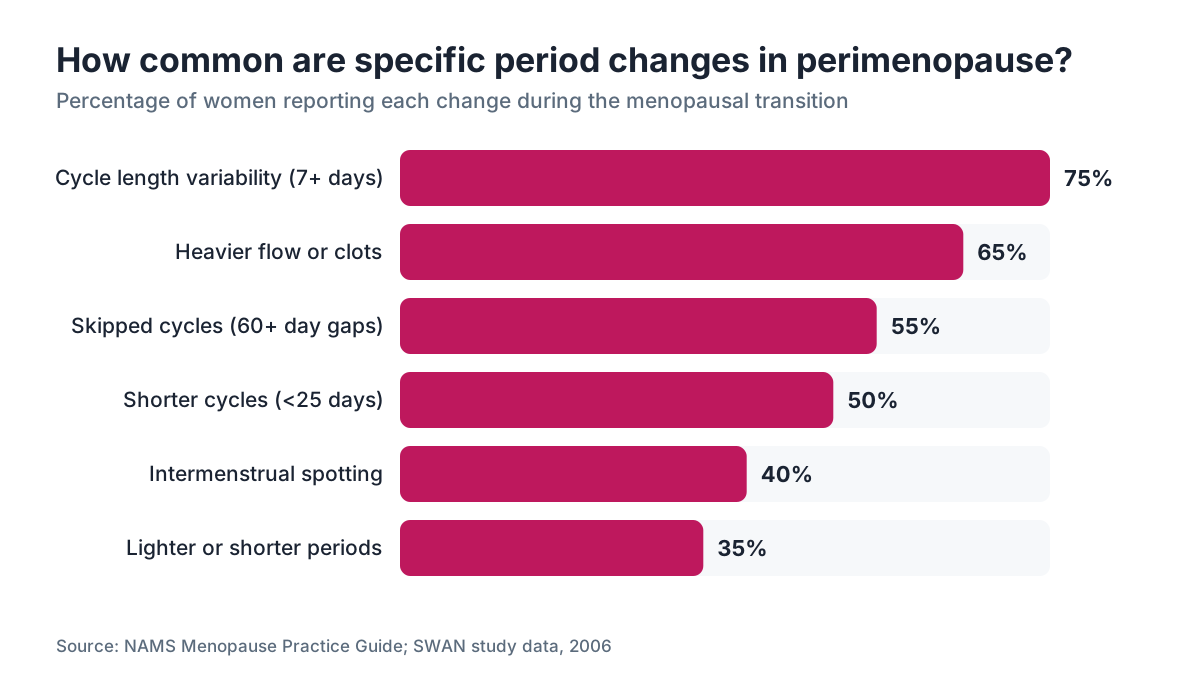
Cycles get longer first, then start skipping. That's the most consistent finding in the research. A 2006 analysis in Obstetrics & Gynecology using data from the Study of Women's Health Across the Nation (SWAN) found women first notice cycles that vary a lot in length, then years later see growing gaps between periods [3].
Here's what women actually report, roughly in order of how often it shows up:
Heavier, longer periods. This is the change that catches women off guard. Progesterone drops before estrogen does, so the lining grows thick and uneven. When it finally sheds, the bleeding is heavier and lasts longer. Clots are common.
Shorter cycles. Early perimenopause shortens the follicular phase (the first half), so periods that came every 28 days may start arriving every 21 to 25 days. It feels like your period is always early.
Skipped periods. In late perimenopause, months pass with no ovulation and no bleed. A gap of 60 or more days is the STRAW+10 marker for late perimenopause [2].
Lighter periods. Some women get the opposite of flooding: short, scanty periods, often brown rather than red, in the months estrogen runs low.
Spotting between periods. Erratic estrogen surges make the lining shed at odd times. Mid-cycle spotting is common. Still worth a look if it's new, heavy, or keeps happening.
A summary of the most common changes:
| Change | When it typically appears | What drives it | |---|---|---| | Shorter cycles (21-25 days) | Early perimenopause | Shortened follicular phase | | Heavier flow, more clots | Early-to-mid perimenopause | Progesterone decline, thick lining | | Irregular timing (varies 7+ days) | Early perimenopause | Erratic ovarian response to FSH | | Skipped cycles (60+ day gaps) | Late perimenopause | Anovulatory cycles | | Lighter, shorter periods | Late perimenopause | Low estrogen, thin lining | | Spotting between periods | Any stage | Estrogen fluctuations |
One number to hold onto: roughly 90% of women live through at least 4 years of irregular cycles before their final period [1].
How heavy is too heavy? When does heavy bleeding become a problem?
Heavy bleeding has a real clinical threshold. The American College of Obstetricians and Gynecologists (ACOG) defines heavy menstrual bleeding (once called menorrhagia) as blood loss over 80 mL per cycle, or bleeding that lasts more than 7 days [4]. In plain terms: soaking through a pad or tampon every hour for several hours straight, passing clots bigger than a quarter, or bleeding that hijacks your day.
Heavy perimenopausal bleeding is so common that plenty of women shrug it off as part of the deal. A month or two of moderately heavier flow, fine. Soaking through protection hourly, passing large clots regularly, or feeling lightheaded and wiped out, not fine. That last combination can mean iron-deficiency anemia.
Anemia from heavy periods gets missed in perimenopausal women all the time. If you've been bleeding heavily for several cycles, ask for a CBC (complete blood count) and a ferritin level, more than hemoglobin. Ferritin catches depleted iron stores earlier.
Heavy bleeding here isn't always the hormone shift itself. Uterine fibroids (which peak in the 40s), endometrial polyps, adenomyosis, and rarely endometrial hyperplasia or cancer can all cause it. Perimenopausal chaos doesn't shield you from any of these. A pelvic ultrasound, and sometimes an endometrial biopsy, is the right move when heavy bleeding is new, getting worse, or comes with unusual symptoms.
What does perimenopause spotting look like and should you worry about it?
Spotting between periods rattles a lot of women, and fair enough. Pink or brown discharge a week before your period, a few spots mid-cycle, light breakthrough bleeding on days you didn't expect it: all fairly common, and usually just the erratic estrogen surges of early perimenopause.
When estrogen spikes mid-cycle, part of the lining can shed. When estrogen drops sharply, same result. Neither one means something is wrong on its own.
Some patterns do need a look, though. Bleeding after sex, spotting that shows up every month in the same phase, or any bleeding after you've gone 12 straight months without a period is not ordinary spotting. That last one is a hard rule. Any bleeding after 12 period-free months counts as postmenopausal bleeding and needs a workup, usually starting with a transvaginal ultrasound to measure endometrial thickness [4].
Endometrial cancer is uncommon (lifetime risk sits around 3%), but it's the most common gynecologic cancer in the US, and its early warning sign is exactly this: unexpected uterine bleeding in a woman who thought she was done [5]. Caught early, outcomes are very good. Don't skip the workup because you're sure it's just perimenopause.
Why does progesterone matter so much for period changes?
Estrogen hogs the spotlight, but progesterone is often the more direct driver of perimenopausal period changes. Here's the mechanism.
In a normal cycle, ovulation triggers the corpus luteum to make progesterone for about 12 to 14 days. Progesterone steadies the uterine lining and keeps it from overgrowing. No pregnancy, progesterone drops, the lining sheds in an orderly way, and your period arrives on time.
In perimenopause, ovulation gets flaky. Cycles where you don't ovulate (anovulatory cycles) make no corpus luteum and therefore no progesterone. Estrogen keeps stimulating the lining unopposed, so it grows thicker than usual. When it finally sheds, it comes off in large, irregular pieces. That's the heavy, clotty, drawn-out bleeding so many women describe.
This is why low-dose progesterone is often the first hormonal move clinicians make when heavy bleeding is the main complaint. Oral micronized progesterone in the back half of the cycle steadies the lining and cuts flow. A hormonal IUD (levonorgestrel, sold as Mirena) is another well-studied option that delivers progestin right where it's needed and drops menstrual blood loss sharply [4].
For the broader role of progesterone across the transition, the progesterone article covers the pharmacology in more depth.
Can perimenopause cause you to skip periods and still get pregnant?
Yes. This is one of the most underappreciated facts about perimenopause.
Irregular and skipped cycles mean you're ovulating unpredictably, not that you've stopped. You can go two months with no period, then ovulate out of nowhere in month three. Unprotected sex in that window, and pregnancy is on the table.
The CDC reports that women aged 40 to 44 have an unintended pregnancy rate of about 26 per 1,000 women a year [6]. It falls after that, but it doesn't hit zero until menopause is confirmed. The clinical definition of menopause is 12 consecutive months without a period [1]. Until you cross that line, contraception still matters if pregnancy isn't the plan.
Some people suggest FSH testing to confirm "menopause" and stop contraception, but a single high FSH isn't reliable. Estrogen and FSH swing wildly in perimenopause, so a reading that looks menopausal this month can normalize next month. ACOG holds that FSH alone should not decide contraceptive need in perimenopausal women [4].
If you want pregnancy and your cycles are turning irregular in your early-to-mid 40s, talk to a reproductive endocrinologist sooner rather than later. Ovarian reserve (measured by AMH and antral follicle count) falls fast in this window.
How long do irregular periods last before menopause?
Perimenopause averages 4 to 8 years, though it stretches from about 1 year to more than 10 [9]. Most of that time comes with some menstrual irregularity.
The STRAW+10 framework, published in the journal Menopause, maps it more precisely [2]. Early perimenopause starts when cycles vary by 7 or more days and usually lasts 1 to 3 years. Late perimenopause, marked by gaps of 60 days or more, averages 1 to 3 years and ends with the final period. After 12 straight months without a period, you've reached menopause, and the irregular bleeding should stop.
Age at the final period averages 51 in the US [7]. Smokers reach menopause about 2 years earlier on average. Surgical menopause (removal of both ovaries) ends periods immediately, whatever your age.
For more on timing, when does menopause start and menopause age both go deeper.
What tests should you get when your periods change in perimenopause?
Not every woman needs a full lab panel just because her cycles are shifting in her mid-40s. Certain situations do call for a workup.
FSH and estradiol. The standard labs for confirming the transition. FSH above 10 IU/L on day 2 or 3 of a cycle suggests declining ovarian reserve. FSH above 25 to 40 IU/L on more than one occasion fits perimenopause or menopause, though the wide swings during the transition limit any single draw. Estradiol helps most when it's very low (below 20 pg/mL), which confirms ovarian suppression.
TSH. Thyroid trouble is common in women in their 40s and mimics perimenopause eerily well: irregular periods, weight changes, fatigue, mood swings. A TSH belongs in any workup for new menstrual irregularity.
CBC and ferritin. If flow has been heavy, check for anemia and depleted iron.
Pelvic ultrasound. Ordered when bleeding is very heavy, when a structural cause (fibroids, polyps, adenomyosis) is suspected, or when bleeding is postmenopausal.
Endometrial biopsy. Ordered for postmenopausal bleeding, for heavy perimenopausal bleeding that doesn't respond to first-line treatment, or when the ultrasound shows a thickened endometrium (generally above 4 to 5 mm postmenopause, or above 12 mm premenopause, though thresholds shift with context) [5].
If you're weighing hormone replacement therapy at the same time, baseline labs often add a lipid panel, fasting glucose, and blood pressure, because cardiovascular and metabolic factors shape the risk-benefit of HRT.
What actually helps with perimenopausal period changes?
Treatment depends on which change is driving you up the wall.
For heavy bleeding without wanting hormones: A hormonal IUD (levonorgestrel/Mirena) cuts menstrual blood loss by 70 to 90% in most users and is approved for heavy menstrual bleeding [4]. Tranexamic acid, taken only on your heavy days, reduces flow by about 40% by slowing clot breakdown [4]. NSAIDs like ibuprofen or naproxen, started at the beginning of your period, cut both flow and cramping by blocking prostaglandins.
For heavy bleeding with hormonal management: Cyclic or continuous progestins steady the lining. Oral micronized progesterone (Prometrium 200 mg) for 12 to 14 days of the cycle is well tolerated, and it often helps sleep or mood too. Combined hormonal contraceptives (pill, patch, ring) regulate the cycle and cut flow substantially, and they're safe for most healthy nonsmoking perimenopausal women under 50.
For the full hormonal transition: Menopausal hormone therapy (estrogen plus a progestogen if you have a uterus) treats the period irregularity and the wider perimenopause picture: hot flashes, broken sleep, brain fog, vaginal changes. Starting MHT is a personal call, and the NAMS 2022 position statement is the best place to understand the risk-benefit framework [1]. An estrogen patch is a common delivery route because it skips first-pass liver metabolism.
For women done with childbearing who want a permanent fix: Endometrial ablation destroys the uterine lining and sharply reduces or ends periods in most women. It isn't reversible and isn't for anyone who may want a future pregnancy.
A telehealth platform like WomenRx can assess whether hormonal options fit you without a months-long wait for an in-person slot. Structural causes of heavy bleeding still need imaging, and a telehealth visit alone can't provide that.
One note on supplements: Black cohosh, vitex (chasteberry), and evening primrose oil all get marketed for perimenopausal cycle changes. The evidence that any of them improve actual bleeding patterns is thin to nonexistent. Nobody has good data showing they reduce menstrual blood loss. They may help mood or hot flashes in some women, but that's a separate question.
How do GLP-1 medications like semaglutide affect your period in perimenopause?
This comes up constantly, and the honest answer is that specific data on GLP-1 effects on perimenopausal cycles is sparse. The bigger picture is clearer.
Obesity raises estrogen through aromatization of androgens in fat tissue. More body fat means more circulating estrogen, which can make perimenopausal cycles heavier and more erratic, and can raise the risk of endometrial hyperplasia. Meaningful weight loss, from lifestyle or medication, often regularizes cycles by trimming that excess estrogen load.
In the STEP 1 trial of semaglutide (Ozempic/Wegovy), average weight loss ran 15 to 20% over 68 weeks [8]. Women of reproductive age in obesity trials often report cycle changes after significant weight loss, usually toward more regular, lighter periods. But the STEP trials weren't built to measure menstrual outcomes as primary endpoints, and perimenopausal women weren't broken out as a separate subgroup.
If you're perimenopausal and eyeing a GLP-1 for weight loss, have the cycle conversation with your prescriber (and the contraception one, if you're relying on combined hormonal contraceptives that may absorb differently when GI motility slows). See semaglutide for weight loss for the full evidence breakdown.
When should you see a doctor about period changes in perimenopause?
Most perimenopausal cycle changes are harmless. Some need prompt evaluation.
See a doctor if you:
- Soak through a pad or tampon every hour for two or more hours in a row
- Pass clots bigger than a quarter regularly
- Bleed for more than 7 days straight
- Have any bleeding after 12 consecutive months without a period
- Bleed after sex
- Have cycles that come more often than every 21 days
- Feel dizzy, short of breath, or unusually tired during or after periods (signs of anemia)
- Have new pelvic pain, pressure, or fullness that comes with bleeding changes
Get urgent same-day care (not a routine appointment) if you're soaking more than one pad or tampon per hour for over two hours, or if heavy bleeding comes with dizziness or near-fainting.
Everything else calls for a scheduled visit with your gynecologist or a hormone-savvy primary care clinician. Bring a few months of cycle data if you can. Apps like Clue or Flo, or a plain notes entry tracking cycle start dates, flow heaviness, and any spotting, give your clinician far more to work with than "my periods have been weird."
Frequently asked questions
Can you have heavy periods in perimenopause even if your periods were always light?
Yes. The shift in the estrogen-to-progesterone ratio can build a much thicker uterine lining than you've ever grown before. Women who had light, regular periods their whole lives often bleed the heaviest of their lives in their late 40s. Your prior period history doesn't predict what perimenopause will bring.
How do you know if irregular periods are perimenopause or something else?
The main alternatives are thyroid dysfunction, polycystic ovary syndrome, high prolactin, and pregnancy. A basic panel (TSH, FSH, estradiol, prolactin, plus a urine pregnancy test) rules most of these out. Age matters: new cycle irregularity in your mid-40s is far more likely perimenopause than new PCOS, but thyroid disease is common enough to always check.
Is it normal to have two periods in one month during perimenopause?
Yes. Early perimenopause shortens the follicular phase, so periods can come every 21 to 24 days instead of 28. Two bleeds in a calendar month is common and usually reflects a shortened cycle, not a structural problem. If cycles run consistently under 21 days, or you're also bleeding between periods, get it evaluated.
What do perimenopause periods smell like?
Most women report no change beyond what heavier flow produces (a stronger metallic or iron smell from more blood). A distinctly foul or fishy odor isn't a feature of perimenopause; it points to bacterial vaginosis or another infection and should be checked. Shifts in vaginal pH during the transition can raise susceptibility to BV.
Can stress make perimenopause period changes worse?
Yes, directly. Cortisol competes with progesterone for the same receptor and can block ovulation by suppressing the LH surge. Chronic stress on top of an already progesterone-poor perimenopausal state can worsen cycle irregularity, worsen premenstrual symptoms, and make heavy bleeding more likely. That's not a reason to just "manage stress better." It's a reason to take the hormonal disruption seriously.
Does a period during perimenopause mean you're not in menopause yet?
Correct. Any uterine bleeding resets the 12-month clock that defines menopause. Even a very light bleed counts. You can't confirm menopause until you've gone 12 consecutive calendar months with no period at all. Until then, you're still in perimenopause by clinical definition, whatever your symptoms or FSH level say.
Can perimenopause cause brown period blood or spotting?
Very commonly. Brown blood is older blood that oxidized before leaving the body. It shows up when flow is slow, which happens when estrogen is low and the lining is thin, or at the very start and end of a period. Brown spotting mid-cycle or just before a period is a frequent complaint. Persistent brown discharge with no clear cyclic pattern, especially after menopause, should be evaluated.
Will taking progesterone stop heavy perimenopausal periods?
Often, yes. Cyclic micronized progesterone (typically 200 mg for 12 to 14 days of the cycle) steadies the uterine lining and can sharply reduce flow when heavy bleeding is driven by anovulatory cycles. A hormonal IUD is even more effective for most women, cutting blood loss by 70 to 90%. Neither is right for everyone; the choice hinges on your symptoms, other health factors, and whether you also want contraception.
At what age do period changes from perimenopause usually start?
Most women notice the first cycle changes between ages 44 and 50, with irregular cycles typically starting around age 47. The range is wide: some notice changes as early as 40, others keep regular cycles into their late 40s. Smoking, certain cancer treatments, and autoimmune conditions can bring the transition earlier. See the perimenopause age article for a full breakdown.
Does exercise help with perimenopausal bleeding or cycle irregularity?
Moderate exercise supports hormonal regulation and lowers systemic inflammation, but there's no strong evidence it directly normalizes perimenopausal cycles or reduces heavy bleeding. Very high-intensity or high-volume exercise can suppress ovulation and worsen irregularity. Weight management through exercise may help indirectly by trimming the excess estrogen produced in fat tissue.
Can endometriosis or fibroids make perimenopause period changes worse?
Significantly. Uterine fibroids, which are estrogen-sensitive, often grow during the estrogen-heavy early perimenopause and can dramatically worsen heavy bleeding. Endometriosis can flare with erratic estrogen swings. Adenomyosis (endometrial tissue inside the uterine muscle wall) causes heavy, painful periods that stack on top of perimenopausal changes. Any of these warrants targeted treatment, more than hormonal management of the transition.
What is the difference between perimenopause and menopause for periods?
Perimenopause is the transition: periods still happen but they're irregular, unpredictable, and often changed in character. Menopause is a single point, confirmed in hindsight, after 12 consecutive months with no period. After menopause, any uterine bleeding is abnormal and needs evaluation. Perimenopause can last 1 to 10 years before that 12-month clock finally completes.
Should you track your periods during perimenopause?
Yes, and it's genuinely useful, not busywork. Tracking cycle start dates, flow heaviness (light, medium, heavy, soaking), and any spotting hands your clinician a real data set. It also helps you spot patterns like steadily shortening cycles or a long gap that signals the late perimenopausal stage. A plain notes entry works as well as any app.
Sources
- North American Menopause Society (NAMS), Menopause Practice: A Clinician's Guide
- Harlow SD et al., Menopause 2012; STRAW+10 staging system
- SWAN study analysis, Obstetrics & Gynecology, 2006
- American College of Obstetricians and Gynecologists (ACOG), Practice Bulletin on Heavy Menstrual Bleeding
- American Cancer Society, Endometrial Cancer Overview
- CDC, National Center for Health Statistics, Unintended Pregnancy Data
- ReproductiveFacts.org / ASRM, Age and Female Fertility
- Wilding JPH et al., NEJM 2021; STEP 1 trial of semaglutide 2.4 mg
- NIH National Institute on Aging, Menopause
- FDA, Progesterone Capsules (Prometrium) Prescribing Information
- Endocrine Society Clinical Practice Guideline, Menopause 2015