Perimenopause mood swings and anger: what's really happening and what helps
TL;DR: Sudden anger, irritability, and anxiety in perimenopause come from falling and erratic estrogen, which destabilizes serotonin and GABA signaling in the brain. Symptoms peak in late perimenopause, the one to two years before your last period. Hormone therapy, certain antidepressants, CBT, and specific lifestyle changes all have real evidence behind them. Rage that wrecks your day is a neurobiological event, not a character flaw.
Why does perimenopause cause mood swings and anger?
Estrogen does far more than run your cycle. It acts directly on serotonin receptors, raises serotonin transporter density, and modulates GABA, the brain's main calming neurotransmitter [1]. When estrogen starts swinging hard in perimenopause (sometimes dropping 40 to 60 percent below premenopausal levels inside a single cycle), those systems swing with it.
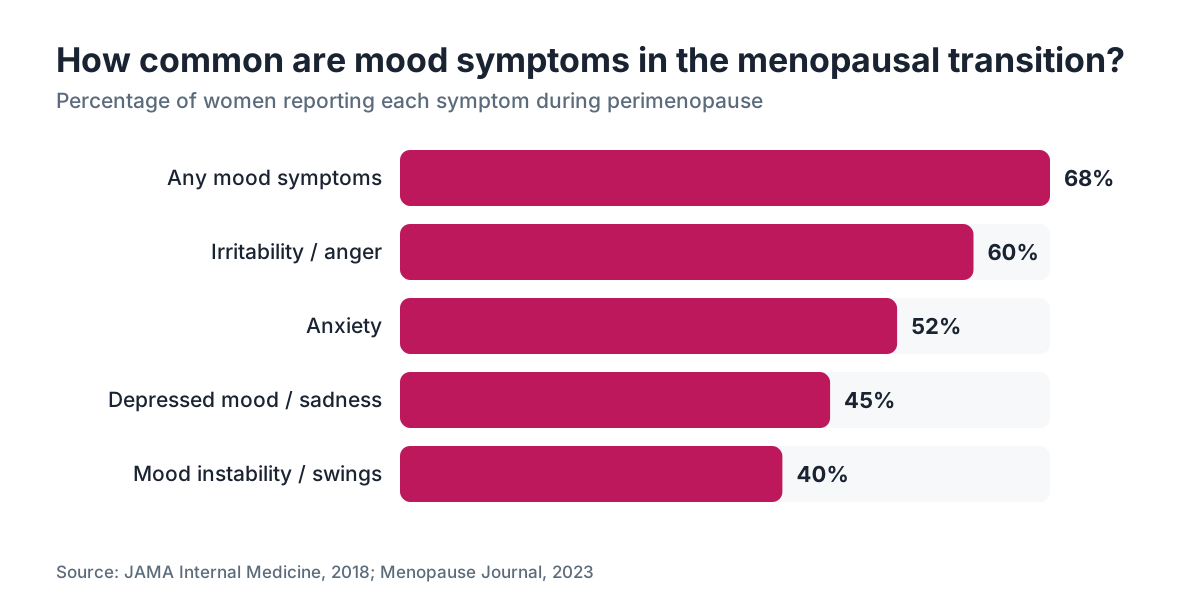
This is not ordinary moodiness. Women describe something closer to a hijacking: a flash of white-hot rage at something trivial, then shame and exhaustion. That pattern is biologically specific to the transition. A 2023 review in Menopause Journal found irritability and mood instability affect 40 to 70 percent of women during the menopausal transition, with rates highest in late perimenopause [2].
Progesterone matters too. Anovulatory cycles become common in perimenopause, which means progesterone often fails to rise in the luteal phase. Progesterone metabolizes into allopregnanolone, a strong positive modulator of GABA-A receptors. Without reliable allopregnanolone, your brain's calming buffer runs thin.
Sleep is the third piece. Night sweats and hot flashes shred sleep architecture, especially the deep and REM stages where emotional regulation gets consolidated. Chronic sleep disruption alone produces irritability that looks like major depression [3]. In perimenopause you often have all three problems running at once, and the anger compounds.
How is perimenopause anger different from regular stress or PMS?
Perimenopausal irritability has a texture you can usually tell apart from ordinary stress once you know the signs. PMS anger is cyclical and predictable, tied to the luteal phase, and it lifts reliably after your period. Perimenopausal anger ignores that schedule. It shows up at any cycle phase, hangs around for weeks, or cycles at random because the cycles themselves have gone irregular.
Ordinary life stress produces irritability that fits the stressor and eases when the stressor does. Perimenopausal rage feels wildly out of proportion. A slow driver, an unanswered text, a partner chewing loudly: any of these can trigger a visceral anger you know is too big but cannot easily stop. That gap between your reaction and what the moment warrants is a clinical signal worth naming out loud.
Depression and perimenopausal mood changes overlap in confusing ways. The Endocrine Society clinical practice guideline on menopause notes the transition carries a two-fold increased risk of clinically significant depressive symptoms, even in women with no prior history [1]. Some women get mostly sadness and anhedonia. Others get mostly anger and agitation. Both come from the same hormonal disruption.
If you cannot tell whether this is perimenopause, a thyroid problem, or something else, the distinction is clinical, not academic. Thyroid hormone replacement therapy and its workup is worth reading, because hypothyroidism produces a nearly identical symptom cluster and the two conditions often show up together. A basic TSH test rules one out fast.
Which hormones are actually driving the anger and how do levels change?
Perimenopause usually starts in the mid-to-late 40s, sometimes as early as the late 30s. It runs four to eight years on average [2]. Across that stretch, three hormonal shifts drive mood.
Estrogen (estradiol) goes erratic first. Early perimenopause often has estrogen surges higher than premenopausal levels, then sharp drops. This volatility, not low estrogen by itself, is what the brain finds destabilizing. By late perimenopause, levels fall and stay low.
FSH (follicle-stimulating hormone) rises as the ovaries stop responding. An FSH above 25 IU/L on two tests four to six weeks apart, alongside irregular cycles, is one way clinicians confirm the transition. But NAMS says FSH is unreliable as a standalone diagnostic in perimenopause because it swings so much [4].
Progesterone falls earlier and more reliably than estrogen. Anovulatory cycles, common by the mid-40s, produce no corpus luteum and therefore no progesterone rise. Losing its GABA-modulating metabolite, allopregnanolone, strips away a layer of neurological buffering.
Testosterone declines gradually too, though less dramatically. Low testosterone tracks with fatigue, low libido, and flat mood rather than sharp anger, so it rarely drives rage on its own but can deepen an already depleted emotional state.
For the full picture of the transition across its stages, the peri menopausal article covers the clinical staging criteria in more detail.
What does the research say about how common perimenopausal anger really is?
The data is clearer than most women expect. For decades, mood symptoms in menopause got waved off as secondary to hot flashes or life stress. Newer research separates them out.
The Study of Women's Health Across the Nation (SWAN), a longitudinal cohort of over 3,300 women, found perimenopausal women were significantly more likely to report high depressive symptom scores than premenopausal women, independent of stressful life events, sleep problems, and prior psychiatric history [5]. Irritability was one of the most commonly endorsed items.
A 2018 analysis in JAMA Internal Medicine found 68 percent of women in the menopausal transition reported mood symptoms, with irritability more prevalent than either sadness or anxiety [6].
The Massachusetts Women's Health Study found that for most women the emotional low point of the transition is late perimenopause, not postmenopause. Symptoms tend to ease once cycles stop entirely and estrogen settles at its new lower baseline.
Nobody has great data on perimenopausal anger specifically, as opposed to depression or general mood, because most study instruments measure depressed affect more than agitated affect. The closest proxy measures suggest anger and irritability may actually be more common than depressed mood in the early-to-middle transition years.
Does hormone therapy (HRT) help with mood swings and anger?
For most women in perimenopause, yes. Estrogen therapy is the most direct treatment for mood symptoms that are hormonally driven. The logic is simple: if erratic estrogen is destabilizing your serotonin system, stabilizing estrogen levels should help. In randomized trials, it does.
A 2015 randomized trial in JAMA Psychiatry found transdermal estradiol with intermittent progesterone significantly reduced depressive symptoms in perimenopausal and recently postmenopausal women compared to placebo, with the largest effects in women who also had hot flashes and night sweats [7]. The effect size matched antidepressants in that population.
NAMS (the Menopause Society) states hormone therapy is the most effective treatment for vasomotor symptoms and is appropriate for healthy women under 60 or within 10 years of menopause onset who have no contraindications [4]. The mood benefit is real, but NAMS lists it as a secondary benefit in current guidance, not a primary indication.
One nuance decides a lot here. HRT works best when the anger and mood instability are primarily hormone-driven. If you have a co-occurring anxiety disorder or a history of major depression, you may need both HRT and a targeted psychiatric treatment. The two are not mutually exclusive.
Progesterone type matters for mood as well. Micronized progesterone (Prometrium) has a friendlier mood profile than synthetic progestins like medroxyprogesterone acetate (MPA), partly because micronized progesterone's metabolites still modulate GABA-A receptors while MPA does not [8]. If you are on a combined regimen and mood is a concern, raise this with your prescriber.
To see what HRT options look like through telehealth, WomenRx prescribes specifically for women in the transition, including which estrogen and progesterone formulations might fit your situation.
What antidepressants and non-hormone treatments actually work?
Antidepressants are a legitimate option, especially for women who cannot take estrogen (history of certain cancers, clotting disorders, or personal preference). The SSRIs and SNRIs with the strongest evidence for perimenopausal mood are escitalopram, venlafaxine, and desvenlafaxine [4].
These drugs do not replace estrogen in the brain. They compensate for the serotonin instability it creates. Response rates for SSRIs in perimenopausal depression run somewhat lower than in premenopausal depression, one clue that estrogen withdrawal is not identical to classic unipolar depression. Some women need higher doses than they did when younger.
Venlafaxine and desvenlafaxine also cut hot flash frequency by about 50 to 60 percent in clinical trials, which makes them useful when both mood and vasomotor symptoms show up [4]. That dual action is a real edge for women who cannot use estrogen.
Gabapentin, a GABA modulator, shows modest evidence for both hot flashes and anxiety in perimenopause, but the data for anger specifically is thin.
For women who want to skip both hormones and antidepressants, the newest option is fezolinetant (Veozah), an FDA-approved non-hormonal treatment for vasomotor symptoms that acts on neurokinin B receptors in the hypothalamus [9]. It was approved in 2023 for hot flashes, not mood. But because sleep disruption and mood are so tied to vasomotor symptoms, better hot flash control often carries over to mood in practice. Fezolinetant does nothing to serotonin directly, so for pure mood and anger symptoms without hot flashes, it is not the right first choice.
Does cognitive behavioral therapy help with perimenopausal mood swings?
Yes, and there is actual trial data behind it, more than generic mental health advice.
A randomized trial by Hunter and Chilcot (2017) tested CBT for menopausal symptoms and found significant reductions in mood disturbance, anxiety, and hot flash interference compared to usual care [10]. The protocol typically runs six weeks, identifies automatic thoughts triggered by symptoms, and includes specific behavioral work on sleep and activity.
CBT for perimenopause is not the same as CBT for a panic disorder or a phobia. The good practitioners frame the work around the biology of the transition, helping women tell apart symptoms that need medical treatment from thought patterns that amplify the distress. A therapist who dismisses the hormonal component and treats this as pure cognitive distortion will not help you.
Mindfulness-based stress reduction (MBSR) has weaker but still positive evidence for menopausal mood symptoms. A 2019 meta-analysis found moderate reductions in anxiety and depression compared to control conditions [11]. If you already have a mindfulness practice, keep it. If you are choosing between MBSR and CBT for a first intervention, the trial evidence slightly favors CBT for the perimenopausal mood profile.
What lifestyle changes actually make a difference for perimenopausal anger?
Sleep is the highest-leverage lifestyle factor, and the research does not hedge on this. Fixing fragmented sleep, whether by treating the hot flashes that cause it or by direct sleep work, produces measurable drops in next-day irritability and anger. SWAN found poor sleep was one of the strongest independent predictors of mood symptoms in perimenopausal women [5].
Aerobic exercise has consistent evidence for perimenopausal mood. A 2022 Cochrane review of exercise interventions in menopausal women found significant improvements in psychological well-being, with moderate evidence for reductions in anxiety and depression [11]. The mechanism is partly serotonin, partly cortisol regulation, partly better sleep architecture. Three to five sessions a week of moderate cardio (brisk walking counts) is the range most trials used.
Alcohol makes perimenopausal mood worse for most women, even though it feels like relief in the moment. It disrupts GABA-A receptor function over time, fragments sleep architecture, and raises hot flash frequency in observational studies. If your evening glass of wine is followed by 3 a.m. wakefulness and more irritability the next day, that is not a coincidence.
Caffeine in the second half of the day disrupts sleep in ways that stack on the hormonal sleep loss already happening. This is about timing it, not cutting it out.
Diet has weaker evidence than exercise and sleep. Eating fewer refined carbohydrates and more protein and omega-3 fats tracks with better mood in some observational data, but there are no clean RCTs in perimenopausal women specifically.
For broader perimenopause support approaches, see the health & her perimenopause support overview.
How do you know if your anger and mood swings need professional treatment?
Most women can feel when their reactions cross from uncomfortable to unmanageable. A few markers worth taking seriously:
If your anger is damaging relationships at home or at work, that is a clinical threshold. Feeling irritable is survivable. Acting on rage in ways you regret means the symptom load is past what lifestyle changes alone can fix.
If you are having thoughts of harming yourself or others, that needs same-day contact with a mental health professional or a crisis line. Perimenopause raises depression risk significantly, and severe depression can escalate.
If mood symptoms come with paranoid thoughts, anxiety that stops you functioning, or feelings of unreality, you need a psychiatric evaluation, more than a hormone workup. Perimenopause can unmask bipolar disorder or psychotic episodes in genetically predisposed women, and this gets missed often.
If standard approaches (lifestyle change, one medication trial) have not produced meaningful improvement after eight to twelve weeks, get a second opinion from a menopause specialist, meaning a clinician with NAMS-certified training. The Menopause Society maintains a provider directory at menopause.org [4].
WomenRx telehealth focuses on exactly this kind of complex picture: women who have tried primary care management and still do not feel like themselves. The platform offers hormonal workup, prescription access, and follow-up calibrated for the transition.
For how menopause care has changed and what patients now ask for, the new menopause is a good read.
Are there supplements with real evidence for perimenopausal mood?
The honest answer: a few have suggestive evidence, none come close to HRT or antidepressants.
St. John's Wort has the most evidence for mild-to-moderate depression in menopausal women. A Cochrane review found it superior to placebo and roughly equal to standard antidepressants for mild-to-moderate depression, though the perimenopause-specific evidence is thin [12]. It has serious drug interactions (especially with tamoxifen, oral contraceptives, and some antiretrovirals) and should not be used without checking interactions with your pharmacist.
Magnesium glycinate at 300 to 400 mg a day has modest evidence for better sleep and less anxiety in perimenopausal women. It is cheap and low risk. The mechanism is GABA modulation. Worth trying, but do not expect it to touch real rage.
Black cohosh has decades of marketing and mixed evidence for mood. A 2012 Cochrane review found insufficient evidence to support its use for menopausal symptoms [12], and the European Medicines Agency has warned about rare cases of liver toxicity.
Phytoestrogens (soy isoflavones, red clover) have inconsistent data for mood and more consistent data for modest hot flash reduction. If your mood symptoms are mainly secondary to poor sleep from hot flashes, they might help indirectly.
B vitamins, especially B6, get recommended a lot, but the evidence for perimenopausal mood is weak. Deficiency is worth ruling out with a basic metabolic panel if you have not had one recently.
What should you tell your doctor to get taken seriously?
Plenty of women report their first attempt to get help for perimenopausal mood was met with a quick antidepressant script and no talk of hormones, or with reassurance that this is normal and will pass. Both responses can miss the mark, even when they are sometimes right.
Things that get you a fuller evaluation:
Bring a symptom log. Two weeks of tracking sleep quality, mood severity (a 1 to 10 daily rating works), cycle timing, and specific anger episodes gives a clinician far more than a verbal description in a seven-minute appointment.
Name the anger specifically. Women tend to report sadness and anxiety in clinical settings because those feel more socially acceptable. If rage is your main symptom, say that word. It changes the differential.
Ask directly about a hormonal workup. A reasonable first panel includes FSH, estradiol, TSH, and a complete metabolic panel to rule out thyroid and metabolic contributors. If your provider won't order it, you can often order basic panels directly through online lab services.
Ask whether hormone therapy is appropriate for you. The NAMS 2022 position statement supports HRT for healthy women under 60 without contraindications, and that evidence base has not changed [4]. If you are told your symptoms are "not bad enough" for HRT, that is a value judgment, not a clinical guideline.
The menopause society has a provider directory and patient education resources worth reviewing before your appointment.
Frequently asked questions
Can perimenopause cause rage and anger even if I don't have hot flashes?
Yes. Hot flashes and mood symptoms both come from estrogen volatility but they are separate neurological events. About 25 to 30 percent of women have significant mood disruption in perimenopause without prominent hot flashes or night sweats. No hot flashes does not mean your mood symptoms are not hormonal. An estradiol and FSH draw during a symptomatic stretch can help clarify whether your levels are in the perimenopausal range.
How long do perimenopausal mood swings last?
Perimenopause averages four to eight years, but mood symptoms tend to peak in late perimenopause, the one to two years before the final period. Most women find mood stabilizes after menopause, once estrogen settles at its new lower baseline. A minority carry mood changes into postmenopause, which often responds well to hormone therapy or antidepressants if left untreated earlier.
Is perimenopausal anger a sign of something more serious like bipolar disorder?
Rarely, but it is a real consideration. Perimenopause can unmask or worsen underlying mood disorders including bipolar disorder, especially with a personal or family history. Anger that cycles rapidly, plus decreased need for sleep without fatigue, grandiosity, or psychotic symptoms, warrants a full psychiatric evaluation rather than just a hormonal workup. Tell your provider your complete mood and family psychiatric history.
What is the best medication for perimenopausal mood swings?
There is no single best answer, because the right choice depends on whether you can use estrogen. For women without contraindications, low-dose transdermal estradiol with micronized progesterone has the strongest combined evidence for both mood and vasomotor symptoms. For women who cannot use hormones, escitalopram and venlafaxine have the strongest specific trial evidence for perimenopausal mood. Discuss both categories with a clinician before deciding.
Can perimenopause cause anxiety as well as anger?
Yes. Anxiety is extremely common in perimenopause, often more prominent than sadness. The same GABA and serotonin disruption that drives irritability and anger also produces generalized anxiety, panic attacks, and a heightened startle response. Women with no prior anxiety history often develop new anxiety in their mid-40s without recognizing it as perimenopause. Hormone therapy reduces anxiety in RCT evidence; SSRIs and SNRIs also have strong data.
Does low progesterone specifically cause anger?
Low progesterone, or more precisely low allopregnanolone (its GABA-modulating metabolite), tracks with anxiety, irritability, and poor stress tolerance rather than the white-hot rage more typically linked to estrogen volatility. The two overlap heavily in late perimenopause when both are disrupted. Adding micronized progesterone to an estrogen regimen can improve the anxiety-irritability component specifically, and some women are prescribed it cyclically even before full HRT is warranted.
How do I track my mood symptoms to see if they're hormonal?
Keep a daily log for at least two full cycles (or eight weeks if cycles are irregular). Record cycle day if known, sleep quality (1 to 10), mood and anger severity (1 to 10), obvious triggers, and physical symptoms like hot flashes or night sweats. After two months, patterns usually show up. Mood swings that correlate with erratic cycle timing, with night sweat episodes, or that hit mid-cycle and around your period point more strongly to a hormonal driver.
Is it normal to feel rage at my partner during perimenopause?
It is very common. Partners are frequent targets partly because the home involves constant low-level stressors that pile up, and partly because there is less social inhibition at home. That does not mean the anger is purely about the relationship. Many women find that treating the underlying hormonal disruption with HRT or antidepressants substantially reduces partner-directed anger, even when the relationship dynamics have not changed.
Can exercise replace medication for perimenopausal mood swings?
For mild mood symptoms, possibly. A 2022 Cochrane review found significant psychological well-being improvements with regular aerobic exercise in menopausal women. For moderate-to-severe anger, rage, or depression, exercise alone is unlikely to be enough, and delaying treatment carries real costs to relationships and quality of life. Treat exercise as a necessary complement to medical treatment, not a substitute when symptoms are clinically significant.
Does alcohol make perimenopausal mood swings worse?
Yes, consistently. Alcohol disrupts GABA-A receptor function over time, fragments sleep architecture (particularly deep and REM sleep), and increases hot flash frequency. Even one to two drinks the evening before can produce measurable next-day increases in irritability. Many perimenopausal women find that cutting back or quitting alcohol produces rapid mood improvements, sometimes within two to three weeks, independent of any other treatment change.
What is the difference between perimenopause depression and perimenopausal anger?
They often co-occur but are not the same. Perimenopausal depression usually involves persistent low mood, loss of interest, fatigue, and sometimes tearfulness. Perimenopausal anger involves irritability, rage, and a lower frustration threshold, often without prominent sadness. Some women get mainly one or the other; many get both at different points. Treatment overlaps (HRT and antidepressants help both), but the agitated, anger-forward presentation may respond better to GABA-modulating approaches like micronized progesterone.
When should I see a specialist rather than my primary care doctor for perimenopausal mood?
See a menopause specialist (NAMS-certified or equivalent) if your primary care provider has not offered hormone therapy and you have no clear contraindications, if one treatment trial has failed, if you have a complicated psychiatric history, or if symptoms are severe enough to affect work, relationships, or daily function. The Menopause Society maintains a provider directory at menopause.org listing certified practitioners by location.
Are perimenopausal mood swings covered by the DSM as a diagnosis?
Not explicitly. DSM-5 includes a 'perimenopause-onset' specifier under major depressive disorder and persistent depressive disorder, which acknowledges the connection. But perimenopause-related anger and irritability without full depressive episode criteria have no diagnostic code of their own. This is a gap in psychiatric classification that some researchers have criticized, because it makes subclinical but impairing perimenopausal mood symptoms harder to study and bill for.
Sources
- Endocrine Society, Clinical Practice Guideline on Menopause
- Menopause Journal, 2023 review of mood symptoms in the menopausal transition
- NIH National Institute on Aging, Menopause overview
- The Menopause Society (NAMS), 2022 Hormone Therapy Position Statement
- SWAN (Study of Women's Health Across the Nation), longitudinal cohort data
- JAMA Internal Medicine, 2018 analysis of mood symptoms in menopausal transition
- JAMA Psychiatry, 2015 RCT of transdermal estradiol for perimenopausal depression
- Climacteric Journal, review of progesterone types and mood
- FDA Drug Approval, Veozah (fezolinetant) 2023
- Hunter & Chilcot, 2017 RCT, CBT for menopausal symptoms
- Cochrane Database of Systematic Reviews, 2022, exercise interventions in menopausal women
- Cochrane Database of Systematic Reviews, 2012, black cohosh and phytoestrogens for menopausal symptoms