Perimenopause missed periods: what's normal and what's not
TL;DR: Missed and irregular periods are among the earliest signs of perimenopause, usually starting in your 40s. Cycles can stay unpredictable for 4 to 10 years before your last period. A skipped period is not proof you're infertile. Menopause is only official after 12 straight months with no bleeding at all.
Why do periods become irregular in perimenopause?
Your ovaries are making less estrogen and progesterone, and ovulation has stopped happening on a reliable schedule. That variability is what throws your cycle off.
Here's the longer version. Each month a follicle in your ovary matures and releases an egg, and that process drives the hormonal cascade that produces your period. In perimenopause you have fewer follicles left, and the ones you have respond less reliably to the follicle-stimulating hormone (FSH) signals coming from your brain [1]. Sometimes ovulation happens on schedule. Sometimes late. Sometimes not at all. No ovulation means no progesterone surge, which means the uterine lining doesn't shed on time, or sheds when you don't expect it.
Estrogen doesn't ease down in a straight line either. It swings hard. A 2020 analysis in the journal Menopause found that perimenopausal women can have estradiol levels ranging from postmenopausal lows to supraphysiologic highs within a single menstrual cycle [2]. Those swings drive the whole set of perimenopausal symptoms: hot flashes, brain fog, mood shifts, and cycles that look nothing like they used to.
FSH climbs as the ovaries get less responsive. An FSH above 25 IU/L on a random test is a rough hint the ovaries are struggling, but it settles nothing on its own. The North American Menopause Society (NAMS) says FSH testing in perimenopause is unreliable as a single reading because levels bounce around month to month [3].
What does perimenopause do to your cycle length and frequency?
Perimenopause has two phases, and they behave very differently. Early on your cycles usually get shorter. Later they start skipping entirely.
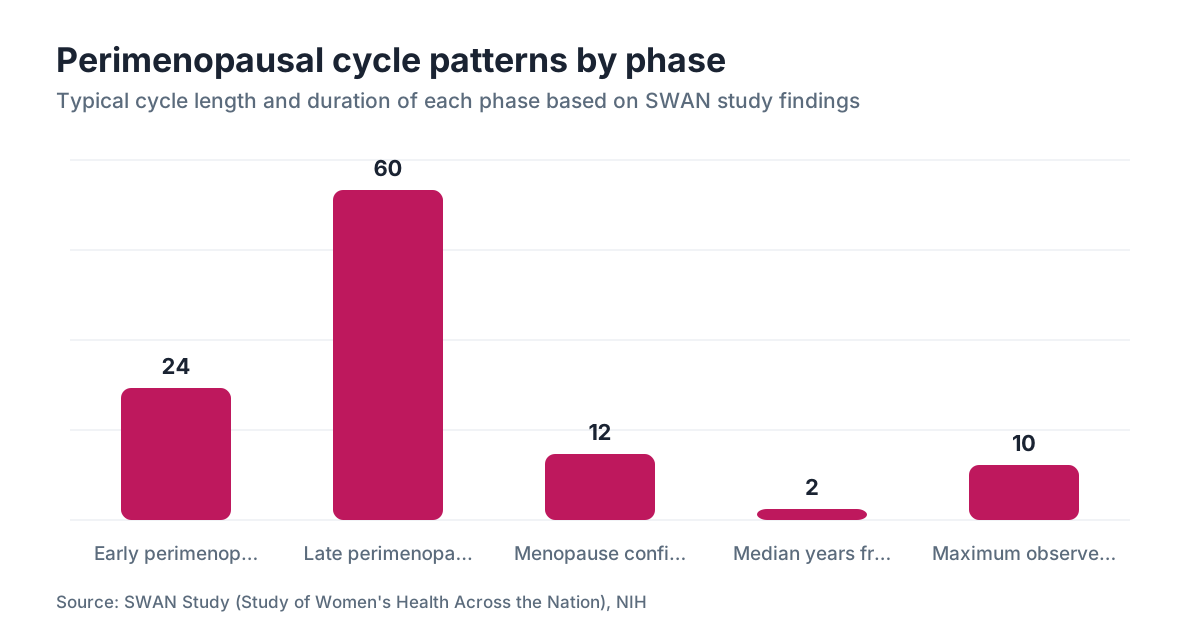
In early perimenopause, if your period used to arrive every 28 days, it might start coming every 24 or 25. The follicular phase (the first half of the cycle) shortens when follicle quality drops. You may also see heavier flow or spotting between periods.
In late perimenopause, cycles skip. You go 60 days between periods. Then a period shows up, then vanishes for 90 days. The SWAN study (Study of Women's Health Across the Nation), one of the largest long-term studies of midlife women ever run, defined the move into late perimenopause as the first cycle that runs at least 60 days [4]. That marker means something clinically: once you've had a 60-day gap, you're statistically closer to your final period.
The average American woman reaches menopause (12 straight months with no period) at 51 to 52, but the perimenopausal window can open as early as the late 30s and usually runs 4 to 8 years, sometimes longer [3]. The perimenopause age article breaks the timing down by decade.
| Phase | Typical cycle pattern | Common duration | |---|---|---| | Early perimenopause | Shorter cycles, heavier flow, spotting | 2 to 5 years | | Late perimenopause | Cycles 60+ days apart, increasingly rare | 1 to 3 years | | Menopause confirmed | 12 consecutive months with no period | Single point in time |
Could a missed period in perimenopause be pregnancy?
Yes. It absolutely can, and this trips up more women than you'd think.
You are not infertile in perimenopause until you've gone 12 full months in a row without a period. Ovulation is erratic, not gone. A fertile window still exists in most perimenopausal cycles even when periods are skipping. Centers for Disease Control and Prevention (CDC) data show unintended pregnancy rates among women 40 to 44 are not trivial, and some of those happen in women who assumed irregular cycles meant they couldn't conceive [5].
Miss a period after unprotected sex in the past few weeks? Take a home pregnancy test. A urine test detects hCG as early as 10 to 14 days after conception and works regardless of your age or hormone status. A negative test plus a period that still doesn't come is far more likely perimenopause, but rule pregnancy out first.
NAMS contraception guidance is blunt: keep using contraception until you've been period-free for 12 consecutive months if you're over 50, and for 24 consecutive months if you're under 50 [3]. Those thresholds are conservative on purpose. Ovarian activity can surprise you.
What other conditions can cause missed periods that look like perimenopause?
Age alone doesn't turn irregular periods into a perimenopause diagnosis. Several other conditions cause missed cycles in women in their 40s and 50s, and a few of them do damage if you miss them.
Thyroid trouble is the big one. Both hypothyroidism and hyperthyroidism disrupt the menstrual cycle. The American Thyroid Association estimates thyroid disease affects up to 20 million Americans, with women five to eight times more likely than men to be affected [6]. A simple TSH blood test rules it in or out.
High prolactin (from a pituitary adenoma or from certain medications, including antipsychotics and some antidepressants) can suppress ovulation and stop periods. It gets overlooked in perimenopausal workups more than it should.
Primary ovarian insufficiency (POI) sometimes gets confused with perimenopause. POI is ovarian dysfunction before age 40, affecting roughly 1% of women. It looks similar on paper: high FSH, low estradiol, irregular or absent periods. The distinction matters because POI carries different heart and bone risks and almost always calls for hormone therapy [7].
Uncontrolled blood sugar in type 2 diabetes can throw off cycle regularity. A big weight change in either direction disrupts the hypothalamic-pituitary-ovarian axis. Hard stress and under-eating can shut ovulation down entirely.
So here's the practical line: if you're in your 40s and your periods have gone irregular, perimenopause is the likely answer, but your clinician should at minimum check TSH, FSH, estradiol, and prolactin before pinning everything on the transition.
How is perimenopause actually diagnosed when periods are irregular?
There's no single blood test that says "you are perimenopausal." That frustrates a lot of women who want a clean answer, and there isn't one.
Perimenopause is diagnosed mostly from history: the pattern of menstrual irregularity in a woman of the right age, usually 40 to 55. NAMS and the Endocrine Society both treat lab testing here as a supporting tool, not a verdict, because hormones swing so much through the transition [3][8].
What labs can tell you: FSH above 25 IU/L on cycle day 2 or 3 (or any day during a long stretch without a period) suggests diminished ovarian reserve. Anti-Mullerian hormone (AMH) is a steadier marker of ovarian reserve because it doesn't rise and fall across the cycle the way FSH and estradiol do. Even so, neither number hands you a start date or an end date.
A good clinician takes a menstrual history (how long have cycles been off, what changed first), asks about symptoms (hot flashes, sleep trouble, mood changes, vaginal dryness), rules out other causes with targeted labs, and builds a picture. The conversation, not the lab slip, usually makes the diagnosis.
To see what menopause looks like on the far side of this, that context helps you place where you are now.
What symptoms come alongside irregular periods in perimenopause?
Missed periods rarely show up alone. Most women in perimenopause notice a cluster of symptoms arriving around the same time cycles go haywire, and that clustering is itself a diagnostic clue.
Hot flashes and night sweats are the most recognized. They hit roughly 75% of women during the menopause transition [3]. In some women they arrive years before any real cycle change. In others they show up after cycles are already a mess.
Sleep gets worse. Part of that is night sweats waking you. Part is falling progesterone, which has mild sedative effects, so sleep turns lighter and more broken even on nights you don't sweat.
Mood shifts too. Anxiety, irritability, and low-grade depression get more common in perimenopause. The SWAN study found the risk of clinically significant depressive symptoms roughly doubles during the transition compared with the premenopausal years [4]. The link between estrogen swings and mood is real, though nobody has it fully mapped.
Then there's brain fog: word-finding trouble, forgetfulness, harder concentration. It tends to peak in late perimenopause and eases after menopause for most women.
Genitourinary symptoms follow: vaginal dryness, more urinary urgency, discomfort with sex, all from falling estrogen thinning the tissues of the vagina and bladder. These usually get worse, not better, after the final period.
Heavy periods before they turn irregular are common too. Fibroids grow in response to estrogen, and the estrogen surges of early perimenopause can enlarge existing fibroids and make bleeding heavier. Soaking through a pad or tampon in an hour or less warrants evaluation no matter what perimenopause is doing.
Does perimenopause affect bone density, and does missing periods make it worse?
Yes on both. This is the part most women don't hear until later than they should.
Bone density peaks in your late 20s to early 30s and then drifts down slowly. In perimenopause that decline speeds up as estrogen falls, because estrogen is the main hormonal brake on bone breakdown. The fastest loss happens in the two years before and the two years after your final period, when women lose on average 2 to 3% of bone mineral density per year [9].
Missed periods add to it. Every skipped ovulatory cycle means less progesterone, which has its own modest bone-protective effect. Long stretches without a period in perimenopause track with more bone loss, the same way missing periods in athletes (from low energy availability) does. Less hormonal support, less bone maintenance.
The U.S. Preventive Services Task Force (USPSTF) recommends bone density screening for all women 65 and older, and for younger postmenopausal women whose fracture risk matches that of a 65-year-old white woman [10]. In practice, many clinicians now order a baseline bone density test around menopause, especially for women who went through an early or drawn-out perimenopause. It's a reasonable ask.
Hormone therapy, when it fits your situation, is the strongest drug tool for preventing perimenopausal and early postmenopausal bone loss. Weight-bearing exercise and enough calcium and vitamin D are non-negotiable whether or not you take hormones.
Can hormone therapy help with irregular periods in perimenopause?
It depends on what you mean by help, and the answer shifts with the type of therapy and where you are in the transition.
Low-dose hormonal contraception (pill, patch, or ring) gets used a lot in perimenopause because it does two jobs at once: it steadies the cycle and it prevents pregnancy. A low-dose combined oral contraceptive can smooth out the hormonal chaos of early perimenopause and cut heavy bleeding, hot flashes, and mood symptoms. It's a common move for symptomatic women in their 40s [8].
Menopause hormone therapy (MHT, sometimes called HRT) is a different conversation. It's usually offered after the final period, or for severe perimenopausal symptoms when contraception is no longer the point. Estrogen-only MHT is for women who've had a hysterectomy. Estrogen plus progesterone (or a synthetic progestogen) is standard for women with a uterus, because unopposed estrogen raises the risk of endometrial hyperplasia and cancer [3].
The estrogen patch is one of the most-used delivery methods in MHT and has real pharmacokinetic advantages over pills, especially a lower effect on clotting factors and triglycerides. Transdermal estrogen skips first-pass liver metabolism, which is why many clinicians prefer it for women with cardiovascular risk factors.
Starting hormone therapy is an individual call. The Endocrine Society and NAMS both back MHT for healthy women under 60 (or within 10 years of menopause) who have bothersome symptoms, once the risks that apply to that specific woman are talked through [8]. For the full picture, the hormone replacement therapy article walks through the current evidence.
Some women are managing perimenopausal symptoms and weight at the same time, and GLP-1 receptor agonists like semaglutide are entering that conversation. Early data suggest metabolic improvements from GLP-1 therapy may ease some hormonal disruption tied to obesity, though GLP-1s treat weight, not perimenopause itself. WomenRx, a women's telehealth platform focused on hormones and metabolic health, can look at both needs together, which matters because the two are more connected than they usually get treated.
One note on bioidentical hormones: the term covers a lot. FDA-approved bioidentical options (estradiol, micronized progesterone) carry the same evidence base as conventional MHT. Compounded preparations are a different thing and have no FDA approval for safety or efficacy [11]. Choose with your eyes open.
When should a missed period in perimenopause prompt a call to your doctor?
Most missed periods in a woman in her mid-40s or older are perimenopause. Some situations still need prompt evaluation, and it's worth knowing which.
Call your clinician if you've gone more than 90 days without a period and haven't ruled out pregnancy. Call for any bleeding after 12 straight period-free months. Postmenopausal bleeding is endometrial cancer until proven otherwise; a uterine biopsy or transvaginal ultrasound is the standard workup. Call if you're under 40 with cycle irregularity, which is primary ovarian insufficiency territory and needs evaluation [7]. Call if your periods turn dramatically heavier (soaking through protection hourly, passing large clots), which warrants a pelvic ultrasound and possibly an endometrial biopsy at any age. Call if you have new pelvic pain with irregular bleeding, which needs a look for structural causes like fibroids, polyps, or cancer.
Anemia is a real risk with erratic, heavy perimenopausal cycles. If you're wiped out and your periods have been heavy and unpredictable, ask for a complete blood count. Iron deficiency anemia from heavy cycles is very common and very treatable.
How long will irregular periods last before menopause?
The honest answer: nobody can tell you for certain, and anyone who claims to is guessing.
The SWAN study followed more than 3,000 women through the transition and found the median time from the first 60-day cycle gap to the final period was about two years, but the range was enormous, from a few months to more than a decade [4]. Women whose periods first went irregular earlier (before 45) tended to have longer transitions. Women who smoked reached menopause an average of one to two years sooner than nonsmokers.
Ethnicity matters more than most women realize. SWAN data showed Black women had longer and more symptomatic transitions than white women. Hispanic women reported more hot flashes and night sweats. Chinese and Japanese American women had fewer hot flashes but weren't spared other transition symptoms [4]. These patterns don't predict any single woman's experience, but they shape what to expect across populations.
The when does menopause start and menopause age articles go deeper on timing factors you can actually check, like smoking, body weight, and family history. Family history is probably the best individual predictor you've got: ask your mother and older sisters when their periods stopped.
What can you do to manage the uncertainty of irregular periods?
Track everything. A cycle app or a paper calendar turns into real clinical data once your cycles go irregular. Note cycle length, flow, spotting, and symptom patterns. After 3 to 6 months, patterns show up that are impossible to see in the moment but obvious looking back.
Stop assuming you know where you are in the transition based on how you feel today. Perimenopausal hormones swing hard. You can feel fine, hit three nights of drenching sweats, then feel fine again. One good month doesn't mean you're through it.
Keep using contraception if pregnancy prevention matters to you. For sexually active women in perimenopause who aren't trying to conceive, this is the single most practical thing on the list.
Treat the symptoms you actually have, more than the irregular periods themselves. Hot flashes, broken sleep, and mood changes all have treatment options. Waiting for your final period before getting care means years of unnecessary suffering. Hormone therapy, low-dose contraceptives, non-hormonal options like fezolinetant (FDA approved in 2023 specifically for vasomotor symptoms), cognitive behavioral therapy for sleep, and vaginal estrogen for genitourinary symptoms are all on the table [11].
Build bone and muscle now. Perimenopause is the time to take strength training seriously, not after the fact. Muscle protects bone, cuts fracture risk, and improves metabolic health through the transition and after it. Women who reach menopause with a solid strength base do better on most physical health measures.
If you're working on weight alongside symptoms, know that visceral fat piles on faster during this transition, and some of the metabolic changes of perimenopause genuinely make weight loss harder than it was at 35. Looking at semaglutide for weight loss as one possible tool, inside your full hormonal picture, is a fair thing to raise with a clinician who understands both sides. WomenRx evaluates exactly that intersection.
Frequently asked questions
Can you miss a period in perimenopause and not be pregnant?
Yes, absolutely. Skipping a period is a hallmark of perimenopause, especially the late phase. Ovulation turns sporadic, so the hormonal sequence that triggers a period doesn't complete every month. But a missed period doesn't prove you're infertile. If you've had unprotected sex recently, take a home pregnancy test before you chalk it up to perimenopause.
How many missed periods in a row means menopause?
Menopause is defined as 12 consecutive months with no menstrual period, confirmed looking back. You can't know you've reached it until a full year has passed with no bleeding. A single missed period, or even a run of three or four, is still perimenopause. Any bleeding after that 12-month mark counts as postmenopausal and should be evaluated promptly.
What blood tests confirm perimenopause?
No single blood test confirms perimenopause. Clinicians usually check FSH, estradiol, TSH (to rule out thyroid disease), and sometimes AMH and prolactin. Elevated FSH (roughly above 25 IU/L) and low estradiol support the diagnosis, but because those levels swing day to day in perimenopause, one measurement doesn't tell the whole story. Your age and menstrual history matter more than any single number.
Is it normal to skip a period for 3 months in perimenopause?
Yes. A 90-day gap between periods sits well within the normal range for late perimenopause. The SWAN study defined late perimenopause as beginning with the first cycle 60 days or longer, so a 3-month gap puts you squarely there. Rule out pregnancy first if that's relevant, then check in with your clinician if this is new for you.
Can stress cause missed periods that look like perimenopause?
Yes. Significant physical or psychological stress suppresses the hypothalamic-pituitary-ovarian axis and can delay or block ovulation, causing missed periods. Extreme weight loss or under-eating does the same. This is more likely the cause in women under 40. In women in their mid-40s with other perimenopausal symptoms, stress can amplify existing hormonal disruption, but perimenopause is usually the main driver.
Why are my periods heavier right before they start becoming irregular?
In early perimenopause, estrogen can surge to unusually high levels while progesterone is falling. Estrogen drives endometrial growth, and without enough progesterone to balance it, the lining builds up more than usual and then sheds heavily. Fibroids, which are estrogen-sensitive, also tend to grow during this phase. Heavier periods before they turn irregular is a common, recognized pattern, not a cause for panic, but worth mentioning to your clinician.
At what age do periods typically become irregular?
For most American women, menstrual irregularity begins in the mid to late 40s, with average onset around 47 to 48. Some women notice changes as early as their late 30s. The median age of the final period is 51 to 52. Smoking, family history, and having fewer total periods in your lifetime (from pregnancies or contraception) can shift these timelines.
Do I still need contraception if my periods are irregular in perimenopause?
Yes, until you've been period-free for 12 consecutive months (if over 50) or 24 consecutive months (if under 50), per NAMS guidance. Irregular cycles do not equal infertility. Ovulation is unpredictable, not gone, and perimenopausal pregnancies do happen. Low-dose combined hormonal contraception or an IUD are reasonable options that also address perimenopausal symptoms for many women.
Can hormone therapy regulate periods during perimenopause?
Low-dose combined hormonal contraceptives (pill, patch, ring) can create a predictable withdrawal bleed each month and are often used specifically to manage cycle chaos in perimenopause while also preventing pregnancy. Traditional menopause hormone therapy (estrogen plus progesterone) isn't built to regulate periods the same way; it's mainly for symptom management after or near the final period.
How do I know if I'm in early or late perimenopause?
Early perimenopause usually looks like shorter, sometimes heavier cycles with occasional spotting. Late perimenopause is defined by cycles running more than 60 days apart. Once you've had your first 60-day gap, you're statistically in late perimenopause. Hot flashes often intensify in this later phase. A clinician can check FSH and estradiol for context, though labs alone don't stage the transition precisely.
What is the difference between perimenopause and premature ovarian insufficiency?
Perimenopause is the natural winding-down of ovarian function, usually starting in the late 40s. Premature ovarian insufficiency (POI) is ovarian dysfunction before age 40, affecting about 1% of women. Both cause irregular or absent periods and elevated FSH, but POI carries different stakes: higher risk of early bone loss and heart disease, and more urgency to start hormone therapy. Under 40 with skipped periods means POI must be evaluated.
Can losing weight or gaining weight affect my periods in perimenopause?
Yes. Rapid weight loss can suppress ovulation and stop periods entirely, even in perimenopausal women. Excess body fat, especially visceral fat, raises estrogen production through peripheral aromatization, which can worsen the hormonal imbalance of perimenopause and drive heavier or more irregular bleeding. Both extremes disrupt. A stable, healthy body weight supports more predictable hormonal patterns through the transition.
Should I get a bone density scan if I'm in perimenopause?
USPSTF recommends formal bone density screening at 65, but many clinicians recommend a baseline scan around menopause, especially for women with risk factors like early perimenopause, smoking history, family history of osteoporosis, low body weight, or long stretches without periods. Perimenopausal bone loss speeds up in the years right around the final period. Knowing your baseline before that window helps you track change.
Is postmenopausal bleeding always a sign of something serious?
Any bleeding after 12 consecutive period-free months needs evaluation. Postmenopausal bleeding is treated as endometrial cancer until a workup proves otherwise, though most cases turn out to have benign causes (endometrial atrophy, polyps, or breakthrough bleeding from hormone therapy). A transvaginal ultrasound and often an endometrial biopsy are the standard steps. Don't wait to see if it clears on its own.
Sources
- NAMS, Menopause Practice: A Clinician's Guide (10th edition)
- Santoro N et al., Menopause (2020), estradiol variability in perimenopause
- North American Menopause Society, NAMS Position Statement 2022
- SWAN Study (Study of Women's Health Across the Nation), NIH
- CDC, Contraceptive Use and Unintended Pregnancy Among Women 40 to 44
- American Thyroid Association, General Information/Press Room
- Endocrine Society, Clinical Practice Guideline: Primary Ovarian Insufficiency (2023)
- Endocrine Society, Menopause Hormone Therapy Clinical Practice Guideline 2015
- International Osteoporosis Foundation, Bone Loss in Menopause
- U.S. Preventive Services Task Force, Osteoporosis Screening Recommendation 2018
- FDA, Drug Approval for Fezolinetant (Veozah) for Vasomotor Symptoms 2023