Perimenopause bleeding for 3 weeks: when to wait and when to act
TL;DR: Bleeding for three weeks in perimenopause is medically called prolonged or abnormal uterine bleeding (AUB). Hormonal chaos, especially low progesterone relative to estrogen, is the most common cause. It usually isn't cancer, but it needs evaluation. A pelvic ultrasound and endometrial biopsy rule out serious causes. Hormonal treatment, typically progesterone or a levonorgestrel IUD, stops most episodes.
What counts as abnormal uterine bleeding in perimenopause?
Perimenopause is, bluntly, a mess for your period. Cycles shorten, lengthen, skip entirely, and then dump a week of heavy flow on you with no warning. So it can be genuinely hard to know where 'normal perimenopausal chaos' ends and 'something needs attention' begins.
The medical definition that gynecologists use comes from the International Federation of Gynecology and Obstetrics (FIGO). Abnormal uterine bleeding (AUB) in women of reproductive age includes bleeding that is too heavy (more than 80 mL per cycle, roughly soaking a pad or tampon every hour for two or more hours), too frequent (cycles shorter than 24 days), too long (periods lasting more than 8 days), or occurring between cycles. [1]
Three weeks of continuous or near-continuous bleeding easily clears the 'too long' threshold. Full stop.
That doesn't mean it's dangerous. Most prolonged perimenopausal bleeding has a benign hormonal explanation. But it does mean your body is asking for a workup, not a 'let's wait and see if it stops on its own' conversation with yourself.
Why does perimenopause cause bleeding that goes on for weeks?
The root cause is almost always the same. Estrogen and progesterone stop cycling in a predictable rhythm, and the uterine lining doesn't know when to stop growing and shed.
Here's the basic mechanics. In a normal cycle, estrogen builds the uterine lining in the first half, ovulation triggers a progesterone surge in the second half, and progesterone withdrawal at the end causes an orderly, timed shed. In perimenopause, ovulation starts skipping. No ovulation means no progesterone surge. Estrogen keeps stimulating the lining unchecked, sometimes for weeks. Eventually the lining outgrows its blood supply or becomes unstable, and it sheds in a chaotic, prolonged way rather than all at once over 4-5 days. [2]
This pattern is called anovulatory bleeding, and it accounts for the largest share of heavy and prolonged perimenopausal bleeding. A 2018 ACOG practice bulletin estimated that anovulation accounts for roughly 30-40% of AUB cases in reproductive-age and perimenopausal women. [1]
Structural causes matter too. Uterine fibroids, which are benign muscle tumors that grow in response to estrogen, affect up to 70% of white women and 80% of Black women by age 50, according to NIH data. [3] Fibroids make any period heavier and longer, so they amplify the anovulatory problem when both are present. Endometrial polyps are another common culprit: small overgrowths of the lining that bleed intermittently or continuously. Adenomyosis (when the lining grows into the uterine muscle) causes heavy, prolonged periods that often worsen in perimenopause.
Thyroid dysfunction deserves mention here. Both hypothyroidism and hyperthyroidism alter menstrual patterns, and thyroid disease is more common in women in their 40s and 50s. A TSH is worth checking if it hasn't been done recently.
Finally, though it accounts for a small share of cases, endometrial cancer has to be ruled out. The risk rises with age and with prolonged unopposed estrogen exposure, which is exactly the hormonal environment many perimenopausal women are in. [4]
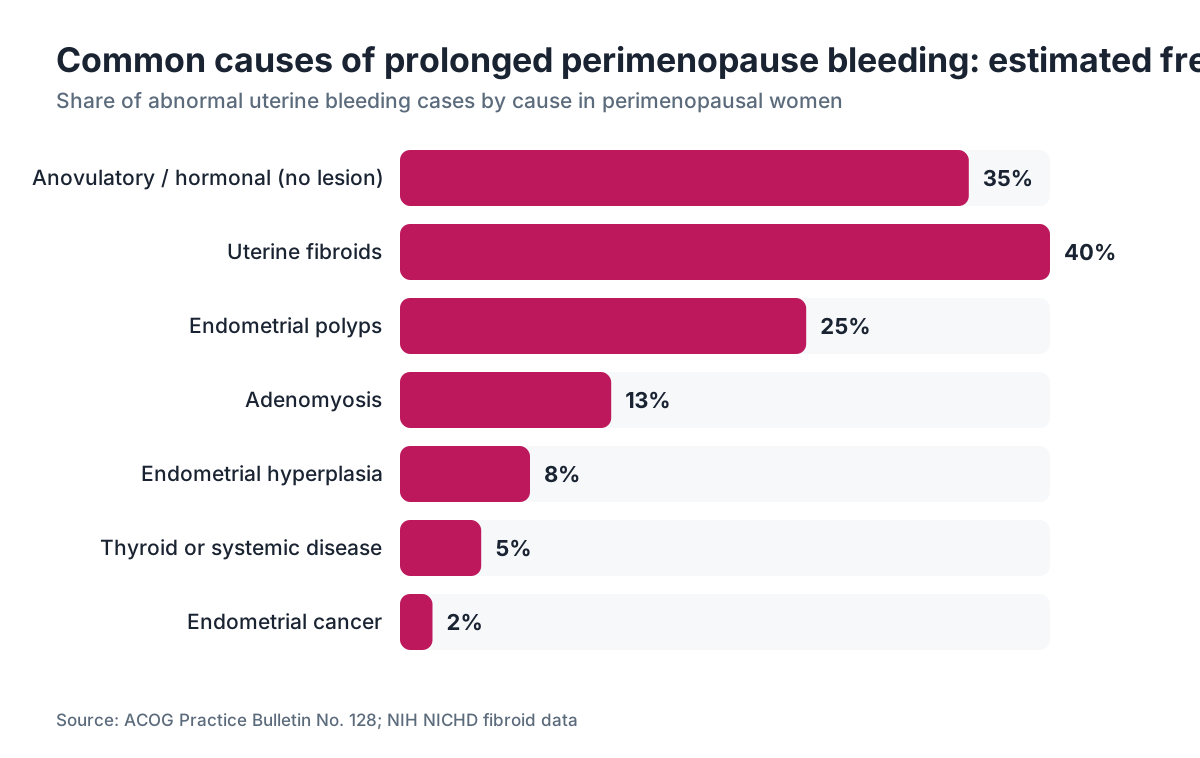
What are the most common causes of 3 weeks of bleeding in perimenopause?
Ranked roughly by frequency in perimenopausal women:
| Cause | Estimated prevalence in AUB cases | Notes | |---|---|---| | Anovulatory/hormonal (no structural lesion) | ~30-40% | Most common in early perimenopause [1] | | Uterine fibroids | ~40% of all AUB referrals | Higher in Black women [3] | | Endometrial polyps | ~20-30% | Often missed on standard ultrasound without saline infusion | | Adenomyosis | ~10-15% | Often co-exists with fibroids | | Endometrial hyperplasia | ~5-10% | Requires biopsy to diagnose; precancer risk | | Endometrial cancer | ~1-2% of AUB workups | Must rule out in all perimenopausal women with prolonged bleeding [4] | | Thyroid or other systemic disease | ~5% | TSH, CBC, coagulation studies |
This table is a rough guide, not a rigid formula. Many women have more than one cause happening at the same time.
What red flags mean you should go to the ER or call your doctor today?
Three weeks of bleeding is concerning enough to warrant a scheduled appointment in the next week or two. Some situations need same-day or emergency care.
Go to the ER if you are soaking more than one pad or tampon per hour for two or more consecutive hours. That rate of loss can cause hemodynamically significant anemia fast, and it sometimes signals a vascular fibroid, a miscarriage (yes, perimenopausal women can still get pregnant), or, rarely, a coagulopathy.
Call your doctor or go to urgent care today if you feel dizzy or faint when you stand up, your heart is racing, you're passing clots larger than a quarter, or you have significant pelvic pain along with the bleeding.
Schedule a non-emergency appointment in the next one to two weeks if the bleeding is manageable in volume but simply won't stop. Three weeks of continuous bleeding at any volume needs a workup. Waiting months 'to see if perimenopause settles down' while losing that much blood is how women end up with a hemoglobin of 8 and a fatigue that took a year to develop.
One more thing worth stating plainly. Bleeding that restarts after 12 months without a period is postmenopausal bleeding, a different clinical situation with higher cancer risk, and it needs evaluation within weeks, not months. [4]
What tests does a doctor order for prolonged perimenopause bleeding?
A good workup for three weeks of bleeding in a perimenopausal woman usually includes several parts.
First, a pregnancy test. This feels obvious but gets skipped more than it should. Ovulation is irregular, not absent, in early perimenopause, and a surprising number of women in their mid-40s have unintended pregnancies.
Blood work: a complete blood count (CBC) to check hemoglobin (iron-deficiency anemia is very common with prolonged AUB), TSH, and sometimes coagulation studies if there's a history that suggests a bleeding disorder.
Pelvic ultrasound: the first-line imaging test. It assesses uterine size, the myometrium for adenomyosis, fibroid number and location, and endometrial thickness. An endometrial stripe greater than 4-5 mm in a postmenopausal woman, or greater than about 16 mm in a perimenopausal woman with abnormal bleeding, is an indication for tissue sampling, though the thresholds vary by guideline and clinical context. [5]
Endometrial biopsy: a thin tube passed through the cervix to sample the lining. This is the key test for ruling out hyperplasia and cancer. ACOG recommends endometrial sampling for any woman 45 or older with abnormal uterine bleeding, and for women under 45 who have risk factors (obesity, chronic anovulation, history of unopposed estrogen exposure, family history of uterine or colon cancer). [1]
Sonohysterography (saline infusion ultrasound) or hysteroscopy may follow if the initial ultrasound is inconclusive or shows a possible polyp. Hysteroscopy lets the clinician see the lining directly and often remove a polyp in the same procedure.
This workup is not optional. It cannot be replaced by 'my OB said this is just perimenopause.' Perimenopause is the most common explanation, but the biopsy is the test that rules out the serious ones.
How is prolonged perimenopause bleeding treated?
Treatment depends on what the workup finds, how heavy the bleeding is, whether you want a future pregnancy (unlikely in late perimenopause but relevant in early), and your preferences. Here's an honest breakdown.
If the cause is hormonal (anovulatory, no structural lesion found):
Progesterone therapy is typically first line. Progesterone as oral micronized progesterone (Prometrium) or a synthetic progestin (medroxyprogesterone acetate, norethindrone acetate) stabilizes the uterine lining and induces a controlled withdrawal bleed. A common acute approach is high-dose oral progestin for 10-21 days to stop the active bleeding, followed by a cyclical schedule. The North American Menopause Society (NAMS) 2022 position statement on menopause hormone therapy supports progestogen use specifically to oppose estrogen effects on the endometrium. [6]
The levonorgestrel IUD (Mirena) is highly effective for ongoing management. It thins the lining locally with minimal systemic hormone exposure and cuts menstrual blood loss by 70-90% over time. A Cochrane review of 21 trials confirmed it as one of the most effective medical treatments for heavy menstrual bleeding. [7] Many gynecologists consider it the best single option for a perimenopausal woman who needs cycle control and contraception at the same time.
Combined oral contraceptives (low-dose) can regulate cycles in perimenopausal women who have no contraindications (no smoking, no history of clots, no migraines with aura). They suppress ovarian function, regulate the lining cycle, and provide contraception. They also help hot flashes in some women.
If fibroids or polyps are found: polyps are usually removed hysteroscopically, which often resolves the bleeding. Fibroids may be managed medically (with hormones or GnRH agonists like leuprolide to shrink them before surgery), with uterine fibroid embolization, or surgically via myomectomy or hysterectomy depending on size, location, and symptoms.
If endometrial hyperplasia without atypia is found: high-dose progestin therapy or a levonorgestrel IUD usually resolves it, with a repeat biopsy in 3-6 months to confirm. Hyperplasia with atypia carries a meaningful risk of progression to cancer and often calls for hysterectomy, though progestin therapy is an option for women who are not surgical candidates or who want to preserve fertility.
If endometrial cancer is found: surgical staging and treatment. This is why you don't skip the biopsy.
NSAIDs (like ibuprofen) and tranexamic acid (a non-hormonal antifibrinolytic) can reduce bleeding volume acutely and are often used as bridging therapy while a longer-term plan is made. Tranexamic acid is FDA-approved specifically for heavy menstrual bleeding (brand name Lysteda) and cuts blood loss by about 40-50% in clinical trials. [8]
For women handling this alongside broader menopause symptoms, hormone replacement therapy decisions often intersect with the AUB workup. A telehealth platform like WomenRx can help you talk through the hormonal picture with a clinician who works in exactly this life stage, particularly when your local OB's next available appointment is two months out.
Can perimenopause bleeding for 3 weeks cause anemia?
Yes, and it does more often than people realize.
Blood loss from three weeks of even moderate bleeding adds up fast. A typical period loses 30-80 mL of blood. Three weeks of abnormal bleeding can mean 150-300 mL or more, sometimes much more with heavy flow. Iron-deficiency anemia from chronic blood loss is one of the most common complications of prolonged AUB, and it often develops quietly, over weeks to months, so women blame the fatigue, brain fog, and breathlessness on perimenopause itself.
A CBC with ferritin is worth getting at the same appointment where you're evaluated for the bleeding. If your hemoglobin is below 10 g/dL or ferritin is below 15-30 ng/mL (labs vary on exact cutoffs), iron supplementation becomes part of the plan. Severe anemia (hemoglobin below 7-8 g/dL) occasionally requires IV iron infusion for faster repletion. [9]
The practical point: don't wait until the bleeding stops to treat the anemia. Both can be addressed at once.
Does bleeding for 3 weeks mean you're getting close to menopause?
Not necessarily, and this is where the timeline gets frustrating.
Perimenopause lasts an average of 4-8 years, though that range stretches to 2-12 years in some women. Perimenopause age of onset averages around 47, and menopause (the actual 12-month period-free mark) averages 51-52 in the US. [10] Prolonged and irregular bleeding is most common in the later stages of perimenopause, the 2-3 years before the final period, when anovulatory cycles dominate. But it can happen at any point in the perimenopausal years.
So three weeks of bleeding might mean you're a year or two from your final period. It might mean you have three or four more years of irregular cycles ahead of you. FSH and estradiol levels can hint at where you are in the transition, but they swing so much cycle to cycle that a single measurement has limited predictive value. NAMS recommends against using FSH alone to confirm perimenopause or predict menopause timing. [6]
If you're curious about where you are in the transition, when does menopause start and menopause age have more detail on reading your own timeline.
Is it safe to use hormones to stop the bleeding?
For most perimenopausal women, yes, and hormones are usually the most effective approach.
The safety question almost always comes back to two concerns: clot risk and cancer risk.
On clot risk: oral estrogens and some oral progestins do carry a small increase in venous thromboembolism (VTE) risk. Transdermal estrogen (patches, gels) does not appear to carry the same elevated VTE risk, because it bypasses first-pass liver metabolism. Micronized progesterone (bioidentical) appears to have a better thrombotic safety profile than synthetic progestins. This matters especially if you have a personal or family history of clots. [6]
On cancer risk: the main hormonal treatments for AUB, progestins and the levonorgestrel IUD, actively protect the endometrium. Progesterone is the physiological regulator of endometrial growth. Using it is not adding risk. It's restoring the check that anovulation removed.
The 2002 WHI finding that raised alarms about hormone therapy involved combined continuous conjugated equine estrogen plus medroxyprogesterone acetate in mostly older postmenopausal women, a different population and a different formulation than what's used for perimenopausal AUB management today. That nuance matters enormously, and it's worth understanding if you're making treatment decisions. The hormone replacement therapy overview covers this in detail.
Women with a history of breast cancer, certain clotting disorders, or active liver disease need a more individualized conversation with their prescriber. Hormones aren't off the table for everyone in those groups, but the risk-benefit math changes.
What if you don't want hormones? Are there non-hormonal options?
A few non-hormonal options exist and are worth knowing.
Tranexamic acid (Lysteda, also available generically) is taken only on heavy bleeding days. It works by preventing clot breakdown in the endometrium, cutting blood loss volume by roughly 40-50%. It does not regulate cycles or prevent future episodes, but it controls the volume of an acute episode. It does not touch hormones at all. [8]
NSAIDs like ibuprofen and naproxen reduce prostaglandin production, which in turn reduces uterine bleeding and cramping. The effect on blood loss is modest, around 20-25% reduction, less than tranexamic acid or hormones.
For structural causes: polyp removal is a non-hormonal cure if a polyp is the source. Endometrial ablation (destroying the lining with heat, cryo, or radiofrequency energy) is a surgical procedure that dramatically reduces or eliminates periods in about 80% of women. It's not appropriate if you want a future pregnancy, and it's less effective in adenomyosis. If the uterus has diffuse disease or very large fibroids, hysterectomy is the definitive non-hormonal answer, though obviously more significant surgically.
The honest answer is that for anovulatory perimenopausal bleeding with no structural lesion, hormones prevent recurrence better than anything else. Non-hormonal approaches manage the acute episode but don't fix the underlying anovulatory pattern.
Could bleeding for 3 weeks be a sign of something serious?
This is the question most women are really asking, and it deserves a direct answer.
Endometrial cancer is the most feared diagnosis here. It's also the most curable gynecologic cancer when caught early, and most perimenopausal women with prolonged bleeding do NOT have it. ACOG estimates that fewer than 10% of postmenopausal women with bleeding have endometrial cancer, and the rate in perimenopausal women is lower still. [4] The risk rises with age over 55, obesity (BMI over 30), diabetes, hypertension, never having given birth, a history of taking estrogen without progesterone, and Lynch syndrome.
Endometrial hyperplasia (a precancerous overgrowth of the lining) is more common than cancer but similarly needs diagnosis and treatment. Untreated atypical hyperplasia progresses to cancer in roughly 25-30% of cases over 10 years.
Cervical cancer can cause abnormal bleeding but is almost always tied to a history of HPV infection and would be caught on a Pap/HPV co-test. Ovarian cancer rarely shows up with abnormal uterine bleeding as the first symptom.
The odds strongly favor a benign hormonal or structural explanation. But you cannot know without the workup. A biopsy that comes back negative for anything serious is genuinely good news, and it costs you one uncomfortable office visit.
What should you track before your appointment?
Showing up to your gynecologist appointment with data shortens the diagnostic process a lot. Here's what to track in the days or weeks before your visit.
Bleeding pattern: which days are heavy versus light, any days of no bleeding within the three-week stretch, color and consistency (bright red, dark brown, passage of tissue or clots).
Pad or tampon count per day: one way to quantify volume. Saturating more than 4-6 heavy-duty pads per day counts as heavy by most clinical definitions.
Clot size: approximately, in comparison to common objects (dime, quarter, golf ball).
Associated symptoms: pain (where, when), bloating, pressure, discharge, fever (which can point to infection as a co-contributing factor).
Cycle history: the date of your last 'normal' period, any recent cycle length changes, when the irregular bleeding started.
Medications and supplements: anticoagulants (aspirin, warfarin, heparin) and some herbal supplements (ginkgo, high-dose fish oil, ginseng) can worsen bleeding. Your prescriber needs this list.
A free period-tracking app or even the notes app on your phone works fine. The goal isn't to be a perfect historian. It's to give your clinician enough signal to form a differential before ordering every test in the building.
How can a telehealth provider help with perimenopause bleeding?
Telehealth has real limits here. A physical pelvic exam, ultrasound, and endometrial biopsy cannot be done remotely. If you haven't had those done and you've been bleeding for three weeks, an in-person visit is genuinely necessary before treatment starts.
What telehealth does well: reviewing biopsy and ultrasound results you already have, prescribing hormonal management once structural and malignant causes are excluded, adjusting hormone doses when an initial approach isn't working, helping you understand your options before a specialist appointment, and managing the broader perimenopausal symptom picture (sleep, hot flashes, mood, libido) alongside the bleeding.
WomenRx clinicians work specifically in women's hormonal health and can help you make sense of results that came back from your OB or urgent care visit and figure out next steps. That's a meaningful gap to fill, especially given that the average wait for a new gynecology appointment in many US cities runs six to twelve weeks.
For women who are also dealing with weight gain in perimenopause and considering hormone replacement therapy or semaglutide for weight loss, those conversations often happen in parallel with the bleeding workup. Perimenopause isn't one problem. It's several, landing at once.
Frequently asked questions
Is it normal to bleed for 3 weeks straight during perimenopause?
It's common, but not normal in the sense of 'you should ignore it.' Anovulatory cycles in perimenopause frequently cause prolonged bleeding because progesterone is missing and the uterine lining sheds chaotically. Three weeks of bleeding exceeds the clinical threshold for abnormal uterine bleeding (more than 8 days) and needs evaluation, including a pelvic ultrasound and endometrial biopsy, to rule out polyps, fibroids, and endometrial pathology.
Can perimenopause cause continuous bleeding for a month or longer?
Yes. When anovulation leads to prolonged estrogen stimulation of the uterine lining with no progesterone withdrawal, bleeding can continue for four to six weeks or longer. This is medically abnormal regardless of the hormonal explanation and can cause significant anemia. Evaluation and treatment are both necessary at that duration. A levonorgestrel IUD or progestin therapy can usually stop the bleeding within days once serious causes are excluded.
What stops heavy prolonged bleeding in perimenopause?
Progestin therapy (oral medroxyprogesterone acetate or micronized progesterone) stabilizes the lining and usually stops the bleeding within a few days to two weeks. The levonorgestrel IUD (Mirena) is highly effective for ongoing management, cutting menstrual blood loss by 70-90%. Tranexamic acid reduces acute volume by about 40-50% without affecting hormones. For structural causes like polyps, removal via hysteroscopy is often curative.
Should I go to the ER for 3 weeks of perimenopause bleeding?
Go to the ER if you are soaking more than one pad or tampon per hour for two or more consecutive hours, feel dizzy or faint when standing, or are passing clots larger than a quarter. If the bleeding is persistent but not that heavy, schedule an appointment with your gynecologist within the next one to two weeks rather than waiting months. Three weeks of any volume of bleeding needs evaluation.
Can perimenopause bleeding for weeks cause anemia?
Yes, and it frequently does. Three weeks of moderate to heavy bleeding can mean a blood loss of 150 to 300 mL or more. Iron-deficiency anemia from chronic blood loss is one of the most common complications of prolonged abnormal uterine bleeding. A complete blood count and ferritin level should be part of your workup. Fatigue, brain fog, and shortness of breath that you're blaming on perimenopause may partly be anemia.
How do I know if my prolonged bleeding is perimenopause or something more serious?
You don't know without a workup. An endometrial biopsy is the only way to rule out endometrial hyperplasia and cancer. ACOG recommends biopsy for any woman 45 or older with abnormal uterine bleeding. The vast majority of biopsies in perimenopausal women come back benign, but you cannot skip the test. A pelvic ultrasound checks for fibroids and polyps. Both together give you an answer within a week or two.
What hormone imbalance causes bleeding that won't stop in perimenopause?
The core imbalance is low or absent progesterone relative to estrogen. In perimenopause, cycles frequently occur without ovulation, which means no progesterone is produced in the second half of the cycle. Without progesterone to stabilize and then trigger orderly shedding of the uterine lining, estrogen drives continuous growth until the lining becomes unstable and bleeds in a prolonged, irregular pattern rather than a defined period.
Does bleeding for weeks mean menopause is close?
It may mean you're in the later stages of perimenopause, the two to three years before the final period, when anovulatory cycles are most frequent. But perimenopause overall lasts an average of four to eight years, and prolonged bleeding can happen at any point. FSH levels fluctuate too much to reliably predict timing. The bleeding pattern alone doesn't give you an accurate countdown to your final period.
Can I use progesterone to stop perimenopause bleeding?
Yes. Progesterone or a synthetic progestin is typically the first-line hormonal treatment for anovulatory perimenopausal bleeding. Oral micronized progesterone (Prometrium) or medroxyprogesterone acetate stabilizes the endometrium and induces a controlled withdrawal bleed. A short high-dose course (10-21 days) usually stops acute prolonged bleeding, followed by cyclic use to prevent recurrence. This requires a prescription from a licensed clinician after appropriate evaluation.
What is the difference between perimenopause bleeding and postmenopausal bleeding?
Perimenopause bleeding occurs while cycles are still happening, even if irregular. Postmenopausal bleeding is any bleeding that occurs after 12 consecutive months without a period. Postmenopausal bleeding carries a higher risk of endometrial cancer (roughly 10% of cases versus a lower proportion in perimenopause) and should be evaluated urgently, within two to four weeks, rather than with a routine appointment timeline.
Can stress or weight gain make perimenopause bleeding worse?
Both can contribute. Significant stress raises cortisol, which disrupts the hypothalamic-pituitary-ovarian axis and can worsen anovulation. Adipose tissue produces estrone (a form of estrogen), so higher body fat increases unopposed estrogen exposure, which thickens the uterine lining and increases bleeding risk. Obesity is one of the established risk factors for both endometrial hyperplasia and endometrial cancer. Weight loss, where clinically appropriate, can reduce this estrogen load over time.
Is a levonorgestrel IUD a good option for perimenopausal heavy bleeding?
For most perimenopausal women, yes, it's one of the most effective options available. The Mirena IUD thins the lining locally with minimal systemic hormone absorption and cuts menstrual blood loss by 70-90%. It also provides contraception, which matters because perimenopausal women can still ovulate and get pregnant. It works for about five years. A Cochrane review of 21 trials confirmed it as among the most effective treatments for heavy menstrual bleeding.
What blood tests are done for prolonged perimenopause bleeding?
A standard workup includes a complete blood count (CBC) to check hemoglobin and identify anemia, ferritin to assess iron stores, TSH to rule out thyroid dysfunction, and a pregnancy test. If there's clinical suspicion for a bleeding disorder (history of heavy periods since puberty, easy bruising, family history), coagulation studies and von Willebrand factor testing may be added. These are usually ordered alongside pelvic ultrasound, not instead of it.
Can an endometrial polyp cause 3 weeks of continuous bleeding?
Yes. Endometrial polyps are a common cause of prolonged or intermenstrual bleeding in perimenopausal women and are present in 20-30% of AUB cases evaluated by gynecologists. They're often missed on standard pelvic ultrasound but visible on saline infusion sonography or hysteroscopy. The good news is that hysteroscopic polypectomy is a minor outpatient procedure, and removal usually stops the bleeding. Most polyps are benign, though a small percentage harbor hyperplasia or malignancy.
Sources
- ACOG Practice Bulletin No. 128 (reaffirmed), 'Diagnosis of Abnormal Uterine Bleeding in Reproductive-Aged Women'
- NAMS, 'The Menopause Guidebook', 2023 edition
- NIH Eunice Kennedy Shriver National Institute of Child Health and Human Development, 'Uterine Fibroids'
- ACOG Practice Bulletin No. 149, 'Endometrial Cancer'
- Society of Radiologists in Ultrasound Consensus Statement on Endometrial Thickness
- NAMS 2022 Hormone Therapy Position Statement, Menopause journal
- Cochrane Review: 'Levonorgestrel-releasing intrauterine system for treating heavy menstrual bleeding', 2020
- FDA Drug Label, Tranexamic Acid (Lysteda) for Heavy Menstrual Bleeding
- American Society of Hematology, 'Iron Deficiency Anemia'
- NIH National Institute on Aging, 'Menopause'
- ACOG Committee Opinion No. 734, 'The Role of Transvaginal Ultrasonography in Evaluating the Endometrium of Women With Postmenopausal Bleeding'
- Endocrine Society Clinical Practice Guideline, 'Treatment of Menopause-Associated Vasomotor Symptoms'