Perimenopause age range: when it starts, peaks, and ends
TL;DR: Perimenopause usually begins between ages 45 and 55, with most women starting in their mid-to-late 40s. It lasts an average of 4 to 10 years and ends when a woman has gone 12 consecutive months without a period. Early perimenopause can start as young as 40, and rarely earlier. The average age of final menopause in the U.S. is 51.
What is the typical age range for perimenopause?
Perimenopause runs, on average, from the mid-40s to the early 50s. The North American Menopause Society (NAMS) describes the typical onset as somewhere between ages 45 and 55, with the average woman beginning the transition around age 47 to 48 [1]. It ends when she hits the clinical definition of menopause: 12 full months without a menstrual period, which happens at a median age of 51 in the United States [2].
That 4-to-8-year window between first symptoms and final period is the part most women are completely unprepared for. The ovaries don't shut down overnight. They sputter. Estrogen levels swing wildly before they drop for good, which is exactly why perimenopause can feel so chaotic compared to the relative hormonal steadiness that preceded it.
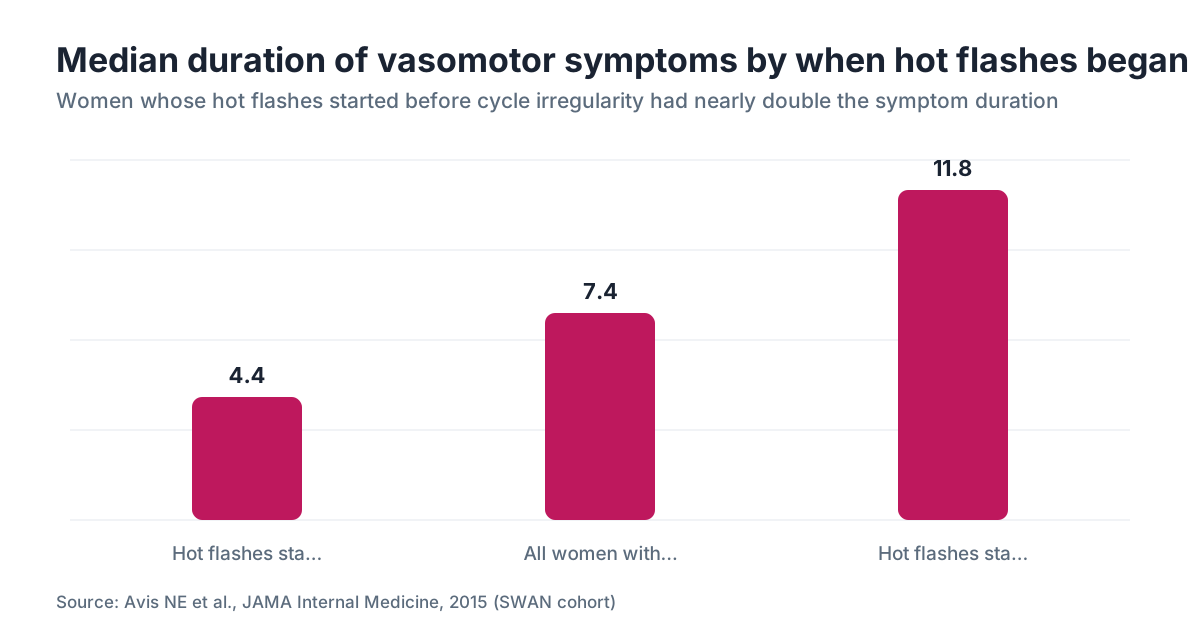
The range is genuinely wide. Some women sail through in two years; others spend a decade in the transition. A 2021 study in the journal Menopause found that the median duration of the menopausal transition is about 7 years when measured from the first irregular cycle to the final menstrual period, though women who started with hot flashes before their cycles became irregular experienced symptoms for a median of 11.8 years [3]. That is not a typo. Nearly 12 years.
So when someone asks "what age is perimenopause," the honest answer is: probably your late 40s, but possibly earlier, and the finish line is further away than most doctors warn you about.
Can perimenopause start at 40, or even earlier?
Yes. Perimenopause at 40 is uncommon but entirely real. The medical community generally considers onset before age 45 to be "early menopause transition," and onset before 40 to be primary ovarian insufficiency (POI), which is a distinct condition requiring its own workup and management [4].
Roughly 10% of women begin perimenopause before age 45 [1]. For most of them, there is no identifiable cause. Genetics is the biggest single predictor: if your mother or older sister started early, your odds go up meaningfully. Smoking is the most well-studied modifiable risk factor, associated with earlier menopause by about 1 to 2 years [5]. Certain cancer treatments, oophorectomy, autoimmune conditions, and specific chromosomal variants (Turner syndrome, Fragile X premutation carriers) can also trigger early transition.
POI, where ovarian function starts failing before 40, affects about 1% of women [4]. It is not the same as perimenopause: cycles may stop and restart unpredictably, fertility is not necessarily zero (spontaneous pregnancy occurs in roughly 5 to 10% of women with POI), and the hormonal picture is different enough that management guidelines diverge from standard perimenopause care. If your periods are becoming irregular before 40, get a workup. Don't just assume it's stress.
For women in their early 40s with new cycle irregularity, hot flashes, or sleep disruption, perimenopause is worth putting on the differential. See perimenopause age for a closer look at what early onset means for your care decisions.
How long does perimenopause last?
The average is 4 to 8 years from first noticeable hormonal changes to final period, but the range in published data runs from about 1 year to more than 10 [3]. Duration varies by several factors, and none of them are fully controllable.
The most cited study on duration is the Study of Women's Health Across the Nation (SWAN), a multi-site longitudinal cohort that followed over 3,000 women from 1996 onward. SWAN data showed that the median time from first menstrual irregularity to final menstrual period was approximately 5.8 years [3]. Hot flash duration data from SWAN's 2015 follow-up, published in JAMA Internal Medicine, found that women who experienced frequent hot flashes had them for a median of 7.4 years total, and that symptoms often started before cycles became irregular [3].
Women who enter perimenopause earlier (before 45) tend to have a longer transition. Women who were smokers, had higher BMI, or experienced more stress had a somewhat longer duration in some analyses, though the effect sizes are modest compared to genetics.
Here's the practical implication. If you're 46 and your period just got weird, plan for years, not months. The symptoms are not a brief detour. Prepare for a sustained stretch of hormonal variability and have a real conversation with a clinician about what management options look like for you over that timeline.
What are the first signs that perimenopause is starting?
Cycle changes are usually the first sign, though not always. The classic early signal is shorter cycles (say, 24 days instead of 28) or cycles that become unpredictable, with some longer than usual and some skipped altogether. This reflects the declining number of follicles and the resulting irregular surges and drops in estrogen and progesterone [1].
But for a meaningful percentage of women, hot flashes and night sweats show up before cycles get noticeably irregular. This matters because women in their early-to-mid 40s with new-onset sleep disruption, heat intolerance, or palpitations often do not connect these symptoms to perimenopause and spend months seeing cardiologists or sleep specialists before anyone checks their hormones.
Other common early symptoms include:
- Mood changes: increased anxiety, irritability, or low-grade depression, often worst in the luteal phase
- Brain fog and concentration difficulty
- Vaginal dryness or changes in lubrication during sex
- Sleep disruption even without obvious hot flashes
- Breast tenderness
- Heavier or longer periods during early perimenopause (counterintuitive but common, driven by estrogen dominance relative to progesterone)
Some women notice joint aches, heart palpitations, or changes in skin texture. These are real perimenopausal symptoms documented in the literature, not psychosomatic, even though they often get dismissed. The hormonal environment affects every tissue that has estrogen receptors, which is essentially every tissue in the body.
A resource on progesterone can help you understand why early perimenopause often looks like progesterone deficiency rather than estrogen deficiency, since progesterone drops first.
How is perimenopause diagnosed? Is there a blood test?
There is no single definitive blood test. This frustrates a lot of women, and reasonably so.
FSH (follicle-stimulating hormone) is the most commonly ordered test, and an elevated FSH (generally above 25 to 40 IU/L depending on the lab's reference range) can suggest diminishing ovarian reserve. But FSH fluctuates dramatically from day to day and cycle to cycle during perimenopause. A single reading in the "normal" range does not rule out perimenopause, and a single elevated reading does not definitively confirm it [1].
Estradiol levels similarly swing around. AMH (anti-Mullerian hormone) is a better marker of ovarian reserve and is more stable across the cycle, but it is not a standard diagnostic tool for perimenopause in clinical guidelines. It can be useful when trying to estimate how far along the transition has progressed.
NAMS and the Endocrine Society both recommend that diagnosis in women over 45 should be primarily clinical: the combination of age, new menstrual irregularity, and characteristic symptoms is usually enough to diagnose perimenopause without lab confirmation [1][4]. Hormone levels are more useful when symptoms occur before 45 (to rule out POI or other causes), when the picture is complicated, or when a woman has had a hysterectomy and lacks cycle data.
If you are 47, your periods are changing, you are waking up drenched at 3 a.m., and you are crying at commercials, you probably do not need to wait for a lab result to know what is happening. The conversation with your clinician should start with your history, not a single FSH number.
What drives the timing? Why do some women start earlier than others?
Genetics is the dominant factor. Studies of mother-daughter pairs and twin cohorts consistently show that age at menopause is highly heritable, with estimates ranging from 44% to 63% heritability [5]. If your mother entered menopause at 48, you are more likely to do so in a similar timeframe than someone whose mother went through it at 54.
Beyond genetics, the evidence-backed factors include:
Smoking: Current and former smokers reach menopause 1 to 2 years earlier than nonsmokers. This is one of the most consistently replicated findings in reproductive aging research [5].
Race and ethnicity: SWAN data showed that Black women tend to enter perimenopause earlier and experience more severe and longer-lasting vasomotor symptoms. Hispanic women also show earlier transition in some analyses. White and Asian women (particularly Japanese-American women in SWAN) tended toward later and somewhat shorter transitions [3]. These are population-level trends, not individual predictions.
Body composition: Very low body weight and low BMI are associated with earlier menopause. Moderate overweight may be associated with slightly later menopause, though excess adipose tissue creates its own hormonal disruptions.
Reproductive history: Nulliparity (never having been pregnant) and shorter cycle length in younger years have both been associated with earlier menopause in some studies.
Surgical and medical history: Bilateral oophorectomy causes immediate surgical menopause. Chemotherapy and pelvic radiation can damage the ovaries and precipitate early transition or premature ovarian insufficiency.
One factor that does not appear to affect timing: oral contraceptive use. Taking the pill does not delay or accelerate menopause, despite a persistent myth that it "saves" eggs.
How does the perimenopause timeline compare to actual menopause?
These two terms get used interchangeably in everyday language, which causes real confusion. They are distinct stages.
Perimenopause is the transition. Menopause is a single point in time: the 12-month anniversary of your last period. Everything after that point is called postmenopause. So technically, you are never "in menopause" for years; you go through perimenopause, reach menopause (one day), and then are postmenopausal for the rest of your life.
See when does menopause start and menopause age for more on how clinicians define the endpoint and what changes after.
The table below shows how the stages break down by typical age and hormonal characteristics:
| Stage | Typical Age Range | Key Hormonal Features | Duration | |---|---|---|---| | Reproductive (premenopause) | 20s, early 40s | Stable estrogen/progesterone cycling | Decades | | Early perimenopause | 44 to 50 | Variable cycle length, progesterone drops first | 2 to 4 years | | Late perimenopause | 47 to 52 | Cycles 60+ days apart, estrogen more erratic | 1 to 3 years | | Menopause | Median age 51 | 12 months since last period | One day | | Postmenopause | 51+ | Consistently low estrogen | Remainder of life |
The distinction matters clinically. A woman in early perimenopause can still get pregnant (ovulation still occurs, just unpredictably). Hormonal treatment decisions differ by stage. And the symptom profile shifts as the transition progresses: early perimenopause often looks like PMS on overdrive; late perimenopause looks more like what most people picture as classic menopause symptoms.
Do symptoms get worse at a particular age or stage?
Generally yes. Symptoms tend to peak in intensity during late perimenopause, the 1 to 3 years just before the final period [3]. This is when estrogen levels are at their most erratic and the average level is dropping toward the postmenopausal baseline. Hot flashes are most frequent and severe during this window for most women.
The SWAN study tracked hot flash frequency over more than a decade and found that peak frequency occurred in the late transition and persisted into the first 2 years of postmenopause before declining in most women [3]. But as noted above, roughly 10 to 15% of women still have clinically significant vasomotor symptoms a decade or more into postmenopause.
Genitourinary symptoms, meaning vaginal dryness, discomfort with sex, and urinary urgency, often don't become prominent until after the final period. They are caused by the sustained low-estrogen environment of postmenopause, not the fluctuating estrogen of perimenopause. So if your primary complaint shifts from hot flashes to vaginal dryness, you've probably crossed the menopause threshold.
Bone loss also accelerates during late perimenopause and the first few years after menopause. The Endocrine Society estimates that women can lose 2 to 3% of bone density per year in the years immediately around menopause, compared to about 0.5 to 1% per year in the premenopausal decade [4]. This is the window when a bone density test starts to matter, well before most primary care practices order one.
What treatment options exist during perimenopause?
Treatment depends on which symptoms are bothering you and how much. Not every woman needs medication. But many women suffer for years with treatable symptoms because no one offered them options.
Hormone therapy is the most effective treatment for vasomotor symptoms (hot flashes, night sweats) and genitourinary symptoms. The Endocrine Society and NAMS both support the use of hormone replacement therapy in healthy women under 60 or within 10 years of menopause onset, provided there are no major contraindications [4][1]. The Women's Health Initiative data (the study that scared a generation of women off hormones in 2002) has been substantially reanalyzed, and the risk picture is considerably more nuanced than the original press releases suggested.
For women in perimenopause specifically, low-dose hormonal contraceptives can do double duty: managing cycle irregularity and contraception while easing symptoms. This is a strategy NAMS explicitly acknowledges as reasonable through the late 40s for appropriate candidates [1].
Progesterone matters enormously in perimenopause. Since progesterone drops before estrogen does, many early perimenopausal symptoms are driven by progesterone deficiency: heavy periods, sleep disruption, anxiety. Micronized progesterone (Prometrium) has data supporting its use for sleep in perimenopausal women specifically. See progesterone for more detail.
For women managing perimenopausal weight gain, GLP-1 receptor agonists like semaglutide have become increasingly relevant. The hormonal shifts of perimenopause redistribute fat toward the abdomen and blunt metabolic efficiency. Platforms like WomenRx can connect you with clinicians who understand the intersection of hormonal health and metabolic support during this transition. See semaglutide for weight loss if metabolic changes are part of your picture.
Non-hormonal options for hot flashes include fezolinetant (Veozah), the first FDA-approved non-hormonal drug specifically for vasomotor symptoms, approved in 2023, as well as older options like SSRIs, SNRIs, and gabapentin that have evidence behind them if not formal menopause-specific approvals [6].
Local vaginal estrogen (cream, ring, or tablet) remains underused. It works, it has minimal systemic absorption, and it is appropriate even for women who cannot use systemic hormones. The estrogen patch article covers the systemic delivery options in more detail.
What does perimenopause mean for fertility and contraception?
This one surprises women repeatedly: you can still get pregnant during perimenopause.
As long as you are still ovulating, which happens intermittently even when cycles are irregular, conception is possible. Unintended pregnancies in women in their 40s are disproportionately high relative to intention rates, in part because women assume irregular cycles mean infertility.
NAMS recommends continuing contraception until menopause is confirmed (12 months without a period) [1]. For women in their mid-to-late 40s, options include low-dose combined oral contraceptives (if no contraindications), progestin-only pills, hormonal IUDs, copper IUDs, and barrier methods. Hormonal IUDs (like Mirena) are particularly useful in perimenopause because they manage heavy bleeding, reduce cramping, and provide reliable contraception. If you are using a hormonal IUD, it is harder to know when your cycles have actually stopped, so confirming menopause requires other markers.
Fertility treatment during early perimenopause is a distinct conversation. Ovarian reserve is declining, but IVF with your own eggs remains possible for some women into their early to mid-40s, with success rates falling sharply after 43. Egg donation or embryo transfer using previously frozen eggs changes the equation significantly. If fertility is on your radar, an AMH level and antral follicle count with a reproductive endocrinologist give you the most useful picture of where you actually stand.
Should you talk to a doctor, or wait it out?
You do not need to wait out years of disrupted sleep, mood crashes, and irregular bleeding because "it's just perimenopause."
The evidence base for intervention is strong. The window around perimenopause is now understood as a time of genuine cardiovascular and bone risk, more than symptomatic inconvenience. The Endocrine Society's clinical practice guideline on menopause explicitly states that "estrogen therapy initiated in women aged 50 to 59 years or within 10 years of menopause reduces all-cause mortality, coronary heart disease, and osteoporosis" [4]. That is a meaningful statement from a conservative medical organization.
Get evaluated if your symptoms are affecting your quality of life, your sleep, your work, or your relationships. Get evaluated even if they are not, honestly, because perimenopause is a natural checkpoint to assess your cardiovascular risk, bone health trajectory, and metabolic health. WomenRx is built specifically for women going through this transition, with clinicians who take hormonal symptoms seriously from the first visit.
If hormone therapy is not right for you, there are real alternatives. The point is that suffering silently is not a medical requirement. The tools exist. Use them.
For the broader hormonal picture of what comes next, menopause covers the postmenopausal stage in detail.
Frequently asked questions
At what age does perimenopause usually start?
Most women begin perimenopause between ages 45 and 55, with the average onset around 47 to 48. About 10% of women start before 45. Genetics is the strongest predictor of your personal timeline. The median age of final menopause in the U.S. is 51, meaning the average transition window runs roughly from the late 40s to the early 50s.
Can perimenopause start at 35?
Perimenopause starting at 35 is uncommon. Onset before 40 is classified as primary ovarian insufficiency (POI), a distinct condition affecting about 1% of women. Between 40 and 45, it is called early menopause transition. True perimenopause at 35 would be unusual enough to warrant a thorough workup, including FSH, AMH, autoimmune screening, and genetic testing.
How long does perimenopause last?
The average duration is 4 to 8 years from first symptoms to final period, though SWAN study data shows a median closer to 7 years. Women who begin with hot flashes before cycle changes may experience symptoms for nearly 12 years. Women who enter the transition later (after 50) tend to have a shorter transition period than those who start in their early-to-mid 40s.
What is the difference between perimenopause and menopause?
Perimenopause is the years-long transition when hormones fluctuate and symptoms arise. Menopause is a single point in time: 12 consecutive months without a menstrual period. After that one-year mark, you are postmenopausal. Symptoms like hot flashes can occur across all three phases, but the hormonal picture and treatment considerations shift between them.
What are the first signs of perimenopause?
The most common first signs are cycle changes (shorter intervals, skipped periods, or unpredictable timing) and hot flashes or night sweats. Many women also notice mood shifts, especially increased anxiety or irritability, sleep disruption, and heavier periods. Some women experience hot flashes before their cycles become irregular, which can delay recognition of the transition.
Is there a blood test that confirms perimenopause?
No single blood test confirms perimenopause. FSH is commonly checked but fluctuates too much during the transition to be definitive. NAMS and the Endocrine Society recommend clinical diagnosis in women over 45 based on age, symptom pattern, and cycle changes. Lab work is more useful when symptoms start before 45 or when the diagnosis is uncertain.
Can you get pregnant during perimenopause?
Yes. Ovulation still occurs intermittently during perimenopause, even when cycles are irregular. Pregnancy is possible until menopause is confirmed by 12 consecutive months without a period. NAMS recommends continuing effective contraception through the full menopausal transition. Unintended pregnancies in women in their 40s remain more common than many realize.
Does race or ethnicity affect when perimenopause starts?
Yes, according to SWAN study data. Black women on average enter perimenopause earlier and experience more severe and longer-lasting vasomotor symptoms. Hispanic women also show somewhat earlier transitions. Japanese-American women in SWAN tended to have later and somewhat shorter transitions. These are population-level patterns, not individual predictions, and the reasons involve a mix of genetic, socioeconomic, and structural health factors.
Does smoking affect when perimenopause starts?
Yes. Smoking is the most consistently documented modifiable risk factor for earlier menopause. Current and former smokers reach menopause 1 to 2 years earlier than nonsmokers on average, according to multiple large cohort studies. The mechanism likely involves toxic effects of smoking on ovarian follicles. Quitting smoking does not fully reverse this risk but has broad health benefits regardless.
What is the difference between early perimenopause and late perimenopause?
Early perimenopause involves variable cycle length (cycles 7 or more days different from usual) while periods are still occurring regularly. Late perimenopause begins when cycles are 60 or more days apart, indicating the ovaries are producing very little estrogen consistently. Symptoms often intensify in late perimenopause. The Stages of Reproductive Aging Workshop (STRAW+10) criteria define these substages precisely.
Can hormone therapy be used during perimenopause, or only after menopause?
Hormone therapy can be appropriate during perimenopause. Low-dose combined oral contraceptives are often used in perimenopausal women to manage irregular bleeding, contraception, and symptoms simultaneously. Progesterone alone can help with early-stage symptoms like sleep disruption and heavy periods. Systemic hormone therapy follows the same evidence base regardless of whether menopause is confirmed, though dosing considerations differ.
How fast does bone loss happen during perimenopause?
Bone loss accelerates significantly during late perimenopause and the first 2 to 3 years after menopause. The Endocrine Society estimates losses of 2 to 3% of bone density per year during this window, compared to about 0.5 to 1% per year during premenopause. This makes the perimenopausal years an important time to assess baseline bone density, especially with a family history of osteoporosis.
Does perimenopause affect weight or metabolism?
Yes. The hormonal shifts of perimenopause, particularly declining estrogen and progesterone, alter fat distribution (shifting it toward the abdomen), reduce insulin sensitivity, and blunt the body's metabolic response to diet and exercise. Women often notice weight gain or body composition changes during this phase even without major lifestyle changes. Addressing metabolic health alongside hormonal health is increasingly standard in perimenopause care.
What is primary ovarian insufficiency and how is it different from perimenopause?
Primary ovarian insufficiency (POI) is the failure of normal ovarian function before age 40, affecting about 1% of women. Unlike perimenopause, POI can be intermittent: periods may return spontaneously, and pregnancy remains possible in roughly 5 to 10% of cases. POI requires a distinct diagnostic workup and management plan, including hormone therapy started earlier than standard menopausal guidance and specific fertility counseling.
Sources
- North American Menopause Society (NAMS), Menopause Practice: A Clinician's Guide
- CDC / National Center for Health Statistics, Reproductive Health Data
- Avis NE et al., Duration of Menopausal Vasomotor Symptoms over the Menopause Transition, JAMA Internal Medicine, 2015
- Endocrine Society, Clinical Practice Guideline: Treatment of Symptoms of the Menopause
- Murabito JM et al., Heritability of age at natural menopause in women from the Framingham Heart Study, Journal of Clinical Endocrinology & Metabolism, 2005
- FDA, Veozah (fezolinetant) Prescribing Information and Approval
- Harlow SD et al., Executive summary of the Stages of Reproductive Aging Workshop + 10, Menopause, 2012
- NIH National Institute on Aging, Menopause: What You Need to Know
- Office on Women's Health, U.S. Department of Health and Human Services, Menopause basics
- Gold EB et al., Relation of demographic and lifestyle factors to symptoms in a multi-racial/ethnic population of women 40-55 years of age, American Journal of Epidemiology, 2000 (SWAN baseline)