Perimenopausal migraine headaches: why they get worse and what helps
TL;DR: Migraines often get worse in perimenopause because estrogen swings hard before settling low at menopause. It's the crash, not the low level, that fires an attack. Up to 45% of women with a migraine history report more frequent or severe attacks during the transition. Transdermal estrogen, established preventives, and a few lifestyle moves cut attack frequency for most women.
Why do migraines get worse in perimenopause?
Blame estrogen volatility. During perimenopause the ovaries stop firing on schedule. Some cycles produce a normal estrogen surge, others spike unusually high and then crash. It's the crash, not low estrogen itself, that triggers migraines in most susceptible women.
The trigeminal pain pathway is dense with estrogen receptors. When estrogen drops sharply, it lowers the threshold for cortical spreading depression, the wave of electrical silence behind a migraine aura, and it sensitizes the trigeminal nerve endings that produce the throbbing pain [1]. A steady low estrogen level, the kind most women reach after full menopause, provokes far less than the rollercoaster of the transition.
This changes how you treat it. If a clinician tells you to "just wait until menopause and they'll stop," that's half-right at best. Many women do get relief after their final period. But the transition, which runs 4 to 10 years, is often the worst window [2]. For what the research says about when this phase starts and ends, see perimenopause age.
Progesterone adds a second layer. It metabolizes into allopregnanolone, a neuroactive steroid that modulates GABA receptors. When progesterone swings unpredictably, those calming GABA signals become unreliable, leaving the brain more excitable between periods [3]. That excitability is migraine-friendly territory.
How common are migraines in perimenopause, really?
Migraine affects roughly 28 million women in the United States, and prevalence peaks between ages 35 and 55, which maps almost exactly onto the perimenopause window [1]. That overlap is no accident.
Data from the Study of Women's Health Across the Nation (SWAN), which followed over 3,300 women through the transition, found headache frequency rose during late perimenopause compared to premenopause [11]. A separate analysis in the journal Neurology found women in perimenopause were 1.6 times more likely to report high-frequency headache, 15 or more days per month, than premenopausal women of similar age [4].
The numbers skew worse if you already had menstrual migraine before the transition. If your attacks were reliably tied to your period, the chaotic hormone shifts of perimenopause multiply your triggers rather than erase them. Women without any migraine history can develop new-onset attacks too, though that's less common and always earns a neurological workup to rule out secondary causes.
Roughly 10 to 15% of women shift from episodic to chronic migraine, 15 or more headache days per month with at least 8 meeting migraine criteria, during the transition [5]. That escalation is the outcome most worth preventing, because chronic migraine is dramatically harder to treat once it takes hold.
What does a perimenopausal migraine feel like versus a regular one?
The attack itself looks the same: moderate to severe throbbing pain, usually one-sided, worse with movement, plus nausea, light sensitivity, and sound sensitivity. What changes in perimenopause is the pattern.
Attacks stop tracking the first day of your period. They can hit at any point in an irregular cycle, sometimes in clusters of two or three within a week, then nothing for three weeks. The unpredictability is its own burden, because it kills the skip-a-trigger strategies that used to work.
Aura can change too. Some women who never had aura develop it for the first time. New neurological symptoms in a woman over 40 always deserve a prompt conversation with a neurologist. Not because they're dangerous in the absence of other risk factors, but because new aura shifts your contraception and hormone therapy options. Migraine with aura carries a small but real increase in ischemic stroke risk, and that changes how clinicians pick hormone formulations [6].
Some women describe perimenopausal attacks as longer, stretching to 48 or 72 hours instead of the usual 24. That drawn-out course probably reflects a sustained hormonal drop rather than a brief perimenstrual estrogen withdrawal.
How do estrogen and progesterone changes specifically trigger attacks?
The estrogen-withdrawal theory is the most studied mechanism [1]. In a normal cycle, estrogen rises in the follicular phase, peaks at ovulation, then falls predictably before menstruation. Women with menstrual migraine are sensitive to that premenstrual drop. In perimenopause, cycles go anovulatory or produce weak luteal phases, so estrogen spikes irregularly and then falls off a cliff without the buffering of a normal cycle.
Estrogen also controls serotonin synthesis and serotonin receptor expression. When it drops, serotonin availability in the brainstem falls, weakening the descending pain-modulation signals that normally dampen trigeminal activation [1]. That's the mechanistic reason triptans, which act on serotonin receptors, work for the acute attack no matter the hormonal cause.
Progesterone is murkier. In theory, falling progesterone should reduce excitatory input, since its metabolite allopregnanolone is inhibitory. The problem is the fluctuation itself. Rapid changes in allopregnanolone, rising or falling, can paradoxically raise neuronal excitability in susceptible brains [3]. Same mechanism behind premenstrual mood symptoms, and the reason some women feel worse when starting or stopping progesterone.
For how supplemental progesterone differs by formulation and delivery route, which decides whether it helps or hurts migraines, see progesterone.
Can hormone therapy help perimenopausal migraines, and is it safe?
This is the question most women bring, and the honest answer is: for many, yes, but formulation and dose matter enormously.
The goal is to flatten the estrogen rollercoaster. A continuous low dose of estrogen, delivered so blood levels stay stable, shrinks the magnitude of hormonal drops and, with them, migraine frequency. The estrogen patch usually beats oral estrogen here because it produces steadier serum levels without a pill's daily peak and trough. A 2017 Cochrane review found transdermal estradiol reduced migraine frequency versus placebo in perimenopausal women, though the evidence was rated moderate quality [7].
The North American Menopause Society favors the transdermal route for women with migraine because it skips the first-pass liver metabolism that affects clotting factors with oral estrogen [8]. Oral estrogen raises sex hormone-binding globulin and can push up triglycerides, both secondary concerns for a woman who has migraine with aura and its already-elevated stroke risk.
Migraine with aura is a Category 4 contraindication to combined hormonal contraceptives containing estrogen, per the CDC's U.S. Medical Eligibility Criteria for Contraceptive Use, which lists it among conditions representing "an unacceptable health risk if the contraceptive method is used" [6]. That same absolute caution does not automatically extend to the lower doses in menopause hormone therapy, but it belongs in the risk conversation. Women with aura plus other vascular risks (smoking, hypertension, diabetes) should treat estrogen carefully and work with a clinician who knows both neurology and endocrinology.
On the progestogen side: micronized oral progesterone (Prometrium) looks like the most migraine-neutral choice. Synthetic progestins, medroxyprogesterone acetate in particular, have drawn more headache complaints in some clinical reports, though head-to-head data are thin [8].
A telehealth platform like WomenRx, built around women's hormones, can prescribe and monitor transdermal therapy with your migraine history in view. But any hormone plan for a woman with aura should loop in her neurologist.
For the broader evidence and current guidelines, see hormone replacement therapy.
What prescription migraine treatments work during perimenopause?
Hormone therapy goes at the root cause. Most women still need acute treatment for breakthrough attacks, and many need a separate preventive.
Acute treatments: Triptans (sumatriptan, rizatriptan, eletriptan, and others) remain first-line for moderate-to-severe attacks in perimenopause. They act on 5-HT1B/1D serotonin receptors to constrict dilated cranial vessels and block trigeminal neurotransmitter release, and they work in roughly 60 to 70% of attacks [5]. NSAIDs like naproxen sodium 550 mg work alone for milder attacks or combined with a triptan.
The CGRP class opened a newer lane. Gepants (ubrogepant, rimegepant) block the calcitonin gene-related peptide receptor acutely; lasmiditan acts on 5-HT1F receptors. Both help women who can't take triptans because of cardiovascular risk. Rimegepant (Nurtec ODT) is also FDA-approved for prevention taken every other day, a genuinely useful dual-purpose option [13].
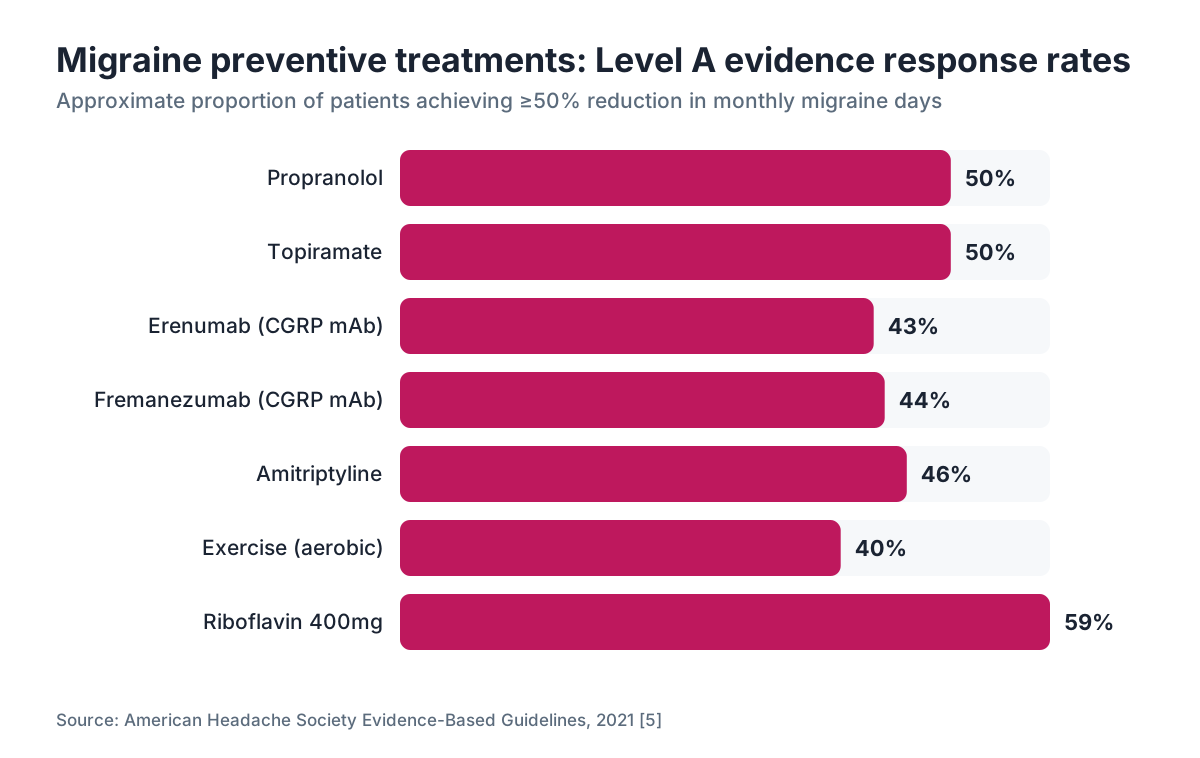
Preventive treatments: The American Headache Society and American Academy of Neurology back the following as having the best evidence for prevention [5]:
| Drug Class | Examples | Evidence Level | |---|---|---| | Beta-blockers | Propranolol, metoprolol | Level A | | Antiepileptics | Topiramate, valproate | Level A | | Antidepressants (TCA) | Amitriptyline | Level B | | CGRP monoclonal antibodies | Erenumab, fremanezumab, galcanezumab, eptinezumab | Level A | | Gepants (preventive) | Rimegepant | Level B |
The anti-CGRP monoclonal antibodies changed the picture for women with chronic or high-frequency episodic migraine. In the ARISE trial of erenumab, patients saw a median reduction of about 2.9 migraine days per month versus 1.8 for placebo [5]. These injectables have no known interaction with hormone therapy, which makes them attractive in perimenopause.
Topiramate works, but its cognitive side effects drive some women off it, and it can lower the efficacy of oral hormonal contraceptives. Worth knowing before you start.
OnabotulinumtoxinA (Botox) is FDA-approved for chronic migraine, 15 or more headache days per month. If you've crossed into that territory during the transition, raise it with a headache specialist.
What lifestyle changes actually reduce perimenopausal migraine frequency?
Sleep disruption is one of the strongest migraine triggers, and perimenopause wrecks sleep through night sweats, anxiety, and estrogen's direct effect on sleep architecture. Treat the night sweats, with hormone therapy or non-hormonal options like cognitive behavioral therapy for insomnia (CBT-I), and you often get a real secondary drop in migraine frequency [2].
Alcohol tolerance falls in perimenopause. A glass of wine that was fine last year may reliably set off an attack now. Red wine, champagne, and aged spirits are the usual culprits, thanks to tannins, sulfites, and histamine.
Skipping meals drops blood sugar and fires attacks. This isn't about a special migraine diet. It's about not going more than 4 to 5 hours without eating during waking hours. Caffeine cuts both ways: a small dose can abort a mild attack, but a daily habit followed by a day off is the classic weekend migraine.
Aerobic exercise earns its place. In a 2011 Swedish RCT in Cephalalgia, 40 minutes three times a week at moderate intensity reduced migraine days about as well as topiramate and relaxation training, with exercise producing roughly a 0.93-day drop per month [9]. It's not a rescue treatment, but as a preventive add-on with zero drug interactions it belongs in any honest plan.
Stress management matters and is easier said than done. Biofeedback and CBT carry Level A evidence for prevention from the American Academy of Neurology [5]. If medication side effects box you in, behavioral approaches aren't a consolation prize. They're legitimate first-tier options.
Are there any migraine triggers unique to perimenopause?
A few stand out beyond the usual suspects.
Hot flashes and migraines share a mechanism: both involve vasomotor instability. Some women find a hot flash reliably precedes or accompanies an attack. Treating the flashes can therefore cut the migraines, which is one practical argument for hormone therapy even when migraine, not vasomotor symptoms, is your main complaint.
Broken sleep from night sweats is covered above, but the anxiety and mood shifts of perimenopause pile on independently. Anxiety is a well-established migraine comorbidity, and perimenopause amplifies it through both hormonal and psychosocial routes. If your anxiety worsened alongside your migraines, treating the anxiety isn't secondary. It can be the main event.
Weight gain matters because obesity is an independent risk factor for migraine chronification. Women who gain significant weight during the transition are likelier to convert episodic migraine into chronic. The mechanism runs through adipose tissue's role in CGRP production and systemic inflammation. That's an underappreciated reason metabolic health during menopause carries neurological stakes, more than cardiometabolic ones.
A few supplements taken for perimenopause symptoms, black cohosh and high-dose B vitamins (above a standard B-complex) among them, carry anecdotal ties to migraine provocation in some women. Nobody has solid clinical data on this; the observation comes mostly from headache clinics. Take it as a cue to track new supplements against your migraine diary, not as gospel.
When should you see a neurologist or headache specialist?
Most perimenopausal migraines can be handled by a primary care physician or OB-GYN who's comfortable with both hormone management and migraine pharmacology. Several situations call for a specialist.
New neurological symptoms alongside headache, new aura, arm or face numbness, speech changes, or visual field loss, warrant a neurological evaluation before you pin anything on perimenopause. Not because these are necessarily serious, but because you want that baseline documented.
If you've tried two or more preventives without adequate response, a headache specialist brings extra tools: IV dihydroergotamine protocols, occipital nerve blocks, and the full CGRP monoclonal antibody lineup, plus the experience to fight the insurance battles around them.
Chronic migraine, 15 or more headache days per month for at least three months, is a specialty indication. It needs a systematic approach a headache specialist runs daily.
If you have migraine with aura and are weighing hormone therapy, a neurologist who can document and monitor your aura status is a useful partner alongside whoever manages your hormones. Clinicians at a hormone-focused platform like WomenRx can coordinate with your neurology team, but the neurological safety check should run in parallel.
And if your headaches have changed character, different location, new associated symptoms, pain that wakes you from sleep, or headache triggered by a Valsalva maneuver, that's a red-flag pattern that needs imaging. These cases are rare but real, and perimenopause offers no protection against secondary causes.
What happens to migraines after menopause is complete?
For most women without aura, migraines improve after the final period. Studies suggest about 67% of women with a history of menstrual migraine report improvement after natural menopause [2]. The reason is simple: estrogen settles at a consistently low baseline, and the sharp drops that trigger attacks disappear.
The improvement is less reliable after surgical menopause (bilateral oophorectomy), which produces an abrupt, large estrogen fall instead of a gradual one. Some women worsen significantly in the months after surgery, and this group benefits most clearly from starting hormone therapy right away [2].
Women with migraine with aura are the exception to the "menopause helps" rule. Their attacks may not settle as reliably, and some studies show a smaller postmenopause improvement than in women without aura [2].
If you start hormone therapy after menopause and your migraines worsen, adjust dose and formulation first. Continuous combined regimens (estrogen plus progestogen daily, no cycling) produce fewer hormonal swings than sequential regimens that cycle the progestogen. For some women, switching from sequential to continuous, or trimming the estrogen dose, ends the hormone-triggered attacks.
For the wider postmenopause picture, including brain, bone, and cardiovascular considerations, see menopause.
How do you track perimenopausal migraines to get better care?
A migraine diary isn't optional if you want useful appointments. Apps like Migraine Buddy or Headache Diary (both iOS and Android) let you log timing, duration, severity, cycle day, sleep hours, and suspected triggers. After two or three months, patterns surface that you'd never spot otherwise.
The data that matters most for a perimenopausal workup: attacks per month, relationship to cycle day if you're still cycling, whether attacks cluster around the apparent estrogen drop (typically days 1 to 3 of menstruation, or in anovulatory cycles around day 14 to 21), response to acute treatments, and any new or changed symptoms.
Bring the numbers, don't reconstruct from memory. "I get them more now" is far weaker than "I averaged 8 migraine days a month over the last 3 months, clustering within 2 days of my period start, and sumatriptan works about 60% of the time."
Tracking cycle irregularity alongside migraine data also tells your clinician where you sit in the transition. FSH and estradiol labs add context but are notorious for day-to-day swings in perimenopause; your clinical picture and cycle history carry more weight than any single hormone value. For how clinicians stage the transition, see when does menopause start.
Frequently asked questions
Can perimenopause cause daily headaches even without a migraine history?
Yes. New-onset daily or near-daily headaches in a woman in her 40s deserve evaluation, and hormone fluctuation is a plausible driver. But a new headache pattern at this age always needs a basic neurological workup to exclude secondary causes, intracranial pressure changes, thyroid dysfunction, or medication overuse headache, before you attribute it to hormones.
Do birth control pills help or hurt perimenopausal migraines?
It depends on formulation and aura status. Combined oral contraceptives with ethinyl estradiol can worsen migraines in women sensitive to the pill-free week. For women with migraine with aura, combined hormonal contraceptives raise stroke risk and land in CDC medical eligibility category 3 or 4. Progestin-only pills or low-dose continuous regimens are generally safer choices.
Is magnesium supplementation worth trying for perimenopausal migraine prevention?
Magnesium oxide or glycinate at 400 to 600 mg daily has Level B evidence from the American Academy of Neurology for prevention. Deficiency is common and can worsen with age. The safety profile is excellent and it interacts with nothing. Most headache specialists treat it as a reasonable first step, though effects are modest: roughly 1 to 2 fewer migraine days per month in responders.
Why do migraines sometimes get worse when I start hormone therapy?
Two common reasons: a dose too high creates new fluctuations, or a sequential progestogen schedule mimics the very shifts you're trying to erase. Switching to a continuous combined regimen, trimming the estrogen dose, or changing the progestogen (particularly to micronized progesterone) often fixes it. Give any new regimen 2 to 3 cycles before judging its migraine effect, but flag persistent worsening to your clinician promptly.
Are CGRP inhibitors safe to use during perimenopause?
Yes. The CGRP monoclonal antibodies (erenumab, fremanezumab, galcanezumab, eptinezumab) have no known interactions with hormone therapy and haven't been flagged for vascular risk in trials. They're especially attractive for women with migraine with aura who want to steer clear of estrogen-containing treatments, since they hit the migraine pathway directly with no hormonal mechanism.
How do I know if my headaches are migraine versus tension headache in perimenopause?
Migraine usually brings moderate to severe throbbing pain, worsens with physical activity, and comes with at least one of nausea, vomiting, photophobia, or phonophobia. Tension headache is typically mild to moderate, non-throbbing, on both sides, and not aggravated by movement. The distinction matters because they respond to different treatments. If you're unsure, the validated ID-Migraine 3-question screener asks about nausea, photophobia, and functional impairment.
Can weight loss reduce perimenopausal migraines?
Evidence suggests it can, especially for women with high-frequency or chronic migraine. Obesity is an independent risk factor for chronification. Bariatric surgery case series and observational studies show migraine improvement with significant weight loss, though randomized data are limited. GLP-1 receptor agonists are now widely used for weight loss in perimenopausal women; they haven't been studied specifically for migraine, but cutting obesity-related inflammation is a plausible secondary benefit.
What is the difference between a migraine aura and a TIA, and how do I tell them apart?
Both can cause visual disturbances, numbness, or speech changes, but migraine aura marches slowly across a visual field over 20 to 30 minutes, resolves completely within 60 minutes, and is followed by headache. TIA symptoms are usually maximal at onset, don't march, and often occur without any headache afterward. Any first-ever neurological episode in a woman over 45 needs urgent evaluation to exclude TIA, not an assumption that it's migraine.
Does vitamin B2 (riboflavin) actually work for migraine prevention?
Riboflavin at 400 mg daily has Level B evidence from the American Academy of Neurology for episodic migraine prevention. A 1998 randomized trial in Neurology found 400 mg/day cut migraine frequency by 50% in about 59% of patients versus 15% on placebo. Effect takes 2 to 3 months to appear. It's safe, cheap, and turns urine bright yellow. A reasonable add-on, not a replacement for prescription preventives in high-frequency migraine.
Is it safe to take triptans during perimenopause if I have cardiovascular risk factors?
Triptans are contraindicated in uncontrolled hypertension, prior stroke or TIA, ischemic heart disease, and hemiplegic or basilar migraine. For women with well-controlled mild hypertension and no vascular history, most headache specialists consider triptans acceptable but lean toward lower doses. The gepant class (ubrogepant, rimegepant) and lasmiditan are cardiovascular-neutral alternatives when triptans are off the table or poorly tolerated.
How long does the perimenopausal migraine worsening phase typically last?
Perimenopause runs roughly 4 to 10 years on average, and migraine tends to track that window. The late stage, the year or two just before the final period, appears to be when frequency peaks. Most women who improve see it within 1 to 2 years after their final period, though timelines vary and women with aura may recover more slowly or less completely.
What blood tests should I ask for if I think perimenopause is worsening my migraines?
An FSH and estradiol on day 2 to 5 of your cycle gives baseline context, though values swing widely in perimenopause and a single result rarely settles anything. A thyroid panel (TSH, free T4) is worth checking, since hypothyroidism independently worsens headaches and is common at this age. A CBC, metabolic panel, and vitamin D round out a reasonable baseline. None of these diagnose perimenopausal migraine, but they rule out common contributors.
Can acupuncture help perimenopausal migraines?
Acupuncture has better evidence for migraine prevention than most people expect. A 2016 Cochrane review found it reduced migraine frequency about as well as prophylactic drug treatment in trials with at least 6 months of follow-up. Effect size was roughly a 50% reduction in frequency in about half of patients. A reasonable option for women who want to limit medication during perimenopause, especially as an add-on.
Sources
- Nature Reviews Neurology, Vetvik & MacGregor, 2017 – Sex differences in the epidemiology, clinical features, and pathophysiology of migraine
- The Menopause Society (NAMS) – Migraines and menopause patient guidance
- Frontiers in Neuroendocrinology, Genazzani et al., 2021 – Neuroactive steroids and the brain in the menopausal transition
- Neurology, Aegidius et al., 2010 – The effect of menopause and hormone therapy on headache prevalence in the Nord-Trøndelag Health Study
- American Headache Society – Evidence-based guideline update: pharmacological treatment for episodic migraine prevention in adults
- CDC – U.S. Medical Eligibility Criteria for Contraceptive Use, 2024
- Cochrane Database of Systematic Reviews, MacGregor, 2017 – Estrogen and migraine: a critical review
- The Menopause Society (NAMS) – 2022 Hormone Therapy Position Statement
- Cephalalgia, Varkey et al., 2011 – Exercise as migraine prophylaxis: a randomized study using relaxation and topiramate as controls
- Neurology, Schoenen et al., 1998 – Effectiveness of high-dose riboflavin in migraine prophylaxis
- Study of Women's Health Across the Nation (SWAN) – National Institute on Aging
- Cochrane Database of Systematic Reviews, Linde et al., 2016 – Acupuncture for the prevention of episodic migraine
- FDA – Drug Approvals: Nurtec ODT (rimegepant) prescribing information