Normal progesterone levels by age, cycle phase, and menopause
TL;DR: Normal progesterone swings hard with your cycle and your age. Before ovulation it sits near 0.1 to 0.3 ng/mL. In the luteal phase it peaks around 6 to 25 ng/mL. In pregnancy it can top 100 to 200 ng/mL. After menopause it drops below 0.2 ng/mL and stays there. One number tells you almost nothing without your cycle day attached to it.
What is a normal progesterone level, and why does it depend so much on timing?
There is no single normal progesterone number. It spikes after ovulation, crashes before your period, climbs into the hundreds during pregnancy, and flatlines after menopause. A result of 0.5 ng/mL is perfectly normal on day 5 of your cycle and a red flag for an anovulatory cycle if it shows up on day 21.
Most major labs and the Endocrine Society report progesterone in nanograms per milliliter (ng/mL). Some labs report in nanomoles per liter (nmol/L). To convert, multiply ng/mL by 3.18. [1]
Because timing drives everything, good clinicians don't order a bare progesterone level. They order it with cycle-day context, ideally 7 days after presumed ovulation, so around day 21 in a textbook 28-day cycle. Without that date, the number is close to uninterpretable.
Lab-to-lab variation is real too. The FDA-cleared assays at Quest and LabCorp publish reference intervals that differ slightly from each other. Compare your result to the range printed on your own report, not a generic figure you found online.
What are the normal progesterone ranges for each phase of the menstrual cycle?
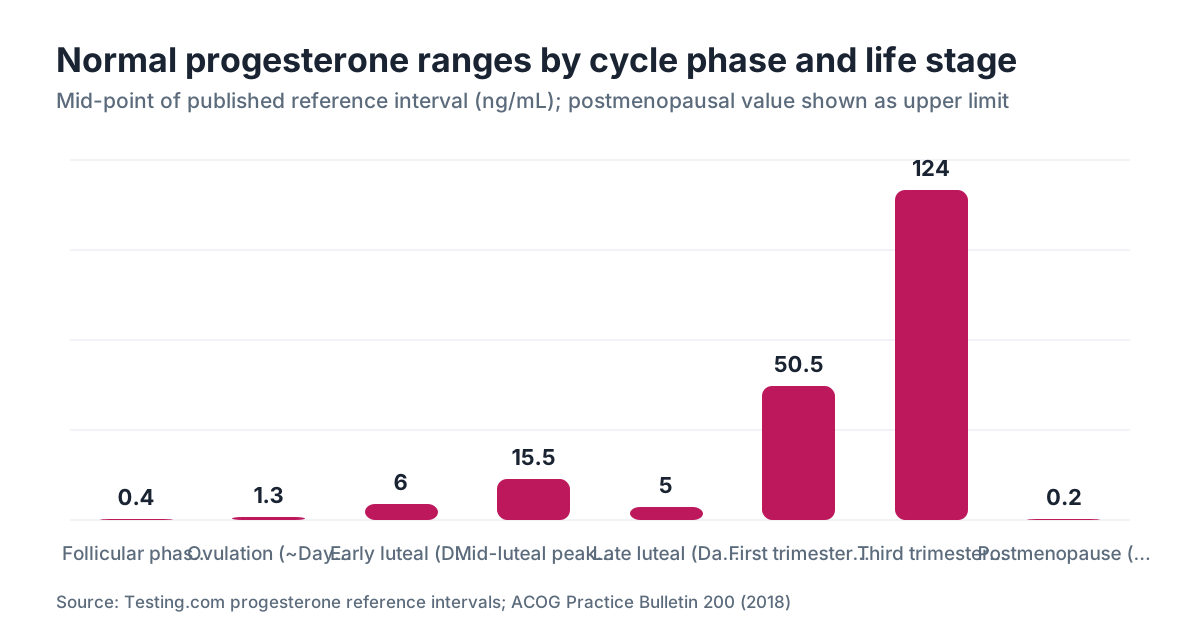
Here is how progesterone moves through a typical 28-day cycle, using published reference intervals from major clinical laboratory references and the Endocrine Society. [1][2]
| Cycle phase | Typical day | Progesterone range (ng/mL) | |---|---|---| | Follicular (before ovulation) | Days 1 to 13 | 0.1 to 0.7 | | Ovulation | ~Day 14 | 0.7 to 1.9 | | Early luteal | Days 15 to 18 | 2.0 to 10.0 | | Mid-luteal (peak) | Days 19 to 23 | 6.0 to 25.0 | | Late luteal (premenstrual) | Days 24 to 28 | 1.0 to 9.0 |
The mid-luteal peak is the window that matters. A level above roughly 3 ng/mL on day 21 is generally accepted as evidence that ovulation happened. [2] Some clinicians want to see 5 ng/mL or higher for a confident read on a healthy luteal phase, because a low-normal result of 3 to 5 ng/mL can point to a luteal phase defect.
One number worth memorizing: the Endocrine Society flags a mid-luteal progesterone below 10 ng/mL as consistent with inadequate luteal function, even when it clears the "ovulation occurred" bar. [2]
Cycles vary. A woman with a 35-day cycle might not hit her luteal peak until day 28. Order a day-21 draw on a long cycle and you'll get a false low almost every time.
What is a normal progesterone level in perimenopause?
Perimenopause is the hardest time to read a progesterone level. Cycles turn irregular, ovulation gets unpredictable, and some cycles are anovulatory, meaning no egg releases and there's essentially no luteal-phase spike at all. [3]
A woman in early perimenopause who still ovulates will still hit a mid-luteal peak in the 6 to 25 ng/mL range, though it may be blunted and shorter than it was in her 30s. In late perimenopause, ovulation happens only sometimes. A random draw on what looks like cycle day 21 could land anywhere from 0.2 to 20 ng/mL depending purely on whether she ovulated that month.
The SWAN study (Study of Women's Health Across the Nation) tracked luteal-phase progesterone across the transition and found that its variability climbs in the three years before the final period. [3] The practical takeaway: one low progesterone in perimenopause proves nothing about ovarian failure. You need serial measurements or at least a solid history of cycle regularity to say anything real.
If you're trying to place yourself in the transition, the perimenopause age and when does menopause start articles lay out how clinicians stage it, which is the context any hormone lab needs.
Progesterone testing also matters for perimenopausal women on hormone replacement therapy. If you have a uterus and take estrogen, you need a progestogen (progesterone or a synthetic progestin) to protect the uterine lining. Confirming adequate serum levels on oral micronized progesterone can matter, especially since absorption shifts with food intake and body composition.
What should progesterone be after menopause?
After menopause, defined as 12 straight months without a period, the ovaries make almost no progesterone. Reference labs put the postmenopausal range below 0.2 ng/mL, and most will flag anything higher if you've marked yourself postmenopausal on the requisition. [1]
That range does not apply to a postmenopausal woman taking oral micronized progesterone. She should read higher, in line with her dose. On 100 mg oral micronized progesterone (the FDA-approved dose in Prometrium), the clinical target runs roughly 5 to 30 ng/mL when the blood is drawn in the evening, 2 to 4 hours after the dose. [4] Timing the draw is the whole game here. Progesterone has a short half-life (around 5 hours for the oral micronized form), so a morning draw after a bedtime dose often reads near baseline.
Oral, vaginal, and topical progesterone behave very differently in the blood. Oral micronized progesterone produces measurable serum levels. Vaginal progesterone reaches high concentrations in the uterus but often shows low serum levels. Topical creams are notorious for unreliable serum readings. The North American Menopause Society (NAMS) states that compounded progesterone creams should not be assumed bioequivalent to FDA-approved oral micronized progesterone based on serum levels alone. [5]
What is a normal progesterone level during pregnancy?
Pregnancy is where progesterone peaks. The corpus luteum makes it through roughly week 10, then the placenta takes over in what's called the luteal-placental shift.
| Trimester | Typical progesterone range (ng/mL) | |---|---| | First (weeks 1 to 12) | 11 to 90 | | Second (weeks 13 to 26) | 25 to 90 | | Third (weeks 27 to 40) | 48 to 200+ |
These ranges are wide because gestational age, singleton versus twin pregnancy, and individual variation all pull in different directions. [6] In early pregnancy, the trend matters more than any single value. A rising progesterone in the first trimester is reassuring. A flat or falling one can signal a struggling pregnancy, though it's not diagnostic on its own.
A common clinical benchmark: a first-trimester progesterone below 5 ng/mL has high specificity for a nonviable pregnancy, and a level above 20 ng/mL is reassuring for an intrauterine pregnancy. [6] Values from 5 to 20 ng/mL sit in a gray zone that needs clinical judgment and serial beta-hCG measurements.
Progesterone supplementation in early pregnancy, usually vaginal, gets prescribed for women with recurrent miscarriage or short luteal phases. The PRISM trial (NEJM, 2019) found that vaginal progesterone at 400 mg twice daily did not improve live birth rates across all women with early pregnancy bleeding, but it did improve outcomes in the subgroup with prior pregnancy loss. [7]
What does low progesterone actually mean for your health?
Low luteal-phase progesterone, called luteal phase defect (LPD), is linked to trouble conceiving and early pregnancy loss, though the evidence for treating it is honestly mixed. [2]
Beyond fertility, chronically low progesterone relative to estrogen creates a state people call estrogen dominance, which isn't a formal clinical diagnosis. The real effect is straightforward. Without enough progesterone to balance estrogen, the uterine lining can thicken more than it should, which raises the risk of irregular bleeding and, over years, endometrial hyperplasia.
Progesterone also drives sleep. Its metabolite allopregnanolone modulates GABA-A receptors, which is why many women sleep better on oral micronized progesterone than on synthetic progestins. A drop in allopregnanolone during the late luteal phase is one proposed mechanism behind the sleep disruption and mood shifts of premenstrual syndrome. [8]
If you're in perimenopause and not sleeping, the progesterone article goes deeper on the mechanisms and treatment options.
Symptoms people pin on low progesterone include irregular periods, spotting in the back half of the cycle, worse PMS, anxiety, poor sleep, and the heavy-then-light pattern many women notice in their mid-40s. None of these are specific enough to confirm low progesterone without a test.
What does high progesterone mean, and when should you worry?
A high progesterone usually means one of three things: you're pregnant, you're in the mid-luteal phase, or you're taking progesterone. In natural cycles outside pregnancy, high is almost never the problem.
Pathologically elevated progesterone (levels far above the pregnancy range, say above 200 ng/mL when you're not in late pregnancy) is rare and can point to an adrenal tumor, a luteoma, or congenital adrenal hyperplasia. [9] The adrenal glands make some progesterone as a precursor to cortisol and aldosterone, so conditions that drive adrenal overproduction can push it well past normal.
In ovulation induction or IVF, a progesterone above 1.5 ng/mL on the day of an hCG trigger shot counts as elevated and links to lower pregnancy rates in fresh embryo transfer cycles. That's a narrow clinical context, but worth knowing if you're doing assisted reproduction.
So if your luteal-phase level comes back at 28 ng/mL, relax. That's almost certainly a sign of a healthy ovulation, not a problem to chase.
How is progesterone tested, and what affects the accuracy of results?
Progesterone is measured from a standard blood draw. Saliva tests get sold direct to consumers and show up in some integrative practices, but the evidence that salivary progesterone tracks serum progesterone is poor. [5] NAMS does not recommend salivary hormone testing for guiding or monitoring progesterone therapy.
A few things decide how useful your result actually is.
Timing. Cycle day matters more than almost anything else. If you can't pin down your cycle day, which is common in perimenopause, serial draws over several months give a clearer read than any single number.
Medications. Oral micronized progesterone, vaginal progesterone, synthetic progestins (medroxyprogesterone acetate, norethindrone), and some compounded creams all show up differently, or not at all, on standard immunoassays. Mass spectrometry testing (LC-MS/MS) is more accurate for monitoring therapeutic progesterone, especially at low levels.
The assay. Many labs still run immunoassay tests with known cross-reactivity to 17-hydroxyprogesterone and some synthetic progestins, which can inflate the reported value. When precision matters clinically, like confirming ovulation in an infertility workup, ask for LC-MS/MS.
Fasting and time of day matter less for progesterone than for some other hormones. But if you're checking whether your therapy is adequate, always time the draw to your oral micronized progesterone dose.
Some clinicians, including those at WomenRx, order progesterone alongside estradiol and FSH to get a fuller read on where a woman sits in her cycle or her transition.
How does progesterone interact with estrogen, and why does the ratio matter?
Estrogen and progesterone work as a counterbalance. Estrogen drives the uterine lining to proliferate and activates estrogen receptors around the body. Progesterone shifts the endometrium from proliferative to secretory and changes how sensitive estrogen receptors are in multiple tissues.
The estrogen-to-progesterone ratio has no universally agreed normal value the way a single hormone level does. But the concept earns its keep in a few situations. In perimenopausal women who ovulate infrequently, estrogen can stay relatively normal while progesterone output drops, because you need ovulation to make meaningful luteal-phase progesterone. The result is unopposed or relatively unopposed estrogen during those anovulatory cycles.
For women on HRT who still have a uterus, added progesterone has one job: prevent endometrial hyperplasia. The data here are solid. The PEPI trial showed that unopposed estrogen raised endometrial hyperplasia risk from about 1% to around 62% over 3 years, while adding cyclic medroxyprogesterone acetate or micronized progesterone pulled that risk back near baseline. [10]
That relationship is also the key to understanding the estrogen patch and why systemic estrogen in a woman with a uterus always needs a matched progestogen. For dosing, timing, and product choices, the hormone replacement therapy article covers the evidence.
When should you actually test your progesterone levels?
Testing earns its place in a handful of specific situations. It is not necessary for every woman curious about her hormones.
Fertility concerns. If you're trying to conceive and struggling, a mid-luteal progesterone (day 21 in a 28-day cycle, or 7 days before your expected period in other lengths) is a reasonable first test to confirm ovulation. [2]
Irregular cycles in perimenopause. If your periods have turned irregular and you want to know whether you still ovulate, serial progesterone across two or three cycles answers that. Add FSH and estradiol and you get a decent picture of where you are in the transition.
HRT monitoring. On oral micronized progesterone, a timed draw 2 to 4 hours after an evening dose can confirm therapeutic levels, though most NAMS-affiliated clinicians manage HRT by symptoms and endometrial surveillance rather than chasing a serum target. [5]
Recurrent miscarriage. Progesterone often gets checked after early pregnancy loss, though the PRISM trial showed the link between low progesterone and miscarriage isn't cleanly causal for the general population. [7]
Random progesterone testing with no clinical question behind it is a waste of money. A lone draw tells you almost nothing unless you can read it against your cycle day and a full picture. Save the test for a real question.
What other hormone tests should be done alongside progesterone?
Progesterone rarely tells the whole story alone. Depending on the question, this panel earns its place.
Estradiol (E2): the main circulating estrogen. Paired with progesterone, it gives context for cycle phase and flags relative estrogen excess or deficiency.
FSH (follicle-stimulating hormone): FSH climbs as the ovaries lose responsiveness, the central hormonal signature of menopause. A consistently high FSH (above 25 to 30 IU/L on more than one draw) alongside irregular cycles marks ovarian aging. [3]
LH (luteinizing hormone): LH surges just before ovulation. In possible PCOS, the LH-to-FSH ratio is part of the picture.
AMH (anti-Mullerian hormone): AMH reflects ovarian reserve and does not change across the cycle, which makes it more reliable than FSH or estradiol for gauging where you are in the reproductive lifespan. [12]
17-hydroxyprogesterone: if there's any concern about congenital adrenal hyperplasia or an adrenal source of elevated progesterone, 17-OHP is the right add-on.
Thyroid function (TSH, free T4): thyroid trouble is common in women and can mimic or worsen nearly every hormonal symptom. Worth checking with any hormone panel.
For women in the transition who are also dealing with weight changes, how GLP-1 receptor agonists fit the metabolic picture is relevant. The semaglutide for weight loss article covers what the data show for women in this stage of life.
How does progesterone change with age across a woman's lifespan?
Progesterone tracks ovarian function almost exactly across a woman's life.
Before puberty it's undetectable, usually below 0.1 ng/mL. The ovaries are quiet and not making meaningful sex hormones.
From menarche through the reproductive years (roughly ages 12 to 45), progesterone follows the cycle rhythm above, peaking mid-luteal and falling before each period. Peak reproductive-age luteal levels average around 10 to 20 ng/mL, though anything in the 6 to 25 range is normal.
Starting in the mid-40s, anovulatory cycles get more frequent. In a SWAN analysis, the share of cycles that were anovulatory climbed from roughly 10% in women aged 43 to 46 to over 50% in women aged 47 to 50. [3] Every anovulatory cycle is a cycle with no real progesterone surge.
After the final period, progesterone settles below 0.2 ng/mL and stays there for life absent supplementation. The ovaries don't shut off entirely; they keep making small amounts of testosterone and estrone. But progesterone production is essentially over.
This arc is why context beats any single number. A 49-year-old with irregular cycles and a "low" luteal progesterone of 4 ng/mL is living a different story than a 35-year-old with the identical result. Read the number through the life stage, always. For the bigger picture, the menopause article ties it together.
Frequently asked questions
What is a normal progesterone level on day 21 of the cycle?
A day-21 progesterone above 3 ng/mL is generally accepted as evidence of ovulation, though many clinicians prefer above 5 to 10 ng/mL for confident luteal adequacy. Values of 6 to 25 ng/mL count as a healthy mid-luteal peak. Day 21 only fits a 28-day cycle. If yours runs longer, draw 7 days before your expected period instead.
What is a normal progesterone level to confirm ovulation?
Most guidelines use 3 ng/mL as the minimum threshold to confirm ovulation occurred. The Endocrine Society and many reproductive endocrinologists prefer 5 ng/mL or higher for a more reliable read. A single low value doesn't rule out ovulation that cycle, though. Timing the draw relative to actual ovulation can produce a falsely low result.
What is a normal progesterone level in early pregnancy (first trimester)?
First-trimester progesterone typically runs about 11 to 90 ng/mL. A level below 5 ng/mL has high specificity for a nonviable pregnancy, while above 20 ng/mL is reassuring. Values from 5 to 20 ng/mL need clinical interpretation with serial beta-hCG. The trend across serial measurements matters more than any single number.
What is a normal progesterone level after menopause?
After menopause, progesterone should sit below 0.2 ng/mL. The ovaries stop making meaningful progesterone once ovulation ends for good. Women on oral micronized progesterone (such as Prometrium 100 mg) read higher, typically 5 to 30 ng/mL when the draw lands 2 to 4 hours after an evening dose. Without supplementation, postmenopausal progesterone is essentially undetectable.
What progesterone level indicates a problem, like luteal phase defect?
A mid-luteal progesterone below 3 ng/mL is generally read as inadequate ovulation or luteal phase defect. The Endocrine Society cites levels below 10 ng/mL in the mid-luteal phase as consistent with inadequate luteal function in infertility contexts. One low value should prompt repeat testing on later cycles before anyone makes a clinical decision.
Can progesterone levels vary between labs, and should I compare my result to internet ranges?
Yes. Reference ranges vary between labs and even between assay generations at the same lab. Compare your result to the range printed on your own report. Immunoassay tests can cross-react with other steroids and slightly inflate results. For precision monitoring, especially on progesterone therapy, mass spectrometry testing (LC-MS/MS) beats standard immunoassay.
Is saliva testing reliable for measuring progesterone?
No, not reliably. The North American Menopause Society and most evidence-based clinicians don't recommend salivary progesterone for guiding therapy or confirming ovulation. Salivary levels shift with gum bleeding, recent food, and saliva hydration. Serum testing from a standard blood draw remains the reference standard.
How does oral micronized progesterone (Prometrium) affect serum levels, and when should I test?
Oral micronized progesterone is absorbed and cleared fast, with a serum half-life around 5 hours. A timed draw 2 to 4 hours after an evening 100 mg or 200 mg dose typically produces levels of 5 to 40 ng/mL. A morning draw after a bedtime dose often reads near baseline. Always tell your lab when you took your last dose before interpreting results.
What progesterone level is needed to protect the uterine lining when on estrogen therapy?
There's no single agreed serum target for endometrial protection. The clinical goal is adequate progestogenic opposition of estrogen-driven proliferation. The PEPI trial showed that adding cyclic micronized progesterone or medroxyprogesterone acetate to estrogen cut endometrial hyperplasia from about 62% back toward 1% over 3 years. Most clinicians manage by symptoms and periodic endometrial surveillance, not a serum cutoff.
Why is my progesterone low even though I'm still having regular periods?
Regular periods don't guarantee ovulation. Anovulatory cycles, where no egg releases, make little or no luteal-phase progesterone but can still trigger a bleed from estrogen withdrawal. In perimenopause, anovulatory cycles get more common. A low progesterone in a woman still menstruating regularly deserves repeat testing with clear cycle-day documentation and a clinician who knows hormonal transitions.
Does progesterone affect mood, sleep, and anxiety?
Yes. Through its metabolite allopregnanolone, which modulates GABA-A receptors in the brain, progesterone has real anxiolytic and sleep-promoting effects. That's one reason oral micronized progesterone taken at night often improves sleep in perimenopausal and menopausal women. Synthetic progestins like medroxyprogesterone acetate don't convert to allopregnanolone the same way, which likely explains why some women feel worse on them.
What is the unit conversion for progesterone from ng/mL to nmol/L?
To convert ng/mL to nmol/L, multiply by 3.18. So a mid-luteal peak of 15 ng/mL equals about 47.7 nmol/L. Some Canadian and European labs report in nmol/L, which can look alarmingly high if you're used to ng/mL. The conversion factor comes from progesterone's molecular weight of 314.46 g/mol.
Can high progesterone levels cause symptoms?
Supraphysiologic progesterone, whether from late pregnancy or heavy supplementation, can cause drowsiness, bloating, breast tenderness, and mood changes. Pathologically high progesterone outside pregnancy (typically well above 200 ng/mL) can point to an adrenal tumor, a luteoma, or congenital adrenal hyperplasia, and warrants a 17-hydroxyprogesterone check and imaging. In normal cycles, high-normal luteal values aren't symptomatic.
How does PCOS affect progesterone levels?
Women with polycystic ovary syndrome often have irregular or absent ovulation, so they make little or no mid-luteal progesterone in anovulatory cycles. A consistently low day-21 progesterone alongside irregular cycles is one pointer toward PCOS. PCOS is diagnosed by the Rotterdam criteria, which require two of three features: irregular cycles, hyperandrogenism, and polycystic ovary morphology on ultrasound. Progesterone level alone doesn't diagnose it.
Sources
- Testing.com (formerly Lab Tests Online): Progesterone test reference intervals
- Endocrine Society Clinical Practice Guidelines, reproductive endocrinology and luteal-phase progesterone thresholds
- Study of Women's Health Across the Nation (SWAN), NIH overview
- FDA drug label: Prometrium (progesterone, USP) capsules
- The Menopause Society (NAMS) 2022 Hormone Therapy Position Statement
- ACOG Practice Bulletin 200: Early Pregnancy Loss (2018)
- Coomarasamy A et al., A Randomized Trial of Progesterone in Women with Bleeding in Early Pregnancy (PRISM), New England Journal of Medicine, 2019
- Backstrom T et al., Allopregnanolone and GABA-A receptor modulation, indexed on NIH PubMed
- NIH MedlinePlus: Progesterone test
- Writing Group for the PEPI Trial, JAMA, 1995: Effects of estrogen or estrogen/progestin regimens in postmenopausal women
- CDC National Center for Health Statistics: reproductive health data
- Endocrine Society: Endocrine Facts and Figures, reproductive endocrinology