Microdosing semaglutide: what it is, who it helps, and what to expect
TL;DR: Microdosing semaglutide means using doses below the standard 0.25 mg weekly starting dose, often 0.1 to 0.2 mg, to cut nausea and gut side effects while keeping some appetite suppression. No published clinical trial tests this exact approach. But the STEP trial dose-response data and prescriber experience both point to real benefit at sub-standard doses for many women.
What is microdosing semaglutide?
Microdosing semaglutide means staying below the standard 0.25 mg weekly dose that Ozempic's label calls its "starting dose" and Wegovy's label sets as the first four-week dose before escalation to 0.5 mg. Clinicians who use this approach usually prescribe between 0.05 mg and 0.24 mg per week. The two most common targets are 0.1 mg and 0.2 mg.
The idea is simple. Semaglutide activates GLP-1 receptors in the brain and gut, which slows gastric emptying and damps appetite signals. Those same mechanisms produce the nausea, vomiting, and reflux that hit roughly 44% of Wegovy users in the first months, according to the STEP 1 trial in the New England Journal of Medicine in 2021 [1]. Get meaningful appetite suppression at a lower dose, and you sidestep a lot of that misery.
This is not an FDA-approved protocol. The approved starting dose for Ozempic (type 2 diabetes) is 0.25 mg weekly, and Wegovy's approved starting point is also 0.25 mg for four weeks [2]. Microdosing is a prescriber-driven off-label strategy. It almost always requires compounded semaglutide, because the approved pens don't dial down to sub-0.25 mg increments. If that term is new to you, read our piece on compounded semaglutide.
Who actually does this? Mostly women who tried standard doses and felt too sick to continue. Also women who are small-framed or metabolically sensitive, women in perimenopause juggling hormone shifts alongside weight, and women who just want a slow, methodical ramp. The strategy isn't fringe. A real number of obesity medicine physicians and GLP-1-focused telehealth practices now build titration schedules that dip below 0.25 mg.
Why would a woman want to microdose instead of using the standard dose?
The short answer: side effects. The STEP 1 trial enrolled 1,961 adults without diabetes and found 44.2% on semaglutide 2.4 mg had nausea, 24.5% had vomiting, and 29.7% had diarrhea, all far above placebo [1]. Those rates are for the full dose, but the escalation period itself pushes a lot of women out before they ever reach it.
For women, there are a few extra layers. Estrogen changes GLP-1 receptor sensitivity, and progesterone already slows gastric motility on its own. Women in perimenopause often have fluctuating estrogen that makes gut symptoms unpredictable. Add a drug that slows the stomach further, and some women land in weeks of reflux, early satiety so severe they can't eat a decent meal, and fatigue that wrecks their day. Our piece on perimenopause age has context on how these hormone shifts stack up.
Then there's muscle. Any rapid GLP-1 weight loss risks losing lean mass along with fat. A 2024 analysis in Obesity found that roughly 25 to 39% of weight lost on GLP-1 agonists can be lean mass, depending on protein intake and activity [3]. Women in their 40s and 50s are already shedding muscle through hormonal change. A slower, gentler loss gives them time to build habits around resistance training and protein. Microdosing produces that slower rate, which is easier to manage for body composition.
Some women also arrive with a history of restrictive eating. For them, full-dose appetite suppression feels destabilizing, not freeing. A lower dose cuts hunger gently, more like normal appetite regulation than a drug switch flipped off. That's a real clinical reason, not a workaround.
Microdosing semaglutide chart: how doses compare across approved and off-label protocols
The table maps the approved titration schedules against the microdosing ranges used off-label. The FDA schedules for Ozempic and Wegovy are fixed. The microdosing column reflects what prescribers who use this approach actually do, not a formal protocol.
| Phase | Ozempic (diabetes label) [2] | Wegovy (obesity label) [2] | Microdose approach (off-label) | |---|---|---|---| | Weeks 1 to 4 | 0.25 mg/week | 0.25 mg/week | 0.05 to 0.1 mg/week | | Weeks 5 to 8 | 0.5 mg/week | 0.5 mg/week | 0.1 to 0.2 mg/week | | Weeks 9 to 12 | Optional escalation to 1 mg | 1.0 mg/week | 0.2 to 0.25 mg/week | | Weeks 13 to 16 | Up to 2 mg for glycemic control | 1.7 mg/week | 0.25 to 0.5 mg/week (if tolerated) | | Maintenance | 0.5 to 2 mg/week | 2.4 mg/week | 0.25 to 1.0 mg/week (individualized) |
Here's the number that matters most in that table. The standard Wegovy maintenance dose is 2.4 mg weekly. The microdose range most often discussed sits at 0.1 to 0.5 mg. That's a 5- to 24-fold difference. Weight loss scales with dose in the STEP data, so you'd expect less total loss at lower doses. That tradeoff is exactly what some women are choosing.
The dose-ranging work that preceded the STEP trials showed measurable GLP-1 receptor activity at doses below 0.5 mg, which is part of why sub-standard doses aren't considered inert. The open clinical question is how much benefit any individual gets at her specific lower dose, and that varies a lot.
Does microdosing semaglutide actually work for weight loss?
No published randomized controlled trial tests microdosing semaglutide for weight loss. Anyone who tells you otherwise is confused or making it up. That's the honest starting point.
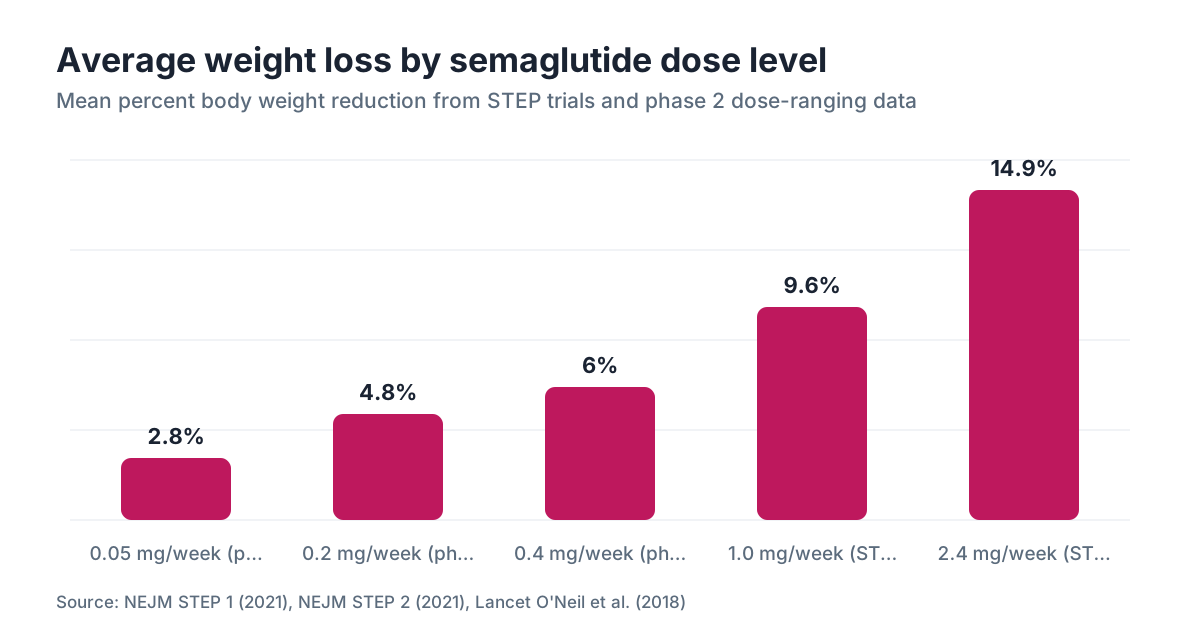
Here's what we do have. The STEP 1 trial showed the approved 2.4 mg dose produced about 14.9% mean body weight reduction over 68 weeks [1]. Earlier dose-ranging trials used doses as low as 0.1 mg and 0.2 mg weekly and still found statistically significant weight loss versus placebo, though smaller. The STEP 2 trial, in adults with type 2 diabetes, showed 9.6% weight loss at 1.0 mg versus 12.4% at 2.4 mg, which confirms lower doses work, just less dramatically [4].
Go below 0.25 mg and nobody has good prospective data. The closest evidence comes from observational reports shared at obesity medicine conferences and from individual practices. The consistent pattern: some women get clear appetite suppression at 0.1 to 0.2 mg, some get modest suppression, and some feel essentially nothing until they hit 0.25 mg or above. That spread likely reflects differences in GLP-1 receptor density, baseline GLP-1 secretion, gut microbiome, and genetic factors nobody has mapped yet.
For women in perimenopause or menopause using semaglutide alongside hormone therapy, the picture is even less studied. Estrogen's interaction with GLP-1 signaling is real but not fully characterized in trial data. If you're already on HRT and considering semaglutide, that's a conversation for a provider who knows both areas. Our hormone replacement therapy piece covers what HRT does and doesn't do.
The practical bottom line. Microdosing probably produces some meaningful weight loss for most women who respond to semaglutide at all. It's almost certainly less than the full 2.4 mg dose would deliver. But for women who can't tolerate standard doses, the real choice isn't 2.4 mg versus 0.1 mg. It's 0.1 mg versus nothing. And 0.1 mg wins that one.
What are the side effects of microdosing semaglutide compared to standard dosing?
Fewer gut side effects. That's the whole rationale, and it holds up because semaglutide's GI effects are dose-dependent. The Wegovy label lists nausea (44%), diarrhea (30%), vomiting (24%), constipation (24%), and abdominal pain (20%) as the most common adverse reactions at the 2.4 mg maintenance dose [2]. At 0.5 mg in STEP 2, nausea ran lower, around 34% [4]. Below 0.25 mg, no systematic data exist, but the logic holds: lower dose, less gut receptor activation, fewer symptoms.
Microdosing doesn't erase side effects, though. Some women are sensitive enough that even 0.05 mg causes noticeable nausea the day after injection. The dose-to-symptom relationship isn't perfectly linear for everyone.
Beyond the gut, a few other signals matter. Semaglutide's label carries a boxed warning about thyroid C-cell tumors based on rodent data. That warning applies at all doses and does not scale down for lower amounts [2]. Pancreatitis is a rare but real risk at any dose. Gallbladder disease risk climbs with rapid weight loss generally, more than with GLP-1s specifically, so the slower loss from microdosing might actually cut gallstone risk a bit.
Muscle and bone need watching. Rapid weight loss without enough protein and resistance training speeds the lean mass and bone density losses that perimenopause already drives. Slower loss from microdosing buys more time to adapt, but it doesn't remove the need to track this. A bone density test is worth discussing if you're losing weight fast at any age over 45.
Then the injection itself. Microdose semaglutide is almost always compounded and drawn from a vial with a small insulin syringe. Precision matters more at low doses. A 0.01 mL measurement error is 10% of a 0.1 mg dose. That's the practical reason to use a good syringe and get clear instructions from your pharmacy.
How do you actually microdose semaglutide? Injection timing, needles, and storage
Microdosing almost always means compounded subcutaneous semaglutide in a vial, not a pen. Novo Nordisk pens (Ozempic, Wegovy) have fixed dose increments and can't deliver sub-0.25 mg amounts in any practical way. Compounded vials, from a 503B outsourcing facility or a 503A compounding pharmacy, come in concentrations that let you draw very small volumes.
Common concentrations are 2.5 mg/mL or 5 mg/mL. At 2.5 mg/mL, a 0.1 mg dose is 0.04 mL. You draw that with an insulin syringe, usually 31-gauge with a 5/16-inch needle. Injections go into subcutaneous fat: abdomen (at least two inches from the navel), outer thigh, or upper arm. Rotate sites weekly.
Pick the same day each week. Most clinicians suggest a morning injection so you have the day to manage any nausea. Some women prefer evening so they sleep through the peak. Neither is formally better. Pick what fits your life.
Storage: keep compounded semaglutide vials refrigerated at 36 to 46 degrees Fahrenheit. Once opened, most compounding pharmacies specify a 28-day in-use window, though this varies by formulation, so check with your pharmacy. Don't freeze it. Don't leave it at room temperature for long stretches.
When WomenRx providers set up microdosing protocols, they include written dosing instructions, a written titration schedule, and check-in calls at four and eight weeks. That structured follow-up matters because the variability between women means you really do have to adjust based on response, more than follow a generic chart.
One more practical note. If you're managing perimenopause symptoms and want to know how semaglutide fits alongside estrogen or progesterone, syncing your hormone dosing and GLP-1 injection to the same weekly schedule simplifies the routine. Our overview of progesterone covers how it's typically dosed in perimenopause.
Who is a good candidate for microdosing semaglutide?
Not everyone needs to microdose. Women who tolerate the standard 0.25 mg starting dose fine and want to reach a therapeutic weight loss dose faster are better served by the approved titration. For them, microdosing adds complexity and buys nothing.
Good candidates for a sub-standard-dose approach:
Women who tried standard-dose semaglutide and couldn't get through the first weeks because of nausea or vomiting. This is the most common reason. If you stopped Ozempic or Wegovy because you felt awful, that's not a failure of the drug concept. It may just be a dose problem.
Women who are lightweight (under 130 pounds) or have a low BMI but real metabolic risk (insulin resistance, family history of type 2 diabetes, visceral fat). These women often get more side effects per milligram because there's less distribution volume.
Women in perimenopause with progesterone-related gut sensitivity. Progesterone already slows motility. Layer a GLP-1 on top and an already-slow gut can tip into serious discomfort.
Women with a history of an eating disorder, where aggressive appetite suppression feels destabilizing. A lower dose gives more control over the experience.
Women who want modest weight loss (5 to 8% of body weight) for metabolic benefit without chasing full GLP-1 doses.
Who is not a good candidate: women with active pancreatitis, personal or family history of medullary thyroid carcinoma or MEN2 syndrome (per the FDA boxed warning [2]), and women who are pregnant or breastfeeding. Semaglutide is contraindicated in pregnancy. If you take warfarin or other drugs with narrow therapeutic windows, the interaction profile matters more than the dose level, so check with a pharmacist.
The BMI question comes up constantly. The FDA approved Wegovy for BMI over 30, or over 27 with at least one weight-related comorbidity [2]. Microdosing doesn't change that threshold. Below those cutoffs it's still an off-label use, regardless of dose.
How does microdosing semaglutide compare to standard dosing for weight loss results?
Standard dosing loses more weight. The STEP 1 trial, the flagship for Wegovy at 2.4 mg, showed 14.9% mean body weight loss over 68 weeks in adults without diabetes [1]. STEP 2, in people with type 2 diabetes, showed 9.6% at 1.0 mg and 12.4% at 2.4 mg [4]. Those are the anchors.
Now look at what's been measured at lower doses. A phase 2 dose-ranging trial by O'Neil and colleagues (2018) tested doses from 0.05 mg to 0.4 mg weekly. At 0.05 mg, weight loss was roughly 2.5 to 3% at 12 weeks. At 0.2 mg, around 4 to 5%. At 0.4 mg, around 6% [5]. Those are shorter timeframes than STEP 1, so the comparison is imperfect, but the pattern is clear: lower dose, less weight loss.
What does that mean for a 175-pound woman?
- At 2.4 mg (full Wegovy dose): roughly 26 pounds over 68 weeks on average
- At 1.0 mg: roughly 17 pounds
- At 0.4 mg: roughly 8 to 10 pounds over a comparable period
- At 0.1 to 0.2 mg: rough estimate 3 to 6 pounds, based on extrapolation, not direct trial data
For women who want metabolic protection, blood sugar stability, or a modest 5 to 10 pound shift, the lower range may be enough. For women with significant obesity chasing 15% or more, microdosing alone won't get there. They may need to ramp to higher doses over time, using microdosing as a slow on-ramp rather than a permanent home.
Semaglutide versus tirzepatide is a separate question worth weighing. Tirzepatide (Mounjaro, Zepbound) hits both GLP-1 and GIP receptors and produces higher average weight loss at full dose. Some women who microdose semaglutide might do better at low doses of tirzepatide. Our comparison of semaglutide vs tirzepatide has the specifics.
What does compounded semaglutide have to do with microdosing?
Almost everything, practically. The approved pens (Ozempic, Wegovy) can't draw a 0.05 mg or 0.1 mg dose. They're fixed-increment devices. The only workable way to use sub-0.25 mg doses is compounded semaglutide in a vial, drawn with an insulin syringe.
From August 2023 through early 2025, the FDA listed semaglutide on its drug shortage list, which legally let 503A compounding pharmacies and 503B outsourcing facilities make copies. The FDA removed semaglutide from the shortage list in February 2025, which triggered an enforcement transition period [6]. After that transition, 503A pharmacies sit in a more constrained legal position to compound copies of the branded product, though individualized compounding based on a prescriber's clinical judgment for a specific patient still has a pathway under federal law.
This is a fast-moving regulatory area. By the time you read this, the rules may have shifted again. The core point holds: if a clinician prescribes compounded semaglutide for microdosing, they should work with a pharmacy that's FDA-registered (503B) or PCAB-accredited (503A), and the formulation should contain only pharmaceutical-grade, appropriate ingredients.
The FDA has warned specifically against compounded products that use salt forms like semaglutide sodium or semaglutide acetate, which are not the same molecule as the approved drug [6]. That matters at any dose, and even more at low doses, where you're leaning hard on the compound being formulated accurately.
Our compounded semaglutide piece covers the regulatory picture in more detail.
How does microdosing semaglutide interact with menopause and hormone therapy?
This is where the evidence is thinnest and the clinical need is highest. Most women asking about microdosing semaglutide are in their 40s and 50s, and many are dealing with perimenopause or menopause at the same time. The overlap matters.
Estrogen has direct effects on GLP-1 secretion and receptor expression. Animal studies and some human observational data suggest estrogen raises GLP-1 receptor sensitivity in the brain regions that control appetite. That would predict women on estrogen-containing HRT might respond more strongly to a given semaglutide dose than women without estrogen. The practical implication: start HRT while already on a stable semaglutide dose and you might notice more appetite suppression, or more side effects. Nobody has run the prospective trial. The closest we have is observational data from GLP-1 registries, still being analyzed.
Progesterone slows gastric emptying on its own. Women taking oral micronized progesterone (brand name Prometrium), or in a high-progesterone phase of their cycle, are already working with a slower gut. Semaglutide on top can push early satiety, bloating, or constipation further than it would in an estrogen-dominant state. That's another argument for lower starting doses in perimenopausal women who are also on progesterone.
Menopause itself, apart from HRT, shifts fat toward visceral storage as estrogen falls. The SWAN study and other longitudinal cohorts show women gain an average of 1.5 to 2 pounds per year during the transition, and waist circumference climbs independent of total weight change [7]. Semaglutide, even at microdoses, preferentially reduces visceral fat, the metabolically harmful kind. So there's a specific biological case for GLP-1 use in perimenopausal women beyond the scale number.
If you're managing menopause symptoms with an estrogen patch or other topical estrogen, keep your GLP-1 provider and your hormone provider talking to each other. Both therapies touch metabolism, body composition, cardiovascular risk markers, and mood. Siloed care serves nobody.
What should you ask your doctor before starting a microdose protocol?
If a clinician proposes microdosing semaglutide, or if you're the one raising it, a handful of concrete questions separate a thoughtful protocol from a vague one.
First: what's the exact starting dose and the titration plan? A serious protocol names milligrams, not "low" or "gradual." If the provider can't tell you whether you're starting at 0.05, 0.1, or 0.2 mg, that's a gap.
Second: which pharmacy will compound it, and is it 503A or 503B? Ask for the pharmacy's name and whether they can provide a certificate of analysis for your lot. Reputable compounders provide this.
Third: how will you track response? Weight alone isn't enough. A thoughtful provider checks fasting glucose or HbA1c if metabolic risk is a concern, and asks about appetite, energy, GI symptoms, and mood at follow-up. Some also check fasting insulin and lipids at baseline and at three months.
Fourth: what's the plan if you don't respond? If 0.1 mg does nothing meaningful after six to eight weeks, do you go to 0.2 mg? If 0.5 mg causes intolerable nausea, do you drop back, add an anti-nausea med, or switch to something like tirzepatide?
Fifth: what contraindications apply specifically to you? Prior thyroid cancer, pancreatitis, or severe gastroparesis are hard stops. A personal or family history of MEN2 is a contraindication in the FDA label [2].
WomenRx providers who manage GLP-1 protocols for women run through exactly this kind of individualized assessment before prescribing. Worth knowing not as a pitch but because the shape of a good consultation is worth recognizing, so you can measure any provider against it.
For how semaglutide works before you take it at any dose, our semaglutide for weight loss overview is a good start. And if you want the core data before your appointment, our semaglutide explainer covers the mechanism, the STEP results, and the safety profile.
Frequently asked questions
What is the lowest dose of semaglutide that actually works?
A 2018 phase 2 trial showed statistically significant weight loss versus placebo at 0.05 mg weekly over 12 weeks, though the amount was small (roughly 2 to 3%). Most clinicians who microdose treat 0.1 to 0.2 mg as the floor for meaningful appetite suppression. Individual response varies a lot, and no published minimum effective dose for weight loss exists.
Can you lose weight on 0.25 mg semaglutide per week?
Yes. And 0.25 mg is actually the standard starting dose for both Ozempic and Wegovy, not a microdose. The STEP data show dose-dependent weight loss, and 0.25 mg sits below the long-term therapeutic dose of 1 to 2.4 mg. Many women lose some weight at 0.25 mg, especially early. Whether you escalate depends on your response at four to eight weeks.
Is microdosing semaglutide FDA-approved?
No. The FDA has approved specific titration schedules for Ozempic and Wegovy. Sub-0.25 mg weekly dosing is off-label. The FDA doesn't prohibit off-label prescribing by licensed physicians, but no approved pen delivers these sub-standard doses accurately. Microdosing therefore requires compounded semaglutide, which carries its own regulatory considerations.
Does microdosing semaglutide reduce nausea compared to standard dosing?
Almost certainly, based on what we know about dose-dependent GI side effects. The FDA label reports 44% nausea at the full 2.4 mg Wegovy dose. GI side effects in GLP-1 trials run lower at lower doses. No randomized trial has tested nausea rates below 0.25 mg, but clinical experience strongly supports less nausea in most women at lower doses.
How long does it take to see results from microdosing semaglutide?
Appetite suppression often starts within the first week for women who respond at low doses. Measurable weight loss usually shows by weeks 4 to 8. At microdoses the rate is slower than at full doses. Expect roughly 0.5 to 1 pound per week at the lower end of the range, though this varies widely by individual, diet, and activity.
Can you microdose semaglutide with a pen (Ozempic or Wegovy) at home?
Not effectively. Ozempic pens deliver fixed doses starting at 0.25 mg, and Wegovy pens are preset for their specific steps. There's no safe or accurate way to pull a 0.1 mg dose from these devices. Microdosing requires compounded semaglutide in a vial plus an insulin syringe, prescribed by a licensed provider and filled at an accredited compounding pharmacy.
Is microdosing semaglutide safe for women in perimenopause or menopause?
No trial has tested low-dose semaglutide specifically in perimenopausal women, so general GLP-1 safety data applies. Perimenopausal women may be more GI-sensitive because of progesterone-related gut slowing, which argues for starting low. Women with risk factors for bone density loss should monitor bone health during any semaglutide protocol, especially if weight loss is significant.
What's the difference between microdosing semaglutide and titrating up slowly?
They overlap but aren't the same. A slow titration follows the standard steps (0.25, 0.5, 1, 1.7, 2.4 mg) but stays at each one longer before moving up. Microdosing specifically uses doses below 0.25 mg, often as a lasting strategy rather than just a slower on-ramp. Some protocols do both: true microdosing to start, then slow escalation toward a therapeutic dose.
Can you stop microdosing semaglutide and keep the weight off?
The STEP 4 extension trial showed participants who stopped semaglutide after 68 weeks regained about two-thirds of their lost weight over the next 12 months. That's at full dose. No data exists on stopping microdose protocols, but the mechanism (GLP-1 receptor activation reducing appetite) stops with the drug. Keeping weight off takes sustained lifestyle habits regardless of dose.
How much does microdosing semaglutide cost per month?
Compounded semaglutide for microdosing typically runs $100 to $300 per month, depending on the pharmacy, concentration, and vial size. That's well below branded Wegovy, which lists over $1,300 per month before insurance. Insurance rarely covers compounded versions. Prices move, so confirm current pricing with the prescribing practice.
What is semaglutide sodium and why do experts warn against it in compounded products?
Semaglutide sodium and semaglutide acetate are salt forms of the molecule, not approved or studied at the same doses as semaglutide base. The FDA has warned that these salt forms are not equivalent to the active ingredient in Ozempic and Wegovy and should not be substituted. If a compounded product lists semaglutide sodium, that's a red flag to raise with your provider.
Does microdosing semaglutide cause hair loss?
Hair loss (telogen effluvium) has been reported with all GLP-1 agonists at standard doses and appears in post-marketing data. It's generally tied to rapid caloric restriction and weight loss rather than the drug directly. Microdosing produces slower weight loss, which may lower this risk, though no comparative trial has tested it. Adequate protein (at least 1.2 g/kg body weight daily) is the main way to limit it.
Can microdosing semaglutide help with blood sugar even without weight loss?
Possibly. Semaglutide's GLP-1 mechanism improves insulin secretion in a glucose-dependent way, independent of weight loss. Even small losses of 3 to 5% improve insulin sensitivity meaningfully. At microdoses, women with prediabetes or insulin resistance may see modest gains in fasting glucose. This hasn't been studied below 0.25 mg specifically, so the effect size is uncertain.
Sources
- New England Journal of Medicine, STEP 1 trial (Wilding et al., 2021)
- FDA, Wegovy (semaglutide) Prescribing Information
- Obesity (The Obesity Society journal), analysis of lean mass loss with GLP-1 agonists (2024)
- New England Journal of Medicine, STEP 2 trial (Davies et al., 2021)
- The Lancet, semaglutide phase 2 dose-ranging trial (O'Neil et al., 2018)
- FDA, Drug Shortage and Compounding Guidance for Semaglutide
- SWAN (Study of Women's Health Across the Nation), NIH-funded longitudinal cohort
- New England Journal of Medicine, STEP 4 trial (Rubino et al., 2021)
- Endocrine Society Clinical Practice Guidelines on Obesity
- FDA, Ozempic (semaglutide) Prescribing Information