Menstrual irregularities in perimenopause: what's normal and what's not
TL;DR: Perimenopause usually starts in the mid-to-late 40s and makes periods irregular because estrogen and progesterone swing erratically. Cycles can shorten, lengthen, get heavier, get lighter, or skip. Most of that is normal. Soaking a pad or tampon every hour for two hours or more, or any bleeding after 12 straight months without a period, needs prompt medical evaluation.
What is perimenopause and when does it start?
Perimenopause is the stretch before menopause, when your ovaries slowly make less estrogen and progesterone. It is not one moment. It is a hormonal shift that plays out over years and ends only after you have gone 12 straight months without a period, which is the day menopause is officially diagnosed.
Most women enter perimenopause between 45 and 55, and the average age of menopause in the United States is 51 [1]. Early perimenopause can start in the late 30s or early 40s. Some women notice nothing much until their late 40s. Our guide on perimenopause age breaks the timing down further.
The North American Menopause Society describes the transition as a time of "marked variability in menstrual cycle length" that usually runs four to eight years, though it can be shorter or longer [2]. That variability is the whole point. Your cycle stops running on the schedule it kept for decades.
Ovulation gets unreliable. When you don't ovulate, the progesterone surge that normally follows the release of an egg is missing or weak. Estrogen swings high and low instead of following a clean pattern. That turbulence is the direct cause of nearly every irregularity in this article.
What menstrual changes are normal during perimenopause?
Here is the honest answer: almost any change to your cycle can be normal in perimenopause, as long as the bleeding is not dangerously heavy and does not come back after a full year of nothing.
The common changes:
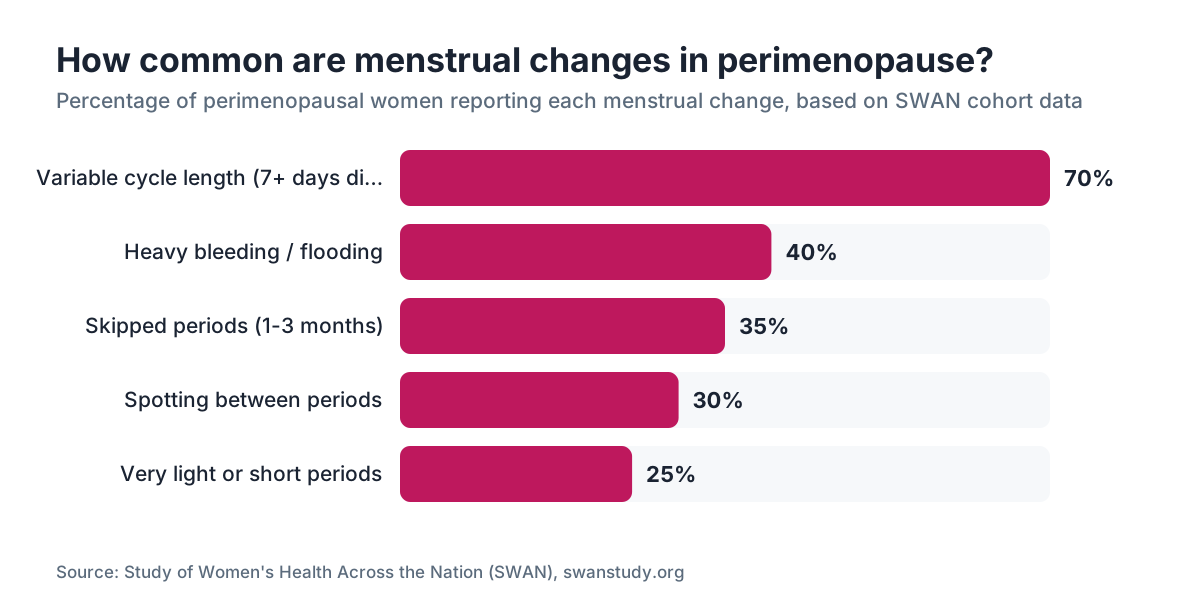
Shorter or longer cycles. The SWAN study (Study of Women's Health Across the Nation) found that a cycle-to-cycle swing of seven or more days is one of the earliest signs of the transition [3]. A cycle that ran 28 days for 20 years might suddenly go 20 days, then 35, then 24.
Skipped periods. Cycles without ovulation can produce very light or absent bleeding. Skipping one or two periods is common. Skipping three to six months and then starting up again happens too.
Heavier or clottier bleeding. Without enough progesterone to balance estrogen, the uterine lining builds up more than usual and sheds harder. Plenty of women have the heaviest periods of their lives in their mid-to-late 40s.
Shorter, lighter periods. The reverse also happens. Some cycles build a thin lining and give you only spotting.
Spotting between periods. Mid-cycle spotting, or spotting in the days before a period, can come from estrogen bouncing around.
Unpredictability ties all of these together. If your periods have gotten unpredictable, you are almost certainly in perimenopause. That by itself is not a reason to panic.
How heavy is too heavy? Recognizing abnormal uterine bleeding
Heavy bleeding is the symptom most likely to land a perimenopausal woman in the emergency room, so it needs a clear line. Clinically, heavy menstrual bleeding means soaking a pad or tampon every hour for two or more hours in a row, passing clots larger than a quarter, or bleeding for more than seven days [4].
Two reasons this matters. That much blood loss can cause iron-deficiency anemia fast. And heavy bleeding in these years has to be checked for structural causes: uterine fibroids, endometrial polyps, and rarely endometrial hyperplasia or cancer. Perimenopause alone can drive heavy periods, but you cannot rule the other stuff out by feel.
The American College of Obstetricians and Gynecologists (ACOG) recommends an endometrial biopsy for women with heavy bleeding who are 45 or older, or younger if they carry risk factors for endometrial cancer such as obesity, polycystic ovary syndrome, or a long history of irregular cycles [4].
An endometrial biopsy is a short in-office procedure. Uncomfortable but quick. A transvaginal ultrasound usually comes first to measure endometrial thickness and look for fibroids or polyps. Together those tests show your provider what is driving the bleeding.
So here is the line to remember: heavy bleeding in perimenopause is common, and it still gets evaluated. Do not file it under "just hormones" without at least one visit to rule out a structural cause.
What bleeding patterns require a doctor visit right away?
Some changes are not part of normal perimenopause and need attention now.
Postmenopausal bleeding. Any bleeding after 12 straight months without a period is postmenopausal bleeding until proven otherwise. The Endocrine Society and ACOG both treat this as urgent because endometrial cancer has to be ruled out. Roughly 10 percent of postmenopausal bleeding cases turn out to be endometrial cancer [5].
Bleeding after sex. Postcoital bleeding can point to cervical changes, polyps, or less often cervical cancer. It is not a normal feature of perimenopause.
Bleeding heavy enough for the ER. If you are soaking through a pad every 30 minutes, passing large clots, or feeling faint, go to an emergency department. Acute abnormal uterine bleeding sometimes needs IV hormonal therapy or a procedure.
Bleeding that returns after months of nothing. If your periods stopped for three or four months and then came back, that can still be normal perimenopause. But once you have hit 12 months without any bleeding, any return counts as postmenopausal bleeding.
Perimenopause is a real explanation for irregular periods. It is not a blanket excuse to ignore bleeding that needs a look. When you are unsure, call your provider.
Why do periods become irregular in perimenopause? The hormonal mechanism
Understanding the mechanism makes the symptom less scary and helps you talk to your doctor.
A normal cycle runs on a feedback loop between the hypothalamus, the pituitary gland, and the ovaries. The hypothalamus releases gonadotropin-releasing hormone (GnRH), which tells the pituitary to release follicle-stimulating hormone (FSH) and luteinizing hormone (LH). FSH grows the follicle. LH triggers ovulation. The ovary makes estrogen before ovulation and progesterone after.
In perimenopause, the ovarian reserve (the pool of remaining eggs and their supporting cells) drops. The follicles that are left respond less reliably to FSH. The pituitary answers by pushing out more FSH, which is why a high FSH level is one marker of the transition. But the follicles don't always respond even to that extra push. Some cycles a follicle grows, makes estrogen, and never ovulates. No ovulation means no corpus luteum, and no corpus luteum means no progesterone surge [6].
Without that progesterone, the lining keeps building under unopposed estrogen. It can grow thicker than usual, then shed in an unpredictable and sometimes very heavy way. Other cycles, estrogen itself runs low because the follicle barely developed, so the lining barely builds and you get a very light or absent period.
This is also why perimenopause raises the theoretical risk of endometrial hyperplasia over time. Sustained estrogen without progesterone lets the lining overgrow. That risk is generally low in the short term, but it is part of why persistent heavy bleeding gets evaluated.
Can you still get pregnant with irregular periods in perimenopause?
Yes. This surprises a lot of women.
Irregular periods mean irregular ovulation, not no ovulation. You can ovulate out of the blue even when cycles are all over the place, and a surprise ovulation means a possible pregnancy. ACOG notes that women stay at risk for unintended pregnancy until menopause is confirmed by 12 consecutive months without a period [7].
Pregnancy odds do fall hard with age. After 40, natural conception rates drop a lot compared with younger years, and miscarriage rates climb. But lower is not zero. Women in their late 40s do get pregnant, both on purpose and by accident.
If you are not trying to conceive, use contraception until you have gone 12 full months without a period. Progestin-only pills, hormonal IUDs, and barrier methods all work here. Some hormonal contraceptives also smooth out the bleeding chaos of perimenopause, which is a nice practical bonus.
A positive pregnancy test in a woman with irregular periods and perimenopausal symptoms gets evaluated promptly. It can be a viable pregnancy, a miscarriage, or rarely an ectopic pregnancy.
How is perimenopause diagnosed when periods are irregular?
There is no single blood test that nails down perimenopause. The diagnosis is mostly clinical: a woman in the right age range with the classic symptoms and menstrual changes. Certain labs help fill in the picture.
FSH (follicle-stimulating hormone) is the marker doctors reach for most. An FSH above 25 to 30 IU/L on day 2 or 3 of a cycle, or on any day if you have been without a period, points to lower ovarian reserve and fits perimenopause [6]. The Endocrine Society is clear that a single FSH reading is not definitive, because levels bounce around during this phase. A normal premenopausal value one month does not rule perimenopause out.
Estradiol (E2) falls on average through the transition but also swings. Anti-Mullerian hormone (AMH) reflects ovarian reserve and declines with age, but it is not a routine perimenopause test. Thyroid function (TSH) is worth checking, because thyroid disease can cause irregular periods and overlapping symptoms like fatigue, mood changes, and temperature sensitivity.
A pelvic ultrasound looks at the uterine lining and checks for structural causes of abnormal bleeding. An endometrial biopsy is indicated for women 45 and older with heavy or persistent irregular bleeding, as covered above.
Your symptom history counts as much as any lab. Hot flashes, broken sleep, mood shifts, and brain fog alongside irregular periods paint a clear picture even when FSH lands in a gray zone.
What treatments help regulate perimenopausal bleeding?
Several options work, and the right one depends on how disruptive the bleeding is, whether you also need contraception, and whether anything rules out hormones for you.
Hormonal IUD (levonorgestrel, e.g., Mirena). One of the most effective options for heavy perimenopausal bleeding. The levonorgestrel IUD thins the lining locally and cuts blood loss sharply. It gives you contraception too, and it delivers the progestin you can pair with systemic estrogen if you are also on hormone replacement therapy. Studies show it reduces menstrual blood loss by 70 to 97 percent in women with heavy bleeding [8].
Oral progesterone. Cyclic progesterone, taken 10 to 14 days a month, balances unopposed estrogen and creates a more predictable withdrawal bleed. Progesterone is commonly prescribed in perimenopause for exactly this, alone or as part of a hormone therapy plan.
Combined oral contraceptives. Low-dose combined pills steady the cycle, cut bleeding, provide contraception, and help with hot flashes. Generally fine for healthy nonsmoking women under 50 with no cardiovascular risk factors.
Progestin-only pills. An option for women who cannot take estrogen-containing contraceptives.
Menopausal hormone therapy (MHT). For women also dealing with hot flashes, night sweats, or genitourinary symptoms, MHT handles it all together. Estrogen-progestogen therapy stabilizes the endometrium and can cut bleeding irregularity a lot. An estrogen patch plus cyclic or continuous progesterone is a common approach in early perimenopause.
NSAIDs. Ibuprofen and other NSAIDs, taken during the heaviest days, can trim menstrual blood loss by roughly 30 to 40 percent. A reasonable non-hormonal choice for mild to moderate heavy bleeding.
Tranexamic acid. A non-hormonal prescription that reduces blood loss by stabilizing clots. Taken only on heavy days. It does not touch your hormones or provide contraception.
Endometrial ablation. A procedure for women with heavy bleeding who are done having children. It destroys the uterine lining and can cut or stop periods. Not for anyone who wants to conceive.
WomenRx offers online consultations for perimenopausal hormone management, including progesterone and MHT, for women who want to tackle bleeding irregularities alongside other symptoms.
If you have noticed weight changes during perimenopause (a very common complaint as metabolism shifts with falling estrogen), our guides on semaglutide for weight loss and menopause cover where hormonal change and body composition meet.
Does perimenopause affect cycle length differently than period heaviness?
Yes, and the timing of each change tells you something.
Cycle length changes, shortening in particular, tend to come first. SWAN research found that early perimenopause shows up as variable cycle length, often shorter cycles at first as estrogen spikes push follicles to develop faster [3]. A woman whose cycles ran a reliable 28 days might shift to 21 to 24.
Heavier bleeding tends to show up in mid-to-late perimenopause, when cycles without ovulation get more frequent and progesterone deficiency deepens. This is often when women see the heaviest periods of their lives.
Late perimenopause, the year or two before the final period, often brings lighter, less frequent bleeding as estrogen falls off more steadily. Some women find this phase easier. Others find skipping two months and then flooding more stressful than a predictable heavy period.
The sequence is not universal. Some women bleed heavily from the start. Some only ever have lighter, irregular periods. A few notice almost no change in bleeding at all and only realize they are in perimenopause because of hot flashes or disrupted sleep. Menstrual change is common but far from the only way perimenopause shows itself.
What non-hormonal factors make perimenopausal bleeding worse?
Hormones are not the only driver. Several conditions converge in these years and can make bleeding much worse.
Uterine fibroids. Fibroids (benign uterine growths) are estrogen-sensitive and often grow during perimenopause, when estrogen can spike erratically. They are the most common structural cause of heavy bleeding in women over 40. Baird and colleagues, publishing in the American Journal of Obstetrics and Gynecology, estimated lifetime fibroid incidence at about 70 percent in white women and above 80 percent in Black women by age 50 [9]. Fibroids that push into the uterine cavity (submucosal fibroids) cause the heaviest bleeding.
Endometrial polyps. Small benign growths of the lining that cause spotting between periods or heavier bleeding. Very common, and easy to spot on ultrasound or hysteroscopy.
Thyroid dysfunction. Both an underactive and an overactive thyroid disrupt periods. Hypothyroidism in particular causes heavy, irregular bleeding. A TSH check is standard in any workup of new menstrual irregularity.
Coagulation disorders. Von Willebrand disease, the most common inherited bleeding disorder, affects roughly 1 percent of the general population but shows up in up to 13 percent of women worked up for heavy menstrual bleeding [10]. If you have had heavy periods your whole life or bleed easily elsewhere (bruising, prolonged bleeding after cuts or dental work), ask about coagulation testing.
Obesity. Fat tissue converts androgens into estrogen. A higher BMI means more estrogen from that conversion, which can thicken the lining and drive heavier bleeding. It also raises the risk of endometrial hyperplasia.
Stress. Chronic stress raises cortisol, which can suppress the hypothalamic-pituitary-ovarian axis and produce cycles without ovulation, making irregular bleeding worse.
What is the difference between perimenopause and menopause?
The distinction is concrete. Perimenopause is the transition. Menopause is a single point in time: the day you reach 12 consecutive months without a period.
After that point, you are postmenopausal. Any bleeding past that 12-month mark is postmenopausal bleeding and is abnormal until proven otherwise.
The line matters for treatment too. Hormone therapy formulations, contraceptive needs, and bleeding evaluation protocols all shift depending on where you sit in the transition. Our articles on menopause age and when does menopause start go deeper on timing across different groups.
Knowing your stage also changes how you read a symptom. A skipped period when you are clearly perimenopausal is probably just a cycle without ovulation. A skipped period when you haven't had one in 11 months might be the final stretch before menopause, or a pregnancy, or a thyroid issue worth checking.
Practical advice: track your periods. A simple app or a paper calendar tells you at a glance whether you have hit the 12-month mark. That date carries real clinical weight.
How long will irregular periods last before menopause?
On average, perimenopause runs four to eight years, and the range is genuinely wide. Some women move through it in one to two years. Others live with irregular periods for a decade [2].
SWAN data put the median time from the first menstrual irregularity (that seven-plus-day swing) to the final period at about five to seven years [3]. But median means half of women land on either side of it.
Genetics is probably the strongest predictor. If your mother or older sisters went through menopause early, you are more likely to as well. Smoking speeds the transition by one to two years on average [11]. Women who have had chemotherapy or radiation may hit abrupt ovarian failure rather than the gradual slide.
No test tells you exactly when your final period will land. AMH gives a rough read on ovarian reserve, but at the individual level it is not sharp enough to run a countdown. What you can do: track your cycles, know your family history, and keep a provider who watches your symptoms and adjusts as things change.
A bone density test is worth raising with your provider as you move through perimenopause, since estrogen loss speeds bone loss and the window for prevention is real.
Frequently asked questions
Can perimenopause cause periods every two weeks?
Yes. Shortened cycles of 14 to 21 days are common in early perimenopause, because fluctuating FSH can drive faster follicle development and earlier ovulation. Bleeding every two weeks can also be mid-cycle spotting mistaken for a period. Still, very frequent or very heavy bleeding gets evaluated to rule out structural causes like fibroids or polyps.
Is it normal to skip a period for three months and then get one in perimenopause?
Yes, this sits inside normal perimenopause. Cycles without ovulation can suppress bleeding for months, then a cycle with ovulation produces a period. As long as you have not yet reached 12 consecutive period-free months, returning bleeding still counts as part of the transition, not postmenopausal bleeding.
What does a perimenopause period look like compared to a normal period?
It can look like almost anything: lighter and shorter than before, heavier with bigger clots, brownish spotting instead of red flow, or a flood with no warning. The defining feature is unpredictability. Perimenopausal periods vary more in timing, length, and flow than what you knew for most of your reproductive years.
Can perimenopause cause bleeding between periods?
Yes. Mid-cycle spotting or spotting in the week before a period is common in perimenopause because of estrogen swings. But bleeding between periods still gets evaluated if it is persistent, heavy, or happens after sex, since polyps, cervical changes, and other causes produce the same symptom and cannot be told apart from hormonal spotting on history alone.
At what age do periods become irregular due to perimenopause?
Most women notice menstrual changes between 45 and 50, but early perimenopause can start in the late 30s or early 40s. The average age of menopause in the U.S. is 51, and perimenopause usually starts four to eight years before that. Irregular periods before 40 should prompt evaluation for premature ovarian insufficiency.
Should I take progesterone for heavy perimenopausal bleeding?
Cyclic progesterone is one of the most common treatments for heavy perimenopausal bleeding, taken 10 to 14 days a month to balance unopposed estrogen and create a more controlled bleed. A levonorgestrel IUD delivers progestin locally and is highly effective. Which one fits depends on whether you also need contraception, your hormone therapy goals, and any contraindications.
Can perimenopause cause a period that lasts two weeks?
A period longer than seven days is clinically defined as prolonged menstrual bleeding and warrants evaluation. Perimenopause can cause longer periods from irregular shedding of a thickened lining, but two weeks of bleeding also needs a workup to rule out fibroids, polyps, or endometrial hyperplasia. Do not assume the change is purely hormonal without an assessment.
Does stress make perimenopausal periods worse?
Yes. Chronic stress raises cortisol, which disrupts the hypothalamic-pituitary-ovarian axis and increases cycles without ovulation. That means less progesterone, more unopposed estrogen, and heavier or more irregular bleeding. Stress is not the only driver in perimenopause, but it measurably amplifies the hormonal disruption. Sleep deprivation, which often rides along in perimenopause, makes it worse.
How do I know if my irregular periods are perimenopause or something else?
Age and symptom pattern are the first clues. Women in their mid-to-late 40s with hot flashes, disrupted sleep, and cycle variability are almost certainly in perimenopause. Labs including FSH, TSH, and a pregnancy test can rule out thyroid disease, premature ovarian insufficiency, or pregnancy. A pelvic ultrasound checks for structural causes. A full evaluation gives you a clear picture instead of guesswork.
What blood tests confirm perimenopause?
FSH above 25 to 30 IU/L on day 2 to 3 of a cycle, or any day without recent bleeding, fits perimenopause, but a single value is not definitive because levels fluctuate. TSH gets checked to rule out thyroid disease. Estradiol is variable and less diagnostic. AMH reflects ovarian reserve but is not a standard perimenopause test. Clinical picture plus labs together make the call.
Can you use a hormonal IUD during perimenopause?
Yes, and it is often an excellent choice. The levonorgestrel IUD (Mirena) is FDA-approved for heavy menstrual bleeding and provides contraception through the transition. It delivers local progestin, which you can pair with systemic estrogen therapy. Studies show it cuts menstrual blood loss by 70 to 97 percent. It does not prevent hot flashes on its own; that takes systemic estrogen.
When should I see a doctor for perimenopausal bleeding?
See a doctor if you are soaking a pad or tampon every hour for two or more hours, if a period runs longer than seven days, if you bleed after sex, if you have any bleeding after 12 consecutive period-free months, or if you pass clots larger than a quarter. Anemia symptoms like fatigue, shortness of breath, or dizziness alongside heavy bleeding are also a reason to be seen promptly.
Does weight affect perimenopausal bleeding?
Yes. More body weight means more fat tissue, which converts androgens into estrogen through a process called aromatization. That extra estrogen can thicken the uterine lining and drive heavier, more irregular bleeding. Obesity is also a risk factor for endometrial hyperplasia. Weight loss, where it is clinically appropriate, can improve hormonal balance and reduce the bleeding burden over time.
Is it possible to have no menstrual changes in perimenopause?
A small share of women report barely any menstrual change before their periods simply stop. Their main symptoms may be hot flashes, disrupted sleep, or mood changes with fairly stable cycles until close to the final period. So yes, it happens. Menstrual irregularity is very common in perimenopause but not universal, and its absence does not mean the transition is not underway.
Sources
- Office on Women's Health, U.S. Department of Health and Human Services, Menopause page
- Study of Women's Health Across the Nation (SWAN), SWAN Research Program overview, University of Michigan
- American College of Obstetricians and Gynecologists, ACOG Practice Bulletin on Diagnosis of Abnormal Uterine Bleeding
- American Cancer Society, Endometrial Cancer page
- Endocrine Society, Clinical Practice Guidelines page
- American College of Obstetricians and Gynecologists, ACOG clinical guidance on contraception in the later reproductive years
- Cochrane Database of Systematic Reviews, Progestogen-releasing intrauterine systems for heavy menstrual bleeding
- Baird DD et al., American Journal of Obstetrics and Gynecology: High cumulative incidence of uterine leiomyoma in Black and White women
- National Institute on Aging (NIA), Menopause page