Menopause definition: what it means, when it happens, and why it matters
TL;DR: Menopause is 12 straight months without a menstrual period, with no other cause. The average age in the United States is 51. Everything before that final period is perimenopause. Everything after is postmenopause. The diagnosis gets made in hindsight, not in real time, which is exactly why the word confuses so many people.
What is the medical definition of menopause?
Menopause is one thing: the permanent end of menstruation, confirmed after 12 straight months without a period. That's the whole definition. The North American Menopause Society calls it "the permanent cessation of menstruation that results from loss of ovarian follicular activity" [1]. It's a single point in time, not a phase or a feeling.
This matters because the word gets thrown around loosely. People say "I'm going through menopause" when they mean perimenopause, the transition leading up to it. They say "menopause symptoms" when those symptoms actually peak during perimenopause and often ease afterward. The technical definition looks backward: you only know you've reached menopause after the 12 months have passed.
Naturally occurring menopause has no lab test or scan that confirms it. Doctors don't diagnose it with a blood draw. FSH (follicle-stimulating hormone) rises as the ovaries make less estrogen, and an FSH above 30 mIU/mL is sometimes used as a supporting signal, but one elevated FSH number doesn't define menopause by itself [2]. The calendar does.
Surgical menopause is a different animal. Remove both ovaries (bilateral oophorectomy) and menopause starts that day, at any age, because the estrogen and progesterone source is gone. Symptoms hit harder and faster in surgical menopause than in the natural kind.
What is the difference between perimenopause, menopause, and postmenopause?
Three terms, three distinct stages. Blur them together and you end up confused about what treatment you need and when.
Perimenopause is the transition before the final period. It usually starts in a woman's mid-to-late 40s, though it can begin in the late 30s. Cycles turn irregular, hormone levels swing wildly, and symptoms like hot flashes, broken sleep, and mood changes are common and often at their worst here. Perimenopause runs anywhere from a few months to more than a decade, though four to eight years is typical [1]. See perimenopause age for a closer look at timing.
Menopause is the single moment: the last menstrual period. You can only pin it down in retrospect, after 12 months of no periods, so the "moment" always gets dated backward.
Postmenopause is everything after that 12-month mark. Estrogen and progesterone sit low and steady instead of fluctuating. Some symptoms like hot flashes can drag on into postmenopause for years. Others, like cycle irregularity, are gone by definition. Risk for osteoporosis and heart disease climbs in these years, which is part of why the hormone replacement therapy conversation often lands here.
| Stage | Timing | Key feature | |---|---|---| | Perimenopause | Years before last period | Irregular cycles, fluctuating hormones | | Menopause | 12 months after last period | Retrospectively confirmed, single point | | Postmenopause | Everything after | Stable low estrogen, new long-term risks |
What is the average age for menopause in the US?
The average age of natural menopause in the United States is 51, based on NAMS and large population studies [1]. The normal range runs 45 to 55. Menopause before 40 is primary ovarian insufficiency (POI), not natural menopause, and it's treated differently. Menopause between 40 and 45 counts as early menopause.
Several things pull timing earlier. Smoking is the best documented: smokers reach menopause one to two years sooner than nonsmokers on average [3]. Genetics count too. If your mother had early menopause, your odds go up. Chemotherapy and pelvic radiation can cause premature ovarian failure. And removing both ovaries triggers menopause immediately, at any age.
Race and ethnicity shift timing as well. The Study of Women's Health Across the Nation (SWAN), one of the largest and longest-running menopause studies in the US, found Black women reach menopause about 8.5 months earlier than white women on average, and Hispanic women about 2 months earlier [3]. Those gaps are real and they matter for planning care.
For a full breakdown of age ranges and what moves them, see when does menopause start and menopause age.
What causes menopause to happen?
Menopause happens because the ovaries run out of usable follicles. Women are born with roughly one to two million. By puberty that number drops to about 300,000 to 400,000. Across the reproductive years, follicles disappear through ovulation and through a steady background process of cell death called atresia. By the late 40s, the pool is nearly empty.
As follicle numbers fall, the ovaries make less estradiol, the main form of estrogen during reproductive years. The pituitary gland answers by pumping out more FSH, trying to kick the ovaries into gear. That's why FSH climbs in perimenopause. Eventually the ovaries stop responding and periods stop.
After menopause, the body doesn't make zero estrogen. The adrenal glands produce androgens (androstenedione and DHEA), which fat tissue converts into estrone, a weaker estrogen. That peripheral conversion becomes the main estrogen source postmenopause. It's not enough to prevent symptoms or long-term risk in most women, but it does mean estrogen never bottoms out completely.
Progesterone drops sharply too, often before estrogen does. In perimenopause many cycles turn anovulatory (no egg is released), so the corpus luteum never forms and no progesterone gets made that month. That's why progesterone can read low even while estrogen still looks relatively normal in early perimenopause.
What are the symptoms of menopause?
Strictly speaking, most of what people call "menopause symptoms" come from the hormonal swings of perimenopause. Once estrogen settles at its lower level in postmenopause, some symptoms ease. But the line is blurry, and plenty of women keep having symptoms for years after their final period.
The most common ones:
- Hot flashes and night sweats (vasomotor symptoms), affecting about 75% of women [1]
- Sleep disruption, often driven by night sweats
- Vaginal dryness and genitourinary symptoms (GSM, genitourinary syndrome of menopause)
- Mood changes, including irritability and low mood
- Brain fog and trouble concentrating
- Joint pain
- Weight changes, especially fat shifting toward the abdomen
- Lower libido
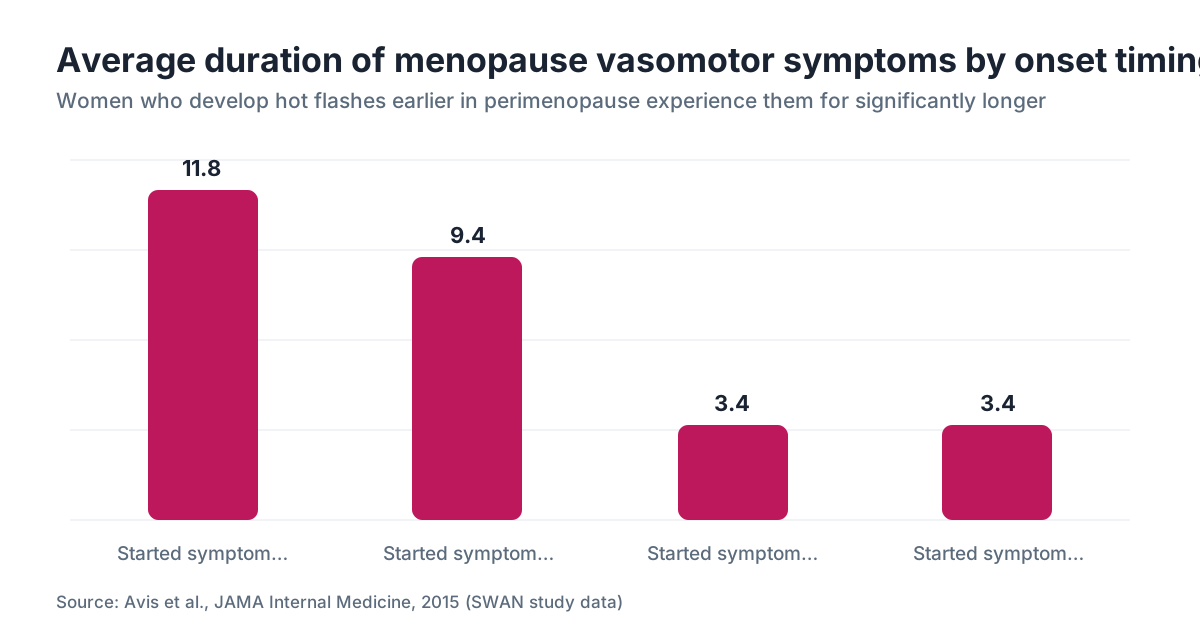
Vasomotor symptoms are the most studied and the most treated. On average they last about seven years, though SWAN found some women carry them for over a decade [4]. Women who enter perimenopause earlier tend to have longer symptom duration.
Genitourinary symptoms behave differently from hot flashes. They get worse over time without treatment instead of better. GSM covers vaginal dryness, irritation, painful sex, and changes in urinary frequency or urgency. It's underreported and undertreated, partly because women don't connect it to menopause and partly because providers don't ask.
Weight gain is real but widely misunderstood. The hormonal shift changes where fat lands (more visceral, abdominal) more than it changes the number on the scale. Metabolism slows with age, and the transition itself adds to that on its own. This is part of why many women and their clinicians have started talking about semaglutide for weight loss alongside hormonal approaches.
How is menopause diagnosed, and do you need blood tests?
For most women over 45 with a year of no periods and classic symptoms, menopause is a clinical diagnosis. No blood test required. The 12-month rule does the job.
Blood tests earn their keep in specific situations. If you're under 45, checking FSH and estradiol helps rule out other reasons for missed periods (thyroid disease, hyperprolactinemia, hypothalamic suppression from stress or low body weight). If you've had a hysterectomy but kept your ovaries, you have no period to track, so symptoms and hormone levels together guide the call. FSH consistently above 30 mIU/mL, plus low estradiol and matching symptoms, supports the diagnosis in those cases [2].
The FDA has not approved any over-the-counter urine FSH test as a diagnostic tool for menopause, even though such tests are sold. They can detect elevated FSH, but one high reading on a home test doesn't confirm menopause, because FSH swings widely in perimenopause.
Anti-Mullerian hormone (AMH) testing sometimes gets used to estimate ovarian reserve, but it isn't a standard menopause diagnostic either. It's more useful for fertility planning.
For postmenopausal bone health, a DEXA scan (bone density test) comes into play. The U.S. Preventive Services Task Force recommends screening at 65 for all women, and earlier for women with risk factors including early menopause [11]. See bone density test for when and how.
What is premature menopause and primary ovarian insufficiency?
Premature menopause means menopause before 40. Primary ovarian insufficiency (POI) is the preferred clinical term for this when no surgery is involved. POI affects roughly 1% of women under 40 [5].
POI is not the same as early menopause. Women with POI can still have occasional periods and, rarely, get pregnant. The ovaries haven't quit completely; they work inconsistently. Diagnosis requires two FSH levels above 40 mIU/mL at least a month apart, in a woman under 40 with irregular or absent periods [5].
Causes include autoimmune conditions (thyroid and adrenal disorders show up here), chromosomal issues (Turner syndrome, fragile X premutation), and cancer treatment. Often no cause turns up at all.
Women with POI face longer exposure to the health consequences of low estrogen: higher risk of osteoporosis, cardiovascular disease, and cognitive changes. Hormone therapy is generally recommended through at least the average age of natural menopause (51) to offset those risks, which is a different recommendation from the one for women who reach menopause on schedule [5].
Early menopause (40 to 45) carries similar but less pronounced risk, and the treatment approach looks much the same.
What are the long-term health effects of menopause?
Menopause is a physiological transition, not a disease. But the sustained drop in estrogen that follows carries real consequences worth understanding before they show up.
Bone loss speeds up sharply in the first few years after menopause. Women can lose 2 to 3% of bone density per year in the early postmenopausal period, compared to under 1% per year beforehand [6]. Over a decade, that adds up. The U.S. Preventive Services Task Force notes that roughly one in two women over 50 will have an osteoporosis-related fracture in her lifetime [11].
Cardiovascular risk rises after menopause. Before it, women have lower rates of heart disease than men the same age. That edge narrows afterward, and by their late 60s and 70s, women's cardiovascular risk catches up to men's. The mechanism is partly estrogen's effect on cholesterol metabolism and blood vessel function.
Cognitive symptoms are real and maddening during perimenopause, but the long-term picture is murkier. Large observational studies hint that the timing of hormone therapy may matter for cognitive outcomes, though no trial has proven hormone therapy prevents dementia.
Genital and urinary changes (GSM) worsen steadily without treatment. Unlike hot flashes, they don't fade on their own.
None of this makes menopause a catastrophe. It makes it a sensible checkpoint to talk with a clinician about which preventive strategies fit you. Hormone replacement therapy is still the most effective treatment for vasomotor symptoms and also protects bone; the decision comes down to individual risk and benefit.
What treatments are available for menopause symptoms?
Treatment splits into hormonal and non-hormonal camps. The right pick depends on which symptoms you have, how bad they are, your health history, and what you prefer.
Hormone therapy (HT), sometimes called hormone replacement therapy or HRT, is the most effective treatment for vasomotor symptoms and for preventing postmenopausal bone loss [7]. It's either estrogen alone (for women without a uterus) or estrogen plus a progestogen (for women with a uterus, to protect the uterine lining). Estrogen comes in many forms: oral pills, estrogen patch, gels, sprays, and vaginal rings. Local vaginal estrogen (low-dose creams, rings, or tablets) treats GSM with barely any systemic absorption.
The Women's Health Initiative (WHI), published in 2002, set off widespread fear of hormone therapy. A more careful reading of the WHI data, plus later analyses, has made clear that the risks differ a lot by age at initiation, formulation, and route. The Endocrine Society's 2015 scientific statement concluded that for healthy women within 10 years of menopause onset or under 60, the benefits of hormone therapy generally outweigh the risks [7].
Non-hormonal options:
- SSRIs and SNRIs (paroxetine and venlafaxine in particular) for hot flashes. The FDA has approved paroxetine mesylate (Brisdelle) for this.
- Gabapentin and pregabalin, used off-label for hot flashes.
- Fezolinetant (Veozah), an NK3 receptor antagonist the FDA approved in May 2023 specifically for moderate to severe vasomotor symptoms in menopause [8]. It's a genuinely new mechanism and a good option for women who can't or won't use hormones.
- Cognitive behavioral therapy (CBT), with reasonable evidence for improving quality of life around hot flashes.
- Ospemifene, a selective estrogen receptor modulator the FDA approved for painful sex due to GSM.
For women dealing with weight changes alongside menopause, some clinicians (including at WomenRx) now discuss how GLP-1 receptor agonists fit alongside hormonal treatment, since the two address different problems.
No supplement has strong enough evidence to recommend for hot flashes. Black cohosh is the most studied; the most rigorous trials haven't shown it beats placebo in any meaningful way [9].
How does menopause affect weight and metabolism?
Weight management gets harder around menopause, and the reasons stack up. Estrogen shapes fat distribution: as it drops, fat moves from the hips and thighs (subcutaneous) toward the belly (visceral). Visceral fat is metabolically active in ways subcutaneous fat isn't, and it raises cardiovascular and metabolic risk on its own.
Muscle mass declines with age in everyone, but the pace of loss picks up around menopause. Less muscle means a lower resting metabolic rate, so you burn fewer calories at rest. Broken sleep piles on by throwing off hunger hormones (ghrelin and leptin).
Average weight gain during the transition is about 1.5 kg (roughly 3 pounds) over three years in SWAN data [3], though that average hides big individual differences. Some women gain far more.
Lifestyle strategies (strength training, enough protein, sleep hygiene) matter and have good evidence. For women with significant metabolic weight gain who haven't responded to lifestyle changes, GLP-1 receptor agonists have entered the conversation. Semaglutide and tirzepatide have been tested in large trials. SURMOUNT-1 found tirzepatide produced an average 22.5% body weight reduction over 72 weeks in adults with obesity [10]. Those trials weren't menopause-specific, but menopausal women were included. See semaglutide and semaglutide vs tirzepatide for how the medications stack up.
Can lifestyle changes really make a difference in menopause symptoms?
Honestly, yes, for some symptoms and some women, though the effect is smaller than hormone therapy.
For hot flashes, dodging triggers (alcohol, caffeine, spicy food, heat) cuts frequency in women who have identifiable triggers. A cool bedroom and breathable fabrics at night help with night sweats. Mind-body approaches, including paced breathing and mindfulness-based stress reduction, have modest but real evidence for reducing hot flash frequency and bother [9].
Strength training is probably the single highest-value lifestyle move across menopause concerns. It preserves muscle mass, supports bone density, lifts mood, and helps sleep. Aerobic exercise matters for the heart. No single study shows exercise reliably cuts hot flash frequency, but the overall health payoff is big enough that it belongs in every menopause conversation.
Sleep hygiene matters because so many menopause symptoms feed on poor sleep. Night sweats wreck sleep; bad sleep lowers pain threshold and mood; mood affects how you perceive hot flashes. Break that loop with steady habits (consistent schedule, cool room, less alcohol near bedtime) and several symptoms improve downstream.
Diet quality affects inflammation, cardiovascular risk, and bone health postmenopause. Adequate calcium (1200 mg/day for postmenopausal women, per the National Institutes of Health) and vitamin D (600 to 800 IU/day, more if your levels are low) matter specifically for bone [6].
Frequently asked questions
What is the exact medical definition of menopause?
Menopause is the permanent cessation of menstruation, confirmed after 12 straight months with no period and no other cause (pregnancy, illness, or medication). It marks the end of ovarian follicular activity. The diagnosis looks backward: you identify it only after 12 months have passed, not while it's happening. The average age in the US is 51.
Is menopause a disease or a normal life stage?
Menopause is a normal biological event, not a disease. Every woman with ovaries who lives long enough will go through it. That said, the hormonal changes that come with it carry real health implications, including higher risk of osteoporosis and cardiovascular disease, which is why it's a meaningful checkpoint for preventive care.
How do I know if I'm in menopause or perimenopause?
If your periods have gone irregular but haven't stopped for 12 straight months, you're in perimenopause. If you've had no period for a full year, you've reached menopause. Symptoms overlap: hot flashes, sleep problems, and mood changes are common in perimenopause and can continue postmenopause. A blood FSH level can add supporting information but isn't diagnostic on its own.
What is the difference between surgical menopause and natural menopause?
Natural menopause happens gradually as the ovaries deplete their follicles, usually over years. Surgical menopause happens immediately when both ovaries are removed (bilateral oophorectomy), at any age. Because the estrogen and progesterone drop is abrupt rather than gradual, surgical menopause often causes more intense and sudden symptoms and shapes hormone therapy discussions differently.
What does postmenopause mean?
Postmenopause is all the years after menopause, meaning after the 12-month no-period mark. Estrogen and progesterone sit consistently low rather than fluctuating. Some symptoms like hot flashes continue for years. Others, like cycle irregularity, are permanently resolved. Long-term risks for bone loss and cardiovascular disease stay elevated throughout this stage.
Can you get pregnant during perimenopause or menopause?
Yes, you can get pregnant during perimenopause. Irregular cycles don't mean no ovulation; you can still ovulate unpredictably. Contraception is recommended until 12 straight months without a period for women under 50, or 12 months after the last period for women 50 and over. After confirmed menopause, natural pregnancy isn't possible.
What is premature menopause, and is it the same as primary ovarian insufficiency?
Premature menopause means menopause before 40. Primary ovarian insufficiency (POI) is the clinical term when no surgery is involved. POI isn't quite identical to permanent menopause: ovarian function can fluctuate and sporadic ovulation is possible. POI affects about 1% of women under 40 and needs different long-term management, typically hormone therapy through at least age 51 to protect bones and heart.
Does menopause cause weight gain?
Menopause drives changes in fat distribution, especially more abdominal (visceral) fat, even without a big change in total weight. SWAN data shows an average gain of about 1.5 kg over three years during the transition, though individual variation is wide. Falling estrogen, muscle loss with age, broken sleep, and slower metabolism all interact. Lifestyle helps; for some women, GLP-1 medications are now part of the discussion.
How long do hot flashes last after menopause?
On average, hot flashes last about seven years from onset, per the SWAN study. Women who start having them earlier in perimenopause tend to have them longer. Some women keep having them into their late 60s. Hormone therapy is the most effective treatment for frequency and severity; non-hormonal options including fezolinetant (FDA-approved 2023) and certain antidepressants exist for women who prefer or need them.
Is hormone therapy safe for menopause symptoms?
For most healthy women under 60 within 10 years of menopause onset, the benefits of hormone therapy generally outweigh the risks, per the Endocrine Society's 2015 statement. The balance shifts with formulation, route, age, and individual history, including personal or family history of breast cancer, blood clots, or cardiovascular disease. Worth a real conversation with a clinician who knows your full picture.
What blood tests are used to diagnose menopause?
For most women over 45 with 12 months of no periods, no blood test is needed; the clinical definition is enough. FSH above 30 mIU/mL and low estradiol support the diagnosis in ambiguous cases: women under 45, women who've had a hysterectomy without oophorectomy, or women on certain hormonal medications. A single elevated FSH doesn't confirm menopause because levels swing widely in perimenopause.
What is genitourinary syndrome of menopause (GSM)?
GSM is a cluster of vaginal and urinary symptoms from declining estrogen: vaginal dryness, irritation, painful sex, urinary urgency, and recurrent urinary tract infections. Unlike hot flashes, GSM worsens over time without treatment rather than resolving. Local low-dose vaginal estrogen (cream, ring, or tablet) is highly effective with minimal systemic absorption. Ospemifene, an oral non-hormonal option, is also FDA-approved.
How does menopause affect bone density?
Bone loss speeds up in the years right after menopause, with women losing an estimated 2 to 3% of bone density per year early on. Over a decade that adds up to a large cumulative loss. Adequate calcium (1200 mg/day) and vitamin D, weight-bearing exercise, and hormone therapy all help preserve bone. A DEXA scan is recommended at 65 for all women and earlier for those with risk factors including early menopause.
What is the Menopause Rating Scale and how is it used?
The Menopause Rating Scale (MRS) is a validated questionnaire used in research and clinics to measure the severity of menopause symptoms across three domains: vasomotor/somatic, psychological, and urogenital. It's a standard way to track how symptoms change over time or with treatment. It isn't a diagnostic tool for menopause itself, but it helps clinicians and researchers quantify symptom burden consistently.
Sources
- North American Menopause Society (NAMS), Menopause Practice: A Clinician's Guide
- Endocrine Society, Clinical Practice Guideline: Menopause
- Study of Women's Health Across the Nation (SWAN), NIH-funded longitudinal study
- Avis NE et al., Duration of menopausal vasomotor symptoms over the menopause transition, JAMA Internal Medicine 2015
- National Institute of Child Health and Human Development (NICHD), Primary Ovarian Insufficiency
- National Institutes of Health, Office of Dietary Supplements, Calcium Fact Sheet for Health Professionals
- Endocrine Society, Scientific Statement: Treatment of Symptoms of the Menopause, 2015
- U.S. Food and Drug Administration, Veozah (fezolinetant) Approval, 2023
- National Center for Complementary and Integrative Health (NCCIH), Menopausal Symptoms: In Depth
- Jastreboff AM et al., Tirzepatide once weekly for the treatment of obesity, NEJM (SURMOUNT-1 trial) 2022
- U.S. Preventive Services Task Force, Osteoporosis to Prevent Fractures: Screening, 2018