Max dose of semaglutide: what the evidence actually says
TL;DR: The maximum approved semaglutide dose is 2.4 mg once weekly (Wegovy) for chronic weight management and 2 mg once weekly (Ozempic) for type 2 diabetes. Both require a slow titration over 16 to 20 weeks to reach that ceiling. Going higher is not FDA-approved. Clinical trials found no added benefit past the ceiling and meaningfully more side effects.
What is the maximum dose of semaglutide?
The maximum approved dose depends entirely on which product you're using and why you're taking it.
For weight management, the FDA approved Wegovy (semaglutide subcutaneous injection) at a maximum of 2.4 mg once weekly in June 2021 [1]. For type 2 diabetes, Ozempic tops out at 2 mg once weekly, a dose the FDA cleared in 2022 after the original 0.5 mg and 1 mg approvals [2]. Rybelsus, the oral tablet form, maxes out at 14 mg daily for diabetes management.
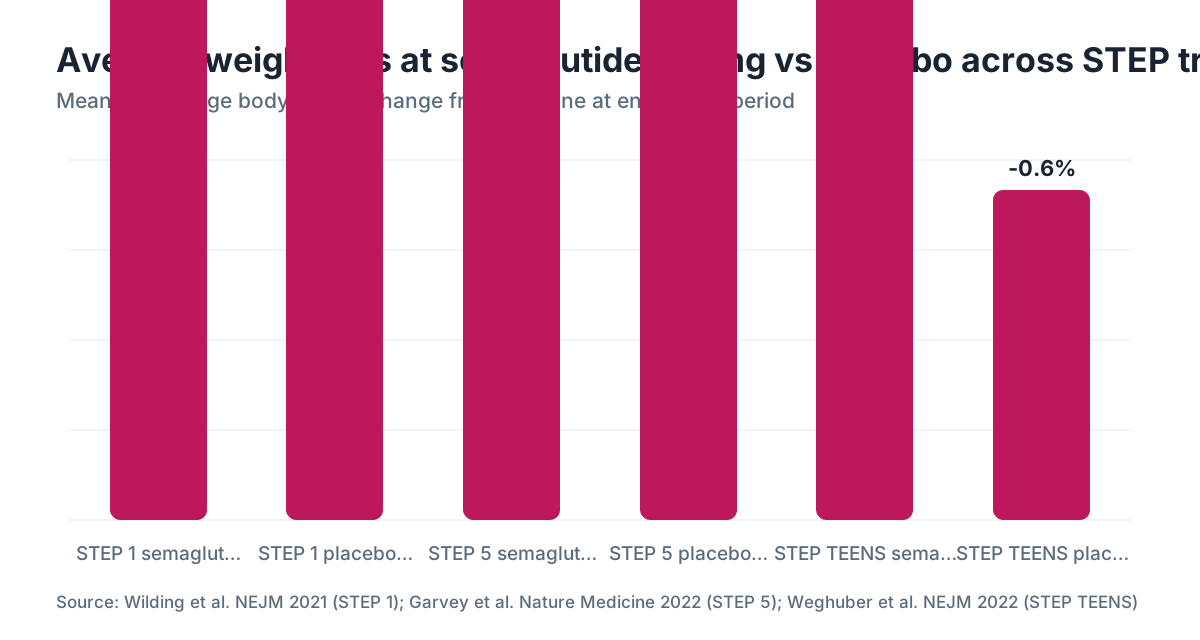
Those aren't arbitrary numbers. The STEP 1 trial enrolled 1,961 adults with obesity and no diabetes and tested exactly this question. Participants on 2.4 mg lost an average of 14.9% of body weight at 68 weeks compared with 2.4% in the placebo group [3]. The trial stopped at 2.4 mg because earlier dose-finding work showed diminishing returns past that point alongside steeper GI side effects.
So when someone asks "can I take more than 2.4 mg," the honest answer is short: there's no clinical evidence that it helps, the FDA hasn't approved it, and the label says not to.
What is the semaglutide dose titration schedule to reach the max?
You do not start at 2.4 mg. The escalation schedule exists because nausea, vomiting, and constipation track with dose, and slower ramp-ups keep those side effects tolerable enough that people actually stay on the medication.
The FDA-approved Wegovy titration for adults looks like this:
| Phase | Dose | Duration | |---|---|---| | Weeks 1-4 | 0.25 mg/week | 4 weeks | | Weeks 5-8 | 0.5 mg/week | 4 weeks | | Weeks 9-12 | 1.0 mg/week | 4 weeks | | Weeks 13-16 | 1.7 mg/week | 4 weeks | | Week 17 onward | 2.4 mg/week (maintenance) | Ongoing |
That's a minimum 16-week ramp before you hit the ceiling. Prescribers can slow it down if a patient isn't tolerating a step well. Rushing it is one of the most common reasons people quit.
Ozempic for diabetes runs a slightly different track: 0.25 mg for 4 weeks, then 0.5 mg, then 1 mg, and the 2 mg dose is the add-on option if glycemic control is still inadequate at 1 mg [2].
A note on compounded semaglutide: compounding pharmacies have used varying concentrations, and dosing can be inconsistent because there's no standardized label. If you're using a compounded version, confirm the actual milligram dose per injection with your prescriber, more than the volume.
What does the research say about doses above 2.4 mg?
Short version: nobody has good phase 3 human data on subcutaneous semaglutide above 2.4 mg. The closest evidence points the other way.
A phase 2 trial published in The Lancet Diabetes & Endocrinology (Blundell et al., 2017) tested doses from 0.05 mg to 0.4 mg weekly in people with obesity and found that weight loss and energy intake reduction flattened well before the highest doses while nausea rates climbed [4].
More relevant to the current max: the STEP program never included a 3.2 mg or 4.8 mg arm for subcutaneous semaglutide, because preclinical and phase 2 data didn't support a favorable benefit-risk ratio at higher doses. The FDA label reflects that judgment.
Tirzepatide (Mounjaro, Zepbound) is a different molecule that works on both GLP-1 and GIP receptors. Its ceiling is 15 mg weekly, and its weight loss at that dose exceeds semaglutide's 2.4 mg results. That comparison matters if you're not getting adequate results at the semaglutide ceiling. See semaglutide vs tirzepatide for a full breakdown of how the two drugs compare on efficacy and side effects.
The plateau in efficacy arrives sooner than most people assume. The GI burden keeps climbing after it does.
Can you stay on a lower dose instead of pushing to the max?
Yes, and for many people this is the smarter move.
The 2.4 mg dose is where the STEP trials measured their outcomes, but Novo Nordisk's own prescribing information says the maintenance dose is 2.4 mg "if tolerated." That phrase is doing real work. If a patient hits clinically meaningful weight loss (typically 5% or more of body weight) and tolerates 1 mg or 1.7 mg well, there's no mandate to push higher.
Real-world data backs this up. A meaningful share of Wegovy patients reach 10% or greater weight loss without ever climbing to the 2.4 mg maintenance dose. The caveat is that long-term data at sub-maximal doses is sparse, so if weight plateaus and you haven't reached 2.4 mg, that's a conversation with your prescriber rather than a reason to stay comfortable.
For women in perimenopause or menopause, this gets more layered. Hormonal shifts change fat distribution and metabolic rate. Some women find weight loss harder at any semaglutide dose when estrogen is low, and addressing the hormonal piece alongside the GLP-1 often produces better results than chasing a higher dose alone. If you're in that window, reading up on hormone replacement therapy and how it interacts with GLP-1 response may be worth your time.
What happens if you don't tolerate the max dose?
Side effects are the main reason people never reach 2.4 mg, or reach it and come back down.
Nausea is the most reported adverse event in the STEP trials, occurring in 44% of participants on semaglutide versus 16% on placebo [3]. Vomiting, diarrhea, and constipation follow close behind. These usually peak during dose escalation and improve with time, but not for everyone.
If you hit 2.4 mg and feel genuinely miserable, the label-approved move is to drop back to 1.7 mg for 4 weeks and try again. If you still can't tolerate it, 1.7 mg becomes your effective maintenance dose. That's not a failure. Weight loss at 1.7 mg is still clinically significant.
Serious but less common adverse events include acute pancreatitis, gallbladder disease, and a theoretical risk of thyroid C-cell tumors based on rodent data. The FDA requires a boxed warning for the thyroid risk, though the Endocrine Society notes the clinical relevance in humans remains uncertain [5]. Anyone with a personal or family history of medullary thyroid carcinoma or MEN2 should not use semaglutide at any dose.
Heart rate increase is another real finding. Mean heart rate in STEP 1 rose by about 1 to 4 beats per minute on semaglutide [3]. That's modest, but worth monitoring if you have an underlying cardiac condition.
How does the max dose differ for weight loss versus diabetes?
The gap between the diabetes ceiling (2 mg, Ozempic) and the weight-loss ceiling (2.4 mg, Wegovy) is small in absolute terms but meaningful in context.
Ozempic was built around A1c reduction as the primary endpoint. The SUSTAIN-6 trial and later studies showed cardiovascular benefits at doses up to 1 mg, and the 2 mg dose was added mainly for patients who needed more glycemic control [6]. The SELECT trial, reported in 2023, showed that 2.4 mg weekly semaglutide cut major adverse cardiovascular events by 20% in adults with cardiovascular disease and overweight or obesity but no diabetes. That result applied to the 2.4 mg dose, not the lower diabetes doses [7].
So if you have both obesity and type 2 diabetes, the question of which product and which max dose applies is a real clinical decision. Many endocrinologists in that situation now prescribe Wegovy at 2.4 mg rather than capping at the Ozempic 2 mg ceiling, particularly after SELECT. That's a conversation between you and your prescriber.
For more on how semaglutide for weight loss differs from its use in diabetes management, that article covers the nuances in more depth.
Does the max dose change for older women or women in menopause?
No. The FDA label doesn't specify a different maximum dose for older women or women in menopause. The dosing ceiling is the same 2.4 mg.
The clinical picture, though, is more complicated. Estrogen loss during menopause slows metabolic rate and shifts fat storage toward visceral adipose tissue, which is exactly the fat semaglutide reduces best. But lower estrogen also means declining bone density over time, and rapid weight loss on semaglutide can speed up bone loss, especially lean mass loss, if protein intake and resistance training aren't a priority [8].
Women over 50 losing weight quickly should think about a bone density test before or during treatment. The STEP 1 trial population had a mean age of about 46 and was mostly female, so it's not a perfect stand-in for the 55-plus postmenopausal woman.
Renal function matters too. Semaglutide isn't renally cleared (it's broken down by proteolytic cleavage), so renal impairment alone doesn't require a dose adjustment. But older women with multiple comorbidities may need slower titration and more frequent check-ins.
At WomenRx, clinicians treating women in perimenopause alongside GLP-1 therapy evaluate the hormonal context first, because getting estrogen and progesterone levels right can meaningfully affect how well any weight management strategy works.
What is the max dose of oral semaglutide (Rybelsus)?
Rybelsus is oral semaglutide for type 2 diabetes. Its maximum approved dose is 14 mg once daily [9].
The titration runs like this: 3 mg daily for 30 days (a stomach-tolerance dose, not a therapeutic one), then 7 mg daily for 30 days or longer, then up to 14 mg daily if you need more glycemic control.
Oral bioavailability of semaglutide is low, around 1%, because GLP-1 receptor agonists are peptides that degrade in the GI tract. Rybelsus uses an absorption enhancer called SNAC to protect the molecule in the stomach. Even so, the 14 mg oral dose isn't equivalent to the 2 mg injectable dose in plasma exposure. The PIONEER 1 trial found 14 mg oral semaglutide reduced A1c by about 1.4 percentage points versus 0.1 for placebo [10].
Rybelsus is not approved for weight management. If you're taking it off-label for weight loss, the data is thinner than for Wegovy, and the oral route's lower exposure means results are generally more modest.
What are the signs you've hit your personal effective dose, before the max?
The 2.4 mg ceiling is a population-level finding. Your effective dose may be lower.
Clinicians watch for a few signals. First, sustained appetite suppression: you feel genuinely less hungry between meals and you're not fighting cravings the way you used to. Second, measurable weight loss: the benchmark used in trials and clinical practice is at least 5% of starting body weight by week 16 to predict a meaningful long-term response [3]. Third, tolerability: if you're losing weight, feeling okay, and not white-knuckling through nausea, there's no pharmacological reason to push higher.
The flip side: if you've been at a stable dose for 8 to 12 weeks with no weight movement and reasonable tolerance, that's a signal to escalate. The titration schedule exists precisely because the therapeutic effect climbs with dose up to the ceiling.
One honest caveat. Some people plateau on semaglutide entirely and don't respond regardless of dose. The non-response rate in trials is real. If you've reached 2.4 mg, tolerated it for 16-plus weeks, and lost less than 5% of your body weight, semaglutide may not be your drug. Tirzepatide is a reasonable next consideration.
How does the semaglutide dose ceiling compare to other GLP-1 medications?
Semaglutide is one of several GLP-1 receptor agonists, and comparing dose ceilings puts the 2.4 mg number in context.
| Drug | Mechanism | Max approved dose | Primary indication | |---|---|---|---| | Semaglutide (Wegovy) | GLP-1 RA | 2.4 mg/week SQ | Weight management | | Semaglutide (Ozempic) | GLP-1 RA | 2 mg/week SQ | Type 2 diabetes | | Semaglutide (Rybelsus) | GLP-1 RA | 14 mg/day oral | Type 2 diabetes | | Tirzepatide (Zepbound) | GLP-1 + GIP RA | 15 mg/week SQ | Weight management | | Tirzepatide (Mounjaro) | GLP-1 + GIP RA | 15 mg/week SQ | Type 2 diabetes | | Liraglutide (Saxenda) | GLP-1 RA | 3 mg/day SQ | Weight management | | Dulaglutide (Trulicity) | GLP-1 RA | 4.5 mg/week SQ | Type 2 diabetes |
The raw milligram numbers aren't directly comparable across molecules because receptor affinity and half-life differ. Semaglutide has a half-life of about 7 days, which is why once-weekly dosing works. Liraglutide has a half-life of about 13 hours, hence the daily injection. Higher milligrams don't mean a stronger effect per se.
If you're curious whether a different molecule might work better for you, semaglutide vs tirzepatide covers the head-to-head data.
Is it safe to take semaglutide at the max dose long-term?
The longest continuous semaglutide trial to date, STEP 5, followed patients for 104 weeks (two years) at 2.4 mg weekly. Participants lost an average of 15.2% of body weight at 104 weeks, and the two-year safety profile matched what STEP 1 showed at 68 weeks. No new safety signals emerged over the longer window [11].
The SELECT cardiovascular outcomes trial, published in the New England Journal of Medicine in 2023, ran for a median of 34 months and confirmed the 20% reduction in MACE. That's the largest safety dataset for 2.4 mg semaglutide to date, enrolling over 17,000 participants [7].
What's less clear: what happens beyond three years at the max dose, whether bone density effects compound over time in postmenopausal women, and whether the modest heart rate elevation carries any long-term cardiac risk. Those are genuinely open questions. The drug has only been at the 2.4 mg dose in a broad population since 2021.
Muscle loss is a legitimate concern too. GLP-1 agonists suppress appetite broadly, and without enough protein (most guidelines suggest at least 1.2 g/kg/day during active weight loss) and resistance exercise, a real share of weight lost can be lean mass. This matters more at the max dose because weight comes off faster. Women in their 40s and 50s who are already losing muscle mass as part of normal aging should take this seriously.
For context on why muscle and bone preservation matters as women age, the discussion of perimenopause age and how body composition shifts across that transition is worth reading alongside any GLP-1 treatment plan.
Where to get semaglutide at the right dose, and what to ask your provider
Getting the dose right is as much a process as a prescription. A few things worth knowing before your appointment.
The branded products (Wegovy, Ozempic, Rybelsus) come in fixed-dose pens, so there's no improvising the dose on your end. Wegovy pens are sold in the exact starter kit configuration matched to the titration schedule. You cannot draw up a smaller or larger dose from the pen.
Compounded semaglutide, available through 503B outsourcing facilities when branded products are on shortage, uses vials and syringes where dose is more flexible but also more error-prone. The FDA has stated plainly that compounded semaglutide is not FDA-approved and has raised quality concerns about some compounders. With branded products more available in 2025, the compounding landscape is shifting. More on that at compounded semaglutide.
Questions worth asking your prescriber before starting or escalating:
- What weight loss milestone should I expect at each dose step before we push higher?
- At what point do we call this dose a failure and try something else?
- How are we monitoring for muscle loss and bone effects?
- If I'm in perimenopause or menopause, are we addressing the hormonal side of things at the same time?
A telehealth platform like WomenRx that manages women's hormones alongside GLP-1 therapy is one option if you want both pieces handled by the same clinical team. For more on the full semaglutide landscape, that overview covers mechanism, FDA history, and candidacy criteria.
Frequently asked questions
What is the maximum dose of Wegovy?
The maximum approved dose of Wegovy (semaglutide for weight management) is 2.4 mg injected subcutaneously once weekly. You reach that dose after a 16-week titration starting at 0.25 mg. The FDA approved this ceiling based on the STEP clinical trial program, which found no meaningful additional weight loss at higher doses alongside greater GI side effects.
What is the maximum dose of Ozempic?
Ozempic's maximum approved dose is 2 mg once weekly, subcutaneous injection. The FDA added the 2 mg dose in 2022 for adults with type 2 diabetes who need more glycemic control beyond the 1 mg dose. Ozempic is not approved for weight management, so the 2.4 mg Wegovy ceiling doesn't apply to Ozempic prescriptions.
Can a doctor prescribe semaglutide above 2.4 mg?
Technically physicians can prescribe off-label, but there's no published phase 3 human data supporting doses above 2.4 mg for subcutaneous semaglutide, and the FDA hasn't approved any higher dose. Phase 2 dose-finding studies showed efficacy plateaued around the 2.4 mg range while adverse events kept rising. Most prescribers wouldn't go above the ceiling without a compelling clinical reason and clear informed consent.
How long does it take to reach the max dose of semaglutide?
It takes a minimum of 16 weeks to reach the 2.4 mg maintenance dose following the FDA-approved Wegovy titration schedule. The steps are 0.25 mg, 0.5 mg, 1 mg, and 1.7 mg, each held for 4 weeks. Prescribers can slow the titration if side effects aren't tolerable, which means some patients take 20 to 24 weeks or longer to reach the ceiling.
What if I can't tolerate the maximum 2.4 mg dose of semaglutide?
The prescribing label explicitly allows dropping back to 1.7 mg if 2.4 mg isn't tolerated. After 4 more weeks at 1.7 mg, you can try increasing again. If you still can't tolerate the ceiling, 1.7 mg becomes your maintenance dose. Weight loss at 1.7 mg is still clinically significant. Intolerance of the max dose is common and not a reason to stop treatment entirely.
Is 2.4 mg semaglutide more effective than 1 mg for weight loss?
Yes, in the STEP 1 trial. Participants at 2.4 mg lost an average of 14.9% of body weight over 68 weeks. Lower doses weren't the direct comparator in STEP 1, but dose-ranging work consistently shows a dose-response relationship up to 2.4 mg. Beyond that ceiling, the additional benefit flattens while side effects increase.
Does the semaglutide max dose change if I have type 2 diabetes?
Yes. If you're using Ozempic for type 2 diabetes, the maximum approved dose is 2 mg weekly, not 2.4 mg. If you have both type 2 diabetes and obesity, some clinicians now prescribe Wegovy at 2.4 mg, particularly given the SELECT trial's cardiovascular benefit data. Which ceiling applies to you depends on which product is prescribed and for which indication.
What is the max dose of oral semaglutide (Rybelsus)?
Rybelsus tops out at 14 mg daily. It's approved only for type 2 diabetes, not weight management. The titration starts at 3 mg for 30 days (a tolerance dose), then 7 mg, then up to 14 mg. Oral bioavailability is about 1%, so 14 mg oral isn't equivalent in plasma exposure to 2 mg injectable. Rybelsus is generally considered less potent than Wegovy or Ozempic on a milligram basis.
Can I lose weight on a semaglutide dose lower than 2.4 mg?
Yes. Many patients hit meaningful weight loss, defined as 5% or more of starting body weight, before reaching the 2.4 mg ceiling. The max dose produces the largest average effect in trials, but individual response varies. If you're losing weight, tolerating your current dose well, and feeling satisfied, there's no absolute requirement to push to 2.4 mg.
Does being in menopause affect how well semaglutide works at any dose?
There's no data showing menopause changes semaglutide's mechanism, but low estrogen affects metabolic rate, fat distribution, and muscle mass, all of which influence how much weight loss you'll see at any given dose. Some clinicians find that addressing estrogen deficiency alongside GLP-1 therapy produces better body composition outcomes than either approach alone. The STEP trials didn't stratify results by menopausal status.
Does rapid weight loss at the max semaglutide dose cause muscle or bone loss?
It can. Faster weight loss carries a higher risk of lean mass loss, and GLP-1 agonists suppress appetite without discriminating between calorie sources. Inadequate protein intake (below roughly 1.2 g/kg/day) during rapid loss speeds this up. Postmenopausal women already losing bone density are at higher risk. Resistance training and protein optimization aren't optional add-ons at 2.4 mg; they're part of the treatment.
How does semaglutide's max dose compare to tirzepatide's max dose?
Semaglutide's ceiling is 2.4 mg weekly (Wegovy). Tirzepatide's ceiling is 15 mg weekly (Zepbound). They're different molecules so the numbers aren't directly comparable, but at their respective ceilings, tirzepatide's phase 3 trials (SURMOUNT-1) showed average weight loss of about 20 to 22% of body weight versus semaglutide's roughly 15% in STEP 1. Tirzepatide is a dual GLP-1 and GIP agonist, which likely explains the efficacy difference.
What should I expect in terms of weight loss at the max dose of semaglutide?
In the STEP 1 trial, adults on 2.4 mg weekly semaglutide lost an average of 14.9% of body weight over 68 weeks. About 86% of participants lost at least 5%, and about one-third lost 20% or more. Real-world results are typically lower than trial results because trials select motivated participants with tight protocols. Expect a realistic range of 10 to 17% body weight loss with good adherence.
Is there a max dose of semaglutide for adolescents?
The FDA approved Wegovy for adolescents aged 12 and older with obesity in December 2022. The maximum dose and titration schedule are the same as in adults: 2.4 mg once weekly after the standard 16-week ramp. The STEP TEENS trial supported this approval, showing 16.1% body weight reduction versus 0.6% for placebo at 68 weeks in participants aged 12 to 17.
Sources
- FDA, Wegovy (semaglutide) prescribing information and approval history
- Wilding et al., STEP 1 trial, New England Journal of Medicine, 2021
- Blundell et al., The Lancet Diabetes & Endocrinology, 2017 (semaglutide dose-finding phase 2 trial)
- Endocrine Society, clinical practice guidelines
- Marso et al., SUSTAIN-6 trial, New England Journal of Medicine, 2016
- Lincoff et al., SELECT trial, New England Journal of Medicine, 2023
- National Institutes of Health, Office of Dietary Supplements, Calcium fact sheet for health professionals
- FDA, Rybelsus (oral semaglutide) prescribing information
- Aroda et al., PIONEER 1 trial, Diabetes Care, 2019
- Garvey et al., STEP 5 trial, Nature Medicine, 2022
- Weghuber et al., STEP TEENS trial, New England Journal of Medicine, 2022