Lowest dose of progesterone for HRT: what the evidence says
TL;DR: The lowest recognized progesterone dose for HRT is 100 mg micronized progesterone taken orally at bedtime (brand name Prometrium), used to protect the uterine lining when combined with estrogen. Women using low-dose local estrogen only may not need progesterone at all. The right dose depends on your estrogen route, your estrogen dose, and whether you still have a uterus.
What is the lowest dose of progesterone for HRT?
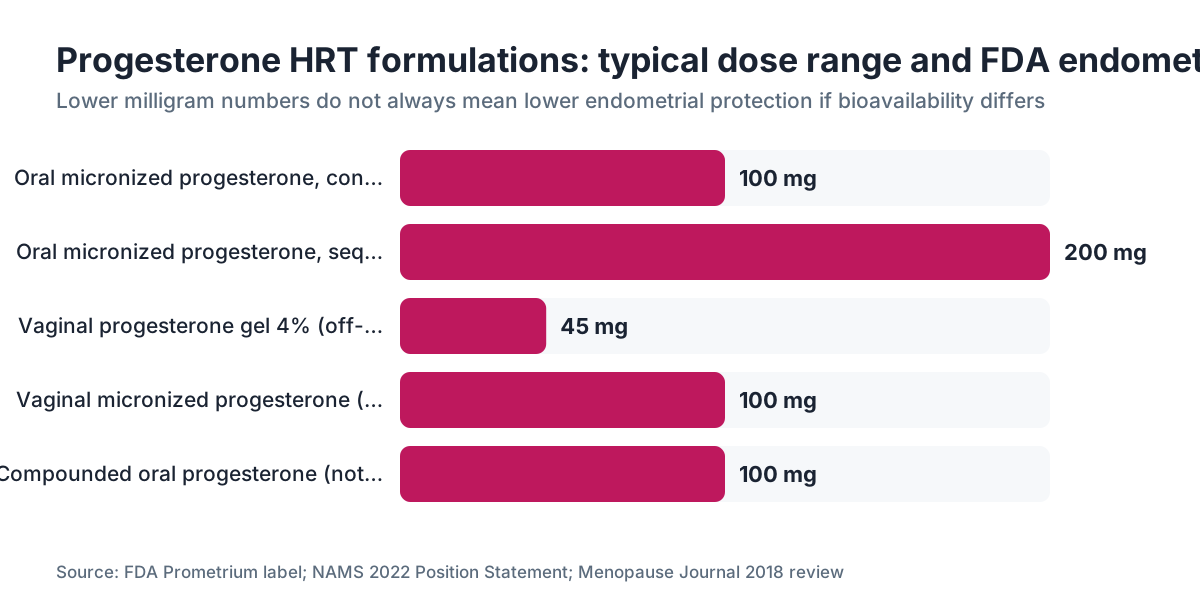
Here's the short answer. 100 mg micronized progesterone, oral, at bedtime, is the lowest dose consistently shown to protect the endometrium when a woman uses systemic estrogen. That number comes straight off the FDA label for Prometrium, the only FDA-approved oral micronized progesterone product sold in the United States. The label lists two protection doses: 200 mg nightly for 12 days per cycle (sequential) or 100 mg nightly continuously [1].
The real answer has more to it, because "lowest dose" depends entirely on what you're trying to do.
If your goal is endometrial protection alongside full systemic estrogen, 100 mg continuous oral is the floor. If your estrogen dose is very low (say a 0.025 mg patch used for symptom relief at the low end of prescribing), some providers keep the 100 mg dose and monitor with periodic ultrasound rather than automatically going higher. And if you use only low-dose vaginal estrogen for genitourinary symptoms, the systemic absorption is so small that no progesterone is needed at all. Both the North American Menopause Society (NAMS) and the Endocrine Society back that position [2][3].
Vaginal progesterone gel (4% Crinone or generic) and vaginal suppositories get used off-label in HRT too, usually at 45 mg every other day or every day. But those doses come mostly from fertility research and have weaker endometrial-protection data for menopause HRT.
So here's the floor. 100 mg oral micronized progesterone nightly is the evidence-based minimum. Going lower is not standard practice and has no controlled trial support for endometrial safety.
Why does progesterone dosing matter in HRT?
Estrogen alone thickens the uterine lining. That's a feature during the reproductive years and a problem after menopause. Unopposed estrogen, meaning estrogen without a progestogen to counter it, raises the risk of endometrial hyperplasia and endometrial cancer in women who still have a uterus. The Women's Health Initiative (WHI) estrogen-alone arm, published in JAMA in 2004, confirmed that women who'd had a hysterectomy could safely take estrogen alone. That study specifically kept women with an intact uterus out of the estrogen-only arm for exactly this reason [4].
Progesterone (and synthetic progestins) push back against that thickening. They turn a proliferative endometrium into a secretory one, which then sheds or holds steady. The dose matters in both directions.
Too little progesterone and the lining is under-protected. Too much and you get more side effects: bloating, breast tenderness, mood shifts, and disrupted sleep (though for a lot of women the mild sedative effect of oral micronized progesterone at bedtime is a benefit, not a problem).
Women without a uterus (post-hysterectomy) don't need progesterone for safety. Whether it offers anything else, like better sleep, steadier mood, or heart effects, is still being studied and genuinely debated among clinicians. The data hint at benefits but don't prove them, and the Endocrine Society's 2015 clinical practice guideline says evidence for non-endometrial benefits of progesterone remains limited [3].
For a wider view of how progesterone fits the full hormonal picture, see our overview of progesterone.
How do progesterone doses for HRT compare across formulations?
Different formulations deliver progesterone differently, and bioavailability varies enough that the milligram number alone doesn't tell the whole story.
| Formulation | Typical HRT dose range | Route | FDA-approved for endometrial protection? | |---|---|---|---| | Micronized progesterone (Prometrium) | 100 mg continuous or 200 mg x 12 days/cycle | Oral | Yes [1] | | Progesterone vaginal gel 4% (Crinone) | 45 mg daily or every other day | Vaginal | No (fertility indication) | | Compounded progesterone capsules | 25-200 mg (varies widely) | Oral or vaginal | No | | Compounded progesterone cream | 20-200 mg/application | Transdermal | No | | Micronized progesterone 100 mg vaginal | 100 mg nightly | Vaginal | No (off-label) |
Oral micronized progesterone goes through first-pass metabolism in the liver, which produces metabolites (allopregnanolone and pregnanolone) that act on GABA receptors. That's why it tends to make you drowsy at night, and why most prescribers tell you to take it at bedtime.
Vaginal delivery skips first-pass metabolism, so you get more direct uterine effect per milligram but less systemic exposure. Sounds appealing. But the evidence for vaginal progesterone as an endometrial protector in HRT is thin next to the oral data. A 2018 review in Menopause found that while vaginal progesterone produces a local uterine effect, current studies are not enough to confirm it matches oral dosing for endometrial protection in HRT [5].
Compounded progesterone creams have the weakest evidence of all. Skin absorption is inconsistent, and blood levels often can't be measured even at doses far higher than topical estrogen. NAMS has said plainly that transdermal progesterone cream lacks adequate evidence to be considered reliable for endometrial protection [2].
For anyone considering hormone replacement therapy, how the pieces of the regimen work together matters more than any single number.
Does every woman on HRT need progesterone?
No. Whether you need progesterone comes down to one anatomical fact: do you still have a uterus?
If you've had a hysterectomy, you don't need progesterone for safety. Full stop. Your provider might still bring it up for other reasons (some women report better sleep, some just feel better on it), but it isn't required.
If your uterus is intact, you need a progestogen any time you use systemic estrogen. "Systemic" means the estrogen enters your bloodstream and circulates through the body, which is what happens with oral estrogen pills, patches, gels, sprays, and rings sized for systemic delivery.
Low-dose vaginal estrogen is the exception. Products like Vagifem (vaginal estradiol 10 mcg), Imvexxy (estradiol vaginal inserts, 4 mcg or 10 mcg), and Estring (a vaginal ring releasing about 7.5 mcg/day) are made for local genitourinary use. Systemic absorption from these is minimal. The NAMS 2020 position statement on genitourinary syndrome of menopause says progestogen addition is generally not recommended with low-dose vaginal estrogen [11]. Some clinicians still recommend periodic endometrial monitoring or progesterone for women on higher local doses long-term.
Then there's the middle ground. The Femring vaginal ring delivers 0.05 or 0.10 mg/day of systemic estradiol, which produces blood levels comparable to a patch. Women using Femring with a uterus do need progesterone.
Perimenopause adds another layer. If you're still having periods but using low-dose HRT for symptoms, your own ovarian progesterone may be irregular but still present. Providers handle this carefully, often using progesterone cyclically rather than continuously. Learn more about perimenopause and how hormone shifts show up before menopause is official.
What does the FDA actually approve for progesterone in HRT?
The FDA has approved Prometrium (micronized progesterone in peanut oil) for two indications relevant to HRT [1]:
-
Prevention of endometrial hyperplasia in nonhysterectomized postmenopausal women receiving conjugated equine estrogen 0.625 mg, at a dose of 200 mg orally for 12 days per 28-day cycle.
-
As part of hormone therapy in postmenopausal women, at 100 mg orally taken once daily in the evening for 12 continuous days per month.
Notice what's missing. Continuous daily 100 mg use alongside low-dose estrogen gets prescribed constantly, but as a continuous year-round regimen it's technically off-label. The FDA approval was for sequential use. Providers prescribe continuous 100 mg daily because the clinical evidence supports it, including data from the PEPI trial and later work, but that's a real distinction patients deserve to hear.
The Prometrium label also carries a boxed warning: progestogens combined with estrogens should not be used to prevent cardiovascular disease or dementia, citing WHI data, and the warning notes increased risks of breast cancer, blood clots, stroke, and dementia in the WHI combined HRT arm [10]. Here's the context the label doesn't emphasize. The WHI used medroxyprogesterone acetate (MPA), a synthetic progestin, not micronized progesterone. Several observational studies suggest micronized progesterone has a safer profile than MPA, especially for breast cancer and cardiovascular risk, though head-to-head randomized data at equivalent protection doses are limited [6].
The FDA has no approved compounded progesterone product. Compounded formulations aren't FDA-approved, though licensed compounding pharmacies can legally dispense them.
Is 100 mg progesterone enough, or do some women need more?
For most women on standard systemic estrogen doses, 100 mg continuous oral micronized progesterone is enough to protect the endometrium. The evidence traces mainly to the PEPI (Postmenopausal Estrogen/Progestin Interventions) trial, which found that micronized progesterone 200 mg cyclically with estrogen prevented hyperplasia effectively. The 100 mg continuous regimen entered clinical practice off the back of that work and later studies [7].
Where 100 mg may need to change:
Higher estrogen doses sometimes call for more progesterone to counter greater endometrial stimulation. If a woman is on a 0.1 mg or higher estrogen patch, some providers move to 200 mg nightly or add sequential higher-dose cycling.
Breakthrough bleeding on a continuous regimen is a signal to reassess, not to ignore. Irregular bleeding on combined continuous HRT in a postmenopausal woman warrants evaluation with endometrial biopsy or transvaginal ultrasound to rule out hyperplasia before you touch the dose.
Women who metabolize progesterone quickly may run lower steady-state blood levels on 100 mg. There's no widely standardized therapeutic range for progesterone blood levels in HRT (unlike thyroid hormone), so monitoring is clinical, not numerical.
Some women genuinely feel better on a lower dose, say 50 mg, especially those who find 100 mg too sedating. That's done off-label. Some practitioners use it, particularly when systemic estrogen is very low, but it doesn't carry the same endometrial safety evidence. If you and your provider go under 100 mg, periodic endometrial surveillance is a sensible safeguard.
For how estrogen delivery affects the progesterone dose you need, the estrogen patch article covers patch options and dose ranges.
What are the risks of taking too little progesterone with estrogen?
The main documented risk is endometrial hyperplasia, an abnormal thickening of the uterine lining that can progress to endometrial cancer if left alone.
The numbers matter here. Estrogen-alone therapy in women with a uterus raises the relative risk of endometrial cancer roughly two to eight times compared to no hormone use, depending on dose and duration, according to a long body of epidemiological data summarized by the American Cancer Society [8]. Adding enough progestogen essentially cancels that risk out.
Endometrial hyperplasia without atypia has a low but real progression rate to cancer (roughly 1 to 3% over several years), while atypical hyperplasia carries a much higher risk. The standard of care: any hyperplasia found in a woman on estrogen-progestogen therapy should trigger a fresh look at the regimen.
Signs that progesterone may be too low include unexpected vaginal bleeding or spotting after 12 months of continuous HRT (by which point most women have no bleeding), a thickened endometrial stripe on ultrasound (usually flagged above 4 to 5 mm in a postmenopausal woman), or a biopsy showing proliferative or hyperplastic changes.
None of this is a reason to fear HRT. Properly dosed progesterone with estrogen does not raise endometrial cancer risk above baseline. The risk shows up only with inadequate or absent progestogen opposition.
What about progesterone HRT for women in perimenopause, more than menopause?
Perimenopause is genuinely complicated because progesterone production is erratic rather than gone. Some cycles are anovulatory (no ovulation, so no corpus luteum, so no endogenous progesterone), and others are normal.
For perimenopausal women with symptoms who still have a uterus, two approaches come up most:
Cyclic progesterone (10 to 14 days per month), which mimics the luteal phase and protects the endometrium during months when ovulation may not have happened. A common protocol is oral micronized progesterone 200 mg for 12 days each month.
Low-dose continuous combined HRT, which some providers use in perimenopause though it's more typical for postmenopause. The continuous approach fits perimenopause less well, because a woman's own hormonal swings can cause irregular bleeding on top of the HRT.
For perimenopausal women whose main complaint is heavy or irregular periods rather than hot flashes, a levonorgestrel IUD (Mirena) is another option. It delivers local progestogen protection of the endometrium while systemic estrogen (if used) handles vasomotor symptoms.
WomenRx providers work through this kind of individualized decision constantly, where there's rarely a one-size-fits-all protocol. If you're not sure where you are in the transition, the articles on when does menopause start and menopause age are useful starting points.
For more on timing and staging, perimenopause age breaks down the typical window and which symptoms tend to show up when.
How does micronized progesterone compare to synthetic progestins in HRT?
This is one of the more clinically meaningful distinctions in menopause care, and it doesn't get enough attention.
Micronized progesterone (bioidentical) is chemically identical to the progesterone your ovaries made. Synthetic progestins (medroxyprogesterone acetate, norethindrone, levonorgestrel, dydrogesterone, and others) are structurally different. They bind progesterone receptors with varying strength, but they also often bind androgen, glucocorticoid, or mineralocorticoid receptors in ways natural progesterone doesn't.
The WHI used MPA, not micronized progesterone. The higher breast cancer risk seen in the combined estrogen-plus-progestin arm pushed many researchers and clinicians to ask whether the progestin type matters. The observational E3N cohort study from France (published in Breast Cancer Research and Treatment, 2008) found that women using estrogen with micronized progesterone had no significant rise in breast cancer risk over 8 years, while those using synthetic progestins did [6]. The E3N study has limits (observational, self-selected), but it's the largest and most-cited dataset on this exact comparison.
The Endocrine Society's clinical practice guideline on menopause hormone therapy says "micronized progesterone and some synthetic progestins appear to have differing safety profiles," a careful acknowledgment that the data lean toward micronized progesterone without overreading observational work [3].
For most women starting HRT today, guidelines from NAMS and the British Menopause Society increasingly favor micronized progesterone over MPA when oral progestogen is needed, especially in women with added cardiovascular or metabolic risk.
Bottom line: if progesterone HRT is right for you, micronized progesterone is generally the preferred choice on current evidence, though it isn't the only reasonable one.
What does a typical low-dose progesterone HRT regimen actually look like?
A common low-dose combined HRT regimen for a postmenopausal woman with an intact uterus looks like this:
Estrogen: 0.025 to 0.05 mg estradiol patch, changed twice weekly. Progesterone: 100 mg oral micronized progesterone at bedtime, every night, continuously.
That's a continuous combined regimen. After an adjustment period of a few months (during which some women have light, irregular spotting), most women on this protocol stop bleeding entirely.
A sequential alternative (sometimes preferred for women recently in menopause who still want a withdrawal bleed, or for those who tolerate continuous dosing poorly): Estrogen: daily throughout the month. Progesterone: 200 mg nightly for the first 12 to 14 days of each calendar month.
The NAMS position statement on menopause hormone therapy, last updated in 2022, supports both continuous and sequential regimens. It notes that continuous combined therapy is generally preferred for women more than one year past their last period, because it's more likely to end in amenorrhea (no bleeding) [2].
For women at the lowest estrogen doses (0.014 to 0.025 mg patches or the equivalent gel), some providers use 100 mg progesterone nightly and monitor with annual or biennial transvaginal ultrasound rather than adjusting on dose alone. That individualized approach makes clinical sense even though no guideline formalizes it.
If you're thinking about starting or adjusting a regimen, a telehealth provider who specializes in women's hormones can help you think through the options. WomenRx offers hormone consultations for perimenopausal and postmenopausal women who want personalized, evidence-based care.
Can you take progesterone without estrogen in HRT?
Yes, and some women do, though it's less common and the evidence is narrower.
Progesterone-only HRT sometimes fits women who have contraindications to estrogen (a history of estrogen-sensitive breast cancer, for instance) but who still have real menopausal symptoms, especially disrupted sleep. The sedating effect of oral micronized progesterone at 100 to 200 mg at bedtime can meaningfully improve sleep. A randomized trial published in Menopause in 2012 (the Hitchcock-Prior study) found that oral micronized progesterone 300 mg at bedtime reduced sleep disturbance in postmenopausal women compared to placebo, with an effect on wakefulness after sleep onset [9].
Progesterone alone does not reliably treat vasomotor symptoms (hot flashes, night sweats) the way estrogen does. If hot flashes are the main problem, estrogen is the most effective treatment by a wide margin.
For women who can't use estrogen but need sleep help, 100 mg oral micronized progesterone at bedtime is a reasonable starting conversation with a provider. It's off-label for that purpose in the United States but commonly prescribed.
For women post-hysterectomy weighing progesterone for non-endometrial reasons, the evidence for sleep, mood, or heart benefits is suggestive but not strong enough to make it a routine recommendation. It's a reasonable individualized choice, not a standard of care.
How should you monitor your response to progesterone HRT?
Monitoring on progesterone HRT is mostly clinical. You and your provider watch symptoms and bleeding patterns rather than chase a number on a lab report.
What to track:
Bleeding pattern. On continuous combined HRT, irregular or heavy bleeding past the first 3 to 6 months is a flag. Bleeding after 12 months of amenorrhea on continuous HRT should always be evaluated, usually with transvaginal ultrasound and sometimes endometrial biopsy.
Endometrial stripe on ultrasound. A stripe above 4 to 5 mm in a postmenopausal woman on HRT warrants further evaluation, though cutoffs vary by lab and context. Some providers do a baseline ultrasound before starting HRT and annual or biennial checks after, especially at lower progesterone doses.
Serum progesterone levels are not routinely used to guide HRT dosing. Unlike thyroid hormone, there's no validated therapeutic range for progesterone in HRT. Blood levels can be drawn if there's clinical concern about absorption (for example, significant side effects at 100 mg, or breakthrough bleeding suggesting weak endometrial protection), but they're not standard monitoring.
Side effects to report: heavy daytime sedation, significant mood changes, bloating, breast tenderness, or new headaches can all mean it's time to adjust dose or timing. Many of these ease off with a switch to bedtime dosing, a slightly lower dose, or a different formulation.
Bone health is a separate but related concern in menopause. Adequate estrogen protects bone density more directly than progesterone, but both matter. If you haven't had a baseline bone density assessment, that's worth raising with your provider, and the bone density test article covers when and why to get one.
For a wider view of the full menopause picture, including non-hormonal options and lifestyle factors, that overview covers the territory well.
Frequently asked questions
What is the lowest dose of progesterone for HRT?
100 mg oral micronized progesterone (Prometrium) taken nightly is the lowest dose with established endometrial protection evidence for women using systemic estrogen. The FDA labels 100 mg continuous or 200 mg for 12 days per cycle as approved dosing. Going below 100 mg is off-label and lacks controlled safety data. Women who use only low-dose vaginal estrogen may not need progesterone at all.
Do I need progesterone if I had a hysterectomy?
No. Progesterone's primary HRT role is protecting the uterine lining from estrogen-driven thickening. Without a uterus, that risk doesn't exist. Some women post-hysterectomy use progesterone for sleep or mood benefits, but this is optional, not medically required. Current guidelines from NAMS and the Endocrine Society do not recommend routine progesterone use in women who've had a hysterectomy.
Is 100 mg progesterone enough to protect the uterus?
For most women on standard systemic estrogen doses, yes. Continuous 100 mg oral micronized progesterone nightly is widely used and supported by clinical evidence for endometrial protection. If you're on higher estrogen doses or have breakthrough bleeding, your provider may reassess and consider 200 mg or a sequential protocol. Periodic endometrial monitoring adds an extra layer of reassurance.
What is the difference between progesterone and progestin in HRT?
Progesterone refers to bioidentical micronized progesterone, chemically identical to what your ovaries produced. Progestins are synthetic versions (such as medroxyprogesterone acetate or norethindrone) that act on progesterone receptors but have different receptor-binding profiles. The WHI used MPA, a synthetic progestin. Observational data, notably the E3N cohort, suggest micronized progesterone may carry a more favorable breast cancer risk profile than synthetic progestins.
Can I take progesterone HRT without estrogen?
Yes, though it's less common. Some women use oral micronized progesterone alone (100 to 300 mg at bedtime) mainly to improve sleep or manage mild perimenopausal symptoms when estrogen isn't appropriate. Progesterone alone does not reliably treat hot flashes. Its use without estrogen is off-label in the US but is practiced and has some trial support for sleep benefit specifically.
How long does it take for progesterone HRT to start working?
Progesterone's effects on sleep can appear within a few days of starting, especially at bedtime doses. Its endometrial-protective effect builds over weeks. Irregular spotting during the first one to three months on continuous combined HRT is common as the endometrium adjusts. Most women on continuous regimens are bleed-free by month three to six. If bleeding persists past six months or restarts after amenorrhea, evaluation is warranted.
Does vaginal progesterone work as well as oral for endometrial protection in HRT?
Probably not, based on current evidence. Vaginal progesterone produces a local uterine effect but lower systemic levels. A 2018 Menopause journal review concluded that existing studies are insufficient to confirm vaginal progesterone equals oral micronized progesterone for endometrial protection in HRT. Vaginal progesterone is primarily studied for fertility. If you need reliable endometrial protection, oral remains the evidence-supported choice.
Is progesterone cream effective for HRT endometrial protection?
No, not reliably. NAMS has stated that transdermal progesterone cream lacks adequate evidence to be considered reliable for endometrial protection. Skin absorption is inconsistent, blood levels often stay undetectable, and no adequately powered randomized trial has shown cream provides protection comparable to oral micronized progesterone. Women with a uterus using systemic estrogen should not rely on progesterone cream alone.
Can progesterone HRT cause weight gain?
The evidence is mixed. Some women report fluid retention or appetite changes on progestogen-containing HRT, but well-controlled studies have not consistently shown significant weight gain from progesterone specifically. The WHI found modest weight changes in combined HRT users, but separating estrogen effects from progestogen effects is difficult. If you notice meaningful weight changes after starting progesterone, a dose, timing, or formulation change is worth discussing with your provider.
What happens if my progesterone dose is too low while I am on estrogen?
Insufficient progesterone with systemic estrogen leaves the endometrium under-protected, which over time raises the risk of endometrial hyperplasia and potentially cancer. Warning signs include unexpected vaginal bleeding after establishing amenorrhea, a thickened endometrial stripe on ultrasound, or biopsy findings of proliferative or hyperplastic changes. Adequate progesterone dosing completely offsets estrogen-related endometrial risk.
Does the dose of estrogen affect how much progesterone I need?
Yes. Higher estrogen doses provide more endometrial stimulation, so they generally require at least standard progesterone doses. Some providers use more frequent or higher-dose progesterone with higher estrogen doses, or add periodic sequential high-dose cycling. Very low estrogen doses (0.014 to 0.025 mg patches) may still warrant standard 100 mg progesterone with monitoring rather than a lower dose, because evidence for sub-100 mg endometrial protection is absent.
Is progesterone HRT safe for women with a history of depression or anxiety?
This is nuanced. Oral micronized progesterone generates allopregnanolone metabolites that act on GABA receptors, which can calm and improve sleep for many women. But some women sensitive to progesterone-related mood shifts (including those with a history of premenstrual dysphoric disorder) report more anxiety or mood changes. Vaginal progesterone, which produces lower systemic metabolite levels, may be tolerated better in this group, though endometrial protection evidence is weaker.
Do I need progesterone if I only use low-dose vaginal estrogen for dryness?
Generally no. Current NAMS guidance states that progestogen addition is not recommended with low-dose vaginal estrogen products (such as estradiol vaginal tablets at 10 mcg or lower, or Estring at about 7.5 mcg/day) because systemic absorption is minimal. Women using higher-dose local preparations or on long-term vaginal estrogen may discuss monitoring with their provider, but routine progesterone is not standard for local-only therapy.
How does progesterone HRT interact with other medications?
Oral micronized progesterone is metabolized by the CYP3A4 enzyme system in the liver. Medications that induce CYP3A4 (such as rifampin, carbamazepine, some anti-seizure drugs) can lower progesterone levels significantly. Inhibitors (certain antifungals, some HIV medications) can raise levels. Grapefruit juice has a modest inhibitory effect. Always review your full medication list with your prescribing provider when starting or adjusting progesterone HRT.
Sources
- FDA, Prometrium (progesterone, USP) prescribing information
- North American Menopause Society (NAMS), Menopause Hormone Therapy Position Statement 2022
- Endocrine Society, Clinical Practice Guideline: Treatment of Symptoms of the Menopause (2015)
- Women's Health Initiative, JAMA 2004: Effects of Conjugated Equine Estrogen in Postmenopausal Women with Hysterectomy
- Menopause Journal (2018), review of vaginal progesterone for endometrial protection in HRT
- Fournier A et al., Breast Cancer Research and Treatment (2008), E3N cohort study on HRT type and breast cancer risk
- PEPI Trial Writing Group, JAMA 1995: Effects of estrogen or estrogen/progestin regimens on heart disease risk factors
- American Cancer Society, Endometrial Cancer Risk Factors
- Hitchcock CL, Prior JC, Menopause (2012): Evidence about perimenopausal use of progesterone
- FDA, Boxed Warning: Prometrium prescribing information (boxed warning on progestogens and cardiovascular/cancer risk)
- NAMS, Genitourinary Syndrome of Menopause Position Statement 2020