Low dose birth control in perimenopause: what you need to know
TL;DR: Low-dose combined oral contraceptives (20 to 35 mcg ethinyl estradiol) are FDA-approved for contraception and can also reduce hot flashes, regulate irregular bleeding, and protect bone density during perimenopause. They're a reasonable option for healthy, non-smoking women under 50, but carry higher clot and cardiovascular risk than menopausal HRT and should be stopped once menopause is confirmed.
What exactly is low-dose birth control, and why does it come up in perimenopause?
Low-dose combined oral contraceptives pair a synthetic estrogen (ethinyl estradiol, usually 10 to 35 mcg per pill) with a progestin. The older pills your mother took had 50 mcg or more. Today's pills use a fraction of that. That's the whole reason they're called "low-dose."
Perimenopause is the runway to menopause. It often starts in the mid-40s and lasts anywhere from two to ten years [1]. In this window your ovaries don't shut off cleanly. They sputter. Estrogen spikes high, crashes low, and spikes again inside a single cycle. That churn is what drives the irregular periods, hot flashes, broken sleep, and mood swings that confuse and exhaust a lot of women in their 40s.
Here's what most women don't realize: you can still ovulate during perimenopause. Fertility drops. It doesn't hit zero until you've gone 12 straight months without a period, which is the clinical line that defines menopause [2]. So pregnancy stays on the table, and because perimenopausal cycles are so unpredictable, plenty of women don't know they're still at risk.
Low-dose OCs handle two problems with one pill. They suppress ovulation reliably enough for contraception, and their estrogen content is high enough (relative to menopausal HRT doses) to flatten the hormonal swings behind the symptoms. That two-for-one is why clinicians started prescribing them off-label for perimenopausal symptoms decades ago, and why several professional societies now name the option outright.
For background on where perimenopause age typically begins and what sets the timing, that context shapes which treatments make sense for you.
Can low-dose birth control actually relieve perimenopause symptoms?
Yes, and the evidence holds up. A 2013 randomized trial in Menopause (the journal of the North American Menopause Society) tested a low-dose combined OC with 20 mcg ethinyl estradiol and 1 mg norethindrone acetate against placebo in perimenopausal women [3]. Hot flash scores fell about 50% in the OC group versus about 25% on placebo at 12 weeks.
The mechanism is simple. A steady daily dose of estrogen erases the fluctuations that set off thermoregulatory instability, which is the hot flash mechanism. Menopausal HRT works the same way, just at lower absolute doses and with estradiol instead of synthetic ethinyl estradiol.
Hot flashes aren't the only win. Low-dose OCs produce a predictable withdrawal bleed, which many women find a relief after months of flooding or random spotting. The progestin also lowers endometrial cancer risk by blocking estrogen's push on the uterine lining.
Bone protection is real too. Estrogen quiets osteoclast activity, and OC users show higher bone mineral density at the spine and hip than non-users [4]. That matters because the steep estrogen drop of perimenopause is exactly when bone loss speeds up. If you're already thinking about baseline bone health, a bone density test before or during this transition gives you a number to work from.
Mood and sleep are harder to pin down in trials, but the hormonal steadiness of OC use often helps both. Clinicians who work in this space see it constantly, even when a study design can't cleanly isolate why.
How do low-dose OCs compare to hormone replacement therapy for perimenopause?
This is the comparison that matters most, and the two options are genuinely different.
| Feature | Low-dose OC (e.g., 20 mcg EE) | Menopausal HRT |
|---|---|---|
| Estrogen type | Ethinyl estradiol (synthetic) | Estradiol (bioidentical) |
| Estrogen potency | ~4 to 6x higher per mcg than estradiol | Lower absolute dose |
| Contraception | Yes, reliable | No |
| VTE (clot) risk | Elevated (3 to 4x baseline) | Lower with transdermal estradiol |
| Hot flash control | Strong | Strong |
| Bone protection | Yes | Yes |
| Regulates bleeding | Yes (withdrawal bleed) | Depends on regimen |
| Approved age range | Any reproductive age | Typically post-menopause |
The estrogen dose is the whole clinical story. Ethinyl estradiol is metabolically potent. A 20 mcg EE pill lands with roughly the estrogenic force of 1 to 2 mg of oral estradiol, a full standard HRT dose. That's why OCs knock down symptoms so well, and it's also why they carry more cardiovascular and clotting risk than low-dose transdermal HRT.
NAMS guidance published in Menopause in 2022 puts it plainly: "Combination oral contraceptives may be used for management of perimenopausal symptoms in appropriate candidates, recognizing that the hormonal doses are higher than those in traditional hormone therapy" [5]. The pills work. They just carry more pharmacologic weight.
If you need contraception, OCs win by default, because menopausal HRT gives you none. If you've had a tubal ligation or your partner has had a vasectomy, low-dose HRT (especially transdermal estradiol) is usually the better call once menopause-level symptoms show up, because the risk-benefit math tilts in its favor. The article on hormone replacement therapy covers the HRT side in full, and the piece on the estrogen patch goes deeper on transdermal delivery.
Who should not take low-dose birth control during perimenopause?
The contraindications are specific, and they're not negotiable. FDA labeling for combined hormonal contraceptives lists absolute contraindications that apply at any age [6]. If any of these describe you, low-dose OCs are off the table:
- Smoking at age 35 or older (the contraindication most likely to trip up a perimenopausal woman)
- Current or past venous thromboembolism (DVT or pulmonary embolism)
- Past arterial cardiovascular disease (stroke, heart attack, angina)
- Uncontrolled hypertension
- Migraines with aura
- Active liver disease or a history of liver tumors
- Known or suspected breast cancer or other estrogen-sensitive cancer
- Diabetes with vascular complications
- Pregnancy (relevant if contraception has already failed)
Smoking plus age 35 deserves its own paragraph because it's the scenario that catches the most women in this group. The relative risk of arterial events (stroke, heart attack) roughly doubles with OC use in women over 35 who smoke, and the absolute risk climbs as cardiovascular age rises. This isn't a judgment call. It's a hard line in every major guideline.
Women over 50 are generally steered off OCs and onto lower-dose HRT if they still want hormone therapy, because the risk-benefit picture shifts as baseline cardiovascular risk grows. In practice, most clinicians use age 51 or the confirmed menopause date, whichever comes first, as the switch point.
A personal or family history of thrombophilia (like Factor V Leiden) is worth genetic testing before starting any combined hormonal contraceptive. If a first-degree relative had a clot young, a clotting panel before you start is a conversation worth having.
What about the risk of blood clots and cardiovascular events?
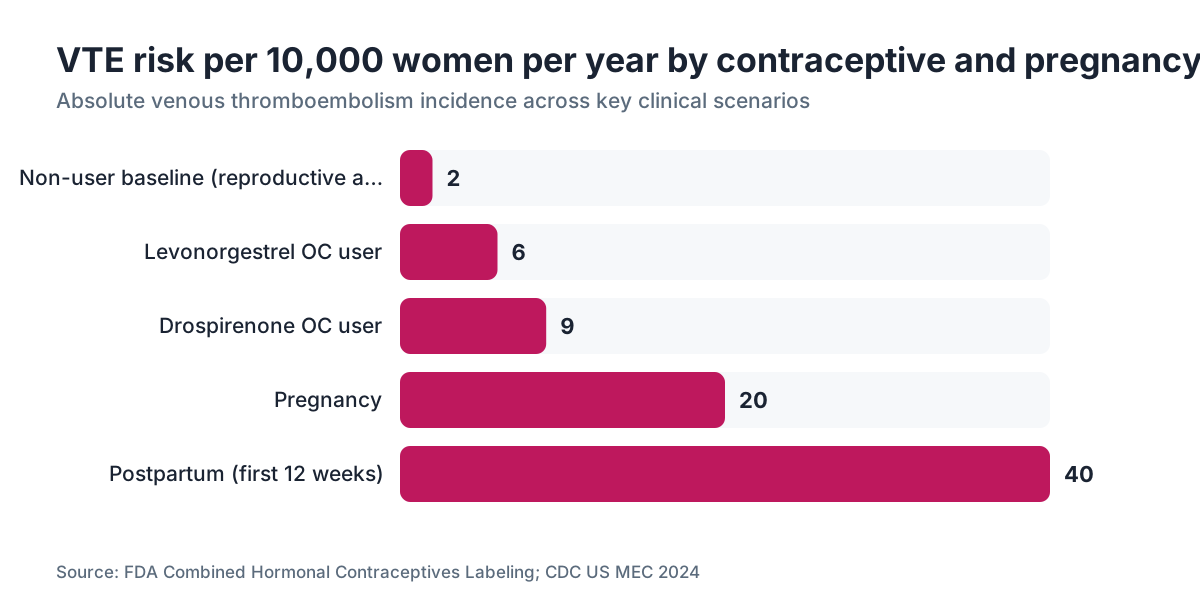
The venous thromboembolism (VTE) risk with combined OCs is well-documented and not trivial. Healthy non-users of reproductive age run a baseline VTE risk of about 2 per 10,000 women per year. Combined OC users sit at roughly 3 to 4 times that, so about 6 to 9 per 10,000 per year, depending on the progestin [6].
The progestin choice matters. Third and fourth-generation progestins (desogestrel, gestodene, drospirenone) appear to carry more VTE risk than second-generation progestins (levonorgestrel). A large observational analysis published in the BMJ found that drospirenone-containing pills carried about 65% higher VTE risk than levonorgestrel-containing ones [7]. That's why some clinicians favor levonorgestrel pills for perimenopausal women whose cardiovascular risk is already ticking up.
Arterial events (stroke, heart attack) track mostly with smoking and hypertension rather than age alone in otherwise healthy women. Blood pressure control genuinely matters here. In a non-smoker with well-managed blood pressure, the arterial risk of low-dose OCs is low, though never zero.
Put the numbers next to each other. The added VTE risk from OC use in a healthy non-smoking 45-year-old is small, probably 3 to 6 extra events per 10,000 women per year. That's below the VTE risk of pregnancy itself, roughly 20 per 10,000 pregnancies. So for women who need contraception, the math often still favors the pill over an unintended pregnancy, especially at perimenopausal ages when obstetric risk is elevated too.
Women with borderline cardiovascular risk factors deserve a real conversation. Not a reflexive prescription, and not a reflexive no.
Which specific low-dose pills are most commonly used in perimenopause?
No single formulation is FDA-approved specifically for perimenopausal symptoms. The FDA approves these pills for contraception, full stop. The symptom uses rest on clinical evidence and professional guidelines, not a dedicated indication.
Still, menopause clinicians tend to reach for a handful of pills.
Loestrin 1/20 and its generics hold 20 mcg ethinyl estradiol and 1 mg norethindrone acetate. This is the pill from the 2013 Menopause RCT above [3]. It has the strongest evidence for hot flash reduction.
Yaz and Beyaz combine 20 mcg EE with drospirenone. The anti-androgenic and mild antimineralocorticoid effects can ease bloating and acne. Remember the higher VTE signal with drospirenone, though.
Alesse and other levonorgestrel-containing 20 mcg pills carry the theoretical edge of lower VTE risk, though head-to-head data in perimenopausal women specifically is thin.
Some women move to the vaginal ring (NuvaRing, about 15 mcg EE daily) or the patch (Xulane, 35 mcg EE) on preference. Transdermal and transvaginal delivery skips the hepatic first-pass effect, which should reduce VTE risk in theory, though that evidence is cleaner for estradiol-based HRT than for ethinyl estradiol contraceptives.
The progestin-only "mini-pill" (norethindrone 0.35 mg daily) is the fallback for women who can't take estrogen. It's weaker on hot flashes and irregular bleeding because it doesn't stop estrogen from swinging, but it works for women who smoke or have estrogen contraindications.
Picking between formulations is an individual call with a clinician who knows your full history. If you're exploring personalized hormone options, WomenRx runs telehealth consultations with clinicians who focus on exactly this transition.
How do you know when to stop the pill and transition to HRT?
This is one of the genuinely tricky calls in perimenopausal care. The catch: you can't measure FSH accurately while you're on a combined OC, because the pill suppresses the pituitary hormones FSH testing reads. So standard bloodwork can't confirm menopause while you're still taking it.
Here's the workaround most clinicians use. At age 50 or 51, stop the OC for 4 to 6 weeks (use barrier contraception during that window), then check FSH and estradiol. An FSH above 30 IU/L on two draws 4 to 6 weeks apart, plus no periods, points to menopause [2]. If you still want hormone therapy at that point, switching to menopausal HRT makes sense, because the OC dose is higher than you need for symptom control.
If testing shows you haven't hit menopause yet, restart the pill. Repeat this dance annually if you're still cycling.
There's a second practical marker. If a woman on a pill that produces a withdrawal bleed suddenly stops bleeding, and she's in her late 40s or early 50s, that can signal her own estrogen has dropped low enough that she's near or at menopause. The withdrawal bleed happens because progestin withdrawal sloughs the estrogen-primed lining. No bleed means either the progestin is too strong for her lining or her estrogen is now genuinely low.
No guideline sets a hard universal cutoff, but age 55 is the number most cited as the point where spontaneous ovulation essentially never happens, so contraception is no longer needed regardless. Most clinicians won't keep a woman on a combined OC past 55 for any reason.
For context on what menopause age and when menopause starts look like across the population, those pieces help set expectations.
Does low-dose birth control prevent pregnancy reliably during perimenopause?
Yes. Combined OCs are among the most effective reversible contraceptives you can get. Perfect use fails about 0.3% of the time per year. Typical use fails around 7 to 9% per year across all ages [8]. Perimenopausal women tend to hit better typical-use adherence than younger women, just because they're more motivated and more consistent. Fertility also drops with age, which shrinks the absolute pregnancy risk even when the pill's mechanism is identical.
Contraception still matters in perimenopause because ovulation can happen throughout the transition. A 44-year-old who hasn't bled in four months is not necessarily post-menopausal. She could be in a quiet stretch and ovulate next month. An unintended pregnancy at this age carries meaningfully higher risks of miscarriage, chromosomal abnormality (Down syndrome risk is roughly 1 in 30 at age 45), and obstetric complications [9].
The CDC's U.S. Medical Eligibility Criteria for Contraceptive Use (US MEC), the main American guidance for contraceptive safety, rates combined OCs Category 1 (no restriction) for women under 40 without risk factors, Category 2 (benefits generally outweigh risks) for women 40 and older, and Category 3 or 4 when specific contraindications show up [8]. That framework gives clinicians a structured way to decide.
If you don't want a daily pill, a hormonal IUD gives you contraception and cuts bleeding without systemic estrogen, which helps women who can't take estrogen. The copper IUD is fully hormone-free. Either can cover contraception while a low-dose estrogen patch or gel handles symptoms separately.
What about low-dose birth control and breast cancer risk?
This is the question most women ask, and the honest answer is: the data shows a small bump in relative risk, the absolute increase is modest, and you have to weigh it against your own risk factors.
A 2017 Danish cohort study in the New England Journal of Medicine followed more than 1.8 million women and found that current or recent hormonal contraceptive use came with a relative breast cancer risk of 1.20, roughly a 20% increase over never-users [10]. In absolute terms, for women aged 40 to 44, that worked out to about one extra breast cancer per 7,690 women per year of use.
A few nuances matter. The risk wasn't limited to combined OCs. Progestin-only pills and hormonal IUDs showed elevated risk too. Risk rose with longer duration. And after stopping, the extra risk faded back toward baseline over about 5 years.
For a woman with a BRCA1 or BRCA2 mutation, or a strong family history, that relative increase carries more weight than it would for someone at average baseline risk. Have that conversation explicitly with a clinician or genetic counselor.
For women with a personal history of breast cancer, combined OCs are generally contraindicated, in line with FDA labeling and oncology guidelines.
For the average perimenopausal woman without major risk factors, one extra case per roughly 7,700 women per year is a small absolute risk. Whether it's acceptable depends on how bad her symptoms are, what alternatives exist, and her own calculus. Good care means laying the numbers out honestly and letting her decide.
Are there non-hormonal options for perimenopause if birth control isn't appropriate?
Yes, several, though none fully copies what estrogen does.
SSRIs and SNRIs (paroxetine, venlafaxine, escitalopram) cut hot flash frequency by 25 to 60% in trials [11]. Paroxetine 7.5 mg (brand name Brisdelle) is the only non-hormonal drug FDA-approved specifically for vasomotor symptoms. These fit women who can't use OCs or HRT, or who just want to skip hormones.
Fezolinetant (Veozah) is a newer non-hormonal option, a neurokinin B receptor antagonist that hits the hypothalamic thermoregulatory pathway directly. It won FDA approval in May 2023 and cut hot flash frequency by about 50 to 60% versus placebo in the SKYLIGHT trials [12]. It's not a contraceptive and does nothing for bleeding irregularity.
Gabapentin trims hot flashes and can help sleep, though it's sedating and not FDA-approved for this use.
Cognitive behavioral therapy (CBT) and clinical hypnosis have reasonable evidence for reducing how much hot flashes bother you, even when frequency barely moves.
For women also fighting perimenopausal weight changes, GLP-1 receptor agonists like semaglutide have drawn real clinical interest. They don't touch vasomotor symptoms, but perimenopause-related weight gain is real and hard to shift with diet alone. The evidence on semaglutide for weight loss and a comparison of semaglutide vs tirzepatide are worth a read if that's part of your picture.
No option is perfect. The best choice comes down to which symptoms hit hardest, what contraindications exist, and what you actually want.
How does progesterone fit into all of this?
Every combined OC already carries a progestin, so if you're on the pill, progesterone is baked in. But standalone progesterone therapy comes up in a nearby context.
For women who want estrogen for symptoms but can't tolerate or don't want a full combined OC, some clinicians pair a low-dose estrogen (patch or gel) with oral micronized progesterone (Prometrium) added separately to protect the uterine lining. That's a classic menopausal HRT regimen, not a contraceptive one.
Progesterone alone, without added estrogen, has modest data for easing hot flash severity. A 2018 RCT in Menopause found that oral micronized progesterone 300 mg at bedtime cut hot flashes by about 50% versus placebo and improved sleep in perimenopausal women [13]. It's a genuinely useful option in early perimenopause, when estrogen is still adequate but progesterone production (which drops first) is fading.
Oral micronized progesterone is also FDA-approved to prevent endometrial hyperplasia in women on estrogen, and it appears to carry a friendlier cardiovascular and breast cancer profile than synthetic progestins, based on the KEEPS and E3N cohort data.
The progesterone article on this site goes deeper on the pharmacological split between synthetic progestins and micronized progesterone, which matters when you're choosing between a combined OC and a custom HRT regimen.
If you're weighing telehealth to access either OCs or a custom HRT regimen, WomenRx runs clinician consultations built around this transition, including bloodwork review and prescription management.
What questions should you ask your doctor before starting a low-dose OC in perimenopause?
Walking in prepared changes the whole appointment. Here's what actually matters.
Be specific about symptoms. "I have irregular periods" tells a clinician far less than "my cycles run 18 to 45 days, I flood for the first three days, and I get 10 to 15 hot flashes a day." Specifics match the treatment to the real problem.
Ask whether you even need contraception. If you've had a tubal ligation, you're in a same-sex relationship, or your partner has had a vasectomy, the OC's contraceptive effect may be pointless for you. In that case, lower-dose HRT may serve you better with less cardiovascular load.
Ask about your cardiovascular risk directly. Blood pressure, BMI, smoking history, family history of clots or stroke, and any history of migraines with aura all decide whether combined OCs fit. Your clinician should be asking all of this. If they aren't, ask it yourself.
Ask whether a progestin-only pill or a hormonal IUD plus separate estrogen would give you what you need with less systemic estrogen.
Ask about the exit plan. When do you check FSH to see whether you've reached menopause? What happens if the pill stops producing a withdrawal bleed? What's the plan at age 50 or 51?
Ask about monitoring. Annual blood pressure checks are standard on any combined OC. A lipid panel every few years is reasonable. Mammograms follow standard age-appropriate screening.
Finally, ask whether your symptoms really point to perimenopause or whether something else needs ruling out. Thyroid disease, anemia, and primary ovarian insufficiency all mimic this picture and should be excluded before anyone assumes the answer is hormones.
Frequently asked questions
Can a 45-year-old woman safely take birth control pills?
Yes, if she doesn't smoke, has well-controlled blood pressure, no history of clots or migraines with aura, and no estrogen-sensitive cancers. The CDC's US Medical Eligibility Criteria rates combined OCs Category 2 for women 40 and older (benefits generally outweigh risks) when no extra risk factors are present. Smoking is a hard contraindication at 35 and above.
Will low-dose birth control mask menopause symptoms or hide the fact that I've reached menopause?
Yes, it can. Because combined OCs suppress pituitary hormones, FSH testing is unreliable while you're on the pill. You also keep having regular withdrawal bleeds, which don't reflect your underlying ovarian function. Most clinicians recommend stopping the pill briefly around age 50 to 51 and testing FSH and estradiol to check whether menopause has happened before deciding to continue or switch to HRT.
Is low-dose birth control the same as hormone replacement therapy?
No. They use different estrogens at different doses for different jobs. OCs use synthetic ethinyl estradiol at doses that work for contraception and symptom control. Menopausal HRT uses lower doses of estradiol (often bioidentical) to relieve symptoms without contraceptive suppression. OCs carry higher cardiovascular risk and aren't appropriate for women who don't need contraception when HRT hits the same symptom goals at lower hormonal load.
Can birth control pills help with perimenopause weight gain?
Not directly, and they won't prevent it. Perimenopausal weight gain comes mostly from declining estrogen and metabolic shifts, not ovulatory cycles. OCs may cut fluid retention in some women (especially drospirenone pills), but they don't touch the metabolic changes that make the 40s and 50s hard on body composition. Diet, resistance training, and sometimes GLP-1 medications are better tools for that piece.
What's the lowest effective dose of birth control for perimenopause symptoms?
Most evidence for hot flash control points to 20 mcg ethinyl estradiol pills as the minimum effective dose. Ultra-low-dose pills (10 to 15 mcg EE) exist, but data in perimenopausal women specifically is thinner. Going below 20 mcg may weaken cycle control and symptom relief without meaningfully improving safety. The 20 mcg / 1 mg norethindrone acetate combination has the best evidence for vasomotor symptoms specifically.
How long does it take for low-dose birth control to reduce hot flashes?
Most women notice improvement within 1 to 2 cycles (roughly 4 to 8 weeks). The 2013 RCT in Menopause showed significant reductions in hot flash scores by week 12. If symptoms aren't meaningfully better after 3 months, it's worth reassessing whether the formulation, the dose, or the diagnosis itself needs another look.
Can I take low-dose birth control if I have high blood pressure?
Uncontrolled hypertension is a contraindication to combined OCs. Well-controlled hypertension (Stage 1, on medication) puts them in the higher-risk category, and most guidelines recommend caution or avoidance. Progestin-only pills, hormonal IUDs, or non-hormonal options are generally preferred for women with significant hypertension, because they don't add to arterial risk the way estrogen-containing pills do.
Do I still need birth control in my late 40s?
Until 12 straight months pass without a period (the clinical definition of menopause), ovulation is possible and pregnancy is possible. Fertility is low but not zero. An unintended pregnancy at 45 or 48 carries higher risks of chromosomal abnormality and obstetric complications than at younger ages. Most clinicians recommend contraception through confirmed menopause, which lands around 51 but varies by individual.
What happens to my bones if I go off birth control in perimenopause without replacing it with HRT?
Bone loss speeds up during perimenopause and menopause as estrogen falls. OCs offer some bone protection through their estrogen content. Stop OCs without switching to HRT or another bone-protective therapy, and you lose that cover. Baseline bone density testing, calcium, vitamin D, and resistance exercise all count. Women at high fracture risk should build a specific plan with their clinician before stopping any estrogen therapy.
Are there perimenopausal women for whom low-dose birth control is clearly the best option?
Yes. A 44-year-old non-smoker with normal blood pressure who has debilitating hot flashes, flooding periods, and still needs reliable contraception is a near-ideal candidate. The OC solves all three at once. Once menopause is confirmed and contraception is no longer needed, switching to lower-dose HRT makes sense, but the OC is the right tool for this specific season.
Can low-dose birth control help with heavy periods during perimenopause?
Yes. Heavy, irregular bleeding is one of the most disruptive perimenopausal symptoms, driven by anovulatory cycles where estrogen builds the lining without timely progesterone withdrawal. Combined OCs regulate this by creating a predictable cycle and reducing endometrial proliferation. Levonorgestrel IUDs are also highly effective for heavy bleeding specifically and involve less systemic hormone exposure if that's a concern.
Should I get genetic testing for clotting disorders before starting birth control in my 40s?
Not routinely for everyone, but it's worth discussing if you have a first-degree relative who had a DVT or pulmonary embolism before age 50, or if you've had an unexplained clot yourself. Thrombophilias like Factor V Leiden or Prothrombin G20210A significantly raise VTE risk with combined OCs. Population-wide screening isn't recommended because the yield is low, but targeted testing based on family history is reasonable.
What's the difference between the mini-pill and low-dose combined birth control in perimenopause?
The mini-pill is progestin-only (norethindrone 0.35 mg daily) and works mainly by thickening cervical mucus rather than reliably suppressing ovulation. It's safer for women who can't use estrogen (smokers over 35, hypertension, clot history) and adds no VTE risk. The downside: it doesn't reliably cut hot flashes or regulate bleeding in perimenopausal women, because it doesn't steady the erratic estrogen swings driving those symptoms.
Will low-dose birth control affect my mood during perimenopause?
It might help or hurt, depending on the person. Some women get steadier mood because OCs smooth the hormonal swings that trigger irritability and anxiety. Others find certain progestins worsen depression or PMS-like symptoms. Drospirenone pills are sometimes preferred by women with mood sensitivity because of the anti-androgenic effect. If you have a history of depression, raise it specifically with your clinician before starting.
Sources
- NAMS, Menopause Practice: A Clinician's Guide
- ACOG, Practice Bulletin No. 141: Management of Menopausal Symptoms
- Menopause (journal), Casper RF et al. 2013: Low-dose OC for perimenopausal symptoms RCT
- NIH Office of Dietary Supplements, Bone Health and Osteoporosis
- NAMS, 2022 Hormone Therapy Position Statement
- FDA, Combined Hormonal Contraceptives Labeling Guidance
- BMJ, Vinogradova Y et al. 2015: Use of combined oral contraceptives and risk of venous thromboembolism
- CDC, U.S. Medical Eligibility Criteria for Contraceptive Use (US MEC), 2024
- CDC, Reproductive Health, Maternal and Infant Health
- NEJM, Mørch LS et al. 2017: Contemporary Hormonal Contraception and the Risk of Breast Cancer
- NAMS, 2023 Nonhormonal Management of Menopause-Associated Vasomotor Symptoms Position Statement
- FDA Drug Approval Package: Fezolinetant (Veozah), May 2023
- Menopause (journal), Hitchcock CL et al. 2018: Oral micronized progesterone for hot flashes and sleep RCT