Is HRT covered by insurance? What women actually get paid
TL;DR: Most FDA-approved hormone replacement therapy prescriptions are covered by at least partial insurance reimbursement under private plans, Medicaid, and Medicare Part D, but coverage varies widely by plan formulary, hormone type, and delivery method. Bioidentical compounded hormones are almost never covered. Out-of-pocket costs range from $0 to over $300 per month depending on your insurer and the specific product.
What does insurance actually cover for HRT?
FDA-approved hormone replacement therapy is generally covered under most private insurance plans, Medicare Part D, and state Medicaid programs. The degree of coverage varies enormously. Your plan's formulary, the tier your specific HRT product lands on, and whether you need prior authorization all decide what you actually pay.
HRT covers a broad set of products: estrogen-only therapy (pills, patches, gels, sprays, vaginal rings), combined estrogen-progestogen therapy, and progestogen-only options like oral micronized progesterone. [1] Each of those has multiple branded and generic versions, and insurers treat them differently. A generic oral estradiol tablet might be Tier 1 (near-zero copay) on your plan while a brand-name estrogen patch sits on Tier 3 with a $50 to $90 copay.
The Affordable Care Act requires most non-grandfathered private plans to cover preventive services rated A or B by the U.S. Preventive Services Task Force (USPSTF) without cost-sharing. HRT for menopausal symptom relief has no blanket A or B USPSTF rating for primary prevention, so there is no federal mandate forcing private plans to cover it for free. [2] Plans cover it because it is a legitimate prescription benefit, not because the law forces zero cost-sharing.
For a deeper look at what hormone replacement therapy is and which formulations exist, that background is useful before you call your insurer.
Does Medicare cover HRT?
Medicare Part D covers most FDA-approved HRT prescriptions, but with wide variation across plans. Medicare Part B generally does not cover self-administered outpatient drugs, which is where most HRT lives. [3]
Under Part D, each plan runs its own formulary. The Centers for Medicare and Medicaid Services (CMS) requires Part D plans to cover drugs in certain protected classes, but hormone therapy for menopause is not one of those. That means your Part D plan can place estradiol patches or oral progesterone on any tier it chooses, or exclude specific brand-name products entirely.
In practice, most Part D plans include at least one oral estradiol and one progestogen option at Tier 1 or Tier 2. The 2023 median monthly premium for a stand-alone Part D plan was about $31, but your out-of-pocket drug cost depends entirely on which tier your HRT lands on. [3]
If you are on Medicare Advantage (Part C), the drug coverage is bundled in, and the same formulary logic applies. Call the plan's pharmacy benefits line and ask specifically: "Is estradiol 0.1 mg patch covered, and what tier is it?" Get the answer in writing or note the date, representative name, and reference number.
Medicare does not cover compounded bioidentical hormones. Full stop. CMS has been explicit that compounded drugs are not FDA-approved and therefore not eligible for Part D reimbursement. [3]
Does Medicaid cover hormone replacement therapy?
Medicaid coverage for HRT varies by state because each state runs its own formulary within federal guidelines. Most state Medicaid programs cover at least generic oral estradiol and generic medroxyprogesterone acetate (MPA), which are the least expensive options. [4]
Other formulations, like the estradiol patch, estradiol vaginal ring, or oral micronized progesterone (brand name Prometrium), may require prior authorization or may not be covered at all in some states. If your state Medicaid plan denies a specific product, ask your prescriber to submit a prior authorization with medical necessity documentation. Denials are frequently overturned when a clinician explains why a lower-cost alternative is not appropriate for you.
For women who qualify for both Medicare and Medicaid (dual eligible), the Medicaid program typically wraps around Part D coverage and may pick up remaining cost-sharing for covered drugs. Check with your state's Medicaid office for the current rules.
How do private insurance plans handle HRT coverage?
Private employer-sponsored plans and individual marketplace plans each set their own formularies, subject to ACA minimum requirements. Most cover HRT because it is a standard prescription benefit. Tier placement decides your actual cost.
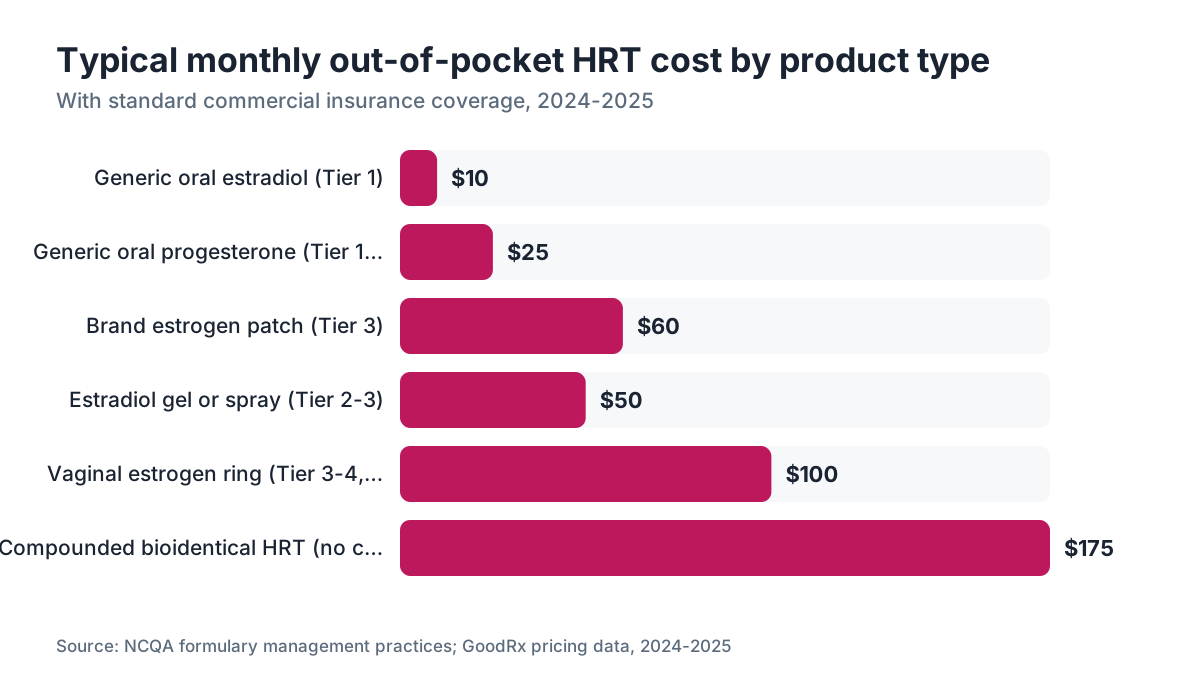
Here is roughly how the tier math works for a typical plan:
| HRT product type | Typical formulary tier | Typical monthly copay range | |---|---|---| | Generic oral estradiol | Tier 1 (preferred generic) | $0 to $10 | | Generic oral progesterone / MPA | Tier 1-2 | $0 to $25 | | Brand-name estrogen patch | Tier 2-3 | $30 to $90 | | Estradiol transdermal gel or spray | Tier 2-3 | $30 to $75 | | Vaginal estradiol ring (Estring/Femring) | Tier 3-4 | $50 to $150 | | Compounded bioidentical HRT | Not covered | Full cash price |
Data reflects typical commercial plan structures; your specific plan may differ. [5]
Some plans require prior authorization for higher-tier products, meaning your prescriber must document that lower-tier alternatives were tried or are inappropriate. This is common with branded patches and vaginal rings. Marketplace plans sold through HealthCare.gov must include prescription drug coverage as an essential health benefit, so HRT will be covered in some form, even if the specific brand you prefer is not. [2]
If you are on a high-deductible health plan (HDHP) with a health savings account (HSA), prescription drugs count toward your deductible. You can use HSA funds tax-free to pay for covered HRT costs, including copays after you meet the deductible.
What kinds of HRT are almost never covered?
Compounded bioidentical hormone therapy (cBHT) is the biggest coverage gap. These are custom-mixed preparations made by compounding pharmacies, often prescribed as troches, pellets, or creams with specific hormone ratios not available in FDA-approved products.
The FDA has said repeatedly that compounded hormones lack the clinical evidence of approved products and are not considered therapeutically equivalent. [6] Because they are not FDA-approved, commercial insurers, Medicare Part D, and most Medicaid programs will not reimburse them. Patients pay cash, which typically runs $50 to $300 or more per month depending on the formulation and pharmacy.
Pellet therapy, where hormones are implanted under the skin every three to six months, is also almost universally not covered. The procedure itself is not reimbursed by most insurers, and the pellets are compounded.
Some newer vaginal DHEA products (prasterone, brand name Intrarosa) and ospemifene (Osphena), a pill for painful sex due to vaginal dryness, are FDA-approved but expensive and often on high tiers. They sometimes require prior authorization and step therapy (trying cheaper alternatives first). [7]
If your prescriber recommends a product that is not on your formulary, ask about a formulary exception. These are legally available under most plans and require documented medical necessity.
Does insurance cover HRT for surgical menopause or premature ovarian insufficiency?
Yes, and often more reliably than for natural menopause. Surgical menopause (from oophorectomy) and premature ovarian insufficiency (POI), which is ovarian failure before age 40, are recognized medical diagnoses with strong clinical guidelines supporting hormone therapy. [8]
The Endocrine Society's clinical practice guideline states that women with POI should receive hormone therapy at least until the average age of natural menopause (around 51) because withholding it carries real risks: cardiovascular disease, osteoporosis, and cognitive effects. [8] When a prescriber documents a diagnosis code like premature ovarian failure (ICD-10 E28.310) or surgical menopause (Z78.0), insurers are much less likely to deny coverage and prior authorizations are easier to win.
If you have one of these diagnoses and your insurer is giving you trouble, have your prescriber attach the clinical guideline language to the prior authorization. The Endocrine Society's POI guidance is a useful document to cite.
For context on when natural menopause typically occurs and what separates it from surgical or premature menopause, that background helps frame the conversation with your insurer.
What does HRT cost without insurance, and are there ways to reduce it?
Without insurance, the cash cost of HRT swings hard by product.
Generic oral estradiol (1 mg or 2 mg tablets) can cost as little as $9 to $20 per month through GoodRx or a warehouse pharmacy like Costco. Generic oral micronized progesterone (100 mg capsules) runs roughly $30 to $60 per month at similar discount pharmacies. [9]
Brand-name patches like Vivelle-Dot or Climara, without any discount, can run $100 to $200 per month. Estradiol gels and sprays are typically in the $80 to $180 range at retail. The estradiol vaginal ring (Estring) can cost $250 to $400 per fill without insurance, though it lasts 90 days.
Several ways to cut costs:
- GoodRx, RxSaver, and similar discount cards work at most retail pharmacies and are free to use. They sometimes beat your insurance copay.
- Manufacturer patient assistance programs exist for brand-name products. Pfizer, Bayer, and other manufacturers offer programs for income-qualifying patients.
- Mark Cuban's Cost Plus Drugs (costplusdrugs.com) carries some generic estradiol and progesterone formulations at dramatically lower prices.
- Telehealth platforms that prescribe HRT directly sometimes negotiate lower pharmacy rates or offer bundled pricing. WomenRx, for example, connects women with clinicians who can help find covered or lower-cost formulations that still match their clinical needs.
The lowest-cost covered option is almost always generic oral estradiol plus generic oral progesterone. If patches or gels work better for you biologically, it is worth fighting the prior auth rather than defaulting to pills.
How do you find out if your specific HRT is covered before you fill it?
Call the member services number on the back of your insurance card and ask specific questions. General inquiries get general answers. Specific questions get useful ones.
Ask: "Is NDC [your drug's NDC number, which your prescriber or pharmacy can provide] covered under my plan?" Also ask: "What tier is it on?" and "Is prior authorization required?" Your prescriber's office can run an electronic benefits check (sometimes called a prior auth check) before writing the prescription, which catches problems before you are standing at the pharmacy counter.
You can also look up your plan's formulary directly. Every insurer is required to post a current formulary online. Download it, search for the drug name, and check the tier and any restriction codes (PA = prior authorization, QL = quantity limit, ST = step therapy).
If your drug is denied, you have the right to appeal. The ACA requires internal appeal rights and, for most plans, an independent external review. Denial letters must include the specific reason for denial, which tells you exactly what documentation your prescriber needs to submit on appeal. Most formulary exception appeals that include a physician letter and a reference to published clinical guidelines succeed.
One more thing. Pharmacy benefit managers (PBMs) negotiate between insurers and drug makers, and they change formularies at the start of each plan year. A drug that was Tier 1 last January can jump to Tier 3 the next January. Check your formulary annually during open enrollment.
Does the Affordable Care Act require insurance to cover HRT?
Not explicitly, and this trips people up constantly. The ACA requires non-grandfathered plans to cover certain preventive services with no cost-sharing, based on USPSTF A and B recommendations. [2] The USPSTF currently recommends against using HRT to prevent chronic conditions in postmenopausal women (a D recommendation for that specific use), which means the ACA preventive care mandate does not apply to HRT as a preventive tool. [10]
The ACA does require that all plans sold on the individual and small-group markets cover prescription drugs as an essential health benefit. That means some form of HRT must be covered on those plans. The law does not specify which formulations or at what cost-sharing level, so plans have wide latitude on tier placement and prior authorization.
Grandfathered plans (older employer plans that have not made significant changes since 2010) are exempt from some ACA rules and may have thinner coverage.
The short version: HRT is covered by prescription drug benefits, not by the preventive care mandate. You will pay some cost-sharing unless your specific product is Tier 1 with a $0 copay on your particular plan.
What about HRT coverage for trans women and non-binary people?
Section 1557 of the ACA prohibits sex discrimination by health programs receiving federal funding, and several federal and state courts have read this to require coverage of gender-affirming hormone therapy for transgender and non-binary patients. Enforcement has been inconsistent and has shifted with each political administration. [11]
As of mid-2025, some states have explicit protections requiring insurers to cover gender-affirming care, while others have passed laws restricting or prohibiting it. The legal picture is actively changing.
For trans women seeking estrogen therapy, the clinical products are identical to those used for menopausal HRT. If a plan covers estradiol for a cisgender woman, a blanket denial for a trans woman using the same product is potentially discriminatory under federal law. The National Center for Transgender Equality (transequality.org) keeps updated guidance on insurance rights.
For clinical context on progesterone and how it fits into various hormone regimens, that background is useful regardless of why you are seeking HRT.
How does HRT coverage compare to GLP-1 weight loss drug coverage?
This comparison is useful because both drug classes sit in a similar gray zone: real clinical benefit, significant out-of-pocket costs, and inconsistent insurer behavior.
GLP-1 receptor agonists like semaglutide (Ozempic, Wegovy) and tirzepatide (Zepbound) for weight loss are covered by some private insurers and a growing number of Medicaid programs, but not by Medicare for the obesity indication as of mid-2025, pending CMS rulemaking. [12] HRT, by contrast, has been covered by commercial plans and Medicare Part D for decades and faces fewer outright denials. The prior authorization burden for HRT is lower than for GLP-1s for weight loss, and the out-of-pocket costs for covered HRT are dramatically lower (often under $30 a month for generics versus $500 or more per month for brand-name GLP-1s without coverage).
If you are weighing both options or combining them, the coverage math for each matters. See our articles on semaglutide for weight loss and semaglutide vs tirzepatide for the cost and coverage picture on GLP-1s specifically.
What should you do if your insurer denies HRT coverage?
First, get the denial in writing. You are entitled to an Explanation of Benefits (EOB) and a denial letter that states the specific reason.
Second, ask your prescriber to submit a prior authorization with the medical necessity rationale. If this is for menopausal symptoms, documentation of symptom severity helps. If this is for POI or surgical menopause, the diagnosis code alone often resolves the denial.
Third, if the PA is denied, file a formal appeal. Internal appeals must be decided within 30 days for non-urgent care under ACA rules. If the internal appeal fails, you can request an independent external review. Plans are legally required to comply with external review decisions in most states.
Fourth, ask about a formulary exception. This is separate from a PA. A formulary exception asks the insurer to cover a non-formulary drug, or a higher-tier drug at a lower tier, due to medical necessity. The standard is lower than you might expect: your prescriber needs to document that covered alternatives are contraindicated or ineffective for you.
Fifth, look into state-level protections. Some states have laws requiring coverage of specific hormone therapies or prohibiting certain insurance practices around women's health. Your state insurance commissioner's website is the right place to look.
If prior authorization issues or access problems are part of your picture, telehealth providers who specialize in women's hormones, like WomenRx, often have staff who work these appeals daily and can help you understand which covered alternatives might work clinically.
Frequently asked questions
Is HRT covered by insurance?
Most FDA-approved HRT prescriptions are covered under private insurance plans, Medicare Part D, and Medicaid, but coverage depends on your specific plan's formulary. Generic oral estradiol and progesterone are almost always Tier 1 or 2 with low copays. Brand-name patches and rings may require prior authorization. Compounded bioidentical hormones are almost never covered.
Does Medicare Part D cover estrogen patches?
It depends on your specific Part D plan's formulary. Most plans cover at least one estradiol patch option, but brand-name patches like Vivelle-Dot may be on Tier 3 with a $30 to $90 monthly copay. Generic estradiol patches, where available, are cheaper. Call your Part D plan directly and ask for the tier placement of the specific drug and dosage you need.
How much does HRT cost without insurance?
Generic oral estradiol can cost as little as $9 to $20 per month at discount pharmacies. Generic oral progesterone runs about $30 to $60 per month. Brand-name patches cost $100 to $200 per month at retail. Estradiol vaginal rings (90-day supply) can be $250 to $400. GoodRx and similar discount cards often cut these prices significantly.
Does insurance cover bioidentical hormone therapy?
FDA-approved bioidentical hormones (like oral estradiol and oral micronized progesterone) are typically covered. Custom-compounded bioidentical hormones made at a compounding pharmacy are almost never covered by any insurer, including Medicare and Medicaid, because they are not FDA-approved products. Patients pay full cash price for compounded preparations.
Is progesterone covered by insurance?
Generic oral micronized progesterone is covered by most private plans and Medicare Part D at Tier 1 or 2, typically $0 to $25 per month. Brand-name Prometrium sits on higher tiers at some plans. Synthetic progestins like medroxyprogesterone acetate (MPA) are also covered and are among the cheapest options.
Does insurance cover HRT for perimenopause?
Yes, if a licensed prescriber diagnoses perimenopausal symptoms and writes a prescription, insurance treats it the same as any other HRT prescription. Coverage follows your plan's formulary. The prescriber should document symptom severity in the record, which helps if a prior authorization is needed. There is no age cutoff in insurance rules that blocks perimenopausal women from HRT coverage.
Can I use my HSA or FSA to pay for HRT?
Yes. Prescription HRT costs are eligible expenses for both health savings accounts (HSAs) and flexible spending accounts (FSAs). This includes copays, deductible spending, and cash-pay prescriptions for FDA-approved HRT products. Compounded HRT prescriptions are generally also FSA/HSA eligible if they are prescribed by a licensed provider, though some FSA administrators require a letter of medical necessity.
What ICD-10 codes help get HRT covered?
Common codes that support HRT prior authorization include N95.1 (menopausal and female climacteric states), E28.310 (symptomatic premature ovarian failure), Z78.0 (asymptomatic menopausal state), and codes for osteoporosis prevention. Having your prescriber include an accurate diagnosis code on the prescription and PA submission significantly reduces denial rates.
Does Medicaid cover HRT?
Most state Medicaid programs cover generic oral estradiol and MPA (medroxyprogesterone acetate) at little or no cost. More detailed formulations like estradiol patches or oral micronized progesterone may require prior authorization. Coverage rules vary by state. Call your state Medicaid plan or check the state's published drug formulary to confirm which specific products are covered.
Does insurance cover vaginal estrogen for dryness?
Vaginal estrogen products (cream, ring, tablet) are usually covered for urogenital symptoms of menopause, though the specific product covered varies by plan. Low-dose vaginal estrogen is often on Tier 2. The vaginal ring Estring may require a prior auth. Ospemifene (Osphena), an oral non-hormonal option, is FDA-approved but often on higher tiers and may need step therapy documentation.
How do I appeal an insurance denial for HRT?
Request the denial in writing, then have your prescriber submit a prior authorization with medical necessity documentation. If denied again, file a formal internal appeal within the timeframe on your denial letter (often 60 to 180 days). The ACA requires plans to respond to non-urgent appeals within 30 days. If the internal appeal fails, you can request a free independent external review, which the plan must comply with.
Is the estrogen patch covered by Medicare?
Estradiol patches are covered by most Medicare Part D plans, but coverage depends on your specific plan's formulary. Some plans cover a generic patch at Tier 2; others place brand-name patches like Vivelle-Dot on Tier 3 with a higher copay. Medicare Part B does not cover self-administered drugs. Check your Part D plan's formulary each year during open enrollment, since tier placements can change annually.
Is HRT covered during a bone density test workup?
A bone density test (DEXA scan) and HRT are billed separately. The DEXA scan itself may be covered as a preventive service for women 65 and older under Medicare, or earlier if you have osteoporosis risk factors. If low bone density is found and HRT is prescribed for osteoporosis prevention, the osteoporosis diagnosis code can support the HRT prior authorization. See our article on bone density testing for more on how screening and treatment intersect.
Sources
- FDA, Approved Risk Evaluation and Mitigation Strategy (REMS) and labeling for menopausal hormone therapy products
- HealthCare.gov, Preventive care benefits for women
- Medicare.gov, Drug coverage (Part D)
- Medicaid.gov, Prescription drugs
- NCQA, Health plan formulary management and tiering practices
- FDA, Compounding and the FDA: Questions and Answers
- FDA, Intrarosa (prasterone) prescribing information
- Endocrine Society, Clinical practice guideline on primary ovarian insufficiency in adolescents and women
- GoodRx, Estradiol and progesterone pricing data
- USPSTF, Hormone therapy for the primary prevention of chronic conditions in postmenopausal women
- HHS Office for Civil Rights, Section 1557 of the Affordable Care Act
- KFF, An Overview of Medicare Coverage of GLP-1 Drugs
- The Menopause Society, 2022 Hormone Therapy Position Statement