Is compounded semaglutide going away? What women need to know
TL;DR: The FDA resolved the semaglutide shortage on May 22, 2025. That ended the legal basis for compounding copies of Ozempic and Wegovy under shortage rules. Large 503B outsourcing facilities stopped first. Some 503A pharmacies may still fill personalized prescriptions under ongoing court orders. Most women on compounded semaglutide need a branded product or an alternative now.
What actually happened with compounded semaglutide in 2025?
The FDA put semaglutide on its drug shortage list in 2022 because Novo Nordisk could not make enough Ozempic and Wegovy to meet demand. That shortage opened a legal door. Under Sections 503A and 503B of the Federal Food, Drug, and Cosmetic Act, licensed compounding pharmacies can prepare copies of a drug that sits on the shortage list, even when patents and exclusivity would normally block them [1]. Hundreds of pharmacies walked through that door. By late 2023, tens of thousands of women were getting injectable semaglutide compounded at a fraction of the branded price.
On May 22, 2025, the FDA removed semaglutide from the shortage list and declared supply adequate [2]. That declaration started a clock. 503B outsourcing facilities, the larger FDA-registered compounders that supply many telehealth platforms, got a wind-down period. 503A pharmacies that fill individual prescriptions got a different timeline, later reshaped by court orders.
If you are on compounded semaglutide and nobody explained any of this to you, you are not alone. Clinics and pharmacies rolled out the news unevenly. Some patients found out when their next shipment simply did not arrive.
Is compounded semaglutide legal right now?
The legal picture is genuinely messy, and it has flipped more than once because of federal court rulings. Here is the honest version: if you fill from a 503A pharmacy under a valid individual prescription, you may still have access depending on the current injunction. If you got it from a large 503B outsourcer, that supply has almost certainly stopped.
After the FDA resolved the shortage, 503B facilities were told to stop making copies of branded semaglutide. The Alliance for Pharmacy Compounding sued to challenge the decision. In April 2025, a federal district court in Texas temporarily blocked FDA enforcement against 503A compounders, which extended legal access for individually compounded prescriptions while litigation ran [3]. That injunction was later modified and appealed, so the exact status turns on the date you are reading this.
One thing stays clear regardless of the courtroom: the FDA's stated final position is that mass-compounded semaglutide copies are not legal once the shortage is over. Two narrow categories may survive. First, a 503A pharmacy filling a prescription with a clinically meaningful difference from the branded product, like a specific combination or a different form documented for a real patient need. Second, formulations built on semaglutide salts such as semaglutide acetate or sodium.
The FDA addressed those salts head on. In its May 2025 guidance the agency stated it does not consider salt forms to be legally equivalent substitutes for the branded active ingredient [2]. That guidance is itself being contested in court.
What is the timeline and deadline for stopping compounded semaglutide?
The FDA set staggered deadlines after pulling semaglutide off the shortage list. 503B facilities got roughly 60 days. 503A retail compounders got roughly 90 days. Personalized formulations sit in an ongoing category tied to litigation. Court injunctions then pushed several of these dates around.
| Pharmacy Type | Initial Deadline | Notes | |---|---|---| | 503B outsourcing facilities | 60 days after May 22, 2025 (approx. July 21, 2025) | No new batches; existing inventory could be sold through the deadline | | 503A retail compounders | 90 days after May 22, 2025 (approx. Aug. 20, 2025) | For standard copies; "office use" bulk compounding ended sooner | | Personalized 503A formulations | Ongoing, subject to litigation | Must document clinical rationale for deviation from branded product |
Those dates shifted repeatedly because of court injunctions [3]. Safest assumption: by fall 2025, standard compounded semaglutide copies from most pharmacies are no longer legal unless a court rules otherwise. Watch the FDA drug shortages page for current status [2], because this changes month to month.
Call your telehealth provider if they have not reached out with a transition plan. Do not wait until you run out to sort this.
Why did the FDA end compounded semaglutide access?
The FDA's reasoning is simple: the legal basis for compounding copies of a drug disappears once the shortage is resolved. Safety reports pushed in the same direction. Between 2023 and 2025, the agency received hundreds of adverse event reports tied to compounded semaglutide, including wrong doses, undisclosed additives, and products of uncertain sterility [4]. In 2024 the FDA published a safety communication warning about products labeled "semaglutide" that contained different active ingredients or were mislabeled.
Novo Nordisk lobbied hard for enforcement. Patient advocates and compounding groups pushed back, arguing the shortage was not truly resolved for every patient in every market. Cost is the fact hanging over all of it. Branded Wegovy lists at roughly $1,300 to $1,400 a month without insurance [5]. Compounded versions ran $200 to $500 a month at most telehealth pharmacies. For a lot of women, especially those in perimenopause and menopause using GLP-1s alongside hormone therapy, that gap decided everything.
The FDA's position, in its May 2025 guidance, is that "patients have access to FDA-approved semaglutide products" and that compounded copies are therefore unnecessary [2]. Critics note the obvious: "available" and "affordable" are not the same word.
What are the alternatives to compounded semaglutide?
You have real options. None of them matches the cost of a $250-a-month compounded prescription, but a few get close.
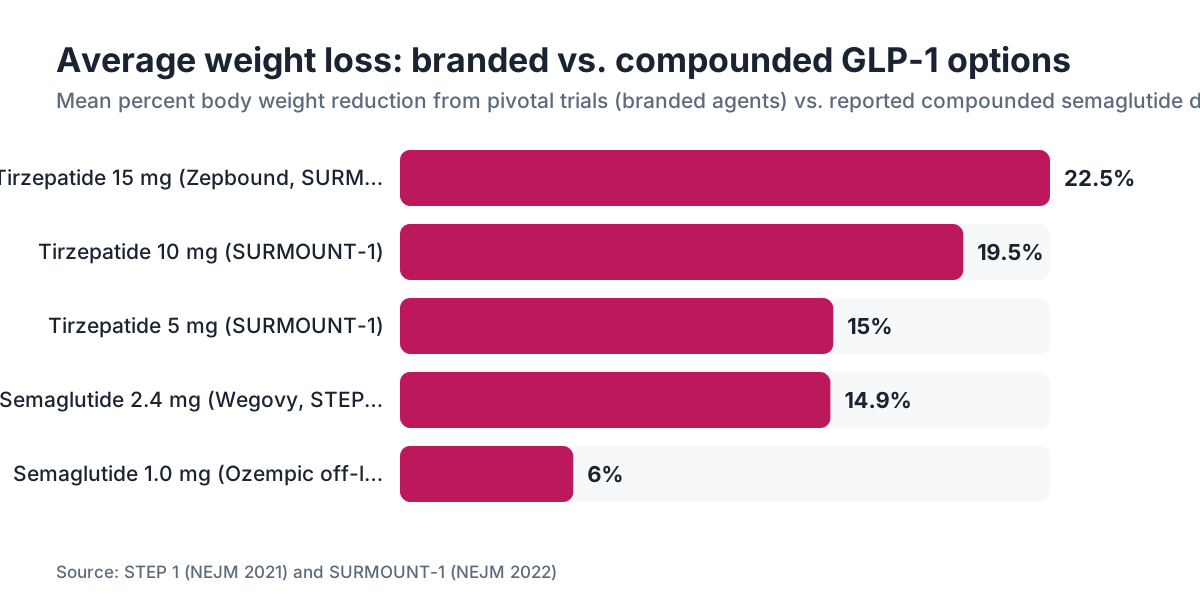
Branded Wegovy or Ozempic with insurance. Wegovy (semaglutide 2.4 mg weekly) is FDA-approved for chronic weight management. Ozempic (semaglutide 0.5 to 2 mg weekly) is approved for type 2 diabetes and prescribed off-label for weight loss constantly. Many commercial plans now cover Wegovy for patients who meet the criteria (BMI 30+, or BMI 27+ with a weight-related condition). The STEP 1 trial found Wegovy produced an average 14.9% body weight reduction over 68 weeks in adults without diabetes [6]. If your insurer covers it and you qualify, this is the cleanest path.
Novo Nordisk's patient assistance. The NovoCare program offers Wegovy for as little as $25 a month for eligible patients who meet income rules [7]. There are caps and eligibility limits, but the program is real and it does ship medication.
Tirzepatide (Mounjaro or Zepbound). Tirzepatide is a dual GIP/GLP-1 receptor agonist from Eli Lilly. SURMOUNT-1 found up to 22.5% mean weight reduction at the highest dose, meaningfully more than semaglutide [8]. Tirzepatide had its own shortage and compounding window. As of mid-2025 the FDA had not resolved every tirzepatide dose, so compounded tirzepatide may still be legal at some pharmacies. That can flip fast. Compare the two in our semaglutide vs tirzepatide guide.
Retatrutide and oral semaglutide. Oral semaglutide (Rybelsus) is FDA-approved for type 2 diabetes. Its absorption is fickle and its weight loss data are weaker than the injectables. Retatrutide is still in trials. Neither is a clean swap for compounded injectable semaglutide right now.
For women in menopause or perimenopause using GLP-1s alongside hormone therapy, the transition matters beyond cost. GLP-1 receptor agonists act on appetite and metabolic rate in ways that stack with estrogen decline. Losing access abruptly during hormonal shifts is disruptive, and more than a minor inconvenience.
Can I still get personalized compounded semaglutide with added ingredients?
Maybe. This is the gray zone that prescribers and pharmacies are working through in real time. The one word that decides it is "clinically meaningful."
503A pharmacies can legally prepare a compounded drug that differs from the commercial product in a clinically meaningful way, for an individual patient with a specific prescription. A documented allergy to an excipient in Wegovy's formulation qualifies. So might a prescriber combining semaglutide with a low-dose B12 or L-carnitine for a patient with a documented need.
Adding B12 because it makes the shot feel better does not clear the bar in the FDA's reading. The agency has been explicit that adding vitamin B12 to semaglutide to invent a "different" product is not a legitimate basis for compounding [2]. Some compounders argue that combinations like semaglutide plus NAD+ precursors or a low-dose peptide count as novel preparations outside the branded drug's scope. The FDA has pushed back on that framing.
If your prescriber writes a prescription that documents a genuine clinical reason for a formulation that differs from Wegovy or Ozempic, some 503A pharmacies will still fill it. Whether it stays legal depends on the litigation. Ask your prescriber to document the rationale specifically. Vague "personalized medicine" language will not protect a pharmacy if the FDA comes knocking.
How does losing compounded semaglutide affect women specifically?
Women between 35 and 65 took up compounded semaglutide in outsized numbers, and it made clinical sense. Weight gain across the perimenopause transition is driven partly by the metabolic slowdown that comes with estrogen decline, more than by what you eat. GLP-1 receptor agonists help by suppressing appetite and slowing gastric emptying in ways that partly offset that hormonal disruption [9].
For women already on hormone replacement therapy, losing a GLP-1 mid-course can bring a fast return of appetite dysregulation and weight. The two therapies get used together because they hit overlapping but distinct mechanisms. Estrogen improves insulin sensitivity and fat distribution. GLP-1s cut caloric intake and help preserve lean mass during weight loss. Pull one without a plan and outcomes suffer.
Cost is also an equity problem that lands harder on women. Women generally earn less and are more likely to sit on plans that historically excluded anti-obesity medications. The Affordable Care Act does not require insurers to cover weight-loss drugs, and Medicare Part D coverage of anti-obesity medications has only recently started to expand [10]. The distance between "FDA-approved and technically available" and "covered and affordable" is wider for women in their 40s and 50s who are not yet on Medicare and whose employer coverage is all over the map.
If you are managing menopause symptoms alongside weight, a provider who understands both hormonal and metabolic medicine matters. WomenRx works in exactly this overlap, including transitions from compounded to branded GLP-1 protocols during perimenopause and menopause.
For a closer look at how semaglutide fits into women's weight management, see our semaglutide for weight loss guide.
What should you do right now if you're on compounded semaglutide?
Count your remaining supply and act before it runs out. Five steps, in order.
First, contact whoever prescribes your compounded semaglutide and ask directly: can you still provide this, and if not, what is the transition plan? Good telehealth platforms should have already reached out. If yours has not, that tells you something.
Second, check your insurance for Wegovy or Zepbound (tirzepatide). Most insurers require prior authorization, and that process runs 2 to 4 weeks. Start it now, not the day you run dry. Expect to need your BMI, any weight-related conditions (hypertension, prediabetes, sleep apnea), and prior weight-loss attempts.
Third, ask about the NovoCare patient assistance program if cost is the wall [7]. Income eligibility is real and the program does deliver medication, though the application takes time.
Fourth, if you are in perimenopause or menopause, use this moment to re-check whether your hormone therapy is dialed in. Estradiol has independent benefits for body composition and metabolic function. A weak estrogen patch dose, or untreated progesterone imbalance (see progesterone), makes weight management harder no matter which GLP-1 you take. Fixing hormones does not replace a GLP-1, but it narrows the gap.
Fifth, consider an obesity medicine specialist if your primary care provider is not engaged here. The American Board of Obesity Medicine certifies physicians in this area, and many handle the compounded-to-branded transition routinely.
What are the safety concerns with compounded semaglutide women should know?
Compounded semaglutide was never FDA-approved. That does not mean it was universally unsafe. It means quality swung widely from one pharmacy to the next.
The FDA's adverse event database logged reports of hospitalizations linked to compounded semaglutide. Severe nausea and vomiting from dosing errors (compounded preparations sometimes came in concentrations that differed from branded products, which made conversion mistakes common). Infections from non-sterile technique. Some products that tested positive for contaminants [4]. The concern is not theoretical.
Reputable 503B outsourcing facilities that followed FDA guidance turned out a product that was generally consistent. Smaller compounders and some overseas operations were less reliable. If you had adverse effects on compounded semaglutide, report them to the FDA's MedWatch program (fda.gov/safety/medwatch) and tell your prescriber.
One safety note specific to women: muscle loss during GLP-1-assisted weight loss is real, and it interacts with bone. A STEP 1 analysis found that roughly 38 to 40% of the weight lost on semaglutide was lean mass, not fat [6]. For women approaching or in menopause, where bone remodeling is already hit by estrogen loss, that matters. Resistance training and enough protein are not optional extras. Know your bone density test baseline if you are 50 or older and on a GLP-1 for the long haul.
Will compounded semaglutide come back if there's another shortage?
Legally, yes. If the FDA puts semaglutide back on its shortage list, the compounding exemptions reopen. That is how the statute works [1]. Whether it happens depends on Novo Nordisk's manufacturing capacity, demand growth (still enormous), and distribution choices.
Demand for GLP-1 medications keeps climbing. Some analysts argue the current shortage resolution is fragile, especially if Wegovy picks up more FDA approvals that widen the eligible population. The FDA approved Wegovy for cardiovascular risk reduction in adults with obesity in March 2024, based on the SELECT trial, which found a 20% cut in major adverse cardiovascular events [11]. That approval pulled a large new group of patients into the drug. Tighten supply again and the shortage list could reopen.
The compounding industry's legal challenges matter too. If courts eventually rule the FDA's shortage resolution was premature or procedurally flawed, access could return independent of any new shortage. The litigation is live and the outcomes are not predictable.
Do not count on a return of compounded access to cover a gap in your current supply. Plan the transition now, and adjust if the ground shifts.
How does the compounded semaglutide situation compare to other compounded hormones?
This is a useful frame if you already use compounded hormone replacement therapy or compounded progesterone. The short answer: compounded hormones sit on firmer legal ground than compounded semaglutide, but that ground is not permanent.
Compounded bioidentical hormones (estradiol, progesterone, testosterone) have a different legal status because FDA-approved versions do not cover every formulation, dose, or delivery route. No FDA-approved testosterone product exists specifically for women in the United States, so compounded testosterone for women lives in a more durable legal space. FDA-approved progesterone (Prometrium) is oral. Compounded topical or vaginal progesterone has legitimate clinical rationale for patients who need a different route.
Compounded semaglutide is more like what would happen if an FDA-approved injectable estradiol suddenly existed in every dose. The shortage exemption for semaglutide was always temporary. The exemptions behind some compounded hormones are structural.
Even so, the FDA has signaled it intends to tighten oversight of compounded bioidentical hormones. The 2020 National Academies report on compounded hormones raised quality and evidence concerns [12]. If you are on compounded hormones, watch this space. The pressure on compounded semaglutide is a preview of where enforcement attention may go next.
For women thinking through the full hormonal picture, including where menopause fits, WomenRx's approach to coordinated hormone and metabolic care may help. Managing GLP-1 transitions and hormone optimization together, rather than in separate silos, is simply better medicine.
Frequently asked questions
Can I still get compounded semaglutide in 2025?
As of mid-2025, it depends on your pharmacy type and current court orders. Large 503B outsourcing facilities stopped production after FDA deadlines in summer 2025. Some 503A retail compounding pharmacies may still fill individual prescriptions under ongoing litigation, but that access is legally uncertain. Contact your prescriber now for a current answer, and do not wait until you run out of medication.
Why did the FDA ban compounded semaglutide?
The FDA did not issue a ban. It removed semaglutide from its drug shortage list on May 22, 2025, which eliminated the legal basis for compounding copies of branded semaglutide. Compounding is permitted during a shortage as an exception; when the shortage ends, the exception closes. The FDA also cited safety reports involving dosing errors and quality issues with some compounded products.
How much does Wegovy cost without insurance?
Wegovy lists at roughly $1,300 to $1,400 per month at retail without insurance or manufacturer coupons. Novo Nordisk's NovoCare program offers it for as little as $25/month for eligible patients who meet income and insurance criteria. Without assistance, cost is the primary barrier for most women transitioning from compounded semaglutide.
Is tirzepatide still available compounded?
As of mid-2025, the FDA had not fully resolved the tirzepatide shortage for all dosages, meaning compounded tirzepatide from some 503A and 503B pharmacies may still be legally available. That status can change quickly. Check the FDA's current shortage list and verify with your pharmacy. Tirzepatide produced greater average weight loss than semaglutide in trial data (up to 22.5% vs. 14.9%).
What happens if I stop semaglutide cold turkey?
Most women see appetite return within days to weeks of stopping semaglutide, and weight regain is common. The STEP 4 trial found participants who stopped semaglutide after 20 weeks regained roughly two-thirds of the weight they had lost within a year. Stopping abruptly during a perimenopause or menopause transition, when metabolic regulation is already disrupted, can speed that regain.
Does insurance cover Wegovy for women in menopause?
Coverage depends on your plan. Wegovy is FDA-approved for adults with BMI 30 or above, or BMI 27 or above with at least one weight-related condition. Menopause itself is not a qualifying condition in insurers' prior authorization criteria, but related conditions like hypertension or prediabetes are. Many commercial plans now cover Wegovy with prior authorization. Medicare Part D began covering anti-obesity medications under recent legislation.
Is compounded semaglutide the same as Ozempic or Wegovy?
Compounded semaglutide contains the same active molecule but is not FDA-approved and was not manufactured under the same quality controls. Formulation, concentration, and purity varied across pharmacies. The FDA found some compounded products labeled as semaglutide that contained different substances or incorrect doses. Reputable 503B compounders produced more consistent products, but no compounded version carries the FDA-approval safety guarantee.
Can my doctor still prescribe compounded semaglutide?
A prescriber can write a prescription, but whether a pharmacy can legally fill it depends on current court orders and the pharmacy's license type. If a 503A pharmacy is still operating under a court injunction that preserves access, and the prescription includes clinical rationale for a formulation that differs from the branded product, it may be filled. Your doctor should be honest about what they can legally support right now.
What is the difference between 503A and 503B compounding pharmacies?
503A pharmacies are traditional compounders that fill individual patient prescriptions from a licensed prescriber. They operate under state pharmacy boards. 503B outsourcing facilities are FDA-registered, operate under stricter manufacturing standards, and can produce larger batches for distribution to healthcare facilities. Most telehealth platforms used 503B facilities. The FDA ended 503B compounded semaglutide access first, with a stricter deadline.
Is compounded semaglutide with B12 or other additives still legal?
No, not as a basis for legal compounding by itself. The FDA stated explicitly in May 2025 guidance that adding vitamin B12 or similar ingredients to semaglutide does not create a sufficiently different product to justify compounding under the shortage exemption or as a personalized formulation. A genuine documented clinical need for a specific combination may qualify, but B12 addition alone does not meet that bar.
How does semaglutide affect women in perimenopause differently than younger women?
Women in perimenopause have declining estrogen, which already disrupts insulin sensitivity, appetite regulation, and fat distribution. GLP-1 medications address overlapping but distinct pathways, making them particularly useful in this window. Muscle and bone mass loss during GLP-1-assisted weight loss are real concerns for perimenopausal women. Resistance training, adequate protein, and optimized hormone therapy all matter more, not less, when using a GLP-1 during the menopause transition.
Will compounded semaglutide become legal again?
Yes, if the FDA places semaglutide back on its drug shortage list, compounding exemptions legally reopen. That could happen if demand outpaces Novo Nordisk's manufacturing again, or if a court rules the shortage resolution was premature. The ongoing litigation from compounding pharmacy groups could also restore access through judicial order. Neither outcome is predictable. Plan your transition now and adjust if the legal picture changes.
What weight loss results can I expect switching from compounded to branded semaglutide?
If the dose and formulation are equivalent, the results should be comparable. The STEP 1 trial, which used branded Wegovy at 2.4 mg weekly, showed 14.9% mean weight reduction over 68 weeks. Compounded versions used the same molecule at varying doses. If your compounded dose was lower than 2.4 mg, moving to the FDA-approved titration schedule on Wegovy may actually improve your results.
Sources
- FDA, Human Drug Compounding (Sections 503A and 503B of the FD&C Act)
- FDA, Drug Shortages database and semaglutide shortage resolution, May 2025
- Alliance for Pharmacy Compounding v. FDA, N.D. Tex., 2025 (federal district court)
- FDA, MedWatch and Drug Safety Communications on compounded semaglutide, 2024
- GoodRx, Wegovy retail price data, 2025
- Wilding JPH et al., STEP 1 Trial, New England Journal of Medicine, 2021
- Novo Nordisk NovoCare Patient Assistance Program
- Jastreboff AM et al., SURMOUNT-1 Trial, New England Journal of Medicine, 2022
- Polyzos SA et al., GLP-1 receptor agonists and menopause metabolic effects, review, Metabolism, 2023
- CMS, Medicare Prescription Drug (Part D) coverage
- Lincoff AM et al., SELECT Trial, New England Journal of Medicine, 2023
- National Academies of Sciences, Engineering, and Medicine, The Clinical Utility of Compounded Bioidentical Hormone Therapy, 2020