How to tell if you're in perimenopause or early menopause
TL;DR: Perimenopause is the transition leading up to menopause, lasting 4 to 10 years on average, during which cycles become irregular and estrogen fluctuates wildly. Menopause is officially one year with no period. Most women enter perimenopause in their mid-40s, though it can start at 35. No single blood test confirms perimenopause; diagnosis is mostly clinical, based on symptoms and cycle changes.
What is the difference between perimenopause and menopause?
Perimenopause is a transition, not an event. It starts when your ovaries begin producing less estrogen and progesterone in an irregular, unpredictable way, and it ends exactly 12 consecutive months after your last menstrual period. That 12-month mark is menopause. Everything after that is postmenopause.
The North American Menopause Society (NAMS) defines menopause as "the permanent cessation of menstruation resulting from loss of ovarian follicular activity" [1]. That sounds simple, but you can only confirm it in hindsight: you have to go 12 months without a period before the date counts.
Early menopause means menopause that occurs between ages 40 and 45. Premature ovarian insufficiency (POI, also called premature menopause) means it happens before 40. These are distinct diagnoses with different causes and different medical management. Most of what people casually call "early menopause" is actually perimenopause.
Perimenopause on average lasts 4 to 10 years, though the Stages of Reproductive Aging Workshop (STRAW+10) framework, the scientific standard for categorizing this transition, breaks it into early and late stages with specific criteria for each [2].
What are the first signs that perimenopause is starting?
The earliest signal is almost always a change in your menstrual cycle. Specifically, cycles that were once regular start varying by 7 days or more. The STRAW+10 framework calls this the beginning of the early perimenopause stage [2]. You might skip a period, or bleed twice in one month, or notice your period is heavier than it used to be.
After cycle changes, the symptoms that tend to show up next include:
- Vasomotor symptoms: hot flashes and night sweats. About 75 to 80 percent of women experience these at some point during the transition [3].
- Sleep disruption, often tied to night sweats but sometimes independent of them.
- Mood changes, including increased irritability, anxiety, and low-grade depression. Research published in the journal Menopause found that the perimenopause period itself carries a 2-fold increased risk of depressive symptoms compared to premenopause [4].
- Brain fog and difficulty concentrating.
- Vaginal dryness and changes in libido.
- Joint aches and, less commonly, frozen shoulder (see frozen shoulder and menopause for more on that connection).
The catch: none of these symptoms are exclusive to perimenopause. Thyroid disease, high stress, poor sleep, and autoimmune conditions can all mimic them. Thyroid hormone replacement therapy is a completely separate conversation from hormone therapy for menopause, but the two get confused often because their symptoms overlap so heavily. If you have any doubt, your doctor should check your thyroid function before assuming everything is hormonal.
Perimenopause symptoms do not arrive in a neat order. Some women have intense hot flashes for years before their cycles change. Others have chaotic cycles for a decade with almost no vasomotor symptoms. There is no single presentation.
What do perimenopausal cycles actually look like?
In early perimenopause, the main change is variability in cycle length, meaning a difference of 7 or more days between your shortest and longest cycles in a 10-cycle window [2]. Your cycles might go from a reliable 28 days to anywhere between 21 and 40 days.
In late perimenopause (the 1 to 3 years before your final period), you start skipping cycles entirely. Having 60 or more days between periods is the STRAW+10 marker for the late perimenopause stage. At that point, you are probably within 1 to 3 years of your final menstrual period [2].
Flow can also change. Heavy bleeding is common in perimenopause because without reliable ovulation, you can go weeks with high estrogen and no progesterone to keep the uterine lining in check. The lining builds up and then sheds dramatically. If you are soaking through a pad or tampon every hour for two or more hours, or passing clots larger than a quarter, that warrants evaluation for other causes, including fibroids or endometrial issues, before blaming hormones alone [3].
Keeping a simple period tracking app or a paper log is genuinely useful here. When you eventually see a provider, your cycle history over the past 6 to 12 months will tell them more than almost any blood test.
Can blood tests tell you if you're in perimenopause?
Mostly no, and this surprises a lot of women. FSH (follicle-stimulating hormone) is the test most commonly ordered, but in perimenopause it bounces around so much that a single result means very little. NAMS explicitly states that "hormone levels are not reliable for diagnosing perimenopause" because FSH fluctuates dramatically from day to day and cycle to cycle [1].
A high FSH (generally above 25 to 30 IU/L, depending on the lab) can suggest reduced ovarian reserve, but a normal FSH does not rule out perimenopause. You can have a completely normal FSH one week and a post-menopausal level the next.
Estradiol levels have the same problem. AMH (anti-Müllerian hormone) is a more stable marker of ovarian reserve but is not a clinical diagnostic tool for perimenopause staging either.
Blood tests are genuinely useful for ruling out other causes of cycle changes and symptoms:
| Test | What it rules out | |------|------------------| | TSH | Thyroid disease | | FSH + estradiol | POI if both very high/low in a woman under 40 | | Prolactin | Pituitary adenoma | | hCG | Pregnancy (yes, this still matters in perimenopause) | | CBC, ferritin | Anemia explaining fatigue |
For women under 40 with suspected early ovarian failure, the Endocrine Society recommends confirming with two FSH measurements at least one month apart, both in the menopausal range, along with low estradiol [5]. That is the threshold for a POI diagnosis, which carries different management implications than typical perimenopause.
The bottom line: diagnosis of perimenopause in a woman over 40 with characteristic symptoms and cycle changes does not require lab confirmation. Your symptom history is the test.
What age does perimenopause usually start?
The average age of menopause in the United States is 51 to 52, and perimenopause typically begins 4 to 10 years before that, so the statistical center of gravity for perimenopause onset is the mid-to-late 40s [3]. But the actual range is wide.
About 5 percent of women enter perimenopause before age 40. At the other end, some women sail into their late 40s with no symptoms and reach menopause relatively quickly. Genetics are the strongest predictor: the age your mother and older sisters reached menopause is the best available forecast for when you will [6].
Factors associated with earlier menopause or perimenopause onset include:
- Cigarette smoking (linked to menopause roughly 1 to 2 years earlier on average) [6]
- Chemotherapy or pelvic radiation
- Surgical removal of the ovaries (surgical menopause, which is immediate)
- Certain autoimmune conditions
- Lower body weight
- Never having been pregnant (associated in some studies, though the data is not definitive)
Race and ethnicity also matter. The Study of Women's Health Across the Nation (SWAN), a large NIH-funded study that has followed the same women for more than two decades, found that Black women in the US experience hot flashes that start earlier, last longer, and are more severe than those reported by white women, and that Hispanic and Black women reach menopause slightly earlier on average than white or Asian women [7].
If you are 35 and your cycles are changing, do not assume it is too early for perimenopause. It is not too early. See a provider and get a workup to rule out other causes, but perimenopause at 35 is real and more common than most women are told.
How is early menopause different from perimenopause?
Early menopause specifically means you reach that 12-consecutive-months-without-a-period milestone between ages 40 and 45. You have been through a perimenopause transition (which may have been short or long) and are now definitively postmenopausal, just earlier than average.
Premature ovarian insufficiency (POI) means the same endpoint before age 40. POI affects about 1 in 100 women under 40 [5]. Unlike natural perimenopause, POI can be intermittent in its early stages, meaning ovulation and even pregnancy can still occur in some cases. The Endocrine Society recommends that women with POI be counseled about contraception if pregnancy is not desired, precisely because the condition is not always permanent in young women [5].
Why the distinction matters medically: women who reach menopause early or prematurely have a longer period of estrogen deficiency than women who reach it at 51. That translates to meaningfully higher risks of cardiovascular disease, osteoporosis, cognitive decline, and overall mortality if estrogen is not replaced [5][12]. The medical consensus, including from NAMS and the Endocrine Society, is that hormone therapy is appropriate and advisable for most women with POI or early menopause, continued at least until the average age of natural menopause [1][5].
For women over 40 going through a typical perimenopause, the decision to use hormone therapy is more individualized. But the point is: earlier onset is more than a timing quirk. It has real health consequences that deserve prompt medical attention.
Can you be in perimenopause and still get pregnant?
Yes. This is one of the most practically important things to understand about perimenopause.
As long as you are still having periods, even irregular ones, you are still ovulating at least some of the time. Ovulation is unpredictable during perimenopause, which means pregnancy is possible. Contraception remains relevant until you have completed a full 12 months without a period and are confirmed postmenopausal.
The CDC and most clinical guidelines suggest women over 50 can discontinue contraception after 12 months of amenorrhea, while women under 50 should continue for 24 months after their last period, given the higher probability of intermittent ovulation [8]. In practice, many clinicians use a pragmatic approach: if you are 48, your periods stopped 10 months ago, and your FSH is consistently in the menopausal range, the residual pregnancy risk is very low. But "very low" is not zero until you have reached the full 12-month mark.
If you think you might be pregnant and are also experiencing perimenopause symptoms, take a test. The symptoms overlap enough that it is worth ruling out.
What symptoms are less commonly discussed but still linked to perimenopause?
Most women have heard about hot flashes and irregular periods. Fewer have heard that perimenopause can also cause:
- Heart palpitations. Estrogen affects cardiac electrical activity, and palpitations are reported by a meaningful number of perimenopausal women. They are usually benign but always warrant cardiac evaluation to rule out arrhythmias.
- Tinnitus (ringing in the ears). The evidence is observational and the mechanism is unclear, but several studies report increased tinnitus rates in perimenopausal women.
- Urinary urgency and recurrent UTIs, stemming from the same genitourinary atrophy that causes vaginal dryness. This cluster is now called genitourinary syndrome of menopause (GSM) [1].
- Dry eyes and dry skin, because estrogen receptors exist in skin and ocular tissue.
- Changes in body composition, specifically a shift toward central (abdominal) fat accumulation, even without weight gain. This happens partly because declining estrogen changes where fat is stored.
- Worsening migraines in women who already had them, particularly menstrual migraines, which are triggered by estrogen withdrawal.
- Frozen shoulder (adhesive capsulitis) has been reported with higher frequency in perimenopausal women, possibly because estrogen receptors in connective tissue affect inflammation. You can read more at frozen shoulder and menopause.
None of these are diagnostic on their own, but if you are experiencing several of them alongside cycle changes and you are in your 40s, the pattern points clearly toward perimenopause.
How do doctors diagnose perimenopause?
In a woman over 40 with characteristic symptoms and cycle changes, the diagnosis is clinical. No single test is required. Your provider should take a detailed history: when your cycles started changing, what your symptoms are, your family history of early menopause, your current medications (including hormonal contraceptives, which can mask cycle changes), and any relevant medical history.
A good clinical assessment also includes checking for the conditions that mimic perimenopause: thyroid disorders are the big one, along with hyperprolactinemia, polycystic ovary syndrome (which can cause irregular cycles at any age), and pregnancy.
For women under 40, a more thorough workup is standard: two elevated FSH values at least one month apart, karyotype testing in some cases, and autoimmune antibody panels, because POI can be associated with autoimmune thyroid disease and adrenal insufficiency [5].
If you want a framework going in, you can review the peri menopausal symptom guide for a plain-language breakdown of what providers look for. Telehealth platforms like WomenRx can handle the initial assessment and labs remotely, which is genuinely convenient for women who have not yet found a menopause-literate provider. That said, any abnormal bleeding, very early symptom onset, or signs of POI should be evaluated in person with a gynecologist or reproductive endocrinologist.
One thing worth knowing: the Menopause Society (formerly NAMS) maintains a directory of certified menopause practitioners at menopause society, which is a useful starting point if you feel like your current provider is dismissing your symptoms.
How long does perimenopause last before menopause?
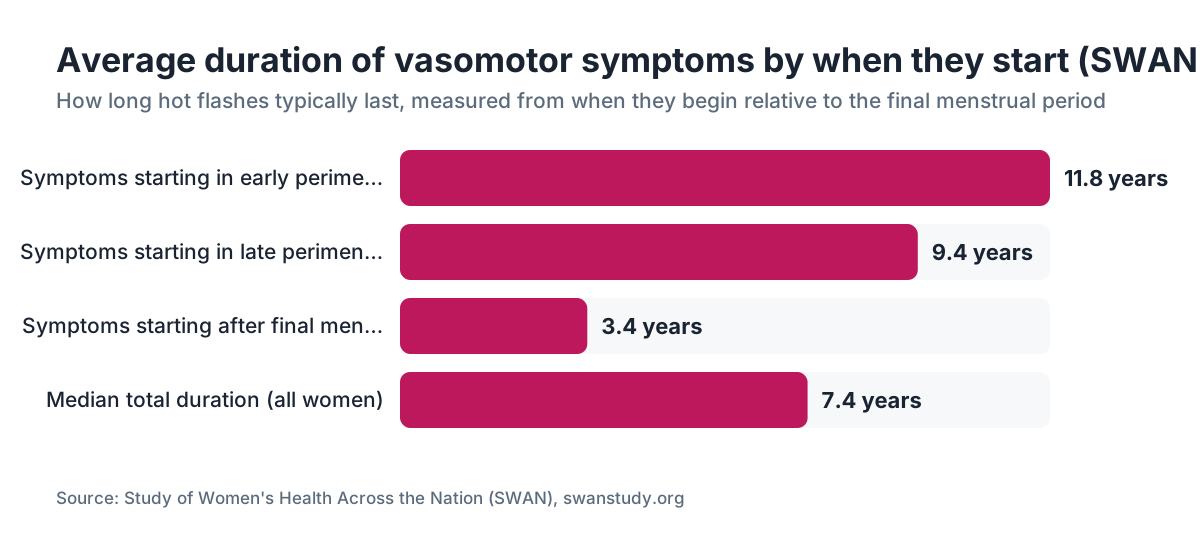
On average, perimenopause lasts about 4 to 8 years, but the range is genuinely wide: from less than a year to over a decade [3]. The SWAN study followed women for years and found that the median duration of vasomotor symptoms (hot flashes and night sweats) was 7.4 years, and that symptoms actually started before the final menstrual period in most women and persisted afterward [7].
The late perimenopause stage (when you are having cycles more than 60 days apart) tends to last 1 to 3 years before the final period. Once you start skipping cycles that long, you are likely within 1 to 3 years of menopause.
Women who enter perimenopause earlier tend to spend longer in the transition. Smoking shortens the total reproductive lifespan, compressing the timeline to menopause. Race and body composition also affect duration.
There is no way to predict exactly when your final period will be. Some women have what feels like a final period, go 10 months, then have one more. That resets the clock. The 12-month mark can feel frustratingly arbitrary when you are living through it.
What treatments or strategies can help during the transition?
Hormone therapy (HT) is the most effective treatment for vasomotor symptoms and for protecting bone density during the transition. The current evidence, and the position of NAMS as of their 2022 Hormone Therapy Position Statement, is that for healthy women under 60 or within 10 years of menopause onset, the benefits of hormone therapy generally outweigh the risks [1]. This is a significant shift from how HT was perceived after the Women's Health Initiative results were first published in 2002.
Non-hormonal prescription options include:
- Fezolinetant (Veozah), an FDA-approved neurokinin B antagonist approved in 2023 specifically for vasomotor symptoms, is an option for women who cannot or prefer not to use hormones [9].
- Certain antidepressants (SSRIs and SNRIs, particularly paroxetine, which is the only FDA-approved non-hormonal option for hot flashes under the brand Brisdelle) and gabapentin have evidence for reducing hot flash frequency.
For genitourinary symptoms specifically, low-dose vaginal estrogen is highly effective, carries minimal systemic absorption, and is considered safe even for most women with a history of hormone-sensitive cancers.
Lifestyle factors that genuinely move the needle: maintaining muscle mass through strength training (which also protects bone), limiting alcohol (a documented hot flash trigger), improving sleep hygiene, and not smoking.
For women also dealing with weight changes during perimenopause, there is growing clinical interest in GLP-1 receptor agonists. The metabolic shifts of perimenopause, including increased central adiposity and insulin resistance, can make weight management much harder. You can learn more about how hormonal changes interact with weight at the new menopause, which covers this intersection in detail.
Over-the-counter supplements marketed for perimenopause symptoms, including products like CVS menopause multivitamin with hot flash support and Health & Her perimenopause support, have limited clinical evidence. Black cohosh has the most data, and even that is mixed. They are not harmful for most women, but I would not spend much money expecting dramatic symptom relief.
When should you see a doctor about these symptoms?
See a provider promptly if:
- You are under 40 and experiencing cycle irregularity or menopause-like symptoms. POI has health consequences that need management, not watchful waiting.
- You have any bleeding after 12 consecutive months without a period. Postmenopausal bleeding is not always cancer, but it is never normal and requires evaluation. The most common cause is endometrial atrophy, but endometrial cancer must be ruled out.
- Your bleeding during perimenopause is extremely heavy (soaking a pad or tampon hourly for multiple hours), or you are passing large clots.
- Symptoms are severe enough to significantly affect your quality of life and you are not getting relief.
- You are not sure what you are experiencing and want to rule out thyroid disease, pregnancy, or other conditions.
You do not need to wait until symptoms are unbearable. Perimenopause is a long transition, and starting a conversation with a knowledgeable provider early means you have more options, more lead time to consider hormone therapy if relevant, and more data (like your cycle history) to bring to the table.
WomenRx offers telehealth consultations for women going through perimenopause and menopause, including hormonal and non-hormonal options, if you are looking for a starting point and do not yet have a menopause-literate provider in your area.
Frequently asked questions
Can I be in perimenopause if my periods are still regular?
Yes, though it is less common. Some women develop classic symptoms, including hot flashes, night sweats, and sleep disruption, before their cycles become irregular. The STRAW+10 framework acknowledges that symptoms can precede measurable cycle changes. If you are in your mid-40s with symptoms but regular cycles, a clinical conversation is still worthwhile, especially to rule out thyroid disease.
What does a perimenopause hot flash actually feel like?
Most women describe a sudden wave of heat starting in the chest and moving up to the face and neck, lasting between 30 seconds and 10 minutes, often followed by sweating and then chills. Heart rate may rise during an episode. Night sweats are the nighttime version and can soak sheets. Intensity ranges from mildly uncomfortable to genuinely disruptive. About 75 to 80 percent of women experience them at some point during the transition.
Is perimenopause the same as premenopause?
No. Premenopause technically refers to the entire reproductive lifespan before menopause, meaning any woman who has not yet reached menopause is premenopausal. Perimenopause specifically refers to the transition phase with hormonal fluctuation and symptoms. The terms are often used loosely and interchangeably in casual conversation, which causes real confusion. Clinically, they mean different things.
Can stress cause symptoms that look like perimenopause?
Yes, and this is a real diagnostic challenge. Chronic stress dysregulates the HPA axis, raises cortisol, and can suppress ovulation, causing irregular cycles. Sleep disruption, anxiety, brain fog, and even temperature dysregulation can all result from stress alone. This is why providers should not assume perimenopause without ruling out thyroid disease, high cortisol states, and other causes, particularly in women under 40.
How do I know if my mood changes are perimenopause or depression?
The distinction matters for treatment. Perimenopause-related mood changes tend to track with hormonal fluctuation, often worse in the premenstrual window, and may improve with hormone therapy. Clinical depression has a broader symptom picture including persistent hopelessness and anhedonia, and typically requires its own treatment. Research from the Harvard Study of Moods and Cycles found that women with a history of depression are more vulnerable to mood episodes during the perimenopause transition. A mental health provider and a menopause specialist can work together.
Can you have a period and still technically be in menopause?
No. If you have had any menstrual bleeding in the past 12 months, you are not yet in menopause by clinical definition. Menopause is confirmed only after 12 consecutive months without a period. Any bleeding that occurs after that 12-month window is postmenopausal bleeding and requires prompt medical evaluation. Menopause is a retrospective diagnosis.
What is the difference between surgical menopause and natural menopause?
Surgical menopause occurs when both ovaries are removed (bilateral oophorectomy), causing an immediate and complete drop in estrogen and progesterone with no transition period. Symptoms typically onset within days and are often more severe than natural menopause. Natural menopause follows the gradual perimenopause transition. Women who undergo surgical menopause before the natural age of menopause face a longer period of estrogen deficiency and generally have stronger indications for hormone therapy.
Does perimenopause cause weight gain?
Perimenopause is associated with a shift in fat distribution toward the abdomen, even without a change in overall body weight, due to declining estrogen. Total weight gain that occurs in midlife is also driven by age-related muscle loss and lifestyle factors. Research from SWAN found that women gained an average of about 1.5 kg during the perimenopause transition, though the pattern varied significantly by individual and lifestyle. Estrogen loss itself, more than aging, appears to drive central fat accumulation specifically.
Can hormonal birth control mask perimenopause symptoms?
Yes. Combined hormonal contraceptives, the pill, patch, and ring, suppress your body's natural hormonal fluctuations and provide a steady exogenous estrogen and progestin level. This can eliminate or mask hot flashes, regulate cycles, and make it impossible to know where you are in the perimenopause transition. Women on hormonal contraceptives who want to assess their menopausal status typically need to stop the contraceptive for a period of time and have FSH checked, though interpretation is still nuanced.
Is perimenopause hereditary?
Genetics are the strongest predictor of menopause timing. The age your mother and sisters reached menopause is the best available forecast for when you will. Twin studies estimate that genetics account for 44 to 65 percent of the variation in age at natural menopause. If your mother had early menopause, ask her specifically what age, and mention it to your provider. It does not guarantee you will follow the same timeline, but it is the most useful data point you have.
What blood tests should I ask for if I suspect perimenopause?
Ask for TSH (to rule out thyroid disease), FSH and estradiol (context-dependent; low value in confirming perimenopause in women over 40, but useful to rule out POI in women under 40), prolactin, a pregnancy test if any doubt, and a CBC with ferritin if fatigue is prominent. AMH can provide information about ovarian reserve but is not a diagnostic test for perimenopause staging. Your provider should decide which panel is appropriate based on your age and presentation.
Can perimenopause start at 35?
Yes. While the average onset is the mid-to-late 40s, perimenopause can begin as early as the mid-30s. If you are 35 and noticing cycle changes, new sleep disruption, or hot flashes, do not dismiss it. You should see a provider to rule out other causes, including thyroid disease and POI, but perimenopause at 35 is clinically real. A family history of early menopause increases this likelihood significantly.
How long do perimenopausal symptoms last after periods stop?
On average, vasomotor symptoms (hot flashes and night sweats) last about 7.4 years total, per the SWAN study, and they do not stop at the final menstrual period. Many women continue experiencing hot flashes for 4 to 5 years into postmenopause. About 10 percent of women have hot flashes into their 70s. Genitourinary symptoms like vaginal dryness and urinary urgency often worsen after menopause rather than improving without treatment.
Sources
- North American Menopause Society, 2022 Hormone Therapy Position Statement
- Harlow SD et al., Menopause journal, STRAW+10 staging system, 2012
- Office on Women's Health, U.S. Department of Health and Human Services, Menopause page
- Cohen LS et al., Archives of General Psychiatry, 2006: perimenopause and depressive symptoms risk
- Endocrine Society Clinical Practice Guideline: Premature Ovarian Insufficiency, 2016
- Gold EB, Epidemiologic Reviews, 2011: factors associated with age at natural menopause
- Study of Women's Health Across the Nation (SWAN), NIH-funded longitudinal cohort, primary publications
- CDC Contraception Guidance, U.S. Medical Eligibility Criteria for Contraceptive Use
- FDA Drug Approval: Fezolinetant (Veozah), 2023
- National Institute on Aging, NIH, Menopause information page
- Santoro N et al., Menopause, STRAW+10 and perimenopause staging clinical application
- Sullivan SD et al., Fertility and Sterility, 2016: POI and cardiovascular/bone risk