How to measure estrogen levels at home: what the tests actually show
TL;DR: You can measure estrogen at home with saliva, dried urine, or fingerstick blood spot kits. Each captures a different estrogen fraction with different accuracy. None replaces a lab draw ordered by a clinician. But they give a useful starting signal, especially for women tracking perimenopause symptoms or checking whether hormone therapy is absorbing.
What types of estrogen do home tests actually measure?
Most home estrogen tests measure estradiol, and for women asking about perimenopause or menopause, that is the right target. Estrogen is not one hormone. Your body makes three main forms: estradiol (E2), estrone (E1), and estriol (E3).
Estradiol is the most biologically active form in premenopausal and perimenopausal women. It is the one most tied to bone protection, mood stability, and vaginal tissue health. Estrone takes over as the dominant circulating estrogen after menopause, made mostly in fat tissue. Estriol spikes during pregnancy and is otherwise very low.
A smaller number of tests, particularly dried urine kits, measure all three forms plus estrogen metabolites like 2-hydroxyestrone and 16-alpha-hydroxyestrone. Those metabolite ratios show up in breast cancer risk research, though whether tracking them at home changes anything is still debated.[1]
FSH (follicle-stimulating hormone) is not estrogen, but many home "menopause tests" measure FSH instead of or alongside estradiol. FSH rises as ovarian reserve falls. The difference matters. A high FSH tells you your pituitary is working hard to recruit eggs. A low estradiol tells you how much estrogen is actually circulating. You want both numbers if you are trying to understand perimenopause. See our overview of what perimenopause actually looks like for the broader symptom picture.
What are the main home estrogen testing methods?
Three formats are available to consumers without a prescription: saliva, dried urine, and fingerstick blood spot. Each answers a slightly different question.
Saliva testing collects free (unbound) estradiol, meaning the fraction not attached to carrier proteins like sex hormone-binding globulin. Companies like ZRT Laboratory sell saliva hormone panels. Free estradiol is roughly 1 to 3 percent of total circulating estradiol, so the absolute numbers look nothing like serum values. Normal follicular-phase saliva estradiol runs about 1 to 3 pg/mL, against 20 to 350 pg/mL in serum.[2]
Dried urine on filter paper (DUTCH test and similar) is the most information-rich home-collect format. You urinate on filter paper strips at several points across 24 hours, let them dry, and mail them to a CLIA-certified lab. The lab measures conjugated metabolites, not free hormone, so results reflect both production and metabolism. This helps most for women on topical or vaginal estrogen, where serum tests can miss absorption. The DUTCH Complete panel runs roughly $400 to $500 out of pocket.[3]
Fingerstick blood spot testing uses a lancet, small blood spot cards, and mail-in processing at a CLIA lab. It tracks standard serum testing more closely than saliva does, though capillary blood and venous blood are not identical. ZRT, LetsGetChecked, and Everlywell all offer this format. Prices run from about $49 for a single-marker FSH test to $150 to $250 for a broader female hormone panel.[4]
None of these is FDA-cleared as a diagnostic for any specific condition. They are laboratory-developed tests (LDTs) processed at CLIA-certified labs. The lab meets federal quality standards, but the specific assay has not gone through the FDA device clearance pathway.[9]
How accurate are home estrogen tests compared to lab blood draws?
Fingerstick blood spot comes closest to venous serum. Saliva has meaningful variability. Dried urine is accurate for what it measures but measures something genuinely different. That is the honest ranking.
A 2020 comparison in the Journal of Applied Laboratory Medicine looked at saliva, dried blood spot, and serum hormone measurements in postmenopausal women. Dried blood spot estradiol correlated well with serum (r = 0.96), while saliva estradiol showed wider variance.[5] That correlation looks great on paper. In one woman on one day, the practical margin of error can still matter clinically, especially around the low postmenopausal values where a few pg/mL changes the picture.
Timing matters more than most people expect. Estradiol swings across the menstrual cycle by a factor of ten or more, from roughly 20 to 30 pg/mL in the early follicular phase to peaks of 150 to 750 pg/mL at ovulation, then a second luteal rise of 50 to 250 pg/mL before dropping ahead of your period.[6] Test on the wrong day and you get a useless number. Most lab protocols want day 2, 3, or 4 of the cycle for a baseline estradiol, or any day in a woman who has not menstruated in 12 or more months.
Sweat, food, and hydration also affect saliva results specifically. Labs give detailed prep instructions: no eating, drinking, or brushing teeth for 30 minutes before collection, and no sex the night before on panels that include testosterone. Skip those steps and you corrupt the sample.
For women on hormone therapy, the delivery route decides which format makes sense. Vaginal rings and topical creams deliver estradiol through the skin, and serum tests often read lower than expected because transdermal estradiol does not spike the blood the way oral forms do. Dried urine tends to capture transdermal exposure better in that situation.[3]
What do normal estrogen levels look like at different life stages?
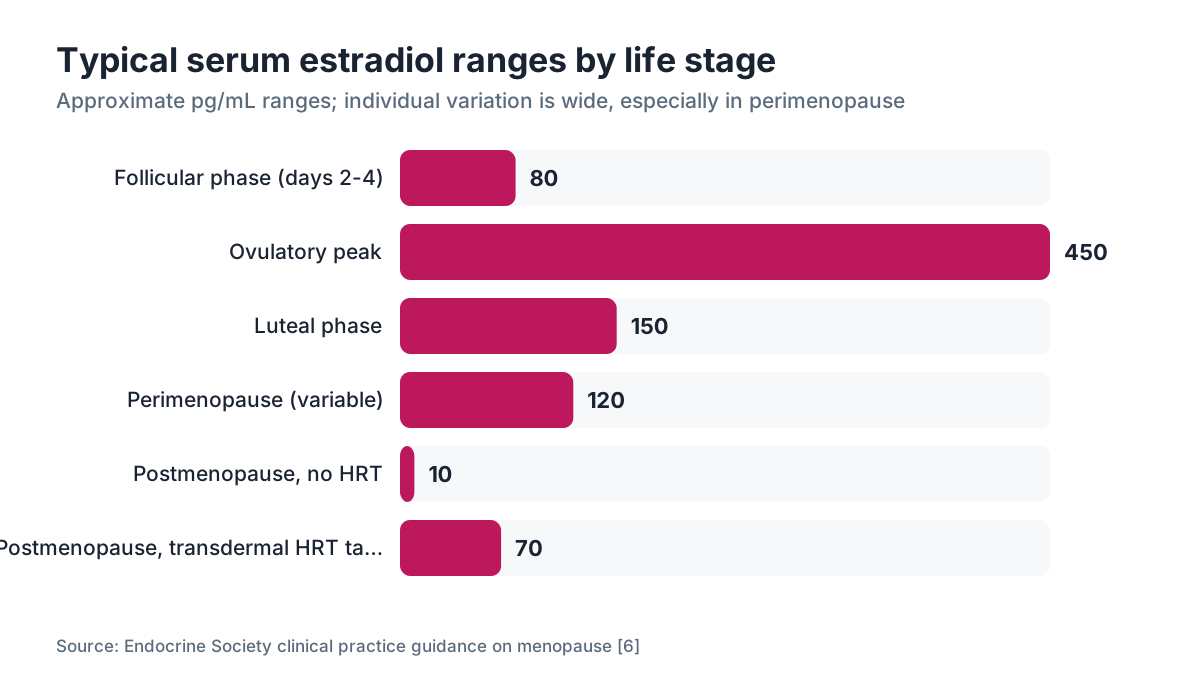
Reference ranges vary by lab and assay, but the Endocrine Society clinical practice guidance on reproductive hormones gives these approximate serum estradiol (E2) benchmarks.[6]
| Life stage | Typical serum estradiol (E2) range | |---|---| | Reproductive age, follicular phase | 20-350 pg/mL | | Reproductive age, ovulation peak | 150-750 pg/mL | | Reproductive age, luteal phase | 50-250 pg/mL | | Perimenopause (variable, erratic) | 10-400+ pg/mL | | Postmenopause (no HRT) | less than 10-20 pg/mL | | Postmenopause on oral estradiol | varies widely by dose and timing | | Postmenopause on transdermal estradiol | 40-100 pg/mL typical therapeutic target |
Perimenopause values are the hardest to read because they swing. A woman might test at 200 pg/mL one week and 15 pg/mL the next. That erratic pattern is itself the clue, and a single home snapshot cannot catch it. Serial testing over three to six months gives more signal.[7]
FSH reference ranges are just as context-dependent. A postmenopausal FSH above 30 IU/L is expected and does not confirm menopause on its own. The menopause society (formerly NAMS) defines menopause as 12 consecutive months without a period in the absence of other causes, which makes the diagnosis time-based, not lab-based, in most cases.[8]
Which home estrogen test is worth buying?
It depends on the question you are actually trying to answer, and being clear about that saves you money.
If you are premenopausal or perimenopausal with symptoms (hot flashes, broken sleep, cycle changes, mood shifts) and you want a sanity check before or between doctor visits, a fingerstick blood spot panel that includes estradiol and FSH is the most defensible buy. Everlywell's Women's Health Test and LetsGetChecked's Female Hormone Test both fit here at $100 to $150, process at CLIA-certified labs, and include a clinician review of results.
If you are already on hormone therapy, especially topical or vaginal preparations, a dried urine panel like DUTCH Complete gives more metabolic context than a serum or blood spot test. It costs more and takes longer (results in about 10 to 14 business days), but for $400 to $500 you see how your body is processing estrogen. Not everyone needs that. It earns its price when symptoms persist despite what looks like adequate dosing on a blood draw.
Saliva tests are cheaper, often $85 to $150 for a panel, but the individual-level accuracy problems make them harder to act on. I would not spend money on saliva if a blood spot option sits at a similar price.
Skip any test that only measures FSH and calls itself an estrogen or menopause test. FSH alone does not tell you your estradiol level. It does not rule hormone therapy in or out. A single FSH reading is a narrow, often misleading data point sold as more than it is.
For a wider view of how hormone testing fits into perimenopause care, The New Menopause covers what clinicians look at beyond one estrogen number.
How do you actually use a home estrogen test kit?
The process is close to identical across fingerstick and urine kits. Here is what to expect.
Fingerstick blood spot: Order the kit and you get a lancet, collection card, and prepaid mailer. Fast for at least 8 hours (water is fine). Warm your hands, use the lancet on the side of a fingertip, fill the circle on the card, let it dry for at least 30 minutes, seal it, and mail within the window the company specifies. Most labs want the sample sent same day or next morning. Results come back in 5 to 7 business days by email or app.
Dried urine (DUTCH-style): Fast for 1 to 2 hours before each collection. Urinate on the filter paper strip at four or five points across a day (typically waking, midday, evening, before bed, sometimes a middle-of-night collection). Let strips dry fully, 24 hours minimum, before sealing them in the foil packet. Mail within 48 hours. Results take 10 to 14 business days.
Saliva: No food, drink, toothbrushing, or sex for 30 to 60 minutes before collection. Spit into a tube until you hit the fill line. This takes longer than it sounds. Seal, refrigerate or freeze if directed, and ship with the provided ice pack. Results in 5 to 7 business days.
If you still cycle, test on day 2 to 4 of your period for a baseline, or day 19 to 22 for a luteal-phase assessment. If you are postmenopausal or on continuous hormone therapy, timing matters less, but consistency across repeat tests matters a lot. Testing at the same time of day cuts down day-to-day biological noise, especially for cortisol if your panel includes adrenal markers.
A result outside the reference range is not a diagnosis. It is a data point to bring to a clinician. WomenRx offers telehealth consultations that let you share home test results with a hormone-specialized clinician who can order confirmatory lab work and talk through next steps without an office visit.
Can a home test tell you if you are in perimenopause or menopause?
Partly, and the caveats do the heavy lifting here. A low estradiol (under 20 pg/mL) with a high FSH (above 30 IU/L) on a home test points toward ovarian insufficiency or menopause in the right clinical context.
But the North American Menopause Society is clear that menopause is a clinical diagnosis, not a lab one, defined by 12 consecutive months of amenorrhea in a woman over 45 without other causes.[8] A single blood draw, home kit or doctor's office, cannot confirm menopause.
Perimenopause is harder still to pin down with one test. The signature of perimenopause is variability. You can have a perfectly normal estradiol on day 3 of your cycle because the follicle recruited that month happened to work well. Next month can look completely different. Serial testing every two to three months over half a year gives a far more meaningful picture than any single result.
Home testing does earn its keep in a few situations. It gives women real data to bring to a doctor who might otherwise wave off symptoms as stress. It helps track whether hormone therapy is absorbing and circulating at a reasonable level. And for women who have had a hysterectomy and lack the 12-month amenorrhea clock, lab values carry more weight in sorting out menopausal status.
For what bleeding after menopause means, and when it demands immediate evaluation rather than at-home reassurance, that is a separate question with a very different urgency level.
What are the limits of home estrogen testing?
Home tests have real gaps, and knowing them keeps you from over-reading a result.
Assay sensitivity at the low end is the first one. Postmenopausal estradiol is often below 10 pg/mL. Many immunoassay-based tests, including some used in home kits, cannot reliably tell 5, 8, and 12 pg/mL apart. Mass spectrometry assays (LC-MS/MS) are more sensitive, and some labs now use them for low-range estradiol. Ask the company which method their lab runs before you order.
Second, no home test can measure bioavailable estrogen at the tissue level. What circulates in blood does not always reflect what estrogen-sensitive tissues (brain, bone, vaginal lining) actually receive. Sex hormone-binding globulin (SHBG) binds estradiol tightly and makes it unavailable. If SHBG is very high, your total estradiol can look fine while your free estradiol runs low. A good panel includes SHBG alongside estradiol for this reason.
Third, a home test cannot replace a conversation. Symptoms plus labs together decide whether hormone therapy makes sense, at what dose, and by what route. Labs alone never make that call. If you are also looking into thyroid hormone replacement therapy, know that thyroid function shifts SHBG, which in turn changes how much estradiol is free and active.
Fourth, the regulatory gap. The FDA treats home hormone tests as laboratory-developed tests and has not specifically cleared the leading home estrogen kits as diagnostic devices.[9] That does not make them useless. CLIA certification of the processing lab is a real quality floor.[12] But it does mean you treat results as directional, not final.
Does insurance cover home estrogen testing?
Almost never for the direct-to-consumer kits. Insurance usually covers estradiol and FSH serum testing when a clinician orders it with a documented clinical reason.
CPT code 82670 is the standard billing code for estradiol in most US labs. If a doctor orders it, many plans cover it like other outpatient lab work, which after your deductible can mean low or zero out-of-pocket cost depending on the plan.
Direct-to-consumer kits skip the clinician order, so they fall outside what insurers reimburse. Some HSA and FSA accounts do cover home lab kits as qualified medical expenses, though rules vary and shifted after the CARES Act expanded eligibility in 2020.[10] Check your plan's summary plan description or call the benefits administrator before you assume FSA coverage.
So the cost math favors getting your doctor to order labs if you have coverage. If you are uninsured or your doctor brushes you off, a cash-pay serum estradiol through Labcorp or Quest, ordered via a direct-lab service like Walk-In Lab, often runs $30 to $60. That is cheaper than many home kits and more analytically reliable. Not a glamorous answer, but an accurate one.
When should you see a doctor instead of relying on home testing?
Home testing is a starting point, not a substitute for clinical care. A few situations call for a clinician regardless of what a mail-in kit says.
Symptoms are severe or worsening. Hot flashes that break your sleep several times a night, significant vaginal atrophy, cognitive changes, or mood instability that affects daily function need clinical evaluation, not a mail-in kit.
You have had any post-menopausal bleeding. Even a spot. That demands a uterine evaluation, not a hormone test. Bleeding after menopause is not always cancer, but it always earns a timely workup.
You are under 40 and suspect premature ovarian insufficiency. POI carries long-term consequences for bone, cardiovascular, and cognitive health that require clinical management, not self-monitoring.
You are considering starting, adjusting, or stopping hormone therapy. Decisions about systemic estrogen need a clinician who can review your personal and family history, walk through the NAMS and Endocrine Society evidence on HRT risks and benefits, and monitor you over time.
Your result is far outside the reference range. A postmenopausal estradiol of 300 pg/mL when you are not on therapy, for example, is unexpected and needs investigation.
WomenRx connects women with hormone-specialized clinicians online. If a home result raises questions, a telehealth visit is a reasonable next step before you commit to any treatment. Many women bring their home test results to a first consultation as context, with the understanding that the clinician will likely order confirmatory serum testing.
Are there free or low-cost ways to estimate your estrogen status?
Not precisely, but symptom tracking is genuinely informative and costs nothing.
The Greene Climacteric Scale and the Menopause Rating Scale are validated symptom questionnaires used in clinical research to quantify estrogen-deficiency symptoms. Both are free online. They do not replace a lab value, but high scores track with low estrogen states in research populations and give a clinician structured data to work with.[11]
Physical findings carry signal too. The vaginal health index is an exam finding, but vaginal dryness, vulvar tissue changes, and urinary symptoms (urgency, recurrent UTIs) are markers of local estrogen deficiency you can notice yourself. These often appear before systemic estradiol drops into the clearly postmenopausal range, because vaginal tissue is especially sensitive to estrogen decline.
If you track your cycles, basal body temperature and luteal phase length are indirect markers of ovarian function. A shortened luteal phase (fewer than 10 days from ovulation to menstruation), or cycles with no temperature rise to suggest ovulation happened, are early signs of perimenopausal shifts.
For a consumer supplement angle, the health and her perimenopause support article covers non-prescription approaches to symptom management, which some women use while they decide whether to pursue hormone testing or therapy.
Frequently asked questions
Can I test my estrogen levels at home without a blood draw?
Yes. Saliva and dried urine kits let you collect samples at home and mail them to a CLIA-certified lab. Dried urine (DUTCH-style) tests help most for women on topical hormones. Saliva measures free estradiol but carries higher individual variability. Neither is as analytically reliable as a venous blood draw at a clinic, but both give directional information worth discussing with a clinician.
What is a normal estradiol level for a woman in her 40s?
It depends heavily on cycle day. In the early follicular phase (days 2 to 4), normal serum estradiol is roughly 20 to 150 pg/mL. At ovulation it can peak at 150 to 750 pg/mL. In the luteal phase, 50 to 250 pg/mL is typical. In perimenopause these values turn erratic and may swing from under 20 to over 300 pg/mL across consecutive cycles, which is itself a diagnostic clue.
Is the Everlywell hormone test accurate?
Everlywell's Women's Health Test uses a dried blood spot processed at a CLIA-certified lab. Blood spot estradiol correlates reasonably well with serum in research comparisons, with correlation coefficients around 0.90 to 0.96 in published studies. Individual measurements can still carry meaningful error, particularly at very low postmenopausal values. Use results as directional data to inform a clinician conversation, not as a standalone diagnosis.
What does a low estrogen result on a home test mean?
A low estradiol, generally under 20 pg/mL in a non-menstruating woman or lower than expected for your cycle day, suggests reduced ovarian estrogen output. Combined with an elevated FSH, it points toward perimenopause or menopause. Low estradiol in a woman still having periods can also mean a poorly timed test or a cycle with weak follicular recruitment. One low result warrants repeat testing and a clinician review.
What day of my cycle should I test estrogen at home?
Day 2, 3, or 4 of your cycle (counting the first day of full flow as day 1) gives a baseline follicular estradiol and FSH. This is the standard protocol in reproductive endocrinology. To check whether you ovulated, a luteal-phase test on day 19 to 22 of a 28-day cycle captures the secondary estradiol and progesterone peak. Postmenopausal women can test any day.
Does the DUTCH test measure estrogen better than a blood test?
The DUTCH (dried urine) test measures estrogen metabolites and conjugated forms, a different picture than serum. It is especially valuable for women on topical or vaginal estrogen, where serum testing can underestimate absorption. For standard monitoring of systemic estradiol, serum or blood spot maps more directly to clinical reference ranges. Neither is universally better; they answer different questions.
Can a home FSH test confirm menopause?
No. An elevated FSH (above 30 IU/L) supports a suspicion of menopause but does not confirm it alone. FSH can spike transiently during perimenopause while a woman is still cycling. The clinical definition of menopause is 12 consecutive months without a period in a woman over 45, without other explanations. FSH-only home tests are a narrow and often misleading proxy for a fuller hormonal picture.
How often should I check my estrogen levels at home?
For tracking perimenopause progression, testing every two to three months over six months gives more signal than a single test. On hormone therapy, check 4 to 6 weeks after a dose change, then every 6 to 12 months once stable, which matches general clinical guidance. More frequent testing rarely changes decisions and adds cost without proportional information. Serial results over time beat one-time snapshots.
Can I use a home estrogen test to monitor hormone replacement therapy?
Yes, with limits. Fingerstick blood spot tests can track whether estradiol sits in a therapeutic range on oral or patch therapy. For transdermal creams, gels, or vaginal rings, dried urine gives a fuller picture of absorption and metabolism. Saliva testing is sometimes used for sublingual monitoring specifically. Whichever format you use, the clinician managing your HRT should review results. Do not self-adjust doses.
Is saliva estrogen testing reliable?
Saliva measures free, unbound estradiol, about 1 to 3 percent of total serum estradiol, so reference ranges look nothing like blood values. Published comparisons show wider individual variability in saliva than serum estradiol, which makes single results harder to interpret with confidence. Some integrative practitioners use saliva testing, but most mainstream endocrinology guidance defaults to serum or blood spot for estrogen monitoring.
What home estrogen test is best for postmenopausal women?
Postmenopausal estradiol is very low, often under 10 pg/mL, and needs a sensitive assay. Look for a lab that uses LC-MS/MS (liquid chromatography-mass spectrometry) rather than standard immunoassay for better accuracy at low levels. Fingerstick blood spot panels that specify LC-MS/MS, or DUTCH urine panels, are reasonable choices. Ask the company directly which method their lab uses before buying.
Do home estrogen tests require a prescription?
No. Direct-to-consumer hormone tests are available without a prescription in the US. Some companies include a clinician review of results, which is a real feature worth having. CLIA certification of the processing lab is the quality floor to look for. The tests are not FDA-cleared diagnostic devices, so they cannot diagnose a condition, but the labs processing them meet federal quality standards.
Can home estrogen testing help with symptoms like hot flashes and brain fog?
It provides context, not treatment. A low estradiol alongside those symptoms strengthens the case for discussing hormone therapy with a clinician. But symptoms and lab values do not always track together. Some women have significant hot flashes with estradiol in the lower-normal range; others have very low estradiol with few symptoms. Home testing is one input into a clinical conversation, not a self-treatment guide.
Sources
- Journal of Steroid Biochemistry and Molecular Biology: Estrogen metabolites and breast cancer risk
- ZRT Laboratory: Saliva testing reference ranges and methodology
- Precision Analytical (DUTCH Test): Dried urine testing methodology
- Everlywell: Women's Health Test product page
- Journal of Applied Laboratory Medicine: Dried blood spot vs serum hormone correlation in postmenopausal women
- Endocrine Society: Clinical practice guidance on menopause and reproductive hormones
- Obstetrics and Gynecology Clinics of North America: Hormonal changes in perimenopause
- The Menopause Society (formerly NAMS): Menopause Practice clinician guidance
- IRS: Publication 502, Medical and Dental Expenses
- Climacteric: Validation of the Menopause Rating Scale
- Centers for Medicare and Medicaid Services: CLIA program overview