How to know if you're in perimenopause: signs, tests, and next steps
TL;DR: Perimenopause usually starts between ages 40 and 44, though it can begin in the late 30s. The clearest signs are irregular periods, new sleep problems, hot flashes, and mood shifts. No single lab test confirms it. Your symptom pattern tells the real story. Most women spend 4 to 8 years in perimenopause before their final period.
What is perimenopause, exactly?
Perimenopause is the hormonal transition leading up to menopause. It is not menopause itself. Menopause is a single point in time: the day marking 12 consecutive months without a period. Perimenopause is everything before that line, sometimes stretching 4 to 10 years.
During this phase, your ovaries gradually make less estrogen and progesterone, but not on a smooth downward slope. They fluctuate. Estrogen can spike unusually high some cycles and drop sharply in others, which is exactly why perimenopause symptoms feel so unpredictable and hard to describe.
The average age at the final menstrual period in the U.S. is 51 [1]. Many women start feeling perimenopausal symptoms in their early-to-mid 40s, and some as early as 37 or 38. If you're in that range and something feels off, the timing alone is reason to pay attention.
The North American Menopause Society defines perimenopause as beginning with irregular periods or other menopausal symptoms and ending 12 months after the last menstrual period [2]. That definition matters because symptoms, not lab values, are the primary diagnostic signal.
What are the first signs of perimenopause?
The earliest signal for most women is a change in the menstrual cycle, specifically in timing or flow, before any other symptom shows up. Your cycles might get shorter (24 days instead of 28). You might start skipping months. Your period might suddenly arrive 10 days late with no pregnancy explanation. Any of those shifts, when they're new for you, deserve attention.
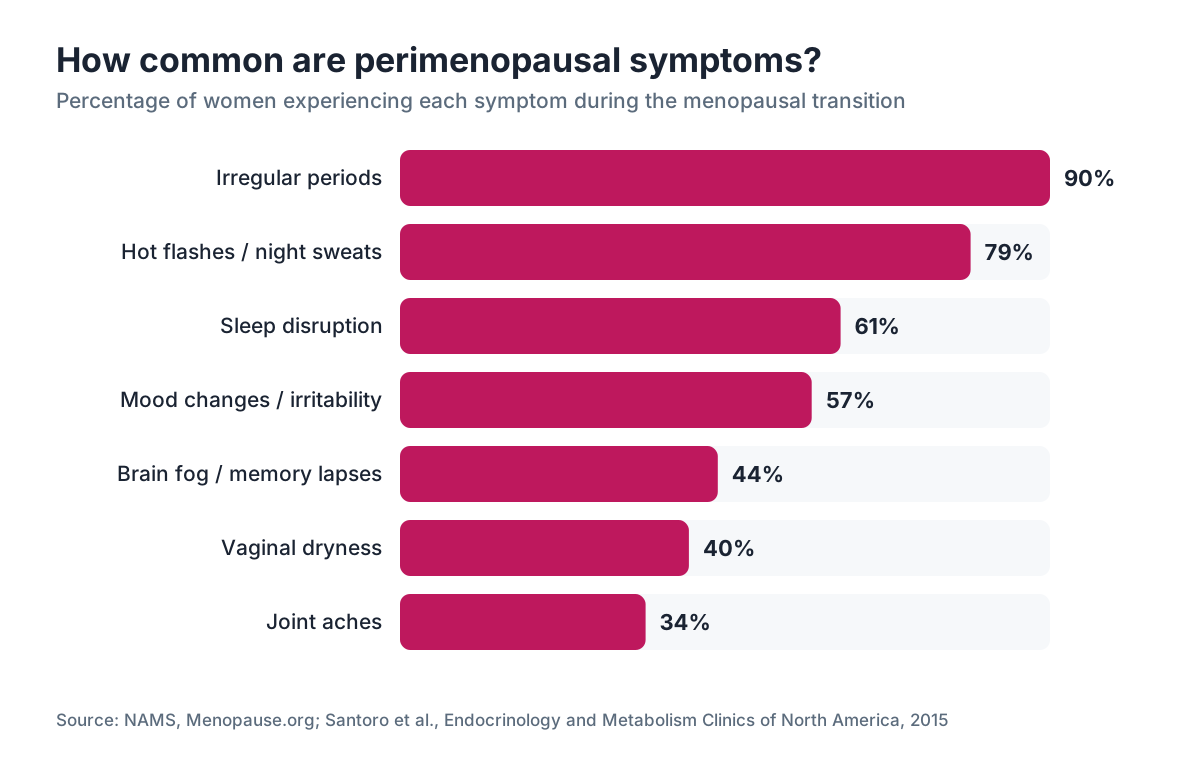
Here are the symptoms most consistently documented in the research:
Menstrual irregularity. Cycles varying by 7 or more days from their usual length, two or more cycles in a row. This is the clinical marker used in the STRAW+10 staging system (the standard framework for reproductive aging) to indicate early perimenopause has begun [3].
Hot flashes and night sweats. Vasomotor symptoms, as clinicians call them, affect roughly 75 to 80 percent of women during the transition. In some women they start before periods become irregular.
Sleep disruption. Waking at 2 or 3 a.m. for no clear reason, often with racing thoughts or a hot flash. This is one of the most commonly reported quality-of-life complaints and is frequently driven by falling progesterone [4].
Mood changes. Anxiety that feels new, irritability that seems out of proportion, or a low-grade depression. The risk of first-onset depression is significantly higher during perimenopause than in the stable premenopausal years, according to a 2011 study in JAMA Psychiatry [5].
Brain fog. Difficulty finding words, poor short-term memory, trouble concentrating. Most women recover full cognitive function post-menopause.
Vaginal dryness or urinary symptoms. These often appear later in the transition and can persist long into postmenopause without treatment.
Joint aches, heart palpitations, headaches. Less talked about, but documented. Estrogen affects vascular tone and inflammation, so its fluctuating levels show up in unexpected places.
Symptoms overlap with thyroid disorders, ADHD, and burnout, which is what makes perimenopause so frequently misdiagnosed. You may have been told you're anxious, or that your bloodwork is normal, and walked away with no answers.
What age does perimenopause usually start?
Most women enter perimenopause between ages 40 and 44, with the full range spanning roughly 35 to 55 [1]. Averages hide a lot.
If you had an early first period, carry a lower body weight, smoke cigarettes, or have a mother or sister who went through menopause early, you're more likely to start perimenopause on the earlier end of that window. Chemotherapy, radiation to the pelvic area, and certain surgeries can also pull the timeline forward.
Premature ovarian insufficiency (POI) is a separate condition that causes menopause-like hormone changes before age 40. It affects about 1 percent of women and has different causes and management needs than typical perimenopause [1].
Want a clearer picture based on your own history? The article on perimenopause age walks through the research on timing predictors in detail. For what happens at the end of the transition, when does menopause start covers the STRAW+10 staging system step by step.
How do you know if you're in perimenopause vs. something else?
This is the hard part. Perimenopause has no lab test you can point to and say, confirmed. What it has is a recognizable pattern of symptoms in the right age window, combined with ruling out other causes.
Thyroid dysfunction is the most important thing to rule out first. Hypothyroidism and perimenopause share almost identical symptom profiles: fatigue, weight changes, mood shifts, brain fog, irregular periods, sleep problems. A TSH and free T4 panel are reasonable first steps. If thyroid results are normal and you're 38 to 50 with new symptoms, perimenopause is the more likely explanation.
Other conditions that can mimic or coexist with perimenopause:
- Anemia (especially with heavy perimenopausal periods)
- ADHD (often unmasked or worsened by estrogen decline)
- Chronic sleep disorders
- Autoimmune conditions
- Depression and anxiety disorders
These conditions coexist with perimenopause more than they mimic it. That's why tracking your symptom pattern over several months matters more than any single snapshot.
The Menopause Rating Scale (MRS) and the Greene Climacteric Scale are validated questionnaires clinicians use to quantify symptom burden. You can find versions of these through academic medical centers. A score on one of these tools, combined with your age and menstrual history, gives a clinician more useful information than a single FSH reading.
Do blood tests diagnose perimenopause?
Not reliably. This surprises a lot of women who ask for a hormone panel and then hear their results are "normal."
FSH (follicle-stimulating hormone) is the most commonly ordered test. When FSH is persistently elevated above 25 to 40 mIU/mL on two readings taken at least 4 to 6 weeks apart, it points to declining ovarian function [12]. But during perimenopause, FSH swings wildly from cycle to cycle. A single normal FSH reading on day 3 of your cycle doesn't rule out perimenopause. A high reading doesn't confirm it either.
Estradiol has the same problem. It swings hard during perimenopause. Test on day 21 of one cycle and get a number that looks fine, then test the next cycle and get something completely different.
AMH (anti-Müllerian hormone), which reflects your remaining egg supply, is more stable across the cycle and declines steadily with age. Some reproductive endocrinologists use it to assess ovarian reserve, but there are no standardized cutoffs for using AMH to stage perimenopause clinically [3].
The STRAW+10 staging framework recommends that clinicians diagnose perimenopause based on menstrual cycle changes combined with symptoms, and use hormone testing as supportive information, not as the primary criterion [3]. If your doctor ordered an FSH test, got a normal result, and told you you're not in perimenopause, that interpretation is not supported by the current staging science.
| Test | What it reflects | Limitation in perimenopause | |------|-----------------|-----------------------------| | FSH | Ovarian signaling demand | Fluctuates cycle to cycle; one normal reading means little | | Estradiol | Circulating estrogen | Highly variable; misleading without serial testing | | AMH | Ovarian reserve (egg supply) | Stable but no clinical cutoffs for staging perimenopause | | TSH | Thyroid function | Useful to rule out thyroid as a cause; not diagnostic of perimenopause | | LH | Ovulatory signaling | Fluctuates; rarely adds information beyond FSH |
What does a perimenopausal period look like?
Your period is usually the first place you'll notice something has shifted. The changes aren't the same for every woman, and they evolve over the course of the transition.
Early perimenopause often brings shorter cycles. You might go from a reliable 28-day cycle to a 24 or 25-day cycle. This happens because progesterone production declines first, shortening the luteal phase. Some women notice their periods getting lighter at this stage.
As perimenopause progresses, cycles turn erratic. You might skip a month, then have two periods close together, then go 60 days without one. Heavy, flooding periods are also common, sometimes startlingly so. Anovulatory cycles (cycles where no egg is released) lead to prolonged estrogen exposure without a progesterone counterbalance, so the uterine lining builds up abnormally thick.
If you're soaking through a pad or tampon every hour for more than two hours, developing iron-deficiency symptoms, or passing clots larger than a quarter, those are reasons to see a clinician promptly. Heavy perimenopausal bleeding is treatable, and ignoring it long enough to become anemic is avoidable.
The endpoint is 12 consecutive months without any period. Once you cross that line, you are in menopause by definition [2]. The article on menopause covers what changes after that threshold.
How does perimenopause affect sleep and mood?
Sleep and mood disruption are probably the two symptoms that send women to their doctors most often, and they are also the two most likely to be blamed on stress or a psychiatric disorder.
The sleep connection is hormonal on multiple levels. Progesterone has a direct calming effect on GABA receptors in the brain, the same receptors that benzodiazepines target. As progesterone drops in perimenopause, that natural sedation fades. Estrogen fluctuations disrupt the thermoregulation that governs sleep, producing the night sweats that fragment sleep architecture. Disrupted sleep itself raises cortisol, which further suppresses progesterone. The cycle feeds itself.
On mood, the data is now solid. A 2011 analysis published in JAMA Psychiatry found that women had a 1.7-fold increased risk of depression during perimenopause compared to premenopausal years, and this held true even after controlling for prior depression history and stressful life events [5]. This is not simply the stress of midlife. It's a neurobiological effect of estrogen withdrawal on serotonin and dopamine systems.
Women who had premenstrual syndrome or postpartum depression appear to be at higher risk for mood symptoms in perimenopause. If that's your history, name it directly with your provider.
Micronized progesterone (Prometrium), specifically the bioidentical oral form, has the best evidence for improving sleep in perimenopausal women. Synthetic progestins like medroxyprogesterone acetate don't carry the same GABA-mediated sleep benefit [11]. That distinction matters when you discuss treatment options with your provider.
Can perimenopause cause weight gain even if you haven't changed anything?
Yes. This is not about willpower or a failure of discipline.
Estrogen shapes where fat is stored. In the reproductive years, most women store fat in the hips and thighs, a pattern driven partly by estrogen receptors in peripheral fat tissue. As estrogen declines, fat storage shifts toward the abdomen. You can keep the exact same diet and exercise routine and still watch your waist grow by 2 to 3 inches over the perimenopausal years.
Muscle mass also drops during this transition, partly because estrogen supports muscle protein synthesis. Less muscle means a lower resting metabolic rate, so the same caloric intake that maintained your weight at 38 gradually becomes a surplus at 44.
Sleep disruption and the cortisol dysregulation that follows amplify both effects. Elevated cortisol independently drives visceral fat accumulation and raises appetite for calorie-dense foods.
For women dealing with significant perimenopausal weight gain, there's growing clinical interest in GLP-1 receptor agonists. The SURMOUNT-1 trial showed tirzepatide producing mean weight reductions of 20.9 percent in adults with obesity over 72 weeks [6]. GLP-1s don't fix the underlying hormonal changes, but they can address the metabolic shift that perimenopause accelerates. A service like WomenRx can evaluate whether that's appropriate for your situation alongside other hormonal considerations.
If you're looking at the evidence on specific medications, semaglutide for weight loss and semaglutide vs tirzepatide cover the clinical data in detail.
What should you tell your doctor to get taken seriously?
This is a genuine problem. Many women spend years being told their symptoms are stress, depression, thyroid-related, or simply "normal for your age" before anyone mentions perimenopause. Coming in prepared changes the appointment.
Bring a 2 to 3 month symptom log. Note the date of every period, its duration, and whether the flow was lighter or heavier than usual. Note when you had a hot flash, a bad night of sleep, a mood crash, a headache. Patterns matter, and a log turns a vague complaint into objective data.
Use the clinical language. "My cycles have varied by more than 7 days over the last three months" is harder to dismiss than "my periods are weird lately." Say that you're 42 (or whatever your age is) and asking specifically about perimenopause staging.
Ask for your TSH to rule out thyroid. Ask for a CBC if you're having heavy bleeding. Ask whether your symptoms are consistent with early perimenopause by the STRAW+10 criteria.
If you leave the appointment feeling dismissed and still have symptoms affecting your quality of life, a second opinion is reasonable. Menopause-specialist clinicians (many certified by NAMS) often have more training in this area than general gynecologists or internists. NAMS maintains a provider finder on its website [2].
For women who want to start the conversation through telehealth rather than waiting for an appointment, providers specializing in hormonal health for women, including WomenRx, can often assess perimenopause symptoms and discuss options including hormone replacement therapy and estrogen patch formulations.
What are the treatment options for perimenopause symptoms?
You have real options. Perimenopause is not something you have to white-knuckle through, and the notion that hormone therapy is too risky for most women has been substantially revised in the past decade.
The 2022 NAMS position statement on hormone therapy holds that for healthy women under 60 or within 10 years of menopause onset, the benefits generally outweigh the risks for managing vasomotor symptoms and preventing bone loss [11]. That statement is the current standard-of-care benchmark, not the 2002 WHI study, which enrolled an older, less healthy population.
Here's a practical overview of common approaches:
Systemic hormone therapy. Estrogen plus progestogen (for women with a uterus) or estrogen alone (for women without one). Comes in pills, patches, gels, sprays, and rings. Addresses hot flashes, sleep, mood, bone density, and vaginal symptoms. The estrogen patch delivers estrogen transdermally and avoids first-pass liver metabolism, which is why many specialists prefer it over oral estrogen for most women.
Local vaginal estrogen. Low-dose estrogen applied directly to vaginal tissue. Essentially no systemic absorption at standard doses. FDA-approved and appropriate for women who can't or don't want systemic treatment.
Micronized progesterone (Prometrium). For sleep and mood benefits specifically, oral micronized progesterone taken at night has solid evidence [11]. See the progesterone article for the clinical details.
Non-hormonal prescription options. Fezolinetant (Veozah), FDA-approved in 2023, is a neurokinin 3 receptor antagonist that reduces hot flash frequency without hormones. SSRIs and SNRIs at low doses (particularly paroxetine, the only FDA-approved non-hormonal option for hot flashes, sold as Brisdelle) are alternatives for women who prefer or require non-hormonal treatment.
Lifestyle measures. Not a replacement for treatment when symptoms are moderate to severe, but genuinely helpful as adjuncts: cooling the bedroom below 68°F, cutting alcohol and spicy food as hot flash triggers, strength training to counter muscle loss, and consistent sleep timing.
Bone density deserves a mention here because it often gets overlooked until it's a problem. Estrogen is one of the strongest protectors of bone, and bone loss speeds up sharply in the years around the final period. A bone density test (DEXA scan) gives you a baseline and helps guide decisions about treatment.
How long does perimenopause last, and how do you know when it's over?
The median duration is about 4 years, but the range is genuinely wide: 1 to 10 years, with longer transitions more common in women who start earlier or who smoke [9].
You know perimenopause is over and you've crossed into menopause when you've had 12 consecutive months without a menstrual period, with no other cause for the absence (pregnancy, illness, certain medications). That's the clinical definition. No blood test required.
Postmenopause is everything after that point. Symptoms like vaginal dryness and urinary changes may worsen in the early postmenopausal years if left untreated. Hot flashes typically peak in intensity in the year or two around the final period and then ease for most women, though about 10 to 15 percent of women have hot flashes for more than a decade past menopause [2].
The menopause age article has more data on the range of transition timelines if you're trying to estimate where you are.
Frequently asked questions
Can you be in perimenopause with regular periods?
Yes. Early perimenopause can occur with cycles that still look regular but have subtle changes, like shorter duration or lighter flow, before obvious irregularity begins. Hot flashes, night sweats, and sleep disruption can appear while cycles stay fairly predictable. The STRAW+10 system recognizes this early stage as part of the transition even before significant cycle changes are measurable.
What is the average age perimenopause starts?
Most women begin perimenopause between 40 and 44, with some starting in their late 30s. The average age of the final menstrual period in the U.S. is 51, so working backward, the transition often begins in the early-to-mid 40s. Genetics, smoking history, and body composition all influence timing. Menopause before age 40 is classified as premature ovarian insufficiency, a distinct condition.
Does FSH level confirm perimenopause?
Not reliably on its own. FSH swings dramatically during perimenopause, so a single normal reading doesn't rule it out and a single high reading doesn't confirm it. The STRAW+10 system, the current clinical standard, prioritizes menstrual cycle changes and symptoms over FSH values. Two readings taken 4 to 6 weeks apart showing FSH above 25 to 40 mIU/mL are more informative than one.
Can perimenopause start at 35?
It's uncommon but possible. Perimenopause before 40 is considered early and warrants evaluation to rule out premature ovarian insufficiency, autoimmune conditions, and genetic factors. If you're 35 to 39 with new irregular cycles, hot flashes, or significant sleep disruption, bring it up with your provider rather than assuming it's too early to be hormonal. Early onset runs in families.
How do you know if hot flashes are from perimenopause or something else?
Hot flashes in the right age range (late 30s to early 50s) with concurrent menstrual changes are most likely perimenopausal. Other causes of flushing include hyperthyroidism, carcinoid tumors, pheochromocytoma, and certain medications. These are much rarer. A TSH test and a brief medication review are reasonable first steps. Carcinoid or pheo flushing usually has accompanying symptoms like diarrhea or hypertension that set it apart from hot flashes.
What does perimenopause brain fog feel like?
Most women describe it as word-finding difficulty (knowing what you mean but not being able to retrieve the word), short-term memory lapses, slower processing speed, and trouble holding a thought while multitasking. It's often most noticeable in high-demand situations. Research shows this cognitive change is real and measurable during the menopausal transition, and that most women return to their prior baseline post-menopause without permanent deficit.
Is perimenopause the same as menopause?
No. Menopause is a single point: 12 consecutive months without a period. Perimenopause is the transition leading up to it, typically lasting 4 to 8 years. Many women use the terms interchangeably, but the distinction matters for treatment decisions and expectations. Symptoms like hot flashes often begin during perimenopause and may peak in intensity just before and just after the final period.
Can perimenopause cause anxiety and panic attacks?
Yes. New-onset anxiety, including panic attacks, is a documented perimenopausal symptom. Fluctuating estrogen affects serotonin and norepinephrine signaling. The GABA-calming effect of progesterone also declines, lowering the threshold for anxiety responses. Women with no prior anxiety history can develop significant symptoms during perimenopause. This is often misdiagnosed as a primary anxiety disorder. Hormone therapy, particularly progesterone, often reduces anxiety alongside other perimenopausal symptoms.
Should I track my symptoms to know if I'm in perimenopause?
Tracking genuinely helps. A log of cycle timing, flow changes, hot flash frequency, sleep quality, and mood over 2 to 3 months gives a clinician far more useful information than a single-visit account. Several apps (Clue, Natural Cycles, MenoPro) offer cycle and symptom tracking. More important than the tool is consistency. Bring the data to your appointment and reference it specifically.
What blood tests should I ask for if I think I'm in perimenopause?
A reasonable starting panel includes TSH and free T4 (to rule out thyroid disease), FSH (taken on day 2 to 4 of your cycle, with the understanding that one normal result is not definitive), estradiol, and a CBC if you're having heavy bleeding. AMH can give information about ovarian reserve but has no standardized cutoffs for staging perimenopause. The most useful diagnostic tool remains your symptom history and menstrual pattern, not any single lab value.
Does perimenopause affect sex drive?
It frequently does. Declining estrogen and testosterone both contribute to reduced libido. Vaginal dryness makes intercourse uncomfortable, which creates a behavioral avoidance cycle that compounds the hormonal effect. Testosterone levels decline through a woman's 30s and 40s independently of the perimenopausal transition. Low-dose testosterone therapy is used off-label for hypoactive sexual desire disorder in perimenopausal women, with emerging but not yet fully established evidence.
Can you still get pregnant in perimenopause?
Yes. Ovulation still occurs during perimenopause, just less predictably. Pregnancy rates are lower than in earlier reproductive years but not zero. Women in perimenopause who do not want to become pregnant should keep using contraception until they've been 12 months without a period (the definition of menopause) or until a clinician confirms it's no longer needed. Hormonal contraceptives can also manage perimenopausal symptoms in appropriate candidates.
How is perimenopause different from thyroid problems?
The symptom overlap is significant: fatigue, weight changes, hair thinning, mood shifts, irregular periods, brain fog, and sleep disruption appear in both. Telling them apart requires lab testing. A normal TSH with free T4 in a 40-plus woman with these symptoms points toward perimenopause. Both conditions can coexist, which is why clinicians should test thyroid function before attributing everything to the menopause transition.
What lifestyle changes actually help with perimenopause symptoms?
Strength training two to three times per week is probably the highest-yield single intervention: it counters muscle loss, improves sleep quality, and supports bone density. Cutting alcohol reliably decreases hot flash frequency and improves sleep. Cooling the bedroom below 68°F before sleep helps with night sweats. Consistent sleep and wake timing steadies circadian rhythms disrupted by hormonal swings. These measures help most as complements to treatment, not replacements for it in moderate-to-severe cases.
Sources
- NIH National Institute on Aging, 'Menopause' overview page
- The North American Menopause Society (NAMS), Menopause.org
- Harlow et al., 'Executive summary of the Stages of Reproductive Aging Workshop +10', Menopause, 2012
- Polo-Kantola P, 'Sleep problems in midlife and beyond', Maturitas, 2011 (PubMed)
- Bromberger JT et al., 'Persistence of depressive symptoms across the menopausal transition', JAMA Psychiatry, 2011 (PubMed PMC)
- Jastreboff AM et al., 'Tirzepatide Once Weekly for the Treatment of Obesity', NEJM (SURMOUNT-1), 2022
- Santoro N et al., 'Menopausal Symptoms and Their Management', Endocrinology and Metabolism Clinics of North America, 2015 (PubMed)
- Greendale GA et al., 'Effects of the menopause transition and hormone use on cognitive performance in midlife women', Neurology, 2009 (PubMed)
- The NAMS 2022 Hormone Therapy Position Statement and Menopause Practice clinical materials, NAMS
- Endocrine Society Clinical Practice Guideline, 'Treatment of Symptoms of the Menopause', Journal of Clinical Endocrinology and Metabolism, 2015