How to get hormone testing covered by insurance
TL;DR: Hormone testing is often covered when a doctor bills it as medically necessary for a diagnosed condition, not routine screening. The right diagnosis codes, a physician order, and an in-network lab are the three levers that decide coverage. Out-of-pocket costs run $30 to over $300 per panel if coverage is denied. Here is how to load the odds in your favor.
Why does insurance coverage for hormone testing vary so much?
Insurance coverage for hormone tests is genuinely inconsistent, and it frustrates patients and clinicians alike. The core reason: insurers split testing into "medically necessary" and "wellness" or "screening." Medically necessary means a physician has documented a specific symptom or diagnosis the test is needed to evaluate. Wellness testing, even when clinically sensible, gets treated as elective and often denied.
The same FSH blood draw can be fully covered for one woman and denied for another depending on how the visit was coded, which lab processed the sample, and which insurer holds the policy. A 2021 Health Affairs analysis found insurer policies on women's preventive services varied widely even within the same state, and hormone panels sit squarely in that gray zone. [1]
The ACA (Affordable Care Act, Public Law 111-148) requires coverage for preventive services rated A or B by the U.S. Preventive Services Task Force, but the USPSTF has not issued an A or B recommendation for routine hormone testing in perimenopausal or postmenopausal women. [2] That gap is why your annual physical rarely triggers automatic coverage for an estradiol level.
There is also a plain routing problem. Your doctor orders a hormone panel, the sample goes to an out-of-network reference lab, and you get a surprise bill even with otherwise good coverage. That single routing issue drives a large share of the complaints women report about hormone test denials.
Which hormone tests are most commonly covered by insurance?
Coverage clusters around tests tied to well-established diagnoses. The table below lists common hormone tests, their typical CPT billing codes, and the conditions insurers most readily link to coverage. [3]
| Test | CPT Code | Common covered indication | |---|---|---| | TSH (thyroid-stimulating hormone) | 84443 | Hypothyroidism, hyperthyroidism, fatigue workup | | Free T4 | 84439 | Thyroid disorder follow-up | | Free T3 | 84481 | Thyroid disorder, T4-to-T3 conversion issues | | FSH (follicle-stimulating hormone) | 83001 | Menstrual irregularity, infertility, menopause evaluation | | LH (luteinizing hormone) | 83002 | Infertility, menstrual irregularity | | Estradiol (E2) | 82670 | Menopause evaluation, abnormal uterine bleeding | | Progesterone | 84144 | Luteal phase defect, infertility | | Total testosterone | 84402/84403 | Low libido, PCOS evaluation | | Free testosterone | 84402 | Same as total; often requires prior auth | | DHEA-S | 82627 | Adrenal workup, androgen excess | | Cortisol (AM) | 82533 | Fatigue, suspected adrenal insufficiency | | AMH (anti-Müllerian hormone) | 86900-series | Infertility workup, ovarian reserve |
TSH is the single most reliably covered hormone test. Insurers pay for it without a fight because hypothyroidism affects roughly 5 percent of the U.S. population and has a clear treatment path. [4] Estradiol and FSH get covered regularly once a woman has documented symptoms: hot flashes, irregular cycles, or a menopause-related ICD-10 code on the chart.
Free testosterone and DHEA-S draw the most scrutiny. Many plans require prior authorization, and some commercial plans flat-out exclude them unless an endocrinologist orders them or the chart carries a listed diagnosis like PCOS or adrenal disorder. If your plan has an exclusion list, ask your HR benefits coordinator to send you the actual policy language before you get the draw done.
What diagnosis codes make hormone tests more likely to be covered?
Billing codes are the language insurers use to decide what they pay for. Your provider assigns an ICD-10-CM diagnosis code alongside the CPT test code, and that pairing is what the insurer adjudicates. Getting the right code on your chart is not gaming the system. It is accurate documentation of your actual symptoms. [3]
The ICD-10 codes most often linked to hormone test approvals include:
N95.1 (menopausal and female climacteric states) covers hot flashes, night sweats, sleep disturbance, and mood changes tied to menopause. This code often opens FSH and estradiol coverage in women 45 and older.
N91.2 (secondary amenorrhea, unspecified) or N91.4/N91.5 for oligomenorrhea cover irregular or absent periods and support FSH, LH, and estradiol orders.
E28.2 (polycystic ovarian syndrome) covers testosterone, DHEA-S, LH, FSH, and androgen panels.
E03.9 (hypothyroidism, unspecified) or R53.83 (fatigue) supports TSH and thyroid panel orders.
Z30.09 (contraceptive management, other) can support hormone testing when a provider is managing oral contraceptive side effects or weighing hormonal IUD placement.
One thing worth knowing. If your visit is billed as a preventive exam (Z00.00), some plans apply the preventive-care benefit and waive cost-sharing for USPSTF-rated services, but they may separately deny any diagnostic testing ordered at the same visit under the "preventive visit" rule. If you want hormone tests covered, booking a separate problem-oriented visit (billed as 99213 or 99214) with documented symptoms is often cleaner than tacking the order onto your annual physical. Ask your doctor's billing staff which approach your plan prefers before you schedule.
How do you get your doctor to order hormone tests with the right billing?
Come to the appointment with your symptoms written down. A single-page summary listing what you feel, how often, and how long it has been going on gives the physician exactly what they need to justify a medically necessary order. Vague complaints lead to vague coding. Specific symptoms lead to specific diagnosis codes.
Use concrete, clinical language: "I have had hot flashes four to six times a day for three months, night sweats that disrupt sleep at least three nights a week, and my cycles have run 19 to 38 days apart for the last six months." That description maps directly to N95.1 and N91.2 and supports an FSH and estradiol order. "I feel off" does not.
If your primary care doctor is hesitant, a referral to an OB-GYN or endocrinologist often produces a fuller panel and sharper coding. The North American Menopause Society (NAMS) holds that menopause diagnosis is primarily clinical (based on symptoms and menstrual history) but that FSH above 40 IU/L on two occasions can confirm menopause in ambiguous cases, which gives a clinician clear grounds to order the test. [5]
For thyroid hormone replacement therapy management, the Endocrine Society's clinical practice guidelines recommend TSH monitoring every 6 to 12 months once a patient is stable on levothyroxine, so repeat thyroid tests carry strong clinical backing for coverage appeals. [6]
After the visit, call your insurer's member services line and ask whether the ordered CPT and ICD-10 codes are covered under your plan before the blood is drawn. Most plans will tell you. This five-minute call can head off a $200 surprise bill.
Does your insurance plan type (HMO, PPO, HDHP) change what gets covered?
Plan type changes both coverage rules and out-of-pocket costs in ways most women do not catch until the bill lands.
HMO plans route all care through a primary care physician and in-network providers. Lab work must go to a contracted lab, or it is denied outright. The upside: when everything is in-network and properly referred, cost-sharing is usually lower.
PPO plans give you more freedom to use out-of-network labs but at a higher cost-sharing percentage, sometimes 40 to 50 percent of the allowed amount for out-of-network services. Confirm the lab your doctor's office uses is in-network. Many physician offices have standing relationships with large reference labs (Quest Diagnostics and Labcorp are the two dominant ones in the U.S.), but not every branch of a large lab is in-network for every plan.
HDHP plans (high-deductible health plans) make you meet a deductible first, which in 2024 was at minimum $1,600 for individuals and $3,200 for families under IRS thresholds, before most benefits kick in. [7] Hormone panels ordered before your deductible is met get billed at the negotiated contract rate, not your copay. That negotiated rate for a full hormone panel can run $150 to $400. Pairing an HDHP with an HSA (health savings account) is the most tax-efficient way to pay for those costs. Contributions go in pre-tax and withdrawals for qualified medical expenses come out tax-free.
Medicare Part B covers diagnostic blood tests, including hormone panels, when a Medicare-enrolled physician orders them for a specific diagnosis. Medicare does not cover screening hormone tests ordered without a clinical indication. If you are on Medicare and your physician documents menopause-related symptoms with an appropriate ICD-10 code, Medicare should process the claim at 80 percent of the Medicare-approved amount after your Part B deductible. [8]
What if your insurance denies your hormone test claim?
A denial is not the end of the road. The ACA requires all non-grandfathered health plans to run an internal appeals process and, if that fails, an external appeals process through an independent review organization. [2]
Step one: request the Explanation of Benefits (EOB) and read the denial reason. The most common denial reasons for hormone tests are "not medically necessary," "diagnosis not covered for this test," "prior authorization required," or "out-of-network lab." Each takes a different fix.
For "not medically necessary" denials, your physician submits a letter of medical necessity. That letter should cite the patient's specific symptoms, the relevant ICD-10 code, and ideally a published clinical guideline supporting the test. The NAMS 2022 Hormone Therapy Position Statement and the Endocrine Society's clinical guidelines are credible references a physician can cite. [5][6]
For "prior authorization required," your physician's office starts the PA request with the insurer. Most PA requests for diagnostic lab work clear within 3 to 5 business days when the clinical documentation is complete.
For "out-of-network lab," ask the insurer whether they will process the claim as in-network given that you had no say in lab routing (this is called a single-case agreement). If the lab your doctor automatically sends samples to is consistently out-of-network for you, ask your doctor to change the routing.
If the internal appeal fails, file for external review. External reviewers are independent physicians contracted by your state's insurance commissioner or the federal government, and they do not work for your insurer. Studies of external review outcomes show patients win roughly 40 percent of external appeals involving diagnostic services. [1]
Keep every document: the original claim, the EOB, your physician's notes, and any appeal letters. Timing matters. Most plans require internal appeals within 180 days of receiving the EOB, and external appeals typically must follow within 60 days of the internal denial.
How can an FSA or HSA pay for hormone testing if insurance won't cover it?
Flexible Spending Accounts (FSAs) and Health Savings Accounts (HSAs) cover any IRS-qualified medical expense, and blood tests ordered by a licensed health care provider qualify under IRS Publication 502. [9] So even a denied claim can be paid with pre-tax dollars.
For an HSA in 2024, the contribution limit was $4,150 for self-only coverage and $8,300 for family coverage. [7] If your hormone tests run $200 to $400 a year and you are in the 22 percent federal tax bracket, paying through an HSA saves you roughly $44 to $88 in federal taxes alone, plus whatever your state tacks on.
FSAs carry a use-it-or-lose-it rule (with a 2.5-month grace period or $640 rollover option in 2024, depending on your employer's plan design). HSAs roll over forever and can be invested once the balance crosses a threshold, typically $1,000 to $2,000 depending on the account custodian. If you expect recurring hormone testing, the HSA is the better vehicle because unused funds compound over time.
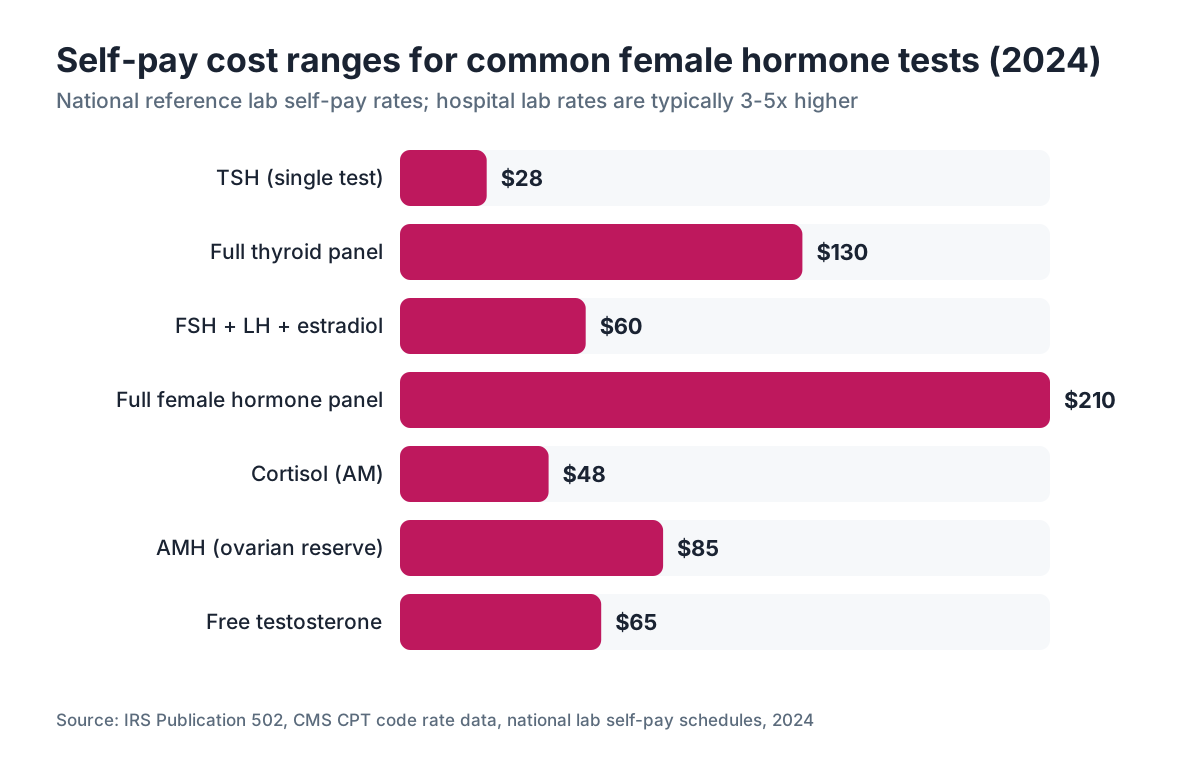
Direct-pay labs like Quest Diagnostics, Labcorp, and various online ordering services (Ulta Lab Tests, Walk-In Lab) sell hormone panels at self-pay rates that often beat what an uninsured patient pays at a hospital lab. A basic menopause panel (FSH, LH, estradiol) runs $30 to $80 at self-pay rates through national lab networks. A full female hormone panel including thyroid, testosterone, and cortisol typically runs $100 to $250. Paying out of pocket at these rates and reimbursing yourself from an HSA is sometimes cheaper than fighting a prior-auth battle for a $150 test.
Does telehealth change how hormone testing is covered?
Telehealth has genuinely widened access to hormone testing, but it adds a new billing layer. A telehealth visit with a physician who orders hormone labs follows the same insurance logic as an in-person visit: the visit must bill under a covered benefit, the order must carry an appropriate diagnosis code, and the lab must be in-network.
The COVID-19 public health emergency expanded Medicare and most commercial plan coverage of telehealth visits, and many of those expansions have been extended through 2026 under the Consolidated Appropriations Act. [10] For most commercial plans, a telehealth visit with a physician (rather than a nurse or health coach) is now covered at parity with in-person care, meaning the same cost-sharing applies.
Where it gets messy is with cash-pay or subscription telehealth services. Some companies charge a flat membership fee and fold lab orders into the service. In that model, the lab order may come with a cash-pay lab requisition rather than an insurance-billed order. The labs are real and the results are accurate, but if you want to submit the cost to insurance for reimbursement, you need a superbill (an itemized receipt with CPT and ICD-10 codes) from the provider. Not all subscription telehealth services hand these out. Ask before you sign up.
Platforms like WomenRx, which focuses on hormones and menopause care for women, typically work with licensed physicians who can generate insurance-compatible orders and provide superbills for FSA/HSA reimbursement. The question to ask any telehealth service: is the clinician a licensed MD or DO who can submit insurance claims, rather than a wellness coach or a nurse practitioner in a state without full practice authority?
For women exploring perimenopause care and wondering whether their symptoms warrant testing, a telehealth visit with a physician can be the fastest way to get a properly coded order without waiting weeks for an OB-GYN appointment.
Are there free or low-cost options for hormone testing?
Yes, though each comes with trade-offs.
Federally Qualified Health Centers (FQHCs) offer services on a sliding-fee scale based on income, and they can order blood tests including hormone panels. Find your nearest FQHC at the HRSA Health Center Finder. [11] Wait times can be longer and the panel may be limited to what the clinic's contracted lab covers, but for women without insurance or with very high deductibles, this is a real option.
Title X family planning clinics offer reproductive health services including some hormone testing at reduced or no cost depending on income. Contact your state's Title X grantee through the HHS Office of Population Affairs for clinic locations. [12]
Some large employers are adding on-site or near-site clinic services that include lab work at no additional cost-sharing. If your employer offers this, hormone testing ordered through that clinic sidesteps lab routing issues entirely.
Research studies and clinical trials sometimes include full hormone panels as part of enrollment labs, at no cost to participants. ClinicalTrials.gov lists open menopause-related studies by location. [13]
At-home hormone testing kits (dried blood spot or saliva) sell directly to consumers and cost $50 to $150. Insurance almost never covers them because no physician ordered them and they use consumer-facing lab methodology. Results from consumer kits are not always accepted by physicians for clinical decisions. If your goal is getting insurance to cover treatment based on results, start with a physician-ordered draw at a certified lab.
What should you ask your doctor before hormone testing to maximize coverage?
Before the blood draw, get answers to five specific questions.
First: will this be billed as a diagnostic test or a screening? Diagnostic tests tied to symptoms have a much clearer path to coverage than screening tests.
Second: what ICD-10 codes will be on the order? You have the right to know. Write them down and cross-reference them against your Summary of Benefits and Coverage (SBC), which your insurer must provide under the ACA.
Third: which lab will process the sample, and is that lab in-network for my plan? Ask specifically whether the lab is in-network, more than whether your doctor's office is in-network.
Fourth: does any test on this panel require prior authorization? If yes, ask the office to submit the PA before the draw.
Fifth: can I get a superbill if the claim is denied or if I am paying out of pocket? A superbill lets you self-submit to insurance or claim FSA/HSA reimbursement.
One more practical note. If you are approaching menopause or are in the perimenopause window, documenting your symptoms over 60 to 90 days before the appointment builds a paper trail that strengthens the medical necessity argument. A symptom diary does not need to be elaborate. Dates, symptoms, and severity on a single sheet of paper is enough.
For what organizations like the Menopause Society recommend on evaluation and care, their published guidelines are publicly available and worth reading before your appointment. [5] The menopause society page on this site has a plain-language summary of their current guidance.
How much does hormone testing cost without insurance coverage?
Self-pay costs vary by lab, test complexity, and whether you order directly or through a physician. Here are realistic ranges as of 2024, drawn from published self-pay rate cards at national labs and direct-pay platforms.
A single TSH test runs $15 to $40 at self-pay rates at major national labs. A full thyroid panel (TSH, free T4, free T3, reverse T3, TPO antibodies) runs $80 to $180.
A basic menopause panel (FSH, LH, estradiol) runs $30 to $90. Add progesterone, total and free testosterone, and DHEA-S and a full female hormone panel reaches $120 to $300 depending on the lab and whether you use a physician order or a direct-access testing service.
Cortisol (AM draw) runs $25 to $70. Insulin and fasting glucose add $20 to $50. A full metabolic and hormone workup including all the above plus a CBC and lipid panel can run $250 to $500 self-pay without insurance.
Hospital-based lab draws carry the steepest prices. The same estradiol test that costs $28 at a national reference lab can cost $150 to $400 when processed through a hospital lab with facility fees attached. If you are paying out of pocket, avoid hospital lab draws for routine hormone panels.
WomenRx and similar telehealth platforms sometimes bundle lab costs into their care model, which can pull the effective per-test cost below ordering a la carte, but verify what is included before assuming coverage.
For women worried about symptoms that reach beyond hormones, such as frozen shoulder during menopause or bleeding after menopause, hormone testing is one piece of a broader workup, and knowing what each part costs helps you prioritize when budget is tight.
Frequently asked questions
Does insurance cover hormone testing for menopause?
Usually yes, if a physician orders the test with documented symptoms and an appropriate diagnosis code such as N95.1 for menopausal symptoms. FSH and estradiol are the most commonly covered tests for menopause evaluation. Coverage hinges on your plan's medical necessity criteria, the diagnosis code used, and whether you use an in-network lab. Screening tests ordered without symptoms face a much higher denial rate.
What ICD-10 code is used for hormone testing related to menopause?
N95.1 (menopausal and female climacteric states) is the most commonly used code for hot flashes, night sweats, and menopause-related symptoms. N91.2 covers secondary amenorrhea. N92.6 covers irregular menstruation in perimenopause. These codes, paired with CPT codes 83001 (FSH) and 82670 (estradiol), give the strongest foundation for insurance coverage of a menopause hormone panel.
Can I use my HSA or FSA to pay for hormone blood tests?
Yes. Hormone blood tests ordered by a licensed health care provider are qualified medical expenses under IRS Publication 502, making them eligible for HSA and FSA payment. This holds even if your insurance denied the claim. In 2024, HSA contribution limits were $4,150 for individuals and $8,300 for families. Paying with pre-tax HSA or FSA dollars saves roughly 22 to 32 percent depending on your tax bracket.
How do I appeal a denied hormone test claim?
Request the Explanation of Benefits to find the specific denial reason. Your physician then submits a letter of medical necessity citing your symptoms, the ICD-10 diagnosis code, and a published clinical guideline such as the NAMS Hormone Therapy Position Statement. If the internal appeal fails, file for external review through your state insurance commissioner. Patients win roughly 40 percent of external appeals for diagnostic services according to published ACA review data.
Does Medicare cover hormone blood tests?
Medicare Part B covers diagnostic hormone tests ordered by a Medicare-enrolled physician when a clinical indication is documented. It does not cover hormone tests ordered as routine screening without a diagnosis. Once your Part B deductible is met ($240 in 2024), Medicare pays 80 percent of the approved amount. Tests for thyroid disorders (TSH) are among the most consistently covered under Medicare.
What is the difference between a diagnostic hormone test and a screening hormone test for insurance purposes?
A diagnostic test evaluates a specific symptom or condition and is paired with a diagnosis (ICD-10) code. A screening test is ordered in the absence of symptoms to catch potential future problems. Insurance plans routinely cover diagnostic hormone tests with proper documentation. Screening hormone tests rarely carry USPSTF A or B ratings, so they are usually not covered as preventive services and face a higher denial rate.
Do I need a doctor to order hormone tests for insurance to cover them?
Yes. Insurance coverage requires a physician order with a diagnosis code. Consumer direct-access testing (ordering your own blood draw online) produces real results but cannot be submitted to insurance because there is no billing provider or diagnosis code attached. For insurance billing, the order must come from a licensed MD, DO, or in some states a nurse practitioner or PA with prescriptive authority.
Which hormone tests require prior authorization?
Free testosterone, DHEA-S, AMH (anti-Müllerian hormone), and specialty panels like reverse T3 most commonly require prior authorization. TSH and basic estradiol and FSH panels rarely require prior auth. Prior authorization requirements vary by plan. Call your insurer's member services line with the specific CPT code before the draw to find out if a PA is needed for your plan.
How often will insurance cover repeat hormone testing?
Coverage frequency depends on the diagnosis. For thyroid management, the Endocrine Society recommends TSH testing every 6 to 12 months on stable therapy, and most insurers cover this frequency. For menopause management, estradiol and FSH are typically covered for initial diagnosis but may draw scrutiny for repeat testing without a documented clinical reason such as symptom change or treatment adjustment. Document the clinical rationale for each repeat test.
Can a telehealth doctor order insured hormone tests?
Yes, if the telehealth physician is licensed in your state and enrolled with your insurer as a covered provider, or if your plan has parity coverage for telehealth. The physician-ordered lab requisition is then processed through an in-network lab. For self-pay telehealth platforms, ask for a superbill with CPT and ICD-10 codes so you can self-submit to insurance or claim FSA/HSA reimbursement.
Are saliva or at-home hormone tests covered by insurance?
Almost never. Consumer saliva and dried blood spot kits sold directly to patients are not billed through a physician order and lack the ICD-10 coding structure insurers require. Results from consumer kits are also not consistently accepted by clinicians for treatment decisions. If coverage matters to you, use a physician-ordered blood draw at a CLIA-certified lab.
What is the cheapest way to get a full female hormone panel?
Direct-access self-pay testing through national labs (Quest, Labcorp, or direct-pay platforms like Ulta Lab Tests or Walk-In Lab) is usually the cheapest route when insurance will not cover it. A full female panel including FSH, LH, estradiol, progesterone, total testosterone, DHEA-S, and TSH runs $100 to $250 at self-pay rates. Pay with HSA or FSA funds to capture the effective pre-tax discount on top of that.
Will insurance cover testosterone testing for women?
Total testosterone is more consistently covered than free testosterone for women. Coverage is strongest when paired with a diagnosis like PCOS (E28.2), androgen excess, or adrenal evaluation. Free testosterone and DHEA-S often require prior authorization, and some commercial plans exclude them unless an endocrinologist orders them. Document low libido, fatigue, or mood symptoms to support medical necessity if your plan requires it.
Does PCOS affect my insurance coverage for hormone testing?
PCOS (ICD-10 E28.2) is one of the strongest diagnosis codes for hormone test coverage. It supports orders for testosterone, DHEA-S, LH, FSH, androstenedione, insulin, and a lipid panel. The Endocrine Society's PCOS guidelines recommend specific lab workups that insurers recognize, which makes coverage easier to get. If you have a confirmed PCOS diagnosis, make sure it appears on every hormone test order.
Sources
- Health Affairs, "Variation in Health Plan Coverage of Women's Preventive Services," 2021
- Healthcare.gov, ACA Preventive Care and Appeals Rights
- National Institute of Diabetes and Digestive and Kidney Diseases (NIDDK), Hypothyroidism
- Endocrine Society, Clinical Practice Guideline: Hypothyroidism in Adults
- IRS, Publication 969: Health Savings Accounts and Other Tax-Favored Health Plans, 2024
- IRS, Publication 502: Medical and Dental Expenses, 2024
- CMS, Telehealth Services and Consolidated Appropriations Act Extensions
- HRSA, Find a Health Center (Federally Qualified Health Centers)
- HHS Office of Population Affairs, Title X Family Planning Program
- ClinicalTrials.gov, National Library of Medicine