How much do estrogen patches cost in New Jersey in 2025?
TL;DR: In New Jersey, estrogen patches cost roughly $20 to $120 per month if you pay cash, depending on the brand, dose, and pharmacy. With insurance or NJ FamilyCare, most women pay $0 to $30. Generic estradiol patches are the cheapest option, and GoodRx or manufacturer coupons can cut cash prices by 50 to 80 percent.
What is the average cash price for estrogen patches in New Jersey?
Cash prices for estrogen patches in New Jersey run about $20 to $120 for a one-month supply. What sets your price is the brand versus generic decision and which pharmacy you walk into. The spread is wide. The same prescription can cost three times more at one chain than at a warehouse club two miles down the road.
Generic estradiol patches are the cheapest starting point. They contain the same active ingredient as brand names like Climara, Vivelle-Dot, and Minivelle. A 30-day supply of generic 0.05 mg/day estradiol patches runs roughly $25 to $55 at most New Jersey retail pharmacies in 2025, according to pricing data aggregated by GoodRx [1]. Brand-name Vivelle-Dot (made by Novartis) lists closer to $80 to $130 for the same patch count before any discount.
Those numbers move. Price shifts by location, by chain versus independent, and by whether you use a discount card. Costco and Sam's Club pharmacies sit at the low end. CVS and Rite Aid land in the middle. Compounding pharmacies charge on a different scale entirely, and they get their own section below.
Here is the practical part. Check GoodRx or RxSaver before you pick up a prescription at any New Jersey pharmacy. The gap between the highest and lowest quote at pharmacies within five miles of each other runs $40 to $60 a month, which adds up to $480 to $720 a year [1].
How much do estrogen patches cost with insurance in New Jersey?
With insurance, most women in New Jersey pay between $0 and $30 a month for generic estradiol patches. The exact number depends on your plan's formulary tier, whether you've met your deductible, and how the patch is classified.
The Affordable Care Act requires most non-grandfathered commercial plans to cover FDA-approved contraceptive methods without cost-sharing. Hormone therapy for menopause is a separate category, and the cost-sharing rules are not the same [2]. Several New Jersey insurers have moved generic estradiol patches to Tier 1, the lowest copay level, often $0 to $10, when prescribed generically. Your plan's formulary is the only place to confirm this.
NJ FamilyCare, New Jersey's Medicaid program, covers generic estradiol patches with a small co-pay, typically $1 to $3 per prescription for most eligibility categories [3]. Medicare Part D plans vary more. In 2025, the new $2,000 annual out-of-pocket cap under the Inflation Reduction Act's Part D redesign limits total drug spending, but estradiol patches sit at Tier 2 in most Part D formularies, meaning a monthly copay around $10 to $25 before you hit any cap [4].
With employer insurance, the fastest move is to call the member services number on your card and ask one specific question: is estradiol transdermal patch, generic, any strength, on the formulary, what tier is it, and is prior authorization required? Some plans want a formulary exception for the 0.025 mg/day low-dose versions.
What do estrogen patches cost at major New Jersey pharmacy chains in 2025?
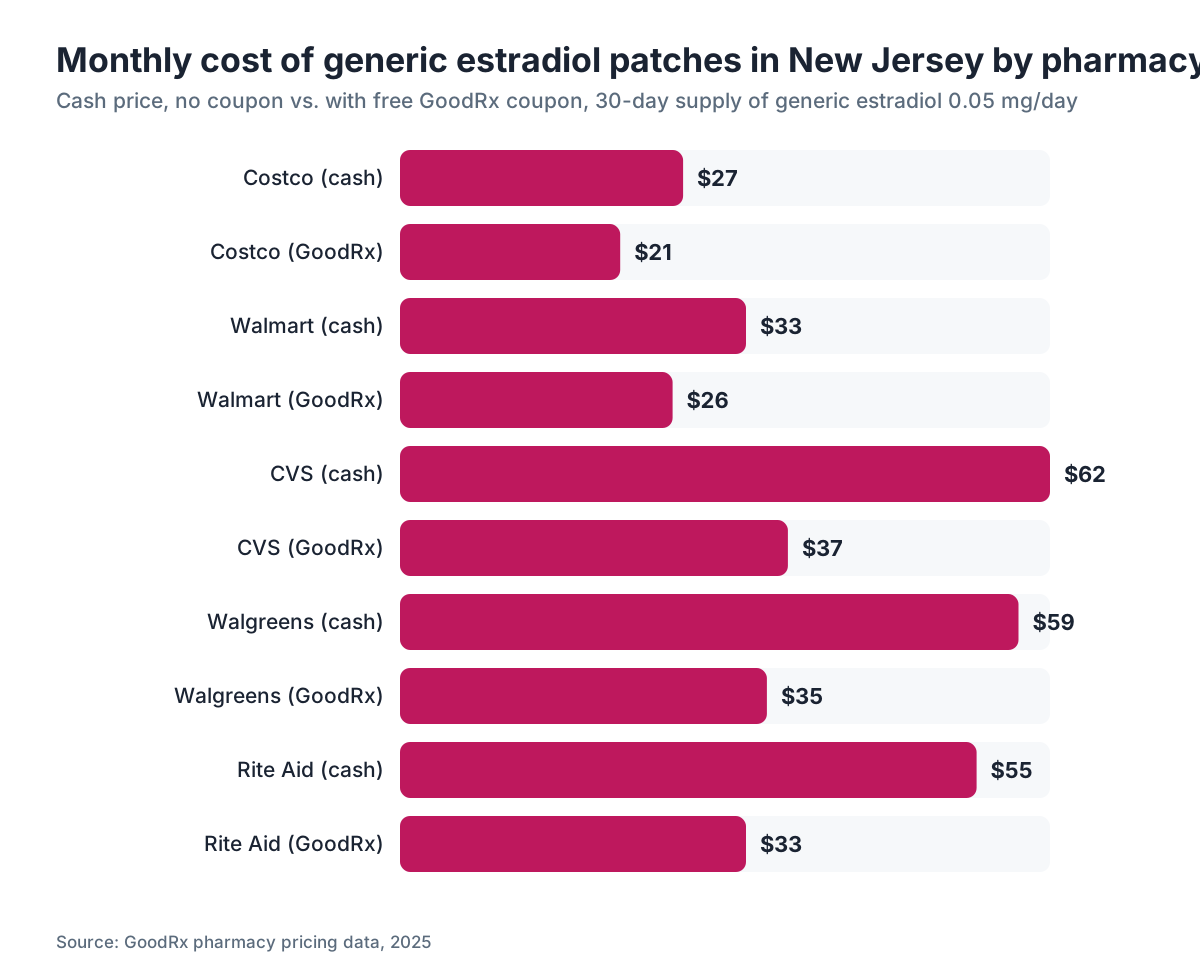
Here is a realistic comparison for a 30-day supply of generic estradiol 0.05 mg/day transdermal patches (8 patches per box, changed twice weekly) at pharmacies common in New Jersey, based on 2025 GoodRx pricing data [1]:
| Pharmacy | Cash price (no coupon) | With GoodRx coupon | |---|---|---| | Costco | $24, $30 | $18, $25 | | Walmart | $28, $38 | $22, $30 | | Rite Aid | $45, $65 | $28, $40 | | CVS | $50, $75 | $30, $45 | | Walgreens | $48, $70 | $28, $42 | | Independent pharmacy | $35, $90 | Varies |
These ranges reflect the 0.05 mg/day strength. The 0.025 mg/day patches (Minivelle equivalent) and higher doses like 0.1 mg/day tend to land within 10 to 15 percent of each other at the same pharmacy, so the pharmacy you choose matters far more than the strength when you're minimizing cost.
One reliable move: ask your prescriber to write the quantity as a 90-day supply if your insurance allows it. Mail-order pharmacies, including those tied to major NJ insurers like Horizon BCBS and Aetna, typically charge two months' copay for a three-month supply, which drops the effective monthly cost by about 33 percent.
Uninsured? GoodRx and RxSaver are free to use and beat most pharmacy membership pricing on estradiol patches in New Jersey [1]. GoodRx Gold runs about $10 a month and can go lower still on some fills, but the free coupon covers most people fine.
Are compounded estrogen patches cheaper or more expensive in New Jersey?
Compounded estrogen patches in New Jersey are almost always more expensive than FDA-approved generics, not cheaper. A compounded transdermal estradiol patch or gel from a New Jersey-licensed compounding pharmacy typically runs $60 to $180 a month for a 30-day supply, depending on the formulation and whether it adds hormones like progesterone or testosterone.
The cost gap is one issue. The regulatory context is another. The FDA has not approved compounded estrogen patches, meaning they are not bioequivalence-tested the way commercially manufactured patches are [5]. The FDA's position is that commercially available FDA-approved products should generally be used when they meet a patient's clinical needs. A prescriber who wants a non-standard dose or combination not sold commercially may have a real clinical reason to compound. For most women, though, the FDA-approved generic patch at $20 to $55 a month is both cheaper and better documented for safety and dosing consistency [5].
New Jersey law allows licensed pharmacists to compound medications for individual patients on a valid prescription. The New Jersey Board of Pharmacy regulates these pharmacies under state law, and compounding pharmacies that ship across state lines also fall under FDA oversight [3]. If you use one, confirm it's registered with the New Jersey Board of Pharmacy and check whether it's accredited by PCAB, the Pharmacy Compounding Accreditation Board, which signals quality control.
Compounding earns its keep in specific clinical situations, like a custom dose or an allergy to an excipient in the commercial product. It is not a way to save money.
Does New Jersey Medicaid cover estrogen patches?
Yes. NJ FamilyCare, New Jersey's combined Medicaid and CHIP program, covers FDA-approved generic estradiol transdermal patches on its preferred drug list [3]. Co-pays for most adult Medicaid members in New Jersey run $1 to $3 per prescription. Some eligibility categories, including pregnant women and children, may have no co-pay at all.
To confirm your coverage, search the NJ FamilyCare preferred drug list on the New Jersey Division of Medical Assistance and Health Services website, or call the member services line on your NJ FamilyCare card. Generic estradiol patches have been on the preferred drug list for years and are not subject to prior authorization for most adult indications.
If your prescriber writes for a brand-name product like Climara or Vivelle-Dot, NJ FamilyCare will typically require a generic substitution or a prior authorization showing medical necessity for the brand. Asking for the generic yourself saves everyone the paperwork.
What discount programs can lower the price of estrogen patches in New Jersey?
Several discount tools cut your out-of-pocket cost in New Jersey, even with no insurance at all.
GoodRx and RxSaver are the two most people use. Both are free, need no membership, and show real-time prices at pharmacies near you. On estradiol patches in New Jersey, these cards routinely bring cash prices down to $18 to $45 a month depending on the pharmacy [1]. Show the coupon at the counter, or pull it up on your phone, and you pay that contracted price instead of the retail cash price.
Manufacturer savings programs exist for some brand-name patches. Novartis has offered a savings card for Vivelle-Dot that can bring the cost as low as $25 per fill for eligible commercially insured patients. These programs exclude Medicare and Medicaid recipients and change year to year, so check the manufacturer's website directly.
The 340B Drug Pricing Program applies at certain federally qualified health centers and qualifying hospitals in New Jersey. Women who get primary care at a 340B-covered clinic may access estradiol patches at deeply reduced prices, sometimes under $10 a month, because the clinic buys at 340B ceiling prices. A list of 340B covered entities is publicly searchable through HRSA [6].
NeedyMeds (needymeds.org) keeps a database of patient assistance programs for uninsured women below certain income thresholds. These programs, run by pharmaceutical manufacturers, can provide medications free or at nominal cost for those who qualify.
How does the estrogen patch dose affect cost in New Jersey?
Estradiol patches come in several strengths: 0.025, 0.0375, 0.05, 0.075, and 0.1 mg/day are the common ones. The price gap between strengths at the same pharmacy is usually small, around $5 to $15 a month for generics. So if your clinician moves your dose up or down, your out-of-pocket cost shouldn't jump much.
Change frequency matters more for cost-per-day than strength does. Patches changed twice weekly (Vivelle-Dot equivalent) need eight patches per 28-day cycle. Once-weekly patches (Climara equivalent, which uses a larger reservoir system) need four per cycle. Per-patch prices for once-weekly formulations run higher, but total monthly cost ends up similar or slightly lower than twice-weekly at equivalent doses.
The FDA-approved estradiol patch label lists the available strengths and their delivery rates. The FDA prescribing information for estradiol transdermal systems notes that steady-state delivery differs by patch size and matrix composition, more than by labeled dose [5].
From a cost standpoint: if your prescriber is fine with either formulation, ask your pharmacy which generic (twice-weekly or once-weekly) is cheapest at that location on that day. It can vary by a few dollars and it's worth the 30-second question.
Is an estrogen patch cheaper than other forms of estrogen therapy in New Jersey?
Transdermal estradiol patches run about even with or cheaper than brand-name oral estrogen tablets, and clearly cheaper than brand-name estrogen gels or sprays. Here is a rough comparison for a 30-day supply using generic or lowest-cost options in New Jersey [1]:
| Estrogen form | Approximate monthly cash price | |---|---| | Generic estradiol patch (0.05 mg/day) | $22, $55 | | Generic oral estradiol (1 mg tablet) | $10, $25 | | EstroGel (topical gel) | $60, $110 | | Evamist (transdermal spray) | $80, $130 | | Divigel (topical gel) | $55, $100 | | Premarin (conjugated equine estrogens, brand only) | $90, $160 |
Generic oral estradiol tablets are technically the cheapest, often under $20 a month with a discount card. But price isn't the only factor. The North American Menopause Society (NAMS) and the Endocrine Society both note that transdermal estradiol has a different metabolic profile than oral estradiol, particularly around clotting risk and triglyceride elevation, which can make the patch the preferred clinical choice for some women regardless of cost [7][8].
NAMS states in its 2022 hormone therapy position statement that "transdermal estrogen does not appear to increase the risk of venous thromboembolism or stroke" unlike oral estrogens, a distinction that matters for women with cardiovascular risk factors [7]. For those women, the patch at $30 to $55 a month is more than a convenience choice. It's the medically preferable route.
If you're also prescribed progesterone alongside estrogen, budget for it separately. Generic oral micronized progesterone (Prometrium generic) runs about $15 to $40 a month in New Jersey [1].
How do I get an estrogen patch prescription in New Jersey?
You need a prescription from a licensed prescriber. In New Jersey that includes physicians, nurse practitioners, physician assistants, and certified nurse midwives. Your options are your primary care doctor, an OB/GYN, a gynecologist, or a menopause-focused specialist.
New Jersey has no state law restricting telehealth prescribing of hormone therapy for New Jersey residents, as long as the prescriber is licensed in New Jersey and the prescription follows a proper evaluation. Telehealth platforms focused on women's hormones, including WomenRx, can evaluate and prescribe estradiol patches for eligible patients without an in-person visit. That helps when local wait times for menopause-specialized providers stretch out for weeks.
When you get the prescription, ask your prescriber to write it as a generic ("generic estradiol transdermal patch") and to include a 90-day supply if your situation is stable. Both details cut your cost at pickup.
For a broader look at hormone replacement therapy options and what to expect from your first HRT conversation, see our full guide. If you're newer to this and wondering where you are in the transition, our article on perimenopause age is a good starting place, and when does menopause start covers the timeline.
New Jersey does not require a separate state-level prescription form for estrogen patches, since they aren't controlled substances. A standard paper or electronic prescription works.
What should I know about estrogen patch safety before focusing on cost?
Cost is a fair concern, but it shouldn't override the clinical picture. Estrogen therapy isn't right for every woman. A prescriber needs to review your personal and family medical history before recommending it.
The FDA requires a boxed warning on all estrogen products noting increased risks of endometrial cancer (in women with a uterus who use estrogen without a progestogen), cardiovascular events, and breast cancer, based on Women's Health Initiative data [5]. The NAMS 2022 position statement clarifies that these risks vary a lot by a woman's age, time since menopause, and type of therapy: "For women aged younger than 60 years or within 10 years of menopause onset, the benefit-risk ratio is favorable for treatment of bothersome vasomotor symptoms" [7].
For women with a uterus, estrogen goes alongside progesterone to protect the uterine lining. That combination changes the total monthly cost of therapy.
The Endocrine Society's clinical practice guideline on menopausal hormone therapy supports individualized prescribing rather than blanket avoidance or blanket use [8]. The goal is matching the therapy to the patient, not cutting cost at the expense of safety. Worried about bone loss? Our article on bone density tests covers why estrogen matters for skeletal health.
Nobody has perfect long-term data on every formulation at every dose. The honest summary: the evidence base for transdermal estradiol is stronger than for many other menopausal interventions, and cost shouldn't push you away from the safest route for your individual profile.
Will New Jersey's insurance laws improve estrogen patch coverage in 2025?
As of mid-2025, no New Jersey-specific state law requires commercial insurers to cover menopausal hormone therapy without cost-sharing the way contraceptives are covered. Coverage depends on federal ACA preventive care mandates, individual plan design, and each insurer's formulary decisions.
Section 2713 of the ACA requires coverage of preventive services rated A or B by the U.S. Preventive Services Task Force without cost-sharing [2]. As of 2025, the USPSTF has not issued an A or B recommendation for menopausal hormone therapy for symptom relief. It has addressed HRT in the context of chronic disease prevention, where the recommendation is against using it solely to prevent chronic conditions. That distinction matters: hormone therapy prescribed for symptomatic menopause relief is not currently mandated to be zero-cost-share under federal ACA rules.
Some New Jersey legislators and patient advocates have proposed state bills that would require commercial plans regulated in New Jersey to cover hormone therapy for documented menopausal symptoms at no cost-sharing. No such law was enacted as of this writing. Watch the New Jersey Department of Banking and Insurance website for updates [3].
For women on Medicare, the 2025 Part D redesign and its $2,000 annual cap is a real change that limits maximum out-of-pocket drug spending, even if it doesn't erase monthly copays for estradiol patches [4].
Frequently asked questions
How much does a one-month supply of estradiol patches cost without insurance in New Jersey?
Without insurance, generic estradiol patches in New Jersey cost roughly $22 to $55 a month at most pharmacies. A free GoodRx coupon can bring that down to $18 to $35 at warehouse clubs or Walmart. Brand-name versions like Vivelle-Dot run $80 to $130 without a discount. Check GoodRx or RxSaver before paying the sticker price at any pharmacy.
Does New Jersey Medicaid (NJ FamilyCare) pay for estrogen patches?
Yes, NJ FamilyCare covers FDA-approved generic estradiol transdermal patches on its preferred drug list. Co-pays for most adult members run $1 to $3 per prescription. Brand-name patches typically require a prior authorization proving medical necessity before NJ FamilyCare will cover them above the generic rate.
Which pharmacy in New Jersey has the cheapest estrogen patches?
Costco and Walmart consistently offer the lowest cash prices on generic estradiol patches in New Jersey, often $24 to $38 a month before any coupon. With a free GoodRx coupon, prices at either store can drop to $18 to $30. Prices shift regularly, so check GoodRx or RxSaver for real-time pricing near your zip code.
Does insurance cover estrogen patches for menopause in New Jersey?
Most commercial plans in New Jersey cover generic estradiol patches, usually at Tier 1 or Tier 2 copay levels ($0 to $30 a month). Coverage is not federally mandated to be zero-cost-share for menopausal symptoms the way contraceptives are, so your copay depends on your plan's formulary. Call the member services number on your card to confirm your tier and any prior authorization requirement.
Are compounded estrogen patches cheaper than brand-name patches in New Jersey?
No. Compounded estrogen patches in New Jersey typically cost $60 to $180 a month, more than FDA-approved generic patches at $22 to $55. Compounding makes clinical sense in specific situations, like custom doses or ingredient allergies, but it's not a way to save money. FDA-approved generics are bioequivalence-tested; compounded patches are not held to the same standard.
What dose of estrogen patch is cheapest?
Price differences between doses of generic estradiol patches are usually small, around $5 to $15 a month at the same pharmacy. The 0.05 mg/day generic patch is the most widely stocked and often the cheapest per-unit option. Let the clinical dose your prescriber recommends drive the choice, not minor price gaps between strengths.
Can I get an estrogen patch prescription via telehealth in New Jersey?
Yes. New Jersey allows telehealth prescribing of hormone therapy by licensed New Jersey providers. Telehealth platforms that specialize in women's hormones can evaluate and prescribe estradiol patches without an in-person visit. You still need a proper clinical evaluation before a prescription is issued; telehealth doesn't bypass that requirement.
Does Medicare cover estrogen patches in New Jersey?
Medicare Part D plans cover estradiol patches, usually at Tier 2. Monthly copays in New Jersey Part D plans typically run $10 to $25 for generic estradiol. Under the 2025 Inflation Reduction Act Part D redesign, total annual out-of-pocket drug costs are capped at $2,000, limiting your maximum exposure even if monthly copays continue.
Is estrogen patch cheaper than estrogen gel or estrogen spray?
Generic estradiol patches ($22 to $55/month) are generally cheaper than estrogen gels like EstroGel ($60 to $110/month) or sprays like Evamist ($80 to $130/month). Oral generic estradiol tablets are the cheapest form at $10 to $25/month, though patches are often preferred for women with certain cardiovascular risk factors because of their different metabolic profile.
Do I need progesterone if I use an estrogen patch in New Jersey?
If you have a uterus, yes. Using estrogen alone without a progestogen raises the risk of endometrial cancer. Your prescriber will typically co-prescribe oral micronized progesterone or a progestin alongside the patch. In New Jersey, generic oral micronized progesterone (Prometrium generic) costs roughly $15 to $40 a month, on top of the patch cost.
What is the 340B program and can it help me afford estrogen patches in New Jersey?
The 340B Drug Pricing Program is a federal program requiring manufacturers to offer outpatient drugs at steep discounts to eligible safety-net health centers and hospitals. New Jersey has multiple 340B-covered entities, including federally qualified health centers. Women who get primary care at a 340B site may access estradiol patches for under $10 a month. Search the HRSA 340B database to find covered entities near you.
How often do estrogen patches need to be replaced and does that affect cost?
Most estradiol patches are changed either twice weekly (8 patches per 28-day cycle) or once weekly (4 per cycle). Twice-weekly patches cost less per unit but you use more of them, so total monthly cost is usually similar. Ask your pharmacy which formulation is currently cheaper, since generic availability and pricing shift and the difference is worth a quick question.
Is it safe to buy estrogen patches from an online pharmacy to save money in New Jersey?
Only if the online pharmacy is verified. Use the National Association of Boards of Pharmacy's .pharmacy or VIPPS accreditation, or check state licensing through the New Jersey Board of Pharmacy. Buying from unverified international or unlicensed sites carries real risk of counterfeit or wrongly dosed products. Legitimate online pharmacies tied to telehealth platforms or major retail chains are generally safe and price competitively.
Sources
- GoodRx – Estradiol Patch pricing data
- HealthCare.gov – Preventive Care Benefits for Women (ACA Section 2713)
- New Jersey Department of Banking and Insurance
- Medicare.gov – Part D drug coverage and 2025 out-of-pocket cap
- FDA – Estradiol Transdermal System Prescribing Information
- HRSA – 340B Drug Pricing Program covered entities database
- North American Menopause Society (NAMS) – 2022 Hormone Therapy Position Statement
- Endocrine Society – Clinical Practice Guideline on Menopausal Hormone Therapy
- National Association of Boards of Pharmacy (NABP) – Verified online pharmacy accreditation