How long does menopause last? A realistic timeline
TL;DR: Menopause is technically a single point in time: 12 consecutive months with no period. But the symptoms surrounding it, from perimenopause through postmenopause, typically span 7 to 14 years. Hot flashes alone last a median of 7.4 years according to SWAN data. Your personal timeline depends heavily on when symptoms started, your race and ethnicity, and whether you use hormone therapy.
What does 'menopause' actually mean, and why does the timeline confuse everyone?
Menopause is not a phase. It is a single moment: the point exactly 12 months after your last menstrual period, with no other medical cause. Everything before that moment is perimenopause. Everything after is postmenopause. [1]
The confusion is completely understandable, because nobody walks around feeling a single moment. What women actually live through is a decade-long arc of hormonal change, and common usage squashes all of it under the word 'menopause.' When your doctor says you are 'going through menopause,' she almost certainly means the whole transition, including perimenopause.
So when people ask how long menopause lasts, they are really asking one of three different questions: How long does perimenopause last before my final period? How long will I feel symptoms? How long does postmenopause last? Each has a different answer, and conflating them leads to a lot of unnecessary panic or, just as bad, unnecessary resignation.
The average age at menopause in the United States is 51, though the normal range runs from about 45 to 55. [1] If you want to understand where you fall in that range, the article on perimenopause age and menopause age cover the predictors in detail.
How long does perimenopause last before you reach menopause?
Perimenopause averages 4 to 8 years, though it can be as short as 1 year or stretch past 10. [2] It begins when your ovaries start producing estrogen erratically, which usually shows up first as irregular periods and then as the classic symptoms: hot flashes, night sweats, sleep disruption, mood changes, and vaginal dryness.
The Study of Women's Health Across the Nation (SWAN), which followed over 3,000 women from premenopause through postmenopause, is the most thorough long-term data set we have on this. SWAN found that the median duration of the entire menopausal transition, from first irregular periods to the final period, was about 5.8 years for women who were premenopausal at enrollment. [3]
The early part of perimenopause (called the early menopausal transition stage) is marked by cycle irregularity: your periods change in length by 7 days or more. The late stage brings skipped periods, cycles more than 60 days apart, and sharply rising FSH levels. That late stage typically lasts 1 to 3 years and is usually when symptoms intensify.
If you want a clearer sense of when does menopause start, that article walks through the hormonal markers and early signs in detail.
How long do menopause symptoms last overall?
This is the question most women actually want answered, and the honest answer is: longer than most doctors used to say.
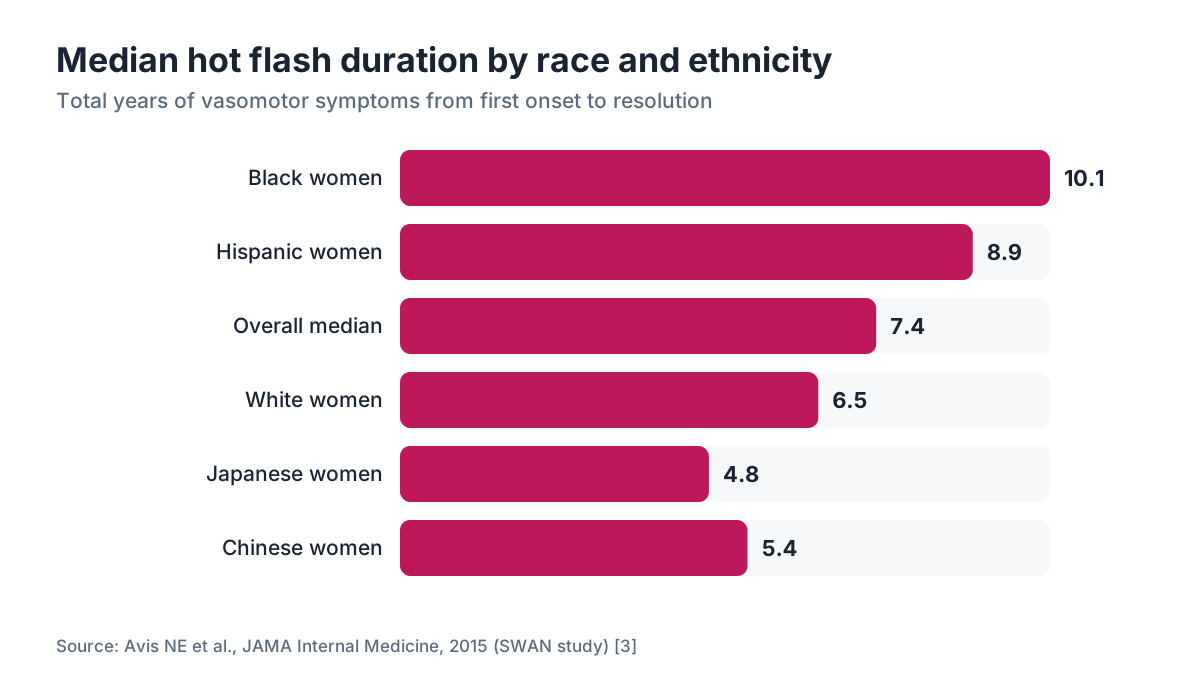
The SWAN data, published in JAMA Internal Medicine in 2015, found that the total duration of vasomotor symptoms (hot flashes and night sweats) was a median of 7.4 years. [3] That number rewrote the older assumption that hot flashes fade within a few years of the final period. Women who started symptoms earlier in perimenopause, before or just around the final menstrual period, had the longest duration. Women who started symptoms later, after their last period, had the shortest, around 3.4 years.
That 7.4-year median is counting from the first hot flash to the last. If you started having hot flashes at age 45 and reached menopause at 51, you could be looking at symptoms that extend years into postmenopause. Some women have clinically meaningful hot flashes into their 60s.
Beyond vasomotor symptoms, other symptoms have different trajectories. Vaginal dryness and genitourinary symptoms (urinary urgency, pain with sex) tend to get worse over time after menopause rather than better, because they are driven by sustained low estrogen. Sleep problems, joint aches, and mood symptoms often improve once hormones stabilize in postmenopause, though this varies a lot by individual. [4]
Nobody has great data on how long every individual symptom cluster lasts, because most studies track hot flashes specifically. The closest we have for the broader symptom picture comes from the SWAN and the Penn Ovarian Aging Study, both of which show meaningful symptom burden persisting 5 to 10 years into the transition.
Does race or ethnicity change how long symptoms last?
Yes, significantly. This is one of the clearest findings from SWAN, and it gets underreported.
Black women had the longest total duration of vasomotor symptoms: a median of 10.1 years in the SWAN analysis. [3] Hispanic women had a median of 8.9 years. White women had 6.5 years. Chinese and Japanese women had the shortest durations, around 5 years, though they also reported the lowest rates of hot flashes overall.
These differences remained even after researchers adjusted for body mass index, smoking, education, and anxiety. The reasons are not fully understood. Differences in stress exposure, socioeconomic factors, and possibly genetic variation in estrogen metabolism are all on the table.
If you are a Black or Hispanic woman and your symptoms are persisting well past what you have been told to expect, you are not imagining it. The data backs you up. This matters for treatment decisions because women with longer symptom duration may benefit from longer treatment windows or different approaches to tapering.
How long can menopause symptoms last after your last period?
Postmenopause is technically the rest of your life after the 12-month mark. But active, bothersome symptoms do not necessarily continue the entire time.
For vasomotor symptoms, about 42% of women over 60 still report hot flashes in some studies, and a non-trivial percentage of women in their late 60s and early 70s remain symptomatic. [5] The SWAN data showed that roughly 1 in 3 women experienced hot flashes for more than a decade total.
Genitourinary syndrome of menopause (GSM, formerly called vaginal atrophy) affects an estimated 50-60% of postmenopausal women and is chronic by nature. [4] Unlike hot flashes, it rarely resolves on its own without treatment, and it can worsen with each passing year without estrogen.
Bone loss also continues silently in postmenopause. The fastest bone loss happens in the 2 years before and 3 years after the final period, but it continues at a slower rate afterward. [6] This is why a bone density test typically becomes relevant for women around age 65, or earlier with risk factors.
In short: some symptoms improve in postmenopause as the hormonal rollercoaster steadies. Others persist or worsen. Knowing which category your symptoms fall into shapes what you do about them.
What is the typical menopause timeline from start to finish?
Here is a realistic timeline built from NAMS guidelines and SWAN data. Individual variation is substantial, so treat these as averages, not predictions.
| Stage | When it typically starts | How long it lasts | |---|---|---| | Early perimenopause | Mid-to-late 40s (range: 35-55) | 2-5 years | | Late perimenopause | 1-3 years before final period | 1-3 years | | Menopause (the moment) | Average age 51 in the U.S. | Single point in time | | Early postmenopause | Immediately after final period | First 5-6 years | | Late postmenopause | ~5-6 years after final period | Rest of life | | Active hot flash duration (median) | Starts in perimenopause | 7.4 years total [3] | | Genitourinary symptoms | Often start in perimenopause | Chronic without treatment [4] |
A woman who starts experiencing irregular cycles at 46 and reaches her final period at 51 has already spent 5 years in perimenopause. She may then carry hot flashes another 5 to 6 years into postmenopause, putting her at 56 or 57 before they fully resolve. That is a 10 to 11 year experience from first symptom to last. Some women sail through in 4 years. Others are still managing symptoms at 65.
There is no single normal.
Does hormone replacement therapy shorten how long symptoms last?
Hormone replacement therapy does not technically shorten the underlying transition. What it does is suppress symptoms while you are taking it. When you stop, symptoms can return, especially if you stop abruptly and early.
NAMS guidelines say that for most healthy women under 60, or within 10 years of menopause, the benefits of hormone therapy generally outweigh the risks for bothersome vasomotor symptoms. [7] The caveat is that the optimal duration of use is not fixed. Some women use it for 2 to 3 years to get through the worst of symptoms; others continue indefinitely with their physician's guidance.
The idea that you should stop hormone therapy after 5 years as a hard rule is outdated. The 2022 NAMS Hormone Therapy Position Statement states: 'Duration of therapy should be individualized based on a woman's symptoms, risks, and patient preference.' [7]
When women stop hormone therapy after years of use, about 50-60% experience a return of hot flashes. [5] A gradual taper works better than stopping cold turkey for most women, though the evidence on taper protocols is not strong.
If you are sorting through which estrogen formulation might work for you, the estrogen patch article covers the transdermal options in detail. And progesterone covers what is needed alongside estrogen if you have a uterus.
What factors make menopause symptoms last longer for some women?
Several variables are associated with longer symptom duration, based on SWAN and other prospective studies.
Starting symptoms earlier in the transition, before the final menstrual period, is the strongest predictor of a longer total duration. Women who had hot flashes starting in premenopause or early perimenopause had roughly 11.8 years of symptoms versus 3.4 years for women who only started experiencing them after their last period. [3]
Smoking is associated with earlier menopause and more severe symptoms. Higher BMI is associated with more hot flashes in postmenopause because fat tissue converts androgens to estrogen, but estrogen levels still drop enough to trigger symptoms. Anxiety and depression are both risk factors for more intense and longer-lasting vasomotor symptoms, possibly because they share overlapping neurological pathways with thermoregulation.
Surgical menopause, which happens when both ovaries are removed, produces a more abrupt hormonal drop than natural menopause and is associated with more severe symptoms, though the duration depends on subsequent hormone therapy use. Women with surgical menopause who do not take hormones often report more intense symptoms than women going through natural menopause.
Race and ethnicity, as covered above, also significantly shape duration independently of other factors.
Can you do anything to predict how long your own symptoms will last?
Honestly, no one test or marker reliably predicts your individual symptom duration. FSH and estradiol levels fluctuate dramatically in perimenopause, so a single measurement is not a reliable timeline. AMH (anti-Müllerian hormone) can give a rough estimate of remaining ovarian reserve and time to menopause, but it does not tell you how long symptoms will last afterward. [8]
The best predictors in population data are: how early your symptoms started relative to your last period (earlier start, longer duration), your racial or ethnic background, your smoking history, and your baseline mental health. None of these is a crystal ball.
What is more useful, practically, is tracking your own symptom pattern. Women whose symptoms began early in perimenopause and are still intense 1 to 2 years past their last period should plan for a longer runway and probably talk to a clinician about treatment rather than waiting it out.
If you are seeing a provider through a telehealth practice like WomenRx, that conversation can happen without a year-long waitlist. A clinician who specializes in this can help you figure out whether you are on a short or long trajectory and build a plan that fits.
How does weight change during the menopause transition, and does it affect symptom duration?
Most women gain weight during the menopause transition: an average of 5 to 8 pounds over the perimenopausal years, with fat redistribution toward the abdomen even in women who do not gain on the scale. [9] This happens partly because estrogen affects fat distribution, and partly because the transition often coincides with natural age-related slowing of metabolism.
Higher adiposity does not straightforwardly shorten or lengthen hot flash duration. The relationship is complicated. More body fat means more peripheral estrogen conversion, but women with obesity still experience significant vasomotor symptoms, and high BMI is associated with more severe hot flashes in postmenopause.
GLP-1 receptor agonists (semaglutide and tirzepatide) have emerged as options for weight management in midlife women, and there is preliminary interest in whether weight loss might reduce hot flash severity. The SURMOUNT-1 trial showed tirzepatide producing up to 22.5% body weight reduction in adults with obesity. [10] Direct evidence in perimenopausal women specifically is still limited.
If weight gain during this transition is something you are managing, the semaglutide for weight loss article covers how GLP-1 therapy works in detail, and the semaglutide vs tirzepatide comparison helps clarify the differences between the two leading options.
When should you actually see a doctor about symptom duration and severity?
A few situations signal that you should more than wait and see.
If hot flashes are disrupting sleep most nights, that is worth treating. Chronic sleep deprivation accelerates cardiovascular and cognitive risk, and 'riding it out' for 7-plus years at that intensity has real health costs beyond quality of life.
If symptoms started before age 45, you are in early menopause territory. Women who reach menopause before 45 (and especially before 40, which is called premature ovarian insufficiency or POI) have higher risks of cardiovascular disease and osteoporosis from the longer time spent in low-estrogen state. [7] The Endocrine Society recommends hormone therapy for women with POI until at least the average age of natural menopause, absent specific contraindications. [6]
If genitourinary symptoms like pain with sex or urinary urgency have developed, these are not going to improve without intervention. Low-dose vaginal estrogen is highly effective and has minimal systemic absorption. It is not the same risk calculation as systemic hormone therapy.
And if you are several years into postmenopause and still having significant hot flashes, that is worth a conversation rather than assuming it will resolve on its own. Some women need support well past the average symptom window.
For context on overall menopause management, that overview article lays out the full picture of what is going on hormonally and what your options are. WomenRx also offers hormone consultations for women who want a clinician-led assessment without the barriers of traditional gynecology scheduling.
Frequently asked questions
How long do menopause symptoms last on average?
The median duration for hot flashes and night sweats is 7.4 years, according to SWAN data published in JAMA Internal Medicine. That counts from the first symptom to the last, spanning perimenopause and postmenopause. Women who started symptoms earlier in the transition had longer durations. Genitourinary symptoms like vaginal dryness tend to persist indefinitely without treatment.
How long can menopause last in total?
The perimenopausal transition averages 4 to 8 years before the final period. Active symptoms, particularly hot flashes, then continue a median of 7.4 years total from first onset. Postmenopause is technically the rest of your life. Some women are symptom-free within 4 years of starting; others manage meaningful symptoms for more than a decade. Race, onset timing, and lifestyle factors all affect your personal timeline.
How long menopause symptoms will last for me specifically?
No test predicts your individual duration reliably. The strongest population-level predictors are: when your symptoms started (earlier start equals longer duration), your racial or ethnic background (Black women average 10.1 years of hot flashes, white women 6.5 years in SWAN data), your smoking history, and your baseline mental health. Tracking your own pattern and reviewing it with a clinician gives you the most useful information.
Can hot flashes last more than 10 years?
Yes. SWAN data showed roughly one in three women experienced vasomotor symptoms for more than a decade total. Black women had the longest median duration at 10.1 years. Women who began hot flashes early in perimenopause had the longest overall exposure. So while a 10-plus year course is not the average, it is common enough that planning for it is reasonable if your symptoms started early.
Does menopause end at a specific age?
No fixed age marks the end of symptoms. Menopause itself, the final period, occurs at an average age of 51 in the U.S. But symptoms can continue well into the mid-to-late 50s or even 60s for many women. About 42% of women over 60 still report hot flashes in some studies. There is no biological cutoff date; symptoms taper when your body fully adjusts to sustained low estrogen levels.
Is perimenopause worse than menopause for symptoms?
For many women, the late perimenopause stage, roughly the 1 to 3 years before the final period, is the most intense part of the transition. Estrogen fluctuates sharply during this period rather than declining steadily, and those swings drive the most severe hot flashes, mood swings, and sleep disruption. Early postmenopause symptoms often improve as hormones stabilize at a consistently lower level, though genitourinary symptoms may worsen.
What is the difference between perimenopause and menopause in terms of timing?
Perimenopause is the transitional phase leading up to menopause, averaging 4 to 8 years. Menopause is defined as 12 consecutive months without a menstrual period. Everything after that single point is postmenopause. Most symptoms people associate with menopause actually begin during perimenopause and may continue years into postmenopause.
Does hormone therapy make menopause end sooner?
Hormone therapy suppresses symptoms while you take it, but it does not accelerate the underlying hormonal transition or guarantee symptoms disappear faster after you stop. When women discontinue hormone therapy, 50 to 60% experience a return of hot flashes. NAMS recommends duration be individualized rather than following an arbitrary 5-year cutoff. A slow taper tends to work better than stopping abruptly.
Can menopause symptoms come back after they stop?
Yes, though it is not common for hot flashes to return after a long, confirmed symptom-free period without a trigger. The most common trigger for symptom return is stopping hormone therapy, which causes rebound hot flashes in roughly half of women. Significant stress, major weight changes, and certain medications (particularly SSRIs or aromatase inhibitors) can also bring back or worsen vasomotor symptoms.
How long does surgical menopause last compared to natural menopause?
Surgical menopause, from bilateral oophorectomy (removal of both ovaries), produces an abrupt hormone drop rather than a gradual decline. Symptoms can be more intense than natural menopause, especially in the first year. Duration afterward depends largely on whether hormone therapy is used. Women who do not take hormones after surgical menopause often report severe symptoms for many years; those who do tend to have experiences closer to natural menopause.
Are there treatments that actually shorten symptom duration?
No treatment is proven to shorten total symptom duration. Hormone therapy suppresses symptoms during use but does not reset the clock. Non-hormonal options like fezolinetant (FDA-approved in 2023 for hot flashes) reduce frequency and severity. SSRIs and SNRIs provide partial relief. What works best varies by individual. None of these options make menopause end earlier; they manage the symptom burden while the transition runs its course.
Does being overweight or obese make menopause symptoms last longer?
The relationship is complicated. Higher BMI is associated with more severe hot flashes in postmenopause, possibly because adipose tissue creates hormonal signals that interfere with thermoregulation. It does not clearly shorten or lengthen total symptom duration. Women with obesity experience significant vasomotor symptoms despite higher peripheral estrogen conversion. Weight loss during the transition may help with symptom severity but the evidence in large trials is still limited.
What is early menopause and does it mean a longer symptom period?
Early menopause means your final period occurred between ages 40 and 45. Premature ovarian insufficiency (POI) means it happened before 40. Both are associated with a longer lifetime exposure to low estrogen, raising cardiovascular and bone risks. Symptom duration specifically follows the same pattern as natural menopause: it depends more on when symptoms started relative to the final period than on the age at menopause itself.
How is postmenopause different from menopause, and how long does it last?
Postmenopause begins the day after you hit the 12-month mark without a period and technically continues the rest of your life. Early postmenopause, roughly the first 5 to 6 years, is when vasomotor symptoms are most active for women who started symptoms late. Late postmenopause is generally more stable hormonally, though genitourinary syndrome of menopause often worsens over time without treatment.
Sources
- NAMS (North American Menopause Society), Menopause 101
- Office on Women's Health, U.S. Dept. of Health & Human Services, Menopause
- Avis NE et al., JAMA Internal Medicine, 2015: Duration of menopausal vasomotor symptoms over the menopause transition (SWAN study)
- NAMS, 2020 Genitourinary Syndrome of Menopause Position Statement
- Politi MC et al., Annals of Internal Medicine, 2008: Revisiting the Duration of Vasomotor Symptoms of Menopause
- Endocrine Society Clinical Practice Guideline: Primary Ovarian Insufficiency in Adolescents and Women
- NAMS, 2022 Hormone Therapy Position Statement
- Broer SL et al., Human Reproduction Update, 2014: Anti-Müllerian hormone as a marker for timing of menopause
- Davis SR et al., Nature Reviews Endocrinology, 2012: Menopause and weight gain
- Jastreboff AM et al., NEJM, 2022: Tirzepatide Once Weekly for the Treatment of Obesity (SURMOUNT-1)
- NIH National Institute on Aging, Menopause