How early can menopause start? Ages, causes, and what to do
TL;DR: Menopause officially starts when you've gone 12 consecutive months without a period. The average age in the US is 51, but it can happen before 40 (premature menopause) or between 40 and 45 (early menopause). Roughly 1 in 100 women under 40 experience premature ovarian insufficiency. Genetics, surgery, chemotherapy, and autoimmune conditions are the most common causes.
What is the earliest age menopause can start?
Menopause can technically start in your 20s, though that's rare. The medical community splits this into two categories based on age: premature menopause (before age 40) and early menopause (between 40 and 45). The average age of natural menopause in the United States is 51, according to the North American Menopause Society [1]. But "average" hides a wide range, and for some women the ovaries stop working a decade or two ahead of schedule.
Premature ovarian insufficiency (POI), sometimes still called premature ovarian failure, affects roughly 1% of women under 40 and about 0.1% of women under 30 [2]. That means around 1 in 1,000 women in their 20s are dealing with something most people assume won't happen until their early 50s. It is not vanishingly rare, and it is not the same as normal early menopause, because in POI the ovaries may still occasionally release eggs and hormone levels can fluctuate rather than decline steadily.
If your periods stopped before 40 without an obvious cause like surgery, this is a medical situation that needs proper evaluation, more than reassurance that "you're just stressed." A single FSH test drawn on day 3 of a cycle is not enough to diagnose POI; the Endocrine Society recommends confirming with two elevated FSH readings (typically above 25-40 IU/L depending on the lab) at least four to six weeks apart [2].
See when does menopause start for a full breakdown of what the timing looks like across the lifespan.
What is the difference between premature menopause, early menopause, and POI?
These terms get used interchangeably online, but they mean different things clinically.
Premature menopause means natural, permanent cessation of menstrual periods before age 40. It is defined by 12 consecutive months without a period, just like regular menopause, just earlier. Early menopause means the same thing but between ages 40 and 45.
Premature ovarian insufficiency (POI) is a broader, more accurate term for what happens when the ovaries lose normal function before 40. Unlike true premature menopause, POI is not always permanent. Ovarian function can fluctuate. Sporadic ovulation still occurs in roughly 5-10% of women with POI, and about 5-10% conceive naturally after diagnosis [2]. This is why the older term "premature ovarian failure" fell out of favor. It implies a finality that is not always accurate.
Surgical menopause is different again. If both ovaries are removed (bilateral oophorectomy) at any age, estrogen levels drop within 24-48 hours, far faster than natural menopause. This produces more abrupt and often more severe symptoms, and it carries distinct long-term risks that natural early menopause does not fully replicate [3].
The distinction matters because the workup, treatment urgency, and fertility counseling differ significantly across these categories. A 38-year-old with POI needs different conversations than a 43-year-old whose periods tapered off naturally.
What are the main causes of early and premature menopause?
Most cases of POI and premature menopause are idiopathic, meaning no clear cause is found even after thorough testing. That said, several known causes account for a meaningful share of cases.
Genetics is the biggest identifiable factor. Fragile X premutation carriers (women who carry the FMR1 premutation rather than the full mutation) have roughly a 20% lifetime risk of POI [2]. Turner syndrome, where one X chromosome is missing or partially missing, nearly always results in ovarian failure. A family history of early menopause in a mother or sister raises your own risk substantially, though the specific genes involved beyond FMR1 are still being mapped.
Cancer treatment is a major cause in younger women. Both chemotherapy (especially alkylating agents like cyclophosphamide) and pelvic radiation can damage ovarian follicles. The risk depends on the drug, the dose, and the woman's age at treatment. The American Society of Clinical Oncology recommends fertility preservation counseling before cancer treatment for this reason [4].
Autoimmune conditions account for roughly 4-30% of POI cases depending on the study. The ovaries can be targeted by the same immune dysfunction that drives conditions like Addison's disease, thyroid autoimmunity, and type 1 diabetes. Testing for adrenal antibodies (specifically 21-hydroxylase antibodies) matters because undetected Addison's disease is life-threatening [2].
Ovarian surgery, even when both ovaries are conserved, can reduce ovarian reserve if blood supply to the ovary is compromised. Endometrioma removal, in particular, is associated with measurable declines in anti-Müllerian hormone (AMH) after surgery [5].
Smoke exposure is a modifiable risk. Women who smoke reach menopause on average 1-2 years earlier than non-smokers [1]. It is a genuine accelerant, not a minor statistical footnote.
See perimenopause age for how the transition before menopause maps onto earlier timelines.
What are the symptoms of early or premature menopause?
The symptoms are the same as regular menopause, just happening sooner and sometimes more intensely. Hot flashes, night sweats, irregular or absent periods, vaginal dryness, sleep disruption, brain fog, and mood changes are the classic picture.
What's different with early and premature menopause is the context. A 35-year-old dealing with hot flashes is often not immediately recognized, by herself or her doctor, as someone in menopause. The diagnosis gets delayed. Studies suggest the average time from first symptoms to POI diagnosis is over five years in some populations [2]. That delay matters because low estrogen at a young age carries compounding risks the longer it goes untreated.
Some women notice menstrual irregularity first, with cycles becoming unpredictable before stopping altogether. Others have sudden amenorrhea. In POI specifically, cycles may return sporadically, which can be confusing and can cause women to assume they've recovered when their ovarian function is still significantly impaired.
Urinary symptoms, including increased frequency and urgency, often appear because estrogen receptors line the urethra and bladder. Joint pain and a decline in exercise tolerance are less talked about but real. Libido changes are common and underreported. The psychological toll of an unexpected early menopause diagnosis, including grief over fertility, deserves its own frank acknowledgment. It is not a minor side effect.
How is early menopause diagnosed?
Diagnosis starts with a careful history and a few targeted lab tests. The core findings that point to POI or premature menopause are:
- FSH (follicle-stimulating hormone) elevated above the menopausal threshold on two separate blood draws at least 4-6 weeks apart [2]
- Estradiol low (typically below 20-30 pg/mL, though labs vary)
- Irregular or absent periods for at least 4-6 months in a woman under 40
AMH (anti-Müllerian hormone) can give additional context on ovarian reserve, though it is not yet a standalone diagnostic criterion for POI. A karyotype is recommended for women under 30 to rule out chromosomal causes like Turner syndrome. FMR1 premutation testing is standard because of the Fragile X link. A pelvic ultrasound to assess antral follicle count is useful context.
The Endocrine Society's 2023 clinical practice guideline on POI recommends screening for associated autoimmune conditions at diagnosis and periodically after: thyroid function (TSH, anti-TPO), adrenal antibodies (21-hydroxylase), and fasting glucose [2].
Bone density testing matters earlier than most women expect. The bone density test is often deferred until age 65 in average-risk women, but women with premature menopause should have a baseline DEXA scan at diagnosis, not 30 years later.
Pregnancy test before anything else. This sounds obvious, but amenorrhea in a young woman has a long differential and ruling out pregnancy first avoids unnecessary testing and correctly frames what follows.
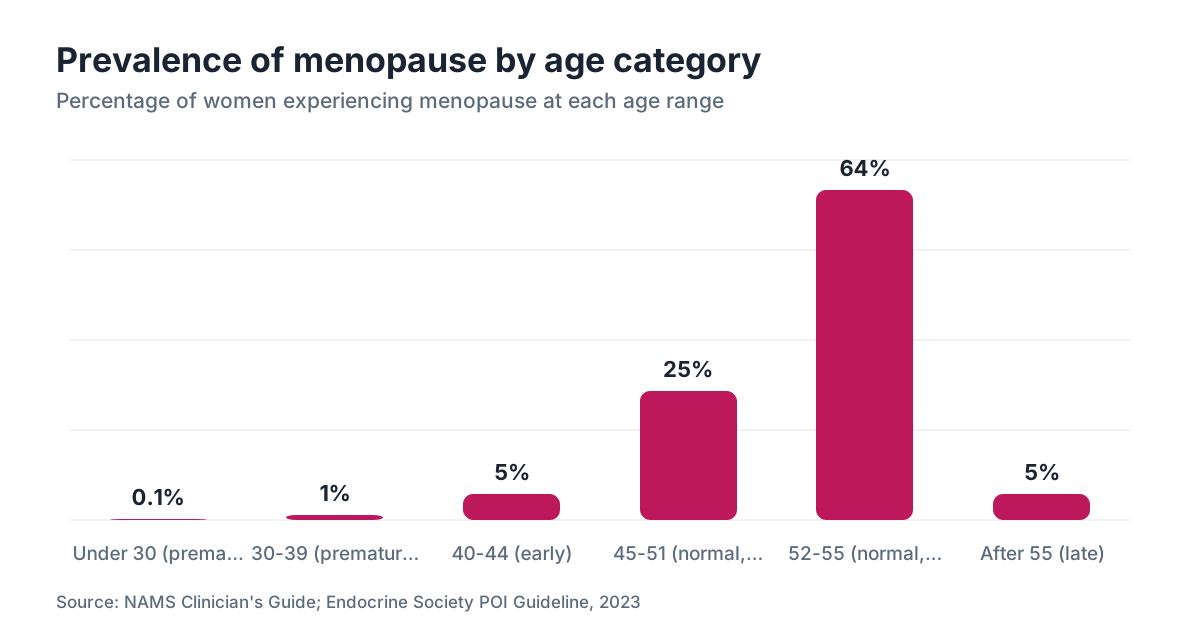
Age ranges and prevalence: how common is early menopause at different ages?
Real numbers help contextualize this.
| Age at menopause | Category | Estimated prevalence | |---|---|---| | Under 30 | Premature (POI) | ~0.1% of women | | 30-39 | Premature (POI) | ~1% of women | | 40-44 | Early menopause | ~5% of women | | 45-51 | Within normal range (earlier end) | ~25% of women | | 52-55 | Within normal range (later end) | Majority of remaining | | After 55 | Late menopause | ~5% of women |
Sources: NAMS position statement [1], Endocrine Society POI guideline [2].
These numbers mean that roughly 1 in 20 women enters menopause before 45. That is not a vanishingly small group. Across the US female population, it represents millions of women who face decades with low estrogen that their bodies were not expecting for another 10 or more years.
Ethnicity influences timing too, though the data is nuanced. The SWAN (Study of Women's Health Across the Nation) found that African American and Hispanic women tend to reach menopause slightly earlier than white women on average, while Japanese and Chinese American women tend toward slightly later menopause [6]. The differences are modest (one to two years on average) but real, and they affect who gets screened proactively.
What are the long-term health risks of early and premature menopause?
This is where the conversation gets serious. Early estrogen loss does more than mean earlier hot flashes. It speeds up several age-related processes that estrogen normally slows.
Cardiovascular disease is the biggest risk. Estrogen has direct protective effects on the cardiovascular system, and women who enter menopause before 40 have significantly higher rates of coronary heart disease compared to women with menopause at 50-51 [7]. A 2019 meta-analysis in The Lancet found that each year menopause is delayed is associated with a 2% lower risk of coronary heart disease [7].
Bone loss is rapid in the years immediately following menopause, and it starts earlier in women with early or premature menopause. Osteoporosis develops earlier and fractures occur at younger ages. A baseline bone density test at diagnosis is not optional for these women.
Cognitive health is an active area of research. Observational studies suggest early menopause is associated with faster cognitive decline and higher dementia risk, though causality is not fully established. The SWAN study found declines in verbal memory and processing speed during the menopausal transition [6].
Sexual function and vaginal health decline significantly without estrogen. Genitourinary syndrome of menopause (GSM) affects the vaginal tissue, urethra, and pelvic floor, and it does not resolve on its own without treatment.
Psychological health is affected too. Rates of depression and anxiety are higher during the menopausal transition, and premature menopause specifically is associated with grief responses that deserve proper support, not minimization.
Here is the part worth remembering: the risks of untreated premature menopause are real and cumulative. Every year without hormone replacement adds to the bone and cardiovascular deficit.
Does hormone replacement therapy help with early menopause, and when should you start?
Yes, and the evidence for starting early is stronger for premature and early menopause than for menopause at the average age.
For women with POI and premature menopause, the Endocrine Society and NAMS both recommend hormone replacement therapy until at least the average age of natural menopause (around 51), barring a contraindication [1][2]. This is not the same as the controversial question about HRT for 60-year-old women. In women under 40, replacing estrogen that the body should still have is physiologic replacement, not pharmacologic addition.
Estrogen alone is not enough for women who still have a uterus. Progesterone (or a progestogen) is needed to protect the uterine lining. For younger women, the form of progesterone matters. Micronized progesterone (bioidentical) is preferred over synthetic progestins in many guidelines because of a more favorable side effect profile, though more data exists for synthetic progestins in older populations.
Dose matters too. Standard HRT doses used for menopausal women in their 50s may not be sufficient to fully replicate the estrogen levels a 35-year-old would normally have. Many clinicians use higher doses in younger women with POI to better approximate physiological estrogen levels, though the exact dosing approach should be individualized [2].
The estrogen patch is often the preferred delivery route because transdermal estrogen bypasses the liver and does not increase clotting risk the way oral estrogen does. This matters for younger women who may be using contraception or have other cardiovascular considerations.
WomenRx provides telehealth-based hormone evaluation and treatment for women navigating early menopause, with clinicians who understand the specific needs of younger patients rather than applying a one-size-fits-all protocol designed for 55-year-olds.
For women with POI who want to conceive, HRT and fertility treatment are not mutually exclusive conversations. Spontaneous pregnancy does occur in POI, and assisted reproductive technology with donor eggs is the most effective fertility option.
Can lifestyle factors cause menopause to start earlier?
Some yes, some are myths.
Smoking is the clearest modifiable risk. Women who smoke enter menopause roughly 1-2 years earlier than non-smokers [1]. The chemicals in cigarette smoke damage follicles directly. This is dose-dependent: heavier smokers tend to have earlier menopause than light smokers.
Body weight has a modest association. Very low body fat is associated with earlier menopause in some studies, likely because adipose tissue produces estrogen that supplements ovarian production. Extreme caloric restriction or eating disorders that suppress ovarian function for years may accelerate follicle depletion over time, though the evidence is not as clean as the smoking data.
Chronic stress does not cause menopause to start early in any well-demonstrated way, though it can cause hypothalamic amenorrhea, which superficially resembles it. The difference matters: hypothalamic amenorrhea (where the brain suppresses ovarian signaling due to stress, undereating, or overexercise) produces low FSH and low estrogen, while POI produces high FSH and low estrogen. This distinction changes treatment completely.
Environmental exposures are an area of legitimate concern and ongoing research. Certain endocrine-disrupting chemicals (phthalates, BPA, certain pesticides) have been associated with earlier menopause onset in epidemiological studies, but the effect sizes are small and causality is not proven.
What doesn't cause early menopause: using hormonal contraception for years, having children later, skipping periods via continuous pill use. These are persistent myths with no supporting evidence.
What happens to fertility with early or premature menopause?
This is often the most emotionally charged part of the conversation.
Natural conception becomes significantly harder with POI and is essentially impossible once true premature menopause is established. The picture is more complicated in POI specifically. Because ovarian function can fluctuate, spontaneous ovulation still occurs in a subset of women. The Endocrine Society estimates roughly 5-10% of women with POI conceive naturally after diagnosis [2]. This is not a reason to delay treatment (waiting and hoping is not a strategy with good odds), but it is worth knowing.
For women with POI who want to conceive, options include:
- In vitro fertilization with donor eggs, which is the most effective option and achieves pregnancy rates comparable to women without ovarian insufficiency
- Embryo or egg banking if POI is diagnosed while some follicular activity remains
- Adoption and gestational surrogacy
Fertility preservation before cancer treatment (egg or embryo freezing) has improved substantially and should be discussed before any gonadotoxic therapy. The American Society of Clinical Oncology classifies fertility preservation counseling as standard of care [4].
Women diagnosed with POI who do not want to conceive still need to know that HRT does not reliably prevent the rare spontaneous ovulations, meaning contraception is a separate conversation if pregnancy would not be desired.
Emotional support matters here. An unexpected infertility diagnosis tied to early menopause deserves more than a pamphlet and a referral. Psychological support, including therapists who specialize in reproductive loss, is a reasonable and important part of care.
How do you know if you're in perimenopause vs. early menopause?
This trips up a lot of women and their doctors.
Perimenopause is the transition period before menopause, typically lasting 4-8 years in women approaching the average age of menopause. Cycles become irregular, symptoms like hot flashes begin, but periods have not yet stopped for 12 consecutive months. Perimenopause age typically starts in the mid-to-late 40s for most women, but can start earlier if early menopause is on the horizon.
Early menopause is confirmed only after 12 consecutive months without a period, in a woman under 45. Before that 12-month mark, you're technically still in perimenopause (or early perimenopause leading to early menopause).
The overlap creates real diagnostic confusion because FSH levels fluctuate during perimenopause. A high FSH on one draw does not mean menopause is complete. A lower FSH the next month does not mean you're fine. This is why the repeated testing at least four to six weeks apart matters, and why pregnancy must always be ruled out first in women under 40 with irregular cycles.
Symptom overlap with other conditions (thyroid disease, hypothalamic amenorrhea, hyperprolactinemia) means the differential has to be worked through properly. A TSH and prolactin level are reasonable additions to the early workup in any woman under 45 with cycle changes.
See menopause age for more on how the full timeline of menopause is defined and measured.
When should you see a doctor about possibly early menopause?
Sooner than most women think. The average delay to POI diagnosis is years, partly because women are reassured and sent home, and partly because symptoms get attributed to stress, thyroid problems, or birth control effects.
See a clinician promptly if:
- You're under 45 and your periods have been absent or markedly irregular for more than three months without an obvious cause
- You're under 40 and experiencing hot flashes, night sweats, or vaginal dryness alongside cycle changes
- You have a family history of early menopause, Turner syndrome, or Fragile X in your family
- You've had pelvic surgery, chemotherapy, or pelvic radiation
- Your periods stopped after stopping hormonal contraception and haven't returned within three months
You are entitled to a workup, more than reassurance. Asking specifically for FSH, estradiol, AMH, TSH, prolactin, and a pregnancy test is reasonable and appropriate.
Telehealth platforms like WomenRx have made it easier to get hormone evaluation from clinicians who specialize in this area rather than waiting for a referral to a reproductive endocrinologist that may take months.
Early diagnosis matters because every year of untreated low estrogen in a woman under 40 has quantifiable effects on bone density, cardiovascular health, and cognitive function. The sooner treatment starts, the more of those risks can be reduced.
Frequently asked questions
How early can menopause start naturally?
Natural menopause can start as early as the late 20s or early 30s, though it's uncommon. Premature ovarian insufficiency (POI) affects roughly 1% of women under 40 and about 0.1% of those under 30. These women have not had their ovaries removed; their ovaries simply stopped functioning ahead of schedule. Most natural early menopause happens between ages 40 and 45, which affects roughly 5% of women.
What is considered premature menopause?
Premature menopause means going 12 consecutive months without a period before age 40. It's often caused by premature ovarian insufficiency (POI), surgery to remove the ovaries, chemotherapy, pelvic radiation, chromosomal conditions like Turner syndrome, or autoimmune disease. About 1 in 100 women under 40 experience it. Unlike regular menopause, some women with POI still occasionally ovulate and a small percentage conceive naturally.
Can menopause start at 30?
Yes. It's uncommon but real. POI affects approximately 0.1% of women in their 20s and 30s combined. Causes include chromosomal abnormalities (Turner syndrome, Fragile X premutation), autoimmune conditions, cancer treatment, and, in many cases, no identifiable cause at all. A 30-year-old with three or more months of absent periods and hot flashes should have FSH, estradiol, and thyroid function tested rather than being reassured without investigation.
What does early menopause feel like?
The symptoms are the same as menopause at any age: hot flashes, night sweats, irregular or stopped periods, vaginal dryness, poor sleep, mood changes, brain fog, and decreased libido. What's different is the context. Symptoms arriving in your 30s or early 40s are often not recognized as menopause by the woman experiencing them or the first clinicians she sees, which delays diagnosis by years in many cases.
Does early menopause run in families?
Yes, meaningfully so. A mother or sister with early menopause approximately doubles your risk of experiencing it yourself. Fragile X premutation carriers have roughly a 20% lifetime risk of POI. Turner syndrome is genetic. Even without a named genetic syndrome, family history of early menopause is one of the strongest individual predictors. If your mother went through menopause before 45, it's worth tracking your own cycle patterns and having a proactive conversation with your clinician.
Can stress cause early menopause?
Stress does not directly cause menopause to start early the way smoking or chemotherapy does. Severe chronic stress can cause hypothalamic amenorrhea, a separate condition where the brain suppresses ovarian signaling and periods stop. This mimics early menopause symptomatically but has a different hormonal profile (low FSH, low estrogen, versus the high FSH seen in POI) and different treatment. Lab testing distinguishes the two.
Is early menopause the same as perimenopause?
No. Perimenopause is the transition leading up to menopause, typically 4-8 years of irregular cycles and fluctuating hormones before the final period. Menopause itself, including early menopause, is defined as 12 consecutive months without a period. A woman under 45 with irregular cycles and rising FSH is in early perimenopause heading toward early menopause, but she hasn't crossed the menopause threshold until periods have been absent a full year.
Should I take HRT if I have premature menopause?
Most major guidelines say yes, unless there's a specific contraindication. Both NAMS and the Endocrine Society recommend hormone replacement therapy for women with POI and premature menopause until at least age 51, the average age of natural menopause. The rationale is that you're replacing estrogen the body should still have, not adding extra. Untreated premature menopause significantly raises the risk of osteoporosis, heart disease, and cognitive decline.
Does early menopause mean I can't get pregnant?
Natural conception becomes very difficult with POI and essentially impossible with confirmed premature menopause. Around 5-10% of women with POI do conceive naturally because ovarian function can fluctuate. The most effective path to pregnancy for women with POI is IVF using donor eggs, which has pregnancy rates comparable to women without ovarian insufficiency. Fertility preservation before cancer treatment is also important and should be discussed before gonadotoxic therapy begins.
What labs diagnose early or premature menopause?
The core labs are FSH (elevated on two separate draws at least 4-6 weeks apart), estradiol (low), and a pregnancy test first. AMH gives context on ovarian reserve. TSH and prolactin rule out thyroid disease and hyperprolactinemia. For women under 30, a karyotype and FMR1 premutation test are recommended. Adrenal antibodies (21-hydroxylase) screen for Addison's disease, which can coexist with POI and is dangerous if missed.
How does early menopause affect bones?
Significantly. Estrogen slows bone resorption, so losing it early means losing bone faster for a longer time. Women with untreated premature menopause have substantially higher rates of osteoporosis and fracture at younger ages than women with typical menopause timing. A baseline DEXA scan at diagnosis is recommended, rather than waiting until age 65. Hormone replacement therapy, adequate calcium and vitamin D, and weight-bearing exercise all reduce the rate of bone loss.
Can removing one ovary cause early menopause?
Removing one ovary (unilateral oophorectomy) does not typically cause immediate menopause because the remaining ovary continues functioning. It is associated with entering menopause roughly one to two years earlier than average, likely because total ovarian reserve is halved. Removing both ovaries (bilateral oophorectomy) causes immediate surgical menopause regardless of age, with an abrupt drop in estrogen within 24-48 hours.
What age is considered "normal" for menopause vs. early?
The average age of natural menopause in the US is 51, with most women falling between 45 and 55 considered normal range. Menopause between 40 and 45 is called early menopause and affects roughly 5% of women. Before age 40, it's classified as premature menopause or premature ovarian insufficiency, affecting about 1% of women under 40. Under 30 is rarer still, occurring in about 0.1% of that age group.
Sources
- North American Menopause Society (NAMS), Menopause Practice: A Clinician's Guide
- Endocrine Society, Clinical Practice Guideline: Premature Ovarian Insufficiency
- ACOG (American College of Obstetricians and Gynecologists), Committee Opinion on Oophorectomy
- American Society of Clinical Oncology (ASCO), Fertility Preservation Guideline
- Somigliana E et al., Human Reproduction Update, 2012 - Ovarian reserve after endometrioma surgery
- Study of Women's Health Across the Nation (SWAN), University of Michigan / NIH
- Muka T et al., The Lancet, 2019 - Age at menopause and cardiovascular disease risk
- NIH National Institute on Aging, Menopause information page
- FDA, Menopause and Hormones fact sheet
- CDC, Women's Reproductive Health Data