How to increase your progesterone: what actually works
TL;DR: Progesterone drops sharply in perimenopause, often years before estrogen does. Sleep, stress reduction, and a stable weight can modestly support production in your reproductive years. Supplements like vitex have thin evidence. The one reliable way to raise a clinically low progesterone is bioidentical or synthetic prescription progesterone, started after a blood test confirms the deficiency.
Why does progesterone drop in the first place?
Progesterone is made almost entirely in the corpus luteum, the temporary structure that forms in your ovary after you ovulate. No ovulation means almost no progesterone. That single fact explains most of the low-progesterone stories women tell: anovulatory cycles in perimenopause, stress-related cycle disruption, hypothalamic amenorrhea, and the complete drop-off after menopause.
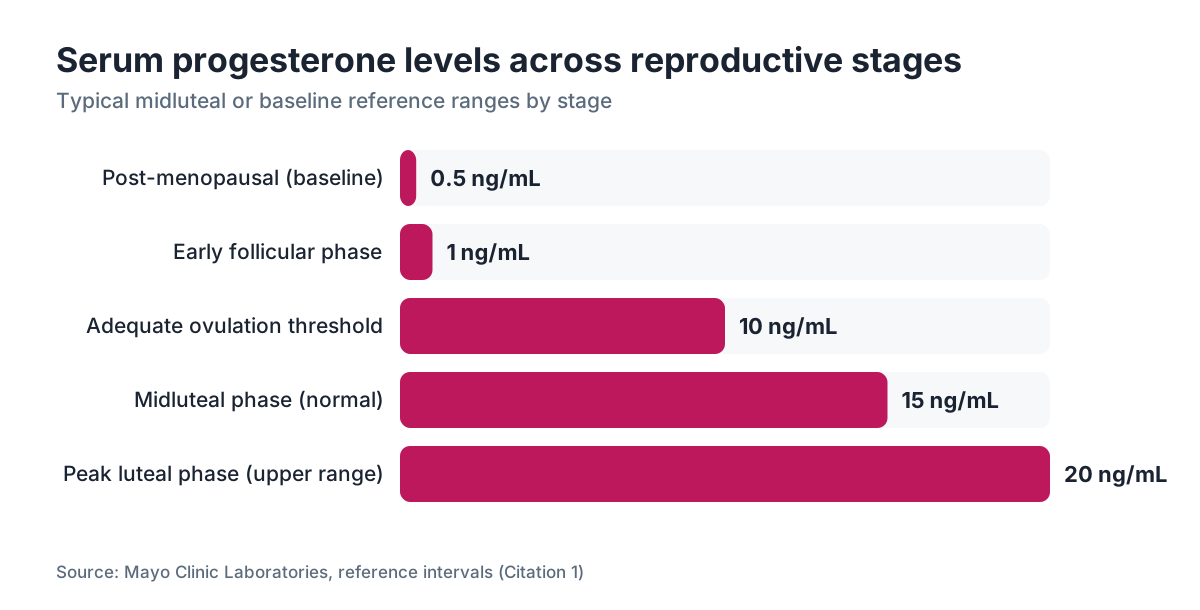
The numbers are stark. In a healthy luteal phase, serum progesterone typically runs 5 to 20 ng/mL [1]. After menopause it falls below 1 ng/mL and stays there. In perimenopause production becomes erratic because ovulation itself becomes erratic. You can have a cycle that looks normal on a calendar and still have a short or absent luteal phase with almost no progesterone output.
Age is the main driver. It's not the only one. High cortisol from chronic stress can suppress the hypothalamic-pituitary-ovarian (HPO) axis and reduce or skip ovulation. Very low body fat, extreme caloric restriction, and overtraining do the same thing. Thyroid dysfunction and elevated prolactin are two other causes your doctor should rule out before blaming age.
The phrase 'estrogen dominance' gets thrown around in wellness spaces to describe a state where estrogen sits high relative to progesterone. The more precise framing is that progesterone is low, either in absolute terms or against a woman's own prior baseline. That distinction changes the fix. A full hormone panel, more than a single progesterone draw, tells the real story. See our explainer on progesterone for what the numbers mean.
What are the real symptoms of low progesterone?
Low progesterone has a recognizable pattern once you know what to look for. The common complaints: irregular or shortened cycles, spotting in the second half of the cycle, sleep that falls apart around ovulation or the week before your period, anxiety that spikes premenstrually, and heavy bleeding that keeps getting heavier.
Sleep disruption is the symptom people miss. Progesterone metabolizes into allopregnanolone, a neurosteroid that binds GABA-A receptors and has a sedating, anxiety-lowering effect [2]. When progesterone falls, that calm disappears. Women in early perimenopause often notice they wake at 2 or 3 a.m. before they notice any hot flashes at all. The 3 a.m. wake-up is a very common early signal.
Bone loss is the longer-term consequence worth flagging. Progesterone appears to stimulate osteoblast activity independently of estrogen [3]. Women with chronically low progesterone, even while still cycling, may lose bone faster than expected. If you're in your 40s and haven't done a bone density test, that's a reason to ask your doctor.
Miscarriage risk also rises with a low luteal-phase progesterone. First-trimester supplementation is common when levels come back below roughly 10 to 15 ng/mL in an established pregnancy, though the evidence is mixed and pregnancy-specific dosing sits well outside this article.
Not every symptom list fits every woman. Some have textbook low-progesterone labs and feel fine. Others have borderline labs and feel terrible. That mismatch is real, and it deserves a clinician who will actually listen.
Can lifestyle changes increase progesterone naturally?
Yes, in a specific and limited way. Lifestyle changes can support production when the underlying problem is that stress, weight, sleep loss, or over-exercise is suppressing ovulation. They do not reverse the age-related decline of perimenopause and menopause. Those are two different problems with two different answers.
Sleep is the most underrated lever. Sleep loss raises cortisol, and cortisol competes with progesterone for the same receptor pathway (the molecules are structurally similar, and high cortisol can block progesterone receptors) [4]. Seven to eight hours consistently lowers cortisol load and lets the HPO axis work better. This is not a subtle effect.
Stress reduction follows the same logic. Chronic psychological stress raises cortisol and suppresses LH pulsatility, the upstream signal that triggers ovulation. Yoga, meditation, and shorter work hours all move cortisol, though the direct translation to measurable progesterone change in human trials is small and the studies are tiny.
Body weight matters in both directions. Very low body fat, roughly under 17 to 22 percent depending on the reference, tracks with anovulation and low progesterone [5]. Significant excess fat also disrupts progesterone, because adipose tissue converts androgens to estrogen and drives that relative imbalance so many women describe. Reaching a stable, healthy weight, whatever that is for your body, tends to steady cycles.
Exercise is nuanced. Moderate aerobic work and strength training support hormone balance and insulin sensitivity. Training for endurance events while under-eating is a reliable way to shut down ovarian function. The clinical term is Relative Energy Deficiency in Sport (RED-S), and it shows up in recreational athletes who have no interest in going pro. If you're training hard and your cycles are shortening or vanishing, that's the first thing to suspect.
Zinc and magnesium get cited as supportive nutrients. The data is real but modest. Zinc is a cofactor in LH synthesis and ovarian steroidogenesis [6]. Severe deficiency disrupts the cycle, and correcting a true deficiency can restore normal ovulation. Supplementing zinc in a woman who isn't deficient does nothing for progesterone. Same story with magnesium, which helps cortisol regulation and sleep rather than raising progesterone directly.
Do supplements actually increase progesterone levels?
This is where the wellness industry overpromises badly. The honest answer: a few supplements have weak-to-moderate evidence for specific situations, most have almost none, and none of them match prescription progesterone for a woman with a clinically meaningful deficiency.
Vitex agnus-castus (chasteberry) is the most studied. It seems to work by weakly binding dopamine D2 receptors, which lowers prolactin, and lower prolactin supports LH and therefore luteal progesterone [7]. A 2017 meta-analysis found it reduced premenstrual symptoms and beat placebo for mild-to-moderate PMS. It is not a direct progesterone precursor. It does nothing for post-menopausal women or women with primary ovarian insufficiency. For a younger woman with a shortened luteal phase tied to mild hyperprolactinemia or cycle irregularity, it may help. Give it three to six months, and don't combine it with hormonal birth control or dopamine-affecting medications without your doctor's input.
DHEA (dehydroepiandrosterone) gets marketed alongside progesterone support. It's an androgen precursor that converts to androgens and estrogens in peripheral tissues. It does not reliably raise progesterone. Unsupervised DHEA can push androgens high enough to cause acne, hair changes, and other unwanted effects.
OTC progesterone cream is the most confusing category. The FDA allows sale of creams containing up to 400 mg of progesterone per ounce under cosmetic or general wellness labeling, but serum absorption from topical progesterone is inconsistent and poorly studied [8]. Salivary levels may rise while serum and endometrial levels stay low. That matters enormously if you're also on estrogen, because the whole job of progesterone in that setting is to protect the uterine lining, and inadequate endometrial delivery is a real problem. OTC cream is not a substitute for prescription progesterone in women on estrogen therapy.
Maca root, ashwagandha, and DIM (diindolylmethane) each have fans and essentially no well-powered randomized trial showing direct progesterone elevation in humans. Ashwagandha has decent cortisol-lowering data, which could help indirectly in stress-related anovulation. DIM shifts estrogen metabolism rather than raising progesterone. Neither is harmful at standard doses. Neither moves a blood test.
| Supplement | Mechanism claimed | Human RCT evidence | Verdict | |---|---|---|---| | Vitex agnus-castus | Reduces prolactin, supports LH | Weak-moderate for PMS/cycle length | Worth trying for mild luteal phase defect | | Progesterone cream (OTC) | Transdermal progesterone delivery | Inconsistent serum absorption | Not equivalent to Rx; avoid if on estrogen | | DHEA | Precursor to sex hormones | Does not reliably raise progesterone | Not useful for this goal | | Zinc | Cofactor in ovarian steroidogenesis | Only if deficient | Check levels first | | Magnesium | Cortisol/sleep support | Indirect, no direct progesterone data | Reasonable for sleep/stress | | Maca | Adaptogenic, pituitary support | Very limited human data | Honest answer: unknown | | Ashwagandha | Cortisol reduction | Cortisol data decent; progesterone data absent | May help stress-related anovulation |
When does prescription progesterone make sense?
Prescription progesterone is the only option that reliably and reproducibly raises progesterone to a therapeutic level. If you're peri- or post-menopausal with bothersome symptoms, or still cycling with labs and symptoms that point to a true luteal phase deficiency, this is the conversation to have with your clinician.
The FDA has approved oral micronized progesterone (brand name Prometrium, plus generics) for use as part of hormone therapy in women with a uterus who take estrogen [9]. The standard dose is 200 mg orally at bedtime for 12 days a month in cycling regimens, or 100 mg nightly continuously. The bedtime timing is deliberate. Oral progesterone metabolizes to allopregnanolone, which causes drowsiness. Taking it at night turns a side effect into a benefit, and many women find their sleep improves dramatically.
For women on hormone replacement therapy, a progestogen (either progesterone or a synthetic progestin) is non-negotiable if you have a uterus. Estrogen alone thickens the uterine lining, and unopposed estrogen raises endometrial cancer risk sharply. The North American Menopause Society (NAMS) guidelines put it plainly: "for women who have a uterus, a progestogen must be added to systemic estrogen to protect the endometrium." [10]
Prescription progesterone is also used off-label for sleep, mood, and perimenopausal symptoms in women who still cycle, often in the second half of the cycle. It's a legitimate and increasingly common practice, though the evidence base here is thinner than for post-menopausal hormone therapy.
Vaginal progesterone (Endometrin, Crinone gel, compounded options) shows up mostly in fertility and IVF care. It delivers high local concentrations to the uterus with lower systemic levels. Less relevant for general symptom management, but worth knowing it exists.
If you want a telehealth provider who can order labs, read your full hormone picture, and prescribe the right therapy, WomenRx offers that kind of personalized evaluation instead of a one-size protocol.
Is bioidentical progesterone different from synthetic progestins?
Yes, and the difference matters clinically. Bioidentical progesterone has the same molecular structure as the progesterone your body makes. Synthetic progestins (medroxyprogesterone acetate, norethindrone acetate, levonorgestrel) are different molecules built to act like progesterone, but with varying activity at androgen, glucocorticoid, and mineralocorticoid receptors.
The Women's Health Initiative (WHI) trial, which scared a generation of women and doctors away from hormone therapy, used conjugated equine estrogen plus medroxyprogesterone acetate (MPA). The cardiovascular and breast cancer signals in that trial came largely from the MPA arm. The estrogen-only arm, in women without a uterus, showed a different risk profile [11].
Oral micronized progesterone (Prometrium) is bioidentical. The KEEPS trial and observational data from France's E3N cohort found bioidentical progesterone combined with estradiol did not carry the breast cancer signal that MPA-based regimens did, though this evidence is observational rather than randomized [12]. NAMS acknowledges the distinction in its 2022 hormone therapy position statement.
The practical takeaway: if your doctor proposes hormone therapy and you have a uterus, asking specifically for oral micronized progesterone rather than a synthetic progestin is a reasonable, evidence-informed request. Your doctor may have a clinical reason to prefer a synthetic for your case, but the conversation is worth having. Read more about menopause and hormone options to go in prepared.
How do you actually test your progesterone levels?
Timing is everything for progesterone testing, because levels swing enormously across the cycle. A serum progesterone drawn on day 3 (when it's supposed to be low) tells you almost nothing about your luteal function.
The standard test for luteal adequacy is a serum progesterone drawn about 7 days after ovulation. In a 28-day cycle that's around day 21, which is why labs often call it a "Day 21 progesterone." But if you have a 32-day cycle, your luteal midpoint sits closer to day 25, and drawing on day 21 gives you a falsely low result. The better instruction: draw 7 days after you confirm ovulation with an LH surge test or a basal body temperature shift.
What does normal look like? A Day 21 (or midluteal) serum progesterone above 10 ng/mL is generally read as evidence of ovulation. Values between 3 and 10 ng/mL suggest possible ovulation with an inadequate luteal phase. Below 3 ng/mL suggests anovulation [1].
Post-menopausal women on oral progesterone show serum levels that don't fully reflect tissue delivery, because much of the oral dose converts to metabolites before reaching circulation. That's one reason clinicians sometimes lean on symptom response and endometrial safety monitoring instead of chasing a specific serum number in that group.
Saliva and dried urine testing (the DUTCH test is the best-known example) measure different metabolite pools. They add context and get used by many functional medicine providers. They are not validated against the serum reference ranges used in conventional practice, so mixing ranges from different test types breeds confusion. If you do a DUTCH test, find a clinician who can read it in context rather than comparing the numbers straight to a standard blood lab range.
What does low progesterone do to weight and metabolism?
This connection is real, and it's often overstated. Progesterone is mildly thermogenic, meaning it slightly raises basal body temperature and resting metabolic rate during the luteal phase. The effect is small, roughly 50 to 300 kcal per day by some estimates, and it disappears with the cycle [13].
More relevant to how most women actually feel: low progesterone relative to estrogen promotes fluid retention (estrogen holds sodium; progesterone partly counteracts it), which accounts for the bloating and weight bounce so many women notice premenstrually. It's water, not fat. It's still real and uncomfortable.
The perimenopause weight-gain story is mostly not a progesterone story. The shift of fat to the abdomen in midlife is driven mainly by falling estrogen, aging itself, and insulin resistance, not by progesterone [14]. Hormone therapy, including progesterone, does not cause weight gain in well-designed trials, despite a widespread belief to the contrary. The Endocrine Society's clinical practice guidelines note the evidence for HT causing weight gain is not established.
If weight management is your main concern alongside hormone balance, GLP-1 receptor agonists have a growing evidence base for women in midlife. Our coverage of semaglutide for weight loss and perimenopause age has the specifics. The two goals aren't mutually exclusive.
How long does it take to feel better after starting progesterone?
Most women notice sleep improvement within the first week of oral micronized progesterone at bedtime. That's the fastest-responding symptom, and for many women the most dramatic.
Anxiety and mood settle over two to four weeks. Cycle regularity, if you still cycle, may take two to three months of consistent use or lifestyle change to show up. Bone protection accumulates over months to years and isn't something you feel.
Here's what progesterone alone won't fix: hot flashes. Vasomotor symptoms are mostly an estrogen-withdrawal problem. Progesterone can blunt them a little, but if hot flashes are your main complaint, estrogen is the treatment. A perimenopause evaluation should sort out which hormones need addressing for your symptom picture.
Side effects in the first two to four weeks can include drowsiness (worse if taken at the wrong time, so stick to bedtime), vivid dreams, and occasionally breast tenderness. Most settle down. If they don't, a dose change or a different formulation is worth raising with your prescriber.
What about progesterone and perimenopause specifically?
Perimenopause is the window where targeted progesterone support makes the most sense for women who still cycle. Estrogen in early perimenopause is often high (erratic, surging follicles pump out excess estrogen), while progesterone falls because ovulation turns irregular. The result is the classic relative deficiency picture: heavy periods, breast tenderness, mood swings, and poor sleep, all while conventional labs read "normal" because FSH hasn't climbed yet.
For women in this stage, low-dose cyclic progesterone, usually 100 to 200 mg of oral micronized progesterone in the luteal phase, can make a real difference. It's often one of the first things worth trying before adding estrogen, because some of these symptoms genuinely come from low progesterone rather than low estrogen.
Knowing roughly when you entered perimenopause helps put your symptoms in context. If you're unsure, our articles on when does menopause start and menopause age can help you place yourself on the timeline.
As you move deeper into perimenopause and closer to your final period, the conversation shifts. Estrogen drops harder, vasomotor symptoms show up, and the case for full hormone therapy (estrogen plus progesterone) gets stronger. This isn't a one-size answer. The right timing and dosing depend on your labs, your symptoms, and your personal risk profile. No article replaces that conversation with a clinician who knows your history.
Are there risks to raising progesterone?
Prescription progesterone is safe for most women at standard doses, with a well-established benefit-risk profile when used appropriately. The main safety consideration is the split between bioidentical progesterone and synthetic progestins, covered earlier.
For women on combined estrogen-progesterone therapy, long-term use (beyond five to seven years) does carry a modestly higher breast cancer risk than estrogen alone, based on observational data. The absolute increase is small. The WHI found an extra 8 cases per 10,000 women per year with combined therapy compared to placebo [11]. For scale, drinking more than one alcoholic drink daily carries a similar or greater increase.
Oral progesterone at higher doses causes sedation in some women. Driving or operating machinery after taking it is not recommended. Some women see irregular spotting during the first few months of cyclic regimens. Spotting that persists past three months needs evaluation to rule out endometrial abnormalities.
OTC progesterone cream is not risk-free. If you have a uterus and use estrogen in any form, OTC cream is not adequate endometrial protection. That's a real harm that wellness marketing tends to downplay.
Supplements like vitex are generally well-tolerated but can cause mild GI upset and headache. Skip them during pregnancy and don't combine them with hormonal contraception. Nobody has good long-term safety data on vitex, because the trials simply haven't been done.
The honest summary: prescription oral micronized progesterone for appropriate indications has a favorable profile. Unsupervised high-dose supplement use carries unknown long-term risk. And OTC cream used as a substitute for prescription protection in women on estrogen is a genuine safety gap.
Frequently asked questions
What is the fastest way to increase progesterone?
Prescription oral micronized progesterone taken at bedtime raises serum levels within hours, and most women notice sleep improvement within the first week. No supplement or food comes close to that speed or reliability. Lifestyle changes (sleep, stress reduction, healthy weight) can support natural production over weeks to months, but only if the cause is stress or weight-related anovulation, not age-related decline.
What foods increase progesterone levels?
No food directly raises progesterone. Some nutrients support the hormonal environment: zinc (pumpkin seeds, shellfish, beef) is a cofactor in ovarian steroidogenesis, and severe zinc deficiency disrupts ovulation. Magnesium (dark leafy greens, nuts, seeds) supports cortisol regulation. Adequate total calories and healthy fats are necessary for any steroid hormone production. But eating these foods will not measurably raise progesterone in a woman with age-related decline.
Can stress really lower my progesterone?
Yes. Chronic stress raises cortisol, which suppresses LH pulsatility, the upstream signal that triggers ovulation. No ovulation means very little progesterone. Cortisol and progesterone are also structurally similar and compete for the same receptors at high concentrations. In younger women, significant chronic stress can produce anovulatory cycles with measurably low midluteal progesterone. Addressing the stress can restore normal ovulation, though it takes weeks to months.
Does vitex (chasteberry) really work for low progesterone?
Vitex has the best supplement evidence in this category, but it's still weak-to-moderate. It appears to lower prolactin via dopamine D2 receptor binding, which supports LH and therefore luteal progesterone. A 2017 meta-analysis found it beat placebo for PMS symptoms. It does not raise progesterone in post-menopausal women and takes three to six months to show effect. It's worth trying for a mild luteal phase defect in women who still cycle.
Is progesterone cream from the health food store safe and effective?
OTC progesterone cream has inconsistent, poorly studied serum absorption. Salivary levels may rise while uterine delivery stays inadequate. For women using estrogen in any form, OTC cream is not an adequate substitute for prescription progesterone, because it may not protect the endometrium. It's not dangerous on its own at standard doses, but its effectiveness for most clinical goals isn't supported by reliable data.
At what progesterone level should I consider treatment?
A midluteal serum progesterone (drawn 7 days after ovulation) below 10 ng/mL is generally read as a suboptimal luteal phase. Below 3 ng/mL suggests anovulation. Post-menopausal women normally sit below 1 ng/mL. Treatment decisions depend on your symptoms, whether you take estrogen, and your overall clinical picture, not a single number. A hormone-specialized clinician looks at the full panel rather than reacting to one value.
Can I increase progesterone without a prescription?
If your low progesterone comes from stress, under-eating, overtraining, or serious sleep loss, correcting those can restore ovulation and raise progesterone without a prescription. Vitex may help for a mild luteal phase deficiency in cycling women. For perimenopause or post-menopausal deficiency, no non-prescription option reliably raises progesterone to clinically meaningful levels. Supplements fill gaps; they don't replace a hormone the body has stopped making.
Does low progesterone cause weight gain?
Directly, the effect is modest. Low progesterone relative to estrogen promotes fluid retention rather than fat gain. Progesterone is mildly thermogenic, and its absence removes a small metabolic boost. The bigger midlife weight-gain pattern, especially abdominal fat redistribution, is driven mainly by declining estrogen and insulin resistance rather than progesterone. Hormone therapy, including progesterone, does not reliably cause weight gain in well-designed trials.
How do I know if my progesterone is low if I'm still having periods?
Key signals: a shortened luteal phase (fewer than 10 days between ovulation and your period), spotting in the week before your period, worsening premenstrual insomnia or anxiety, and increasingly heavy bleeding. Confirming it takes a serum progesterone drawn 7 days after ovulation, more than a fixed day 21 if your cycle runs longer than 28 days. Tracking ovulation with LH strips first makes the lab timing accurate.
Is bioidentical progesterone safer than synthetic progestins?
Observational data, especially the French E3N cohort study, suggests oral micronized progesterone paired with estradiol carries a lower breast cancer signal than regimens using medroxyprogesterone acetate. NAMS acknowledges this in its 2022 position statement. The evidence is observational, not randomized, so certainty doesn't exist. Asking specifically for oral micronized progesterone if you need a progestogen is a reasonable, evidence-informed request to make of your prescriber.
Can low progesterone affect my anxiety and mood?
Yes, substantially. Progesterone metabolizes to allopregnanolone, a neurosteroid that binds GABA-A receptors and produces calming effects. When progesterone drops, that buffer disappears. Women often notice more anxiety, irritability, and poor stress tolerance in the luteal phase of perimenopause, or chronically after menopause. Oral micronized progesterone at bedtime restores some of that effect. It's one of the most clinically meaningful reasons to address low progesterone.
Does progesterone help with perimenopause hot flashes?
Modestly. Progesterone alone can cut hot flash frequency somewhat, and some small trials support this. But vasomotor symptoms are mostly caused by estrogen withdrawal, not progesterone deficiency. If hot flashes are your main complaint, estrogen is the treatment. Progesterone is essential if you have a uterus and take estrogen, but it isn't the driver of hot flash relief. Expect it to help most with sleep and mood in perimenopause.
How long do I need to take progesterone?
That depends entirely on why you're taking it. Women using it as part of hormone therapy for menopausal symptoms typically continue as long as they're on estrogen, which for many is years to decades depending on individual risk-benefit. Women taking cyclic progesterone for perimenopausal luteal phase support may taper or stop once they've passed the transition. There's no universal duration. Annual reassessment with your clinician is standard practice.
What's the difference between the DUTCH test and a standard blood test for progesterone?
Standard serum testing measures free and bound progesterone in blood against well-validated reference ranges. The DUTCH (dried urine test for complete hormones) measures progesterone metabolites in urine over a full day, capturing a different but useful picture of how you process the hormone. DUTCH can reveal metabolic patterns a single blood draw misses. The two use different reference ranges and shouldn't be compared directly. Both have legitimate uses; the key is a clinician who can read whichever you choose in context.
Sources
- Mayo Clinic Laboratories, Progesterone reference intervals
- NIH National Institute of Neurological Disorders and Stroke, allopregnanolone and GABA
- Prior JC, Endocrine Reviews 1990, 'Progesterone as a bone-trophic hormone'
- Genazzani AR et al., Gynecological Endocrinology, cortisol-progesterone receptor competition
- Frisch RE, Journal of Adolescent Health 1994, body fat and reproductive function
- Sharif R et al., Pakistan Journal of Pharmaceutical Sciences 2012, zinc and female reproductive hormones
- van Die MD et al., Planta Medica 2013, meta-analysis of vitex agnus-castus for premenstrual syndrome
- FDA, Progesterone topical products and endometrial safety
- FDA prescribing information, Prometrium (oral micronized progesterone)
- North American Menopause Society (NAMS), 2022 Hormone Therapy Position Statement
- Women's Health Initiative Investigators, JAMA 2002
- Fournier A et al., Breast Cancer Research and Treatment 2008, E3N cohort study
- Bisdee JT et al., British Journal of Nutrition 1989, progesterone and basal metabolic rate
- Endocrine Society, Clinical Practice Guidelines on Menopause and Weight