Hormone replacement therapy for low estrogen: what actually works
TL;DR: Hormone replacement therapy replaces the estradiol that drops in perimenopause and menopause. It cuts hot flashes by 75% to 90%, protects bone, and improves sleep and mood. Most healthy women under 60, or within 10 years of their last period, gain more than they risk. Your right form, dose, and whether to add progesterone or testosterone depend on symptoms, uterine status, and heart history.
What is low estrogen and why does it matter so much?
Estrogen is not one hormone. It is a family of three: estradiol (the dominant reproductive-age form), estrone (the main postmenopausal form), and estriol (produced mostly during pregnancy). When people say low estrogen about midlife women, they almost always mean falling estradiol. The ovaries make most of it, and as follicle counts drop through perimenopause age and beyond, estradiol swings wildly before settling into a permanently low baseline after menopause.
Low estradiol reaches nearly every tissue. Bone density falls because estradiol normally holds back the osteoclasts that break bone down [1]. The vaginal lining thins. Skin loses collagen. Sleep changes shape. Serotonin and dopamine signaling shifts, which is part of why mood and memory feel off. Hot flashes and night sweats, the classic vasomotor symptoms, happen when estrogen withdrawal destabilizes the thermostat in your hypothalamus.
None of this is suffering you have to accept. That is what hormone replacement therapy is built to fix.
The lab line for "low" estradiol shifts by lab and context. Reproductive-age women run 30 to 400 pg/mL depending on cycle phase. Postmenopausal women without HRT generally sit below 20 pg/mL, often under 10 [2]. Symptoms usually show up long before blood levels hit the floor. That is one reason symptoms count as much as labs when you decide whether to treat.
Who is a candidate for HRT, and who should be cautious?
Most healthy women in their 40s and 50s with low-estrogen symptoms are candidates. The 2022 Menopause Society (formerly NAMS) position statement says hormone therapy fits healthy women who are under 60 or within 10 years of their last period and have bothersome hot flashes or other low-estrogen signs, as long as there are no contraindications [3].
Some contraindications make standard estrogen genuinely risky: a personal history of estrogen-receptor-positive breast cancer, active or recent clots or stroke, untreated high blood pressure, active liver disease, and unexplained vaginal bleeding. These are not soft cautions. These are the situations where the math tips against treating.
Other women need a real conversation instead of a flat no. That includes a family history of breast cancer (different from a personal diagnosis), migraines with aura, or past clot risk factors. Transdermal estrogen skips first-pass liver metabolism and does not raise clot risk the way oral estrogen does, which shifts the picture for women with borderline thrombotic risk [4].
If you hit early menopause (before 45) or premature ovarian insufficiency (before 40), the case for treating gets stronger, not weaker. Losing estrogen in your early 40s raises long-term heart and bone risk. That is why when does menopause start matters: the earlier it happens, the longer you go unprotected if nobody treats it.
Timing drives heart risk too. The "window of opportunity" holds up well in the data. Starting estrogen within 10 years of your last period looks heart-protective. Starting it more than 10 years out, or past 60 after years of low estrogen, may raise cardiovascular risk instead [3].
What are the main types of HRT for low estrogen?
HRT comes in more forms than most patients expect, and the form matters almost as much as the hormone.
Estrogen-only therapy is for women who have had a hysterectomy. No uterus means no lining to protect, so you skip the progestogen.
Combined estrogen plus progestogen is for women with a uterus. Estrogen alone thickens the endometrium and raises uterine cancer risk over time. Adding a progesterone cancels that out.
Here is how the delivery routes stack up:
| Route | Examples | Clot risk | Notes | |---|---|---|---| | Oral estrogen | Premarin, Estrace | Modestly elevated (first-pass effect) | Convenient, well-studied, may raise triglycerides | | Transdermal patch | Vivelle-Dot, Climara | Not significantly elevated | Preferred with clot risk or migraines [4] | | Transdermal gel/spray | Divigel, Evamist | Not significantly elevated | Daily, absorption varies | | Vaginal ring (systemic) | Femring | Not significantly elevated | Weekly or twice-weekly dosing | | Vaginal estrogen (local) | Vagifem, Imvexxy, Estring | Minimal systemic absorption | For GSM only, no uterine protection needed | | Pellet implants | Various compounders | Varies | Hard to reverse, inconsistent dosing |
For the progestogen, micronized progesterone (Prometrium, or compounded bioidentical) carries a lower breast cancer signal than synthetic progestins like medroxyprogesterone acetate (MPA), based on observational data including the French E3N cohort [5]. That matters, but it is not settled. The WHI used MPA, not micronized progesterone, which is part of why that trial's breast cancer numbers may not carry over to bioidentical regimens.
Local vaginal estrogen earns its own line. It treats genitourinary syndrome of menopause (GSM): dryness, painful sex, recurring UTIs, with almost no systemic absorption. The FDA label for Vagifem states absorption is minimal at approved doses [6]. If vaginal symptoms are your only complaint, local estrogen is often the whole answer.
How do estrogen doses compare, and how do you know if yours is right?
Start low, adjust up. That is the standard. For transdermal estradiol patches, common starting doses are 0.025 mg/day or 0.0375 mg/day. Plenty of women need 0.05 mg/day for real relief. Some, especially after surgical menopause, need 0.1 mg/day [2].
Oral estradiol usually runs 0.5 to 2 mg daily. Oral conjugated equine estrogen (CEE, brand name Premarin) runs 0.3 to 0.625 mg daily.
Blood levels guide you. They are not a number to chase. Serum estradiol between 40 and 100 pg/mL usually tracks with symptom control, but some women feel great at 30 and others need 120. The Endocrine Society's menopause guideline is clear that symptom relief, not a set serum level, is the endpoint that matters [2].
You see whether a dose works in 4 to 12 weeks. If hot flashes are still there at 8 weeks on a starting dose, stepping up is fair. If your symptoms are harder to pin down (fatigue, joint pain, brain fog), reassess dose and delivery before you decide HRT flopped.
Patch placement matters more than people think. Abdomen and buttock absorb more consistently than the arm, where sweat and movement cut delivery. Rotate sites within those spots to keep skin calm.
Get a bone density test at baseline and every so often on HRT. Not mainly to track protection, but because bone density is one of the cleanest objective signs that estrogen is doing its job at the tissue level.
Does HRT for low estrogen include testosterone for women?
Yes, and the evidence here has grown a lot in ten years. Women make testosterone in the ovaries and adrenal glands. Levels fall with age and drop hard after surgical menopause. Low testosterone tracks with reduced libido, fatigue, less muscle, and sometimes mood changes, though separating low-T symptoms from low-estrogen symptoms is genuinely hard in the clinic.
The main evidence-based use for testosterone in women's hormone therapy is hypoactive sexual desire disorder (HSDD) in postmenopausal women. The 2019 Global Consensus Position Statement on testosterone for women, endorsed by the Endocrine Society and other major bodies, concluded that transdermal testosterone at physiological doses improves sexual function in postmenopausal women and that the evidence supports its use for that one indication [7].
No testosterone product is FDA-approved for women in the US. So doctors prescribe low-dose male formulations off-label or use compounded versions. The target is serum testosterone in the upper premenopausal range, roughly 15 to 70 ng/dL, not the male range. Push levels above 150 ng/dL for long and you invite acne, hair loss, and voice changes, and the long-term safety data up there are thin.
Testosterone therapy overlaps with low-estrogen HRT but is its own intervention, with different targets and shakier regulatory footing. Surgical menopause usually needs both. In natural menopause, adding testosterone depends on whether libido and energy complaints stick around after estrogen is dialed in.
One practical trap: testing testosterone in women takes the right lab. Most standard assays are calibrated for male ranges and read poorly at the low levels that matter for women. The Endocrine Society recommends LC-MS/MS (liquid chromatography-mass spectrometry) assays for this reason [2].
What are the real risks of HRT, based on the best evidence we have?
The WHI trial (Women's Health Initiative, 2002) scared a generation off HRT. It deserves an honest read. The trial found that combined CEE plus MPA in women aged 50 to 79 raised breast cancer, blood clots, and stroke [8]. Those findings are real. But the design does not map onto most women seeking HRT today: the average participant was 63, twelve years past menopause, and the progestogen was MPA, not micronized progesterone. The estrogen-only arm, women without a uterus, did not raise breast cancer risk and hinted at fewer cardiovascular events.
Here is what the current evidence actually shows.
Breast cancer. The risk with combined estrogen-progestogen, if real, is small in absolute terms. The Million Women Study and the WHI put it around 4 to 8 extra cases per 10,000 women per year on combined HRT [8][10]. Obesity, alcohol, and sitting all day carry comparable or bigger risks. Estrogen-only, for women without a uterus, does not clearly raise risk and may lower it.
Blood clots (VTE). Oral estrogen roughly doubles VTE risk. Transdermal estrogen at standard doses does not show that jump in observational data [4]. This is one of the cleanest, most useful distinctions in HRT prescribing.
Stroke. Oral estrogen modestly raises ischemic stroke risk. Transdermal low-dose estrogen does not, in most observational studies.
Cardiovascular disease. In women under 60 or within 10 years of menopause, estrogen looks neutral to protective for the heart. The KEEPS and ELITE trials both support a timing-dependent benefit [11].
Endometrial cancer. Estrogen alone, without progestogen, raises uterine cancer risk sharply. Adequate progestogen removes that risk in women with a uterus [12].
So the risks are real but conditional, smaller than the WHI first suggested, and often outweighed by the cost of undertreated menopause for the average healthy woman in her late 40s to mid-50s.
How long can you stay on HRT for low estrogen?
There is no universal number, and anyone who hands you one without knowing your history is guessing.
The old "5 years maximum" rule came from the WHI era and has been walked back. The 2022 Menopause Society statement says the arbitrary duration limits of the past are not backed by current evidence, and that duration should be individualized around ongoing symptoms, benefit-risk, and what the patient wants [3].
Plenty of women stay on HRT for 10 years or more. Some stay on local vaginal estrogen indefinitely, because systemic absorption is minimal and the relief (no painful sex, fewer UTIs) keeps mattering. Women with premature ovarian insufficiency should generally continue systemic estrogen at least until the average age of natural menopause, around 51 to 52 [9], because stopping early stretches out the estrogen deprivation beyond what their body would have done on its own.
Revisit the decision every year. Your heart risk, breast density, symptom load, and priorities all move over time. What fit at 50 might need a fresh look at 65. That is not a reason to quit. It is a reason to keep talking with a clinician who reads the literature.
What symptoms does HRT for low estrogen actually improve?
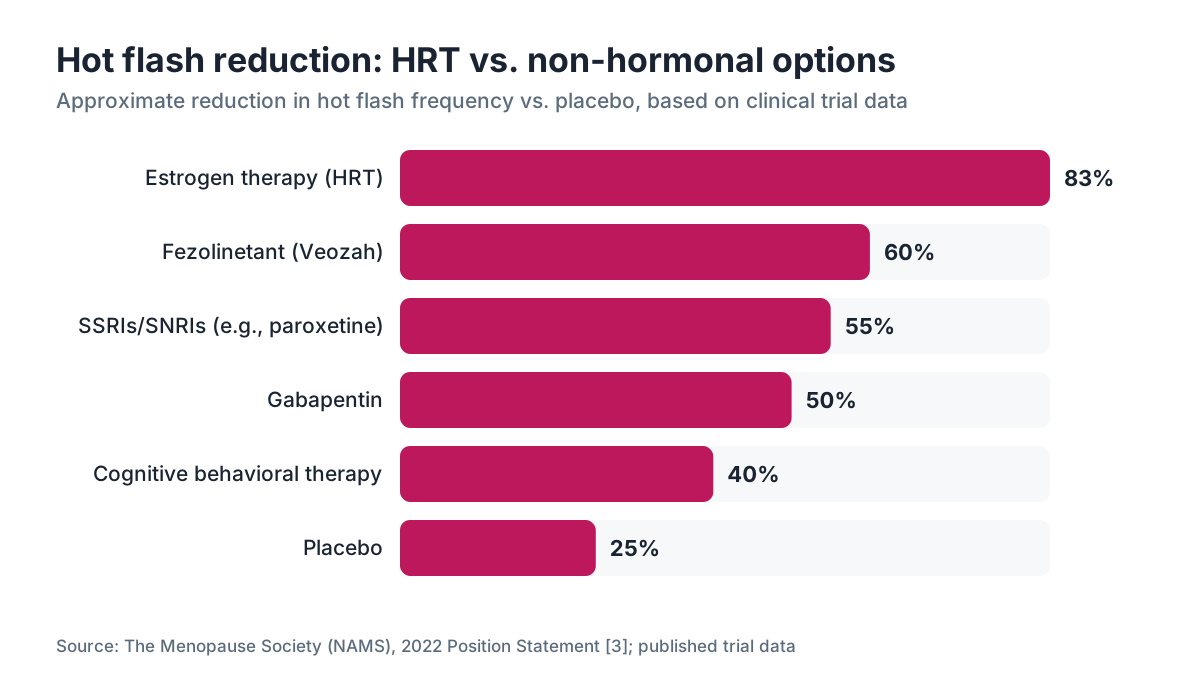
The evidence is strongest for vasomotor symptoms. Estrogen cuts hot flash frequency by 75% to 90% versus placebo in randomized trials, which makes it the most effective treatment there is by a wide margin [3]. No non-hormonal option comes close.
Sleep, often wrecked by night sweats but also directly tied to estrogen, improves in most women on HRT.
Genitourinary symptoms (vaginal dryness, painful sex, urinary urgency, recurring UTIs) respond well to both systemic and local estrogen. Local vaginal estrogen shines here and works even in women who cannot take systemic HRT.
Mood, anxiety, and depressive symptoms in perimenopausal women improve modestly to moderately on estrogen across several trials. The effect is strongest when the mood shift clearly tracks hormonal swings, weaker in women with longstanding depression unrelated to menopause.
Bone loss slows or stops on estrogen. The WHI found a significant drop in hip and vertebral fractures in women on combined HRT [8]. That benefit is easy to overlook. A bone density test can measure what HRT is doing for your skeleton over time.
Cognitive symptoms (brain fog, losing words mid-sentence) get reported by a lot of perimenopausal women, and some evidence suggests estrogen supports brain function. The timing rule applies here too: estrogen started early may protect the brain, while starting late may not. This evidence leans observational and early, not as solid as the hot flash or bone data.
What HRT does not reliably fix: osteoarthritis joint pain (though cartilage does carry estrogen receptors, hinting at a partial role), established heart disease, or weight gain driven by metabolic aging rather than estrogen loss. If weight is stacking on top of menopause, read up on semaglutide for weight loss, because GLP-1 medications are increasingly used alongside HRT in this group.
How do you choose between an estrogen patch, pill, or other delivery method?
The estrogen patch is where most evidence-informed clinicians land first for systemic replacement, and the reason is simple: it delivers estradiol (the same molecule your ovaries made) through the skin, skips the liver, and dodges the first-pass effect that drives up clot risk and triglycerides with oral estrogen [4].
The pill is not wrong. It is simpler for some women, backed by decades of data, and often cheaper. If you have no clot risk, no migraines, and normal triglycerides, oral estradiol is reasonable. If you have any of those, the patch or gel is the better call.
Gels and sprays give a patch-free option for women whose skin reacts to adhesive, but they need daily application and care about transfer to kids or partners (let it dry fully before skin contact).
Systemic vaginal rings (Femring) suit women who want weekly or twice-weekly dosing, if you are comfortable inserting one.
Pellet implants (small estrogen or testosterone pellets placed under the skin) are popular in some functional-medicine and cash-pay practices. The pitch is convenience: one insertion every 3 to 6 months. The problems are real. Pellets cannot be pulled out if you have a side effect or a health event, dosing swings widely between compounders and even between insertions in the same patient, and supraphysiologic levels are common. For estrogen especially, pellet dosing often runs above what guidelines recommend. I would not pick pellets first, and most academic menopause specialists agree.
With a telehealth provider like WomenRx, the patch and pill are the most practical and standardized, and a clinician can adjust the dose off your symptoms and labs without the irreversibility that pellets lock you into.
How does HRT interact with other medications or conditions common in midlife women?
A few interactions are worth knowing outright.
Thyroid medication. Oral estrogen raises thyroid-binding globulin, which can lower free thyroid hormone and force a higher levothyroxine dose. Transdermal estrogen does not do this. If you take thyroid medication and start or switch to oral estrogen, recheck your TSH about 6 to 8 weeks later [2].
Statins and heart medications. No major direct interaction, but estrogen itself moves lipids. Oral estrogen raises HDL, lowers LDL, and raises triglycerides. Transdermal is more neutral on triglycerides. If you are on a statin the distinction matters less, but it is still worth flagging with your prescriber.
Antidepressants and mood medications. SSRIs and SNRIs also treat hot flashes, but if you are on one for mood and your estrogen is undertreated, adding or optimizing estrogen often helps both mood and flashes. They are not either-or.
GLP-1 medications (semaglutide, tirzepatide). There is no known pharmacokinetic interaction between GLP-1 receptor agonists and estrogen. Many women use both. GLP-1s address the metabolic and weight shifts of menopause that estrogen alone does not reverse. If you want to see how the two categories fit together, the semaglutide vs tirzepatide comparison covers which GLP-1 is more studied in women with obesity.
Autoimmune conditions. Some autoimmune diseases (lupus, for one) are relative contraindications to systemic estrogen because estrogen can modulate immune activity. That calls for an individual assessment, not a blanket rule.
What is the process for getting HRT prescribed, and what should labs include?
Getting HRT does not take a complex workup, but a solid baseline does matter.
Before you start, a clinician should go through your personal and family history for the contraindications above, check blood pressure, and do a breast exam or confirm your mammogram is current. The Endocrine Society lists baseline labs that usually include FSH (follicle-stimulating hormone, which climbs in menopause), estradiol, and for many women a thyroid panel and lipid panel [2].
If testosterone is on the table, add total and free testosterone (by LC-MS/MS), SHBG, and DHEA-S.
You do not need an estradiol level to diagnose menopause or start treatment. Symptoms plus menstrual history (12 straight months without a period) settle the diagnosis in women over 45 [9]. FSH above 40 mIU/mL confirms it but is not required.
Follow-up labs help most 8 to 12 weeks after starting or changing a dose. Serum estradiol can confirm absorption, especially with transdermal routes where patch-to-patch variation exists. After that, annual or as-needed labs plus symptom check-ins are the norm.
HRT prescriptions come from ob-gyns, internists, family doctors, and telehealth platforms built for women's hormones. If your primary care doctor is uneasy prescribing HRT or defaults to outdated risk framing, a menopause specialist (the Menopause Society runs a provider locator at menopause.org) or a telehealth service like WomenRx is a practical route to evidence-based care.
Cost varies a lot. Generic estradiol patches run roughly $30 to $80 a month without insurance. Oral estradiol is often $10 to $30 generic. Micronized progesterone (generic Prometrium) runs around $20 to $60 a month. Branded and compounded products cost more.
What about bioidentical hormones and compounded HRT?
"Bioidentical" means the hormone molecule is chemically identical to what your body makes. Estradiol and micronized progesterone in FDA-approved products are bioidentical. The word gets used loosely to imply compounded formulas beat FDA-approved ones, which the evidence does not support.
FDA-approved bioidentical estradiol products (patches, gels, pills) went through clinical trials, are made under Good Manufacturing Practice standards, and carry standardized doses. Compounded products are not FDA-approved, lack the same quality controls, and can vary in dose from batch to batch.
Saliva testing, often sold alongside compounded bioidentical HRT, is not a reliable way to monitor hormone levels. The Endocrine Society and the Menopause Society both advise against using saliva hormone levels to guide dosing [2][3]. Blood (serum) levels are the right tool.
Compounding earns its place in specific cases: an allergy to an excipient in an FDA-approved product, a genuinely unusual dose or route not sold commercially, or a combination not available pre-formulated. For most women, FDA-approved products across a range of doses and forms cover the need without the uncertainty.
Related: if you are looking at compounded semaglutide for weight management alongside HRT, the quality and regulatory issues run parallel. Compounded does not automatically mean worse, but it does mean less oversight and more variability, and that counts when you are dosing hormones with narrow windows.
Frequently asked questions
What is the best hormone replacement therapy for low estrogen?
For most healthy women in perimenopause or early menopause, transdermal estradiol (patch, gel, or spray) plus micronized progesterone (if you have a uterus) is what most evidence-based clinicians reach for first. Transdermal estradiol skips first-pass liver metabolism, which lowers clot and triglyceride risk versus oral estrogen. Micronized progesterone shows a lower breast cancer signal than synthetic progestins. The best regimen is still the one that fits your risk profile and actually relieves your symptoms.
How do I know if my symptoms are from low estrogen and not something else?
Hot flashes, night sweats, vaginal dryness, and irregular periods are fairly specific to estrogen decline. Brain fog, fatigue, joint pain, and mood changes are less specific and can come from thyroid problems, poor sleep, depression, or nutrient gaps. A useful workup includes FSH, estradiol, thyroid function, and a CBC. Tracking when symptoms started relative to your cycle changes helps too. If they line up with menstrual irregularity, low estrogen is the likely driver.
Can I take HRT if I still have periods but think I'm in perimenopause?
Yes. Perimenopause can run 4 to 10 years before your final period, and the estrogen swings in that stretch cause real symptoms. Low-dose estrogen, or progesterone alone to steady cycles, can be used during perimenopause. Pregnancy is still possible then, so if you use HRT rather than combined hormonal contraception, you need a separate birth control method when pregnancy is not the goal.
Does HRT cause weight gain?
This is a top fear, and the data do not back it. Clinical trials have not shown that estrogen therapy causes weight gain. Estrogen loss at menopause actually drives fat toward the middle, and HRT may modestly push back on that. Some women notice early water retention starting HRT, especially oral forms, which usually settles in 4 to 6 weeks. Any real weight gain on HRT deserves a look for other causes, including thyroid and metabolic shifts.
How long does it take for HRT to work for hot flashes?
Most women feel meaningful relief in hot flash frequency and severity within 4 to 8 weeks at an adequate dose. Full effect can take up to 12 weeks. If you are 8 weeks in and still having significant flashes, check whether the dose needs a step up or the patch is absorbing properly. Night sweats often ease before daytime flashes fully settle.
Is there a hormone replacement therapy for low testosterone in women?
No testosterone product is FDA-approved for women in the US, but low-dose transdermal testosterone is prescribed off-label and backed by the 2019 Global Consensus Position Statement for hypoactive sexual desire disorder in postmenopausal women. Male formulations are used at much lower doses to keep women's levels in the upper normal premenopausal range. Blood testosterone should be tracked with a sensitive LC-MS/MS assay to avoid supraphysiologic levels.
Does HRT protect against osteoporosis?
Yes, and it is one of HRT's most consistent benefits. Estrogen holds back bone resorption, and the WHI trial found statistically significant drops in hip and vertebral fracture rates on combined HRT versus placebo. HRT is not a standalone treatment if you already have significant bone loss, but it is very effective at preventing loss in the first place. A baseline bone density test before or soon after starting helps track your response.
What happens if you stop HRT suddenly?
Stopping cold tends to bring hot flashes roaring back. Most clinicians suggest a gradual taper over weeks to months if you choose to stop, dropping the dose in steps rather than quitting all at once. Bone density starts declining again after estrogen stops, at a rate like the early postmenopausal period. There is no evidence that tapering changes long-term health outcomes, but it makes the symptomatic transition easier to handle.
Can women with a family history of breast cancer take HRT?
Family history of breast cancer is not an absolute contraindication. A personal history of estrogen-receptor-positive breast cancer is. For a woman with a first-degree relative who had breast cancer, the calculation has to weigh breast density, BRCA status if known, and whether progestogen is needed. Some clinicians are comfortable with transdermal estrogen alone in women without a uterus who have family history but no personal diagnosis. Have this talk with a breast oncologist or menopause specialist, not off a general rule.
Is local vaginal estrogen safe for women who can't take systemic HRT?
For most women, yes. Local vaginal estrogen (cream, tablet, ring, or suppository) delivers very little systemic estrogen because absorption from vaginal tissue is minimal at therapeutic doses. The FDA label notes minimal systemic absorption at standard doses. It is commonly used in breast cancer survivors for genitourinary symptoms, though that call should involve an oncologist. It does not require progestogen even in women with a uterus at standard doses.
What is the difference between synthetic progestins and bioidentical progesterone in HRT?
Synthetic progestins (like medroxyprogesterone acetate) are structurally different from the progesterone your body makes and bind extra receptors. Bioidentical micronized progesterone (Prometrium) is chemically identical to your own progesterone. Observational data, including the French E3N cohort, suggest a lower breast cancer signal with micronized progesterone versus synthetic progestins. Both protect the uterus when dosed correctly. Most evidence-based prescribers prefer micronized progesterone when it is available and tolerated.
Can HRT help with low libido after menopause?
Estrogen helps indirectly by improving vaginal tissue, easing painful sex, and lifting mood and sleep, all of which feed libido. But if low libido sticks around after estrogen is optimized, testosterone is the more direct fix for hypoactive sexual desire disorder. The Global Consensus Position Statement supports transdermal testosterone for that indication in postmenopausal women. Both hormones are sometimes needed together, especially after surgical menopause.
How does perimenopause affect when I should start HRT?
Starting HRT during perimenopause rather than waiting for the final period has growing support. The estrogen swings of perimenopause cause real symptoms, and the timing hypothesis suggests heart and brain benefits from holding estrogen steady through the transition instead of waiting until levels have been low for years. The age you start matters: women who begin within 10 years of their last period see better outcomes than those who start later.
Sources
- NIH National Institute of Arthritis and Musculoskeletal and Skin Diseases, Bone Health overview
- Endocrine Society, Clinical Practice Guidelines
- The BMJ (Renoux et al., 2010, transdermal and oral HRT and risk of stroke)
- International Journal of Cancer (Fournier et al., 2008, E3N cohort on breast cancer risk and progestogen type)
- FDA, Vagifem (estradiol vaginal tablets) Prescribing Information
- The Journal of Sexual Medicine, Global Consensus Position Statement on Testosterone for Women, 2019
- JAMA, Women's Health Initiative Writing Group, 2002, Risks and Benefits of Estrogen Plus Progestin in Healthy Postmenopausal Women
- U.S. Office on Women's Health, Menopause basics
- The Lancet, Million Women Study Collaborators, 2003, Breast cancer and hormone-replacement therapy
- Annals of Internal Medicine (Hodis et al., 2016, ELITE trial: vascular effects of early versus late postmenopausal treatment with estradiol)
- FDA, Drugs information (hormone replacement therapy guidance)