Hims compounded semaglutide: what women need to know
TL;DR: Hims & Hers sold compounded semaglutide during the FDA drug shortage window. In early 2025 the FDA declared injectable semaglutide no longer in shortage, which ended legal compounding for most patients. If you were on the Hims product, you need a transition plan now. Here is what happened, what the safety data show, and what your real options are.
What was Hims compounded semaglutide and why did it exist?
Hims & Hers Health is a telehealth company that built its name on hair loss and ED treatments, then moved into GLP-1 weight loss prescribing around 2023. At its peak it was one of the largest distributors of compounded semaglutide in the country, reportedly shipping millions of doses a month.
Compounded semaglutide was legal because of one specific regulatory window. The FDA puts a drug on its shortage list when brand-name supply cannot meet demand [10]. While a drug sits on that list, licensed 503A compounding pharmacies (which fill individual prescriptions) and 503B outsourcing facilities (which make drugs in bulk for providers) can legally compound copies of it, even without a license from the brand. Ozempic and Wegovy both landed on the shortage list in 2022. That opened the door.
Hims worked with 503B outsourcing facilities to supply semaglutide injections at a price far under Novo Nordisk's list. Wegovy lists at roughly $1,349 a month. Hims charged closer to $199 to $299 a month during the shortage [2]. That gap pulled in enormous consumer interest, especially from women who could not get insurance to cover a branded GLP-1.
The compound itself used semaglutide base (the free acid form) or semaglutide sodium, not the specific semaglutide salt in Ozempic and Wegovy. That distinction matters. I cover it below.
Is Hims compounded semaglutide still available in 2025?
No, not in its original form. The FDA finalized its determination in early 2025 that injectable semaglutide was no longer in shortage, and it resolved the tirzepatide shortage in the same stretch [10]. Once a drug leaves the shortage list, the legal footing for compounding it mostly disappears.
The FDA set wind-down deadlines. 503A pharmacies had until April 22, 2025, to stop compounding semaglutide for new patients. 503B facilities had until May 22, 2025. After those dates, compounding semaglutide outside narrow personalization exceptions (like a documented allergy to an ingredient in the branded product) became illegal.
Hims was loud about it. The company publicly criticized the FDA timeline and told investors, in its own earnings disclosures, that the compounding ban would hit revenue hard. It pivoted toward branded Wegovy prescriptions with manufacturer savings programs and kept lobbying for continued access. As of mid-2025, Hims cannot legally supply most patients the same compounded product it once did.
If a telehealth platform is still shipping you something labeled compounded semaglutide, ask for the pharmacy's 503B registration number and confirm the product falls under a real personalization exception. Do not assume it is legal. Make them show you.
What are the real safety concerns with compounded semaglutide?
This is where the conversation gets more uncomfortable than most telehealth marketing lets on.
The FDA issued more than one safety communication about compounded semaglutide. The core worry: compounded versions use semaglutide base or semaglutide sodium, while FDA-approved Ozempic and Wegovy use a specific salt formulation that has been through full pharmacokinetic testing [10]. In a 2024 alert the agency said it had "received reports of adverse events, including hospitalizations, associated with dosing errors with compounded semaglutide products." That is a direct quote from the FDA.
The specific problems the agency flagged: products arriving in multi-dose vials that patients had to reconstitute themselves (far more room for a dosing error than a pre-filled pen), inconsistent concentration labeling, and added ingredients like B12 or L-carnitine with no established safety record alongside semaglutide. Some Hims formulations did include B12. The clinical value of that additive is genuinely unclear.
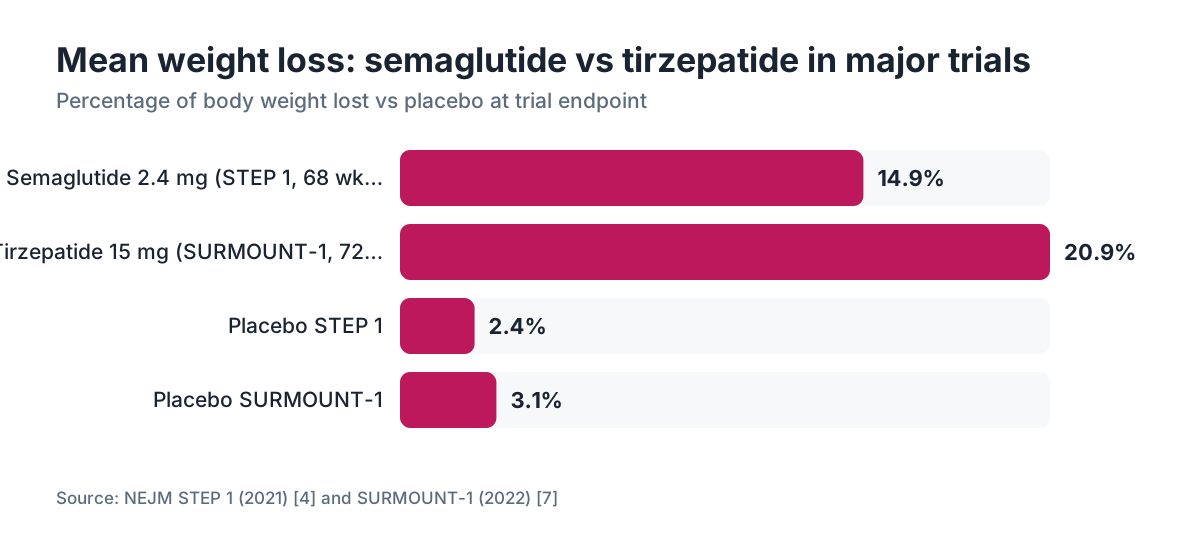
So did compounded semaglutide harm people at scale? The honest answer is nobody has a clean denominator. Millions of patients took these products, and most reported weight loss in the range branded trials show. The STEP 1 trial found a 14.9% mean body weight reduction with branded semaglutide 2.4 mg over 68 weeks [4]. Compounded-product outcomes in that range are plausible because the active molecule is the same. But you cannot separate formulation quality brand to brand without head-to-head manufacturing data, and that data does not exist publicly.
Nobody has good outcomes data on Hims-sourced semaglutide specifically. What we do have is the FDA's own testing showing that some samples of compounded semaglutide from various pharmacies were subpotent or carried impurities. That finding should not be waved away.
How does compounded semaglutide compare to Ozempic and Wegovy?
The table below has the practical differences that actually change a decision.
| Feature | Ozempic (brand) | Wegovy (brand) | Compounded semaglutide (when legal) | |---|---|---|---| | FDA-approved indication | Type 2 diabetes | Chronic weight management | Neither (shortage compounding only) | | Dose used for weight loss | Off-label up to 2 mg | 0.25 mg to 2.4 mg | Pharmacy-specific, no FDA review | | Delivery device | Pre-filled pen | Pre-filled pen | Multi-dose vial or pen (varies) | | Salt formulation | Semaglutide (specific salt) | Semaglutide (specific salt) | Semaglutide base or sodium | | Monthly list price (2025) | ~$935 [2] | ~$1,349 [2] | ~$199-$299 during shortage | | Insurance coverage | Often covered for T2D | Limited, improving | Never covered | | Clinical trial data | Extensive (SUSTAIN series) | STEP trials [4] | None for specific formulations |
If the compounded product came from a legitimate, high-quality 503B facility, the efficacy gap is probably small. The regulatory and quality-assurance gap is not small. Wegovy's pre-filled pen removes an entire category of dosing error that a multi-dose vial hands right back to you. For a woman also managing perimenopause, the last thing you need is a medication error stacked on top of symptoms that already move around.
See semaglutide vs tirzepatide if you are also weighing tirzepatide (Mounjaro/Zepbound), which has its own compounding story now that its shortage is resolved too.
Why does this matter differently for women, especially those in perimenopause or menopause?
GLP-1 drugs like semaglutide are not weight-neutral for women in midlife. They act on a body already going through big hormonal change, and the interaction runs both directions.
Estrogen decline in perimenopause pushes fat storage toward the abdomen, raises insulin resistance, and makes the usual female response to eating less less efficient [5]. GLP-1s go straight at appetite regulation and insulin sensitivity, which is why a lot of clinicians now treat them as a reasonable tool in midlife metabolic care. The STEP 1 population was roughly 75% female, so the headline number (14.9% at 68 weeks) does reflect a female-majority group, though the trial did not break out results by menopausal status [4].
Now the concern in the other direction. Semaglutide drives rapid caloric restriction and rapid weight loss, and that speeds up lean mass and bone density loss. Women already lose bone after menopause fast enough that roughly half of women over 50 face osteoporosis-related fracture risk [11]. Add aggressive GLP-1 weight loss without resistance training and enough protein, and you compound that risk in a way the branded trials mostly did not measure.
Hims, like most telehealth GLP-1 platforms, did not require a baseline bone density test before prescribing. Most required nothing beyond a BMI and a short intake form. That is a real clinical gap. A woman in her mid-40s on compounded semaglutide, with no hormone therapy in the picture, may be losing muscle and bone faster than she knows while the scale moves the way she wants.
If you are in perimenopause or past menopause and using or considering a GLP-1, the co-intervention that matters most is not a B12 shot. It is a real conversation about hormone replacement therapy and a resistance training plan. The Endocrine Society's 2023 obesity guideline states that treating obesity in the menopause context requires accounting for the hormonal environment [5].
What did Hims actually charge and how did it make money on this?
Hims charged $199 to $299 a month for its compounded semaglutide subscription during the shortage [2]. That covered the medication, a telehealth consult, and ongoing messaging with a provider.
The model worked because 503B outsourcing facilities could make semaglutide at a cost per milligram that was a fraction of Novo Nordisk's branded price, and the shortage list made it legal to do without a license from Novo. Hims sat in the middle as a distribution layer. It ran the patient-facing telehealth, collected subscription fees, and bought from outsourcing facilities at wholesale.
At its peak Hims reported GLP-1 revenue contributing meaningfully to its total, and analysts pegged the company at several hundred thousand active GLP-1 patients. When the FDA ended the shortage exemption, Hims disclosed in SEC filings that it expected a large revenue hit.
The pivot: partner with Novo Nordisk's NovoCare savings program to offer branded Wegovy with out-of-pocket help, and test whether personalized compounding exceptions (say, a custom dose escalation schedule) could keep some legal window open. That second play is still legally contested as of mid-2025.
Here is the takeaway for you. The $199 price was a product of a temporary regulatory window, not a permanent market correction. If you built a long-term semaglutide budget around that number, you need a new plan.
What are your real options now that compounded semaglutide is no longer legal for most patients?
Five realistic paths.
First, branded Wegovy with a manufacturer savings card. Novo Nordisk's NovoCare program caps out-of-pocket cost at $0 to $650 a month depending on income and insurance status. The $0 tier is real but carries income and insurance restrictions. Check eligibility at novocare.com directly.
Second, branded Ozempic off-label for weight loss. Ozempic is approved for type 2 diabetes but is the same molecule as Wegovy, and many endocrinologists and obesity medicine physicians prescribe it off-label for weight management. Supply has improved a lot since 2022.
Third, tirzepatide (Zepbound). Tirzepatide hits both GLP-1 and GIP receptors and produced a 20.9% mean weight reduction in the SURMOUNT-1 trial, higher than semaglutide's 14.9% [7]. Its compounding window also closed in 2025, but branded Zepbound has its own savings program and growing insurance coverage. See semaglutide vs tirzepatide for a full comparison.
Fourth, a legitimate personalized compounded formulation. If you have a documented allergy or intolerance to an inactive ingredient in the branded product, a 503A pharmacy can still compound a modified version. Narrow exception. Requires documentation.
Fifth, do nothing right now and revisit. If perimenopausal weight gain was your main driver and you have not addressed estrogen and progesterone status, starting there may shift your metabolic baseline before you add a GLP-1. Estrogen therapy reduces visceral fat accumulation in postmenopausal women, per NAMS guidance [6]. That is not a reason to skip GLP-1s. It is a reason to sort out the hormonal picture first.
For women who want a provider who looks at hormones and GLP-1s together instead of siloing them, platforms like WomenRx assess both, which matters when you are managing perimenopause and weight at the same time.
How does the FDA's compounding crackdown affect telehealth GLP-1 companies broadly?
Hims was one of many. Ro, Noom Med, LifeMD, Found, and dozens of smaller startups all sold compounded semaglutide during the shortage. The FDA's crackdown hits all of them under the same legal framework.
The 503A and 503B wind-down deadlines applied across the industry. Several companies sued to delay the timeline. At least one compounding pharmacy trade group's suit was pending in federal court as of mid-2025, seeking to overturn the shortage-resolution determination. Their argument: demand for branded semaglutide still outruns supply even if Novo Nordisk says availability has improved. Courts have not landed decisively on either side.
The FDA's position, stated in its early-2025 announcement, is that the shortage-list decision rests on supply chain data, not on retail availability at any one pharmacy. That is a technical reading of the statute, and it may or may not survive judicial review.
Here is the practical reality for patients. Any telehealth platform still marketing compounded semaglutide subscriptions without disclosing the legal complexity is not being straight with you. Ask directly: what is the legal basis for your current compounding, and can you show me the 503B facility's FDA registration?
The broader telehealth GLP-1 space will likely consolidate around branded drug access, cash-pay programs, and hybrid models. The era of $199 compounded semaglutide at scale is close to over.
For more on compounded semaglutide broadly, including how to verify a pharmacy's legitimacy, that article walks through the regulatory landscape in detail.
What should women ask a provider before starting or continuing semaglutide?
Starting semaglutide for the first time or moving off a compounded product, there are specific questions that separate a thoughtful prescriber from a checkbox mill.
One. What is my baseline metabolic panel, HbA1c, and fasting insulin? Semaglutide's mechanism matters most if you have insulin resistance, which is common in perimenopause. A baseline also lets you track real metabolic improvement, not only the scale.
Two. Have we checked my thyroid? Hypothyroidism and estrogen decline both cause weight gain and fatigue. Reaching for semaglutide first while an undiagnosed thyroid problem drives your symptoms is common and not good medicine.
Three. What is my bone density status? If you are over 45 and have never had a DEXA scan, you do not know whether the weight you are about to lose is fat, muscle, or bone. The Wegovy label does not require baseline bone density, but the clinical logic for getting one is strong [11].
Four. Are we addressing hormones? Estrogen and progesterone loss in perimenopause and menopause changes where fat goes and how your body uses insulin. A provider who ignores that while prescribing a GLP-1 is handing you half a treatment.
Five. What is the dose escalation plan, and what happens if I get side effects? The standard STEP escalation ran at 4-week intervals up to 2.4 mg. Some patients do better going slower. A prescriber who cannot explain their escalation logic probably copied the default protocol without reading the patient in front of them.
For more on GLP-1s for weight loss, semaglutide for weight loss covers the mechanism, dosing, and what the STEP data actually say in plain language.
What does the science say about semaglutide and women's hormones specifically?
Here the honest answer is that the data are thinner than the marketing implies.
No large randomized controlled trial has studied semaglutide in perimenopausal or postmenopausal women as a defined subgroup with hormone-stratified outcomes. The STEP trials enrolled mostly women but did not publish menopausal-status-stratified data in their primary papers [4]. STEP 5, a 2-year extension study, also lacked hormonal subgroup analysis.
What we do have: observational evidence that GLP-1 receptor agonists improve insulin sensitivity and reduce visceral fat, both of which estrogen decline disrupts. There is also early data from small studies hinting that GLP-1 agonists may cut hot flash frequency, possibly through shared central appetite and temperature pathways, though no powered trial has replicated it.
The interaction between semaglutide and exogenous estrogen (from hormone replacement therapy) has not been studied in a prospective trial. The mechanistic question cuts both ways: estrogen improves insulin sensitivity, which might mean women on HRT need slightly different GLP-1 titration. Nobody has the data. The Endocrine Society's 2023 obesity guidelines name the lack of sex-hormone-stratified GLP-1 data as a gap [5].
Women on both HRT and semaglutide should flag the combination to their prescriber and watch for hypoglycemia or unexpected changes in appetite suppression if their HRT dose changes. The combination is not dangerous in any well-documented sense. It is simply unstudied enough that attention is warranted.
For context on perimenopause timing and why it shifts your metabolic picture, perimenopause age explains when the hormonal changes typically begin and what symptoms to watch for.
Frequently asked questions
Is Hims semaglutide the same as Ozempic or Wegovy?
Hims compounded semaglutide held the same active molecule (semaglutide) but used semaglutide base or sodium instead of the specific salt in Ozempic and Wegovy. The FDA has flagged this distinction and raised quality concerns about some compounded products. Branded Ozempic and Wegovy have full pharmacokinetic testing behind their specific formulations. Compounded versions do not.
Can I still get compounded semaglutide from Hims in 2025?
Almost certainly not in its original form. The FDA removed semaglutide from its shortage list in early 2025, ending the legal basis for large-scale compounding. Hims publicly acknowledged this would hit its GLP-1 business. A narrow exception exists for personalized compounding if you have a documented allergy to an ingredient in the branded product, but that requires clinical justification and documentation.
Was Hims compounded semaglutide FDA-approved?
No. Compounded drugs are not FDA-approved. Hims supplied compounded semaglutide legally under the drug shortage exemption, which lets licensed compounding pharmacies make copies of shortage-listed drugs without FDA approval. The product was never evaluated by the FDA for safety, efficacy, or manufacturing quality the way Ozempic and Wegovy were.
How much did Hims charge for semaglutide compared to the brand-name cost?
Hims charged roughly $199 to $299 a month for compounded semaglutide. Branded Wegovy lists at about $1,349 a month and Ozempic at about $935 a month as of 2025. The price gap was possible because compounders making product under shortage exemptions were not paying patent licensing fees to Novo Nordisk.
What happened to patients who were on Hims semaglutide when the ban took effect?
Patients had to switch to branded products, pay out of pocket, or stop treatment. Hims offered a transition path toward branded Wegovy with Novo Nordisk's savings program. Patients who stopped abruptly often regained weight. Semaglutide's weight loss is not maintained after you stop, as the STEP 4 withdrawal trial confirmed when it found roughly two-thirds of lost weight came back within a year of stopping.
Are there any safety risks specific to compounded semaglutide from telehealth platforms?
Yes. A 2024 FDA safety alert cited adverse events, including hospitalizations, linked to dosing errors with compounded semaglutide. Multi-dose vials require self-reconstitution and raise error risk versus branded pre-filled pens. Some products also carried added ingredients like B12 whose safety alongside semaglutide has not been tested. Quality varied across facilities.
Does semaglutide work differently for women in menopause or perimenopause?
The STEP trials did not stratify results by menopausal status, so there is no direct comparative data. Perimenopausal women carry more visceral fat and more insulin resistance from estrogen decline, which in theory makes GLP-1 mechanisms more relevant. But the risk of accelerated bone and muscle loss with rapid weight loss also runs higher in this group, so protein intake, resistance training, and possibly HRT become important co-interventions.
What is a 503B outsourcing facility and why does it matter for compounded semaglutide?
503B facilities are FDA-registered bulk compounding manufacturers that supply providers directly, unlike 503A pharmacies that fill individual prescriptions. 503B facilities face FDA inspection and current good manufacturing practice rules, which makes them generally more reliable than 503A compounders for consistent potency. Hims sourced from 503B facilities. Even so, 503B compounded drugs are not FDA-approved and have not gone through the clinical testing branded products have.
Can I use insurance to pay for branded semaglutide after transitioning off Hims?
Coverage depends on your insurer and diagnosis. Ozempic is more broadly covered for type 2 diabetes. Wegovy coverage for obesity is improving but stays inconsistent. Medicare Part D began covering Wegovy for cardiovascular risk reduction in 2024 following the SELECT trial. Employer plans vary widely. If you are paying cash, Novo Nordisk's NovoCare savings programs can cut costs a lot for eligible patients.
Is tirzepatide a better option than semaglutide for women with menopausal weight gain?
Tirzepatide (Zepbound) showed 20.9% mean weight loss versus semaglutide's 14.9% in their respective trials, though these were not head-to-head in the same population. Both carry similar side effect profiles. Tirzepatide's compounding window also closed in 2025. For women with significant menopausal metabolic shifts, the extra efficacy from tirzepatide may matter, but hormone status should be addressed no matter which GLP-1 you use.
Should I combine semaglutide with hormone replacement therapy?
No published trial covers this combination, but the clinical logic is sound. HRT addresses the estrogen-driven causes of menopausal weight gain and protects bone density. Semaglutide addresses appetite and insulin sensitivity. They work through different mechanisms and are not known to interact dangerously. Tell both prescribers about all medications so titration decisions account for the full picture. Many women's health providers now prescribe both together.
How do I know if a telehealth platform is still legally offering compounded semaglutide?
Ask for the dispensing pharmacy's FDA 503B registration number, which you can verify in the FDA's 503B outsourcing facility database. Ask what legal basis the platform is using, since the shortage exemption is no longer valid for most patients. Ask whether the formulation qualifies as a personalized compounding exception and what clinical documentation supports it. A legitimate provider answers these without hesitation.
What weight regain should I expect if I stop semaglutide?
Significant regain is likely without continued treatment. The STEP 4 trial, which withdrew patients from semaglutide after 20 weeks, found participants regained roughly two-thirds of their lost weight within a year of stopping. This is not a willpower failure. It reflects semaglutide's mechanism working on appetite hormones that revert once the drug is gone. Long-term planning matters before you start.
Does losing weight on semaglutide cause bone loss in women?
Weight loss of any kind reduces mechanical load on bones and can lower bone density. The STEP trials did not show significant bone density changes over 68 weeks in the general population, but they also did not specifically study postmenopausal women who already carry elevated fracture risk. Women over 45 losing weight fast on semaglutide should discuss a baseline DEXA scan and keep calcium, vitamin D, and protein adequate, plus resistance training.
Sources
- ASPE/HHS, Comparing Branded GLP-1 Drug Prices and List Price Trends
- Wilding et al., STEP 1 Trial, New England Journal of Medicine (2021)
- Endocrine Society, Clinical Practice Guideline on Pharmacological Management of Obesity (2023)
- NAMS (North American Menopause Society), Menopause Practice: A Clinician's Guide
- Jastreboff et al., SURMOUNT-1 Trial, New England Journal of Medicine (2022)
- Rubino et al., STEP 4 Trial, JAMA (2021)
- NIH National Institute on Aging, Osteoporosis
- Lincoff et al., SELECT Trial, New England Journal of Medicine (2023)