FSH levels in perimenopause: what the numbers actually mean
TL;DR: Follicle-stimulating hormone (FSH) rises as your ovaries become less responsive to it. A single FSH above 10 IU/L can suggest perimenopause; levels consistently above 25-30 IU/L point toward late perimenopause or menopause. But FSH swings wildly month to month, so one number is never a diagnosis on its own. Symptoms and menstrual pattern matter just as much.
What is FSH and why does it change in perimenopause?
FSH stands for follicle-stimulating hormone. Your pituitary gland releases it every month to nudge your ovaries into growing a follicle and producing estrogen. When that system is working smoothly, estrogen rises, the pituitary gets the signal to back off, and FSH drops back down. Clean feedback loop.
In perimenopause, the ovaries start running low on good-quality follicles. They don't respond as briskly to FSH. So the pituitary does what any reasonable system would do: it shouts louder. FSH climbs. Sometimes it climbs a lot, then crashes back down when an ovary happens to pop out a follicle that month. This is why FSH is so variable in the years before your last period, and why a single test can be genuinely misleading [1].
The North American Menopause Society (NAMS) describes FSH as a marker that rises "intermittently" in early perimenopause and more consistently in late perimenopause, and it explicitly cautions that "no single FSH value definitively diagnoses menopause" in women who are still cycling [2]. That's not bureaucratic hedging. It reflects real biology: ovarian function sputters before it stops.
What are normal FSH levels by age and cycle phase?
FSH isn't one fixed number. It changes depending on where you are in your menstrual cycle and where you are in your reproductive life. Labs typically report a reference range, but those ranges vary slightly between labs, which is one reason your doctor can't just look at a number in isolation.
Here's a broad picture of what most clinical reference ranges look like for women:
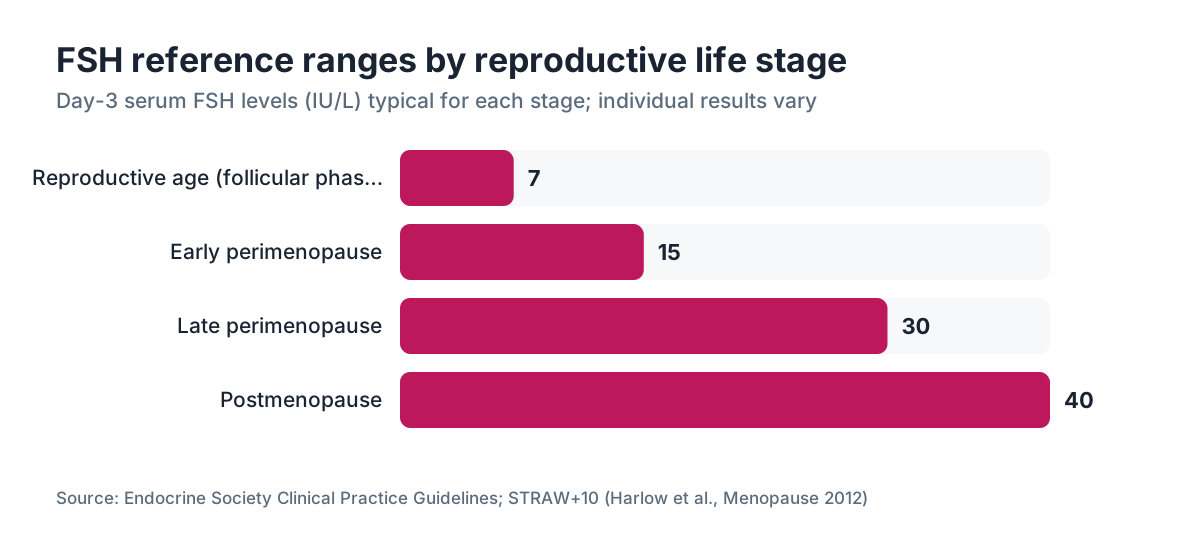
| Life stage / cycle phase | Typical FSH range (IU/L) | |---|---| | Follicular phase (days 1-13), reproductive age | 3 to 10 | | Ovulatory surge, reproductive age | 4 to 25 | | Luteal phase (days 14-28), reproductive age | 1.5 to 7 | | Early perimenopause | 10 to 20 (variable) | | Late perimenopause | 20 to 40+ | | Postmenopause (12+ months no period) | typically > 25-30 |
These ranges come from published clinical reference data reviewed by the Endocrine Society [3]. Your lab's own reference interval is printed on your report, and that's the one your clinician should use to interpret your specific result.
For the standard day-3 FSH test (drawn on the third day of your period), most reproductive endocrinologists start to pay attention when FSH is above 10 IU/L, because it suggests ovarian reserve is declining. Values consistently above 25-30 IU/L, especially when estradiol is low (below 20 pg/mL), are consistent with late perimenopause or menopause [3].
What FSH level indicates perimenopause specifically?
There is no single cutoff that "diagnoses" perimenopause, and that's not a cop-out. The Stages of Reproductive Aging Workshop (STRAW+10), which is the closest thing to an international consensus on reproductive aging, defines perimenopause primarily by menstrual cycle changes, not by a hormone number [4].
That said, FSH gives useful context. In clinical practice, a day-3 FSH above 10 IU/L in a woman who's noticing cycle irregularity is consistent with early perimenopause. A value above 25 IU/L on two tests taken at least 4-6 weeks apart suggests late perimenopause or menopause. The STRAW+10 framework considers FSH above 25 IU/L a "supportive criterion" for the late menopausal transition [4].
The problem is that FSH in early perimenopause can look completely normal one month and then spike dramatically the next. One study published in the Journal of Clinical Endocrinology and Metabolism found that FSH variability was so high during the menopausal transition that a single measurement had limited predictive value for where a woman actually was in that transition [5]. So if your FSH came back at 18 IU/L and you're 44 with irregular periods and hot flashes, that result fits perimenopause even if it's not a slam-dunk "positive test."
Symptoms are not a lesser form of evidence. Hot flashes, night sweats, sleep disruption, mood changes, and irregular cycles are what NAMS calls the defining clinical features of the menopausal transition [2].
How is FSH tested and when should you get it done?
FSH is a simple blood draw, usually ordered as part of a hormone panel. If you're still having periods, your clinician will typically want it drawn on day 2, 3, or early day 4 of your cycle, because that's the standardized time to assess ovarian reserve and baseline hormonal status.
If your cycles are irregular (a common early perimenopause sign), picking day 3 can be tricky. In that case, your doctor may order it on any convenient day, knowing they'll interpret it with extra caution, or they may repeat it. Timing matters a lot: FSH drawn mid-cycle during an LH surge can look elevated simply because of the ovulatory peak, not because of declining ovarian function.
Some things that can falsely lower FSH: being on hormonal birth control (the pill suppresses pituitary signaling significantly), taking estrogen, or being in the luteal phase of your cycle when FSH naturally drops. If you're on the pill and trying to understand your perimenopause status, stopping it for at least a full cycle before testing gives you cleaner data, though that's a conversation to have with your clinician [3].
FSH is typically ordered alongside estradiol (E2) and sometimes LH (luteinizing hormone). Estradiol below 20-30 pg/mL combined with elevated FSH paints a much clearer picture than FSH alone. Some clinicians also include AMH (anti-Müllerian hormone), which is a more stable marker of ovarian reserve since it doesn't fluctuate as much across the cycle [4].
Can FSH levels diagnose menopause definitively?
Not on their own, no. Menopause is a clinical diagnosis: 12 consecutive months without a period, with no other medical explanation (pregnancy, thyroid disease, prolactin problems, or medications that stop periods). That 12-month marker is the standard used by NAMS, the Endocrine Society, and the World Health Organization [2][3].
For most women over 45, FSH testing isn't actually necessary to diagnose menopause. If you've gone 12 months without a period and you're in your late 40s or 50s, you're in menopause. A blood test won't change that.
Where FSH testing is genuinely useful is in younger women (under 40) who may be experiencing premature ovarian insufficiency (POI), in women whose periods have stopped for unclear reasons, or in women on hormonal contraception who want some sense of their ovarian reserve. The Endocrine Society recommends two FSH measurements at least 4-6 weeks apart, both above 25 IU/L, along with amenorrhea (no period) for 4 months, to diagnose POI in women under 40 [3].
For women on continuous hormonal contraception like the Mirena IUD or combined pill, who may not have periods at all, FSH testing becomes more important for understanding whether they're in the menopausal transition, because there's no menstrual pattern to track.
Why does FSH fluctuate so much during perimenopause?
This is the part that trips people up, and it's worth spending a minute on it.
Your pituitary and ovaries are in constant conversation. The pituitary releases FSH; the ovaries respond with estrogen; the estrogen signals the pituitary to dial back FSH. In perimenopause, that conversation becomes erratic. Some months a follicle develops well and estrogen rises strongly, which temporarily suppresses FSH to reproductive-age levels. Other months follicular development is poor, estrogen stays low, and FSH spikes.
This is why a 46-year-old can have an FSH of 8 IU/L in March and 32 IU/L in June. Both numbers are real. Neither one is wrong. They just reflect where her ovaries happened to be in two different months. The data from the Study of Women's Health Across the Nation (SWAN), a large longitudinal cohort that followed over 3,000 women through the menopausal transition, showed that within-person FSH variability was substantial in the years immediately before the final menstrual period [5].
This variability has a real clinical consequence: don't make major treatment decisions based on one FSH result. If you're trying to figure out whether you're in perimenopause, testing once and seeing a slightly elevated number doesn't confirm it, and testing once and seeing a normal number doesn't rule it out. Context, symptoms, and sometimes serial testing over a few months give you better information.
What should you do if your FSH is high?
First, put it in context. High compared to what? A day-3 FSH of 12 IU/L in a 47-year-old with shorter cycles and occasional hot flashes is a perfectly sensible finding. The same number in a 32-year-old with regular cycles might warrant more attention.
If your FSH is elevated and you're having symptoms of perimenopause (irregular periods, sleep problems, hot flashes, mood shifts, vaginal dryness), that's a reasonable time to have a real conversation with a clinician about whether hormonal support makes sense for you. Hormone replacement therapy in perimenopause is well-studied and effective for vasomotor symptoms; NAMS's 2022 position statement concluded that for healthy women under 60 or within 10 years of menopause, the benefits of hormone therapy generally outweigh the risks [2].
If you're under 40 and your FSH is above 25 IU/L on repeated testing, that's a different situation that warrants evaluation for premature ovarian insufficiency. POI has implications for bone health, cardiovascular health, and fertility that go beyond symptom management [3].
A platform like WomenRx makes it possible to get a hormone panel ordered and reviewed by a clinician who specializes in this area, without waiting months for a gynecology appointment. That matters when you're trying to understand a confusing lab result.
If your FSH is high and you're worried about bone density, which is a legitimate concern because declining estrogen accelerates bone loss, a bone density test is worth discussing with your doctor. The Bone Health and Osteoporosis Foundation recommends DXA screening at menopause for women with risk factors [6].
Does FSH level affect symptoms or how you feel?
FSH itself doesn't cause symptoms. Hot flashes, night sweats, and mood changes are driven primarily by declining and fluctuating estrogen, not by high FSH directly. FSH is the messenger, not the problem.
That said, when FSH is high, it means estrogen is likely low or erratic, and that's what generates symptoms. So high FSH often tracks with the worst symptom days, but the FSH number isn't the cause.
There's emerging research looking at whether FSH has direct effects on bone, fat metabolism, and the cardiovascular system independent of estrogen. A 2021 study in Nature found that FSH signaling may affect adipose (fat) tissue and bone in ways that aren't entirely mediated by estrogen, which would suggest FSH isn't purely a passive readout [7]. This is active research territory, not yet practice-changing, but worth knowing about.
For now, symptoms are still the most reliable guide to how you're actually doing in perimenopause. A woman with FSH of 40 who sleeps fine and has no hot flashes may need less intervention than a woman with FSH of 15 who's having severe vasomotor symptoms and can't function at work.
How does FSH testing compare to other hormone tests in perimenopause?
FSH isn't the only hormone in the picture. Here's how it stacks up against the others most commonly ordered:
| Hormone | What it tells you | Limitations in perimenopause | |---|---|---| | FSH | Ovarian responsiveness; rises as reserve declines | Highly variable month to month | | Estradiol (E2) | Active estrogen level; pairs with FSH for context | Also variable; doesn't predict future trajectory | | LH | Mirrors FSH pattern; less commonly used alone | Similar variability issues | | AMH | Ovarian reserve; stable across the cycle | Doesn't predict symptom onset or severity | | Progesterone | Confirms ovulation; useful if cycles are irregular | Low in anovulatory cycles of perimenopause | | Thyroid (TSH) | Rules out thyroid as cause of symptoms | Not an ovarian marker but often overlaps symptomatically |
AMH is increasingly popular for assessing ovarian reserve because it doesn't fluctuate with the cycle the way FSH does. Low AMH (generally below 1.0 ng/mL) suggests diminishing ovarian reserve. But AMH doesn't predict when you'll have hot flashes or how severe perimenopause will be [4].
Progesterone is worth testing if you want to know whether you're still ovulating, because many perimenopausal cycles are anovulatory (no egg released) even when bleeding occurs. A mid-luteal progesterone (drawn around day 21 of a 28-day cycle) above 3 ng/mL suggests ovulation happened that month.
The honest answer is that no single hormone test captures the full picture of perimenopause. A panel including FSH, estradiol, AMH, progesterone, and TSH, interpreted alongside your symptoms and menstrual history, gives a clinician far more to work with than any one result.
When does perimenopause start and what FSH levels go with each stage?
Most women enter perimenopause somewhere between 45 and 51, though the range is wide. About 10% of women notice changes in their late 30s; a small percentage reach menopause before 40 (premature ovarian insufficiency) [8]. For a closer look at typical timing, see perimenopause age and when does menopause start.
The STRAW+10 framework breaks the menopausal transition into stages:
Early perimenopause (Stage -2): Cycles are still regular or only slightly longer or shorter. You might have occasional skipped periods. FSH often runs 10-20 IU/L on day 3 but can be completely normal some months. Estradiol may actually spike above normal (over 200-300 pg/mL) in some cycles as the pituitary pushes hard.
Late perimenopause (Stage -1): Cycles are more than 60 days apart. You've had at least one gap of that length. FSH is more consistently elevated, often 20-40 IU/L or higher. Estradiol is more consistently low. This stage usually lasts 1-3 years. Vasomotor symptoms are most common and often most severe here.
Menopause (Stage 0): The final menstrual period. You only know it was the final one in retrospect, after 12 months have passed. FSH is typically above 25-30 IU/L at this point [4].
Knowing which stage you're in matters for decisions about contraception (you're still technically fertile in perimenopause, even with elevated FSH), symptom management, and bone health planning.
Should you treat perimenopause based on FSH levels alone?
No, and any clinician who tells you otherwise is oversimplifying. FSH is one data point. Treatment decisions in perimenopause should be based on symptoms, overall health history, cardiovascular risk, breast cancer risk, bone density, and personal preference.
That said, a documented pattern of elevated FSH alongside symptoms does support starting a conversation about hormone replacement therapy or lower-hormone options. The FDA has approved estrogen-containing products for hot flashes, vaginal symptoms, and prevention of postmenopausal osteoporosis, with labeling that specifies the lowest effective dose for the shortest duration appropriate for each woman's goals [9].
For women who don't want or can't use systemic hormones, there are non-hormonal options: the FDA approved fezolinetant (Veozah) in 2023 specifically for moderate-to-severe vasomotor symptoms [9]. SSRIs, SNRIs, and gabapentin have evidence for hot flash reduction, though they're not FDA-approved for that indication.
The estrogen patch is often preferred over oral estrogen because transdermal delivery bypasses first-pass liver metabolism, which matters for women with certain clotting risk factors.
Here's the plain version. If your FSH is elevated and you feel fine, you don't need to treat a number. If you're miserable with symptoms, a somewhat normal FSH doesn't mean you don't deserve treatment. Symptoms are valid. A specialist in hormones can help you sort this out, whether through your own gynecologist or a telehealth service like WomenRx that focuses specifically on this area.
What about FSH levels and fertility in perimenopause?
This is one of the most practically important questions women in their 40s have, and the answer is more nuanced than either "you're infertile" or "you can still get pregnant."
High FSH does mean reduced ovarian reserve, which means fewer viable eggs. But pregnancy is still possible in perimenopause, sometimes well into your late 40s, and occasionally even with FSH values above 20 IU/L. The ovaries don't give up in a linear, predictable way. A high FSH month can be followed by a month where a viable egg is released.
This means perimenopausal women who don't want to get pregnant should not assume high FSH equals reliable contraception. NAMS recommends continuing contraception until 12 months after the final menstrual period [2]. That's the medically defensible guideline.
For women who are actively trying to conceive with high FSH, the picture is harder. A reproductive endocrinologist is the right specialist here. IVF success rates drop significantly with elevated FSH and age; for women over 43, success rates with own eggs are generally below 5-10% per cycle, though donor eggs dramatically improve those odds [8]. These are real numbers from CDC ART data, not reassurances.
The FSH number alone doesn't determine fertility outcomes, but it's one useful input for reproductive planning conversations.
Frequently asked questions
What FSH level confirms menopause?
No single FSH level confirms menopause on its own. Clinically, menopause is 12 consecutive months without a period. FSH consistently above 25-30 IU/L, paired with low estradiol (below 20-30 pg/mL) and no periods, supports the diagnosis in women over 45, but the 12-month amenorrhea rule is the actual standard used by NAMS and the Endocrine Society.
Can FSH levels be normal during perimenopause?
Yes, absolutely. In early perimenopause especially, FSH can look completely normal on a day-3 draw. Because FSH swings month to month depending on how well the ovaries respond in any given cycle, a normal result doesn't rule out perimenopause. Irregular cycles and symptoms like hot flashes matter just as much as the hormone number.
How often should FSH be tested during perimenopause?
There's no universal protocol. If the first test is ambiguous, repeating it 4-6 weeks later during the same cycle phase (early follicular phase, days 2-4) gives useful comparative data. Serial testing every 6-12 months makes sense if you're tracking progression or timing decisions about contraception or hormone therapy. Single annual panels are reasonable for most women.
Does birth control affect FSH test results?
Yes, significantly. Combined hormonal contraceptives (pill, patch, ring) suppress pituitary signaling and will artificially lower FSH, sometimes to undetectable levels. If you're on hormonal contraception and want to know your true FSH, you'd need to stop it for at least one full natural cycle before testing, which is a decision to make with your clinician based on your contraceptive needs.
What is a normal FSH level for a woman in her 40s?
In your early 40s, a day-3 FSH below 10 IU/L is generally considered within the normal reproductive range. Values of 10-20 IU/L suggest declining ovarian reserve and early perimenopause. By the mid-to-late 40s, values of 20-40 IU/L are common and expected. Your lab's specific reference range matters more than any generic cutoff.
Is FSH testing or AMH testing better for perimenopause?
Both measure different things. AMH (anti-Müllerian hormone) is more stable across the menstrual cycle and gives a cleaner picture of ovarian reserve without worrying about cycle day. FSH shows the pituitary's response to that reserve in real time. For most women assessing perimenopause status, FSH plus estradiol is sufficient. AMH adds value if you need a more stable ovarian reserve estimate or are considering fertility treatment.
Can stress raise FSH levels?
There's no strong direct evidence that psychological stress acutely raises FSH in women with normal ovarian function. However, stress can disrupt the hypothalamic-pituitary axis, affect cycle regularity, and influence cortisol in ways that secondarily affect reproductive hormones. An abnormal FSH result should be interpreted alongside clinical context, not attributed to a stressful week at work.
Does a high FSH mean I will reach menopause soon?
Elevated FSH signals declining ovarian reserve, but it can't predict your exact timeline to the final menstrual period. The SWAN study found that the time from first irregular cycles to the final period ranged from 2 to 8 years across women. AMH may be a slightly better predictor of timing than FSH, but even then the uncertainty range is wide.
What FSH level is considered too high?
There's no "too high" in an absolute sense. FSH above 40 IU/L on repeat testing, combined with no periods and low estradiol, is consistent with established menopause or premature ovarian insufficiency. In a woman who's still having any periods, very high FSH (above 30-40 IU/L) warrants workup to rule out non-ovarian causes like pituitary adenoma or thyroid disease.
Can FSH levels go back down after being elevated?
Yes. In perimenopause especially, FSH can spike dramatically one month and return to near-normal the next if the ovaries produce a good follicle. This is one of the most clinically confusing features of the menopausal transition. FSH tends to stabilize at consistently elevated levels only in the final 1-2 years before the last period and post-menopause.
Does high FSH mean low estrogen?
Not necessarily at the same moment. In early perimenopause, FSH can be elevated precisely because it's pushing the ovaries hard, and estrogen may actually be higher than normal in that cycle. It's the overall declining trend in estrogen and the failure of the feedback loop that drives FSH up over time. Testing both FSH and estradiol together is more informative than either alone.
Should I start hormone therapy if my FSH is elevated?
Elevated FSH alone isn't an indication to start hormone therapy. The decision depends on whether you're having symptoms that affect your quality of life, your health history, and your personal preferences. NAMS guidelines say that for healthy women under 60 or within 10 years of menopause, benefits of hormone therapy generally outweigh risks when symptoms are present. A clinician should make this call with you, not based on a number alone.
Sources
- National Institutes of Health, MedlinePlus: FSH test
- North American Menopause Society (NAMS), Menopause Practice: A Clinician's Guide and 2022 Hormone Therapy Position Statement
- Endocrine Society Clinical Practice Guideline: Menopause and Premature Ovarian Insufficiency
- Harlow SD et al., Executive summary of the Stages of Reproductive Aging Workshop +10 (STRAW+10), Menopause 2012
- Study of Women's Health Across the Nation (SWAN), Journal of Clinical Endocrinology and Metabolism
- Bone Health and Osteoporosis Foundation: Clinician's Guide to Prevention and Treatment of Osteoporosis
- Liu P et al., Blocking FSH induces thermogenic adipose tissue and reduces body fat, Nature 2021
- CDC: 2021 Assisted Reproductive Technology Fertility Clinic and National Summary Report
- FDA: Approved Drug Products (Veozah/fezolinetant NDA 216578; estrogen product labeling guidance)
- Soules MR et al., Executive Summary: Stages of Reproductive Aging Workshop (STRAW), Fertility and Sterility 2001