FSH levels and menopause: what the numbers actually mean
TL;DR: FSH (follicle-stimulating hormone) rises as ovarian reserve falls. A level above 30 mIU/mL on two tests taken at least 4-6 weeks apart is the clinical threshold most labs and the Endocrine Society use to confirm menopause. Perimenopause produces wildly fluctuating readings, often between 10 and 40 mIU/mL. A single test means very little on its own.
What is FSH and why does it rise during menopause?
FSH is a hormone made by your pituitary gland. Its job is to tell your ovaries to mature a follicle each month. When your ovaries respond well, rising estrogen signals the pituitary to back off. As ovarian reserve declines in your 40s and 50s, that estrogen feedback weakens, and the pituitary keeps pushing out more and more FSH trying to get a response. By the time you've been in full menopause for a year, FSH can run three to ten times higher than it did in your reproductive years. [1]
Here's the part most people get backwards. FSH doesn't cause menopause. It reflects it. A high FSH tells you the pituitary is working overtime because the ovaries aren't answering. That distinction matters when you're reading your own lab report.
FSH is measured in milli-international units per milliliter (mIU/mL). Labs use slightly different reference ranges, and that's one of the most common sources of confusion. A result flagged as "high" at one lab may sit inside the reference range at another, depending on which assay and which population norms they use. [2] Always look at the lab's own reference range printed on your results, and ask your provider which stage of the cycle the blood was drawn during.
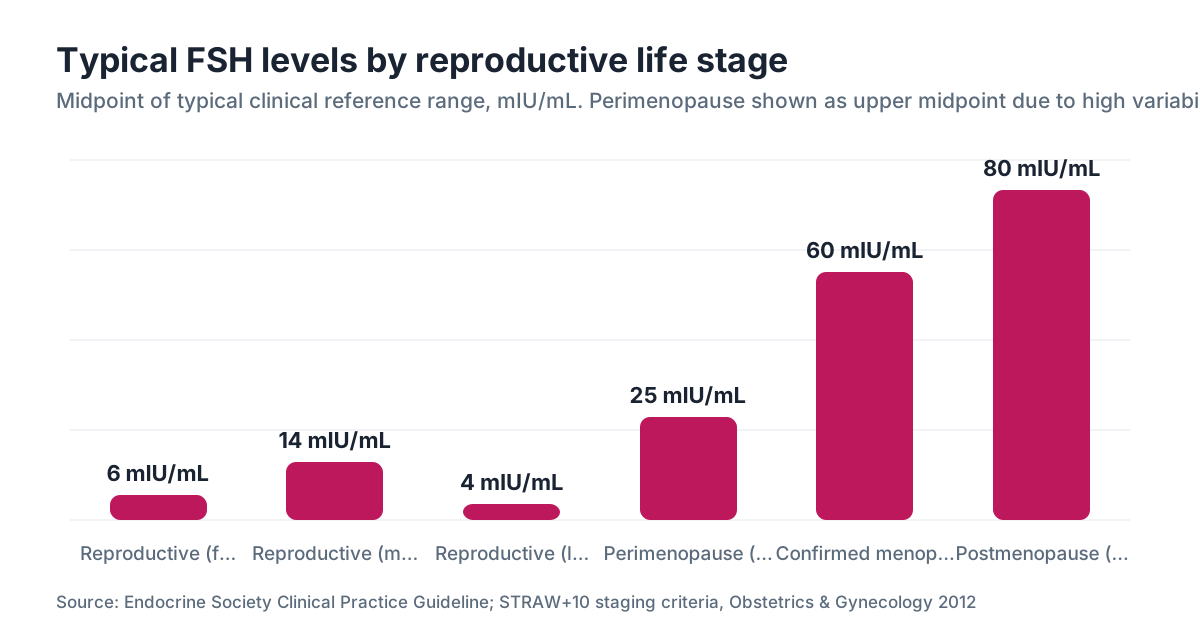
FSH levels by life stage: a reference chart
The table below shows the typical FSH ranges reported by major clinical labs and referenced in Endocrine Society guidelines. These are population averages. Individual variation is real and large.
| Life stage | Typical FSH range (mIU/mL) | Notes | |---|---|---| | Reproductive years (follicular phase, day 2-3) | 3 to 10 | Day 3 draw is the standard for fertility assessment | | Reproductive years (mid-cycle LH surge) | 4 to 25 | Peaks with the LH surge | | Reproductive years (luteal phase) | 1 to 7 | Lower in the second half of the cycle | | Perimenopause | 10 to 40+ (erratic) | Can overlap with reproductive range on any given day | | Menopause (confirmed, 12+ months no period) | 30 to 150 | Typically stabilizes above 30; median around 50-70 | | Postmenopause | 40 to 150 | Remains elevated for life |
A few caveats to keep in your head as you read this. The perimenopause row is the messiest. FSH can be 6 one month and 45 the next, because ovarian function is sputtering rather than stopping cleanly. [3] Women on hormonal contraceptives (especially combined estrogen-progestin pills) will have artificially suppressed FSH, which makes the test useless for menopause staging unless they stop the pill for at least two weeks. [1] And labs running older immunoassays may report numbers 15-20% different from those using newer automated platforms. [2]
The Endocrine Society's clinical practice guideline on menopause treats FSH greater than or equal to 25-30 mIU/mL on two occasions, in a woman with matching symptoms and no menstrual period for 12 months, as consistent with menopause. [1] The North American Menopause Society (NAMS) uses the same general threshold, noting that FSH "typically exceeds 30 mIU/mL" in confirmed menopause. [4]
Why is my FSH high but my period is still regular?
This is one of the most common questions women in their early 40s ask, and the answer is straightforward: an elevated FSH on a single early-cycle draw signals declining ovarian reserve, not proof of menopause or even perimenopause by itself. [3]
Your ovaries can still make enough estrogen to trigger ovulation and a period even as FSH climbs. Picture an engine running rough but still moving. The pituitary strains harder, and ovulation still happens. Women with a day-3 FSH above 10-12 mIU/mL are often told by fertility specialists that ovarian reserve is dropping, yet they may cycle regularly for another three to eight years before their last period. [3]
One test won't tell the story here. Ask your provider to pair FSH with anti-Mullerian hormone (AMH) and an antral follicle count (AFC) on ultrasound. AMH doesn't swing with the cycle the way FSH does, which makes it a steadier marker of remaining ovarian reserve. If you want to understand where you sit on the timeline, the article on perimenopause age walks through the full picture.
What FSH level confirms menopause?
Menopause is defined as 12 consecutive months without a menstrual period, with no other medical cause. That's the clinical gold standard, and it doesn't require a blood test at all. [4]
FSH testing earns its keep in specific situations: you've had a hysterectomy (no periods to track), you're on progestin-only contraception that can suppress periods, you're in your early 40s and want to know if symptoms are ovarian or something else, or you want confirmation before making decisions about hormone therapy.
In those cases, an FSH at or above 30 mIU/mL, confirmed on a second draw 4-6 weeks later, is the threshold most clinicians use. [1][4] Why two draws? In perimenopause, FSH can spike above 30 and then drop back below it the very next cycle. A woman with a single FSH of 35 mIU/mL and ongoing irregular periods has not been confirmed as menopausal. She's perimenopausal until the 12-month mark is met.
Age changes the reading. The average age of natural menopause in the U.S. is 51.4 years, based on the Study of Women's Health Across the Nation (SWAN). [5] An FSH of 35 in a 38-year-old is a very different picture than the same number in a 52-year-old. Early menopause (before 45) and premature ovarian insufficiency (before 40) call for more workup, including repeated FSH tests and evaluation for autoimmune causes. [1]
What can cause a falsely high or falsely low FSH result?
Labs aren't infallible, and a handful of factors push FSH in misleading directions.
Things that drive FSH higher than your true baseline: recent illness or surgery (physical stress suppresses ovarian function for a while), being very underweight (fat tissue converts androgens to estrogen, so less fat means less estrogen feedback), and certain pituitary tumors that secrete excess gonadotropins. [1]
Things that suppress FSH and hand you a falsely reassuring low result: combined oral contraceptives (estrogen plus progestin suppress both FSH and LH), estrogen-containing hormone therapy (draw FSH before starting, or stop estrogen for 2-4 weeks before testing), high BMI (more fat tissue, more peripheral estrogen conversion), and pregnancy (obvious, but worth naming). [1][2]
Timing within the cycle matters a lot if you're still cycling. FSH peaks at the LH surge (ovulation) and bottoms out in the luteal phase. The reference standard for menopause-related testing is an early follicular draw, meaning day 2 or 3 of your cycle. [3] A result drawn on day 14 is not comparable to one drawn on day 3.
One more practical note: the lab's own reference range rules. Quest Diagnostics and LabCorp, the two largest U.S. reference labs, each publish their own FSH reference intervals by age and menopausal status. Those intervals differ slightly from each other and from your hospital's in-house lab. Ask for the lab-specific range on your result sheet.
Does FSH level predict menopause symptoms or severity?
This is where the data gets humbling. The short answer: not reliably. [4]
FSH level does not predict how bad your hot flashes will be, how badly your sleep breaks up, or how fast bone loss will move. The SWAN study followed more than 3,000 women through the transition and found symptom severity poorly correlated with absolute FSH values. Some women with moderate FSH had severe vasomotor symptoms. Some women with very high FSH had almost none. [5]
Estradiol (E2) tracks symptoms better than FSH does, but even that link is loose. Symptoms come from the rate of estrogen decline and from central nervous system sensitivity, more than from the absolute level at any single moment. [6]
What FSH does predict reasonably well is fertility potential. Women in fertility evaluation use FSH alongside AMH to gauge how many follicles remain and how well they'll respond to stimulation. For menopause care, though, treating the FSH number as a target is a mistake most good clinicians avoid.
If you're dealing with real symptoms regardless of what your FSH says, that's the signal that matters. Understanding your options at that point, including hormone replacement therapy and other interventions, is the next step.
How does FSH relate to estrogen during the menopause transition?
FSH and estradiol (E2) move in opposite directions across most of the reproductive lifespan. When estradiol is high (mid-cycle, early follicular phase), FSH is suppressed. When estradiol is low (menopause), FSH is high.
Perimenopause scrambles that tidy relationship. In early perimenopause, FSH starts to rise on day 3 while estradiol stays normal or even spikes abnormally high in some cycles. [3] The remaining follicles, under heavier FSH stimulation, overproduce estrogen. Women in early perimenopause sometimes have estradiol in the 200-400 pg/mL range in the first half of the cycle, higher than their reproductive-age baseline, while FSH is already elevated. That combination can bring breast tenderness, heavier periods, and mood changes.
By late perimenopause, both estradiol and progesterone production turn erratic and then decline. After menopause, estradiol typically falls below 30-40 pg/mL (some labs set the postmenopausal reference range under 20 pg/mL). [6] FSH stays elevated permanently unless suppressed by outside hormones.
For a fuller picture of how progesterone fits this transition, and why low luteal-phase progesterone is often the first hormonal shift women notice, read that article alongside this one.
Can you still get pregnant with a high FSH?
Yes, but with meaningfully lower odds. High FSH marks diminished ovarian reserve, not zero ovarian reserve. [3]
Women with FSH in the 15-25 mIU/mL range who are still cycling have had spontaneous pregnancies. The concern is that elevated FSH means fewer remaining follicles, and those follicles may be lower quality. That raises the risk of chromosomal abnormalities and miscarriage, independent of age. [3]
Reproductive endocrinologists often describe FSH above 12-15 mIU/mL as a "poor prognosis" threshold for IVF stimulation, meaning ovarian response to injectable gonadotropins is likely to be weak. But that's a statistical tendency, not an iron rule. There are documented live births from women with FSH above 20 mIU/mL.
Women over 40 who aren't trying to conceive often ask about FSH in the context of whether they still need birth control. Here's the honest answer: until 12 consecutive months without a period have passed, pregnancy is biologically possible and contraception still counts if you want to avoid it. [4] An FSH above 30 mIU/mL is not a contraception-free pass by itself.
Should you test FSH at home or in a lab?
Home FSH tests exist. The FDA has cleared several over-the-counter urine-based FSH tests (Clearblue Menopause Stage Indicator is the most prominent), and they do detect elevated FSH. [7] They're qualitative, meaning they tell you "elevated" or "not elevated" rather than a number. The threshold these tests use is usually around 25 mIU/mL.
My honest take: a home test can work as a first signal if you're having symptoms and want a quick gut-check. It shouldn't be the basis for a treatment decision, though, for a few reasons. You don't know exactly where in your cycle you are, which changes interpretation. You get no number, just a positive or negative. And you have no simultaneous estradiol, AMH, or LH to put it in context.
A proper serum FSH drawn by a lab, ideally paired with LH and estradiol, costs $30-80 out of pocket depending on the lab and whether insurance covers it. [8] That's money well spent over a home test if you're making real decisions about hormone therapy, fertility, or bone health.
If you're working with a telehealth provider like WomenRx, they'll order serum labs through a reference lab and read the results against your full hormone panel, which beats a qualitative strip by a wide margin.
FSH levels and bone health: what's the connection?
The FSH-bone connection runs more direct than many clinicians once thought. For decades the assumption was that menopausal bone loss came purely from low estrogen. Research over the last 15 years, including work from the SWAN bone cohort, suggests FSH itself may stimulate osteoclasts, the cells that break down bone. [9]
A 2006 study in Cell identified FSH receptors on osteoclasts and found that FSH promotes bone resorption independently of estrogen. [9] More recent human data from SWAN showed that the FSH rise in perimenopause tracks with faster bone loss even before estrogen has fallen much. [5]
The clinical implication is still being worked out. Guidelines from the Bone Health and Osteoporosis Foundation and NAMS still recommend bone density screening (DEXA) at age 65 for all women, and earlier for women with risk factors including premature or early menopause. [4][10] Whether FSH level should independently trigger earlier screening isn't in formal guidelines yet, but many clinicians factor it in.
If your FSH sits clearly in the postmenopausal range and you're under 65, a bone density test is worth asking about. Bone loss in the first two years after menopause averages 2-3% per year, against less than 1% per year in premenopausal women. [10]
When should you see a doctor about your FSH levels?
A single elevated FSH on routine bloodwork does not need urgent action. Certain patterns do warrant prompt evaluation.
See a clinician soon if your FSH is repeatedly above 30-40 mIU/mL and you're under 40 (this meets the threshold for premature ovarian insufficiency, which carries cardiovascular and bone implications beyond fertility), if your FSH is elevated alongside hot flashes, night sweats, or sleep disruption bad enough to hurt your quality of life, or if you're trying to conceive and your FSH is rising on serial day-3 draws.
Premature ovarian insufficiency (POI) affects roughly 1% of women under 40. [1] The Endocrine Society guideline recommends that women diagnosed with POI receive hormone therapy at least until the average age of natural menopause (51), because the cardiovascular and bone risks of prolonged estrogen deficiency before that age are well documented. [1]
For women in their late 40s and early 50s with expected perimenopause or menopause, the FSH result is one data point among many. Symptoms, menstrual history, and quality of life carry equal or greater weight in treatment decisions. An estrogen patch or other hormone therapy is neither indicated nor contraindicated by any single FSH value. It's a conversation about risk and benefit in the context of the whole picture.
For anyone weighing what to do after a menopause diagnosis, the overview at menopause covers the treatment options, and the when does menopause start article handles the timing questions in more depth.
Frequently asked questions
What FSH level indicates menopause?
Most labs and clinical guidelines use an FSH at or above 30 mIU/mL, confirmed on two draws at least 4-6 weeks apart, as consistent with menopause. That number means more in the context of 12 consecutive months without a period. Perimenopause can produce readings above 30 that then fall back down, so a single result is not definitive.
What is a normal FSH level for a 50-year-old woman?
At 50, FSH ranges widely depending on where you are in the transition. If you're still cycling, a day-3 FSH anywhere from 3 to 20 mIU/mL can turn up. If you've passed your last period, FSH above 30-40 mIU/mL is expected. The average American woman reaches menopause at 51.4 years, so a 50-year-old is often still perimenopausal with variable readings.
Can FSH levels fluctuate during perimenopause?
Yes, dramatically. In perimenopause, FSH can go from 8 mIU/mL in one cycle to 45 mIU/mL in the next and back down again. This is one reason a single test is unreliable for staging the transition. The erratic pattern reflects the unpredictable recruitment of remaining follicles. Perimenopause is defined by this variability, not by any fixed number.
What is a dangerously high FSH level?
There is no FSH level that is medically dangerous by itself. Very high FSH, sometimes above 100-150 mIU/mL, simply reflects advanced ovarian failure. It doesn't cause harm. The health concerns in menopause come from the downstream effects of low estrogen: bone loss, cardiovascular changes, and genitourinary changes. FSH is the messenger, not the problem.
What day of the cycle should FSH be tested?
Day 2 or 3 of your menstrual cycle, counting the first day of full bleeding as day 1. That early follicular draw is the standard reference point for fertility and menopause assessment. FSH peaks around ovulation and is lowest in the luteal phase, so a draw done at another cycle time can mislead if compared to day-3 reference ranges.
Does high FSH mean I'm in menopause?
Not necessarily. High FSH is a strong sign of declining ovarian reserve, but menopause is confirmed only after 12 consecutive months without a period. You can have FSH in the 30s or 40s and still be ovulating occasionally. Perimenopause can last 4-8 years with fluctuating high FSH before the final period. Two elevated draws plus the 12-month criterion is the full diagnostic picture.
Can you lower FSH levels naturally?
Not in any clinically meaningful way. FSH rises because the ovaries are producing less estrogen. Short of restoring estrogen (via hormone therapy), you cannot sustainably lower postmenopausal FSH. Some supplements are marketed for this, but no peer-reviewed evidence supports them for FSH normalization. Hormone therapy will suppress FSH because the added estrogen feeds back to the pituitary, but that doesn't reverse ovarian aging.
What is the difference between FSH and LH in menopause testing?
Both FSH and LH are gonadotropins made by the pituitary, and both rise after menopause. In practice, FSH rises more steeply and is the primary marker for menopause staging. LH is more useful for pinpointing ovulation timing. In postmenopause, an FSH to LH ratio greater than 1 is typical; a reversed ratio can occasionally suggest a pituitary problem rather than ovarian failure.
How accurate are home FSH tests for detecting menopause?
FDA-cleared home FSH tests detect elevated FSH with reasonable sensitivity, using a threshold around 25 mIU/mL in urine. They won't give you a specific number, and they can't account for cycle timing or hormone suppression. They're a reasonable early signal but not a substitute for serum testing if you're making decisions about hormone therapy, fertility, or bone health.
Does FSH level affect how I should be treated for menopause symptoms?
Treatment decisions in menopause rest on symptoms and overall health, not on hitting an FSH target. No evidence shows that targeting a specific FSH level improves outcomes. Whether you need hormone therapy, the type, and the dose depends on symptom severity, cardiovascular and breast cancer risk, and personal preference. FSH can confirm you're in the right stage but doesn't drive the prescription.
What FSH level means I no longer need birth control?
Guidelines vary. NAMS suggests women under 50 who want to avoid pregnancy continue contraception for two years after their last period; women 50 or older can stop after one year. An FSH above 30 mIU/mL is not standalone clearance to stop contraception, because occasional ovulation can still occur. Use the 12-month period-free criterion alongside FSH, not FSH alone.
Can thyroid problems affect FSH levels?
Yes. Untreated hypothyroidism can elevate TSH and sometimes secondarily alter FSH and LH through effects on the hypothalamic-pituitary axis. Hyperthyroidism can also disrupt cycle regularity and confound interpretation. This is one reason providers often check TSH alongside FSH when a woman shows up with irregular periods or menopause-like symptoms, especially under age 45.
What is premature ovarian insufficiency and how does FSH help diagnose it?
Premature ovarian insufficiency (POI) is diagnosed when a woman under 40 has irregular or absent periods for more than 4 months, with FSH above 25-30 mIU/mL on two draws at least 4 weeks apart. It affects about 1 in 100 women under 40. Unlike natural menopause, POI can have intermittent ovarian function, so fertility isn't entirely ruled out and hormone therapy is strongly recommended until at least age 51.
How do FSH levels change after starting hormone therapy?
Estrogen-containing hormone therapy suppresses FSH through the same negative feedback that worked during your reproductive years. Within weeks of starting an estrogen patch, pill, or gel at typical doses, FSH often falls into the 10-30 mIU/mL range or lower. This doesn't mean menopause has reversed; it means the pituitary is responding to outside estrogen. Testing FSH while on therapy has limited diagnostic value.
Sources
- Endocrine Society, Clinical Practice Guideline: Menopause and Perimenopause
- LabCorp, FSH Test Reference Ranges
- Obstetrics & Gynecology, Staging the Menopause Transition: STRAW+10
- North American Menopause Society (NAMS), Menopause Practice: A Clinician's Guide
- Study of Women's Health Across the Nation (SWAN), NIH-funded longitudinal cohort
- Journal of Clinical Endocrinology & Metabolism, Estradiol Reference Intervals
- U.S. Food and Drug Administration, 510(k) Premarket Notification Database
- Quest Diagnostics, FSH test pricing and ordering
- Cell, FSH Directly Regulates Bone Mass (Sun et al., 2006)
- Bone Health and Osteoporosis Foundation, Clinician's Guide to Prevention and Treatment of Osteoporosis
- MedlinePlus (U.S. National Library of Medicine), Follicle-Stimulating Hormone (FSH) Levels Test
- National Institute on Aging (NIH), What Is Menopause?