Fluctuating hormones in perimenopause: what's actually happening
TL;DR: In perimenopause, estrogen and progesterone don't fall in a straight line. They spike, crash, and surge unpredictably for an average of 4 to 8 years, sometimes longer, before periods stop for good. FSH climbs as the ovaries get less responsive. The swings, not low estrogen alone, drive the symptoms women find hardest to live with: irregular cycles, broken sleep, mood changes, and hot flashes.
What does 'fluctuating hormones' in perimenopause actually mean?
Most women picture menopause as a clean decline. Estrogen drops, periods stop, done. That's not how it goes. In perimenopause, estrogen can swing hard inside a single cycle, sometimes climbing higher than it did in your 30s before it crashes. The variability is the problem, more than the eventual decline.
The reason is follicle dynamics. Each menstrual cycle, a group of follicles competes to ovulate. In your late 30s and 40s, the ovarian reserve shrinks and follicle quality drops. Your brain answers by releasing more FSH (follicle-stimulating hormone) to recruit whatever follicles remain [1]. Sometimes that extra FSH signal pulls several follicles at once, producing a surge of estradiol (the main active form of estrogen) that overshoots normal levels. Other cycles, no dominant follicle matures and estrogen stays low. The pattern looks less like a slow sunset and more like a broken thermostat.
Progesterone is the other half of the story. It comes mostly from the corpus luteum, the structure left behind after ovulation. When cycles become anovulatory (no egg released), there's no corpus luteum, so progesterone stays low while estrogen keeps fluctuating. That relative shortage of progesterone against variable estrogen is what some clinicians loosely call "estrogen dominance," though the term is contested in formal endocrinology and I'd take it with a grain of salt.
The Menopause Society defines perimenopause as beginning with menstrual irregularity and ending 12 months after the final period, and it puts the typical transition at 4 to 8 years, with some women running symptoms for 10 years or more [2]. Knowing you're in a years-long hormonal whiplash phase, not a brief blip, changes how you plan your care.
When does perimenopause start and how long does it last?
The average age at the final menstrual period in the United States is 51.4 years [3]. Perimenopause usually begins 4 to 8 years before that, which puts the average start in the mid-40s. But "average" hides a wide range. Some women notice cycle changes and symptoms in their late 30s. Others see no clear irregularity until their late 40s. Genetics, smoking, and some autoimmune conditions push the start earlier. There's no reliable way to predict the exact timing for any one person.
For more on what drives the timing, see perimenopause age and when does menopause start.
The SWAN study (Study of Women's Health Across the Nation), one of the most detailed long-running looks at the menopausal transition, tracked women for more than two decades. It found the early transition (first change in cycle length) begins on average around age 47, and the late transition (cycles more than 60 days apart) around age 49 [4]. Those are medians. Your number may sit several years on either side.
One practical point most women miss: symptoms often peak in the middle of perimenopause, not the end. The ovaries are still active enough to fire off erratic surges but too depleted to hold a stable cycle. The most disruptive stretch is usually the two to three years before the final period, when cycles get very irregular and estrogen swings are widest.
Which hormones are actually fluctuating and what are they doing?
Three hormones carry most of the story: estradiol (E2), progesterone, and FSH.
Estradiol is the dominant estrogen during the reproductive years. In a normal cycle it rises to a pre-ovulatory peak of roughly 150 to 400 pg/mL, then falls. In perimenopause, a random test can land anywhere from below 20 pg/mL to above 400 pg/mL on different days of the same month, sometimes the same week. A single blood draw is close to useless for pinning down perimenopausal estrogen status.
Progesterone normally reaches 5 to 20 ng/mL in the luteal phase (the second half of the cycle). During anovulatory perimenopausal cycles it can stay below 1 ng/mL for months at a stretch. Low progesterone against variable estrogen feeds irregular bleeding, breast tenderness, and broken sleep, since progesterone has calming, GABA-modulating effects in the brain [5].
FSH is the pituitary hormone that drives follicle recruitment. As ovarian reserve falls, FSH climbs. Levels above 10 to 12 IU/L in the early follicular phase suggest diminishing reserve. Levels consistently above 25 to 30 IU/L show up in late perimenopause. The clinical criterion for confirming menopause is FSH above 40 IU/L on two tests at least six weeks apart, though labs use slightly different reference ranges [1].
AMH (anti-Müllerian hormone) comes from small ovarian follicles and tracks ovarian reserve more reliably than FSH. It falls steadily through the 40s, and very low levels predict how close you are to menopause. It does not predict how bad your symptoms will be.
LH (luteinizing hormone) and SHBG (sex hormone-binding globulin) shift too, but they sit closer to the edge of the perimenopausal symptom picture for most women.
What symptoms do hormone fluctuations actually cause?
The list runs long, and some of it surprises women who expected nothing but hot flashes.
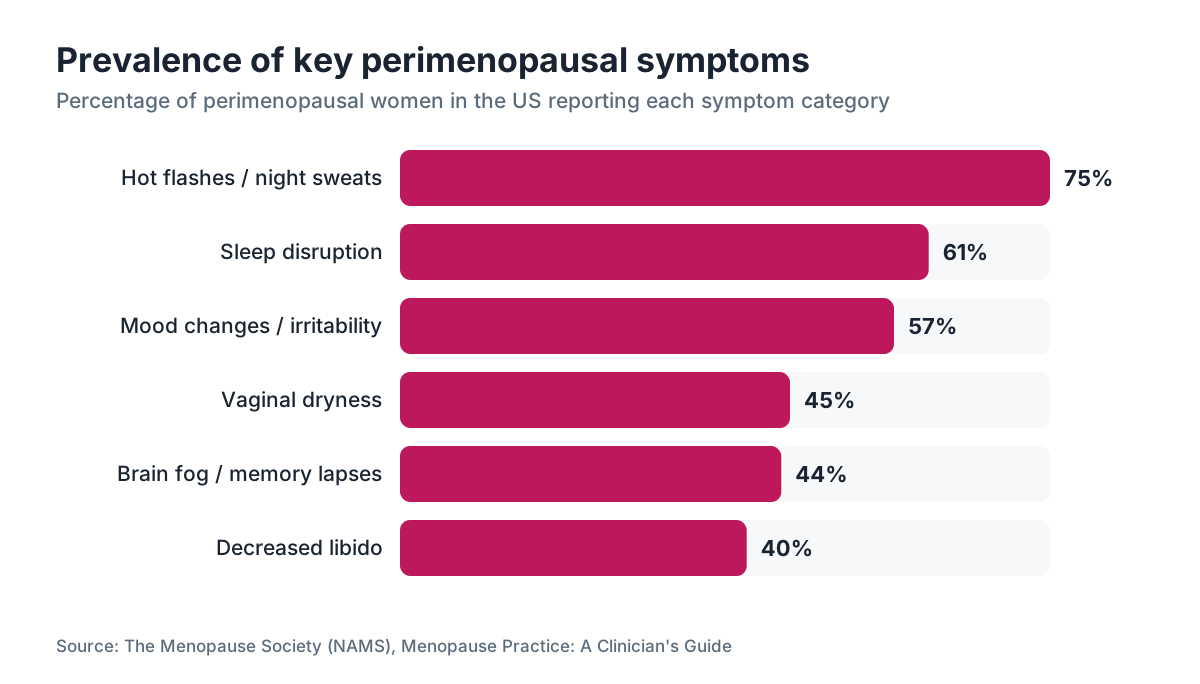
Vasomotor symptoms (hot flashes and night sweats) hit roughly 75 percent of perimenopausal women in the US, though severity varies enormously [2]. They come from estrogen instability acting on the hypothalamic thermoregulatory zone, specifically a group of kisspeptin/NKB/dynorphin (KNDy) neurons that go hyperactive when estrogen signaling turns erratic. The thermoneutral zone narrows, so small temperature shifts trigger a heat-dumping response.
Sleep disruption often shows up before the hot flashes women notice. Progesterone's sleep-promoting effect drops out during anovulatory cycles. Night sweats pull women out of REM and deep sleep. The SWAN study found sleep complaints rose sharply in late perimenopause independent of hot flash status, which points to a direct hormonal hit on sleep architecture [4].
Mood changes are real and underdiagnosed. The stretch of greatest depression risk across a woman's life is perimenopause, not postmenopause. A 2006 analysis in Archives of General Psychiatry (Cohen et al.) found women in the menopausal transition had roughly double the odds of depressive symptoms compared to premenopausal women, even after controlling for prior depression history and life stressors [6]. Estrogen touches serotonin, dopamine, and GABA systems, and the unpredictable swings seem to cause more mood trouble than steady low levels ever do.
Brain fog and memory lapses are among the most upsetting symptoms. Short-term verbal memory, processing speed, and concentration are estrogen-sensitive. Some longitudinal work has found temporary dips in memory scores during perimenopause that partly recover after menopause, once hormones settle at a lower but steadier level.
Irregular bleeding can be alarming. Cycles may shorten to 21 days, stretch to 60 or more, or turn very heavy when anovulatory cycles pile estrogen onto the uterine lining without the progesterone signal that normally triggers shedding. Heavy or unpredictable bleeding always needs other causes ruled out (fibroids, polyps, endometrial hyperplasia) before you chalk it up to perimenopause.
Genitourinary symptoms tend to arrive later in the transition: vaginal dryness, tissue thinning, recurrent UTIs, and changes in sexual response as estrogen withdrawal affects the vulva, vagina, and lower urinary tract.
Other reported symptoms tied to hormone swings include joint pain, heart palpitations (often from estrogen withdrawal sparking adrenergic activity), headaches, and skin changes. Here's the honest caveat: the evidence linking all of these specifically to hormone fluctuation, rather than aging or other conditions, varies a lot in quality.
Why does estrogen fluctuate so much instead of just declining steadily?
This is the question most women never get answered. The steady-decline picture is incomplete.
In early perimenopause, FSH rises and that extra stimulus can actually recruit more follicles, producing estradiol surges that beat premenopausal levels. Daily hormone sampling in the SWAN study showed peak estradiol among perimenopausal women ran higher than premenopausal controls on some cycle days, sometimes past 400 pg/mL, even as average levels started to drop [4]. So you can be in perimenopause and intermittently high on estrogen at the same time.
As the transition rolls on, follicle supply genuinely dwindles, and both the surges and the baseline fall. But not smoothly. Researchers describe ovarian function in the final years of perimenopause as "chaotic," with months of apparent quiet interrupted by surprise ovulations and estrogen surges. That's why women in their late 40s still need contraception if they want to avoid pregnancy, and why a hormone test on any given day tells you only what that day looked like.
The size of the swings, more than the direction, tracks with how bad symptoms get. A 2011 study in Menopause (Randolph et al.) found women with greater estradiol variability, measured as the coefficient of variation across serial samples, reported more vasomotor symptoms and worse sleep than women whose estradiol fell more smoothly [7]. That detail matters. It explains why measuring "estrogen levels" at one time point and calling them normal or low often misses what's really going on.
How is perimenopausal hormone fluctuation diagnosed?
Diagnosis is mostly clinical. The Stages of Reproductive Aging Workshop (STRAW+10) criteria, the international standard for staging the transition, define early perimenopause as cycle length varying by 7 or more days from your usual, and late perimenopause as 60 or more days between periods [8]. These are observable. No lab test needed.
Labs still get ordered, usually to rule out other causes or guide treatment. What's worth knowing:
A single FSH above 40 IU/L, confirmed on a repeat test 6 or more weeks later, meets the clinical definition of menopause if no period has come in 12 months. Inside perimenopause, FSH bounces around, and one high reading confirms very little.
AMH below 0.1 ng/mL lines up with being close to the final period, but the link isn't tight enough to predict timing for any one woman.
Thyroid function (TSH, free T4) should be checked, because hypothyroidism produces overlapping symptoms: irregular cycles, fatigue, weight gain, mood changes. Thyroid disease is more common in midlife women and gets missed all the time.
Estradiol and progesterone drawn on a single day are rarely diagnostic in perimenopause because of how much they move cycle to cycle and week to week. If a provider uses one snapshot estradiol level to tell you "your hormones are fine" or "you're not in perimenopause," that's an incomplete read.
For what a full hormonal workup looks like across the broader transition, the menopause overview covers each test.
What does the hormone fluctuation timeline look like?
The table below summarizes the typical hormonal changes across reproductive stages, drawn from STRAW+10 criteria [8] and Menopause Society clinical guidance [2].
| Stage | Cycle pattern | Estradiol | FSH | Progesterone | Typical symptoms | |---|---|---|---|---|---| | Late reproductive (35-45) | Regular, possibly shortening | Normal to variable | Early rise, still normal | Normal if ovulating | Mild PMS changes, subtle mood shifts | | Early perimenopause | Variable length, > 7-day difference | Surging and crashing | Elevated, variable | Dropping, anovulatory cycles begin | Hot flashes, irregular periods, sleep changes | | Late perimenopause | Cycles > 60 days apart | Declining with surges | Consistently elevated | Very low | Severe vasomotor symptoms, mood shifts, brain fog | | Menopause (12 months no period) | None | Low, < 30 pg/mL | > 40 IU/L | < 1 ng/mL | Genitourinary symptoms, bone loss begins | | Early postmenopause (1-6 years) | None | Stable low | High, stable | Low | Vasomotor symptoms may persist 4-7 years |
One thing this table can't capture: the progression isn't linear for any individual woman. You can slide backward into something that looks like early perimenopause after months of late perimenopause, because the ovaries can flicker back to life. Many women find that the most confusing and maddening part.
What treatments actually help with perimenopausal hormone swings?
The evidence is clearest for menopausal hormone therapy (MHT, also called HRT). For women without contraindications, MHT is the most effective treatment for vasomotor symptoms, with response rates of 80 to 90 percent versus 30 to 40 percent for placebo in randomized trials [2]. It also helps sleep, mood, and genitourinary symptoms. When started within 10 years of menopause or before age 60, the cardiovascular risk picture is generally favorable, an idea called the "timing hypothesis" supported by reanalysis of Women's Health Initiative data and later observational work.
For perimenopausal women specifically, still cycling and not yet postmenopausal, dosing is trickier. Your own hormone output is erratic, so adding hormones on top of that takes a careful hand. Low-dose estrogen with cyclical or continuous progesterone is one route. Others use low-dose combined oral contraceptives, which also cover contraception and can steady cycles. The hormone replacement therapy article covers how the formulations compare.
Progesterone earns extra attention in perimenopause. Oral micronized progesterone (Prometrium) at 100 to 200 mg at bedtime has good evidence for improving sleep, and its body-identical structure avoids some side effects of synthetic progestins. The estrogen patch is often better than oral estrogen for delivery, because transdermal routes skip hepatic first-pass metabolism and don't drive up clotting factors the way oral estrogen can.
Non-hormonal options with real evidence include fezolinetant (Veozah), an FDA-approved neurokinin B receptor antagonist that acts directly on the KNDy neurons driving hot flashes, cleared in May 2023 for moderate to severe vasomotor symptoms in women who can't or won't use hormones [9]. Paroxetine 7.5 mg (Brisdelle) was the only FDA-approved non-hormonal option for hot flashes before fezolinetant. Other SSRIs and SNRIs at low doses have decent evidence for vasomotor and mood symptoms, though they aren't FDA-approved for this use.
Cognitive behavioral therapy (CBT) has randomized trial evidence for reducing how much hot flashes interfere with daily life, even when it doesn't cut the physiological events themselves. The MENOS trials out of the UK showed meaningful quality-of-life gains.
For perimenopausal weight changes, the metabolic picture gets tangled up with the hormonal one. Some providers at telehealth practices like WomenRx assess whether GLP-1 receptor agonists fit alongside hormonal management, since midlife weight gain often reflects both hormonal and metabolic shifts that diet alone won't fix. The semaglutide for weight loss article covers what the evidence shows for midlife women.
A quick word on supplements: black cohosh has modest, inconsistent evidence. Phytoestrogen supplements (isoflavones) have weak evidence at best. DHEA has some data for genitourinary symptoms specifically. None of them replaces the evidence base for MHT or the newer non-hormonal drugs.
Does hormone fluctuation in perimenopause affect bone and heart health?
Yes, and this is where the long-term stakes catch women off guard.
Bone loss speeds up in late perimenopause and early postmenopause. The Bone Health and Osteoporosis Foundation estimates women can lose up to 20 percent of their bone density in the 5 to 7 years after menopause [10]. The mechanism is estrogen withdrawal. Estrogen normally holds back osteoclast activity (bone breakdown), so as estrogen falls, osteoclasts outpace the osteoblasts building bone back up. That process starts in late perimenopause, when estrogen turns chronically erratic, not only after periods stop.
This is why a bone density test (DEXA scan) is worth raising with your provider around the time of menopause, and earlier if you have risk factors (smoking, low body weight, family history, long-term corticosteroid use). The US Preventive Services Task Force recommends screening for all women 65 and older, and earlier for younger postmenopausal women with risk factors [11].
Cardiovascular risk shifts during the transition too. Estrogen's protective effect on lipid profiles, vascular flexibility, and inflammatory markers fades as perimenopausal estrogen turns erratic and eventually drops. LDL cholesterol tends to rise and HDL may fall in late perimenopause, independent of diet. The Menopause Society position statement on hormone therapy states that "for women who are within 10 years of menopause onset or younger than 60 years of age and have no contraindications, the benefits of hormone therapy outweigh the risks" for managing symptoms, and that cardiovascular risk is not raised in this age group with appropriate formulations [2].
Mental health carries long-term weight as well. The higher depression risk during perimenopause that the research documents isn't trivial, and untreated mood disorders in this window can leave lasting marks on quality of life.
Can you still get pregnant with fluctuating perimenopausal hormones?
Yes, and more women get caught off guard by this than you'd expect. Perimenopause does not mean infertility. As long as ovulation still happens, even now and then, pregnancy is possible. Ovulation can occur in cycles that look irregular, even after several months with no period.
The standard guidance is to keep using contraception until 12 consecutive months without a period if you're over 50, or 24 consecutive months if you're under 50, since younger perimenopausal women are more likely to have ovulation resume unexpectedly [2]. Progestin-containing IUDs are a common pick because they provide contraception, cut down heavy irregular bleeding, and deliver progesterone locally to the uterus without moving systemic hormone levels much.
Fertility drops sharply in the early 40s, but "sharply" doesn't mean zero. The unpredictability of perimenopausal ovulation is exactly why contraception still matters even when cycles are all over the place.
For women who want to know where their fertility stands, AMH testing gives a rough read on ovarian reserve, though it won't predict the exact timing of your last ovulation.
What about weight gain during perimenopause, is that hormonal too?
Partly hormonal, partly aging physiology, and the two are hard to pull apart.
Estrogen shapes fat distribution. As estrogen falls and turns erratic in perimenopause, fat storage shifts from the hips and thighs (subcutaneous) toward the abdomen (visceral). Visceral fat carries higher metabolic and cardiovascular risk than subcutaneous fat, and it's more active in ways that feed insulin resistance. So perimenopausal women often notice their body changing shape even when the number on the scale barely moves.
Metabolic rate changes with age too. Lean muscle mass declines from the mid-30s on (sarcopenia), and muscle burns more than fat, so resting energy expenditure drops. Add broken sleep (which raises ghrelin and lowers leptin, cranking up appetite) plus the stress of unpredictable symptoms, and perimenopausal weight gain has too many causes to blame just one.
Hormone therapy can partly blunt the abdominal fat shift. Several randomized trials found MHT preserved more lean mass and reduced visceral fat accumulation versus placebo in postmenopausal women, though the effects are modest.
For women with significant metabolic weight gain, GLP-1 receptor agonists like semaglutide or tirzepatide have entered the conversation more often. The SURMOUNT-1 trial found tirzepatide produced a 20.9 percent mean body weight reduction in adults with obesity over 72 weeks [12]. The semaglutide vs tirzepatide comparison lays out how the two differ in mechanism and results.
When should you see a doctor about perimenopausal hormone changes?
Not everyone with perimenopausal symptoms needs medical treatment, but there are moments when waiting is a mistake.
See a provider sooner if you're under 45 with irregular cycles or symptoms (this counts as early menopause, or premature ovarian insufficiency if before 40, which carries its own health implications and needs a workup [3]); if you're bleeding very heavily (soaking a pad or tampon every hour for several hours); if mood changes are bad enough to hurt your work or relationships; if your sleep disruption is chronic and not letting up; or if you have bone risk factors and haven't talked about screening.
Here's the honest reality: perimenopause is badly undertreated. Surveys from the Menopause Society have found a large share of women with significant vasomotor symptoms had never discussed treatment with a provider, and many didn't know effective non-hormonal options exist. Part of that is a knowledge gap on both sides of the exam room.
Telehealth has moved the needle on access. Platforms including WomenRx let women get a hormonal evaluation, talk through options, and, when appropriate, get prescriptions for MHT or non-hormonal alternatives without the months-long wait that often comes with in-person menopause specialists. The trick is finding providers who actually keep up with the evidence, since menopause training in US medical education has been thin for years.
The Menopause Society (formerly NAMS) keeps a "find a provider" database of clinicians who've completed menopause specialist certification, a good starting point if you'd rather see someone in person.
Frequently asked questions
What are the first signs that hormone fluctuations are starting?
The earliest signs are usually subtle cycle changes: periods arriving a few days earlier than usual (cycle shortening), heavier or lighter flow than before, and mild new PMS-like symptoms like breast tenderness or mood shifts in the week before your period. Hot flashes and night sweats often arrive later, once cycles start skipping. Some women notice sleep changes or new anxiety before any obvious cycle irregularity.
Can hormone fluctuations in perimenopause cause anxiety and panic attacks?
Yes. Erratic estrogen affects serotonin and norepinephrine signaling, and sudden estrogen drops can trigger autonomic arousal that mimics anxiety or panic. Many women who develop new anxiety or panic attacks in their 40s never get asked about their cycle status. The link is real enough that Menopause Society clinical guidance includes mood and anxiety symptoms in the perimenopausal picture. If SSRIs are on the table for new anxiety in a woman in her 40s, perimenopause belongs in that conversation.
How long do hormone fluctuations last in perimenopause?
Perimenopause usually lasts 4 to 8 years, with some women running symptoms up to 10 years before reaching menopause. After menopause (12 consecutive months without a period), hormone levels settle at a lower baseline, though vasomotor symptoms can persist for an average of 7.4 years after the final period per SWAN study data. The most intense fluctuation stretch is usually the two to three years right before the final period.
Is there a blood test to confirm hormone fluctuations in perimenopause?
There's no single test that confirms perimenopause with precision. A single FSH level is unreliable because FSH swings from cycle to cycle. Serial testing over several months gives a better picture. AMH (anti-Müllerian hormone) can flag diminishing ovarian reserve. STRAW+10 criteria, the international staging standard, lean on cycle irregularity patterns rather than labs to define perimenopause. A good clinical history plus ruling out thyroid disease is often more useful than a single hormone panel.
Why are my hot flashes worse some months than others?
Because your estrogen isn't falling in a straight line. Months with bigger, more erratic swings tend to produce worse hot flashes than months with steadier (even if lower) levels. Triggers like alcohol, caffeine, stress, poor sleep, and heat stack on top of your baseline hormonal instability. Severity can shift week to week within the same month, which fools women into thinking they're improving, then backsliding.
Can perimenopause cause heart palpitations?
Yes. Sudden estrogen drops trigger adrenergic activity (the fight-or-flight system), which can cause a racing heart, skipped beats, or fluttering. These are often benign but deserve evaluation to rule out arrhythmia, thyroid disease, or anemia, especially if they're frequent, come with chest pain or shortness of breath, or occur in a woman with existing heart risk factors. Most perimenopausal palpitations settle or improve as hormones stabilize.
Does HRT stop hormone fluctuations or just mask the symptoms?
Both, in a sense. MHT gives a steady outside supply of estrogen (and usually progesterone), which shrinks the amplitude of your body's own swings by feeding the hypothalamus and pituitary a consistent signal. It doesn't stop your ovaries from doing their thing, but it lays down a hormonal floor that prevents the crash-driven symptoms. Most women see symptoms improve within 4 to 12 weeks of a well-dosed regimen.
What's the difference between perimenopause and menopause?
Perimenopause is the transition: cycles are irregular, hormones are fluctuating, symptoms are active. Menopause is a single point in time, defined as 12 consecutive months without a period. Everything after that is postmenopause. So when someone says they're "going through menopause," they almost always mean perimenopause. The distinction matters clinically, because treatment decisions, contraception needs, and expected timelines differ at each stage.
Can fluctuating hormones in perimenopause affect my thyroid?
Perimenopause doesn't directly cause thyroid disease, but the two share many symptoms and often show up in the same age range. Estrogen changes can affect thyroid-binding globulin levels, which shifts how thyroid hormone reads on a blood test. Women with Hashimoto's thyroiditis (autoimmune hypothyroidism) may find their thyroid harder to stabilize during perimenopause. Anyone with classic perimenopausal symptoms should have TSH tested to rule out thyroid dysfunction as a contributor.
Are the mood swings in perimenopause just psychological or truly hormonal?
Truly hormonal, with a well-described neurobiological mechanism. Estrogen modulates serotonin receptor density, dopamine turnover, and GABA-A receptor sensitivity. Erratic estrogen swings, especially rapid drops, destabilize these systems and produce irritability, low mood, and mood lability. A 2006 Archives of General Psychiatry study (Cohen et al.) found perimenopausal women had roughly double the odds of depressive symptoms versus premenopausal women, even after controlling for prior mental health history and life circumstances. This is biology, more than stress.
Do perimenopausal hormone fluctuations affect libido?
Yes, through several pathways. Declining progesterone, erratic estrogen affecting vaginal tissue and lubrication, broken sleep, mood changes, and testosterone shifts all cut into libido during perimenopause. Testosterone, present in smaller amounts than estrogen, also declines through the transition and is strongly tied to sexual desire. Some providers use low-dose testosterone off-label for this, though no testosterone product is currently FDA-approved specifically for women.
What lifestyle changes actually help with fluctuating perimenopausal hormones?
Resistance training two to three times a week preserves muscle and improves insulin sensitivity, both relevant to the metabolic shifts perimenopause brings. Alcohol clearly worsens hot flashes and wrecks sleep architecture, so cutting back is one of the higher-yield moves. A consistent sleep schedule steadies the circadian cortisol pattern that interacts with estrogen. Avoiding rapid weight swings matters because fat tissue converts androgens to estrogen and adds to the variability. None of this replaces medical treatment when symptoms are severe.
Can perimenopausal hormone fluctuations cause weight gain even with no diet changes?
Yes. Estrogen swings shift fat storage from subcutaneous (hips and thighs) to visceral (abdomen) even without eating more. Anovulatory cycles lower progesterone, which affects fluid retention and metabolism. Broken sleep from night sweats raises ghrelin and lowers leptin, so appetite climbs. Muscle mass falling from the mid-30s on lowers resting metabolic rate. The result is body composition change and often modest weight gain that shrugs off the dietary approaches that worked in your 30s.
Sources
- Endocrine Society – Menopause overview
- The Menopause Society (NAMS) – Menopause Practice: A Clinician's Guide
- NIH National Institute on Aging – Menopause
- Study of Women's Health Across the Nation (SWAN) – University of Michigan
- National Institutes of Health – PubMed: Progesterone and the GABA-A receptor complex
- Archives of General Psychiatry – Cohen et al., 2006: Risk for new onset of depression during the menopausal transition
- Menopause journal – Randolph et al., 2011: Associations of hormone variability and vasomotor symptoms
- STRAW+10 Staging System – Harlow et al., Menopause 2012
- FDA – Fezolinetant (Veozah) approval, 2023
- Bone Health and Osteoporosis Foundation (formerly NOF) – Osteoporosis fast facts
- US Preventive Services Task Force – Osteoporosis screening recommendation
- New England Journal of Medicine – SURMOUNT-1 trial (Jastreboff et al., 2022): Tirzepatide once weekly for the treatment of obesity