FDA semaglutide drug shortage: what actually happened and what's next
TL;DR: The FDA put semaglutide (Ozempic, Wegovy) on its official shortage list in 2022. In February 2025 it cleared Ozempic, and in May 2025 it declared Wegovy resolved too. That flipped a legal switch: compounding pharmacies had to stop making unapproved copies. Brand-name supply is broadly available now. Cost, not availability, is the wall most women hit without insurance.
What is the FDA semaglutide drug shortage and when did it start?
The FDA added semaglutide to its official drug shortage database in 2022. Ozempic (semaglutide 0.5 mg, 1 mg, and 2 mg injection) got flagged first, then Wegovy (semaglutide 0.25 mg through 2.4 mg, the higher-dose version approved for chronic weight management). The listing fell under Section 506C of the Federal Food, Drug, and Cosmetic Act, which makes manufacturers tell the FDA about any interruption likely to cause a meaningful supply disruption. [11]
Demand broke the system. Novo Nordisk makes both products, and it could not produce drug fast enough to match the prescription surge that followed Wegovy's 2021 approval and Ozempic's explosion in off-label weight-loss use. Novo Nordisk said as much publicly and poured billions into new manufacturing at sites in Denmark and the United States. Scaling a sterile injectable takes years. It does not happen in a quarter.
The gap had real clinical fallout. People losing weight or controlling type 2 diabetes hit interruptions mid-titration, which can blunt how well the drug works. Doctors fought to keep patients on stable doses. That empty shelf is exactly what opened the legal door for compounding pharmacies to walk through.
Why did the shortage allow compounded semaglutide to be sold legally?
Federal law has a specific carve-out. Under Sections 503A and 503B of the FD&C Act, compounding pharmacies generally cannot make copies of commercially available FDA-approved drugs. When a drug lands on the FDA's official shortage list, that ban lifts temporarily. [11] Both traditional 503A pharmacies (filling individual prescriptions) and larger 503B outsourcing facilities (making batches) could legally compound semaglutide because the branded versions weren't there.
That exemption built an enormous market. Compounded semaglutide spread through telehealth platforms at prices far under Wegovy's roughly $1,300-per-month list price. Many products were sold as semaglutide salts (semaglutide sodium, semaglutide acetate) instead of the base form in Ozempic and Wegovy, a difference the FDA later flagged by name. [2]
For women weighing options, including through telehealth services like WomenRx, the compounded route was often the only affordable way in when the brand was gone or out of reach. But that legal footing was always tied to shortage status. When the shortage ended, so did the legal basis for compounding.
See our full explainer on compounded semaglutide for how those formulations differ from the branded drug.
When did the FDA declare the semaglutide shortage resolved?
The FDA cleared Ozempic from its shortage database in February 2025 and announced in May 2025 that Wegovy was no longer in shortage. [3] That May determination for Wegovy started a formal compliance clock for compounding pharmacies.
For 503B outsourcing facilities (the large commercial compounders), the FDA set a stop date of May 22, 2025, to end production and distribution of compounded semaglutide. For 503A pharmacies filling individual prescriptions, a wind-down period ran roughly 90 days from the resolution determination, putting the hard stop in late summer 2025. [2]
The FDA was blunt about enforcement. Compounders who kept making semaglutide past those dates would be operating outside the exemption and open to regulatory action. The agency said it "intends to take action against firms that continue to compound semaglutide" after the applicable deadlines. [2]
This is a real shift. If a compounding pharmacy was filling your prescription, it was legally required to stop taking new orders and wind down existing ones inside those windows.
What does the end of the shortage mean for women currently using compounded semaglutide?
It means your compounded supply has a hard stop date that has already passed or is close. What you do next hangs on three things: whether your insurance covers Wegovy, whether you qualify for Novo Nordisk's assistance program, and whether your prescriber can push prior authorization through your plan.
Wegovy coverage is a patchwork. Plenty of commercial plans still exclude it or demand step therapy (proof you tried other things first). Medicare Part D was long barred from covering weight-loss drugs, and as of mid-2025 broad Medicare coverage for the weight-loss indication still isn't settled. Medicaid varies state to state. So "the brand is available" does not mean "you can afford the brand."
Novo Nordisk's savings program (NovoCare) has offered eligible commercially insured patients Wegovy at sharply reduced cost for a trial window, with income limits and eligibility rules attached. People without commercial insurance have fewer formal paths. [4]
For women who ran compounded semaglutide inside a broader hormone and metabolic plan during perimenopause or menopause, this transition needs a real conversation with a prescriber who sees both sides. Weight changes during menopause aren't simple, and losing a medication that was working hits you metabolically and psychologically at once.
Is compounded semaglutide still available anywhere legally after the shortage ended?
No, not in the broad way it was before. The legal exemption that let 503A and 503B compounders copy semaglutide died with the shortage designation. Any pharmacy still selling compounded semaglutide past the FDA's stated deadlines is operating outside compliance. [2]
There's one narrow exception. Section 503A lets a pharmacy compound a drug that is "essentially a copy" of a commercially available drug only when the prescribing practitioner decides the compounded version is "necessary" for a specific patient, say a documented allergy to an inactive ingredient in the branded product. That's a clinical call for one patient, not a loophole for everyone. [11]
Some telehealth companies moved fast to tirzepatide (Mounjaro, Zepbound), which stayed on the FDA shortage list longer and kept its compounding eligibility. Others pivoted patients to oral semaglutide (Rybelsus) or the branded injectables. A site still advertising compounded semaglutide with no shortage and no patient-specific justification after mid-2025 is a red flag. Treat it as one.
For a side-by-side on semaglutide and tirzepatide, including which stays more accessible through compounding, see our semaglutide vs tirzepatide breakdown.
What were the FDA's specific safety concerns about compounded semaglutide?
Beyond the deadline, the FDA raised direct safety concerns about compounded semaglutide during the shortage. The agency issued safety communications in 2023 and 2024 about adverse events tied to compounded versions.
The worries clustered around three things. Some compounders used semaglutide salts (semaglutide acetate, semaglutide sodium) rather than the base molecule. The FDA said flatly that "semaglutide salts have not been shown to be safe and effective" and are not the same as the active ingredient in approved products. [2] Dosing errors were the second problem: compounded vials often came in multi-dose formats with self-draw instructions, unlike the single-dose auto-injector pens for Ozempic and Wegovy, and the FDA got reports of patients dosing far higher than intended. Third, some compounders threw in extras (B12, NAD+, l-carnitine) with no evidence the combinations were safe.
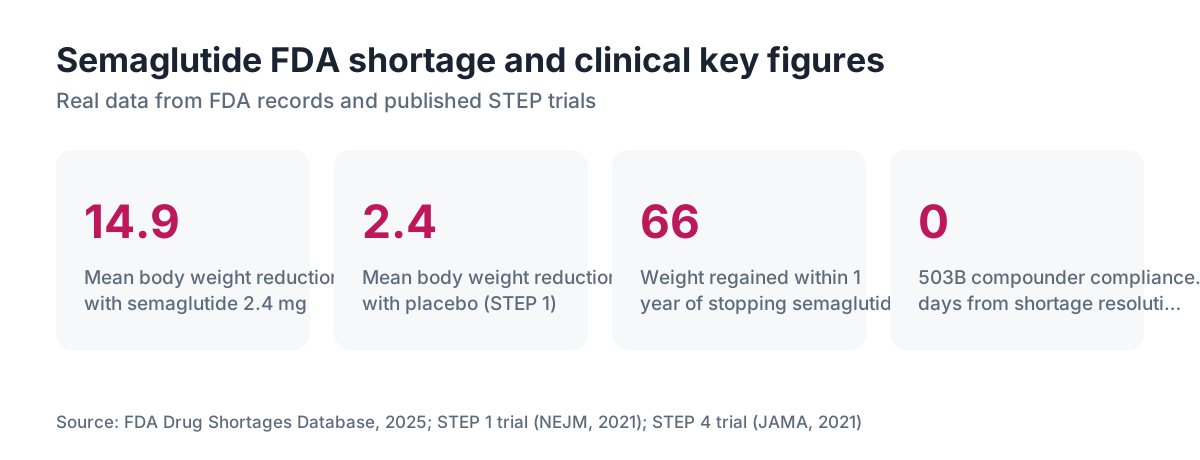
The STEP trial program that built semaglutide's clinical record tested one specific formulation, at specific doses, under controlled conditions. STEP 1 showed a mean 14.9% body weight reduction with Wegovy 2.4 mg weekly versus 2.4% with placebo over 68 weeks. [5] That evidence does not automatically carry over to a differently formulated compounded product.
This isn't a reason to write off semaglutide. The mechanism and the efficacy data are solid. It's a reason to know exactly which product is going into your body.
How does the FDA shortage list actually work, and how can you check current status?
The FDA keeps a public, searchable drug shortage database on its website. A drug shows up there after the manufacturer reports a shortage and the FDA assesses supply. The list updates regularly, not always in real time, but it's the authoritative public record. [6]
A shortage can sit at the manufacturer level (Novo Nordisk can't make enough) or at the distributor and pharmacy level (the drug exists but isn't reaching patients). Both count. The database separates "current shortages" from "resolved shortages," and both are searchable.
Check status at https://www.fda.gov/drugs and open the drug shortages database from the main drugs page. As of this writing, semaglutide sits in the resolved category. [6]
Do this before you fill any semaglutide prescription through any channel. If the shortage reopens (a manufacturing failure, a new approved formulation in tight supply), the compounding exemption can legally switch back on. That hasn't happened as of mid-2025. Status can still change.
How does semaglutide fit into weight management for women in perimenopause or menopause?
This deserves attention because women 35 to 65 are the biggest group taking semaglutide for weight loss, and the hormonal context changes everything.
Estrogen decline during perimenopause and menopause pushes fat from the hips and thighs toward visceral (abdominal) fat, which carries higher metabolic and cardiovascular risk. Insulin resistance usually worsens. Appetite hormones like leptin and ghrelin shift too. So weight gain here isn't a plain calorie equation, and tools that hit the hormonal drivers of hunger (which is what GLP-1 receptor agonists do) have a rational place. The North American Menopause Society addresses this link between estrogen decline, visceral fat, and weight management directly. [12]
Semaglutide mimics GLP-1, a gut hormone that slows gastric emptying, boosts insulin release in response to food, and acts on the hypothalamus to cut appetite. None of that is specific to menopause, but it targets the appetite dysregulation that gets worse across the transition.
The interaction between semaglutide and hormone replacement therapy is understudied. No large randomized trial has looked at combined HRT plus semaglutide outcomes in perimenopausal women. What we have is observational and mechanistic: hormone replacement therapy with estrogen tends to preserve lean mass and slow visceral fat redistribution, which complements rather than repeats what semaglutide does. A prescriber who understands both is worth finding.
One real concern with semaglutide weight loss at any age is loss of lean mass and bone density. Weight-loss trials show a meaningful share of lost weight is lean tissue, in the range typical for caloric-restriction weight loss but worth watching, especially in women already at higher osteoporosis risk after menopause. A bone density test is worth raising with your provider if you're losing significant weight on a GLP-1. Endocrine Society obesity guidelines cover patient selection and monitoring for this class of drug. [10]
For women using semaglutide alongside or instead of hormonal support, platforms like WomenRx that pair GLP-1 prescribing with hormone literacy can help. Any prescriber you work with should be willing to look at the whole picture, more than the scale.
What is the current FDA-approved status of semaglutide products?
Here's where the approvals stand as of mid-2025:
| Product | Manufacturer | Approved Indication | Dose Range | Approved Year | |---|---|---|---|---| | Ozempic (semaglutide injection) | Novo Nordisk | Type 2 diabetes (also cardiovascular risk reduction) | 0.5 mg, 1 mg, 2 mg weekly | 2017 [7] | | Wegovy (semaglutide injection) | Novo Nordisk | Chronic weight management (BMI 30+, or 27+ with comorbidity) | 0.25 mg to 2.4 mg weekly | 2021 [8] | | Rybelsus (oral semaglutide) | Novo Nordisk | Type 2 diabetes | 3 mg, 7 mg, 14 mg daily | 2019 [7] |
Wegovy picked up an extra FDA approval in March 2024 for cutting the risk of serious cardiovascular events (heart attack, stroke, cardiovascular death) in adults with established cardiovascular disease plus obesity or overweight, based on the SELECT trial. [8] That indication matters because it strengthens the case for insurance coverage and makes Wegovy's value clearer than aesthetics alone.
None of these products are approved for use in pregnancy. All carry a boxed warning about thyroid C-cell tumors based on animal data. Human relevance is uncertain, but the warning stands. [7]
What should you do now if your compounded semaglutide supply has been cut off?
Start with your insurance. Pull up your plan's formulary (the list of covered drugs) and search Wegovy and Ozempic. If Wegovy is listed, check for prior authorization and step-therapy requirements. Your prescriber's office can usually kick off prior authorization with a letter of medical necessity.
If you have commercial insurance and Wegovy is covered or coverable, the NovoCare savings program has historically cut out-of-pocket costs a lot for eligible patients. Check NovoCare.com directly. Eligibility rules change, and I won't quote a copay number that might be stale.
No commercial insurance, or a plan that flatly excludes weight-loss drugs? The options get thinner. Rybelsus (oral semaglutide) is sometimes covered under diabetes formularies where Wegovy isn't, though it's approved only for type 2 diabetes. Tirzepatide (Zepbound) may still have compounding availability given its separate shortage history. Check the FDA shortage list for current status.
For semaglutide for weight loss context, including how to approach the prior authorization conversation, see our dedicated guide.
One more thing. If you were making real progress on compounded semaglutide and feel yourself sliding backward as you transition, that's a clinical problem, not a character flaw. Tell your prescriber. Bridging strategies exist, and the medication is still out there. Reaching it is just harder now.
What happens to the FDA shortage list if manufacturing disruptions occur again?
Shortage status runs both directions. The FDA can re-add semaglutide if Novo Nordisk hits a new manufacturing failure, if demand outruns supply again (plausible as cardiovascular and diabetes indications keep widening the eligible pool), or if a new formulation gets approved and immediately runs tight.
If semaglutide gets re-listed, the compounding exemption switches back on. That's how the statute works. [11] But the FDA has signaled it views the compounding industry's response to the GLP-1 shortage as partly problematic (the salt formulations, the dosing errors) and has floated stricter guidance on what counts as an acceptable compounded version even during a shortage.
Here's the practical read for the next year or two: don't build a long-term plan that leans on compounding staying available. Treat branded semaglutide as your baseline goal and use whatever coverage or assistance path fits you. If compounding comes back, that's a bonus, not a strategy.
The FDA posts shortage guidance and updates through its Drug Shortages staff and the Federal Register. Watching those channels is the most reliable way to catch a status change early. [6]
Frequently asked questions
Is semaglutide still in shortage in 2025?
No. The FDA removed Ozempic from the drug shortage list in February 2025 and declared Wegovy no longer in shortage in May 2025. Compounding pharmacies lost their legal exemption to make unapproved copies once those determinations landed. Brand-name semaglutide is generally available now, though insurance coverage and cost stay barriers for many patients.
Can I still get compounded semaglutide after the shortage ended?
Legally, no, not through 503B outsourcing facilities after May 22, 2025, and not through 503A pharmacies after the roughly 90-day wind-down following resolution. The only narrow legal path left is a prescriber documenting a patient-specific clinical need, such as an allergy to an inactive ingredient in the branded product, for an individual compounded formulation.
Why did the FDA allow compounded semaglutide in the first place?
Federal law (Sections 503A and 503B of the FD&C Act) lets compounding pharmacies copy drugs on the FDA's official shortage list, because patients need access when the branded version isn't there. Semaglutide sat on that list from 2022 until early-to-mid 2025. Once the shortage resolved, the legal basis for compounding expired.
What is semaglutide acetate and why did the FDA warn about it?
Semaglutide acetate and semaglutide sodium are salt forms used by many compounding pharmacies. The FDA said these salts "have not been shown to be safe and effective" and are not the same active ingredient as in approved products. They aren't bioequivalence-tested versions of Ozempic or Wegovy, so efficacy and safety claims from the STEP trials don't directly apply.
How much does Wegovy cost without insurance in 2025?
Wegovy's list price has run roughly $1,300 to $1,350 per month, though the real number varies by pharmacy and any discounts. Novo Nordisk's NovoCare savings program has cut costs meaningfully for eligible commercially insured patients. People without commercial insurance have far fewer discount options and usually pay closer to list price unless they qualify for patient assistance.
Does Medicare cover Wegovy or semaglutide for weight loss?
As of mid-2025, Medicare Part D coverage for Wegovy specifically for weight management stays limited and inconsistent. The SELECT trial's cardiovascular data strengthened the case for coverage, and CMS has explored expanded coverage for obesity drugs, but broad Medicare coverage for the weight-loss indication wasn't established as of mid-2025. Check Medicare.gov for current Part D formulary guidance.
What are the FDA-approved alternatives to semaglutide for weight loss?
Approved options include tirzepatide (Zepbound, a dual GLP-1/GIP agonist), liraglutide (Saxenda, daily injection), naltrexone-bupropion (Contrave), phentermine-topiramate (Qsymia), and orlistat (Alli/Xenical). Tirzepatide showed slightly greater weight loss than semaglutide in head-to-head trial data and may still have compounding availability due to its own shortage history.
Is semaglutide safe for women in perimenopause or menopause?
No large randomized trial has studied semaglutide specifically in perimenopausal or menopausal women as a defined group. The STEP trials included women across age ranges, and subgroup data supports efficacy. The main concerns specific to this group are lean mass and bone density loss during weight loss, already elevated risks after menopause. A prescriber who understands both GLP-1 pharmacology and hormonal health matters here.
Can semaglutide and hormone replacement therapy be taken together?
There's no established contraindication between semaglutide and HRT (estrogen, progesterone). No large trial has formally studied the combination, but the mechanisms complement rather than overlap. Estrogen-based HRT tends to preserve lean mass and slow visceral fat redistribution, which addresses some body composition concerns that come with GLP-1-driven weight loss. Discuss both with one provider who can see the full picture.
What did the STEP trials show about semaglutide for weight loss?
STEP 1 (2021, New England Journal of Medicine) showed adults on semaglutide 2.4 mg weekly lost a mean 14.9% of body weight versus 2.4% with placebo over 68 weeks. STEP 4 showed people who stopped semaglutide regained roughly two-thirds of the lost weight within a year, which confirms the drug needs ongoing use to hold its effect.
How do I check if a drug is currently on the FDA shortage list?
Go to the FDA's drug shortages database through the main drugs page at fda.gov. You can search by drug name and see current and resolved shortage status. The database updates regularly and is the authoritative public record. Semaglutide shows as resolved as of mid-2025, but status can change if new supply disruptions hit.
What should I tell my doctor if I was using compounded semaglutide and my supply stopped?
Be direct. Tell your doctor which dose you were on, how long you took it, how much weight you lost, and that your source shut down. Ask about prior authorization for Wegovy through your insurance, whether you qualify for manufacturer savings programs, and whether tirzepatide fits given its current coverage. Bring your last month's supply details if you have them.
Does the FDA shortage resolution apply to oral semaglutide (Rybelsus) too?
Rybelsus (oral semaglutide for type 2 diabetes) had its own separate shortage status from Ozempic and Wegovy. Check the FDA shortage database directly for current Rybelsus status. Rybelsus is approved only for type 2 diabetes, not weight management, so it isn't a direct substitute for Wegovy even if it becomes easier to get.
Are there any safety differences between compounded semaglutide and Wegovy?
Compounded versions using semaglutide salts (acetate, sodium) haven't been tested for bioequivalence with branded semaglutide. Dosing errors were reported to the FDA with multi-dose compounded vials. Some formulations added ingredients (B12, NAD+) with no evidence supporting the combinations. The branded product has a defined, tested formulation. That doesn't make compounded semaglutide categorically unsafe, but the evidence base is thinner.
Sources
- FDA safety communications on compounded semaglutide (2023, 2024)
- FDA Drug Shortages Database
- Novo Nordisk NovoCare Patient Assistance
- Wilding JPH et al., STEP 1 trial, New England Journal of Medicine, 2021
- FDA Drug Shortages Staff and Database
- FDA, Ozempic and Rybelsus prescribing information
- FDA, Wegovy approval and SELECT trial cardiovascular indication, 2024
- Rubino DM et al., STEP 4 trial, JAMA, 2021
- Endocrine Society, Obesity Pharmacotherapy Guidelines
- FDA, Section 506C of the Federal Food, Drug, and Cosmetic Act
- North American Menopause Society (NAMS), Menopause and Obesity Position Statement