Estrogen patch HRT shortage: what's causing it and what to do now
TL;DR: Several estrogen patch brands, including Climara, Vivelle-Dot, and generics, have cycled on and off the FDA drug shortage list since 2022. The causes: a tiny number of specialized manufacturing plants, raw-material bottlenecks overseas, and a demand surge after guidelines swung back toward HRT. If your pharmacy is out, estradiol gels, sprays, compounded patches, and oral tablets are all clinically reasonable substitutes.
Which estrogen patches are actually in shortage right now?
Estradiol transdermal patches have landed on the FDA's real-time drug shortage database repeatedly since 2022. As of mid-2025, the affected products have included generic matrix patches in the 0.025 mg/day, 0.05 mg/day, and 0.1 mg/day strengths from several manufacturers, plus branded Climara (Bayer) and Vivelle-Dot (Sandoz/Noven) at various points [1]. The FDA lists status as "currently in shortage," "resolved," or "discontinued" for each strength and manufacturer separately, so the map changes month to month.
The shortage is patchy, not total. A 0.05 mg/day patch from one company might be missing while the identical dose from another sits on the shelf. Your pharmacist can see wholesaler inventory in real time and is your best first call, full stop. Plenty of women find out their usual brand is gone but a therapeutic equivalent ships the same day.
Branded products carry no immunity here. Climara went through a documented shortage stretch, and Vivelle-Dot has had wholesaler allocation limits even when the FDA never formally listed it. The generic market looks like it adds supply redundancy on paper. But when one raw-material supplier feeds several generic makers, a single upstream failure hits all of them at once.
Why is there a shortage of estrogen patches?
There is no single villain. The estrogen patch shortage is four separate pressures that stacked on top of each other over roughly a decade.
Start with manufacturing concentration. Making a matrix patch that pushes a precise microgram-per-hour dose through skin takes specialized coating equipment, pharmaceutical-grade adhesive chemistry, and tight process controls. Very few plants worldwide can do it at commercial scale. When one has a quality problem, goes down for maintenance, or catches an FDA warning letter, shifting production elsewhere takes months or years because regulators have to inspect and approve any change [2].
Next, raw-material fragility. Estradiol itself is synthesized from plant sterol precursors, mostly diosgenin from wild yam or stigmasterol from soy. The supply chain for pharmaceutical-grade sterols runs through a handful of facilities in China and India. A factory closure or an export-control change there hits every downstream estradiol product at the same moment.
Third, demand jumped. The 2002 Women's Health Initiative results scared millions of women and their doctors off HRT for more than a decade. Then in 2017, a reanalysis by Manson and colleagues in JAMA concluded that absolute risks had been overstated for younger menopausal women and that transdermal estrogen carried a different risk profile than oral conjugated equine estrogen [3]. Prescribing rebounded. The North American Menopause Society updated its guidelines to support starting HRT in symptomatic women within 10 years of menopause onset or under age 60. More prescriptions against flat manufacturing capacity equals shortage.
Fourth, the COVID-era supply shock hit drug manufacturing hard from 2020 through 2022 and exposed how thin the buffers were. Some plants never got back to their pre-2020 throughput.
How long has the estrogen patch shortage been going on?
The current wave dates most clearly to 2022, when the FDA started logging multiple estradiol transdermal products in its shortage database. But pharmacists in high-prescribing regions reported allocation trouble as early as 2019 and 2020, before any of it was formally acknowledged.
The FDA's estradiol transdermal entries have been updated over and over, with some spanning more than 18 months from the first shortage declaration to resolution [1]. That is normal for a complex manufactured product. It is also a lot longer than most patients expect when their refill just gets declined at the counter.
Resolution usually means partial resolution. Enough supply returns for the FDA to pull a product off the official list, and pharmacists in some regions keep seeing wholesaler allocation limits for months after that.
What does the FDA actually say about this shortage?
The FDA's Center for Drug Evaluation and Research tracks shortages under 21 U.S.C. § 356C, which requires manufacturers to notify the agency at least six months before a permanent discontinuation, or "as soon as practicable" for an unexpected interruption in production [4]. The FDA publishes the reason for each shortage when it can pin one down.
For estradiol transdermal products, the agency has cited "manufacturing delays" and "increased demand" as contributing factors, though it does not always name the specific manufacturer having the problem, citing confidentiality rules.
The FDA does hold some tools. It can expedite inspections of alternative suppliers, use enforcement discretion to let a foreign facility not yet approved for the US market ship temporarily, and work with manufacturers on releasing lots that would otherwise be held. Whether any of that moves fast enough to help a woman who needs her patch this week is a separate question. The honest answer is usually no. Most shortage interventions run on a timeline measured in months.
The FDA asks patients and providers to report shortages through MedWatch, and it lists manufacturer contact information on its shortage pages so pharmacists can flag supply problems directly [1].
What are the real alternatives if your estrogen patch is out of stock?
If you can't get your estradiol patch filled, you have several real options, and none of them means going without estrogen.
Transdermal gels and sprays are the closest match. EstroGel (estradiol gel 0.06%), Divigel (estradiol gel 0.1%), and Evamist (estradiol transdermal spray) all push estradiol through the skin and hit serum levels similar to patches at equivalent doses. They are not caught in the same shortage because they are made differently, in different plants. Your prescriber can write a new script the same day [5].
Oral estradiol is another route. Tablets (Estrace and many generics) are cheap and everywhere. The tradeoff is first-pass liver metabolism, which produces higher estrone levels and slightly bigger effects on clotting factors and triglycerides than transdermal delivery. For most healthy women under 60 with no personal history of clot or stroke, oral estradiol still sits at very low absolute risk. NAMS treats both oral and transdermal as appropriate for most women [6].
Compounded estradiol patches from a 503A pharmacy are a third path. A licensed compounding pharmacy can make patient-specific patches across a range of doses. These are not FDA-approved products, so they lack the same manufacturing oversight, but they are legal when prescribed for a specific patient with a real clinical need. If you go this way, pick a pharmacy that follows USP Chapter 795 and 800 standards.
On a telehealth service like WomenRx, your provider can usually switch you to a gel, spray, or tablet the same day by message, without a new appointment, and check current pharmacy stock in your area before sending it.
What I would actually do: call two or three independent pharmacies before you switch formulations at all. Independents often pull from different wholesalers and may have your exact product when the big chains don't. If that dead-ends, ask your prescriber about estradiol gel. It is the path of least disruption.
Is compounded estradiol a safe option during the shortage?
Compounded estradiol is not the same thing as FDA-approved estradiol, and that gap matters. The FDA does not review compounded products for safety, potency, or quality before they reach you. Compounding is legal under 21 U.S.C. § 353b for 503A pharmacies filling patient-specific prescriptions, and under stricter oversight for 503B outsourcing facilities that make larger batches [7].
The Endocrine Society's 2022 clinical practice guideline advises against compounded hormones as first-line therapy when FDA-approved products are available, specifically because quality-control variability introduces dosing uncertainty [8]. That guidance assumes normal supply. During an active shortage, when FDA-approved patches genuinely can't be had, compounding becomes a reasonable bridge rather than a preference.
What actually wobbles in compounded products is potency consistency. A 2012 study in Menopause found considerable potency variation across tested compounded hormone products. If you use a compounded patch or cream, track your symptoms and ask for a serum estradiol level 4 to 6 weeks after starting [11].
For a woman stable on a specific patch dose for years who suddenly can't fill it, a short course of compounded estradiol at an equivalent dose beats going without and watching the hot flashes, broken sleep, and vaginal dryness come roaring back.
Will switching delivery methods affect how well your HRT works?
In most cases, moving from a patch to a gel or spray produces nearly identical clinical outcomes, because the pharmacology is the same. You're still delivering estradiol through skin, still skipping first-pass metabolism, still landing similar serum estradiol levels when the dose is matched right.
Dose equivalence is the fiddly part. There's no clean linear conversion table because skin absorption varies person to person. A rough starting point: a 0.05 mg/day patch produces roughly the same mean serum estradiol as EstroGel around 1.25 g/day, or two pumps of Evamist [5]. Those are approximations. Start at the estimated equivalent dose, then reassess symptoms and, if needed, check a serum estradiol level at 4 to 6 weeks [11].
Switching to oral estradiol needs more thought if you have any of these: personal or family history of deep vein thrombosis, known thrombophilia, active migraine with aura, or significantly elevated triglycerides. In those cases the oral route is less preferred regardless of the shortage, and your prescriber should make that call.
If you take progesterone alongside your estrogen patch, changing the estrogen formulation does nothing to your progesterone requirement. Intact uterus means you still need a progestogen, no matter which estrogen delivery method you land on.
Does insurance cover the alternatives to estrogen patches?
Coverage swings a lot, and it's often the real barrier to switching, more than the medicine itself.
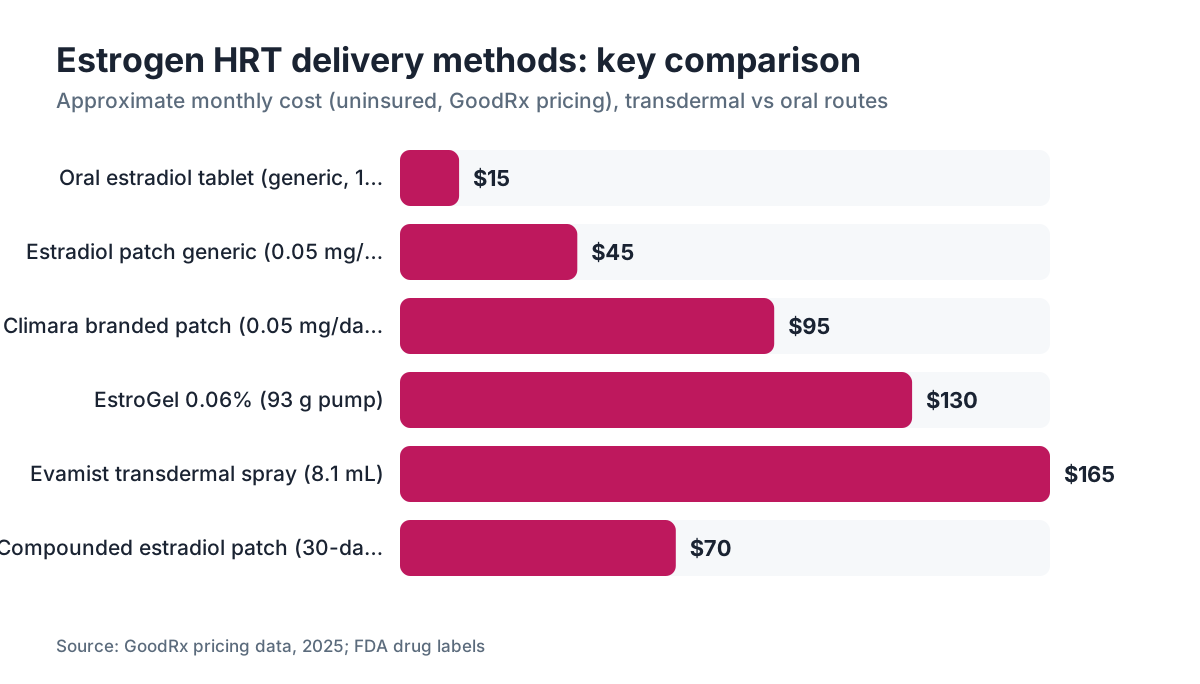
Estradiol gels and sprays are branded. EstroGel, Divigel, and Evamist each list somewhere between $80 and $200 a month without insurance. Many plans cover at least one at tier 2 or tier 3, though prior authorization comes up often, especially for the sprays. Generic estradiol gel still isn't widely available in the US as of mid-2025, which keeps prices higher than they should be.
Oral estradiol is dirt cheap. Generic tablets (0.5 mg, 1 mg, 2 mg) often run $10 to $20 a month at GoodRx prices, and most plans cover them at tier 1. For women who are good candidates for oral therapy, that cost gap is hard to argue with.
Compounded products are rarely covered, though some FSA and HSA accounts will pay with a valid prescription. Expect $40 to $100 a month out of pocket for a compounded transdermal estradiol product, depending on the pharmacy and formulation.
If you're switching because of the shortage and your plan slaps a quantity or formulary restriction on the alternative, ask your prescriber to write "estrogen patch shortage" into the prior authorization paperwork. Many insurers now accept that as a valid basis for an exception during documented shortage periods.
How does the estrogen patch shortage affect perimenopause and menopause care broadly?
The shortage lands at a moment when getting hormone replacement therapy at all is already harder than it should be. Women in perimenopause often wait years for a diagnosis, cycle through providers who wave off their symptoms, then finally get a prescription and can't fill it. That's the healthcare system failing twice on the same patient.
Hot flashes, night sweats, wrecked sleep, mood swings, brain fog, joint pain. These are not minor inconveniences. The 2023 NAMS position statement holds that for women under 60 or within 10 years of menopause onset with no contraindications, the benefits of HRT outweigh the risks for most indications [6]. Going without because a plant had a quality problem is not a medically acceptable outcome.
There's a bone angle too. Estrogen directly slows bone resorption. Women who stop or interrupt HRT see faster bone loss, sharpest in the first year after stopping. If you have osteopenia or osteoporosis risk factors, a gap in estrogen is not neutral. A bone density test after any long gap is reasonable.
Women who can't get patches should also remember that menopause care doesn't end at estrogen. Sleep habits, resistance training, and, for those who qualify, other therapies stay on the table right through the shortage.
What should you actually do this week if you can't get your estrogen patch?
Here's a sequence that works for most women.
Step one: call or message your pharmacy before you assume it's a full shortage. Ask specifically whether a different manufacturer's version of the same dose is in stock. In most states the pharmacist can swap a generic for a brand, or one generic for another, with prescriber authorization already on file.
Step two: try two or three independent pharmacies. Costco, smaller regional chains, and independent compounding pharmacies pull from different wholesalers than CVS or Walgreens. Availability genuinely tracks with your zip code.
Step three: contact your prescriber and ask for a bridge prescription for estradiol gel or spray. Frame it as a shortage substitution, not a permanent switch. This usually skips a new appointment and can run through a portal message.
Step four: if you're heading past a few weeks with no estrogen at all, tell your prescriber. She may want to document the gap and reassess your symptom burden and, if you carry risk factors, your bone health.
Step five: if you want a provider who has been managing HRT through this exact supply mess, telehealth platforms built around women's hormones, including WomenRx, can often move faster on prescriptions and see which formulations are actually stocked in your pharmacy network.
Don't just stop therapy without medical guidance. A cold stop off estrogen brings vasomotor symptoms back fast in most women, and it can feel genuinely awful.
Is the estrogen patch shortage likely to resolve soon?
The outlook is mixed, and I won't pretend otherwise. The FDA does not publish forecasted resolution dates, and manufacturers aren't required to disclose their production timelines. The shortage database shows products resolving and then re-entering shortage within months, which tells you the underlying supply fragility hasn't been fixed.
A few signals point to modest improvement. Generic manufacturing capacity for estradiol patches has been growing, with additional manufacturers seeking FDA approval over the past three years. More approved makers means more redundancy. The FDA's Drug Shortages Staff has also stepped up proactive outreach to manufacturers since 2022, backed by shortage authorities that the CARES Act expanded.
Cutting the other way: demand for HRT keeps climbing on better patient awareness and prescriber education. If prescribing volume keeps rising at the pace seen since 2017, modest manufacturing gains may not clear the backlog.
The realistic expectation is episodic, not total. You might find your preferred product for three months, then hit a wall again. The most practical adaptation is a flexible relationship with your prescriber, one where switching formulations is treated as a normal part of managing this treatment rather than an emergency.
Frequently asked questions
Why is there a shortage of estrogen patches in 2024 and 2025?
The shortage reflects converging problems: a very small number of specialized plants make transdermal patches, raw estradiol supply chains are concentrated in a few overseas facilities, and demand for HRT surged after 2017, when major guideline bodies reversed course and recommended hormone therapy more broadly for symptomatic younger menopausal women. Any disruption in this tight system creates immediate shortages.
Which specific estrogen patch brands are affected by the shortage?
The FDA's drug shortage database has listed generic estradiol transdermal patches in 0.025, 0.05, and 0.1 mg/day doses from multiple manufacturers, plus branded Climara and Vivelle-Dot at various times. Availability changes monthly. Check the FDA's current shortage page or call your pharmacy for the most up-to-date picture on your specific dose and brand.
Can I use an estradiol gel instead of a patch if my pharmacy is out?
Yes. Estradiol gel delivers estradiol through skin like a patch and is not caught in the same supply problem. EstroGel and Divigel are workable substitutes. The dose needs adjusting since conversion isn't perfectly linear. A 0.05 mg/day patch corresponds roughly to about 1.25 g of EstroGel 0.06% per day, but your prescriber should confirm the right starting dose for you.
Is it safe to switch from an estrogen patch to oral estradiol?
For most healthy women without a history of blood clots, stroke, migraine with aura, or very high triglycerides, oral estradiol is considered safe. The tradeoff is first-pass liver metabolism, which raises estrone levels and has modestly greater effects on clotting factors than transdermal routes. NAMS and the Endocrine Society treat both routes as appropriate for most women, but women with any of those risk factors should stay on transdermal options.
What does the FDA say about the estrogen patch shortage?
The FDA lists estradiol transdermal systems in its drug shortage database and attributes the shortage to manufacturing delays and increased demand. Under 21 U.S.C. § 356C, manufacturers must notify the FDA of production interruptions. The FDA can expedite supplier approvals and work with manufacturers to release held lots, but these tools typically take months to reach pharmacy-level availability.
Are compounded estrogen patches safe during the shortage?
Compounded patches are legal and can be a reasonable short-term bridge. They are not FDA-reviewed for quality or potency consistency, which is a real limitation. The Endocrine Society recommends FDA-approved products when available but treats compounding as an option when approved products can't be obtained. If you use a compounded patch, request a serum estradiol level 4 to 6 weeks after starting to confirm the dose is working.
Will insurance cover estradiol gel or spray if my patch is unavailable?
Coverage varies by plan. Branded gels like EstroGel and Divigel typically land at tier 2 or tier 3 and may require prior authorization. Oral estradiol tablets are often tier 1 and cost $10 to $20 a month with GoodRx pricing. Compounded products are rarely covered by insurance but may be reimbursable through FSA or HSA accounts. Note 'estrogen patch shortage' on any prior auth paperwork for a faster exception decision.
How long does the estrogen patch shortage last?
Individual shortage periods on the FDA database have run from a few months to over 18 months for specific products. The problem is episodic rather than continuous, so some products resolve and then re-enter shortage. Generic manufacturing capacity is slowly expanding, but demand is growing too. Realistically, plan for intermittent availability issues rather than one clean resolution.
Does going without estrogen for a few weeks matter for bone health?
A brief gap of a few weeks has limited measurable impact on bone density. Longer interruptions, especially over several months, can speed up bone resorption, particularly in women within the first few years after menopause when bone loss runs fastest. If you have osteopenia or multiple osteoporosis risk factors and face a prolonged gap, discuss your bone health with your provider and consider a bone density test.
Can my pharmacist substitute one estrogen patch brand for another without a new prescription?
In most states, pharmacists can substitute a therapeutically equivalent generic for a branded product with prescriber authorization, which may already be on file. Swapping one generic manufacturer's patch for another at the same dose is generally permitted too. Substituting across entirely different formulations, say switching from a patch to a gel, requires a new prescription. Call your pharmacy and ask specifically what they have in the same dose.
Does the HRT patch shortage affect progesterone availability too?
Progesterone (Prometrium and generics) and levonorgestrel-releasing IUDs used for the progestogen component of HRT have not been similarly affected as of mid-2025. The manufacturing processes differ and the supply chains are separate. If you use a combination estrogen-progestogen patch like CombiPatch, that product has had some availability issues, but standalone micronized progesterone capsules remain broadly available.
Are there non-hormonal alternatives for menopause symptoms during the shortage?
Yes. Fezolinetant (Veoza), FDA-approved in 2023, is a neurokinin 3 receptor antagonist that reduces hot flashes without estrogen. Low-dose paroxetine (Brisdelle) is FDA-approved for vasomotor symptoms. Cognitive behavioral therapy and certain lifestyle changes have solid evidence for hot flash reduction. These don't replace estrogen for bone, vaginal, or cardiovascular effects, but they are real options for managing the most disruptive symptoms while supply normalizes.
Is the estrogen patch shortage happening in other countries too?
Yes. The UK's NHS reported significant shortages of Evorel and other estradiol patches starting in 2022 and running into 2023 and 2024, prompting a national guidance update recommending gel and spray substitutions. Australia and Canada have had similar intermittent supply problems. The issue is global because estradiol active ingredient and specialized patch manufacturing are both internationally concentrated.
Sources
- FDA Drug Shortages Database, CDER
- FDA, Drug Shortages information and CDER resources
- Manson JE et al., JAMA 2017 Oct 3;318(13):927-938
- U.S. Code, 21 U.S.C. § 356C (Drug Shortage Notification)
- FDA Drug Label, EstroGel (estradiol gel 0.06%), Ascend Therapeutics
- North American Menopause Society (NAMS), 2023 Menopause Hormone Therapy Position Statement
- U.S. Code, 21 U.S.C. § 353b (Outsourcing facilities) and § 353a (Pharmacy compounding)
- Endocrine Society, Clinical Practice Guideline on Menopausal Hormone Therapy, 2022
- NHS Business Services Authority, HRT product supply guidance, 2023
- Pinkerton JV et al., Menopause 2020;27(9):976-1013 (NAMS)
- FDA Drug Approval, Fezolinetant (Veoza), NDA 216578, May 2023