Estrogen patch placement: where to put it and what actually works
TL;DR: Apply estrogen patches to clean, dry, hairless skin on the lower abdomen, upper buttock, or hip, rotating sites with each change. Avoid breasts, waistbands, and any irritated skin. Proper placement improves absorption and cuts skin reactions. Change patches every 3-4 days (twice-weekly) or weekly depending on your brand, always pressing firmly for 10 seconds.
Where exactly should you put an estrogen patch?
The lower abdomen is the site most clinicians recommend first, and for most women it works well. FDA-approved labeling for products like Vivelle-Dot and Climara points specifically to the lower abdomen below the navel, the upper buttock, and the hip as acceptable locations [1]. All three deliver estradiol consistently when the skin is clean, dry, and hairless.
Your clinician may have a preference based on your specific patch brand, but the principle stays the same: flat, relatively thin skin that doesn't move much during the day. Thigh skin shows up in some older guidance, but most current prescribing information leaves it off the primary list because absorption there is less predictable.
Avoid the breasts entirely. The FDA labels for estrogen patches state that patches should not be applied to the breast [1]. Breast tissue has higher local estrogen sensitivity, and direct application raises theoretical concerns about local hormone concentration even though systemic levels are what matter pharmacologically.
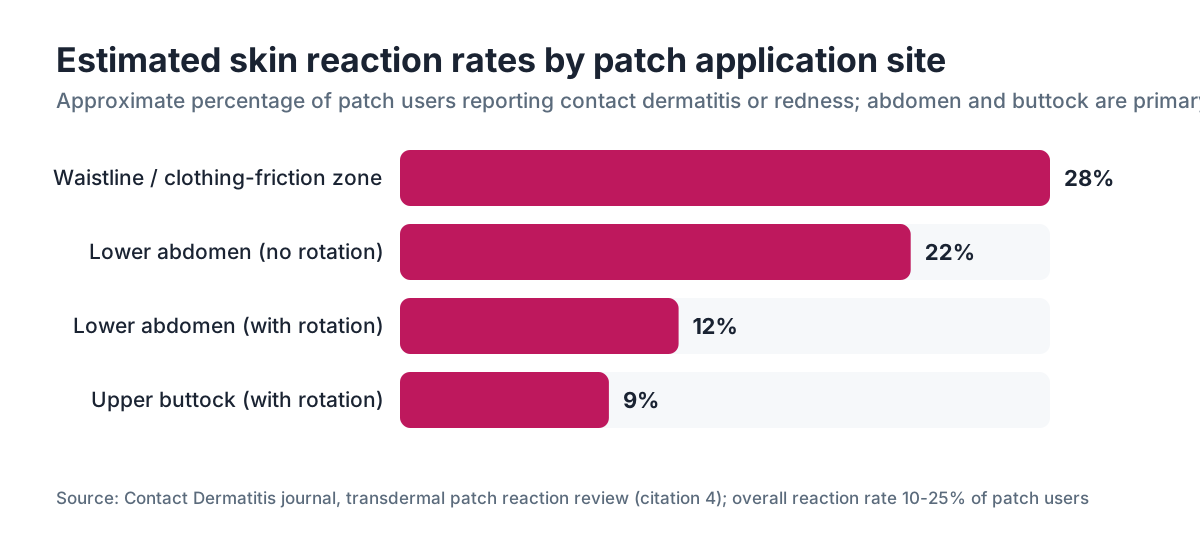
Also stay away from the waistline (clothing pressure lifts edges), skin folds (poor contact means uneven release), irritated or broken skin, and areas where you've recently applied lotions or oils. Even a thin layer of moisturizer forms a barrier between the adhesive and your skin and drops absorption noticeably.
Why does patch placement matter for absorption?
Transdermal estradiol skips the liver entirely, which is one of its main clinical advantages over oral estrogen. Swallow estrogen and the liver processes it first, converting most estradiol to estrone and raising proteins like sex hormone-binding globulin (SHBG) and C-reactive protein. The transdermal route avoids that first-pass metabolism, so what you absorb goes straight into circulation as estradiol [2].
But that only works if the patch actually stays stuck and the skin underneath is a good absorptive surface. Skin thickness, hair follicle density, local blood flow, and subcutaneous fat all influence how much estradiol passes through. The lower abdomen and buttock have been studied more than other sites, and the pharmacokinetic data behind approved labeling comes from those locations specifically [1].
A 2021 review in Menopause noted that real-world patch adherence problems, including partial detachment from poor placement, are a meaningful source of symptom breakthrough in women who are otherwise on the right dose [3]. Put plainly: a patch that's half-peeled off at the waistline is a lower dose patch. Placement isn't a trivial detail.
The patch matrix (how the drug is embedded in layers of adhesive) also matters. Reservoir patches (an older design with a membrane and liquid estradiol gel) behave differently from matrix patches (where estradiol is distributed throughout the adhesive). Matrix patches like Vivelle-Dot and Minivelle are thinner, more flexible, and generally stick better, but they're still affected by placement choice.
What is the best placement for estrogen patches to avoid skin irritation?
Skin irritation is the most common reason women stop using patches. Studies show 10 to 25 percent of patch users report contact dermatitis or redness at the application site [4]. Rotation is the single most effective fix.
Rotate to a new spot every time you change the patch, keeping new applications at least one inch from the previous site. Most clinicians recommend waiting at least a week before returning to the same exact spot, which gives skin time to recover fully.
A few practical tips that make a real difference:
- Wash the site with mild soap, rinse well, and let skin dry completely before applying. Even a tiny bit of moisture traps air bubbles under the patch.
- Press the patch firmly with your palm for 10 full seconds after application. Run your finger around all the edges.
- Apply after showering, not before, so you're not soaking the adhesive right away.
- In hot, humid climates or if you sweat heavily, the buttock tends to hold better than the abdomen because waistbands and clothing don't rub it.
If redness keeps coming back, try switching the anatomical region entirely (abdomen to buttock, for example) for a few weeks. Some women react to the specific adhesive in one brand and do fine with another. Vivelle-Dot and Climara use different adhesive systems, so a formulary switch sometimes solves the problem without any dose change.
For women who develop true allergic contact dermatitis to the adhesive rather than simple irritation, a short course of topical hydrocortisone applied to the skin before patch placement (letting it dry fully first) can reduce reactions, though this is an off-label approach worth discussing with your prescriber.
How often do you rotate estrogen patch sites?
Every time you change the patch. That's the rule. It sounds obvious, but it's easy to default to the same comfortable spot, especially once you find one that holds well.
For twice-weekly patches (changed every 3 to 4 days, like Vivelle-Dot or Minivelle), you're rotating at minimum twice a week. For weekly patches (like Climara), you rotate once a week. Either way, a mental map of where you last applied helps.
Some women keep a simple log or set a phone reminder that notes which quadrant they used. Others divide the abdomen into four zones (upper left, upper right, lower left, lower right) and cycle through them in order.
The one-inch rule from the previous site isn't arbitrary. Repeated application to the exact same spot causes cumulative skin irritation and can slightly alter local skin permeability over time, which may affect absorption. Consistent rotation keeps absorption more predictable [1].
If a patch partially comes off between changes, the FDA label guidance for most brands says to press it back on firmly, or if it won't re-adhere, apply a new patch and keep the same change schedule (don't start a fresh 3- or 4-day clock) [1]. This is brand-specific, so check your prescribing information or ask your pharmacist.
Abdomen vs. buttocks: is one site better than the other?
For most women, both work. The pharmacokinetic studies used to approve the major patch brands included both sites, and the resulting serum estradiol levels landed within acceptable ranges for either location [1]. Clinically, there's no strong evidence that one is categorically better.
Practically, though, real differences are worth weighing.
| Site | Adherence | Discretion | Notes | |---|---|---|---| | Lower abdomen | Good | Moderate (hidden by underwear) | Waistband can catch edges; avoid cesarean scar areas initially | | Upper buttock | Very good | High (covered by all clothing) | Less waistband interference; may be harder to self-apply | | Hip | Good | Good | Useful if abdomen skin is irritated; check patch edge daily | | Thigh | Variable | Good | Not listed on most current FDA labels; absorption less studied |
Women who had cesarean sections may have scar tissue on the lower abdomen that affects absorption locally. There's no large controlled trial on this specifically, but clinicians generally advise staying at least a couple of inches from scar tissue for the first year or two after surgery, while scar remodeling is still active.
If you can reach your upper buttock easily, it's a genuinely good option for adhesion. The skin there is smooth, less affected by bending and waistbands, and farther from areas that get moisturizer daily. A hand mirror helps with self-application.
Body composition matters too. Very thin skin with minimal subcutaneous fat (common in underweight women or women with late-stage osteoporosis) may absorb transdermal estradiol differently than skin over more adipose tissue. That's one reason to check serum estradiol levels at 6 to 8 weeks after starting a patch, rather than assuming the labeled dose delivers exactly that concentration for every body [5].
Can you put an estrogen patch on your thigh?
Some older product labeling included the thigh as an option. Current FDA-approved labeling for the most commonly prescribed patches (Vivelle-Dot, Climara, Minivelle) does not list the thigh as an approved application site [1]. That doesn't mean it can never work, but the manufacturer hasn't provided pharmacokinetic data showing consistent absorption from that location.
If you have a medical reason to avoid abdomen and buttock (skin conditions affecting those areas, for instance), talk to your prescriber. They may make an individual judgment. For routine use, stick to the sites listed on your patch's specific labeling so you get the intended dose.
What happens if the estrogen patch falls off?
First, don't panic. One brief gap in estradiol delivery won't cause harm, but you do want to replace the patch promptly to avoid breakthrough symptoms.
If a patch partially detaches, press it back on firmly. If it won't stick, apply a new patch to a different site. The real question: do you restart your 3- or 4-day (or 7-day) timer from the new application? Generally, no. Keep your regular change schedule rather than extending it by the full interval from the new patch date. This keeps you from accidentally going longer between changes [1].
If a patch falls off completely and you don't notice for a day or more, apply a new patch and return to your regular schedule. You might feel some symptom return (hot flashes, sleep disruption) in the gap, especially in early menopause when estrogen swings are more dramatic.
Some situations knock patches loose more often: swimming longer than about 30 minutes, saunas and hot tubs (heat causes skin vasodilation and loosens adhesive), heavy exercise with lots of sweat, and humidity. Many women who swim regularly find the buttock site holds better than the abdomen. Some apply a small piece of medical-grade adhesive tape (like Tegaderm) over the patch edges as extra insurance for activities they know will challenge adhesion. This is common and clinically harmless, though the FDA label doesn't specifically endorse it.
Can you shower or swim with an estrogen patch on?
Yes. All the major patch brands are water-resistant. You can shower, bathe, and swim while wearing one. The caveats:
Brief showers and baths are fine with no extra precautions. Extended soaking in a hot bath or hot tub is harder on the adhesive. If you soak often, schedule patch changes for just after those sessions rather than before.
Swimming is generally fine for typical lap-swim durations of 30 to 45 minutes. Open-water or pool swimming several times a day may push adherence limits, especially for patches on the abdomen. Switching to the upper buttock is the most practical adjustment.
After bathing, pat the patch area dry gently rather than rubbing it with a towel. Friction on the edges is a common cause of early detachment.
How does estrogen patch placement relate to HRT safety and monitoring?
Transdermal estradiol has a different safety profile than oral estrogen partly because of where and how it's absorbed. Because it skips first-pass liver metabolism, transdermal estrogen does not significantly raise clotting factors the way oral estrogen can [2]. A large observational study (the ESTHER study, Circulation, 2007) found that unlike oral estrogen, transdermal estradiol was not associated with increased venous thromboembolism risk [6].
North American Menopause Society (NAMS) guidance accepts transdermal estrogen as a reasonable option for women with cardiovascular risk factors, where the thrombotic impact of oral estrogen is a concern [5]. But that safety edge only holds if the patch actually delivers estradiol effectively, which brings us back to placement. A patch that repeatedly falls off or sits on poor sites may deliver erratic levels, and the therapeutic window where symptoms are controlled without excess exposure is a real target.
Monitoring usually means a serum estradiol level drawn 6 to 8 weeks after starting or adjusting a patch, ideally mid-cycle between changes (not right after applying a fresh patch and not right before the old one is due to come off). This gives a representative trough-to-peak average. If your levels come back lower than expected despite good compliance, review your placement sites with your provider before assuming you need a higher dose.
Women who are also using progesterone should know that progesterone delivery (typically oral micronized progesterone or a progesterone patch) is a separate system, and placement questions for the two hormones don't interfere with each other. For a broader overview of the therapy itself, the hormone replacement therapy and estrogen patch guides on this site cover the full clinical picture.
If you don't have a local menopause-specialized provider, telehealth platforms like WomenRx can prescribe and monitor estrogen patches, read labs in context, and adjust dosing, which helps if your primary care clinician isn't comfortable with hormone management.
Does estrogen patch placement change in perimenopause vs. postmenopause?
The physical placement guidance is the same wherever you are in the menopause transition. But the clinical context differs enough to be worth knowing.
In perimenopause, ovarian estrogen production is erratic, not zero. Your patch is supplementing a moving baseline. Some weeks your body makes near-normal amounts; other weeks it doesn't. That makes serum monitoring less predictable, and hot flashes may still break through even with good placement and compliance simply because endogenous production dropped suddenly that week.
In postmenopause (12 or more months after your final period, or after surgical menopause), the ovaries have essentially stopped producing estrogen. The patch becomes your primary source, which makes consistent absorption from good placement more consequential. Small variations in delivery hit harder when there's no endogenous backup.
Body composition shifts in postmenopause (more abdominal fat, thinner skin) can subtly change how well transdermal products absorb. That's one reason postmenopausal women sometimes need dose adjustments over time even without changing their patch or placement, and why an annual review of symptoms and levels beats a set-and-forget approach.
For context on timing: the average age of menopause in the US is 51, with perimenopause often starting in the mid-to-late 40s [5]. If you're unsure when menopause starts or what menopause age looks like for your situation, those resources can orient you before you discuss patch dosing with a provider.
Step-by-step: how to apply an estrogen patch correctly
Getting the application technique right matters as much as choosing the right site. Here is the full sequence:
- Choose your site, rotating from the last location. Lower abdomen, upper buttock, and hip are your primary options.
- Wash the area with mild, unscented soap. Rinse thoroughly.
- Dry completely. Wait at least 2 to 3 minutes. Do not apply to damp skin.
- Do not use lotions, powders, sunscreen, or oils on or near the site. Apply those products elsewhere, before or after, but not where the patch will go.
- Open the pouch and remove the patch. Peel the release liner (the backing) off halfway. Handle the patch by the liner, not the adhesive surface.
- Apply the exposed adhesive to your skin. Fold the liner back, pressing the second half down as you go.
- Press the entire patch firmly with your palm for 10 full seconds. Then trace around all four edges with your fingertip.
- Check for lifted edges or air bubbles. If an edge isn't sticking, press again.
- Wash your hands.
- Dispose of used patches by folding them sticky-side together before putting them in the trash, away from children and pets. Estradiol stays active in used patches. The FDA advises against flushing most patches unless the product label says that's acceptable [7].
For twice-weekly patches: change days are usually the same two days each week (Sunday and Wednesday, or Monday and Thursday). A phone alarm prevents a forgotten change, which is one of the most common reasons women report inconsistent symptom control.
For weekly patches: pick one day per week and stick to it. Some women anchor the habit to another weekly routine (grocery day, laundry day).
Bone density, osteoporosis, and why estrogen delivery method matters
Estrogen does much of the work in bone maintenance. The rapid bone loss that accelerates in the first few years after menopause is tied directly to the drop in estradiol. Adequate estrogen replacement, delivered consistently, preserves bone mineral density and reduces fracture risk [8].
The Women's Health Initiative (WHI) data showed women using estrogen (with or without progestogen) had significantly fewer hip fractures than placebo, with a relative risk reduction on the order of 30 to 40 percent for hip fracture depending on the analysis [8]. This is one of the clearest hormone therapy benefits in terms of hard clinical outcomes.
For that benefit to show up in real life, the patch has to work. Inconsistent delivery from poor placement or frequent detachment means your actual estradiol exposure runs below the prescribed dose. Over years, subtherapeutic estrogen means less bone protection. Good patch technique matters beyond symptom control.
If you're worried about bone health, a bone density test (DEXA scan) at or around menopause gives you a baseline. NAMS recommends considering DEXA for all women at age 65, and earlier for women with risk factors including surgical menopause, low body weight, or a history of fractures [5].
Women managing weight with GLP-1 medications should know that rapid weight loss can accelerate bone loss, which is one reason some providers pair GLP-1 therapy with hormone support. If you're looking at semaglutide for weight loss or comparing semaglutide vs tirzepatide, the interaction with bone health and estrogen status is a real clinical consideration worth raising.
Common mistakes with estrogen patch placement and how to fix them
A few errors come up over and over in clinical practice, and each is easy to correct once you know about it.
Applying over moisturized skin is probably the most common. Many women apply patches right after their morning routine, when they've already put on body lotion. The fix: shower before patching and skip lotion on the patch area, or apply lotion everywhere except the patch site.
Not pressing long enough. Ten seconds feels long when you're in a hurry. It matters anyway. The adhesive needs sustained pressure to bond fully with skin.
Applying to the same spot repeatedly. Some women find one spot that works and stick with it for months. That causes cumulative irritation that eventually makes the spot unreliable, and by then the skin may be sensitized to the adhesive.
Applying over hair. Even fine hair creates tiny gaps in adhesion across the surface. If you have hair in the typical patch zones on the abdomen or hip, shaving or clipping the area (and waiting a day for any micro-irritation to settle) before applying is reasonable.
Putting the patch on right before physical activity. Sweating during the first hour after application, before the adhesive has fully set, is a common cause of early detachment. Apply patches at a calm time of day, not before a workout.
Using adhesive removers on the skin before reapplying. Some women wipe the last patch site with alcohol or adhesive remover before applying the new one. Alcohol dries and irritates skin, which worsens adherence and reactions. Mild soap and water is enough.
For broader context on hormone replacement therapy decisions, or if you're still deciding whether a patch is the right delivery form for you, those foundational articles are worth reading before you get into the fine points of placement technique.
Frequently asked questions
Can I put an estrogen patch on my stomach?
Yes. The lower abdomen below the navel is one of the primary FDA-approved application sites for estrogen patches like Vivelle-Dot and Climara. Avoid the waistband area where clothing pressure can catch the edges. Apply to clean, dry, hairless skin and rotate to a different spot with each change.
How long does an estrogen patch stay on?
Twice-weekly patches (Vivelle-Dot, Minivelle) are designed to be changed every 3 to 4 days, so twice per week on a fixed schedule. Weekly patches (Climara) are changed once a week. Never leave a patch on longer than its labeled interval, since estradiol delivery drops significantly as the patch ages.
Why does my estrogen patch keep falling off?
The usual causes are moist or oily skin at the time of application, not pressing firmly enough for a full 10 seconds, waistband or clothing friction, and swimming or heavy sweating shortly after application. Try the upper buttock site, apply after showering and drying fully, and hold the patch firmly with your palm for 10 seconds before letting go.
Can I apply an estrogen patch to my arm?
The arm is not listed as an approved site on current FDA labeling for the major patch brands. Skin thickness and blood flow on the upper arm differ from the abdomen and buttock, so absorption data isn't available for that location. Stick to the lower abdomen, upper buttock, or hip as directed in your specific patch's prescribing information.
Should I shave the area before applying an estrogen patch?
If there is visible hair in the patch area, shaving or clipping it improves adhesion by creating full contact between adhesive and skin. Wait a day after shaving before applying so you're not placing a patch on freshly irritated or micro-cut skin. Most women with minimal hair in the application zone don't need to shave.
Can I wear an estrogen patch while swimming?
Yes. Estrogen patches are water-resistant and designed to stay on during showering, bathing, and swimming. Extended soaking in hot tubs or long swim sessions may challenge adhesion. The upper buttock site tends to hold better for active women or frequent swimmers. Pat the area dry gently after water exposure rather than rubbing.
What if I accidentally apply my estrogen patch to my breast?
Remove it and reapply to an approved site (lower abdomen, upper buttock, or hip). FDA labeling for estrogen patches states they should not be applied to the breast. Direct local application to breast tissue is not recommended even though systemic estradiol levels, not local concentration, are the therapeutic goal.
How do I know if my estrogen patch is absorbing properly?
Symptom improvement (fewer hot flashes, better sleep, less vaginal dryness) is the main signal, but a serum estradiol level drawn 6 to 8 weeks after starting or changing a dose gives objective data. A mid-cycle trough level (measured midway between patch changes) is most representative. Your prescriber can read levels in the context of your symptoms.
Can I use the same spot for my estrogen patch every time?
No. Reusing the same spot causes cumulative skin irritation and can reduce adhesion over time. Rotate to a new site at least one inch from the previous location every time you change the patch. Most clinicians advise waiting at least a week before returning to the exact same spot.
Does estrogen patch placement matter if I've had a C-section?
The lower abdomen remains an approved site after cesarean delivery, but it's reasonable to stay a few inches away from scar tissue, especially in the first year while scar remodeling is still active. Scar tissue has different skin permeability than surrounding skin. The upper buttock or hip are good alternatives if the abdominal scar is extensive.
Can I fold or cut an estrogen patch to adjust the dose?
No. Cutting or folding a matrix patch disrupts the even distribution of estradiol in the adhesive layer and can cause unpredictable delivery. If you need a lower dose, your prescriber can switch you to a smaller-surface-area patch. Some brands (like Vivelle-Dot) come in multiple strengths, making dose adjustments possible without altering the patch itself.
What should I do with used estrogen patches?
Fold them sticky-side together and put them in household trash away from children and pets. Significant estradiol stays in used patches. The FDA advises against flushing most patches. Check your specific product labeling: a small number of products list flushing as acceptable, but the default guidance for most brands is sealed trash disposal.
Is transdermal estrogen safer than oral estrogen for blood clots?
The current evidence points that way. The ESTHER study (Circulation, 2007) found transdermal estradiol was not associated with increased venous thromboembolism risk, unlike oral estrogen. NAMS acknowledges this distinction in its guidance and considers transdermal estrogen a reasonable option for women with cardiovascular risk factors. This is one reason patches are often preferred over pills for certain women.
Sources
- FDA, Vivelle-Dot (estradiol transdermal system) prescribing information
- Obstetrics and Gynecology, Stanczyk et al., pharmacology of transdermal vs oral estrogen
- Menopause (journal), review of transdermal HRT adherence and patch detachment, 2021
- Contact Dermatitis journal, review of transdermal drug delivery skin reactions
- North American Menopause Society (NAMS), Menopause Practice guidelines
- Circulation, Canonico et al., ESTHER study, 2007
- FDA, safe disposal of transdermal patches guidance
- JAMA, Women's Health Initiative (WHI) hormone therapy trial, bone fracture outcomes
- Endocrine Society, Clinical Practice Guideline on Menopause
- FDA, Climara (estradiol transdermal system) prescribing information