Estrogen patch doses: what the numbers actually mean
TL;DR: Estrogen patches deliver 0.014 mg to 0.1 mg of estradiol per day through your skin. Most women start at 0.025 or 0.05 mg/day. The lowest dose that clears your symptoms is the right dose. Needs shift over time, and getting there usually takes 8 to 12 weeks of titration with a prescriber.
What doses do estrogen patches come in?
Estrogen patches deliver estradiol, the same hormone your ovaries made before perimenopause. The FDA-approved range runs from 0.014 mg per day on the low end to 0.1 mg per day on the high end, with several stops in between [1].
The strengths prescribers reach for most are 0.025, 0.0375, 0.05, 0.075, and 0.1 mg/day. Some brands add 0.014 mg (the lowest approved dose, sold as Menostar, cleared only for bone protection and not symptom relief) and 0.06 mg. What your pharmacy stocks depends on the brand; generic transdermal estradiol covers most of the major strengths.
Here is the full range at a glance:
| Dose (mg/day) | Typical brand examples | Primary indication | |---|---|---| | 0.014 | Menostar | Osteoporosis prevention only | | 0.025 | Vivelle-Dot, Climara, generics | Mild vasomotor symptoms, bone | | 0.0375 | Vivelle-Dot, Minivelle | Moderate symptoms | | 0.05 | Vivelle-Dot, Climara, generics | Moderate symptoms (common starting dose) | | 0.06 | Minivelle | Moderate symptoms | | 0.075 | Vivelle-Dot, Climara, generics | Moderate-to-severe symptoms | | 0.1 | Vivelle-Dot, Climara, generics | Severe symptoms |
The twice-a-week patch (Vivelle-Dot, Minivelle) and the once-a-week patch (Climara) deliver the same daily dose. The only difference is how often you swap it. Both absorb through the skin straight into the bloodstream, skipping liver metabolism entirely, which is one reason transdermal estrogen carries a lower clot risk than pills [2].
What is the right starting dose for most women?
For a woman new to hormone therapy, that usually means 0.025 or 0.05 mg/day. NAMS (the North American Menopause Society) recommends starting at the lowest effective dose for each individual, then adjusting on symptom response and tolerability [3].
The 0.025 mg patch is a reasonable first pick if your symptoms are mild, you are early in perimenopause, or you have reasons to stay cautious about cardiovascular or breast-related risk. The 0.05 mg patch is where most prescribers begin women with moderate hot flashes, because trial data shows real vasomotor relief at that dose [4].
Age and time since your last period both matter. A 42-year-old in early perimenopause is not the same physiological case as a 58-year-old who has been postmenopausal for seven years. Younger women moving through perimenopause often need higher doses to keep pace with erratic ovarian output. Older women starting fresh tend to begin lower.
Here is something nobody says clearly. The number on the box is a nominal delivery rate measured under controlled conditions. Your real absorption shifts with skin hydration, body temperature, and where you stick the patch. That gap is exactly why individual titration beats any universal number.
How does estrogen patch dose compare to pill or gel doses?
Patch doses look tiny next to oral estradiol, and that is on purpose. Swallow an estradiol pill and your liver processes most of it before it reaches circulation, a step called first-pass metabolism. To hit effective blood levels, oral doses typically run 0.5 mg to 2 mg per day [5].
Patches skip first-pass metabolism completely. A 0.05 mg/day patch reaches serum estradiol levels comparable to a 1 mg oral estradiol tablet [5]. That routing has real consequences. Oral estrogen raises C-reactive protein, sex-hormone-binding globulin, and triglycerides more than transdermal does, and the venous thromboembolism (blood clot) data consistently favors the patch [2].
Gels and sprays also bypass the liver, so their logic is similar. Estrogel 0.75 mg (one pump) delivers roughly the equivalent of a 0.025 to 0.05 mg patch. The catch with gel is variability: a patch has a fixed membrane, while gel absorption depends on how much skin you cover and whether you wash it off too soon.
Comparing a patch to a compounded formula? Look hard at the estrogen type. Compounded bi-est and tri-est contain estriol, which the FDA has never approved for menopause and whose long-term safety data is far thinner than estradiol's [3].
What serum estradiol levels should you expect at each patch dose?
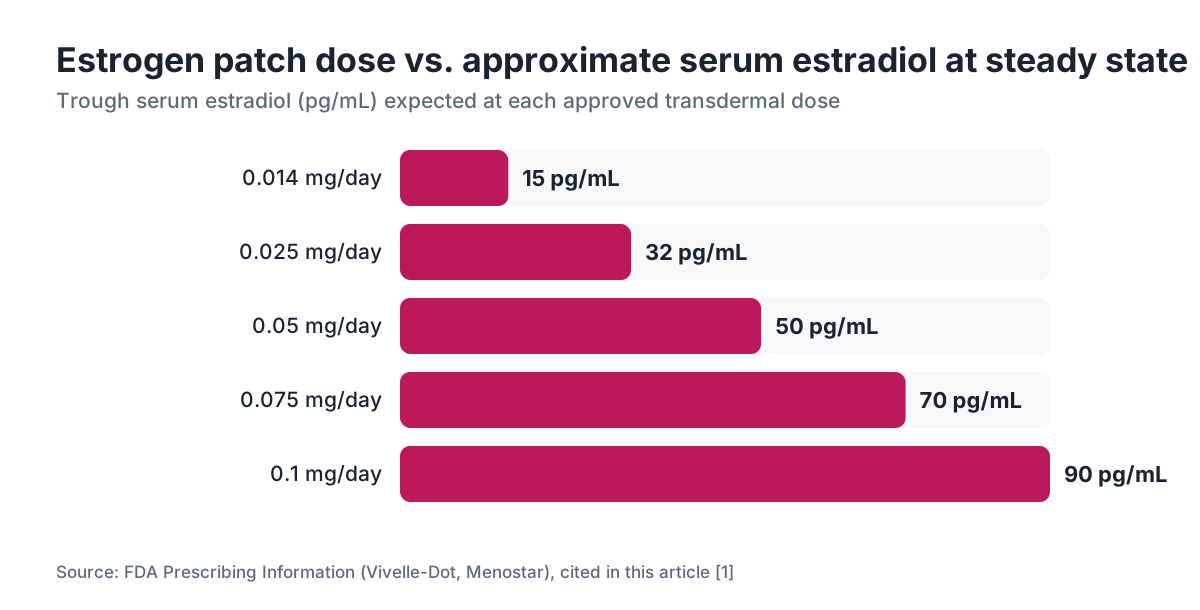
Blood levels give your prescriber a way to check whether the patch is actually delivering. The numbers below come from pharmacokinetic studies in package inserts and are approximate; individual variation is real [1].
| Patch dose (mg/day) | Approximate steady-state serum estradiol (pg/mL) | |---|---| | 0.014 | 10-20 | | 0.025 | 25-40 | | 0.05 | 40-60 | | 0.075 | 60-80 | | 0.1 | 80-100+ |
For context, premenopausal estradiol in the follicular phase averages around 50 to 150 pg/mL and spikes much higher at ovulation. Postmenopausal baseline sits below 20 pg/mL. Most symptom-relief studies show benefit in the 40 to 80 pg/mL range.
Test serum estradiol 3 to 4 weeks after starting or changing a dose, on the day before your next patch change (a trough level), for the most useful reading. A trough below 25 pg/mL with hot flashes still going usually means the dose needs to climb. A level above 100 pg/mL with no matching symptom load should start a conversation about cutting back.
Labs are a tool, not the whole story. Some women feel great at 30 pg/mL. Others still sweat through the sheets at 70. Symptom diary plus lab plus prescriber judgment is the full assessment.
Do you always need progesterone with an estrogen patch?
Yes, if you have a uterus. Estrogen alone stimulates the uterine lining, and without a progestogen to oppose it, that stimulation raises endometrial cancer risk. This is not theoretical. It is why unopposed estrogen was dropped for women with intact uteruses after studies in the 1970s showed the link clearly [3].
If you still have your uterus, you get a progestogen alongside the estrogen patch. Options include oral micronized progesterone (Prometrium), a levonorgestrel IUD, or a combined estrogen-progestogen patch. NAMS most often recommends oral micronized progesterone because it has the friendliest side-effect profile and the best breast and cardiovascular safety data compared to synthetic progestins [3].
Had a hysterectomy? You typically skip the progestogen and use estrogen alone. That changes the risk math. Most of the breast cancer signal in the Women's Health Initiative was tied to the combination arm (estrogen plus progestin), not to estrogen by itself [6].
For a full breakdown of how progesterone fits into a regimen, the progesterone guide goes deeper.
How do you know your estrogen patch dose is too low?
The clearest sign is symptoms that stick around despite consistent patch use for at least 4 to 6 weeks. Hot flashes still waking you at 3 AM, vaginal dryness that is not improving, brain fog that will not lift: those all say the dose is not enough for you.
Other, quieter signs:
- Joint pain that started with menopause and has not eased
- Mood instability, especially irritability or low mood, that predated the patch and has not budged
- Sleep staying broken even though hot flashes are supposedly under control
- Serum estradiol trough below 25 to 30 pg/mL on lab work
No single one of these proves underdosing. Taken with your symptom picture, they point your prescriber in a clear direction. The fix is usually a step up: 0.025 to 0.05, or 0.05 to 0.075.
Watch for poor absorption too, because that can masquerade as a low dose. Patches on oily skin, scar tissue, or areas with a lot of subcutaneous fat absorb less reliably. The lower abdomen below the waistline and the upper buttock are the recommended sites for most twice-weekly patches [1].
How do you know your estrogen patch dose is too high?
Excess symptoms are easy to miss because some overlap with perimenopause itself. Breast tenderness or swelling, bloating, headaches, and nausea that start after you begin or increase the dose are classic flags [1].
Mood can cut both ways. Some women feel wired at high doses, with anxiety or irritability. Others get fluid retention they notice in their fingers or ankles. A serum estradiol that stays above 100 to 120 pg/mL with no matching symptom load is another flag.
The usual response is a step down: 0.1 to 0.075, or 0.05 to 0.025. Sometimes the culprit is not the estrogen but the progestogen running too low against it, which can mimic estrogen excess.
Placement can also cause spikes. Apply a patch right after a hot shower, when skin is warm and dilated, and absorption jumps for a while. Steady timing and site keep delivery even.
What does the research say about the lowest effective dose?
The evidence for low-dose transdermal estrogen is reasonably solid. A 2004 randomized trial by Bachmann and colleagues in Menopause found that a 0.014 mg/day patch lowered bone turnover markers versus placebo, which earned it FDA approval for osteoporosis prevention. It was not strong enough to cut hot flash frequency in any meaningful way [7].
The 0.025 mg dose has trial data showing statistically significant drops in moderate vasomotor symptoms against placebo. A 2001 Stingl trial found the 0.025 mg Vivelle-Dot patch cut mean hot flash frequency by roughly 60% over 12 weeks in postmenopausal women [4].
For severe symptoms, the 0.05 to 0.1 mg range is where trials show the strongest control. The Endocrine Society's menopause guideline notes that higher doses may be needed in younger women with surgical menopause, who often carry a heavier symptom burden than women who transition naturally [8].
The 2022 NAMS position statement puts it plainly: "The goal is to use the lowest dose that provides the desired benefits for each individual" [3]. Simple to say. In practice it takes a few months of adjustment to land there. For the wider view of hormone therapy options, read the hormone replacement therapy overview alongside this.
Does the right dose change as you get older or further into menopause?
Yes, and it moves in both directions.
Women who start therapy in early perimenopause, say 42 to 47, when ovarian estrogen is still lurching around, sometimes need relatively higher doses because they are filling a moving gap. As natural production keeps falling, the patch dose that felt just right can start feeling like too much or too little depending on the month.
In the years right after your final period, doses often run higher to control vasomotor symptoms while they peak. Hot flashes last about 7 years on average, per the SWAN study, and some women get them for more than a decade [9].
For women in their 60s starting therapy for the first time (less common, and worth a careful risk-benefit talk), the guidance is start lower and go slower. The cardiovascular picture differs for a woman 10-plus years past menopause versus one who begins near the transition.
Long-term users often find needs drop over time as the fiercest symptom phase passes. A woman who needed 0.1 mg at 50 may do fine at 0.05 mg at 58. Reassess at least once a year. The menopause guide has more on how symptom patterns shift across the timeline.
Trying to place yourself in the transition? When does menopause start and menopause age lay out the typical arc.
Are there safety differences between low and high estrogen patch doses?
Yes, but the differences are smaller for transdermal than for oral estrogen, and the risk picture leans heavily on your individual history.
Breast cancer: WHI and later analyses suggest estrogen alone (in hysterectomized women) showed no significant rise in breast cancer incidence, and possibly a slight drop over 7 years [6]. Combined estrogen-progestogen came with a modest increase, roughly 8 additional cases per 10,000 women per year after 5-plus years, which sits in the same range as one glass of wine a day or being sedentary [6]. Dose-response data for breast cancer at different transdermal doses is limited. The clearest signal is duration, not dose.
Blood clots: observational data consistently show transdermal estradiol up to 0.05 mg/day does not significantly raise VTE risk, while oral estrogen does [2]. Above 0.05 mg/day transdermal, the data thins. A 2016 BMJ study by Vinogradova and colleagues, covering more than 80,000 women, found no significant rise in VTE with transdermal estrogen at any dose studied, though the confidence intervals widened at higher doses [2].
Cardiovascular: timing matters as much as dose. Starting within 10 years of menopause or before age 60 links to neutral-to-beneficial cardiovascular effects in most studies. Starting later may carry a different profile [8]. This is the "timing hypothesis," or window of opportunity.
For bone, the 0.025 mg dose holds bone density in most women, with 0.014 mg giving measurable but more modest protection [7]. A bone density test before and during therapy is standard for tracking your own response.
How do you titrate estrogen patch dose in practice?
Titration is not a fixed protocol. It is a conversation between you and your prescriber, shaped by symptoms, labs, and tolerance. Here is how it usually runs.
Weeks 1 to 4: Start at the prescribed dose and give it a fair trial. The patch takes 1 to 2 weeks to reach steady-state levels, so do not judge it in week one. Keep a plain symptom diary: hot flash count, sleep, mood, energy, vaginal comfort.
Weeks 4 to 8: Check in. If you have a uterus, confirm the progestogen dose is adequate. Run a serum estradiol trough if symptoms are not improving or you see signs of excess. If labs and symptoms both say underdosing, step up one increment (0.025 to 0.05, for example).
Weeks 8 to 12: Most women have a maintenance dose settled by now. A second serum estradiol confirms where you are landing.
After that, annual review is the standard. Symptoms change, body composition changes, life changes. A dose set at 52 may not fit at 59.
Some women run this process with a telehealth menopause prescriber. WomenRx, for one, builds titration around labs plus symptom tracking with a licensed prescriber, the systematic approach NAMS guidelines support. You can get full symptom control without ever going in person, as long as the prescriber actually reads your labs and adjusts. The estrogen patch overview covers application tips that matter at every dose phase.
What about estrogen patches during perimenopause vs. after menopause?
Perimenopause is the harder dosing problem. Ovarian estrogen is still firing, just erratically. Some months you ovulate normally, others you do not. Your own estrogen swings wildly, so a fixed patch dose can feel fine one week and like too much the next.
Many prescribers stay cautious in early perimenopause, using the 0.025 mg patch as a floor to smooth the valleys without stacking on top of the peaks. Others reach for low-dose oral contraceptives to steady the whole system when contraception is also on the table. The right call depends on your age, symptom severity, and whether pregnancy is still possible (it is, until you have gone 12 straight months without a period).
Once menopause is confirmed, natural estrogen production is basically zero and the patch does all the work. Dosing gets more predictable. The 0.05 mg dose is a reliable starting point for most postmenopausal women with bothersome symptoms.
Surgical menopause, from removal of both ovaries, is its own case. Estrogen crashes to near zero overnight instead of over years. These women often need the higher end (0.075 to 0.1 mg/day) because the symptom burden runs more severe and the bone and cardiovascular protection needs are immediate. Perimenopause age has context on the natural transition timeline if you are working out where you stand.
Frequently asked questions
What is the most common starting dose for an estrogen patch?
Most prescribers start women with moderate vasomotor symptoms at 0.05 mg/day. Women with mild symptoms or notable cardiovascular risk factors often begin at 0.025 mg/day. The NAMS recommendation is the lowest effective dose for each individual, so the starting point is a clinical judgment, not a universal rule.
How long does it take for an estrogen patch dose to work?
Steady-state blood levels build over 1 to 2 weeks after a new patch. Most women notice symptom improvement within 2 to 4 weeks at an adequate dose. Hot flashes usually respond faster than vaginal symptoms, which can take 8 to 12 weeks of consistent use. If nothing has changed after 6 weeks, discuss an adjustment.
Can I cut an estrogen patch to get a lower dose?
No. Most transdermal patches use a membrane-rate-controlled or matrix system, and cutting one changes the delivery rate unpredictably and can irritate the skin. If you need a dose between available strengths, your prescriber should write for the correct strength. Cutting a patch is not a safe workaround.
What is the difference between the 0.05 mg and 0.1 mg estrogen patch?
The 0.1 mg patch delivers twice the daily estradiol of the 0.05 mg patch and typically produces serum levels of 80 to 100-plus pg/mL versus roughly 40 to 60 for the 0.05 mg. Symptom control is generally stronger at 0.1 mg, but so is the risk of breast tenderness and bloating. Most women with moderate symptoms do well at 0.05 mg.
Do estrogen patch doses need to be higher after surgical menopause?
Usually yes. Removing both ovaries causes an abrupt, complete drop in estrogen rather than a gradual decline. Symptom severity tends to be greater, and the need for cardiovascular and bone protection is immediate. Doses of 0.075 to 0.1 mg/day are commonly required. The Endocrine Society guideline specifically notes higher dose needs in surgical menopause.
Is the 0.025 mg estrogen patch enough to protect bones?
Yes, for most women. Trials show the 0.025 mg dose maintains bone mineral density and lowers bone turnover markers in postmenopausal women. The 0.014 mg dose (Menostar) also has FDA approval specifically for osteoporosis prevention. A baseline and follow-up bone density scan confirms your response. Dose is not the whole picture; calcium and vitamin D intake matter too.
Do you need a progestogen with every estrogen patch dose?
If you have a uterus, yes, at every dose. Even the lowest approved dose (0.014 mg/day Menostar) requires endometrial protection if your uterus is intact. The FDA label for Menostar states a progestogen should be added for women with a uterus. After a hysterectomy, estrogen alone is appropriate at any dose.
Can estrogen patch dose affect mood and anxiety?
Yes, both ways. Adequate estradiol supports serotonin and norepinephrine activity, and many women notice mood improve at the right dose. Too low, and mood instability goes untreated. Too high, or a dose without adequate progestogen balance, can bring irritability, anxiety, or emotional lability. Mood symptoms that persist after 8 weeks warrant a dose or regimen review.
What blood test shows whether my estrogen patch dose is correct?
Serum estradiol (E2) at trough, meaning the morning before your next scheduled patch change, gives the most reliable read. Target range for symptom relief is roughly 40 to 80 pg/mL for most postmenopausal women. A trough below 25 pg/mL with ongoing symptoms usually means underdosing. FSH is less useful on therapy because exogenous estrogen suppresses it regardless of symptom status.
Are there estrogen patches that combine estrogen and progestogen in one patch?
Yes. Combination patches like CombiPatch (estradiol 0.05 mg/day plus norethindrone acetate 0.14 or 0.25 mg/day) and Climara Pro (estradiol 0.045 mg/day plus levonorgestrel 0.015 mg/day) carry both hormones in one patch. They are convenient but limit dose flexibility, since you cannot adjust one hormone independently of the other, a real drawback for women who need individual titration.
Does body weight affect how much estrogen a patch delivers?
Indirectly. The patch delivers a fixed rate based on surface area and membrane, not on your weight. But women with more body fat have larger distribution volumes, so the same dose can produce lower serum levels. That partly explains why some heavier women need a higher dose to reach the same blood levels and relief. Labs are especially useful here.
How often should estrogen patch dose be reassessed?
Annually at minimum, and any time symptoms shift significantly. NAMS guidelines recommend a yearly review of continued need, lowest effective dose, and individual risk-benefit. Events that change risk, including a new cardiovascular diagnosis, a breast cancer diagnosis in a first-degree relative, or major weight change, should each trigger a prompt reassessment rather than waiting for the annual visit.
What is the highest estrogen patch dose approved by the FDA?
The highest FDA-approved transdermal estradiol patch dose is 0.1 mg per day, sold in brands like Vivelle-Dot and generic estradiol patches. It is typically reserved for severe vasomotor symptoms or surgical menopause when lower doses have not worked. Side effects, including breast tenderness and bloating, are more common at this dose.
Can you switch from an oral estrogen pill to an estrogen patch without a dose gap?
Yes, and the switch is usually straightforward. Apply the patch on the day you would have taken your next oral dose. Expect 1 to 2 weeks to reach new steady-state levels. The rough equivalent is a 0.05 mg patch for a 1 mg oral estradiol tablet, though responses vary enough that a lab check at 4 to 6 weeks is smart to confirm adequate levels.
Sources
- FDA, Vivelle-Dot (estradiol transdermal system) Prescribing Information
- Vinogradova Y et al., BMJ 2016;354:i4875 — Use of hormone replacement therapy and risk of venous thromboembolism
- North American Menopause Society (NAMS), 2022 Hormone Therapy Position Statement
- Stingl JC et al., Menopause 2001 — Efficacy of low-dose 0.025 mg estradiol transdermal patch for vasomotor symptoms
- Stanczyk FZ, Endocrine Reviews 2003 — Pharmacokinetics and potency of progestogens and estrogens used in HRT
- Women's Health Initiative, JAMA 2002 and subsequent analyses — Risks and benefits of estrogen plus progestin in healthy postmenopausal women
- Bachmann GA et al., Menopause 2004 — Menostar (0.014 mg/day estradiol transdermal patch) for osteoporosis prevention
- Endocrine Society Clinical Practice Guideline — Treatment of Symptoms of the Menopause, 2015
- Study of Women's Health Across the Nation (SWAN), Obstetrics & Gynecology 2015 — Duration of menopausal vasomotor symptoms
- FDA, Menostar (estradiol transdermal system 0.014 mg/day) Prescribing Information
- NAMS, Menopause Practice: A Clinician's Guide, 6th edition